New to the catalogue
How to read the catalogue
What the parts of a note are called, and what the labels and kinds on a Pick page mean.
How to read a note
This is a real note from the catalogue: the Fiji 1 Pound of 01.Sep.1959, P-53c. Press a number on the note, or a line in the list, to light up that part and read what it is.

The parts of this note
Use the arrow keys to move from one part to the next.
-
The issuer named on the note: Government of Fiji.
On the Pick page: Issuing bank, in At a glance
-
The value of the note: 1 Pound. The catalogue lists it as the Fiji 1 Pound.
On the variety page: Denomination, in At a glance
-
The date on the note: 01.Sep.1959.
Each issued date of this Pick number is a variety of its own: this date is P-53c.
On the variety page: Date, under the title
-
The serial number is printed twice on this note. The letters and figures in front of the number are the serial prefix.
The catalogue records the prefixes of each variety: C/6 - C/8 for this date.
On the variety page: Serial prefixes, under the title
The serial numbers recorded for a variety are in its Serial register, part of NumiCrown Pro.
-
The signatures on the note: Bevington & Griffiths & Marais.
The catalogue lists a variety for each date and set of signatures.
On the variety page: Signatures, under the title
-
Queen Elizabeth II, at the right.
On the Pick page: Obverse, in Obverse & Reverse
-
The arms of Fiji, at the upper centre.
On the Pick page: Obverse, in Obverse & Reverse
-
The watermark area, at the left. The watermark: Fijian head.
On the Pick page: Watermark
-
The printer: Bradbury Wilkinson and Company, United Kingdom. Its name is printed in the lower margin.
On the Pick page: Printer, in At a glance
What the catalogue calls it
- Variety
- P-53c
- The label of one variety of P-53: here, the issued note of 01.Sep.1959.
- NumiCrown ID
- NCFIJ032003
- This catalogue's own number for the variety. It never changes, and the search finds it.
Fiji P-53 has 9 issued varieties, one for each date from 01.Jul.1954 to 01.Jan.1967. Open the P-53c page · All varieties of P-53
How to read a label
Each variety has a label: its Pick number and a few letters after it. The letters follow the patterns below. Whatever the letters, the Kind at the top of every variety page names the kind of variety.
- a, b, c
-
An issued variety’s label is usually its Pick number and a small letter.
For example Fiji P-53a, P-53b, P-53c
4,089 of 4,148 issued varieties
- a1, a2
-
Some labels add a figure after the letter.
For example Ceylon P-19a1, P-19a2
- s
-
A specimen’s label always ends in s.
A few other labels end in s as well, such as the issued Ceylon P-16s: the Kind settles it.
For example Fiji P-53s
3,954 of 3,954 specimens
- cts
-
A colour trial specimen’s label always ends in cts, sometimes with a figure after it.
For example Fiji P-53cts, Bermuda P-5cts1, P-5cts2
321 of 321 colour trial specimens
- p
-
A proof’s label usually has a p after the Pick number.
For example Fiji P-53p2, P-53p
682 of 691 proofs and die pulls
- r
-
A remainder’s label usually ends in r.
For example Fiji P-48r
58 of 60 remainders
- e
-
An essay’s label usually has an e after the Pick number.
For example Bermuda P-2e1, Fiji P-59e
11 of 12 essays and composite essays
- CS
-
A collector series specimen’s label always ends in CS (or cs), sometimes with a figure after it.
For example Jersey P-11CS1
31 of 31 collector series specimens
- z
-
Outside Fiji, a replacement note’s label always ends in z.
Without the z (or, in Fiji, the star), the label is usually that of the issued variety whose signatures the replacement shares.
For example Jersey P-8cz
307 of 307 replacement notes outside Fiji
- *
-
In Fiji, a star takes the place of the z, as in PMG’s own numbers for these notes.
For example Fiji P-64a*
54 of 54 Fiji replacement notes
- x
-
A counterfeit’s label always has an x. An error note’s label usually has one too.
For example Palestine P-7cx, East Africa P-14ax
78 of 78 counterfeits; 66 of 77 error notes
- A
-
A capital letter is part of the Pick number itself: each of these is a Pick number with a page of its own.
For example Jersey P-A1, East Africa P-26A
- NL
-
P-NL is a note with no Pick number, an unlisted note. Where Pick numbers come from.
For example British West Indies P-NL
Kinds of variety
A Pick page lists its varieties in groups, one for each kind, and heads each group with a line. Here are those lines, each with one example. The name in bold is the kind as the variety page gives it.
-
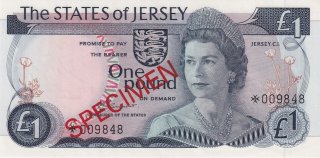
Specimen
Printer's specimens — never released into circulation
For example Fiji P-53s, 1 Pound, 01.Sep.1959© Noonans
-
Replacement note
Printed to replace sheets spoiled in production
For example Jersey P-8cz, 1 Pound, ND© Noonans
-
Proof
Pre-production proofs from the printer's files — complete, progressive and die proofs together
For example Fiji P-53p2, 1 Pound, ND© Spink
-
Progressive proof
The design part-printed, stage by stage
For example Fiji P-53p, 1 Pound, ND© Stack's Bowers
-
Die proof
Impressions pulled from the engraved die
For example Hong Kong P-311p, 1 Dollar, ND© Spink
-
Colour Trial Specimen
Trial printings in colours other than the adopted one
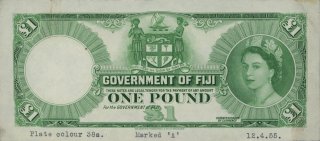
For example Fiji P-53cts, 1 Pound, ND© Christoph Gärtner
-
Remainder
Printed and dated, but never put into circulation
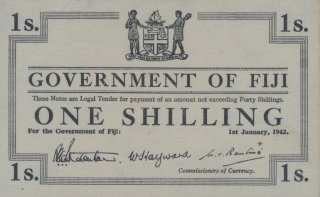
For example Fiji P-48r, 1 Shilling, 01.Jan.1942© Christoph Gärtner
-
Unissued
Prepared but never issued
For example Bahamas P-11f, 1 Pound, L. 1936 (1953)I.B.N.S. Journal, vol. 55 no. 4, 2016
-
Printer's model
The printer's own mock-up of the design
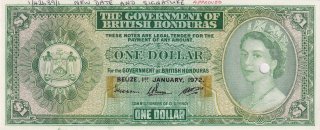
For example British Honduras P-28pm, 1 Dollar, 01.Jan.1972© Green Apple Auction
-
Archival photograph
The printer's own photographs of the finished design, kept for the record
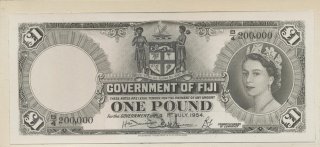
For example Fiji P-53p, 1 Pound, ND© Christoph Gärtner
-
Counterfeit
Forgeries and fraudulently altered notes, catalogued for reference
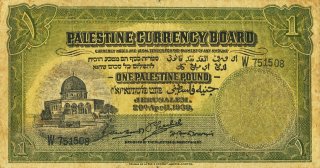
For example Palestine P-7cx, 1 Pound, 20.Apr.1939© Heritage Auctions
-
Error note
Notes carrying a printing error
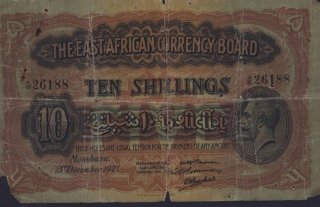
For example East Africa P-14ax, 10 Shillings, 15.Dec.1921© Spink
-
Collector Series Specimen
Specimens sold to collectors by the issuing authority, not for circulation
For example Jersey P-11CS1, 1 Pound, ND (1978)© Green Apple Auction





Rarer kinds
-
Front printer's model 5 The printer's mock-up of the front of the design, the back left blank Rhodesia & Southern Rhodesia P-17pm1 © Heritage Auctions
-
Reverse proof 2 Proofs of the back of the note alone British Caribbean Territories P-9p © Heritage Auctions
-
Die pull 2 Impressions pulled directly from the engraved die Rhodesia & Southern Rhodesia P-8p © Spink
-
Essay 4 Designs drawn or printed for approval before the note was settled Bermuda P-2e1 I.B.N.S. Journal, vol. 30 no. 4, 1991
-
Composite essay 8 Essays made up of printed and hand-drawn parts, for the front and the back Fiji P-59e © Spink
-
Counterfoil 1 The stub that stayed in the book when a note was issued British Honduras P-1cf © Noonans
-
Photographic proof 2 Photographs of the design, used as proofs British India P-16p © Heritage Auctions


Now find your own note
Start from a country, or type a Pick number in the search box at the top of the page.