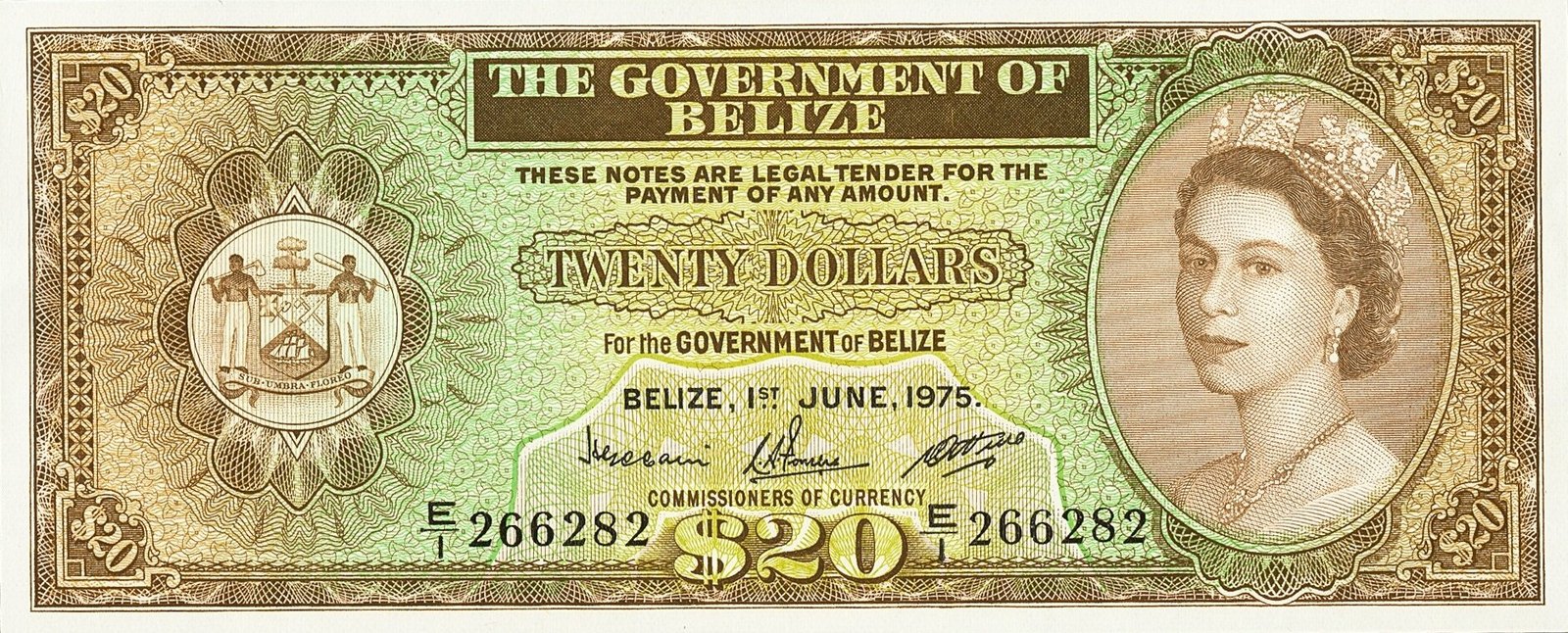
The notes headed THE GOVERNMENT OF BELIZE carry three dates only, of 1974 to 1976, and ceased to be legal tender on 1st January 1981. This article gathers what the Pick pages, the annual reports of the Monetary Authority and the Central Bank, and the auction houses' descriptions say of them: the dates and how the numbers divide between them, the numbers printed, the colour trial specimens, and what became of the notes that were never handed in.
The issue
The Board of Commissioners of Currency, set up in 1894, issued the colony's notes until 1976. British Honduras was renamed Belize in 1973, and from 1st January 1974 the Board's notes were headed THE GOVERNMENT OF BELIZE and signed by three Commissioners of Currency, Cain, Fonseca and Cattouse.
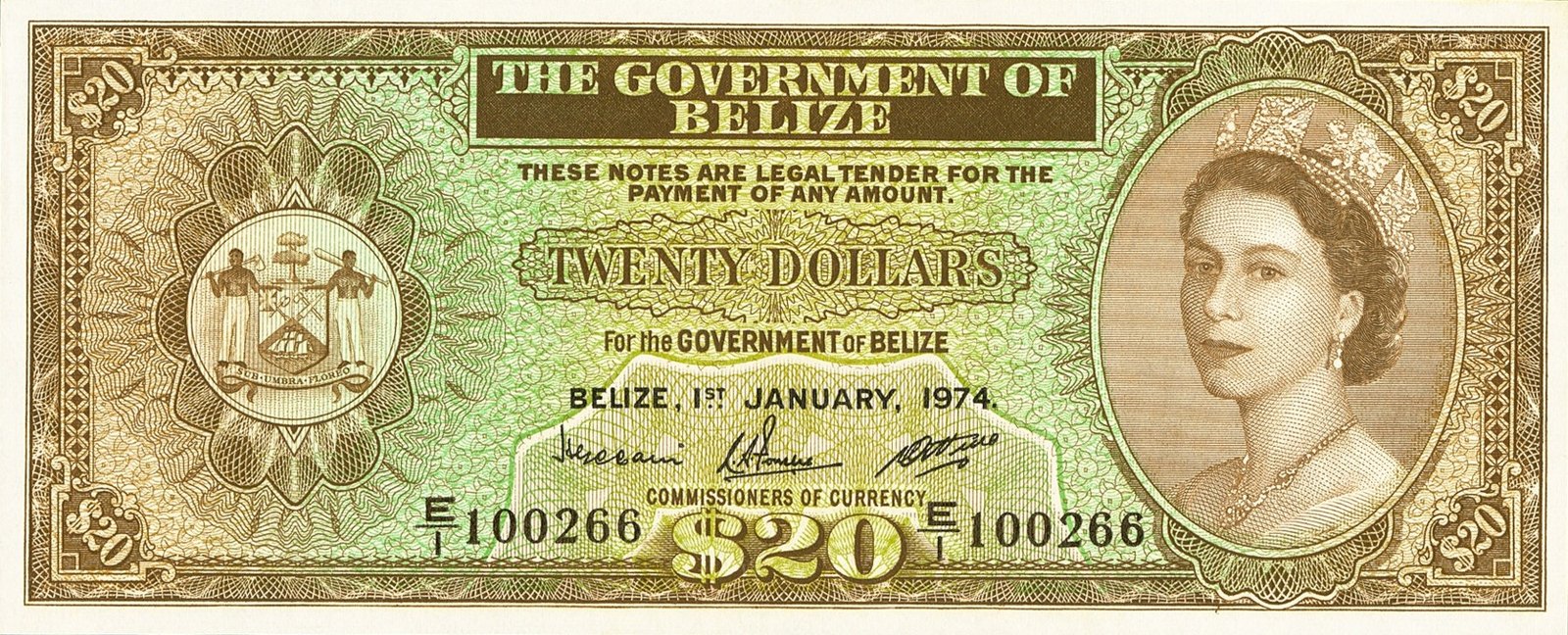
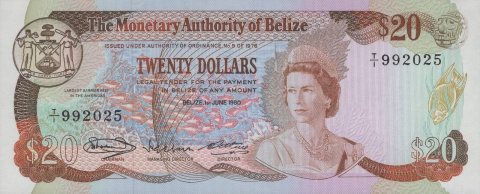
There are five values: the 1 dollar, the 2 dollars, the 5 dollars, the 10 dollars and the 20 dollars. All measure 157 x 68 mm and were printed by Bradbury Wilkinson and Company. The designs and colours are those of the British Honduras notes that ran to 1973, from 1953 on four values and from 1952 on the 20 dollars, as the Pick pages give them. Spink's description of lot 102 in its sale of 17 April 2019 gives the Queen at right, the arms at left and a back of guilloches. Sources mention that the portrait follows a 1952 photograph by Dorothy Wilding, engraved by Bradbury Wilkinson. Only the name, the dates and the signatures are new.
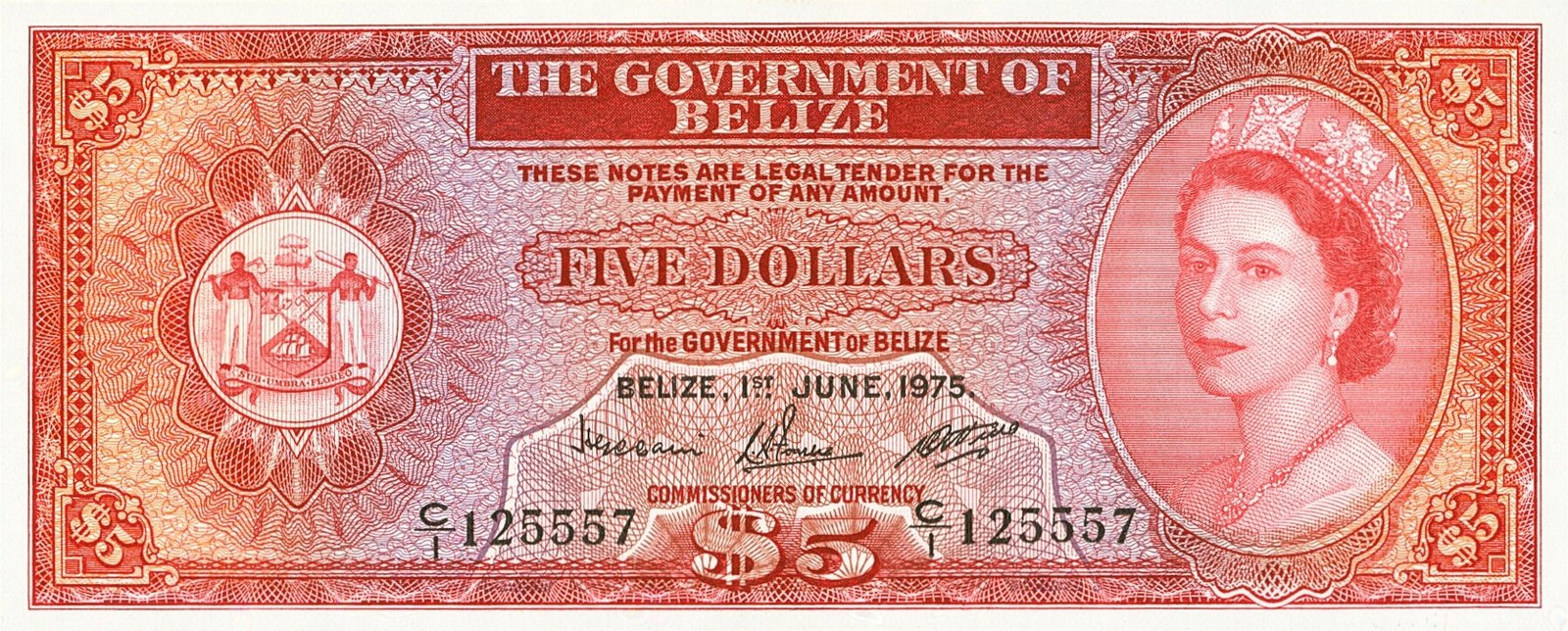
Spink's description of lot 635 in its sale of 7 December 2011 gives the colours of three values as green for the 1 dollar, violet on lilac for the 2 dollars and red for the 5 dollars. Heritage, describing a colour trial on 6 September 2018 (lot 26107), calls the issued 20 dollars tan.
Telling a Belize note from a British Honduras note
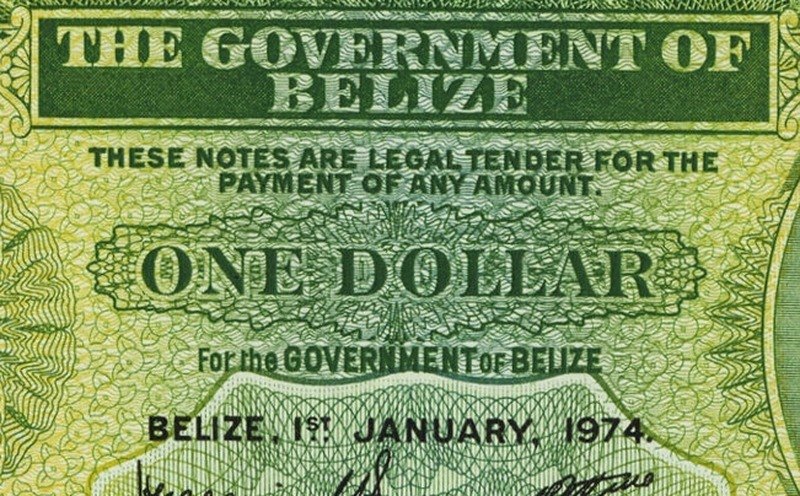
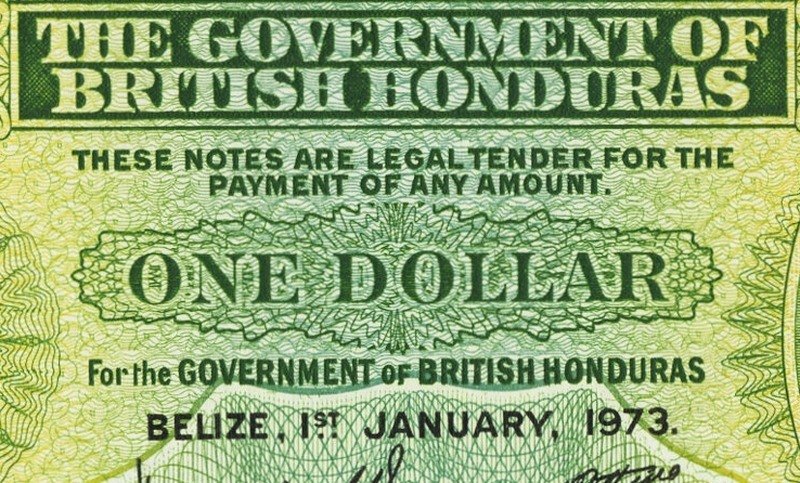
The British Honduras notes have the same design and colours. The heading decides, and so does the line above the date: THE GOVERNMENT OF BELIZE on these notes, THE GOVERNMENT OF BRITISH HONDURAS on the earlier ones. The place name BELIZE before the date is printed on both, so it does not make a note a Belize note.
Three dates on one prefix
Three dates were printed: 1st January 1974, 1st June 1975 and 1st January 1976. The 5 dollars has only the last two. The prefix letter follows the denomination, A for the 1 dollar to E for the 20, and the first prefix of each value runs across all of its dates. Only the printed date places a note.
The Pick pages give the numbers recorded so far on the first prefix of each value. They show where one date ends and the next begins:
| Value | 1st January 1974 | 1st June 1975 | 1st January 1976 |
|---|---|---|---|
| 1 dollar | to A/1 375375 | A/1 384169 to A/1 782677 | from A/1 929929, then A/2 to A/5 |
| 2 dollars | B/1 000093 to B/1 103406 | B/1 118008 to B/1 491657 | from B/1 520404, then B/2 |
| 5 dollars | none | to C/1 470264 | from C/1 500005, then C/2 |
| 10 dollars | D/1 023932 to D/1 051415 | D/1 068080 to D/1 629111 | from D/1 659905, then D/2 and D/3 |
| 20 dollars | E/1 021408 to E/1 100266 | E/1 150363 to E/1 484352 | from E/1 530316, then E/2 and E/3 |
These are numbers seen, not the limits of each printing. The true break between two dates lies somewhere in the gap between the highest number of one and the lowest of the next.
How many were printed
No annual report gives a number printed. What exists are statements of auction houses and the number runs above.
Spink (28 April 2015, lot 41, and 5 July 2016, lot 33) says fewer than 400,000 notes of the 1 dollar of 1st January 1974 were printed. That fits the numbers recorded, which run to A/1 375375 on that date and start again at A/1 384169 on the next.
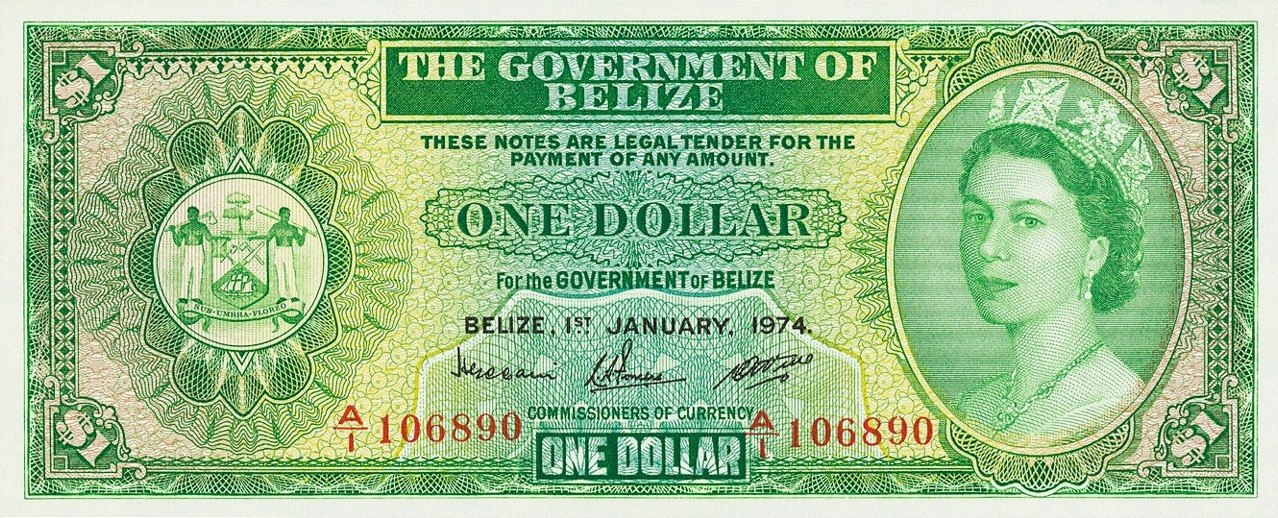
For the 20 dollars, Heritage's description of lot 24064 in its sale of 23 March 2023 says this value had the smallest print totals of the series and that only the first part of the notes with prefix E/1 carry the date 1974. The notes of 1974 recorded so far run to E/1 100266, and those of 1975 start at E/1 150363. Heritage's description of 9 November 2023 (lot 24067) reads the one prefix used across several dates as a sign of how few notes were printed for each date. Its description of 18 September 2020 (lot 28067) notes that E/1 is seen on all three dates.
The houses also quote the counts of the grading company PMG, each as it stood on the day of cataloguing:
- 20 dollars of 1st January 1974: six examples graded in all (Heritage, 23 March 2023, lot 24064).
- 10 dollars of 1st January 1974: eleven examples graded (Heritage, 9 November 2023, lot 24064).
Such counts say how many notes had been sent in for grading, not how many exist.
The colour trial specimens
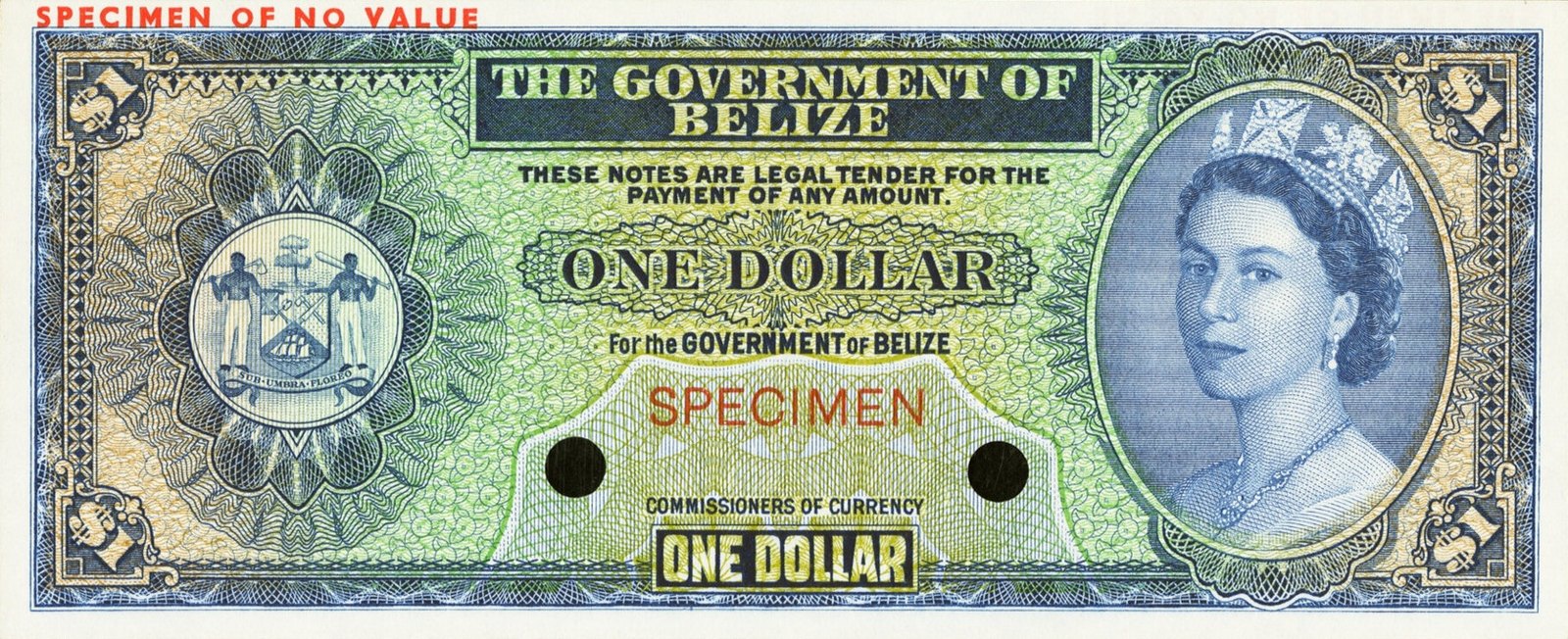
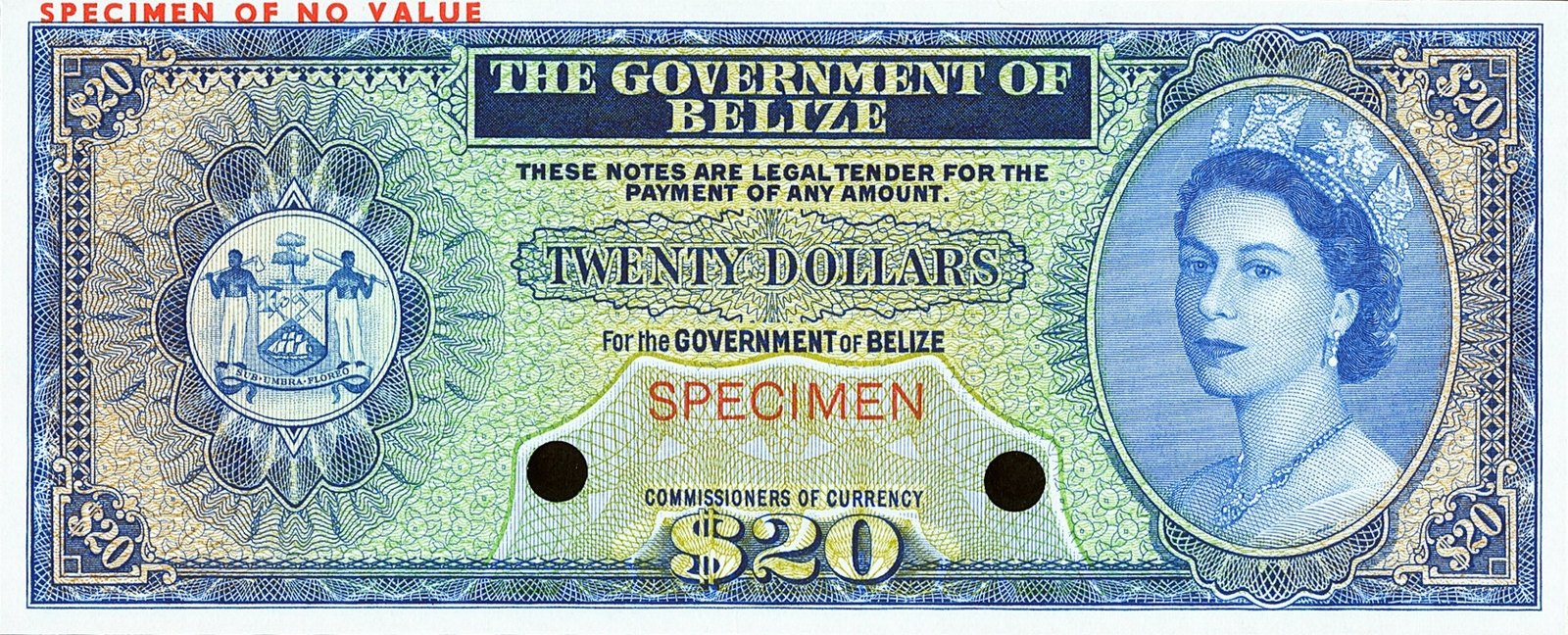
Each value is known as a colour trial specimen, printed in colours other than those of the issued note. Spink's description of lot 102 in its sale of 17 April 2019, the Ibrahim Salem Collection, lists a set of five:
| Value | Colours of the trial, as Spink gives them |
|---|---|
| 1 dollar | blue, green and pale orange |
| 2 dollars | brown, orange and red |
| 5 dollars | red |
| 10 dollars | olive-green and orange |
| 20 dollars | blue, green and pale yellow |
Spink describes all five as overprinted SPECIMEN in red on both sides, with two punch holes. Stack's Bowers, describing a 20 dollars trial on 6 January 2012 (lot 4036), places the holes in the space for the signatures and notes SPECIMEN OF NO VALUE in the upper margin. Two descriptions give a number on the back: 084 on a 2 dollars (Heritage, 30 September 2013, lot 19053) and 069 on a 10 dollars (Stack's Bowers, 20 August 2024, lot 32045). Heritage's description of a 20 dollars trial on 6 September 2018 (lot 26107) says the blue of that trial was used for no other note of the series.
The Heritage description of 30 September 2013 names Thomas De La Rue as the printer of the 2 dollars trial. The Pick pages give Bradbury Wilkinson for the whole issue, and Stack's Bowers prints "Printed by BWC" in descriptions of issued notes (4 May 2023, lots 50121 and 50123, among others). Among the descriptions saved, the Heritage statement stands alone.
Besides the colour trials, the Pick pages list specimens of each date, remainders of the 1, 5, 10 and 20 dollars, proofs, progressive proofs of the 2, 5 and 20 dollars, and one error note of the 20 dollars of 1st January 1976.
A design that was not used
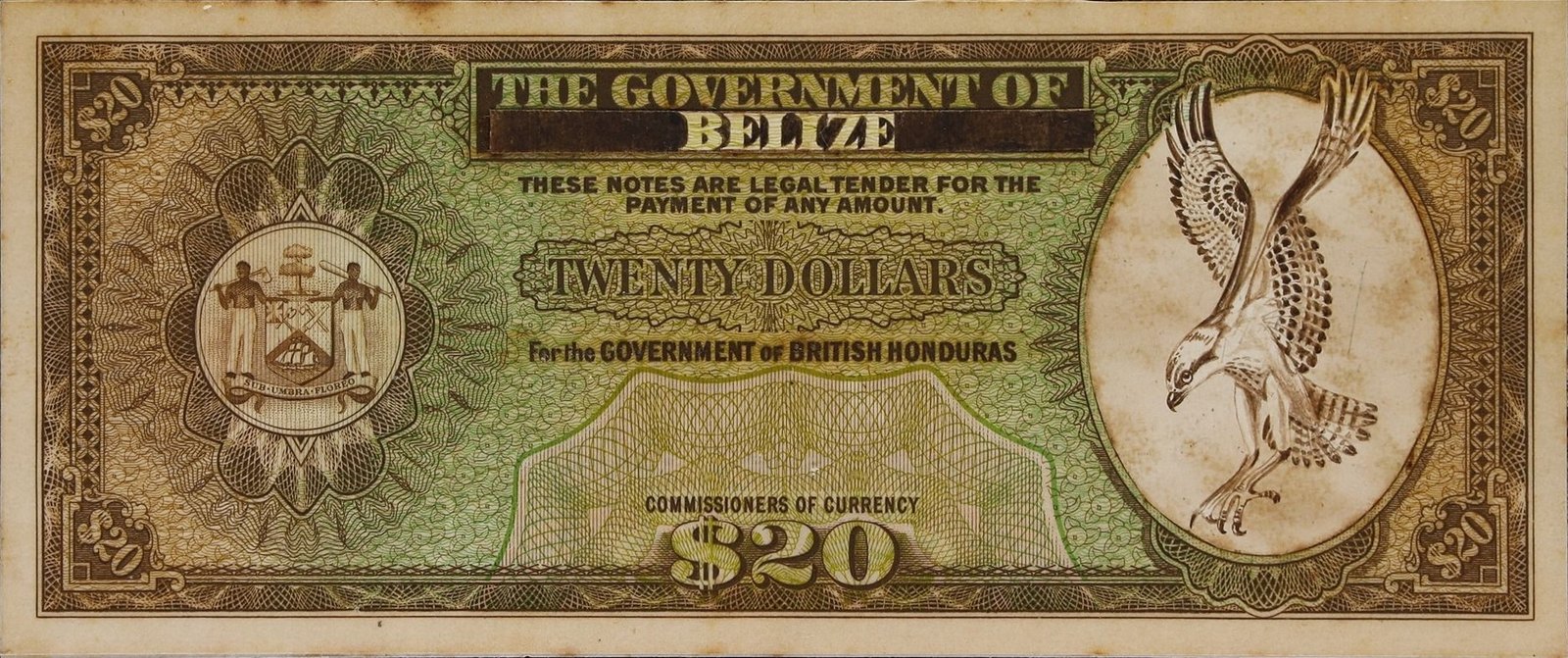
Stack's Bowers offered on 12 August 2026, in the Britannia Collection (lot 71035), two artist's renditions for a 20 dollars, a front dated 1973 and a back of about 1980. The front is the printer's model with an osprey in place of the Queen. It is described in From the monarch to national figures.
The end of legal tender
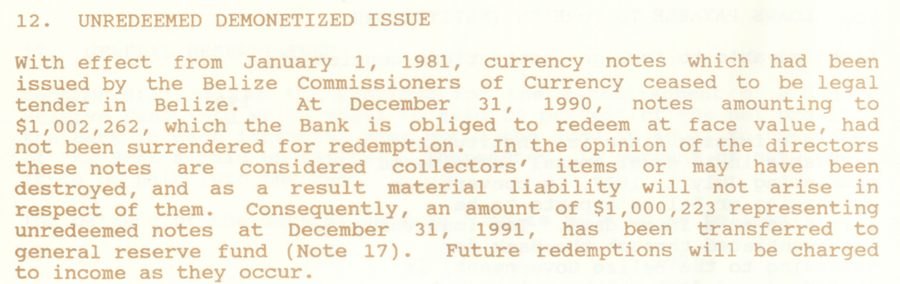
The Monetary Authority that took over in November 1976 was allowed to pay out as its own the notes printed for the Board and still in stock, and these stayed legal tender until called in. The Authority's annual report for 1980 says its own notes replaced those of the Commissioners of Currency on 1st July 1980, and that the old notes ceased to be legal tender after 31st December 1980. The reports never say "withdrawn". Their words are "ceased to be legal tender" and, as a heading in the accounts, "Unredeemed demonetized issue".
The Authority, and then the Central Bank, stayed bound to pay the old notes at face value. The accounts carried the sum still out year after year:
| At the end of | Commissioners' notes not yet redeemed, in dollars |
|---|---|
| 1980 | 1,878,245 |
| 1981 | 1,103,344 |
| 1982 | 1,053,375 |
| 1983 | 1,035,331 |
| 1984 | 1,024,532 |
| 1985 | 1,018,384 |
| 1986 | 1,016,062 |
| 1988 | 1,004,693 |
| 1990 | 1,002,262 |
| 1991 | 1,000,223 |
The report for 1987, a draft, has no accounts, and the report for 1989 repeats the figure for 1988.
Three quarters of a million dollars came back in the first year. After that the sum hardly moved: about 100,000 dollars in the ten years from the end of 1981. In its accounts for 1991 the Central Bank wrote the balance off. The directors held that the notes still out "are considered collectors' items or may have been destroyed", and 1,000,223 dollars was transferred to the general reserve fund. Later redemptions were to be charged to income as they occurred.
The figure covers every note of the Commissioners of Currency. The notes headed THE GOVERNMENT OF BRITISH HONDURAS are in it together with those headed THE GOVERNMENT OF BELIZE, and the reports do not divide the sum between the two.
Sources
- The Pick pages of this catalogue for Belize, P-33 to P-37.
- Monetary Authority of Belize, annual reports for 1980 and 1981.
- Central Bank of Belize, annual reports for 1982 to 1991, notes to the accounts.
- Spink, 7 December 2011, lot 635; 28 April 2015, lot 41; 5 July 2016, lot 33; 17 April 2019, lot 102.
- Heritage Auctions, 30 September 2013, lot 19053; 6 September 2018, lot 26107; 18 September 2020, lot 28067; 23 March 2023, lot 24064; 9 November 2023, lots 24064 and 24067.
- Stack's Bowers, 6 January 2012, lot 4036; 4 May 2023, lots 50121 and 50123; 20 August 2024, lot 32045; 12 August 2026, lot 71035.
Member comments
Log in or register to post a comment.