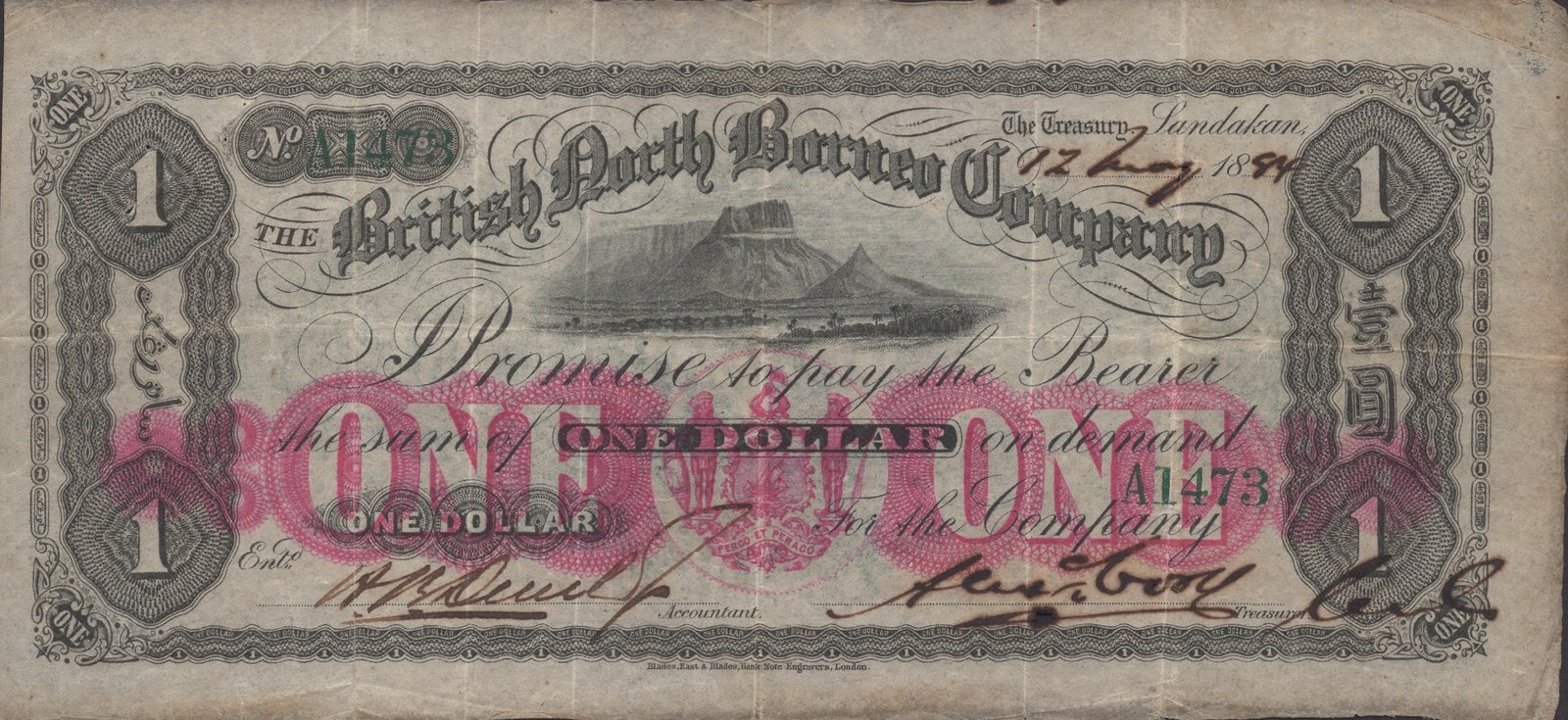
This article follows the paper money of British North Borneo from the first dated note in the catalogue, a 1 dollar of 12.08.1884, to 1st September 1953, when the Company's notes ceased to be legal tender. It is written from the catalogue's 24 Pick pages, from the colony's annual reports and the Colonial Office Lists, from two debates in the House of Commons, and from what the auction houses and Bank Note Reporter have printed. Where a statement is a house's own, it is given as that house's statement.
The Company
Every note was issued by the British North Borneo Company, and every Pick page names one printer, Blades, East and Blades of London. The pages name no law under which the notes were issued.
Two statements in the House of Commons describe the issuer. On 17 March 1882 Mr. Gorst said that the Company's Charter was not granted until the month of November, and that the rights the Sultans had ceded to Mr. Dent and Baron Overbeck included making laws and coining money. On 25 February 1889 the Under Secretary for Foreign Affairs, Sir James Fergusson, said that the Company was not recognised as an independent State but as administering the government of the territory, with an authority that came from the Sultans of Sulu and Brunei, and that the Charter conferred only the ordinary incidents of incorporation.
Two houses add dates of their own. Heritage's description of lot 28252 in its sale of 5 September 2019 says Alfred Dent was the founder and chairman of the Company in 1881. Stack's Bowers' description of lot 41087 in its sale of 4 October 2022 says British North Borneo was a protectorate of the United Kingdom from 1888.
The first notes, 1884 to 1897
The oldest note is the large 1 dollar with Mount Kinabalu, serial prefix A. Its first rows are dated from 12.08.1884 to 01.03.1897 on a form with the partly printed date __ 18__, a violet underprint and two handwritten signatures.
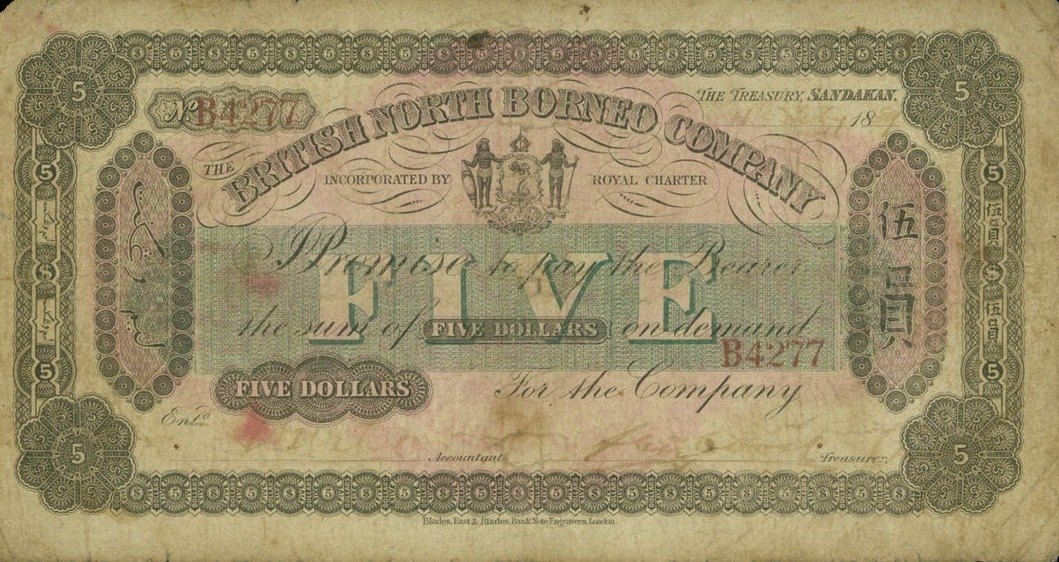
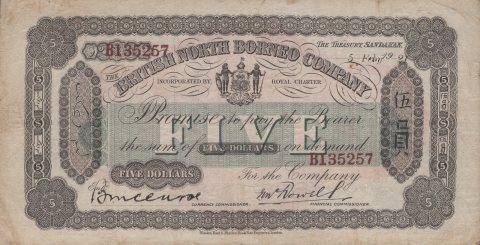
The 5 dollars, prefix B, begins on 04.07.1889, also with two handwritten signatures, Accountant and Treasurer. The 10 dollars, prefix D, is seen dated 3 March 1896 on the same kind of form.
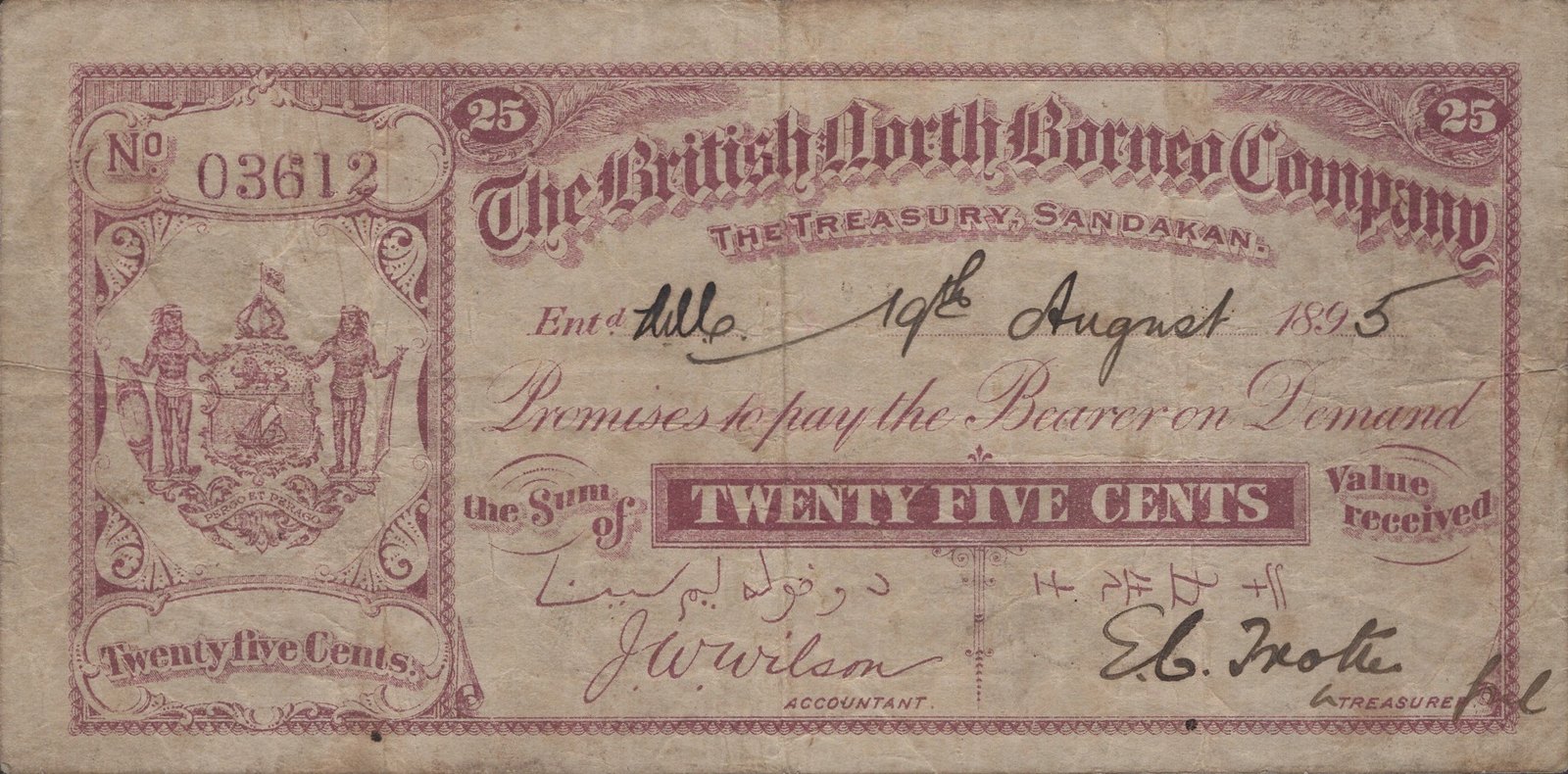
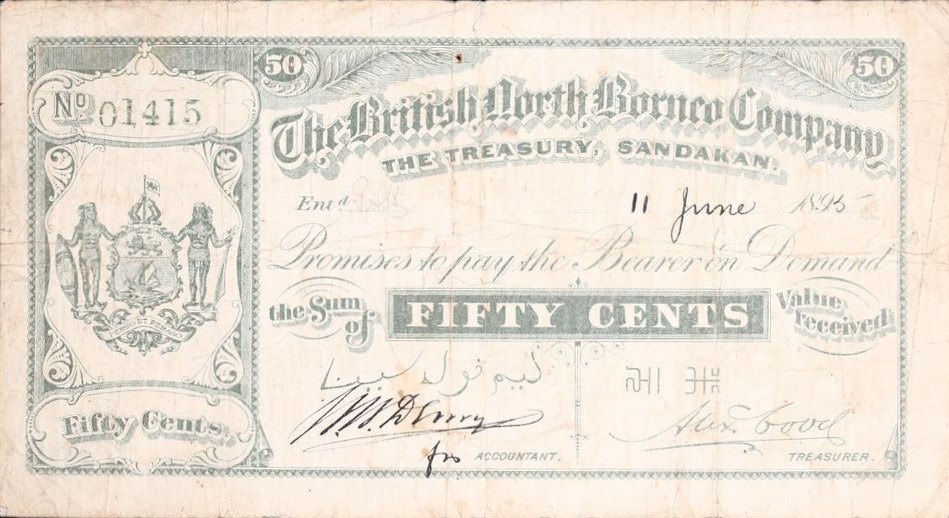
The two small values are dated from 1895. The mauve 25 cents is dated from 19.08.1895 and the green 50 cents from 11.06.1895. Both are uniface, have no serial prefix and are on the partly printed __ 189_ date form. Both come in two signature forms on the same dates: a handwritten Accountant with Cook's printed signature as Treasurer, and Wilson's printed signature as Accountant with a handwritten Treasurer.
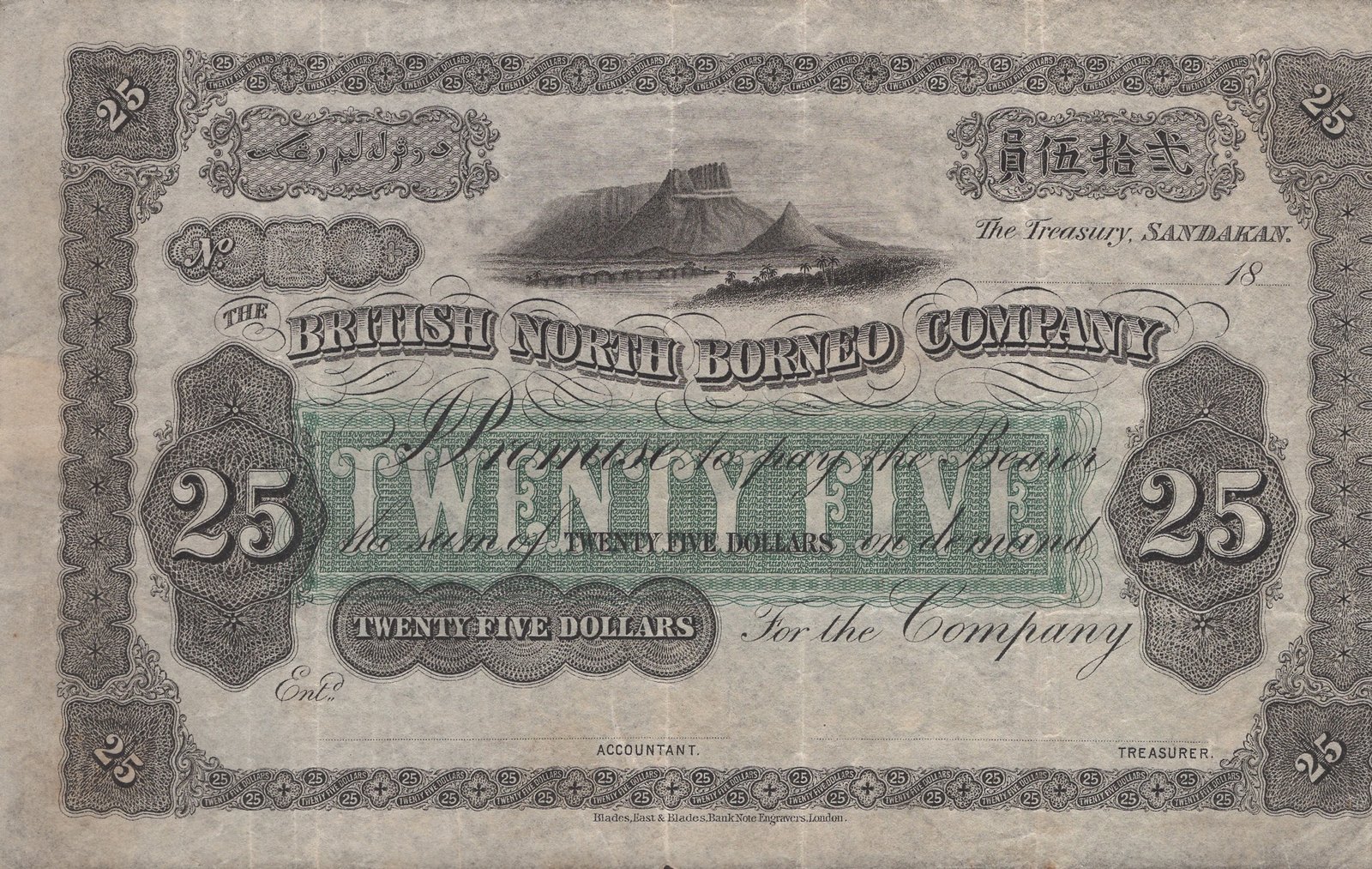
The 25 dollars, prefix C, has no dated note of these years, but an unissued remainder on the __ 18__ form, with spaces for the Accountant and the Treasurer, is recorded on the page of the early 25 dollars. Noonans' description of that piece (31 August 2023, lot 108) says the earliest date recorded for the 25 dollars until then was 1905, and that the remainder shows the value was prepared much earlier.
The same designs carried on, 1900 to 1920
From 1900 the 25 cents and the 50 cents are still on the old forms of the 1890s, with the year written over the printed figures on the 50 cents, and written or stamped over or beside them on the 25 cents. The catalogue keeps these notes on pages of their own: the 25 cents of 1900 to 1920 and the 50 cents of 1900 to 1910. Other sources treat each pair as one note.
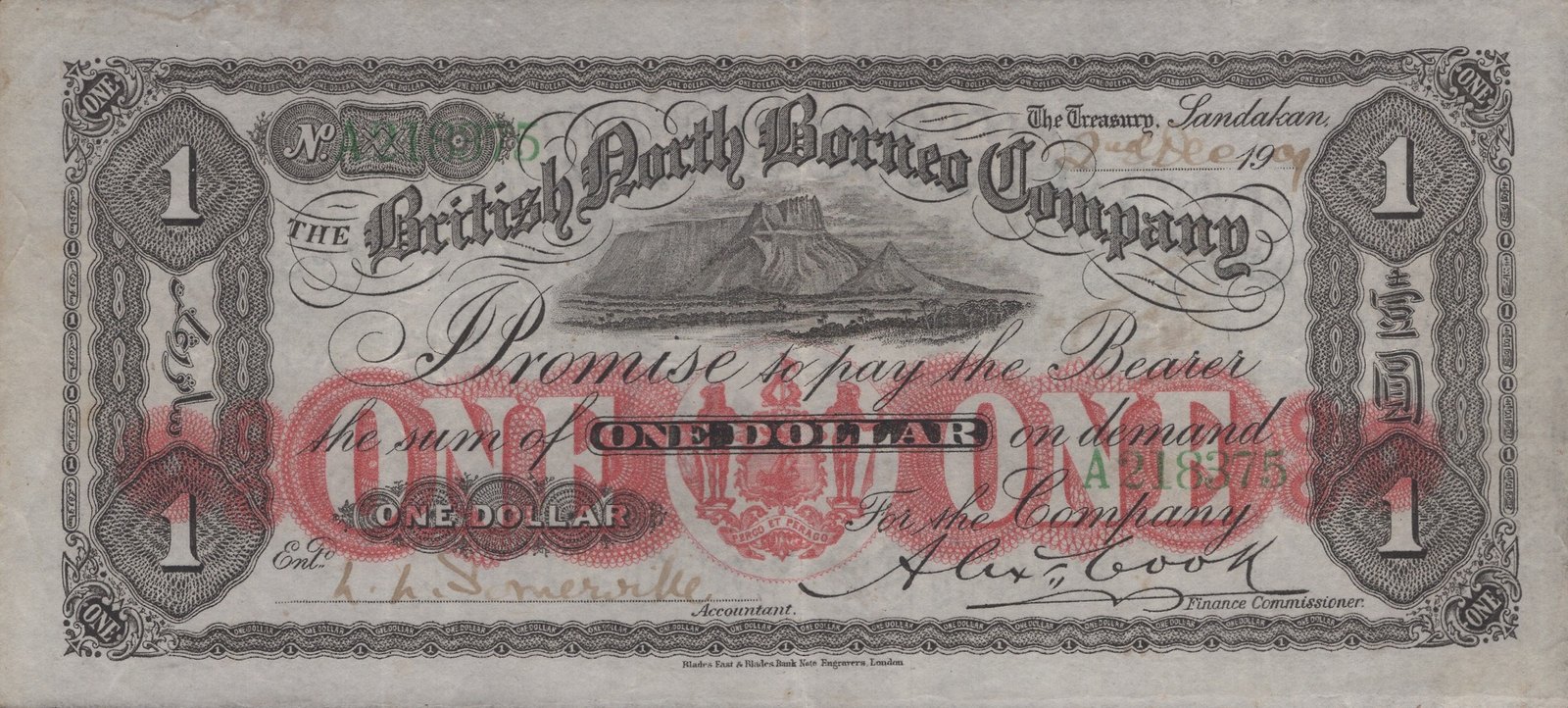
On the 1 dollar every note from 1902 has a red ONE underprint in place of the violet one. Most have a handwritten Accountant signature and a printed Finance Commissioner. A smaller group, seen dated 1912 and 1913, has both signatures handwritten and is kept as the 1 dollar P-3A. The 5 dollars and the 10 dollars changed in the same way from 1904, when Cook's printed signature as Finance Commissioner joined the Accountant's handwritten one.
A brown 50 cents is listed for 1910 to 1920, with a handwritten District Treasurer signature and Wilson's printed signature as Finance Commissioner. One issued note has been seen, dated 15th October 1913.
The two notes seen of the early 25 dollars are on the __ 19__ form with the printed titles ACCOUNTANT and FINANCE COMMISSIONER and two handwritten signatures. One is dated 10 August 1914.
New forms and printed dates, 1917 to 1927
From 1917 the notes changed step by step: on the dollar values the titles became Currency Commissioner and Financial Commissioner, both signatures came to be printed, and then the whole date.
- The red 25 cents of 1917 to 1925, serial prefix N, has handwritten or handstamped dates and a printed date of 1st March 1921.
- The green 50 cents on paper watermarked NBC, 1917 to 1929, has handstamped dates of 1919 and 1920 and the printed dates 1st March 1921 and 1st June 1929.
- The large 1 dollar with two printed signatures, prefix A/A, has dates of 1919 to 1925 filled in by hand or handstamp and the printed dates 2nd May 1921 and 2nd January 1922. The last of these notes begin prefix E, which runs on to the last large 1 dollar, dated 1st January 1927.
- The 5 dollars has both signatures printed by February 1921, a printed date of 1st December 1922, and notes of 14 July 1926.
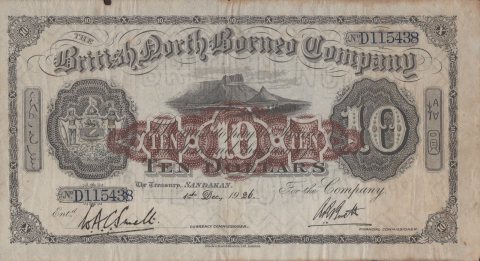
- The 10 dollars has the printed dates 1st December 1922 and 1st December 1926. The note with the fully printed date 1st January 1927 has a page of its own.
- The later 25 dollars, 1919 to 1927, has the new titles, handstamped dates in 1919 and 1920, printed signatures from November 1925, and the printed dates 1st December 1926 and 1st January 1927.
The Economic Survey of the Colonial Territories for 1932 lists the Treasury notes of North Borneo as 25, 10, 5 and 1 dollars, 50 and 25 cents: the six values of these pages.
The small notes, 1927 to 1938
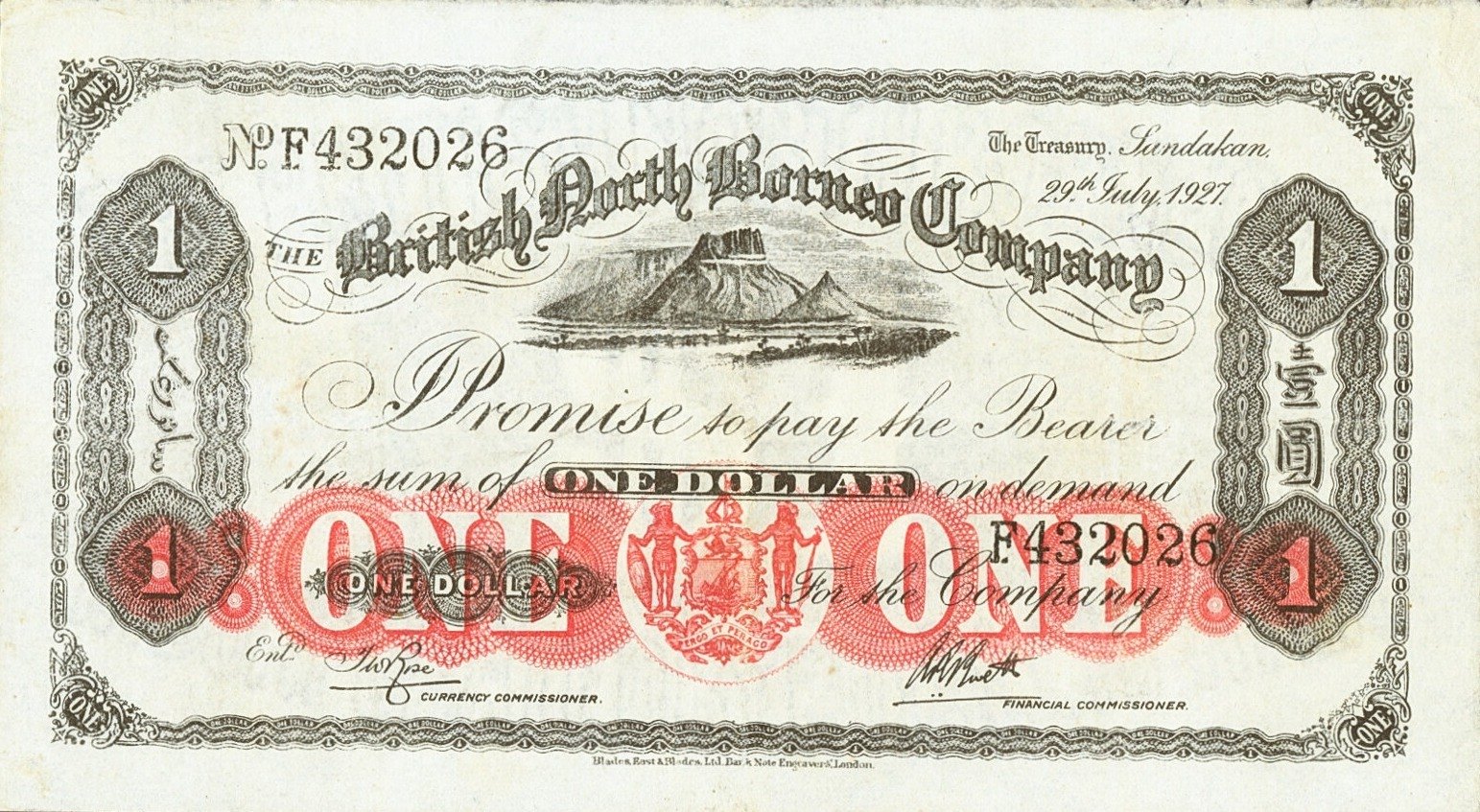
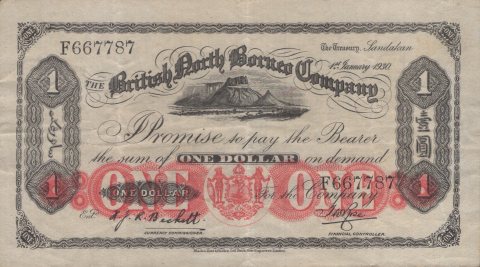
The first small 1 dollar, prefix F, is dated 29th July 1927. The Pick pages give the large 1 dollar as 195 by 90 mm and this note as 135 by 75 mm. A second date, 1st January 1930, differs in its signatures, in its machine-cut paper and in having no "No." before the serial number.
The small 50 cents is dated 1st January 1930 and has a red six-digit number without a prefix. Smaller notes followed: the 1 dollar of 1st January 1936, prefix G, and the 50 cents of 1st January 1938.
One figure for the notes in circulation before the war has been found. The Chartered Company's balance sheet of 31st December 1933, printed in the Economic Survey of the Colonial Territories for 1933, counts Treasury notes in circulation at 119,030 pounds among the Company's liabilities. It is a balance-sheet line in sterling, and it is not divided by value.
The last series, 1940 and 1942
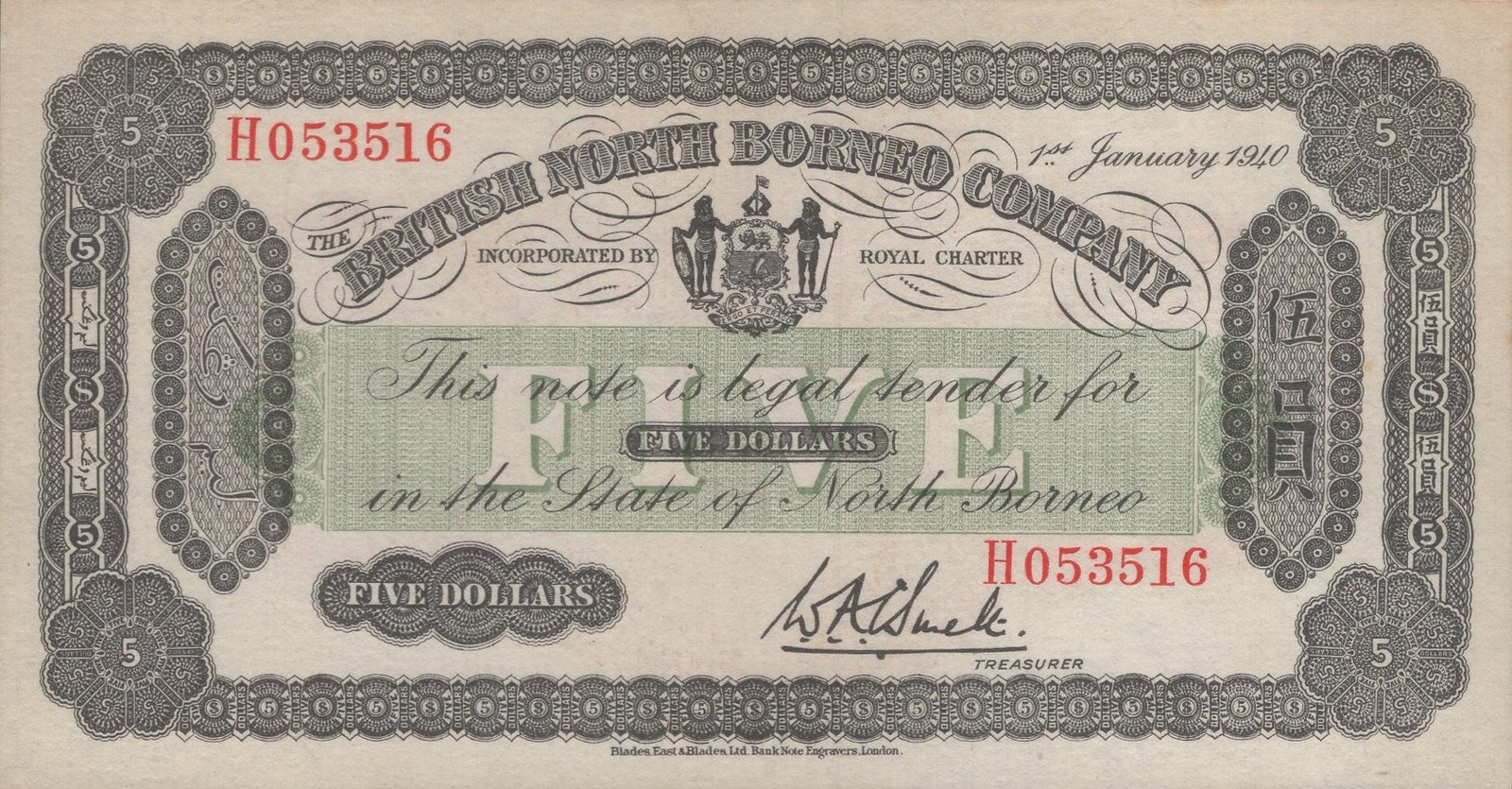
The last notes are signed by Smelt alone as Treasurer: the 1 dollar of 1st July 1940, prefix K; the 5 dollars of 1st January 1940, prefix H; the 10 dollars, prefix I, and the 25 dollars, prefix J, both of 1st July 1940. The 5 dollars keeps the frame of the old 5 dollars, but in place of the promise to pay it reads that the note is legal tender for five dollars in the State of North Borneo.
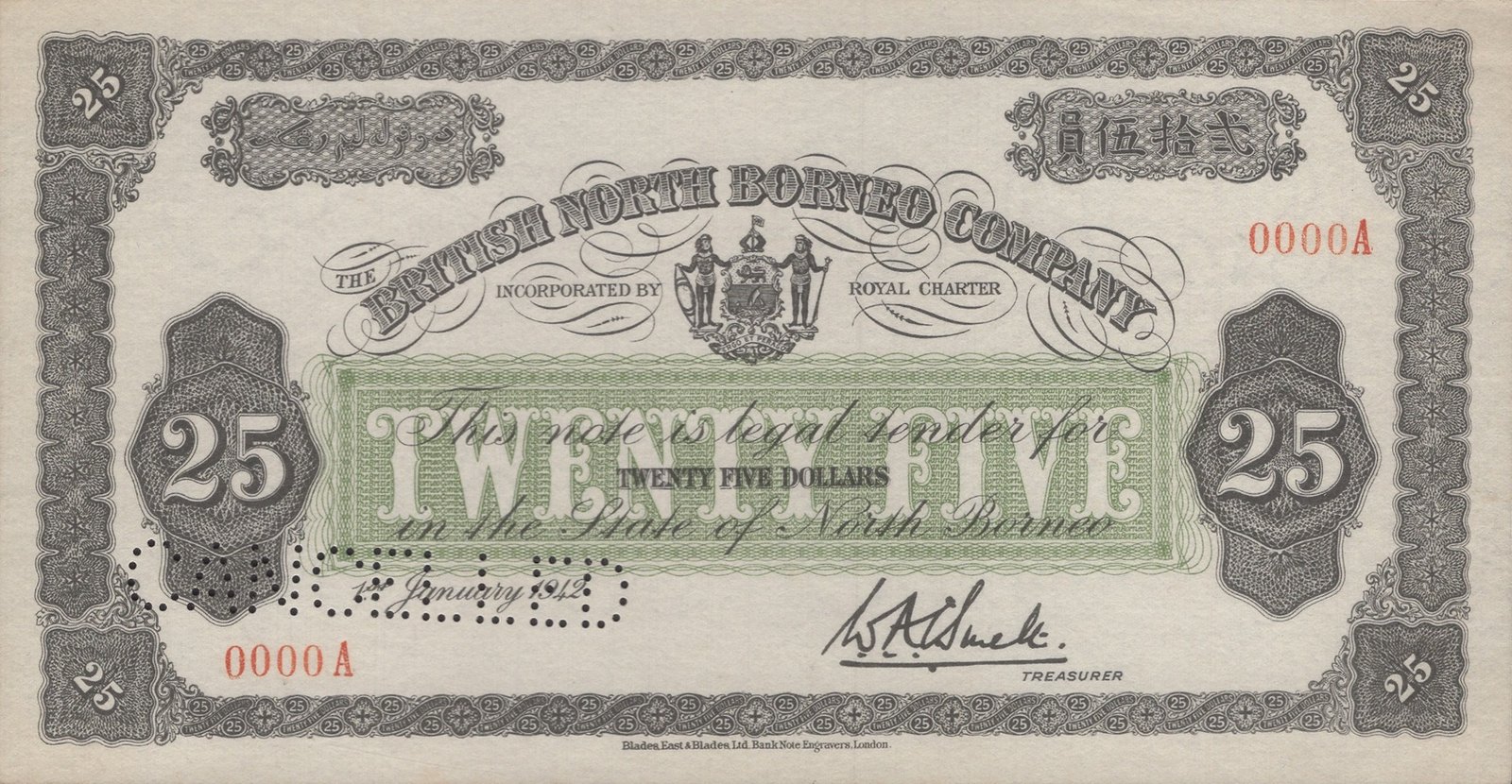
A second date of the 10 and 25 dollars, 1st January 1942, was printed in 1941 and shipped to Sandakan. The Pick pages say these notes were destroyed at the Japanese invasion in December and never issued, and that only CANCELLED specimens of that date are confirmed. Heritage's description of lot 24073 in its sale of 14 October 2026 says the shipment came from Blades, East and Blades in London. Bank Note Reporter of March 1988, reporting the Spink-Taisei sale at Singapore of 11 February 1988, says the two cancelled pieces of 1942 sold there had been carried to India by the printer and had stayed in the printer's family for some forty years. The report does not name the printer.
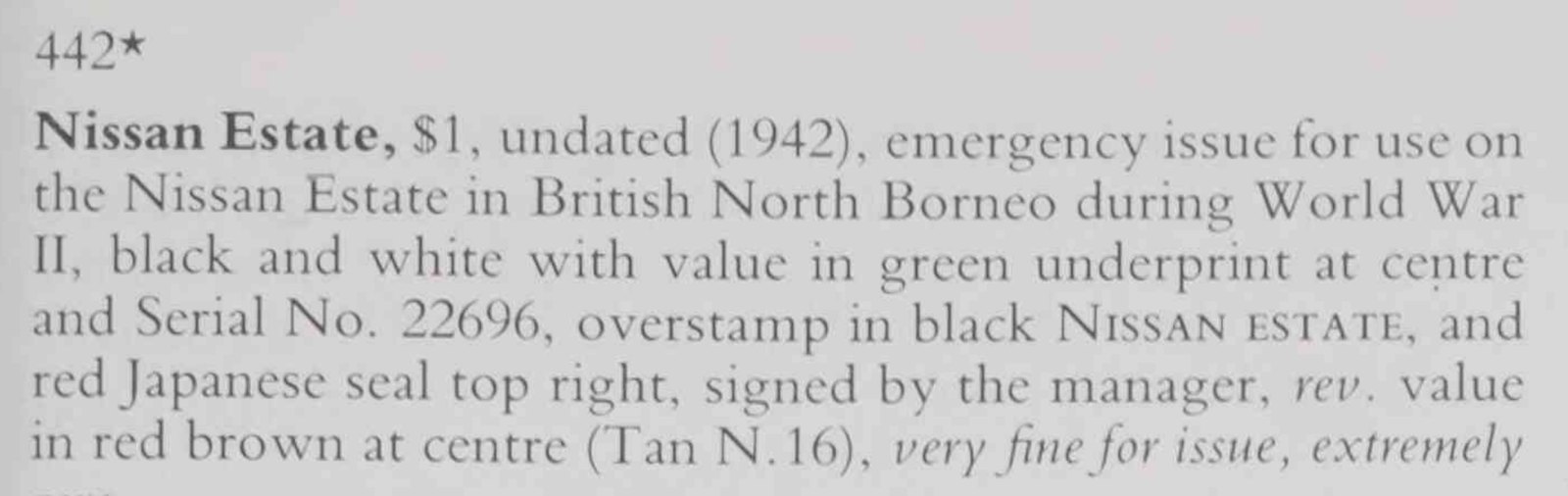
Bank Note Reporter of October 1983 (page 12) describes another wartime issue that is not in the catalogue: crudely printed notes of 50 cents, 1 dollar and 5 dollars used by the Nissan Estate at Tawau, some stamped with the manager's name and some with a Japanese stamp allowing them to circulate to 31 July 1942. Two of them were lots 442 and 443 of Spink's Singapore sale of 25 June 1994.
Redemption and the end, 1945 to 1953
The colony's annual report for 1947 says that before the Japanese occupation the Chartered Company issued its own notes and coins, and that on liberation the British Military Administration introduced Malayan currency throughout the three Borneo territories. The Company's notes and coins were still legal tender, but when they were handed in to banks or treasuries they were redeemed at face value in Malayan currency and not issued again, so that little of the Company's currency remained in circulation. The same report puts the Malayan currency in circulation in the colony at about 7 million dollars. The book Money in British East Asia (1957) also says that the British Military Administration issued Malayan notes in British Borneo after the war and that the Company's notes were withdrawn.
The report for 1952 (page 33) still calls the Company's currency legal tender. The reports for 1953, 1954 and 1955 say it ceased to be legal tender as from 1st September 1953, but was still redeemed at face value for Malayan currency when handed in to banks or treasuries. The Colonial Office Lists of 1959, 1960, 1962 and 1963 repeat the date. In Sarawak, where the Company's notes had also been legal tender, the Sarawak annual report for 1954 (page 27) says that from 1st January 1953 only the notes and coins of the Board of Commissioners of Currency, Malaya and British Borneo, were legal tender. The Economic Survey of the Colonial Territories for 1955 adds that a Currency Commission was set up by Ordinance No. 10 of 1951.
For the oldest notes 1st September 1953 is the latest possible end, not a proven one: no source read gives a day on which any single issue was called in.
One phrase in the 1952 report does not fit the Pick pages. It speaks of Company notes and coin "issued before, and during, the Japanese occupation", while the pages say the notes of 1942 were destroyed and never issued. The report does not explain the word "during".
What the sources do not give
The North Borneo annual reports for 1952 to 1955 give no figure of the Company's notes by value and name no Company Treasurer or other signer. The Pick pages give no law for the note issue, no number printed of any note and no day of issue. The date on which the first note was issued is not stated by any source used here: 12.08.1884 is the earliest date on a row of the catalogue.
Sources
- The catalogue's 24 Pick pages of British North Borneo.
- Colony of North Borneo, annual reports for 1947, 1952, 1953, 1954 and 1955.
- Sarawak annual report for 1954, page 27.
- The Colonial Office Lists of 1959, 1960, 1962 and 1963.
- Economic Survey of the Colonial Territories for 1932, 1933 and 1955.
- Money in British East Asia (1957).
- Hansard, House of Commons, 17 March 1882 (vol 267) and 25 February 1889 (vol 333, cc260-2).
- Bank Note Reporter, October 1983, page 12, and March 1988.
- Spink, Singapore, 25 June 1994, lots 442 and 443.
- Heritage, 5 September 2019, lot 28252, and 14 October 2026, lot 24073.
- Stack's Bowers, 4 October 2022, lot 41087.
- Noonans, 31 August 2023, lot 108.
Member comments
Log in or register to post a comment.