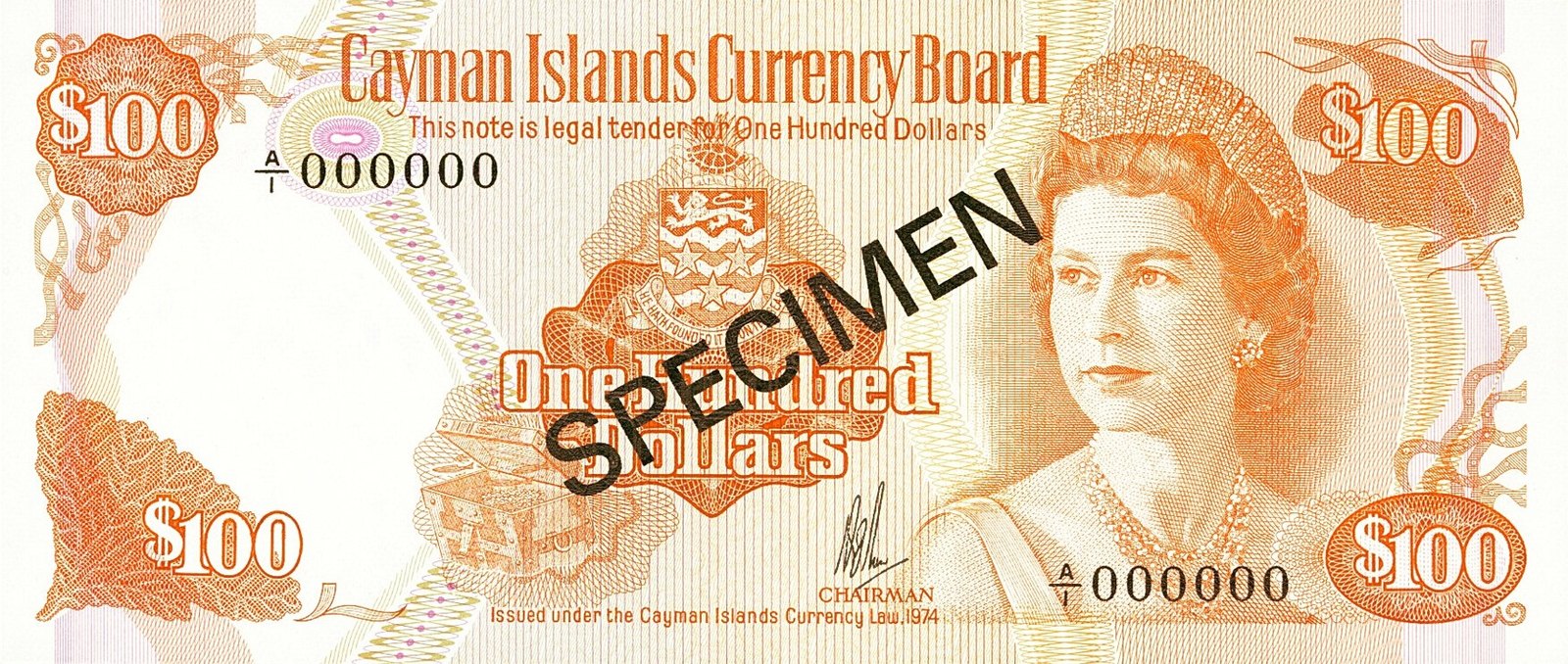
Beside the notes that went to the banks, the Cayman Islands Currency Board and the Monetary Authority sold sets to collectors, and the printer made trials and designs that were never used. This article gathers what is on record about them. Much of it comes from the descriptions of auction houses. Those are given here as each house's own statement, with the sale and the lot, and where two of them disagree both are set down.
The specimen set of the 1974 law
Bank Note Reporter of March 1987 reports that the Currency Board was then selling a specimen set of the six values, 1, 5, 10, 25, 40 and 100 dollars, to collectors at 50 Cayman dollars, in gold-printed plastic sleeves; the paper's new-issues column of the same month estimates 100 sets. The six values are the 1 dollar, 5 dollars, 10 dollars, 25 dollars, 40 dollars and 100 dollars of the Currency Law, 1974.
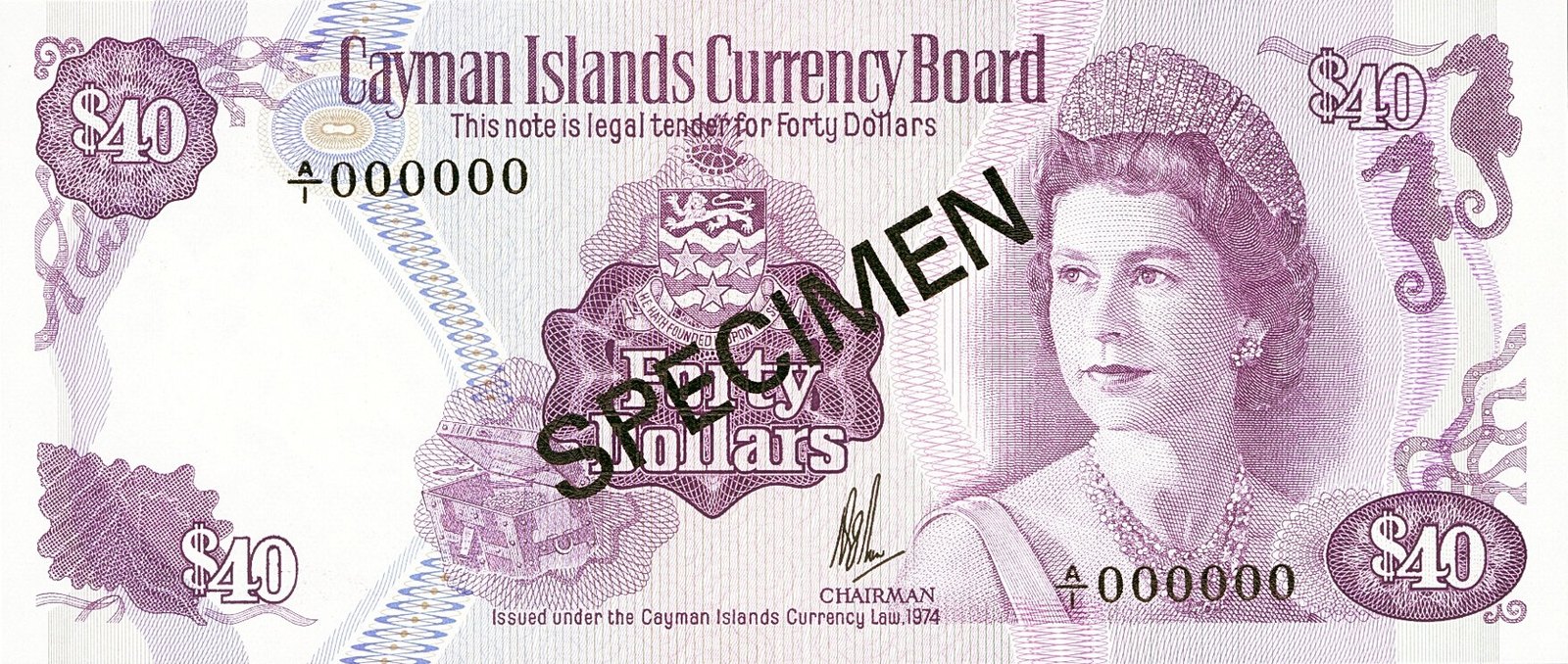
The houses give a different number, and they do not agree on what the set held.
- Stack's Bowers, 14 August 2013, lot 10118, a 40 dollars specimen, calls it part of a release of 300 sets.
- Spink, 17 April 2019, lot 358, from the Ibrahim Salem Collection and before that the Laurence Pope Collection, was a set of six, all with serial numbers of noughts and SPECIMEN across front and back in red or black. Spink's description says that, contrary to the catalogues, the set was issued with six notes only, the 50 dollars being released later with a different signature, and that 300 sets were issued.
- London Coins, 6 June 2021, lot 117, was a set of seven in the Currency Board's plastic sleeve with gold lettering. It had the six values above and a 50 dollars numbered A/1 000000 with the signature of Jefferson; the other six were signed by Johnson, and the 1 dollar had prefix A/3. London Coins says SPECIMEN was in black on the 100, 40 and 10 dollars and in red on the 50, 25, 5 and 1 dollar, and that 300 sets were issued.
So the newspaper of 1987 estimates 100 sets and three houses say 300, and no source read gives the Currency Board's own figure. On the number of notes, the newspaper and Spink say six and the London Coins set had seven. The newspaper's six values fit the note pages: the fifty dollars carries a later signature than the other six.
The London Coins description also names the back of each value: the seacoast at George Town on the 100 dollars, Government House on the 50, the Pirates Week festival on the 40, a compass and a map of the islands on the 25, a beach on the 10, a sailing boat on the 5, and fish and coral on the 1 dollar. For the fifty dollars this differs from the note page, which gives an old Caymanian cottage.
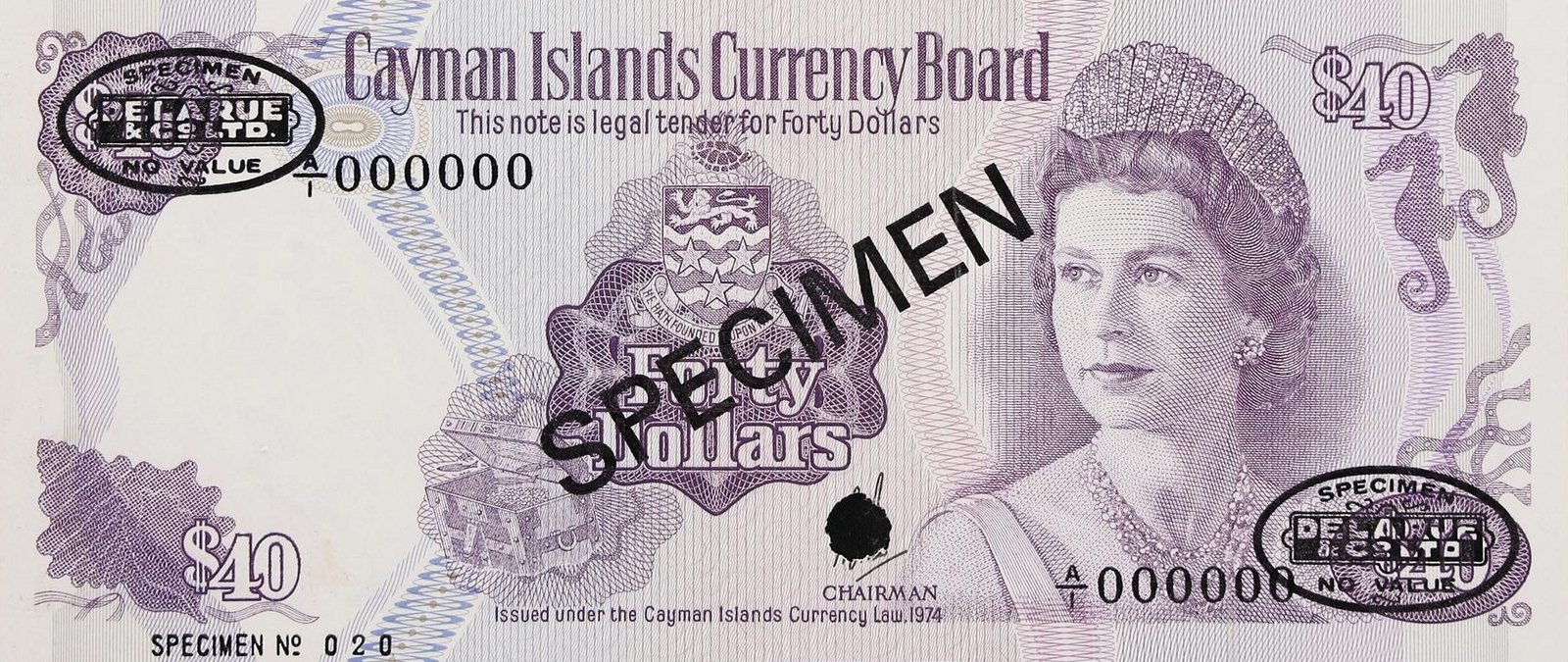
Another kind of 40 dollars specimen has been sold, with a De La Rue oval stamp beside the black SPECIMEN. Stack's Bowers, 20 January 2026, lot 32270, from the Jerry and Diane Fishman Collection, was one, and the grading company's label on it reads "Previously Mounted".
The specimen set of 1991
Bank Note Reporter of August 1992 gives 61.35 United States dollars as the issue price of the Currency Board's specimen set of the four 1991 values, 5, 10, 25 and 100 dollars: the 5 dollars, 10 dollars, 25 dollars and 100 dollars.
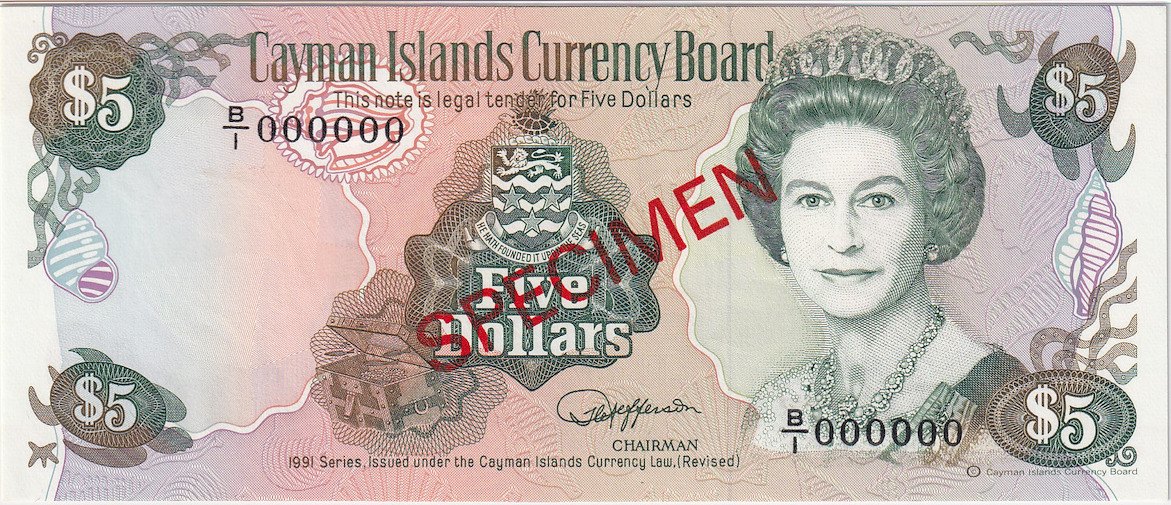
Sets of the four have been sold whole, by Heritage on 9 September 2019 (lot 28797) and by Stack's Bowers on 9 September 2025 (lot 72192, from the Meadows Collection). London Coins, in the description of 2021 quoted above, says the sets of 1991 and 1996 were made in the same number as the 1974 set. No report of the Currency Board that would confirm any of these numbers has been read. The Monetary Authority's report for 1997 says only that its currency office went on selling coins and banknotes to collectors at home and abroad.
Sets with one number on every value
Several sets of the first issue carry the same low number on all four values, the 1 dollar, 5 dollars, 10 dollars and 25 dollars. Spink, 4 October 2018, lot 1381, was a set numbered A/1 000255. Stack's Bowers, 29 August 2025, lot 30126, was a set with the number 186, and the house's description supposes that such sets were once easy to come by and have mostly been broken up. Spink's sale of 4 October 2018 also had the four values of 1991 all numbered 000049 (lot 1387). None of the sources read says how these matched sets left the Currency Board.
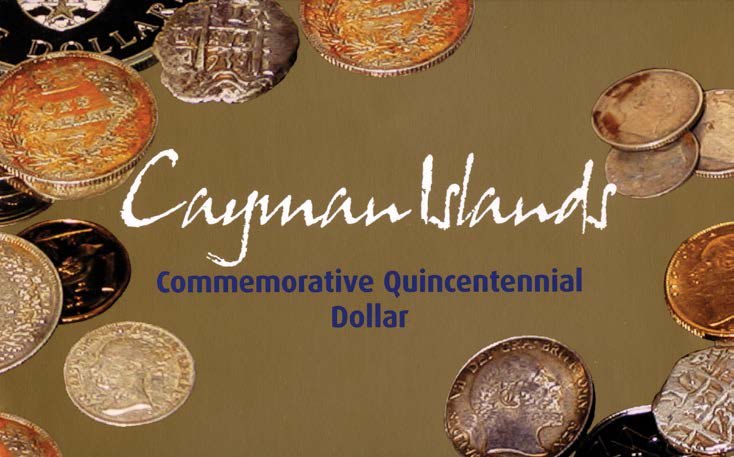
The folder dollar of 2003
The 500th-anniversary one dollar of 2003 was sold to collectors in a descriptive folder with a certificate. The folder notes are Q/1 000001 to Q/1 004000 and were released on 10 February 2003; Bank Note Reporter of July 2003 gives the price of the folder as 12.27 United States dollars, with 4 dollars for postage. The Monetary Authority's report for 2019 says the letter Q in a prefix marks notes for special occasions.
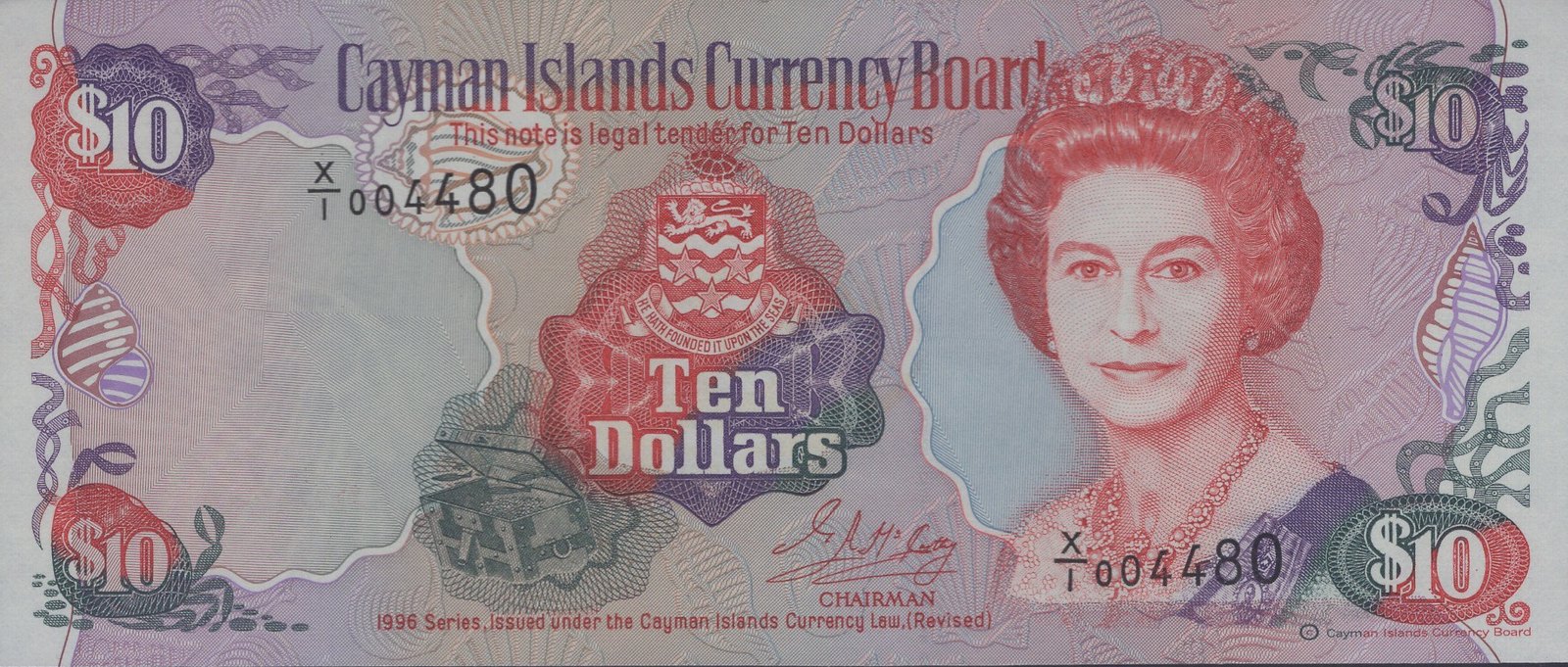
The ten dollars on trial paper, prefix X/1
Part of the 1996 ten dollars was printed on experimental paper under its own prefix, X/1; this is the row P-18b. The series line, heading and signature are those of the B/1 notes, so the prefix alone places these notes. Sources mention the X/1 notes as a De La Rue paper trial, released with the ordinary ten dollars and watched for wear against it; neither the paper nor the result has been made public.
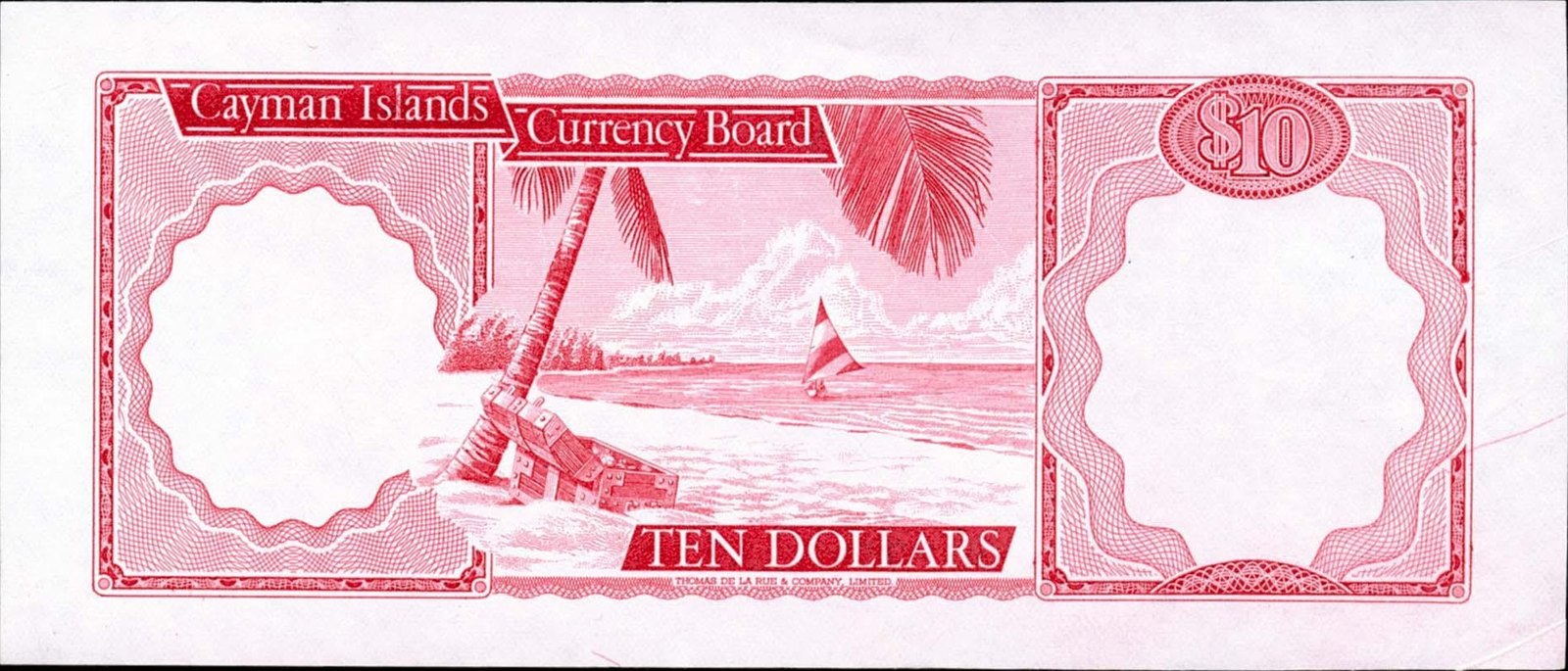
The houses add detail, each on its own authority, and those that give a number give 100,000 notes.
- Heritage, 6 September 2018, lot 26317, says the notes were put into circulation without notice to the public, passed through the usual channels, and were collected at the end of the test.
- Heritage, 25 April 2019, lot 28653, says the type was withdrawn quickly and returned to the printer.
- Heritage, 23 March 2023, lot 24186, says the plan was to withdraw the notes after a time to see how the paper stood up to wear and to the climate of the islands.
- Lyn Knight, September 2021, lot 94167, says many of the 100,000 were circulated and then sent back to De La Rue to be examined.
- Spink, 26 April 2017, lot 1034 (X/1 004478) and 12 April 2021, lot 1100 (X/1 094875), says that all the notes, with a few exceptions, went back to De La Rue for analysis and destruction.
None of the houses names a source, and nothing on the trial was found in the Monetary Authority's reports, which begin with 1997. How many X/1 notes were not returned is not known.
The 1996 series has one more oddity, on the one dollar: the row P-16x is an error note printed without the pale green and lilac tints of the underprint.
Proofs and designs that were not used
The catalogue lists a progressive proof of the ten dollars of the first design under both laws, P-3pp and P-7pp.
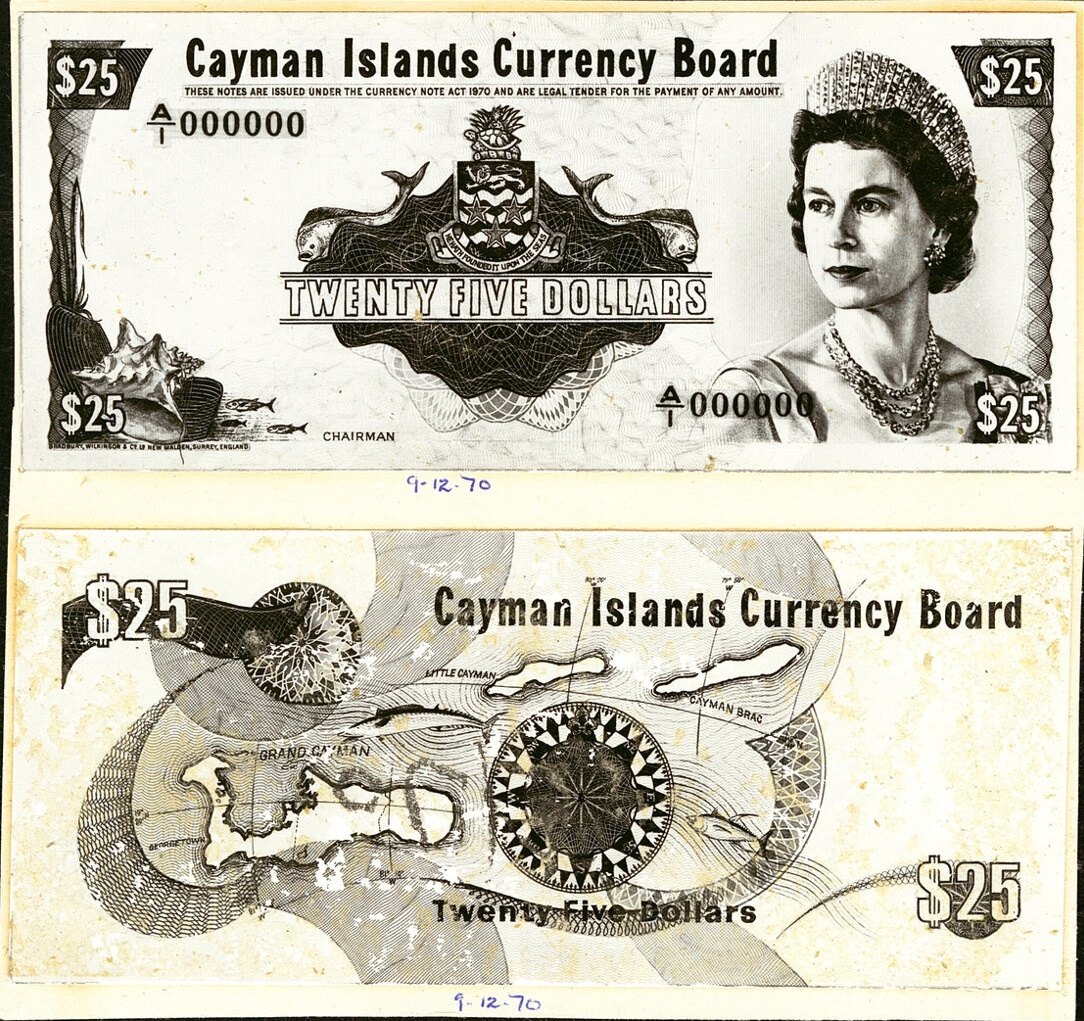
Two designs that never became notes have passed through the sale rooms.
A 25 dollars in photographs. Spink, 7 April 2020, lot 871, was a pair of black and white archive photographs, front and back, of an unissued 25 dollars of the Currency Board, mounted on card, which Spink dated 1970. Its description gives the Queen at right, a seashell and fishes at left and the arms in the centre between fishes, with a map and compass on the back. Heritage sold front and back photographic proofs of an unadopted 25 dollars on 8 December 2023, lot 22706, from its Queen Elizabeth II Collection, with the same grade from the grading company and the same remark on mounting remnants; Heritage dated them about 1972. The two descriptions could be of one and the same pair; neither house says so.
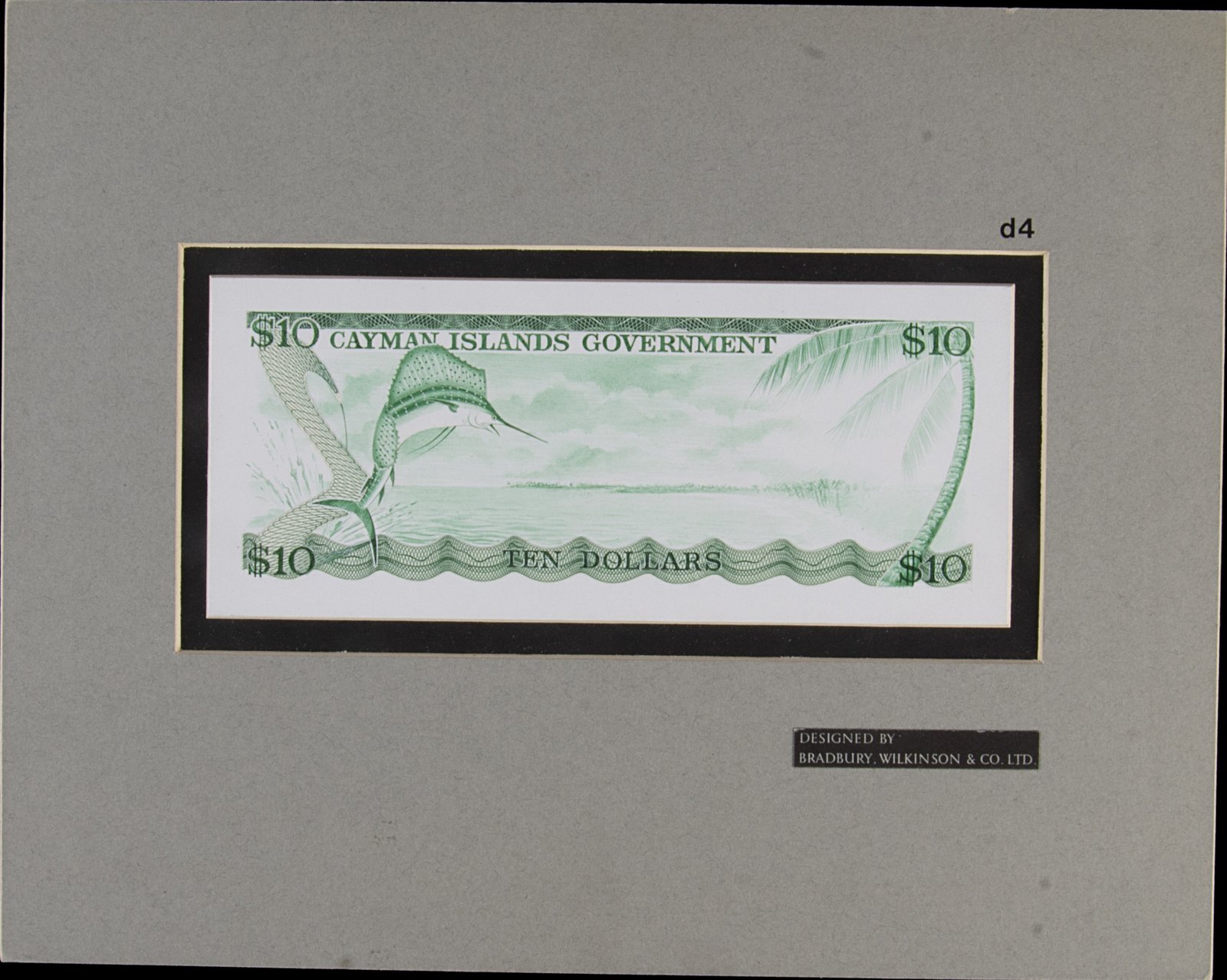
A ten dollars headed "Cayman Islands Government". Stack's Bowers, 8 May 2025, lot 50080, was a printer's model for the back of a ten dollars under that title. The house's description says no notes were ever issued in that name, likens the design to Bahamas notes of the 1960s and 1970s, and supposes that the model was made by Bradbury before the first series. That is the house's reading and no document is cited for it. The same description puts the first series into circulation in 1971; the note pages, and the Monetary Authority's own account, give 1st May 1972.
Sources
- Bank Note Reporter, March 1987, August 1992 and July 2003.
- Stack's Bowers: 14 August 2013, lot 10118; 8 May 2025, lot 50080; 29 August 2025, lot 30126; 9 September 2025, lot 72192; 20 January 2026, lot 32270.
- Spink: 26 April 2017, lot 1034; 4 October 2018, lots 1381 and 1387; 17 April 2019, lot 358; 7 April 2020, lot 871; 12 April 2021, lot 1100.
- Heritage Auctions: 6 September 2018, lot 26317; 25 April 2019, lot 28653; 9 September 2019, lot 28797; 23 March 2023, lot 24186; 8 December 2023, lot 22706.
- London Coins, Auction 173, 6 June 2021, lot 117.
- Lyn Knight, September 2021, lot 94167, as quoted on the note page of the 1996 ten dollars.
- Cayman Islands Monetary Authority, annual reports for 1997 and 2019.
- Cayman Islands Monetary Authority, web page "Currency" (address above).
- The note pages of the Cayman Islands in this catalogue.


Member comments
Log in or register to post a comment.