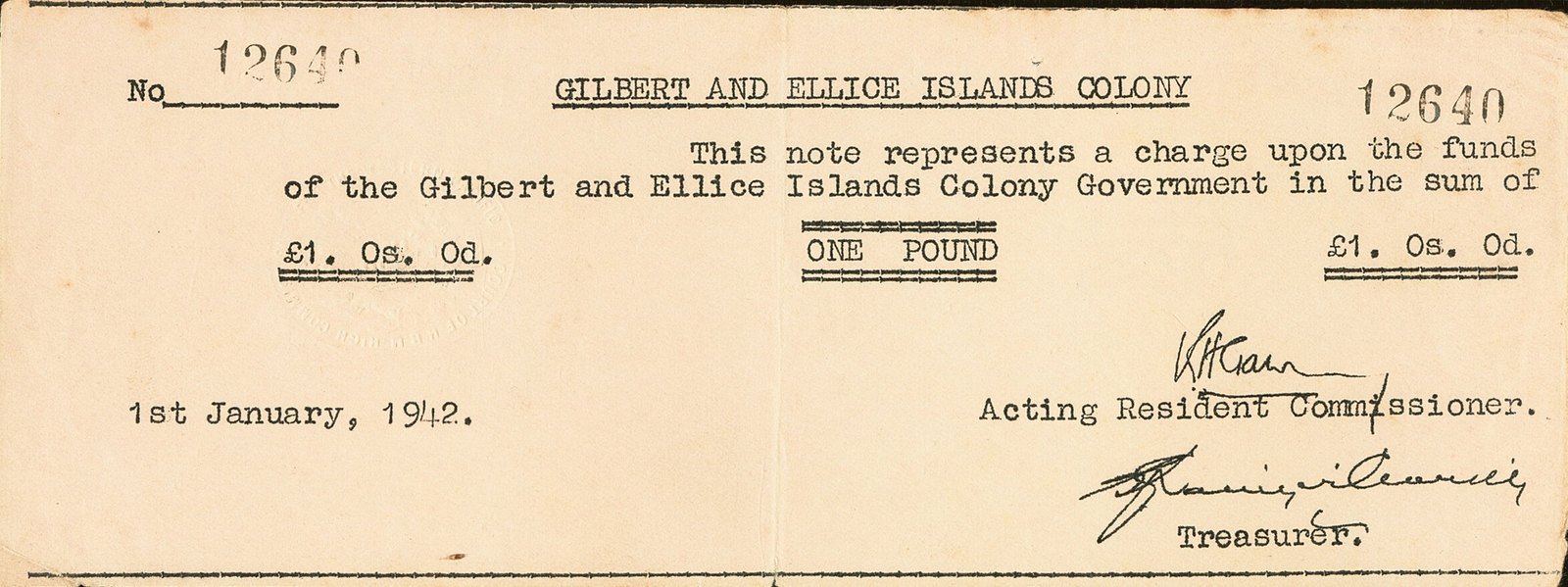
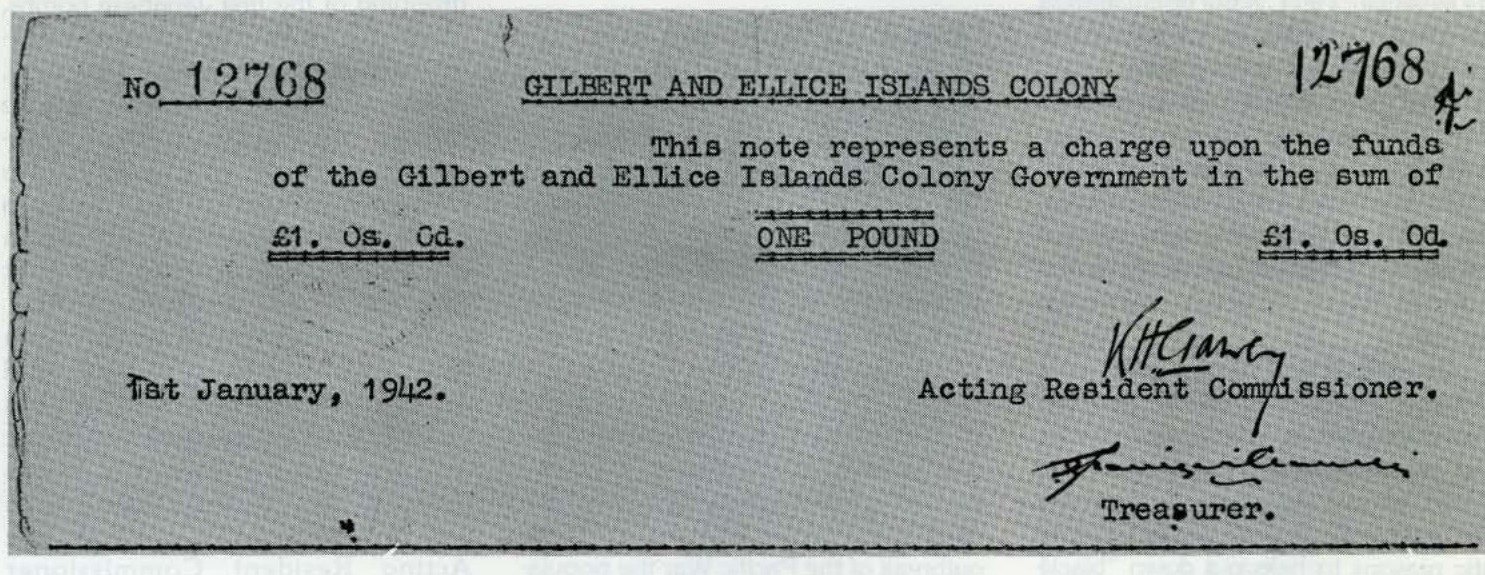
The Gilbert and Ellice Islands Colony has four notes in this catalogue, all dated 1st January 1942 and all made on Ocean Island on an office duplicator. This article puts together what is told of them by the report of the Acting Resident Commissioner, R. H. Garvey, as printed in the International Bank Note Society Journal in 1989, by Kerry Rodgers in Bank Note Reporter in November 2005, by the Colonial Office's own reports, and by the houses that have sold the notes.
Money in the Colony before 1942
The Colony had no notes of its own before these. The annual report for 1928-29 (Colonial Reports, Annual, No. 1500, paragraph 11) says that taxes, duties, fees, fines and wages were payable in British coin, but that the currency commonly used was Australian. The same report says that postal orders of 6d. to £1 were issued from Ocean Island only and cashed throughout the Colony, that an agency of the Commonwealth Bank of Australia (Savings Bank Branch) stood on Ocean Island, and that there were no banks in the Gilbert and Ellice groups. The report for 1930-31 (No. 1621) again names no notes of the Colony and gives Australian currency as the money in use. The report on the Protectorate for 1910 (No. 734) says nothing of currency at all.
An Economic Survey of the Colonial Territories, 1951 (volume VI, page 260) says that Australian notes and coin were legal tender under the Currency Ordinance of 1937, and gives the currency in circulation at the end of 1951 as £156,187. It names no local issue.
Ocean Island in December 1941
Kerry Rodgers and Fred Schwan, in "Gilbert and Ellice Islands Emergency Currency of World War II" (International Bank Note Society Journal, volume 28, No. 3 and 4, 1989, pages 79 to 81), write that Ocean Island had been added to the Colony in 1900 and was the second most important phosphate mine in the Pacific after Nauru. They give its population at the outbreak of the Pacific war as 134 Europeans, 880 Chinese, and 1,700 Polynesian and Micronesian labourers and Banabans.
By their account the news of Pearl Harbour reached the island on 8th December 1941, and a Japanese flying boat bombed it the same day. Partial rationing had been in force since October, when the last ship had called. Three flying boats attacked on 9th December. On the news that the Japanese had landed at Tarawa, the Acting Resident Commissioner had the secret documents destroyed and the phosphate plant demolished.
The issue of the notes
The two authors print Section IV of Garvey's report to the High Commissioner for the Western Pacific word for word. Paragraph 44 says that a shortage of currency developed on Ocean Island in the later part of December, that the half-yearly payment of the Banaban annuities fell due at the end of the month and needed a sum running into £3,000, and that £5,000 in notes was therefore struck off on the office duplicator as a local token currency. Rodgers adds in Bank Note Reporter of November 2005 that the notes were used to pay all annuities and wages.
Paragraph 46 of the report says that the Chinese were the only part of the community to refuse the notes, until they were told that there was no other money in which they could be paid.
The Pick pages give the signers as Garvey and Clarke. Garvey signed as Acting Resident Commissioner. Rodgers and Schwan wrote in 1989 that the Treasurer had not been identified among the officials known to have been on Ocean Island, and Rodgers in 2005 still called the second signer an unidentified Treasurer. Garvey's record of services in the Colonial Office List for 1948 names no post in the Colony at all: it shows Garvey as assistant British Resident Commissioner in the New Hebrides in 1940 and as a district officer in Nyasaland in 1942.
What the notes look like
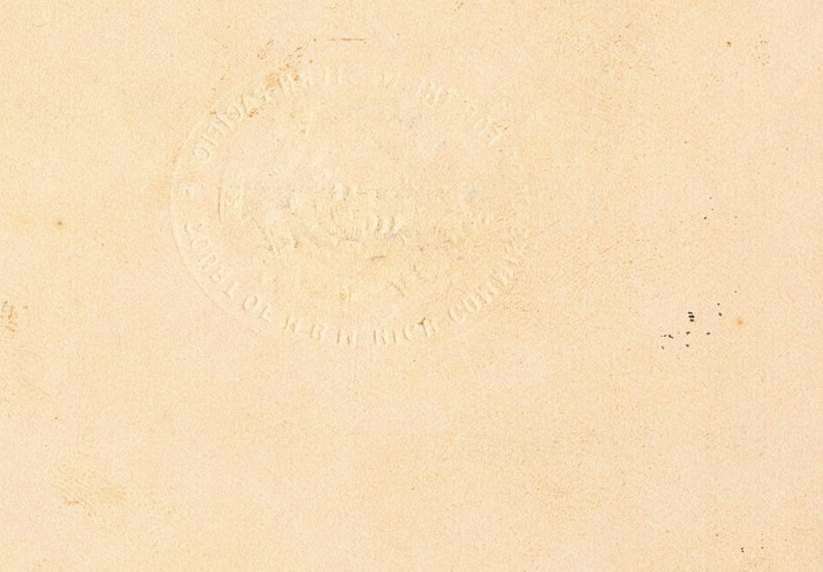
The four notes are the 1 shilling, the 2 shillings, the 10 shillings and the 1 pound. All are mimeographed in black on hand-cut coloured paper, uniface, 207 x 75 mm, with the embossed seal COURT OF H.B.M. HIGH COMMISSIONER FOR THE WESTERN PACIFIC at left. Bank Note Reporter of October 1983 gives the wording, the same on every value but for the sum:
The Pick pages give white paper for the 1 shilling, yellow for the 10 shillings and pink for the 1 pound. Rodgers in 2005 gives off-white or buff for the 1 shilling, pale green for the 2 shillings, very pale parchment yellow for the 10 shillings and pale pink for the 1 pound, calls the paper standard duplicator paper, and says no watermark has been identified.
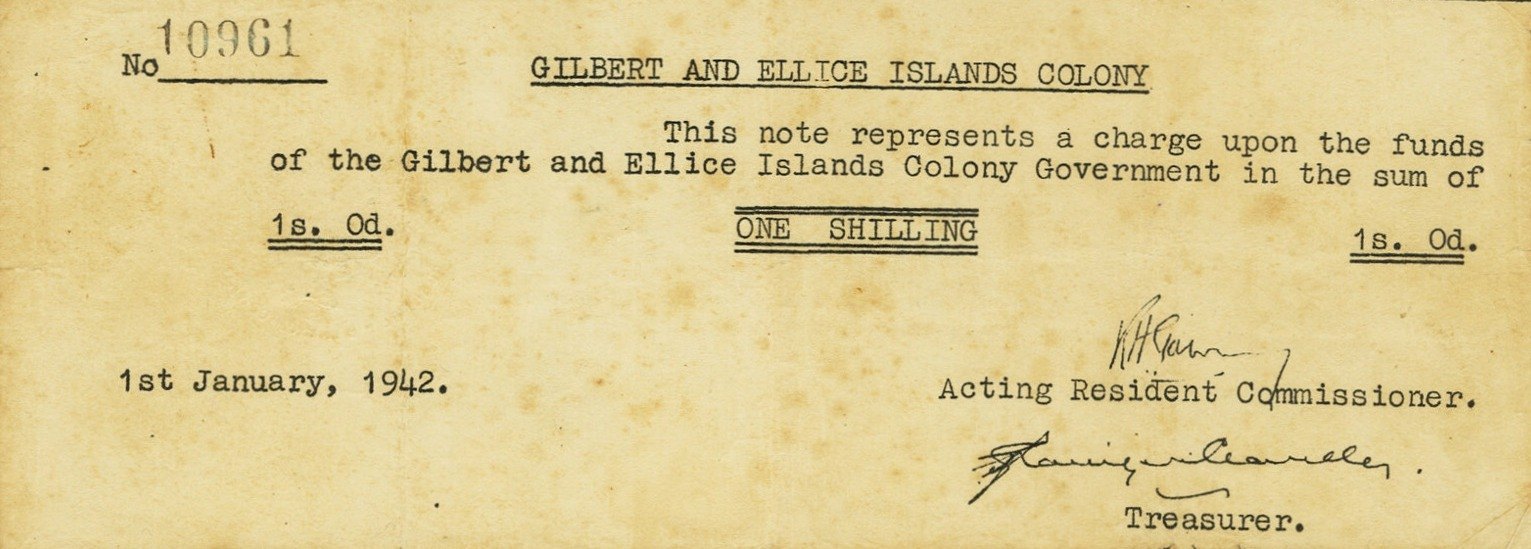
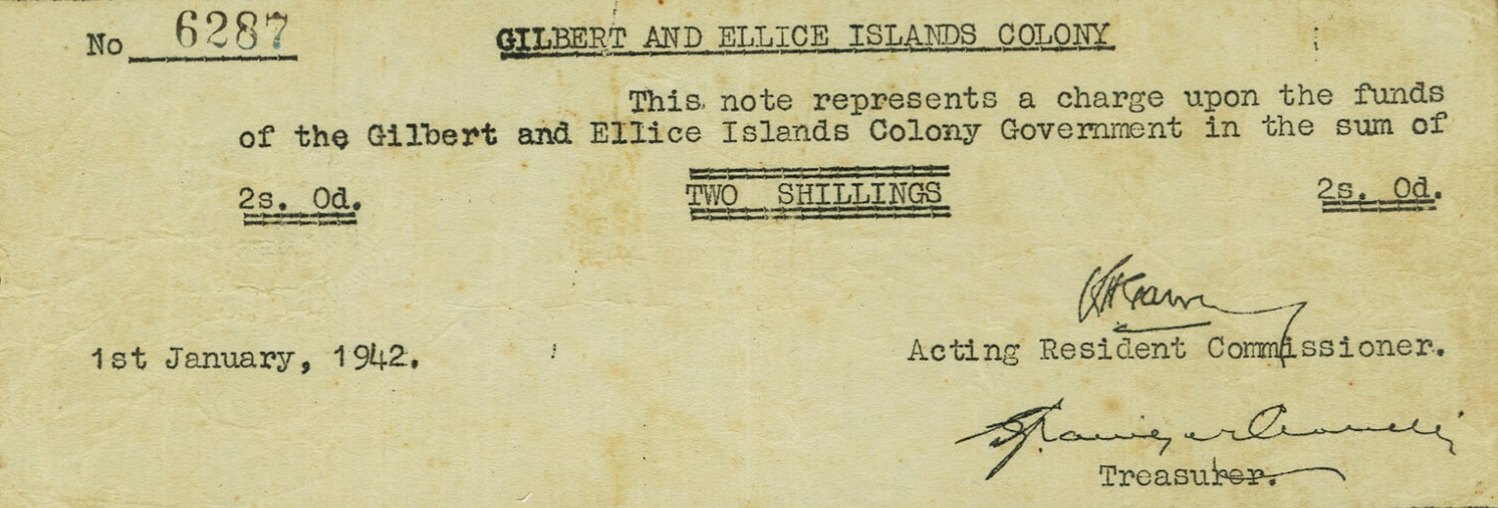
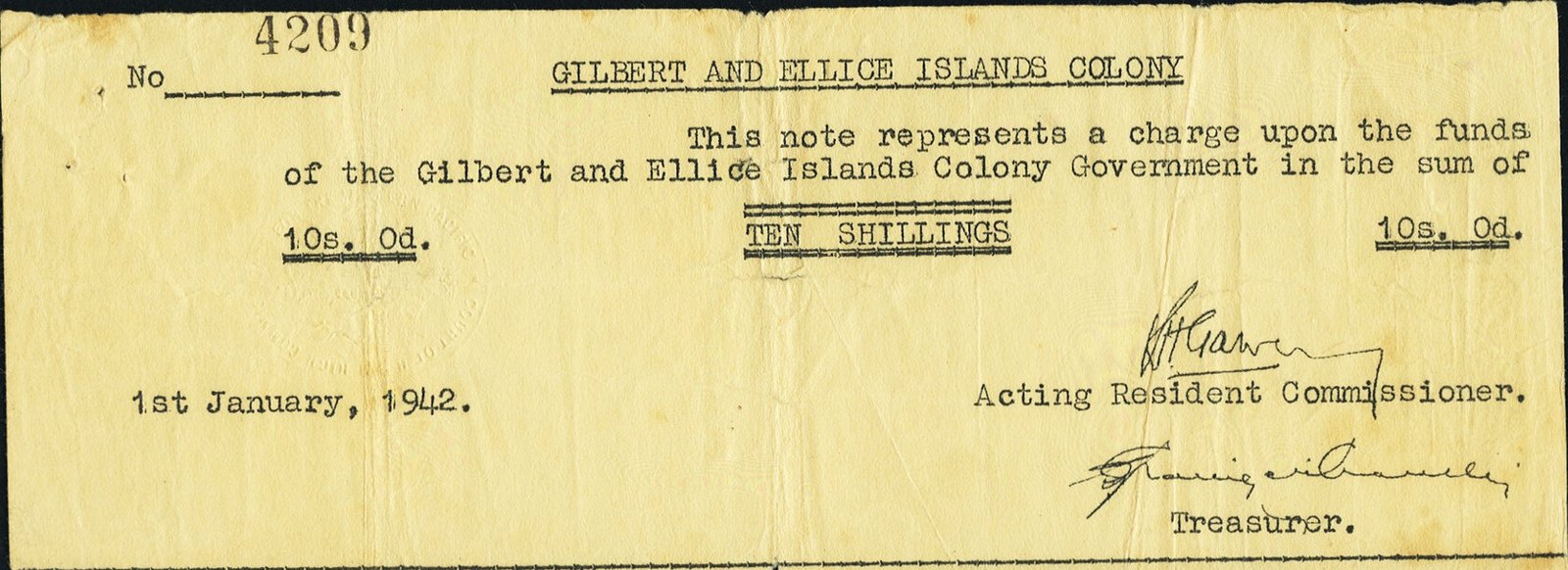
On the numbering Rodgers says that a standard mechanical office handstamp was used, that the three lower values carry one number at the top left, that the 1 pound is usually numbered in both upper corners, and that one 1 pound exists with a handwritten number at the upper right, initialled by the Treasurer.
Rodgers also says that the Standard Catalog of World Paper Money gave the seal wrongly as "H.R.H.". Lyn Knight's descriptions of 31 March 2005 (lot 1) and 9 June 2011 (lot 239) read the seal that way. Heritage's description of lot 28624 in its sale of 10 January 2019 reads it as H.B.M.
Which values were made
The sources do not agree. Garvey's report names the 1 pound, the 10 shillings and the 2 shillings, and not the 1 shilling. Frank Pasefika, Sub-Accountant in the Ellice Islands from late 1941, told Rodgers and Schwan in an interview in August 1986, confirmed in writing in June 1989, that the values were 1 shilling, 10 shillings and 1 pound. The catalogue the two authors quote, the fifth edition of the Standard Catalog of World Paper Money, listed five values, a 5 shillings among them, with the 2, 5 and 10 shillings as reported and not confirmed. The authors knew of no evidence for a 5 shillings and of no 10 shillings.
Rodgers wrote in 2005 that no 5 shillings was ever produced and that the catalogue's P-3 was spurious. All four of the other values are now on record: the complete set sold in Brisbane in September 2005 held one of each.
Redemption and recall
Paragraph 45 of Garvey's report tells how the notes were paid off. When the stores on Ocean Island had gathered notes, they handed them to the Treasury against a telegraphic remittance from the Colony's bankers in Sydney to the stores' accounts in Australia. When the Europeans and Chinese were evacuated, every note they held was recalled into the Treasury for cash or Treasury receipts. By arrangement with the British Phosphate Commissioners the receipts were to be paid on arrival in Australia, and the Colony Government was to repay the Commissioners. The report gives the reason: it was thought unwise to let the notes leave Ocean Island, because they could have been counterfeited without difficulty. Rodgers adds in 2005 that the recalled notes were then destroyed.
The evacuation took place on 28th February 1942. Rodgers and Schwan name the ship as the Free French destroyer Le Triomphant, under Capitaine de Vaisseau P. Auboyneau. Rodgers names the same ship in Bank Note Reporter of November 2005.
The Pick pages say the notes circulated on the island. Sources also mention that some passed briefly on Funafuti in the Ellice Islands, and that none were left in use when American forces arrived in October 1942. That rests on the memory of Frank Pasefika, as Rodgers and Schwan report it in the International Bank Note Society Journal in 1989 and Rodgers again in Bank Note Reporter of November 2005.
The note attached to the report
Garvey attached to the report one note still held on leaving the island. Rodgers and Schwan identify it as a 1 pound, number 1602. Sources mention that the original report, in the National Archives of Kiribati, still had the note attached in 1989, with a copy of the report in the National Archives of Tuvalu. The Pick page of the 1 pound dates the report to April 1942 and says that the copy kept in the colony's archive has the note typed out.
How many survive, as each source puts it
- Rodgers and Schwan, 1989: three notes known to the authors in private collections. Bill Christensen and Ruth Hill supplied the pictures.
- The book World War II Remembered by Schwan and Boling (1995), as the houses quote it. Lyn Knight (31 March 2005, lot 1) says it listed four 1 pound notes, one of them in the National Archives of Kiribati. Lyn Knight (9 June 2011, lot 239) says its 1 shilling, number 8243, was the only one in the book, and knew of one more found since. Stack's Bowers (6 September 2026, lot 31194) says the book listed the 10 shillings as unreported, and that two have come to light in the last decade.
- Rodgers, November 2005: at least five 1 pound notes, and only one 1 shilling in private hands before the set appeared. No museum or archive held all four values.
- The set of four was sold as one lot by Roxbury's Auction House, Brisbane, on 24 September 2005, to an Australian bidding by telephone. Bank Note Reporter of February 2017 reports a set of four sold by Heritage on 5 January 2017 (lot 27459). Heritage's description says three of the four are the notes pictured in the Standard Catalog of World Paper Money.
- Heritage (16 October 2025, lot 24187) says that three 1 pound notes stood in the PMG population report at the time.
- Heritage (24 April 2014, lot 21454) sold a 1 pound from the Ruth W. Hill Collection. The handwritten inventory of that collection, scanned for the Newman Numismatic Portal, lists one note of the Colony, a 1 pound.
Where the houses differ from the report
Stack's Bowers (6 September 2026, lot 31194) and Heritage (16 October 2025, lot 24187) say the notes were made to pay the workers of the Pacific Phosphate Company; Stack's Bowers adds the annuity payments to the local inhabitants. Garvey's report gives the Banaban annuities as the cause and names the British Phosphate Commissioners. Lyn Knight's two descriptions, quoting World War II Remembered, say the labourers were evacuated to Australia and given credit in Sydney. The report speaks of the Europeans and Chinese. Heritage's description of the set (5 January 2017, lot 27459) calls the notes typewritten on what looks like notebook paper. The report and Rodgers say they were run off on a duplicator.
Sources
- R. H. Garvey, report to the High Commissioner for the Western Pacific on the defence, evacuation and capture of Ocean Island, 1942, Section IV, as printed by Rodgers and Schwan.
- Kerry Rodgers and Fred Schwan, "Gilbert and Ellice Islands Emergency Currency of World War II", International Bank Note Society Journal, volume 28, No. 3 and 4, 1989, pages 79 to 81.
- Kerry Rodgers, "World War II rarities auctioned in Brisbane", Bank Note Reporter, November 2005.
- Bank Note Reporter, October 1983 and February 2017.
- Colonial Reports, Annual: No. 734 (Gilbert and Ellice Islands Protectorate, 1910), No. 1500 (Colony, 1928-29), No. 1621 (Colony, 1930-31).
- An Economic Survey of the Colonial Territories, 1951, volume VI, page 260.
- The Colonial Office List for 1948, record of services of R. H. Garvey.
- Ruth W. Hill, handwritten collection inventory, Newman Numismatic Portal.
- House descriptions: Lyn Knight, 31 March 2005, lot 1, and 9 June 2011, lot 239; Heritage Auctions, 24 April 2014, lot 21454, 5 January 2017, lot 27459, 10 January 2019, lot 28624, and 16 October 2025, lot 24187; Stack's Bowers, 6 September 2026, lot 31194.
- The Pick pages of the four notes.
Member comments
Log in or register to post a comment.