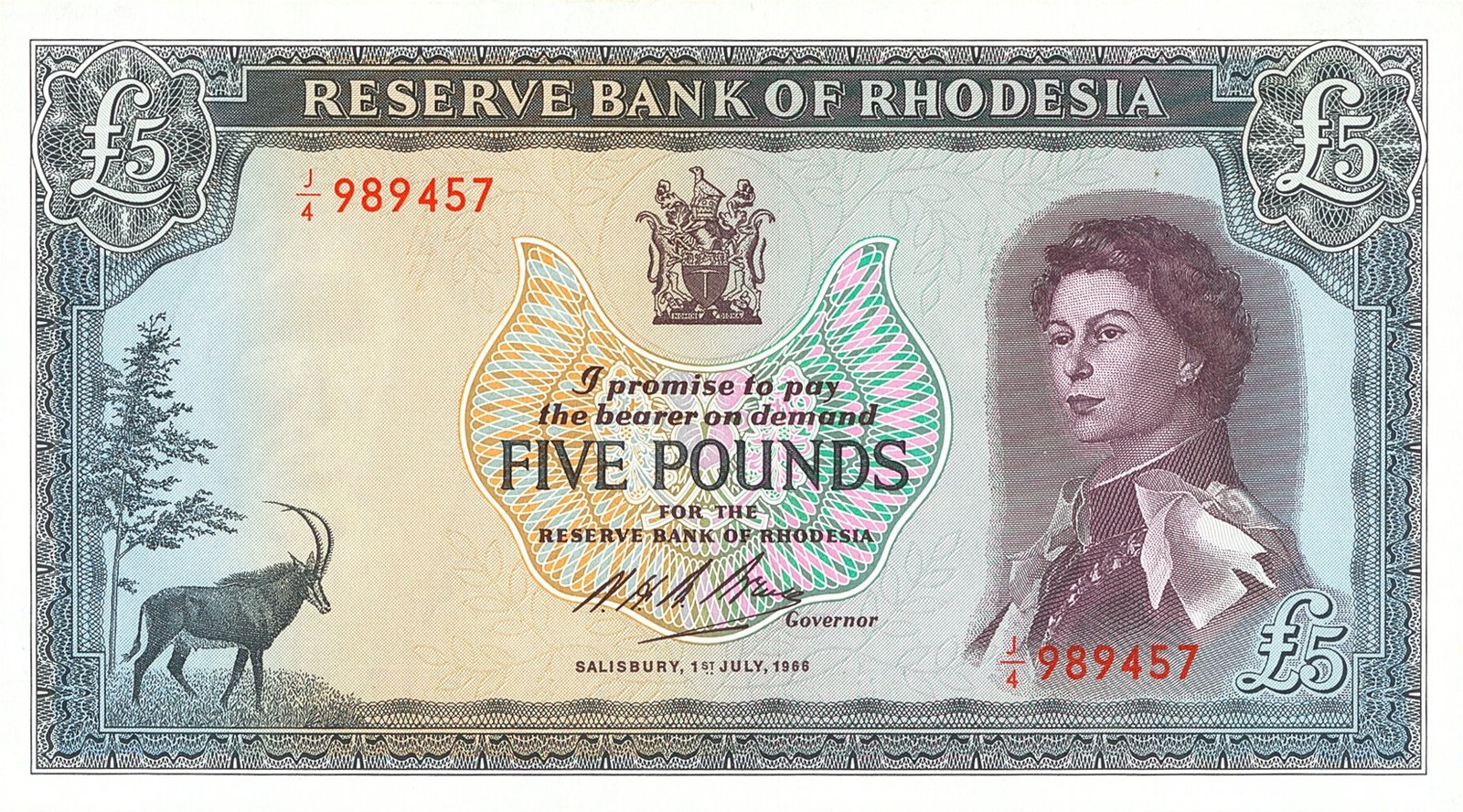
The gazettes, annual reports, Hansard, one thesis and one journal article have been read for the notes of Southern Rhodesia and Rhodesia. They settled a good deal, and they left nine points open. This article sets each one out: what each source says, what the Pick page says, and where the answer would be found. Nothing here is decided. A paper that has not been read is named as a place to look and no more.
1. When were the Reserve Bank's pound notes called in?
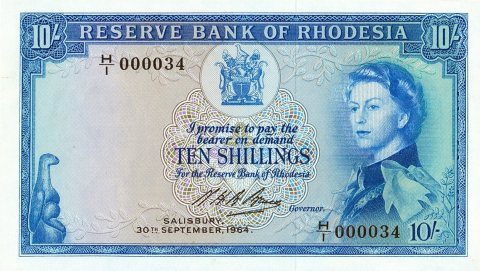
This is the largest gap. Under section 12 (2) of the Reserve Bank of Rhodesia Act 1964 the notes were legal tender until the Governor of Southern Rhodesia should "by notice in the Gazette, call in and demonetize" them. Decimal day was 17th February 1970 (Rhodesia Proclamation No. 26 of 1968). The Gazette prints no such notice from 1964 to the end of 1973: the index entries under the Reserve Bank of Rhodesia Act and the Decimal Currency Act for 1970 to 1973 hold only the demonetisation of the penny and halfpenny coins (Rhodesia Government Notice No. 742 of 1972).
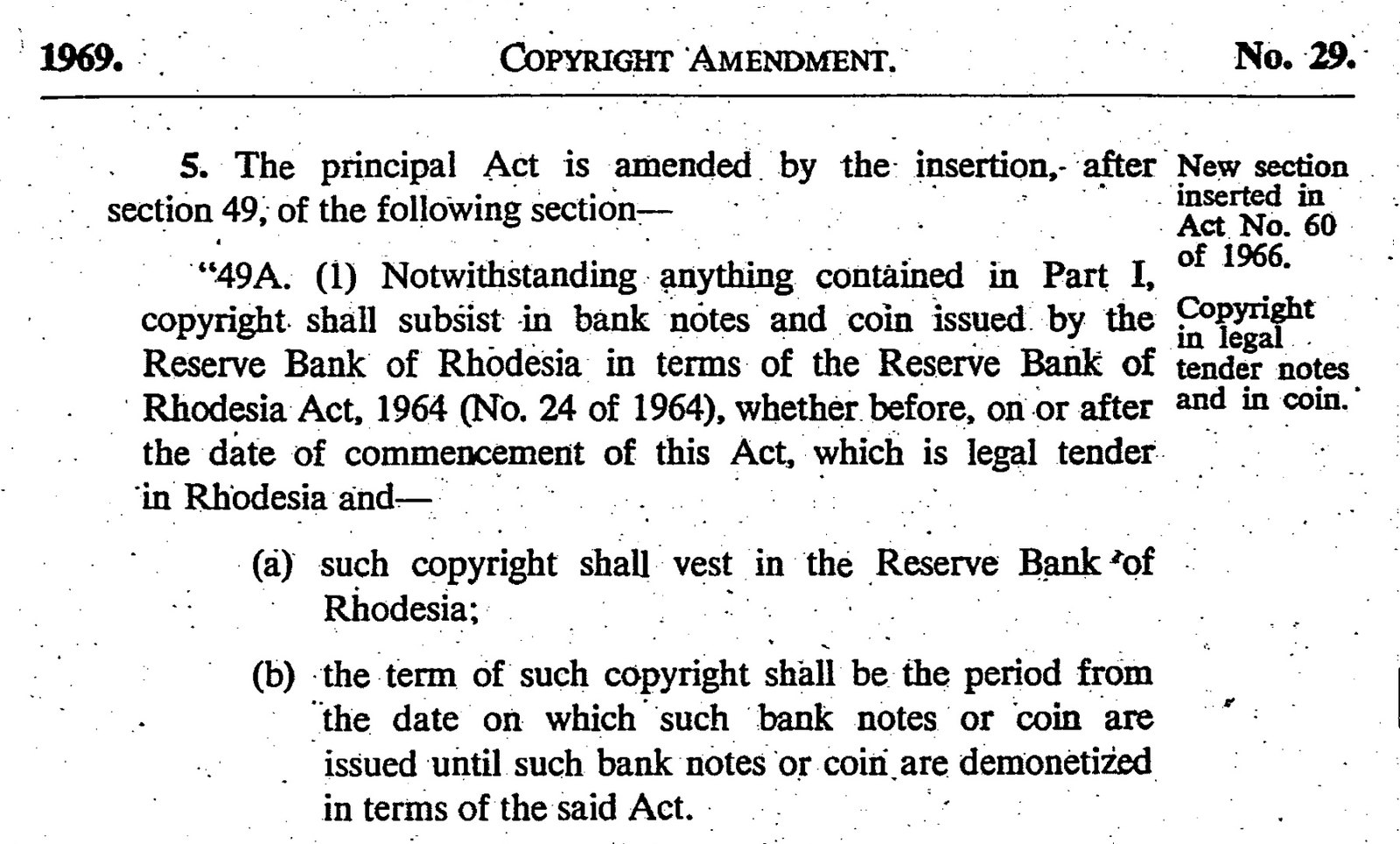
Two other papers bear on it without settling it. The Copyright Amendment Act 1969 speaks of the Bank's notes "until such bank notes or coin are demonetized". The Governor's press statement of 19th July 1967, quoted by Steve Milner (I.B.N.S. Journal, vol. 52 no. 2, 2013, pp. 44-45), said of the 1964 notes: "It is not the intention to take any special steps to withdraw notes of the existing issues from circulation". Tinashe Nyamunda's thesis Financing Rebellion (University of the Free State, 2015) does not mention the pound notes after 1970.
The Pick pages of the 10 shillings, 1 pound and 5 pounds of 1964 and of the Salisbury 10 shillings, 1 pound and 5 pounds give no day.
Where the answer would be: the Rhodesia Government Gazette of 1974 to 1980, which has not been read.
2. The first issue of 1964: the 15th or the 16th of November?
| Source | Day |
|---|---|
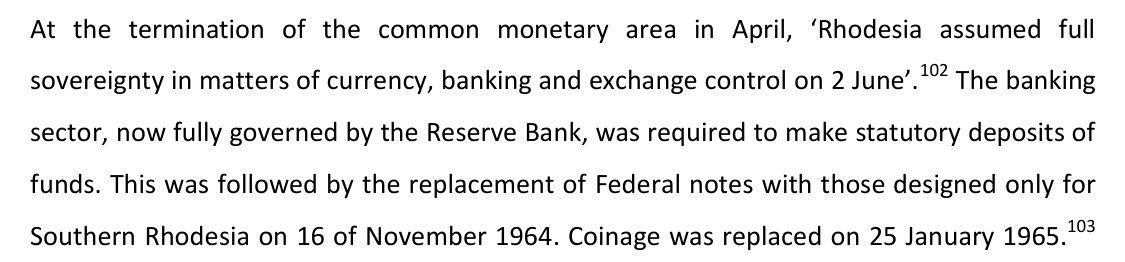
| The Treasury's statement in the Gazette of 4th June 1965, Rhodesia Notice No. 812 of 1965, p. 682 | "From 16th November, 1964, the Reserve Bank of Rhodesia issued its own notes" |
| The Minister of Finance's Budget statement of 1st July 1965, p. 6, as cited by Nyamunda, p. 79 | 16th November 1964 |
| The Pick pages | 16th November 1964 from the Gazette, and "sources mention 15 November 1964" |
The note sections of the Act came into operation on Friday, 13th November 1964 (Southern Rhodesia Proclamation No. 41 of 1964). The 15th was a Sunday and the 16th a Monday. No notice of the issue itself was printed in the Gazettes of 13th, 20th or 27th November 1964. Nothing found so far supports the 15th.

A related difference: Milner (p. 41) says Bruce was appointed Governor on February 21, 1964. Southern Rhodesia Notice No. 799 of 1964, in the Gazette of 22nd May 1964 (p. 648), makes the appointment on the day the Act came into operation, 22nd May 1964.
3. Was the 5 shillings issued a year after its date?
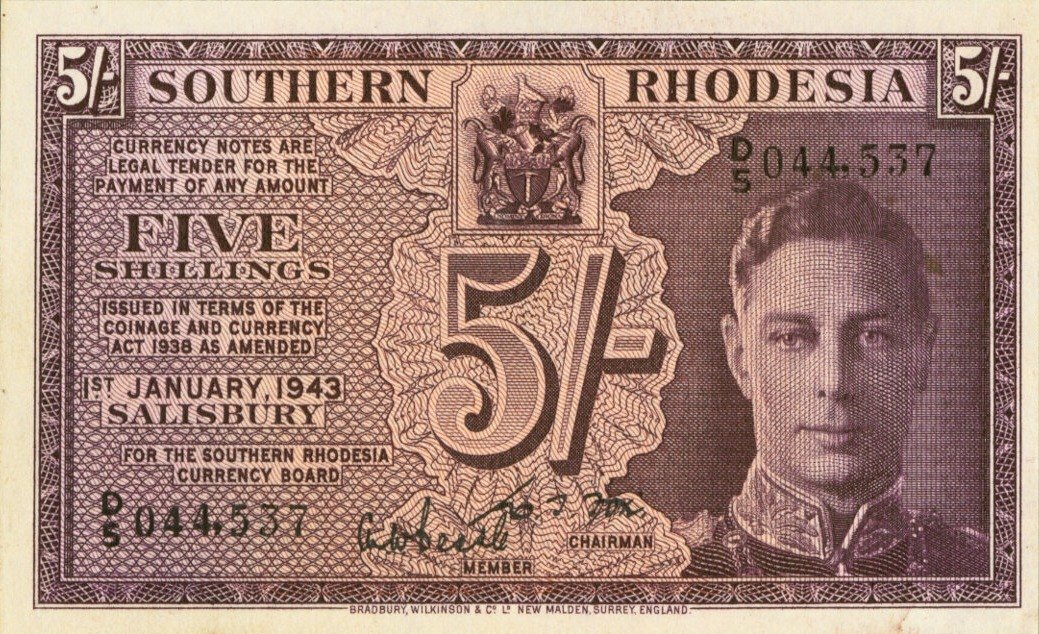
The first 5 shillings is dated 1st January 1943.
- The Coinage and Currency Amendment Act 1942 (No. 23 of 1942), which allowed the value, was promulgated on 4th December 1942.
- A notice of 7th December 1943 in the Nyasaland Government Gazette says the Board "has caused to be made currency notes for five shillings for the purpose of circulation in Southern Rhodesia, Northern Rhodesia and Nyasaland after 31st December, 1943".
- A working paper on currency board accounts by Krus and Schuler (Currency Board Financial Statements, 2014, p. 218), citing page 1 of the Southern Rhodesia Currency Board's annual report for 1944, says the Board began issuing 5 shilling notes on 1st January 1944, to reduce the demand for silver, especially half-crowns.
The notice and the working paper are consistent with each other, and neither is the Board's own record. The Pick page quotes the Gazette notice and gives no day of issue.
Where the answer would be: the Board's own annual report for 1944, which has not been seen.
4. The Bank of Rhodesia and Nyasaland's first issue: one witness
The Northern Rhodesia annual report for 1957 (p. 20) says: "On the 23rd April, 1957, however, the Bank of Rhodesia and Nyasaland commenced the issue of its own notes." The sentence is repeated every year to 1962. The first date on the notes is 3rd April 1956. The Nyasaland reports name the Bank's notes only from 1958.
The Federal Government Gazette issues of January 1956 to May 1957 that have been read hold no notice of the first issue. The thesis has no day. So 23rd April 1957 rests on the Northern Rhodesia reports alone. The Pick pages of the 10 shillings, 1 pound, 5 pounds and 10 pounds give it as the reports' statement.
Where the answer would be: the rest of the Federal Government Gazette, and the Bank's own annual reports for 1956 to 1963, which have not been found online.
5. When did Grafftey-Smith die, and when was Richards appointed?
The Bank's notes change signature in the second half of 1960: the last printing signed by A. P. Grafftey-Smith is dated 17th June 1960, and the first signed by B. C. J. Richards are dated from November 1960 to February 1961. R. A. Sowelem (Towards Financial Independence in a Developing Economy, 1967, p. 36, as cited by Nyamunda, p. 48) says Grafftey-Smith was Governor until death and was succeeded by Richards. The Nyasaland annual report for 1958 names Richards as Deputy Governor.
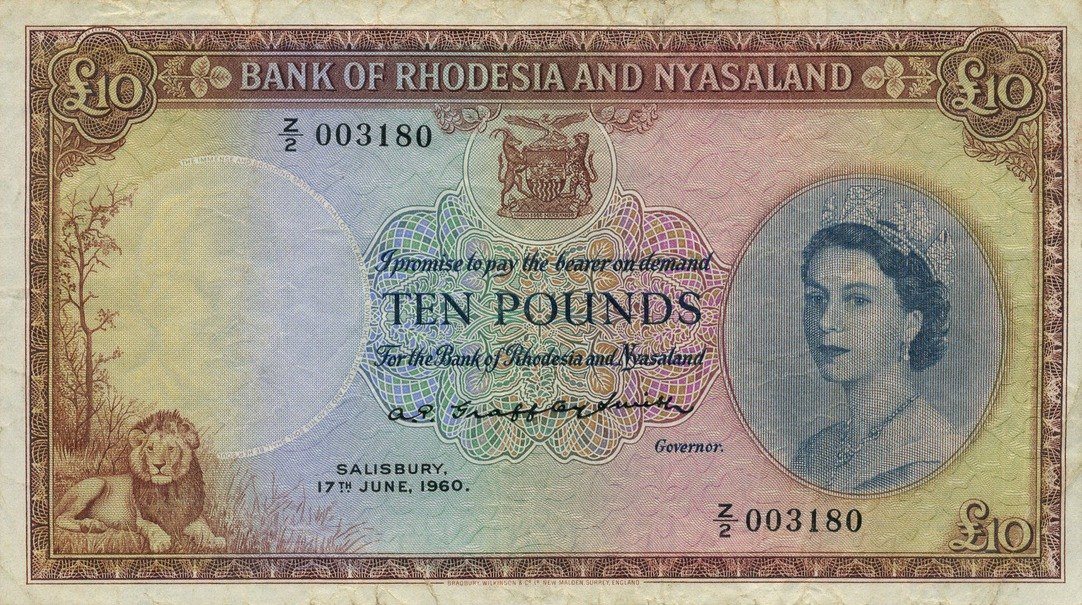
No source read gives a day for either event. The Southern Rhodesia Gazette of 1957 to 1963 names neither Governor. Sowelem's book itself has not been seen; its statements are known only through the thesis.
Where the answer would be: the Federal Government Gazette of 1960 and 1961.
6. The Currency Board's notes: on what does 1st June 1965 rest?
No notice in the Gazette of 1957 to 1973 names the Southern Rhodesia Currency Board or the Central Africa Currency Board. The end of legal tender for the Board's notes rests on two papers:
- Southern Rhodesia Government Notice No. 956 of 1963: "A tender of a note of the Currency Board or the Bank shall be legal tender in payment within the Territories of the amount expressed in the note until the 1st June, 1965, or such earlier date as the Committee of Ministers may fix."
- Rhodesia Notice No. 812 of 1965: the currency of the Federation was demonetized on 1st June 1965.
The regulation allowed an earlier date. None was gazetted in 1964 or 1965. The Pick pages give 1st June 1965, and 16th February 1968 as the day from which the Reserve Bank was no longer bound to pay (Rhodesia Government Notice No. 96 of 1968). The Dissolution Order in Council of 1963, a United Kingdom instrument, is not printed in the Gazette and has not been read.
At the other end of the Board's life, the Pick pages say its notes became legal tender in Nyasaland on 8 June 1940 and in Northern Rhodesia on 1 November 1940. No annual report is held for the war years, so neither day is confirmed or contradicted from that side.
7. The London notes: July or August 1966, and the matter of the signature
Two writers used the same Bank of England papers and differ.
| Point | Nyamunda, Financing Rebellion, 2015 | Milner, I.B.N.S. Journal, 2013 |
|---|---|---|
| When Bradbury Wilkinson was paid 64,337 pounds | August 1966 (p. 107) | July 1966 (p. 42) |
| Why the notes were held back | The Governor in Salisbury had not supplied a signature "for stamping" (pp. 106-107) | The printing had begun; the signature of Bruce still had to be added and the dates were awaited from Salisbury. The London board first let the printer go on "without signature or dates", and later agreed that the printing be completed with signatures and dates up to 1st December 1965 (p. 42) |
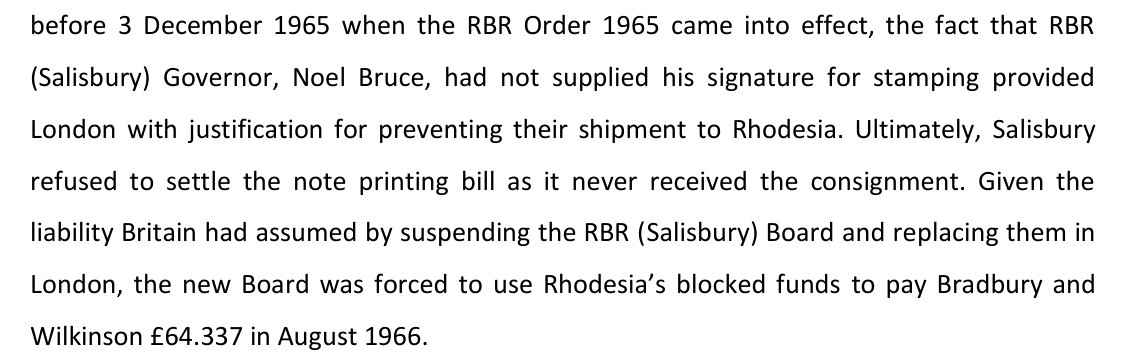
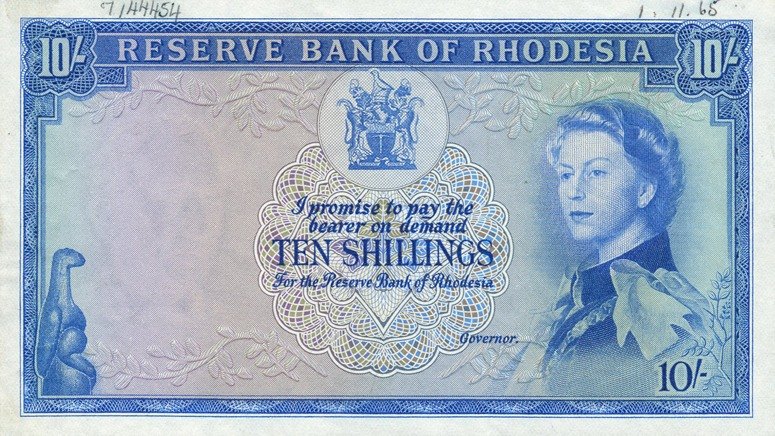
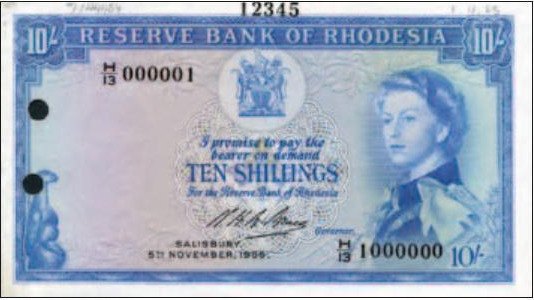
The range specimens of the 1965 printings on the Pick pages carry the signature of Bruce. A specimen of the 10 shillings with no serial number, no date and no signature is also recorded there; its page does not connect it with Milner's account.
Where the answer would be: Bank of England Archive file 8A96/1, "Reserve Bank of Rhodesia: Bradbury Wilkinson bank notes", 1966 to 1973. The Archive's catalogue entry says the printer was to be paid in full and that the notes bore the signature of Governor Bruce. The file itself has not been read.
8. How many notes were burned?
For the German order the numbers finished and partly printed are known from Milner (p. 44) and are on the Pick pages. For the London order the sources give the order (8 million of 10 shillings, 11 million of 1 pound and 1 million of 5 pounds) and say that 210 boxes went to the Bank of England in 1967 (Milner, p. 42), but no count of the notes burned at Debden from 18th to 26th June 1973.
One figure differs by a digit. The text of Milner's article as scanned reads 8,673,000 notes of 10 shillings with the numbers L/1 000,001 to L/9 675,000; the Pick page has 8,675,000.
Where the answer would be: Bank of England Archive files 8A96/1 and 8A70/1. The catalogue entry for 8A70/1, on the notes printed in Germany, lists "official signed destruction records". Neither file has been read.
9. Smaller points
- Nyasaland's bank notes. That all notes other than the Board's ceased to be legal tender in Nyasaland from 1st March 1942 rests on An Economic Survey of the Colonial Territories, 1951, written ten years later. The Nyasaland Gazettes of 1941 and 1942 that are held do not show the measure. The Southern Rhodesia Official Year Book for 1952 (p. 632) gives the same day for the Currency Board taking over the banks' outstanding notes.
- A figure in the Nyasaland report for 1946. It gives 6,648,841 pounds "in circulation" at the end of 1946, far above the 1,710,882 pounds given for Nyasaland a year later, and does not say what it counts.
- The court order of 1961. The Gazette of 14th April 1961 (p. 350) prints a High Court order on bank notes to the value of 995 pounds, an exhibit in Regina versus Manuel de Rodrigues. Nothing more is known of the case. The Rhodesia and Nyasaland Law Reports for 1961, and The Chronicle and The Rhodesia Herald of April 1961, are where it would be.
- The press for the Salisbury notes. Ken Flower's account of a press flown in on a disguised aircraft is known only as quoted by Nyamunda (p. 128) from Serving Secretly (1987, p. 72). Milner (p. 44) quotes Klaus Bender's Moneymakers (2006) for another account: two used presses sold through a South African company. Neither book has been seen.
The figures and notices behind these points are set out in Notes in circulation week by week, Paper money in Northern Rhodesia and Nyasaland, 1931 to 1962 and The laws and Gazette notices behind the notes.
Sources
- Reserve Bank of Rhodesia Act 1964 (No. 24 of 1964), section 12; Southern Rhodesia Proclamation No. 41 of 1964; Southern Rhodesia Notice No. 799 of 1964; Southern Rhodesia Government Notice No. 956 of 1963.
- Rhodesia Notice No. 812 of 1965 (Gazette of 4th June 1965, p. 682); Rhodesia Government Notice No. 96 of 1968; Rhodesia Proclamation No. 26 of 1968; Copyright Amendment Act 1969 (No. 29 of 1969); Rhodesia Government Notice No. 742 of 1972; the indexes of the Rhodesia Government Gazette for 1970 to 1973.
- High Court order in the Gazette of 14th April 1961, p. 350.
- Coinage and Currency Amendment Act 1942 (No. 23 of 1942); Nyasaland Government Gazette, notice of 7th December 1943.
- Krus and Schuler, Currency Board Financial Statements, working paper, 2014, p. 218, citing the Southern Rhodesia Currency Board's annual report for 1944.
- Annual reports on Northern Rhodesia for 1957 to 1962; annual reports on Nyasaland for 1946, 1947 and 1958; An Economic Survey of the Colonial Territories, 1951; Southern Rhodesia Official Year Book, 1952, p. 632.
- Federal Government Gazette, issues of January 1956 to May 1957.
- Tinashe Nyamunda, Financing Rebellion: The Rhodesian State, Financial Policy and Exchange Control, 1962-1979, thesis, University of the Free State, 2015, pp. 48, 79, 106-107 and 128, citing R. A. Sowelem (1967), Ken Flower (1987) and the Budget statement of 1st July 1965.
- Steve Milner, "A Tale of Three Cities: the Story of Rhodesian Banknotes from 1965 to 1967", I.B.N.S. Journal, vol. 52 no. 2, 2013, pp. 41-45.
- Bank of England Archive, catalogue entries for files 8A96/1 and 8A70/1.
Member comments
Log in or register to post a comment.