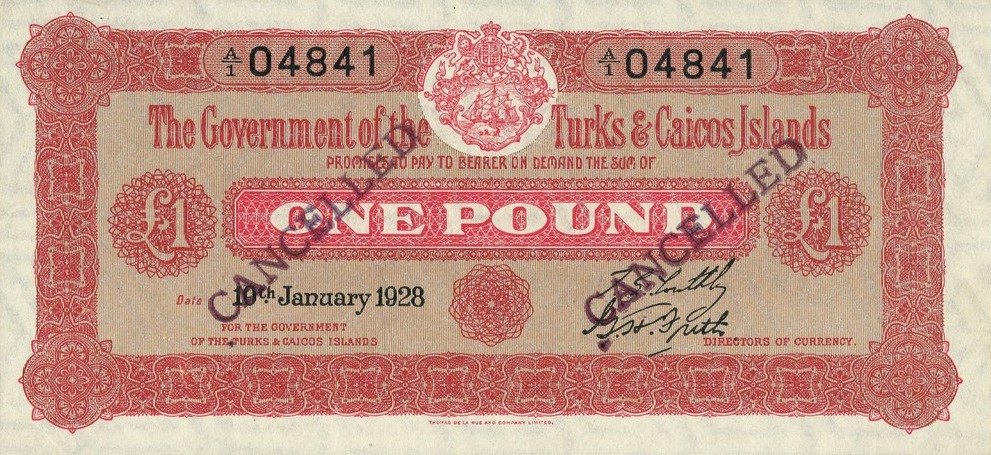
The Government of the Turks and Caicos Islands put out notes of 5 shillings, 10 shillings and 1 pound, printed by Thomas de la Rue and Company and dated from 1903 to 1928. This article sets out the three types of note, the men who signed them and the offices they held, the amounts in circulation as the annual reports give them, and the Jamaica notes that came after. It also says plainly what the official papers read so far leave out.
Three types of note
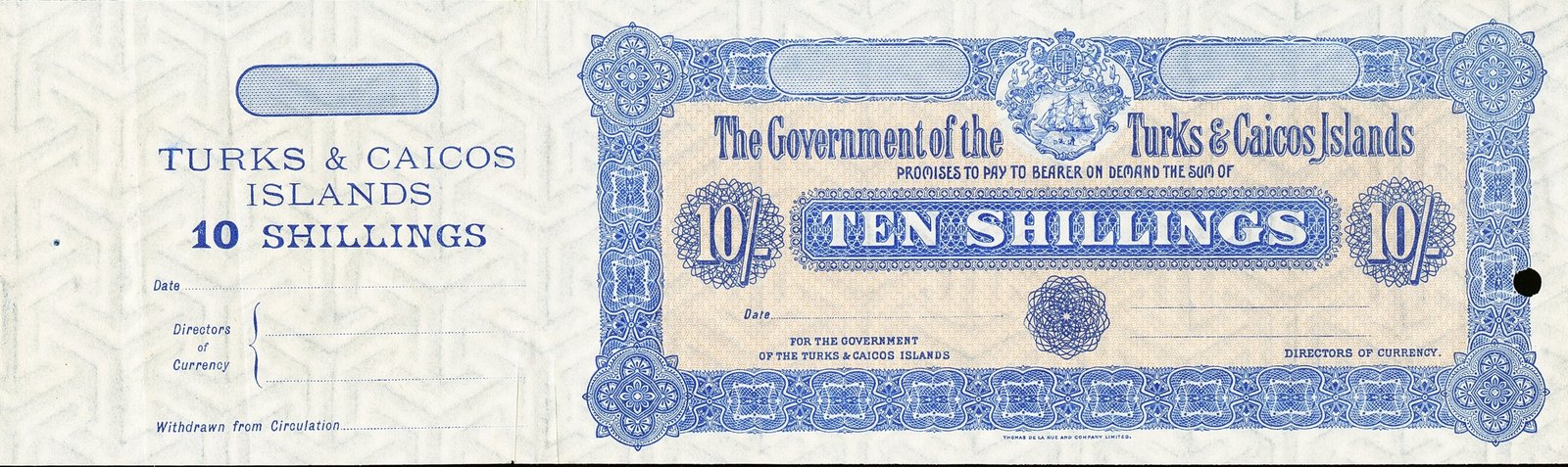
The first type was made to be dated and signed by hand. The face has blank dotted lines for the date and the two signatures, and a pale interlocking pattern lies across the sheet. A counterfoil at the left has dotted lines for Date, Directors of Currency and Withdrawn from Circulation. De La Rue's records suggest that the notes were bound in booklets of 100, which would give an issued note a perforated left edge. All notes of this type are uniface.
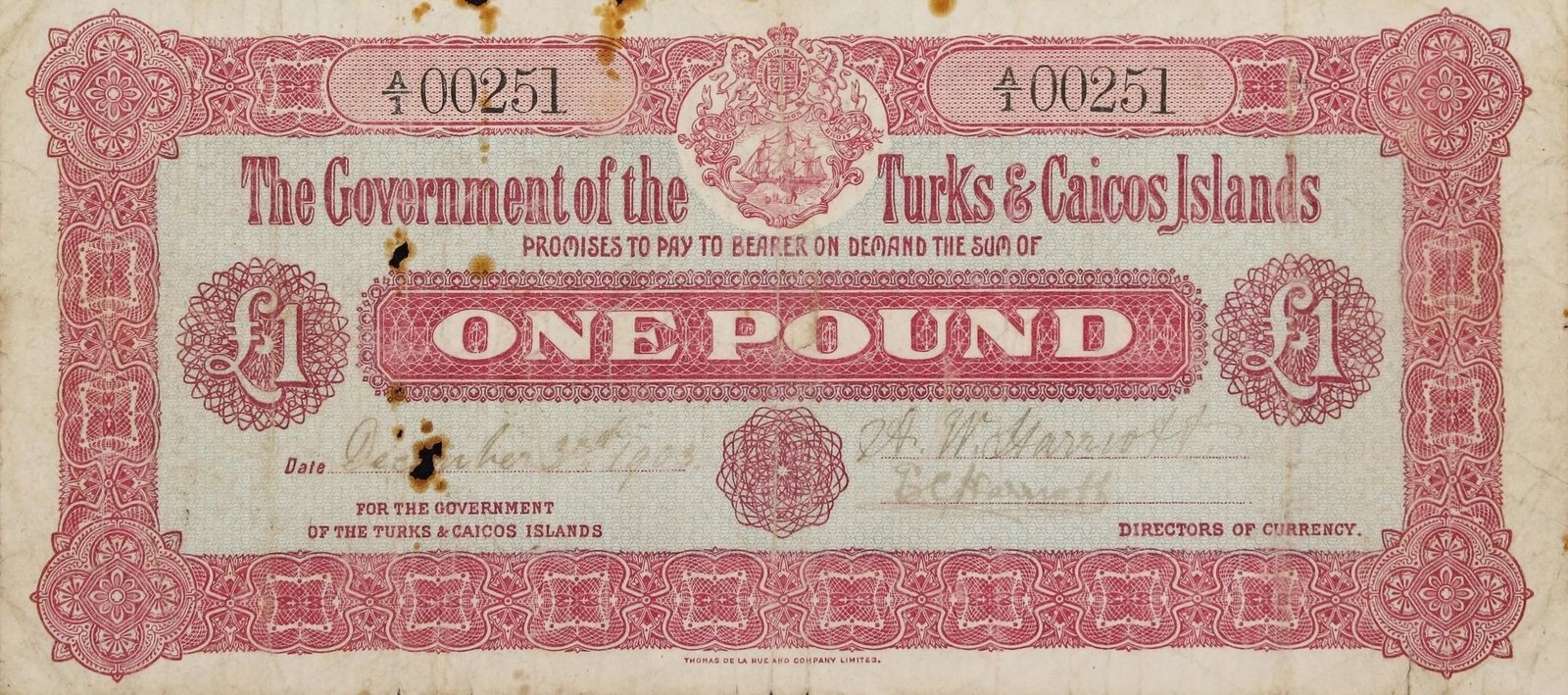
The 1 pound of this type is dated 3rd December 1903 on the note recorded, and numbers A/1 00001 to A/1 02055 were printed. The 5 shillings of the first type was printed on 7 July 1910, numbers A/1 00001 to A/1 01200. No note, specimen or proof of it has been seen. The 10 shillings of the first type is known only as colour trials. Sources mention an issued 10 shillings of this type, of 1903, but none is confirmed.
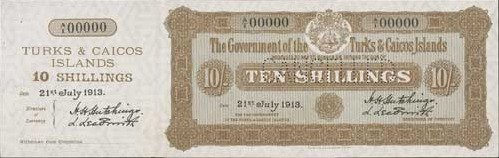
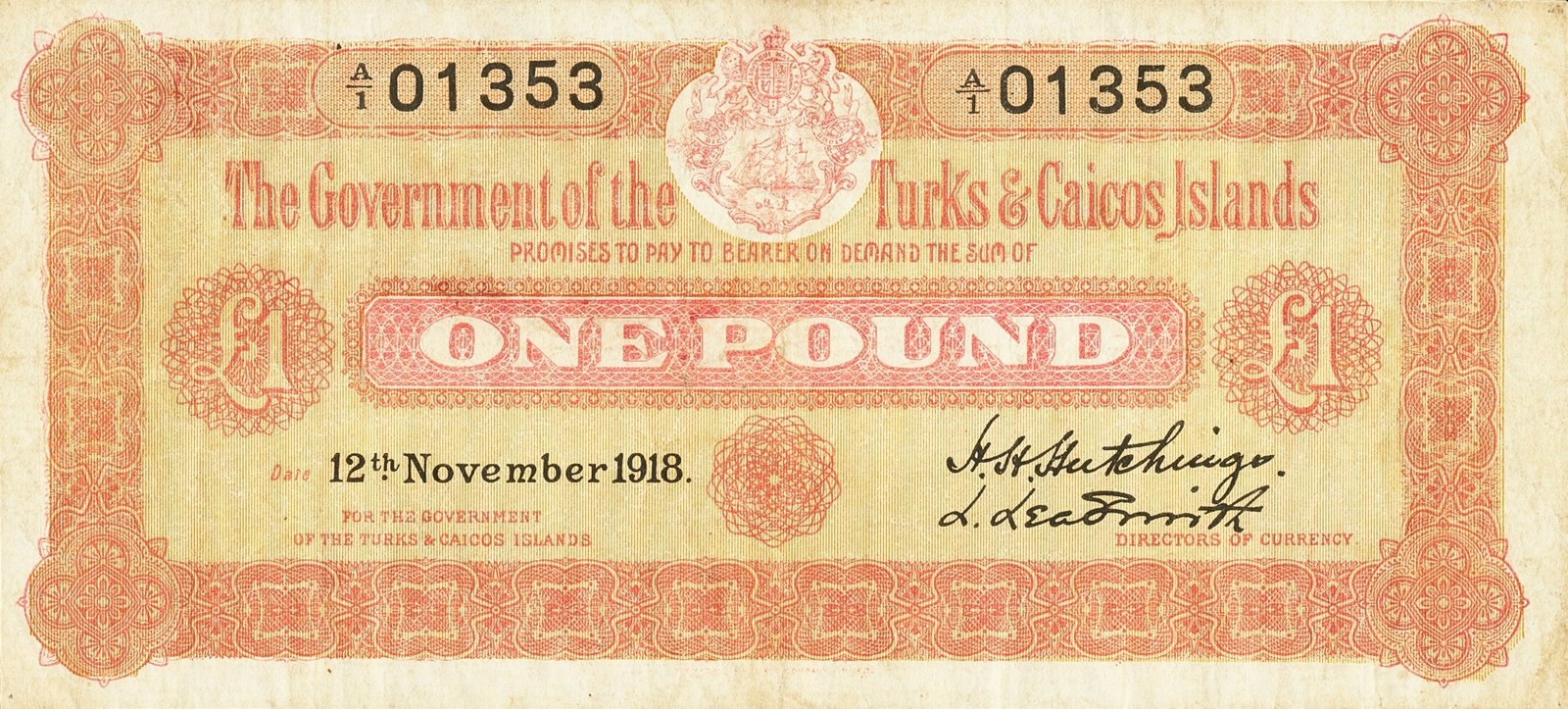
The second type has the date, the two signatures and the serial number printed, over an underprint of fine vertical lines. It is still uniface. The 10 shillings is dated 21st July 1913 and 1st June 1924. The 1 pound is dated 21st July 1913, 12th November 1918 and 1st June 1924. The counterfoil does not tell the two types apart, because the 1913 specimens of the second type keep one, with the serial, date and signatures printed on it.
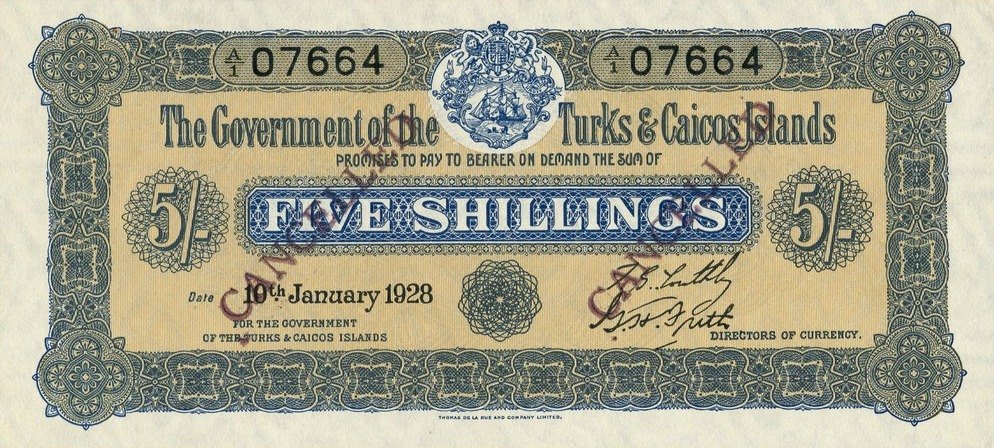
The third type is dated 10th January 1928 and is the first with a printed back, the arms between guilloches. It was made as a 5 shillings and a 1 pound. No 10 shillings dated 1928 is recorded. The specimens of the 1928 5 shillings and 1 pound carry the ink numbers 268 and 270, and the 10 shillings numbered 269 between them is dated 1st June 1924.
Heritage's description of a printer's model of the 5 shillings (23 October 2021, lot 28524) says that the same large uniface design was used for the early notes of the Falkland Islands, Fiji and the Solomon Islands.
The Directors of Currency and their offices
The counterfoil of the first type names the signers' office: Directors of Currency. The annual report for 1909 (Colonial Reports, Annual, No. 646, printed page 5) shows a liability of 1 pound to the "Directors of Currency" in the balance sheet. No report read names the Directors as persons. Their names come from the notes, and their posts from the Handbook of Jamaica and the records of services in the Colonial Office Lists.
| Date on the note | Signers | Their posts, and the source |
|---|---|---|
| 3rd December 1903 (by hand) | Alexis Wynns Harriott and Edmund Cowles Harriott | A. W. Harriott: assistant commissioner, Grand Turk, from 1888, and acting auditor on various occasions from 1888 to 1906 (Colonial Office List for 1910). E. C. Harriott: acting accountant and clerk in the Commissioner's office from April 1903, confirmed in July 1903 (Colonial Office List for 1927). |
| 21st July 1913 and 12th November 1918 | Hutchings and Lea-Smith | Hugh Houston Hutchings: assistant commissioner, Grand Turk, 1908 to 1919, acting auditor 1908 to 1913, auditor 1913 to 1919 (Dominions Office and Colonial Office List for 1935). Lindsay Lea Smith: accountant and clerk from January 1907, general manager of the savings bank from 1 July 1907 (Colonial Office List for 1925). |
| 1st June 1924 | Lea-Smith and Frith | Lea Smith: Assistant Commissioner, Magistrate, Registrar and Auditor (Handbook of Jamaica for 1923, 1924 and 1926). Geoffrey Hammond Frith: assistant treasurer, collector of customs and postmaster from 1923 (Colonial Office List for 1940). |
| 10th January 1928 | Southby and Frith | T. G. Southby: Assistant Commissioner, Magistrate, Registrar and Auditor, first shown in the Handbook of Jamaica for 1927. Frith: Assistant Treasurer in the Handbooks for 1926 and 1927, and acting assistant commissioner in 1927 (Colonial Office List for 1940). |
No source read says which posts made up the Directors of Currency by rule.
The records of services add where the men went. E. C. Harriott moved to the Jamaica revenue department in January 1907, and A. W. Harriott became assistant commissioner at Salt Cay in July 1907. Hutchings became Commissioner of the Cayman Islands in June 1919 and of Montserrat in September 1929. Lea Smith had been confirmed as clerk to the Commissioner on 1 July 1903 and acted as assistant commissioner from December 1910 to January 1911 and from September 1912 to April 1918. Frith entered the service in 1919, acted as Commissioner of the Cayman Islands in 1929 and of Tobago in 1931, and became Treasurer of St Lucia in 1933. The Handbook of Jamaica shows Southby as a solicitor admitted on 8 January 1906 and as assistant clerk of a Resident Magistrate's Court in Jamaica from May 1920. No record of services for Southby was found in the Colonial Office Lists.
Stack's Bowers (29 August 2025, lot 30342) says that the two Harriotts were father and son, and that Alexis Harriott had been commissioner of Salt Cay in the late nineteenth century. The Colonial Office List for 1910 has A. W. Harriott as assistant commissioner at Grand Turk from 1888 and as assistant commissioner at Salt Cay from July 1907.
Notes in circulation, 1922 to 1936
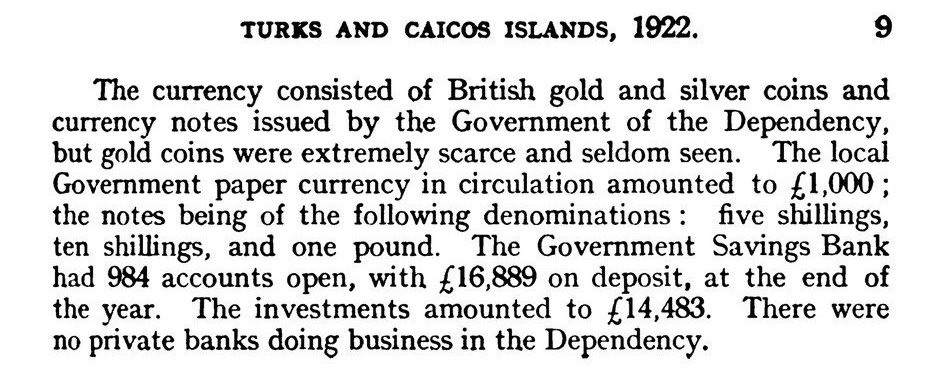
The Finance paragraph of the annual reports gives the local Government paper currency in circulation from 1922. The reports for 1922 to 1926 name the values as five shillings, ten shillings and one pound.
| Year | Government notes in circulation | Source |
|---|---|---|
| 1922 | £1,000 | annual report for 1922 |
| 1923 | £1,800 | annual report for 1923 |
| 1924 | £3,000 | annual report for 1924 |
| 1925 | £3,000 | annual report for 1925 |
| 1926 | £4,500 | annual report for 1926 |
| 1927 | £5,500 | annual report for 1927 |
| 1928 | £6,000 | annual report for 1928 |
| 1929 | £5,500 | annual report for 1929 |
| 1930 | £5,500 | annual report for 1930 |
| 1931 | £3,000 | Handbook of Jamaica for 1933-34 |
| 1934, 1935, 1936 | £3,000 | Handbooks of Jamaica for 1936, 1937-38 and 1939 |
The abstracts of these reports in the Handbook of Jamaica differ in two places: they give £1,800 for 1924, which is the figure of the report for 1923, and £4,000 for 1930 where the report itself says £5,500.
The naming of a five shillings in circulation in every year from 1922 to 1926 matters for the catalogue. The 5 shillings of 1928 was not yet printed, so the reports point to the hand-signed 5 shillings printed in 1910 having been issued. They do not prove it, since no such note has been seen.
No report read gives the notes out by value, and none read gives a figure before 1922.
What the official papers leave out
The annual reports for 1909 (No. 646), 1910 (No. 681) and 1912 (No. 763) do not mention the Government notes at all. The report for 1921 (No. 1147, printed page 13) says that the current coins were British gold and silver and that no bank did business in the Dependency, and that currency was one of the subjects governed by Jamaica laws applied to the Dependency. The Turks and Caicos appendix of the Handbook of Jamaica, in the volumes for 1904 to 1924, names the officers and says nothing of the notes.
Not found in any report, Handbook or List read so far:
- the Ordinance or other law under which the notes were issued;
- the day any of the three types went into circulation;
- any notice withdrawing the notes.
The end of the local notes
The annual report for 1931 (No. 1582) says that the Government's own notes circulated beside a few British and foreign notes. The report for 1933 still speaks of notes issued by the local Government as current, and the Handbooks of Jamaica carry £3,000 in circulation to 1936. The Colonial Office report on the islands for 1946 says that British and foreign currency notes were also in circulation, and the reports for 1948 and 1950 name Jamaica currency notes and British silver. The Pick pages put it that from 1946 the reports name only Jamaica notes.
The houses give earlier dates. Heritage (24 April 2020, lot 26193) says in one sentence that Jamaican banknotes replaced the local issues in 1928 and in another that they did so in 1930, and Heritage (8 March 2024, lot 24564) says the islands issued notes until about 1930. Against that, the annual report for 1933 speaks of the local Government's notes as current, and the Handbooks of Jamaica for 1936, 1937-38 and 1939 count £3,000 of them in circulation in 1934, 1935 and 1936. Neither account is settled here: no source read gives a notice of withdrawal or the day the notes ceased to be current.
The Colonial Office reports on the Turks and Caicos Islands estimate the Jamaica notes in the islands at £40,000 in 1953-54, £40,500 in 1955-56, £40,000 in 1957-58 and £50,000 in 1959-60, 1961-62 and 1963-64, and the report that covers the change to decimal money gives £206,000 before decimalisation. The report for 1961-62 says the Jamaica Government had agreed to the use of its currency after Jamaica's independence. The islands followed Jamaica into decimal money in September 1969, under the Turks and Caicos Islands Currency Ordinance 1968.
Specimens, proofs and colour trials
The Pick pages hold specimens of the 10 shillings and 1 pound dated from 1913 to 1924 and of both values of 1928, unprinted notes of the second type with their counterfoils and without date, signatures or number, colour trials of the first-type 10 shillings and of the 1928 5 shillings, and proofs and progressive proofs of the 5 shillings.
Spink's description of a 10 shillings specimen dated 21 July 1913 (27 September 2011, lot 1728) says that the date was then unrecorded in the Pick catalogue. The 1913 date and signatures of both values are still known only from such specimens.
Three more points come from the houses. Spink (27 September 2011, lot 1727) describes a 5 shillings piece, which it calls a specimen, as perforated CANCELLED and carrying the pencil date 1927 in the top margin. Spink (4 November 2020, lot 430, and 12 October 2021, lot 1860) describes a 5 shillings piece that was split and rejoined as, in its view, a De La Rue experiment with another colour and paper. Heritage (13 January 2022, lot 28461) points out that a blue colour trial of the 10 shillings has a dotted line for a handwritten date on the counterfoil, and concludes that the piece may be older than the years 1903 to 1924 on its holder. That agrees with the Pick page, which places these trials with the first type.
How many issued notes survive, as each source puts it
The Pick pages say that no issued note of 21st July 1913 has been seen for either value, and no issued 1 pound of 1st June 1924.
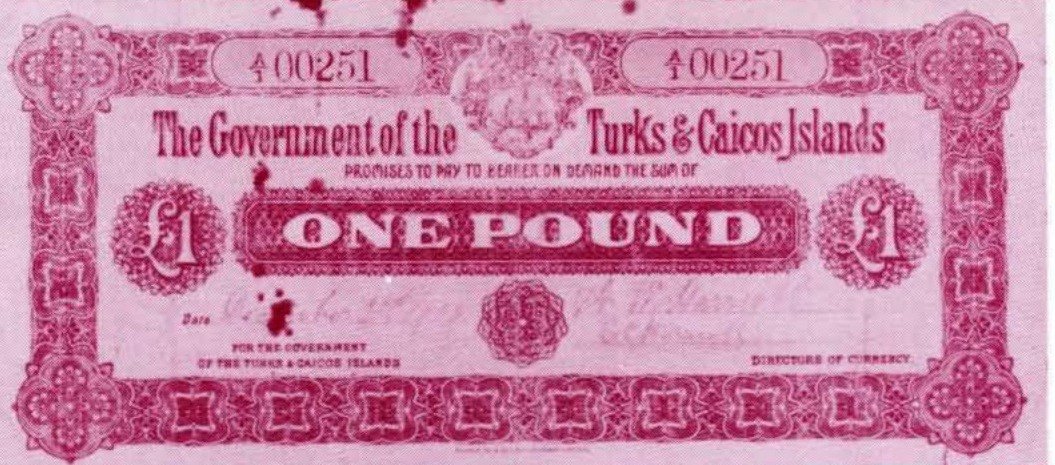
Stack's Bowers (29 August 2025, lot 30342) says that its 1 pound of 1903, number A/1 00251, appears to be the only known example of the first type with handwritten date and signatures, and that just one other issued 1 pound, dated 1918, has been sold at auction in recent years. The same 1903 note was on the cover of the International Bank Note Society Journal, volume 23, No. 2, 1984, sent in by the collector Bill Pheatt. Bank Note Reporter of November 1986 reports that a 1 pound "hand signed and hand dated Dec. 2, 1903" was sold in London in October 1986, without naming the house or the number. The date on the note recorded is 3rd December.
Heritage (24 April 2020, lot 26193) says that its 1 pound of 12th November 1918 was the first note of the islands in any form sent to PMG for grading, that the Dauer collection had bought it in the Christensen sale of 2009, from the Amon Carter collection, and that it is the note pictured in the Standard Catalog of World Paper Money. The same description gives the population of the colony as between 4,500 and 6,000 during the life of the notes.
Of the 1928 issue, Spink sold a 5 shillings and a 1 pound on 30 September 2014 (lots 1753 and 1757), each, by Spink's description, with a CANCELLED handstamp at left and right. NASCA had offered the same 5 shillings and 1 pound in New York on 30 March 1990 (lots 1716 and 1718), with a 10 shillings of 1st June 1924 between them as lot 1717, and its catalogue pictures all three with the CANCELLED handstamps. Bank Note Reporter of May 1990 reports the 5 shillings as sold.
Sources
- Colonial Reports, Annual, Turks and Caicos Islands: No. 646 (1909), No. 681 (1910), No. 763 (1912), No. 1147 (1921), the reports for 1922 to 1930, No. 1582 (1931), the report for 1933.
- Colonial Office reports on the Turks and Caicos Islands, 1946 to 1970.
- The Handbook of Jamaica, volumes for 1904 to 1939: the Turks and Caicos appendix and the abstracts of the Dependency's annual report.
- The Colonial Office List for 1910, 1925, 1927 and 1940, and the Dominions Office and Colonial Office List for 1935: records of services.
- International Bank Note Society Journal, volume 23, No. 2, 1984, "About the Cover Note".
- Bank Note Reporter, November 1986 and May 1990.
- House descriptions: Spink, 27 September 2011, lots 1727 and 1728; 30 September 2014, lots 1753 and 1757; 4 November 2020, lot 430; 12 October 2021, lot 1860. Heritage Auctions, 24 April 2020, lot 26193; 23 October 2021, lot 28524; 13 January 2022, lot 28461; 8 March 2024, lot 24564. Stack's Bowers, 29 August 2025, lot 30342.
- The six Pick pages of the islands.
Member comments
Log in or register to post a comment.