On 24th November 2026 we read six bound volumes of the "Colonial Reports - Annual", 1908 to 1931, against the catalogue: 184 reports on 6,422 pages, of which 110 are on territories the catalogue covers and were read for it. This article is not about one note. It sets out what such a report can tell a collector, where it misleads, and what it never says, with the pages that prove each point.
The source
Each colony sent a printed report to the Secretary of State every year. The reports were sold by H.M. Stationery Office, each with a number of its own: the report on Seychelles for 1921 is No. 1146, came out in 1923 and cost 3 pence. Most have a short chapter on currency and a list of the year's laws. Of the 184 reports, 32 had been read earlier on other scans and 42 are on territories outside the catalogue. The examples below come from these:
| Territory | Report for | No. |
|---|---|---|
| British Honduras | 1908, 1911, 1922 | 631, 733, 1181 |
| Falkland Islands | 1912 | 764 |
| Kenya | 1921 | 1153 |
| Gold Coast | 1921 | 1154 |
| Sierra Leone | 1921, 1922, 1928 | 1150, 1165, 1430 |
| Cyprus | 1922 | 1159 |
| Zanzibar | 1922, 1928, 1929 | 1163, 1434, 1480 |
| Grenada | 1922 | 1168 |
| Fiji | 1922 | 1171 |
| Gibraltar | 1922, 1928 | 1173, 1437 |
| Nigeria | 1929 | 1493 |
| British Guiana | 1929 | 1496 |
| Mauritius | 1929 | 1503 |
What a report gives well
Notes in circulation on a named day. The Gold Coast's report for 1921 counts the notes of the West African Currency Board in that colony on 31st March 1922 value by value, from 5,750 pounds in 5 pound notes to 54,699 pounds 12 shillings in 1 shilling notes, 1,078,631 pounds 2 shillings in all. Nigeria's report for 1929 gives all West Africa with the number of notes: 764,672 pounds in 1,143,409 notes on 30th June 1928.
A day of issue. British Guiana's report for 1929 says the replacement of the old notes by the notes of the 1929 design "was commenced on 12th February, 1929". Sierra Leone's report for 1928 says the new 20 and 10 shilling notes were placed in circulation "as from 1st July".
A withdrawal. Grenada's report for 1922 says that of the 12,500 pounds issued in 1920 only 10,254 pounds remained in circulation on 31st December, "the 2s. 6d. notes having been withdrawn" (2 shillings 6 pence of 1920). The Cyprus report for 1922 says the 5, 2 and 1 shilling notes had been "demonetised by 1st May".
A law with its date. Kenya's report for 1921 lists a Proclamation of 7th June 1921 that demonetised the silver rupees. Fiji's report for 1922 says Ordinance No. 1 of that year let the Commissioners of Currency pay notes in current coin other than gold.
A paragraph carried over can mislead
The currency chapter was seldom written afresh. Last year's paragraph was taken up and a figure or a date changed, and not always both.
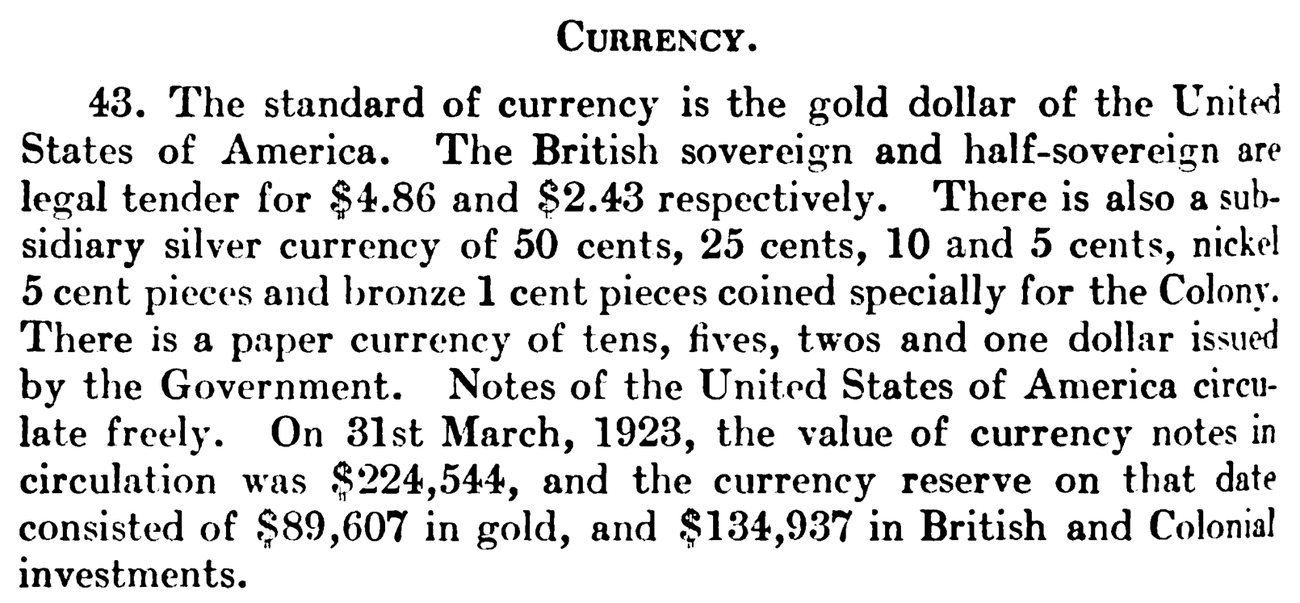
British Honduras. The report for 1922 gives the notes in circulation on 31st March 1923 as 224,544 dollars, against 89,607 dollars in gold and 134,937 dollars in investments. The two parts of the reserve add up to the total. The report for 1924 prints the same 224,544 dollars for 31st March 1925. A circulation that is the same to the dollar two years apart is not likely. We think the 1923 date is the true one and the later line a paragraph carried over with its date changed, but that is our inference: the page of the 1 dollar of 1924 now gives both dates and says which report prints which.
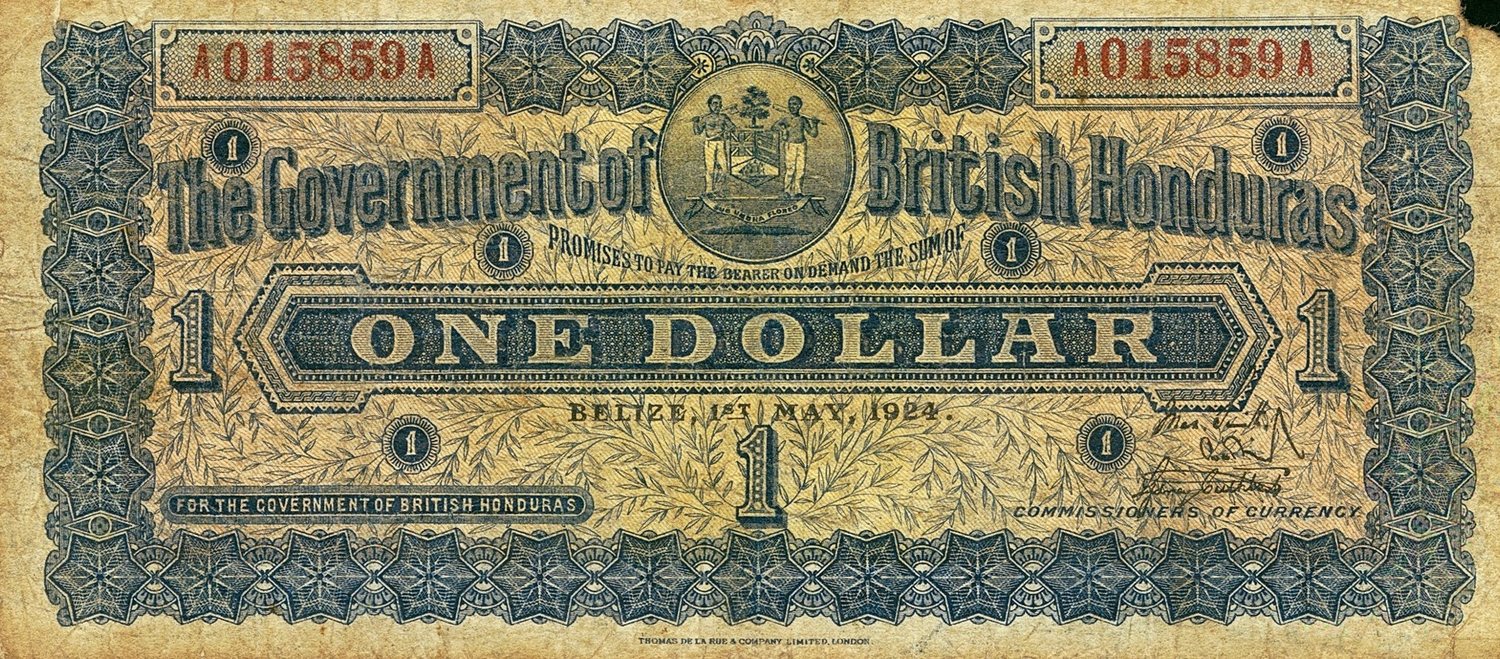
The same colony's reports for 1908 and 1911 both say notes "have been issued" for 1, 2, 5, 10, 50 and 100 dollars. That is a standing sentence about the law of 1894 and does not prove that 50 and 100 dollar notes were still in use in 1911.
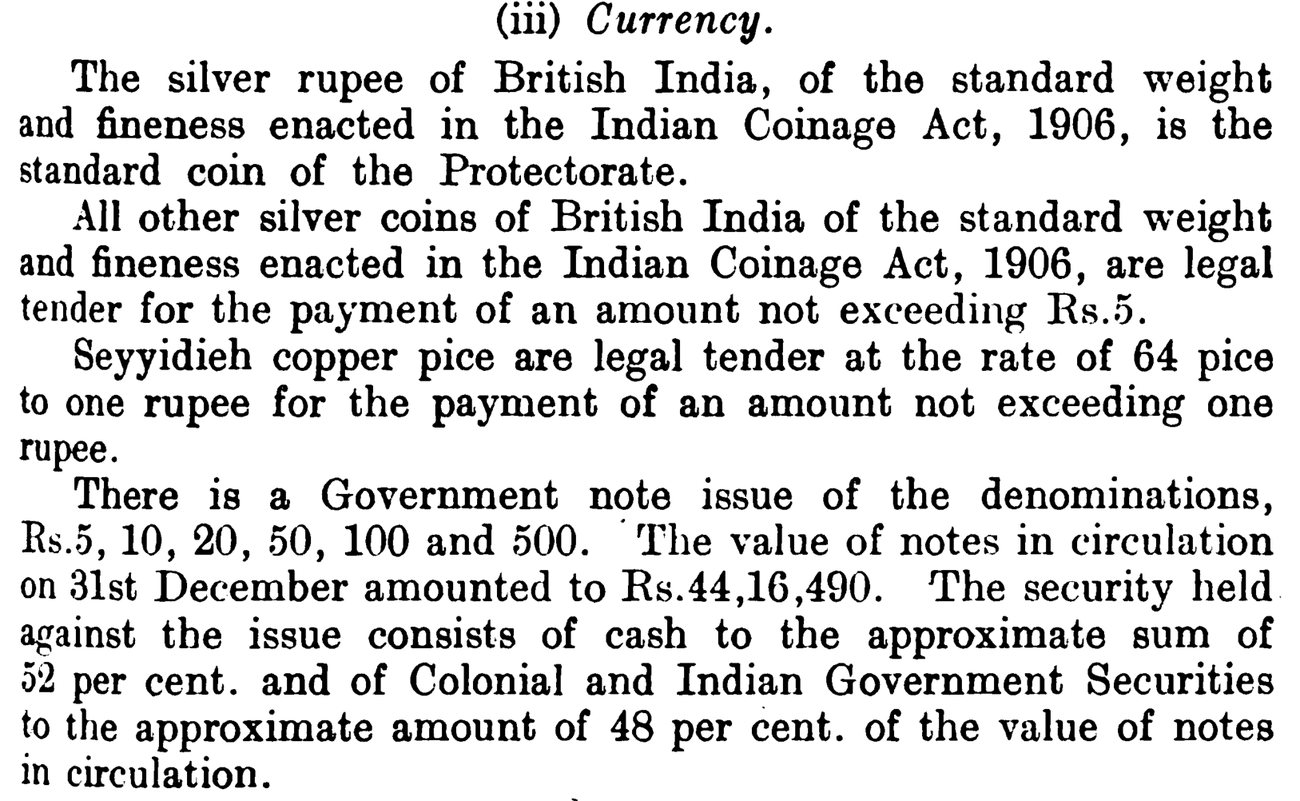
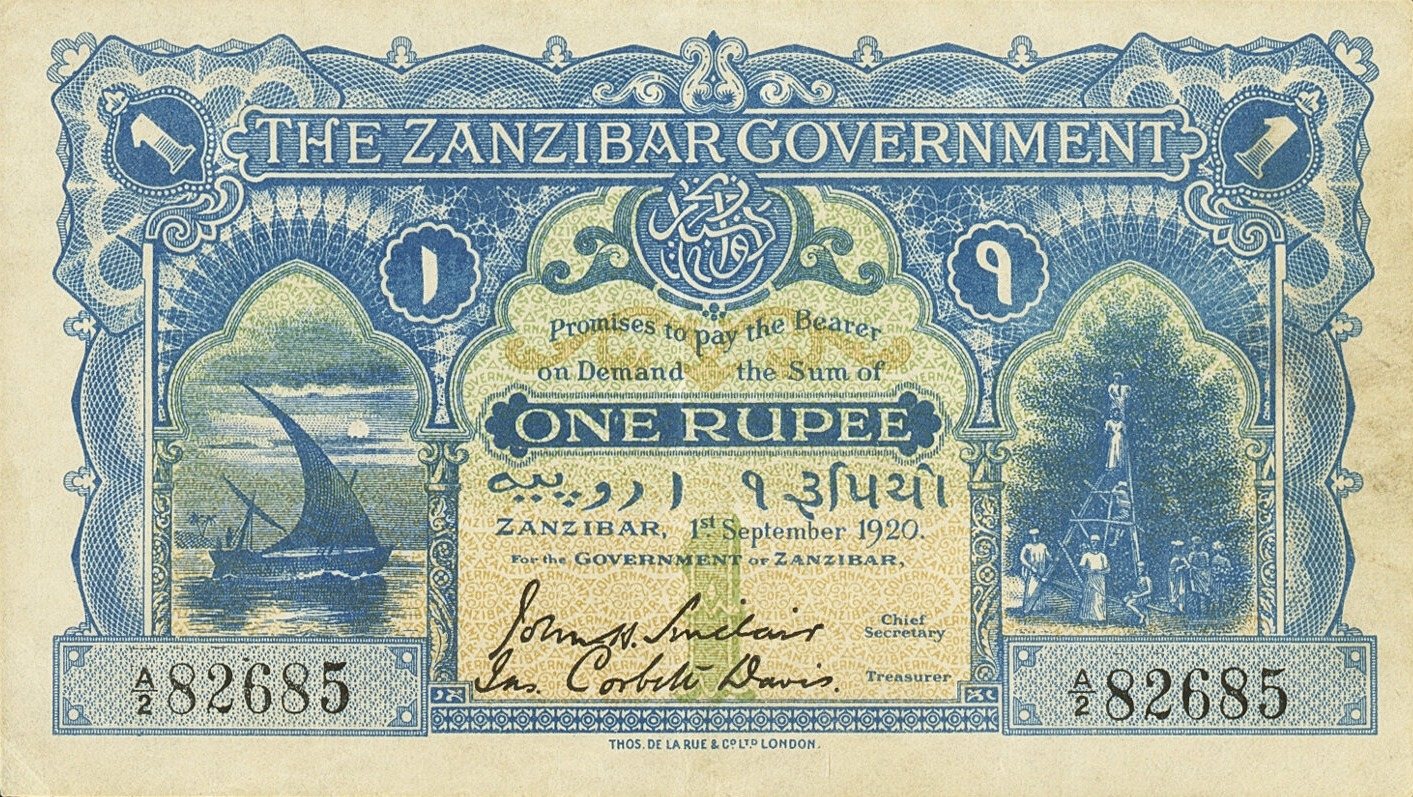
Zanzibar. The report for 1922 lists "the denominations, Rs.5, 10, 20, 50, 100 and 500" and gives 4,416,490 rupees in circulation on 31st December. The 1 rupee is not in the list, though the note is dated 1st September 1920. The reports for 1928 and 1929 name it. The list of 1922 is most likely an older sentence not yet brought up to date. The total does not settle it: 4,416,490 rupees can be made up with or without 1 rupee notes. A list of values in a report is weak proof that a note existed and no proof at all that one did not.
Add up every table
The Falkland Islands report for 1912 counts the notes in circulation at the end of the year: 603 of 5 pounds, 4,372 of 1 pound and 452 of 5 shillings (1 pound of 1899 to 1920). The values add up to the printed 7,500 pounds. The numbers do not: the three lines make 5,427 notes by our addition, and the report prints a total of 5,507. A printed total is a figure like any other. Where the lines are given, add them.
A word may not mean what it seems
"In circulation." Sierra Leone's report for 1921 gives notes "in circulation" of 225,760 pounds at the start of the year and 82,500 pounds at the end, with 243,982 pounds withdrawn. The figures do not balance as a circulation, and the report for 1922 calls the same 82,500 pounds notes held: it is the stock at Freetown, where notes issued in the other colonies were landed and cashed. The report for 1922 estimates the notes really with the public at the end of that year at 62,000 pounds.
One colony or four. The Gold Coast's 1,078,631 pounds is nearly the whole of what was out in the four West African colonies together at that date. Notes moved between the colonies, and Nigeria's report for 1929 says for that reason that no figure can be given for Nigeria alone. Colony figures of a shared note issue cannot be added up.
"Old notes in circulation." Gibraltar's report for 1928 counts about 4,500 pounds of old notes among 130,000 pounds in circulation. After the notes of 1914 were demonetised the later reports still count them. Here the words mean notes not yet handed in.
Names of laws differ
A report names a law as the office knew it, not as the statute book has it. Gibraltar's report for 1922 says the notes were issued under "the Bank Note Ordinance, 1914" and gives no number; the catalogue has Ordinance 10 of 1914. That the two are one law is likely and not proved. The Mauritius report for 1929 rests the rupee currency on "Proclamation No. 28 of 1876", where Chalmers' History of Currency in the British Colonies has an Ordinance 28 of 1876. Before two names are joined, the law itself should be read.
How we read them
The machine text of a scan is rough: it is good for finding a page and bad for figures. Every figure was read on the image of the page. Each find was then tested against the catalogue page before a sentence was written, and a figure went on a page with the report named.
What the reports do not say
- No picture. No note, specimen or form of note is pictured on any of the 6,422 pages.
- No serial number, no prefix and no quantity printed.
- No signer named as a signer. No Commissioner of Currency, Treasurer or Currency Officer appears by name in a currency chapter.
- Almost nothing before 1914. The reports of 1908 to 1912 for Jamaica, Malta, Gibraltar, St Helena and Uganda, among others, have no word on paper money, or no currency chapter at all.
- Missing reports. The Barbados reports of 1915-16 to 1918-19 are not in these volumes, which jump from No. 779 to No. 1146. The volume titled Nos. 1146 to 1186 lacks Nos. 1183 to 1185.
What would settle the open points: the British Honduras report for 1923 for the date of the 224,544 dollars; the Zanzibar reports for 1920, 1921 and 1923 to 1927 for the year the 1 rupee joins the list; the Gibraltar Ordinances of 1914 for the name of the law. For serial numbers, signers and the look of a note, the reports are the wrong place to search: those come from the notes and from the registers of the issuing office.


Member comments
Log in or register to post a comment.