A banknote design begins with the name of the issuer, and the name is the part most likely to be out of date before the note is printed. Printers were asked for designs while a bank was still being planned, sometimes before its law was passed, and they lettered the designs with the name they had been given. The design archive of this catalogue holds designs lettered with twelve names that never appeared on a note in circulation. One bank was planned and never set up. Others opened under another name. Some of the names are of currency boards that never existed.
Everything here is taken from the pieces themselves, as the archive records them, and from the catalogue's pages for the notes that were issued instead. Where a date comes from an auction house and not from the piece, that is said. Dates printed or written on a design are given as "1st January 1950"; days of events as "28 August 1950".
Jamaica, 1959 to 1960: The Central Bank of Jamaica
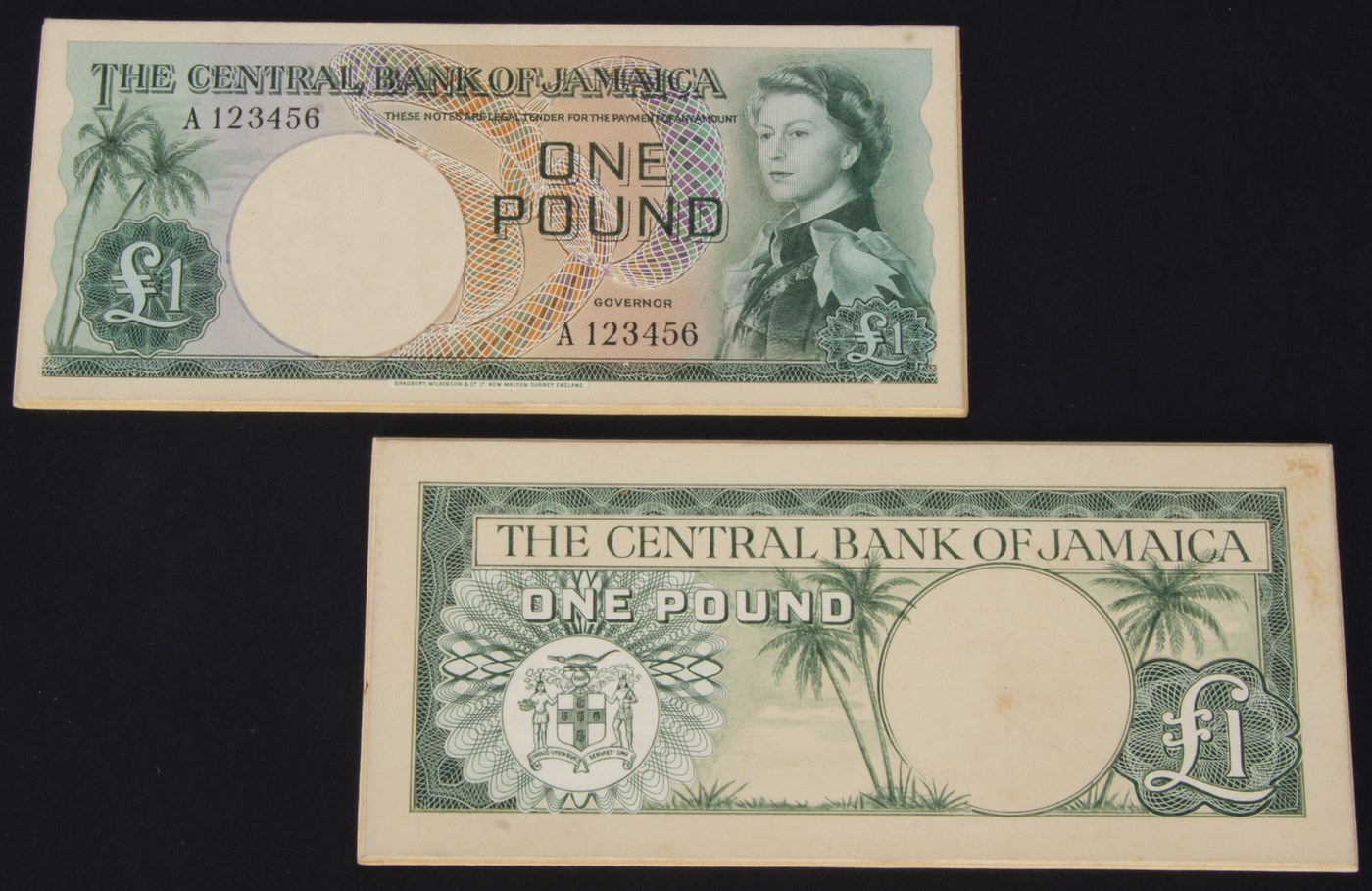
Jamaica has the fullest set. Five pieces in the archive are lettered THE CENTRAL BANK OF JAMAICA, and they show a design being worked up over about a year.
The earliest are two essays in pencil, ink and watercolour: an alternative face with a large £1 rosette at the centre, and a back with the Jamaican arms, palm trees and "17 Grey Green" pencilled in the top margin. The auction house that sold them from the Derek Friday Collection recorded a pencil date of May to June 1959 on the back of two of the three designs in the lot, and thought them most likely drawn for Bradbury Wilkinson by Derek Friday. The third design in that lot was a face painted in green: palm trees and a £1 rosette at the left, a blank circle for the watermark, the Queen at the right, the word "Signature" written above GOVERNOR and the number 000000.
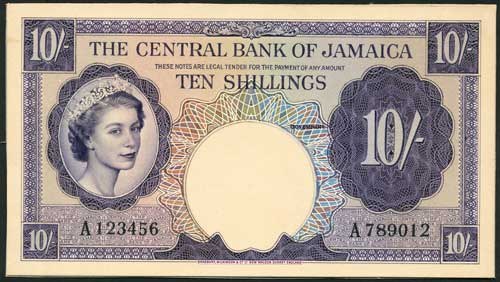
That face was then made up as a pair of essays on hardboard, each 15.2 by 6.7 cm, with a printed portrait laid on, the number A 123456 and the Bradbury Wilkinson imprint at the foot, and photographed: the firm's black and white photographs of the front and back show the same design. A 10 shillings under the same title went another way. It follows the layout of the George VI notes of the Government of Jamaica, with the Queen in an oval at the left, a large 10/- in a rosette at the right, and the numbers A 123456 and A 789012.
Then the name changes. A pair of photographs dated 2-8-60 in ink shows the same 1 pound, palm trees at the left and the Queen at the right, redrawn with BANK OF JAMAICA across the top and a signature over GOVERNOR. By 2 August 1960, then, the bank had its final name, and this layout was still in play.
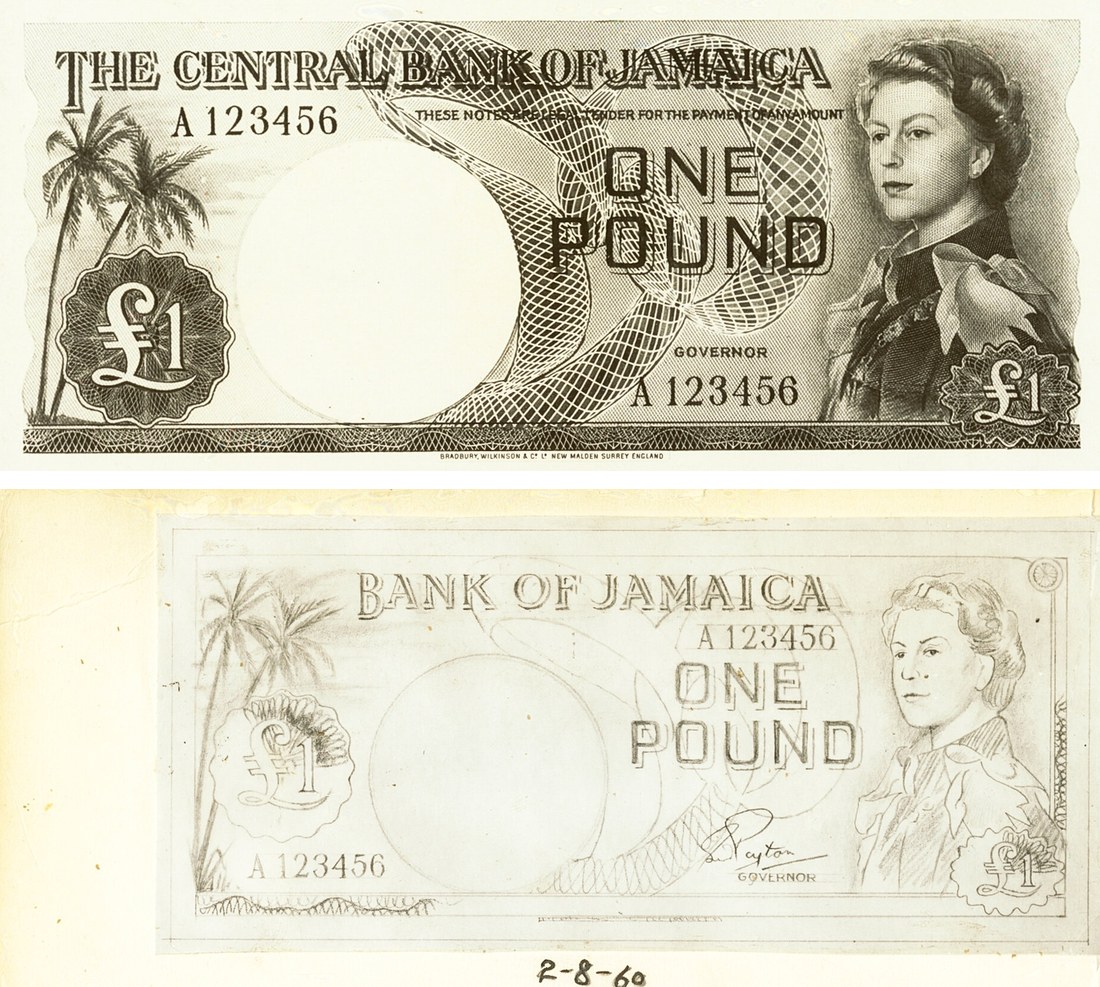
Neither version was issued. The notes of the Bank of Jamaica were issued under the Bank of Jamaica Law 1960, the 1 pound first on 1 May 1961, and they were printed by Thomas de la Rue with the portrait at the left. The title on the essays was dropped, and so, in the end, was the design.
Ceylon, 1948 to 1950: the Reserve Bank of Ceylon
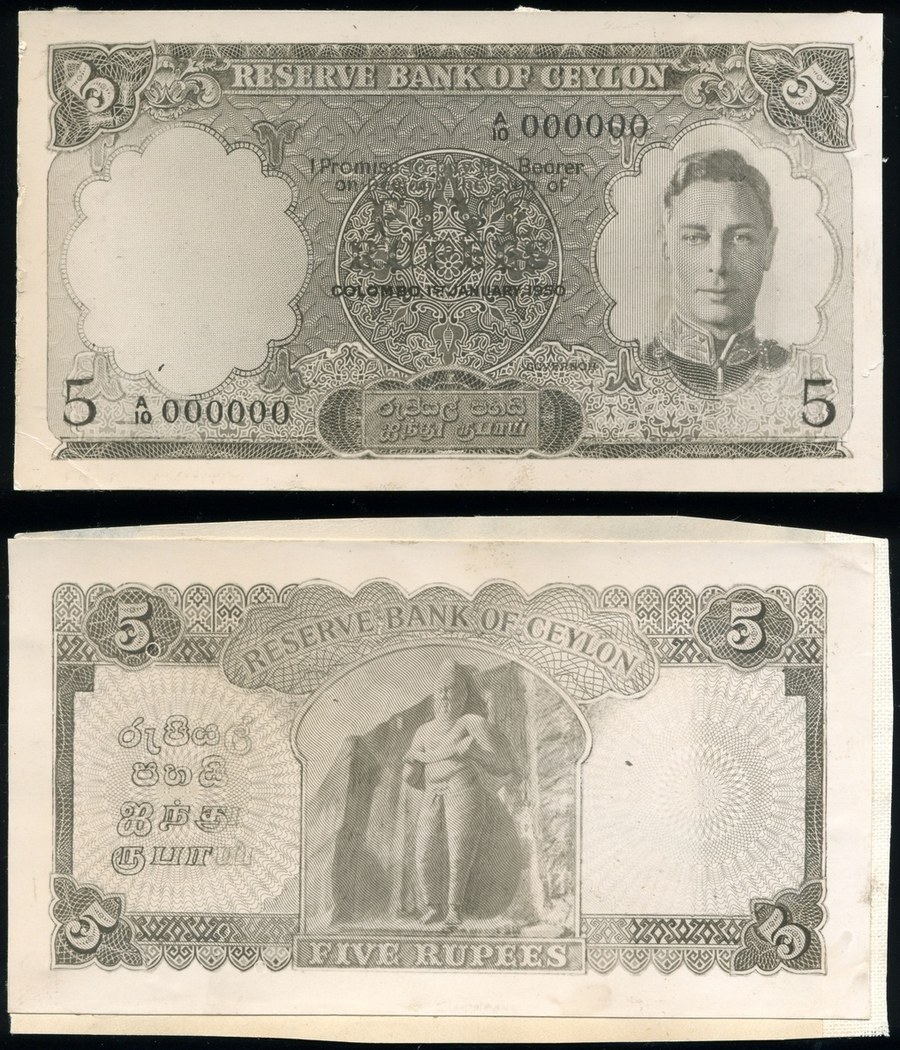
In Ceylon the name changed twice. Four pencil essays for a 2, 5, 50 and 100 rupees, dated 1st February 1948 in the design, are already lettered CENTRAL BANK OF CEYLON. A year later the printer's photographs carry another name. A 5 rupees and a set of a 10, 50, 100 and 1,000 rupees are headed RESERVE BANK OF CEYLON and dated Colombo, 1st January 1950, with King George VI and the number A/10 000000. The photographs themselves are older than the date in the design: both lots are marked 24 February 1949 in pen or pencil. A hand-painted 10 rupees with a dagoba at the centre carries the same title and no date.
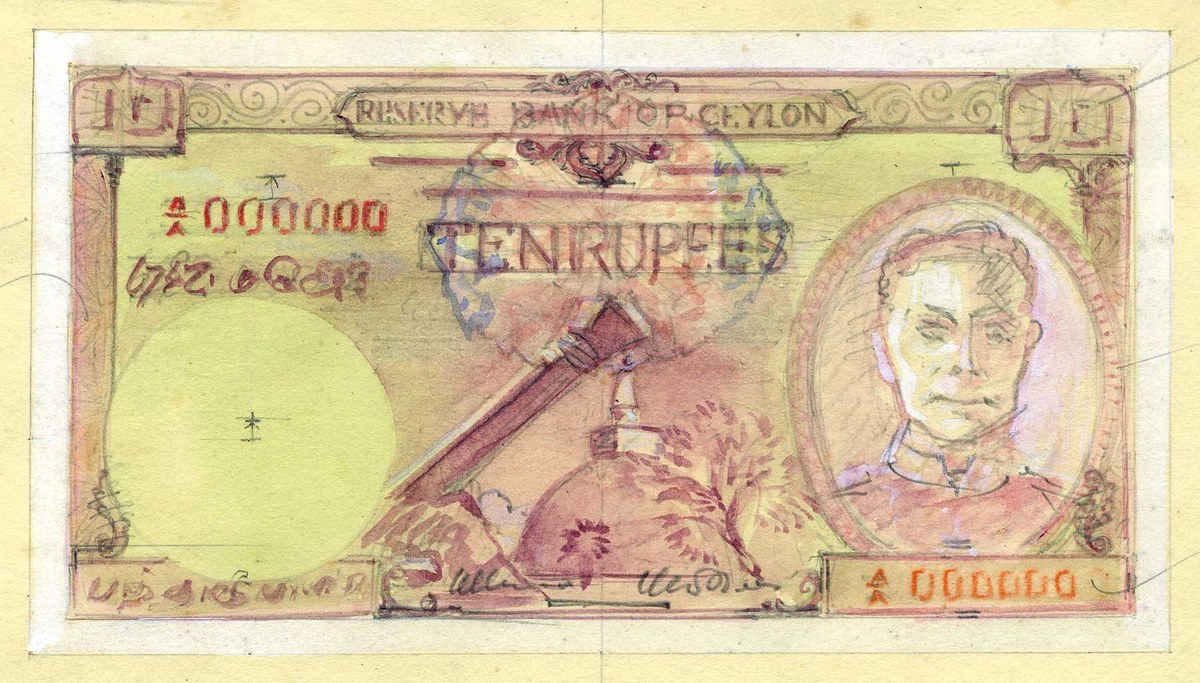
The bank that was set up, by the Monetary Law Act No. 58 of 1949, was the Central Bank of Ceylon. It opened on 28 August 1950 and its first notes, a 1 rupee and a 10 rupees, are dated 20th January 1951. The work done under the other name was not wasted: the archive records that the backs of the Reserve Bank photographs were used, with the title changed, for the Central Bank notes of 1951 to 1954.
Rhodesia and Nyasaland, about 1955 to 1956: the name was shortened
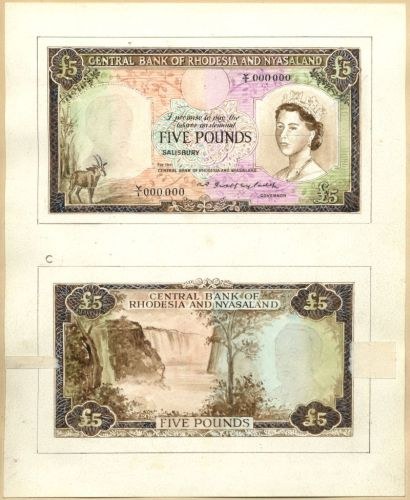
Three hand-painted essays on card, a 10 shillings, a 1 pound and a 5 pounds, are lettered CENTRAL BANK OF RHODESIA AND NYASALAND. They are not dated; the auction house that sold the three together in 2013 put them at about 1955 to 1956. The 10 shillings and the 1 pound are signed by hand for Grafftey-Smith as Governor; the 10 shillings card is pencilled A in the margin and the 5 pounds C.
Set beside the notes that were issued, the essays are very close. The 10 shillings has a fish eagle and the number W/1 000000; the 1 pound a leopard, the ruins of Great Zimbabwe on the back and X/1; the 5 pounds a sable antelope, the Victoria Falls on the back and a Y prefix. The issued 10 shillings, 1 pound and 5 pounds have the same animals, the same two backs on the higher values, the letters W, X and Y, and Grafftey-Smith's signature as Governor. What changed is the first line. The bank was established on 15 March 1956 and its notes read BANK OF RHODESIA AND NYASALAND.
The longer name was not the artist's invention. The Northern Rhodesia annual report for 1956 uses it: "A Central Bank of Rhodesia and Nyasaland was set up on 15th March, 1956."
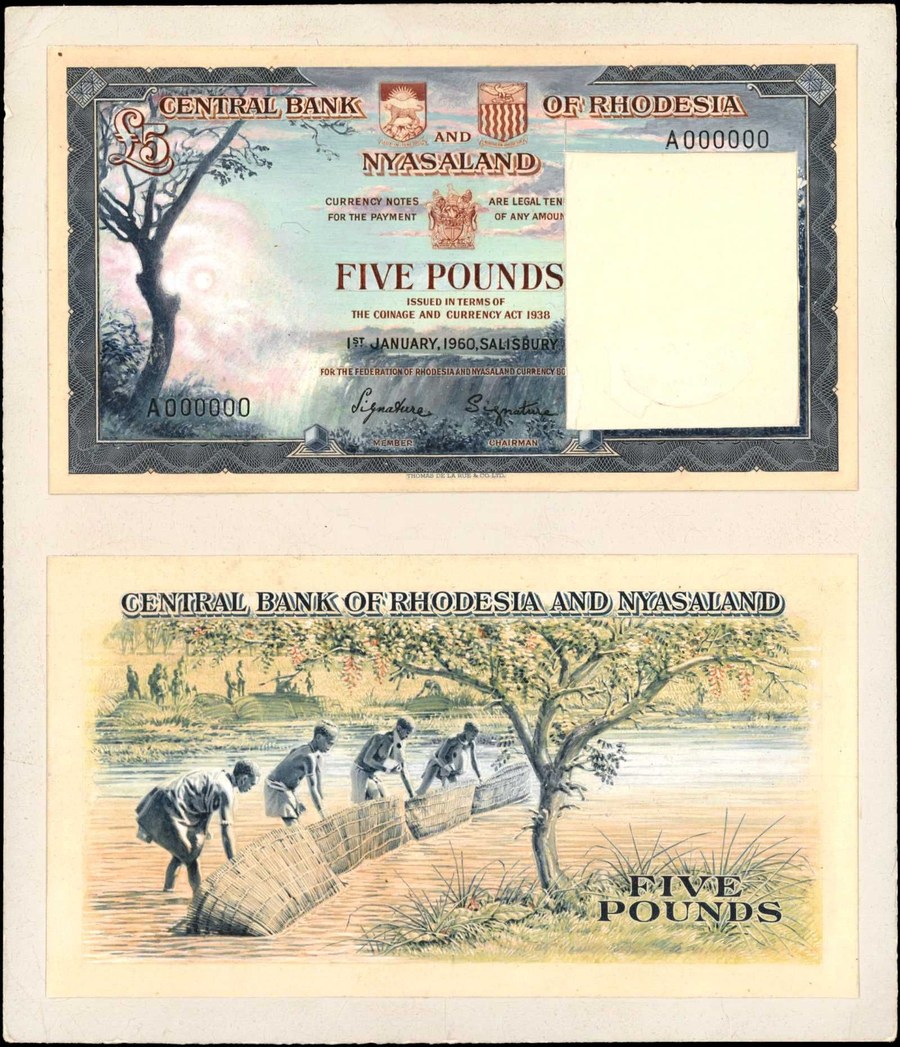
One more piece is harder to place. A De La Rue 5 pounds headed CENTRAL BANK OF RHODESIA AND NYASALAND is dated Salisbury, 1st January 1960, nearly four years after the Bank opened under its shorter name. Under its two specimen signatures, for a Member and a Chairman, it reads FOR THE FEDERATION OF RHODESIA AND NYASALAND CURRENCY BOARD. No board of that name issued notes. The board the Federation did have was the Central Africa Currency Board, the Southern Rhodesia Currency Board renamed in March 1954, and the Bank took over its assets on 1 April 1956. The archive gives no account of why a design of 1960 names both a central bank and a currency board, and none is offered here.
The West Indies, 1957: a federation with no currency board
The federation of the British Caribbean islands, formed under an Act of 1956 and in being from January 1958 to May 1962, was given two names on paper and no currency of its own. Bradbury Wilkinson took the 1 dollar of the British Caribbean Territories dated 2nd January 1957 and changed the title to THE WEST INDIES, leaving out the EASTERN GROUP line; the printer's model has the word "Signature" in ink under MEMBER, CHAIRMAN and MEMBER. A second board carries the wording of the Act itself, THE BRITISH CARIBBEAN FEDERATION, over FOR THE CURRENCY BOARD. The auction house dated it about 1963, after the federation had ended; the catalogue records that date and doubts it, since the wording belongs to 1956 and 1957.
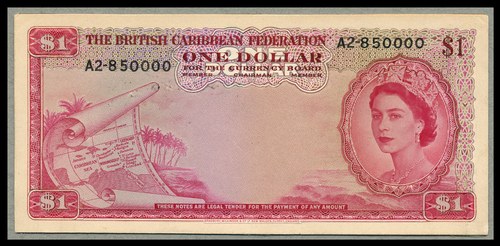
The federation was never given a currency board. The British Caribbean Currency Board went on issuing its own notes until the East Caribbean issue of 1965 replaced them, so the issuer named on both designs never existed.
Malaya, 1957 to 1958: the Central Bank of the Federation of Malaya
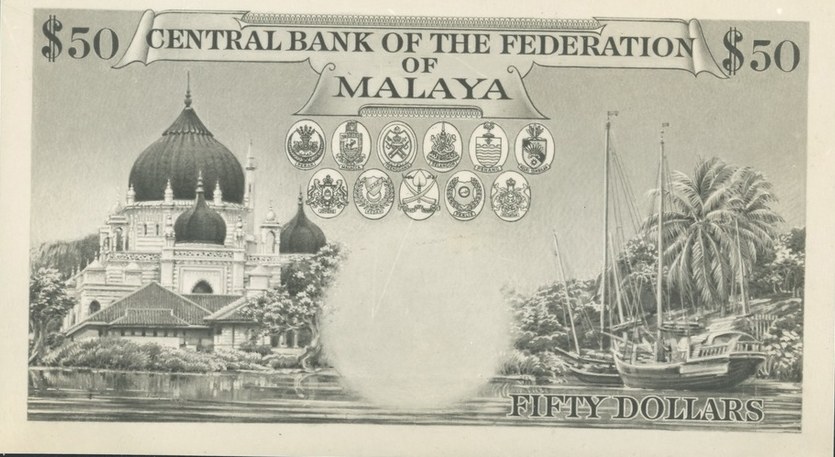
The Federation of Malaya became independent in 1957 and went on using the notes of the Board of Commissioners of Currency, Malaya and British Borneo, which it shared with Singapore, Sarawak, North Borneo and Brunei. De La Rue was meanwhile drawing notes for a bank of the Federation's own. A photograph of a back for a 50 dollars, with a domed mosque by the water, sailing boats among palms and eleven state arms, has CENTRAL BANK OF THE FEDERATION OF MALAYA on a ribbon at the top; the lot text gives a stamp on its back, "DLR Studio Photographed 4 Dec 1957". A back for a 10 dollars, largely made by hand in red, is recorded under the same title. It shows two buildings in Singapore, the clock tower of the Victoria Theatre and Memorial Hall and the dome of the old Supreme Court. And a 1 dollar dated 1st March 1958 names no issuer at all, but has the arms of the Federation at the top and the word "Signature" above GOVERNOR OF THE BANK, a line that points to a central bank and not to the Board.
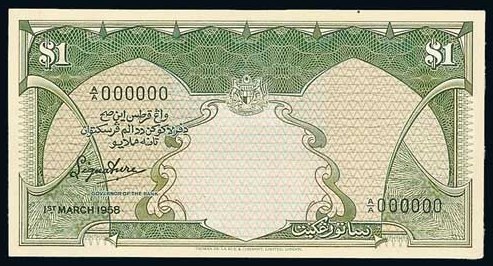
Here a central bank did open. The catalogue's page for the 1 dollar of 1959 cites the Bank of England Quarterly Bulletin of 1962: the Central Bank of Malaya was founded in 1958, the Federation kept the Board's notes under a new agreement of 1960, and by 1962 the bank had not issued a note of its own. The Board stopped issuing currency on 10 June 1967. No note is recorded with the title these designs carry; what the bank issued after 1967 lies outside this catalogue.
The eastern Caribbean, 1963 and 1969: a board, and a bank that was never set up
The islands that had used the British Caribbean dollar produced two names that were never issued, one before their new notes and one after.
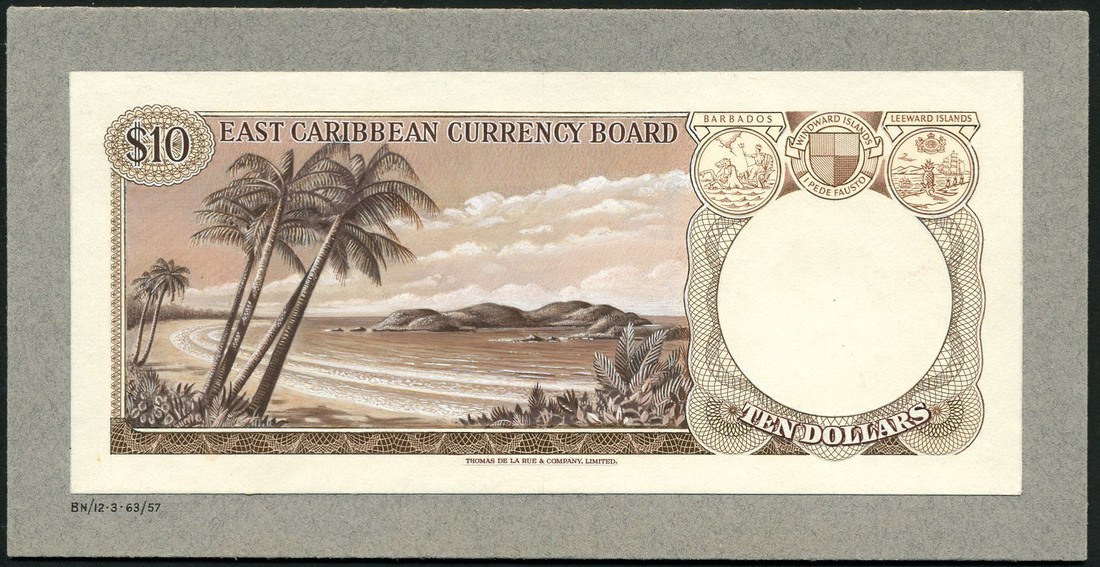
The first is a matter of months. A 20 dollars dated 3rd January 1963 is headed EAST CARIBBEAN CURRENCY BOARD and signed for the CURRENCY COMMISSIONERS, laid out like the British Caribbean notes it was to replace; the back model sold with it is already headed EAST CARIBBEAN CURRENCY AUTHORITY. A back for a 10 dollars with the Currency Board title, a beach with palm trees and the arms of Barbados, the Windward Islands and the Leeward Islands, carries De La Rue's job reference BN/12.3.63/57. The notes came out in September 1965 in the name of the East Caribbean Currency Authority, and without a 10 dollars.
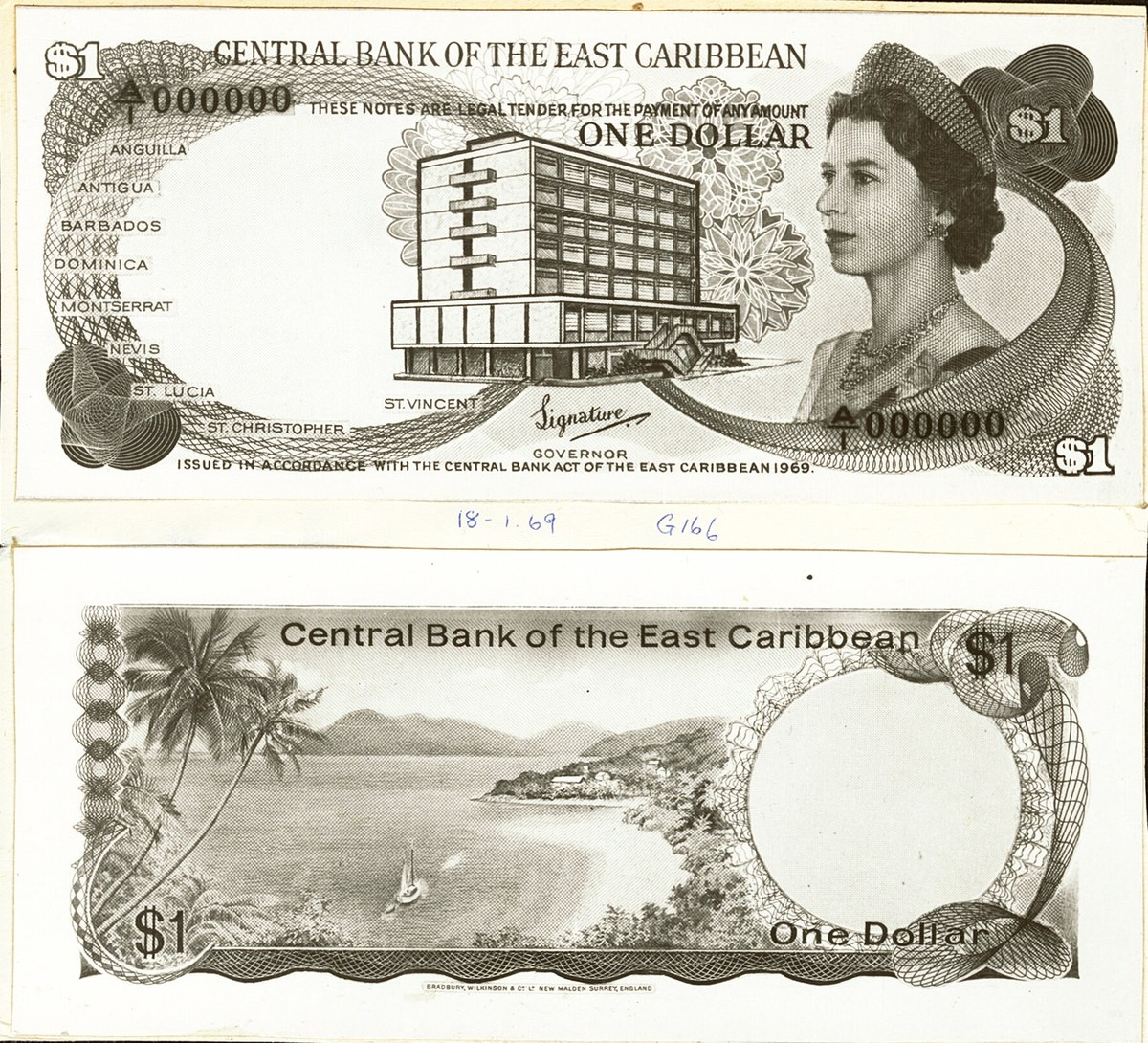
The second is the plainest case in the archive of a bank that never opened. Photographs of a 1 dollar, a 5 dollars and a 20 dollars are headed CENTRAL BANK OF THE EAST CARIBBEAN. The 1 dollar has the Queen at the right, a modern bank building at the centre, the member territories listed from Anguilla to St Vincent with Barbados among them, the number A/1 000000 and a Governor's line marked "Signature". The 5 dollars adds a schooner beside the building and has sugar cane being harvested on the back, with a lorry and a windmill. The 20 dollars has no portrait: the bank building fills the front, with a coat of arms at the right, and a two-masted schooner is on the back. The cards are marked 18-1-69 and G166 by hand.
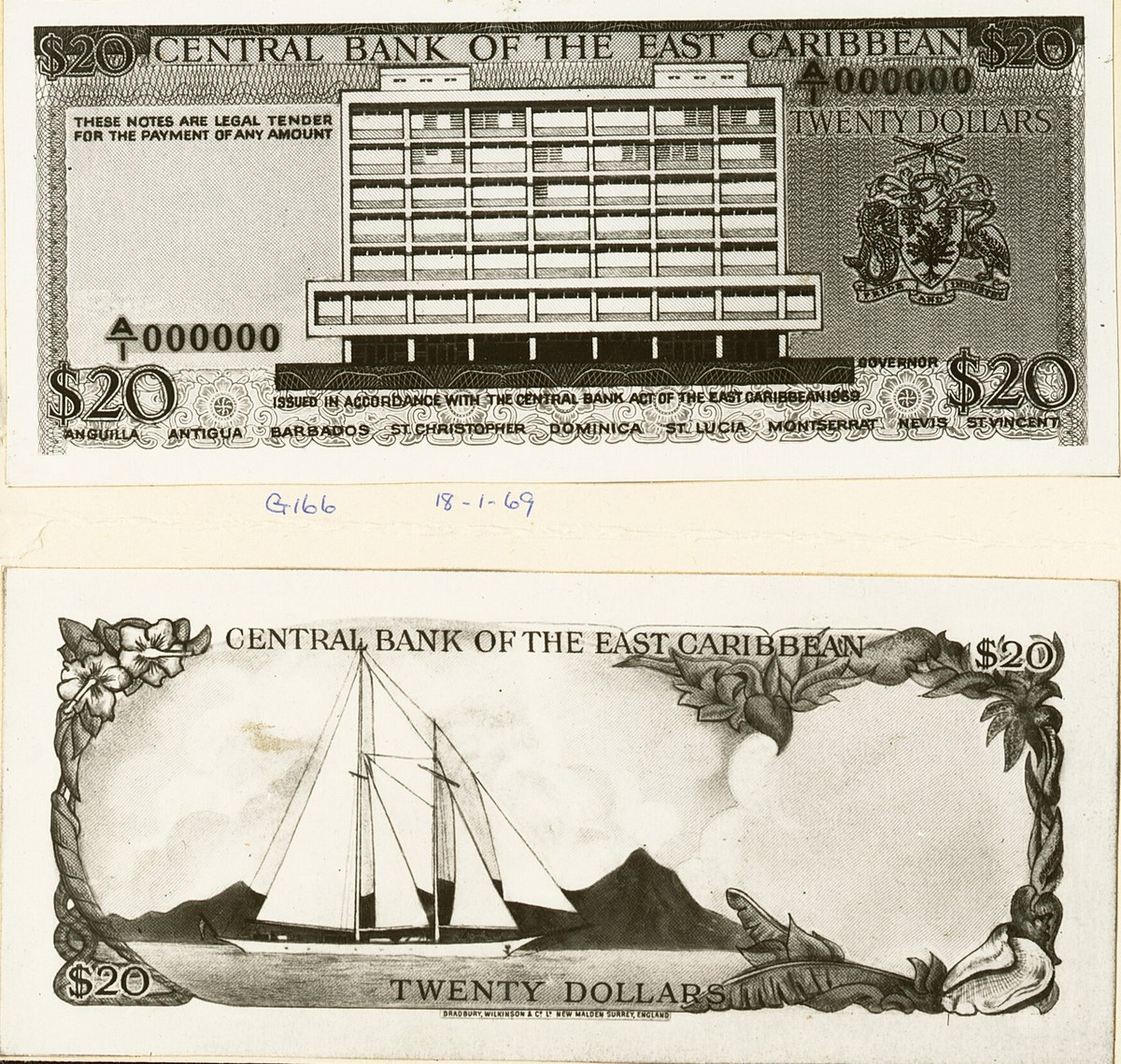
The designs name their own law, "the Central Bank Act of the East Caribbean 1969". The bank was never established, and the Currency Authority went on issuing the notes of 1965 until 1983. Barbados, named on these designs, left the currency union in 1973. The bank that did come has another name, the Eastern Caribbean Central Bank; this catalogue lists its notes from 1984, and the Bank's own chronology gives 1st August 1986 as the day its 1 dollar was introduced.
Fiji, about 1974 to 1975: the Central Bank of Fiji
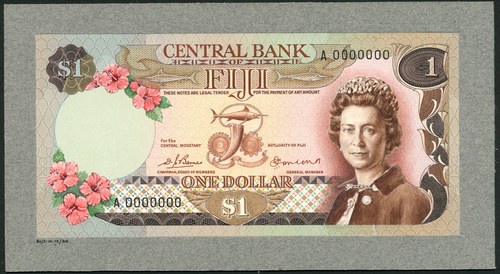
No Fiji note has carried a Central Bank title. Two 1 dollar essays do. The earlier is a hand-painted front and back on card, with hibiscus, a tabua and fish on the front, the docks on the back and the Queen's face blocked in but not finished. The second is a composite essay of the front, numbered A 0000000 and signed Barnes and Earland. The archive puts them at about 1974 and 1975 and ties them to the discussion of that time over what Fiji's new monetary institution should be called.
The composite essay shows how far the idea went. The title at the top is CENTRAL BANK OF FIJI, but the line above the signatures is still that of the body that was issuing the notes: "For the Central Monetary Authority of Fiji", over CHAIRMAN, BOARD OF MEMBERS and GENERAL MANAGER. Barnes and Earland are one of the pairs recorded on the Authority's own 1 dollar of 1974.
The Central Monetary Authority had taken over from the Currency Board under an Act assented to on 5 April 1973, and it kept its name. When the change came, on 1 January 1984, the new body was the Reserve Bank of Fiji.
Zanzibar, the 1960s: the Bank of Tanganyika and Zanzibar
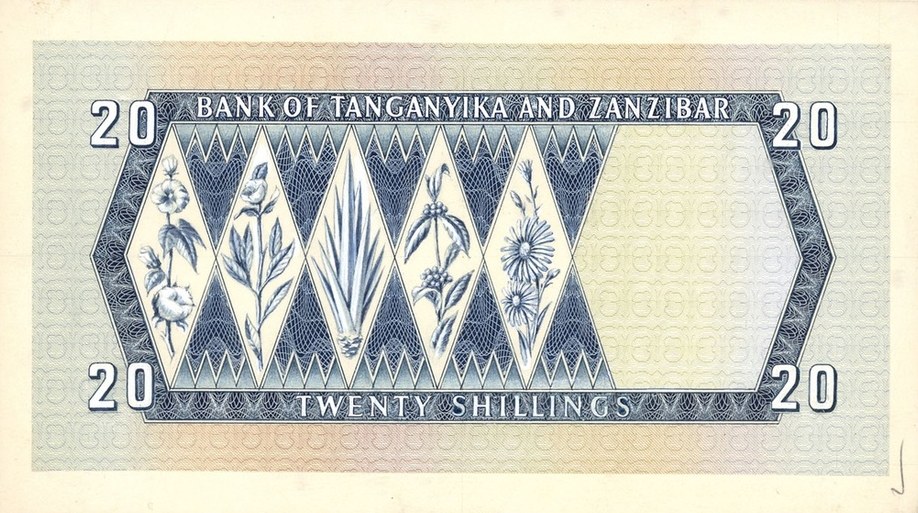
A single model of a back for a 20 shillings, on board, in blue and pale red, has BANK OF TANGANYIKA AND ZANZIBAR across the top and five diamond panels of plants, cotton and sisal among them. The archive records that the bank was proposed as the issuing authority for the union that became Tanzania in 1964, and that no note was issued under that name. The piece is not dated; "about the 1960s" is the grading company's reading.
One more: a "Bank of Nigeria"
A hand-painted essay on a large card, pencilled "Sketch for an African Note" at the top, is headed BANK OF NIGERIA, with a 10 in the upper corners and no unit. Its parts are labelled in pencil: Banana Plant, Nigerian Pattern, Palms, Line Patterns. It is recorded as of about 1960. The bank set up by the Central Bank Act of 1958 was the Central Bank of Nigeria, and that is the name on its first notes, dated 15th September 1958. Whether the sketch was a serious proposal or a printer's exercise cannot be told from the piece.
The names, side by side
| Name on the design | Date on the piece | What happened |
|---|---|---|
| Central Bank of Ceylon (pencil essays) | 1st February 1948 | The name adopted in the end |
| Reserve Bank of Ceylon | 1st January 1950; marked 24 February 1949 | The Central Bank of Ceylon opened on 28 August 1950 |
| Central Bank of Rhodesia and Nyasaland | none; about 1955 to 1956 | The Bank of Rhodesia and Nyasaland was established on 15 March 1956 |
| Federation of Rhodesia and Nyasaland Currency Board | 1st January 1960 | No board of that name issued notes |
| The West Indies; The British Caribbean Federation | 2nd January 1957; none | The federation had no currency board |
| Central Bank of the Federation of Malaya | photographed 4 December 1957 | The Board's notes stayed in use until 1967 |
| The Central Bank of Jamaica | May to June 1959 | The Bank of Jamaica issued from 1 May 1961 |
| East Caribbean Currency Board | 3rd January 1963 | The East Caribbean Currency Authority issued from September 1965 |
| Bank of Tanganyika and Zanzibar | none; the 1960s | No note under that name |
| Central Bank of the East Caribbean | marked 18-1-69 | Never established |
| Central Bank of Fiji | none; about 1974 to 1975 | The Reserve Bank of Fiji took over on 1 January 1984 |
| Bank of Nigeria | none; about 1960 | The Central Bank of Nigeria issued notes dated 15th September 1958 |
What the pieces have in common
They are finished-looking designs with nothing final in them. The numbers are 000000 or A 123456, the signature is the written word "Signature", and the circle for the watermark is blank. The printer was working ahead of the law: in Jamaica the year before the Bank of Jamaica Law 1960, in Ceylon with a date in the design ten months later than the day the photographs were marked.
And the name was the cheapest thing to change. In Rhodesia and Nyasaland the animals, the backs, the prefix letters and the Governor all went from the essays to the notes, and only the title was shortened. In Ceylon the backs outlived the Reserve Bank. In the eastern Caribbean and for the West Indies there was nothing to carry the work forward, and the photographs are all that was made.


Member comments
Log in or register to post a comment.