Before a note is printed it is a sheet of paper with a watermark in it, and the paper has a history of its own: a drawing, trials, a mould, and samples kept by the mill. The design archive of this catalogue holds 126 pieces filed as watermark samples, 95 of them for British India, from a pencil drawing of 1860 to the papers of the Reserve Bank of India in the 1940s. Many of the inscribed ones come from the archive of Portals, the papermaker, which Noonans has sold in parts since 2023. A few pieces filed under other kinds, such as sketches and a wax mould, belong with them. The inscriptions on the British India pieces were read again, word for word, on 23 November 2026.
This article follows the paper through those pieces. It says only what the sheets, their folders and the catalogue's own pages show. It does not explain how paper is made.
1860: a drawing in pencil
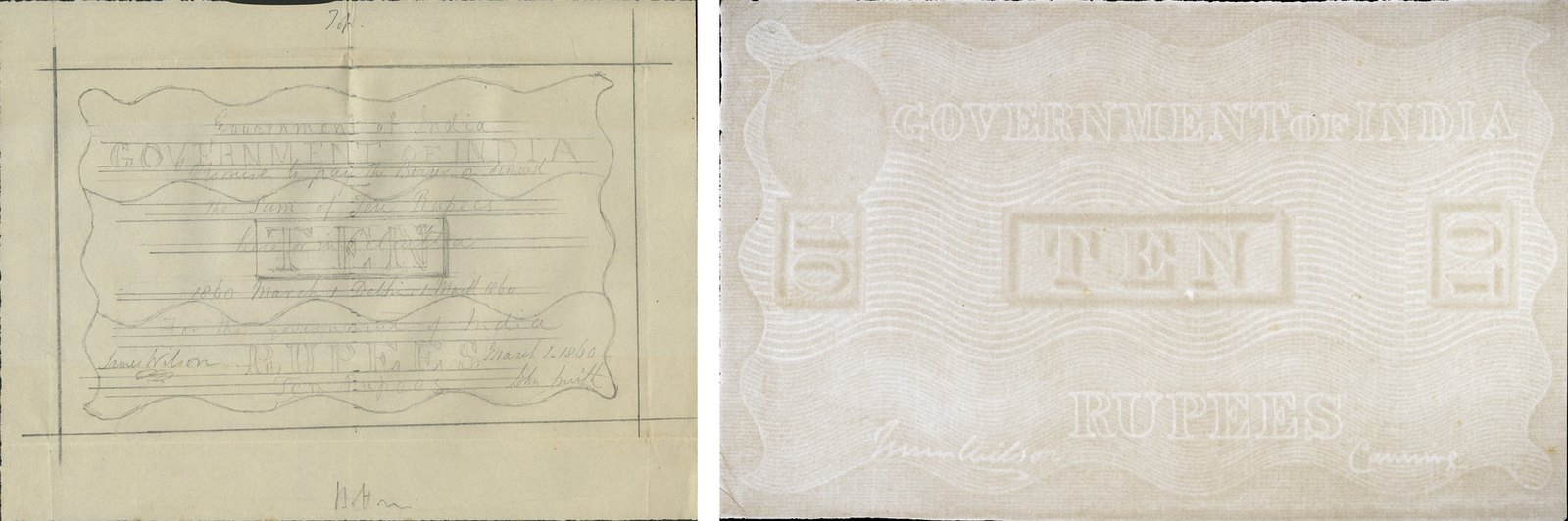
The oldest piece is the pencil design for the watermark of the first 10 rupees, the note with the portrait of Queen Victoria (P-A1). It is drawn on laid paper inside ruled lines, with "Top" pencilled at the head and "Bottom" at the foot. Inside a wavy outline it sets out the words that were to show in the paper: GOVERNMENT OF INDIA, a promise to pay the bearer the sum of ten rupees, TEN in a box, RUPEES, and the names "James Wilson" and "John Smith". It carries the date three times: "1860 March 1 Delhi 1 March 1860" and "March 1 1860".
With it are 22 trial papers on different stocks, kept in five paper folders dated 1860. Four are photographed. Two show the watermark as it was used: GOVERNMENT of INDIA across the top, TEN in a box, 10 in a box at each side, RUPEES below, and two signatures in the paper at the foot, the left one read as James Wilson and the right one as Canning. The other two have an extra word, RUES, at each side of RUPEES. Three of the four are numbered in pencil in a corner: 3/25, 1C and what looks like 3C.
1861 to 1865: four notes on a sheet
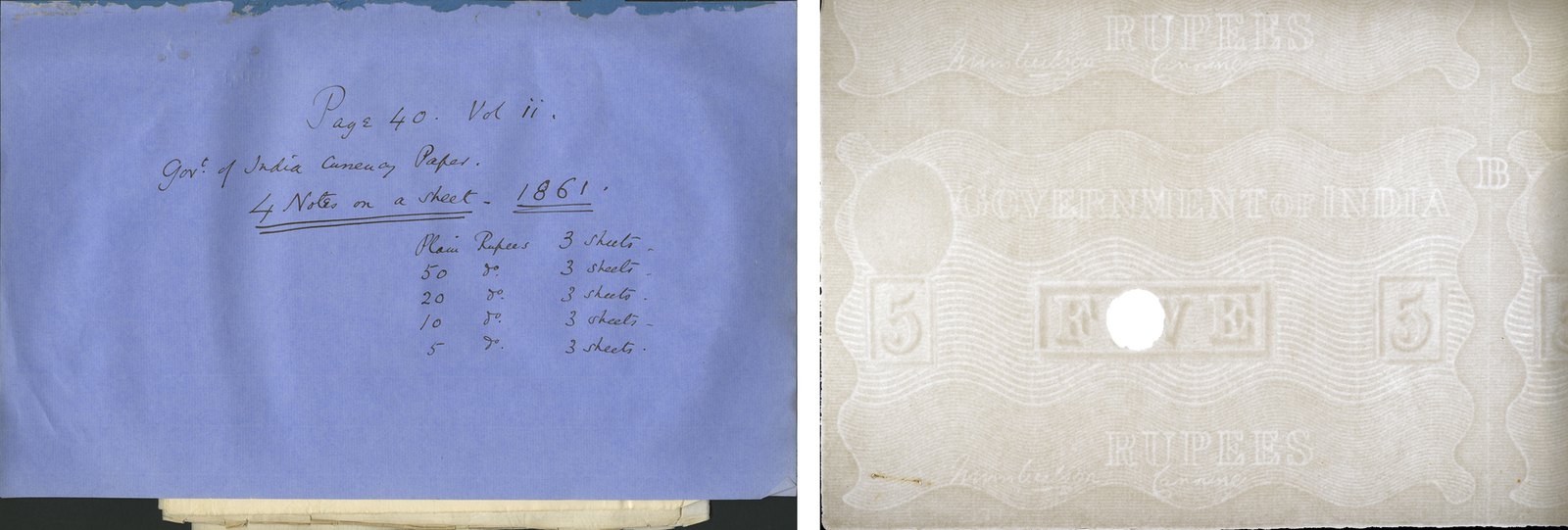
A blue folder of fifteen sheets is written in ink: "Page 40. Vol ii. Govt. of India Currency Paper. 4 Notes on a sheet - 1861." It lists its contents: three sheets each of plain rupees, 50, 20, 10 and 5. The watermark of each value has GOVERNMENT of INDIA, the value in words in a box, the figure in a box at each side, RUPEES above and below, and two signatures. The plain sheets have the same watermark with no value. A letter, A or B, stands in the paper beside each note pictured. A round hole is punched through most of the sheets pictured, on three of them through the value.
The page and volume numbers come back on later pieces: "P.43. Vol iii." on a folder of 1914, "P. 96. Vol: 3" on an envelope of about 1917. They look like references to the mill's own sample books. That is our reading of them; no piece says so.
Two more papers belong to the Victoria portrait notes. A trial dated in pencil "June/64", with the word "Thin" under the date, has TEN in a panel inside a triple wavy border. An uncut pair without a value is annotated on the back "Indian Currency note paper May 1865", and Noonans records that it was approved by a letter of 13 April 1865.
1866 to 1876: trials, and paper that carries its own date
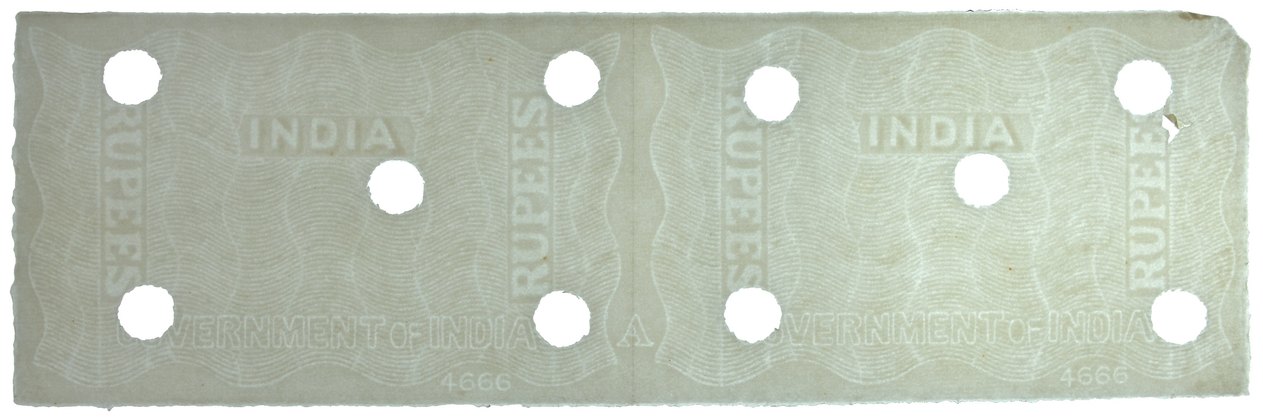
The notes that followed the portrait issue were printed on one side only, and their paper was a new one: INDIA in a panel at the top, RUPEES in a panel at each end and GOVERNMENT OF INDIA along the foot, in a field of wavy lines. An uncut pair has the figures 4666 in the paper under each note, which Noonans reads as the 46th week of 1866, and a letter A between the two. Another paper of the same kind has the letter H and 0576, and a 10 rupees paper has a V and 0323. The catalogue's pages on the notes themselves say the same of the printed notes: the paper carries a mould letter and then the week and the year it was made, so that A 41 06 is week 41 of 1906 (see the 10 rupees of 1910 to 1920).
A pair of two late trials has the words TRIAL SHEET in the paper under each design, with a letter H under one and A under the other.
For the 5 rupees there are three Portals sheets of trial watermarks: one with eight panels, a second that differs from it in two panels, and one with four designs on a sheet ruled into ten. The panels try INDIA, FIVE RUPEES, 5 RUPEES 5 and a large 5 in different frames. None is the watermark that was adopted. Each sheet has the word TRIAL and a number in the paper along its left edge: 9171, 62971, and one whose first figure is unclear, ?2671.
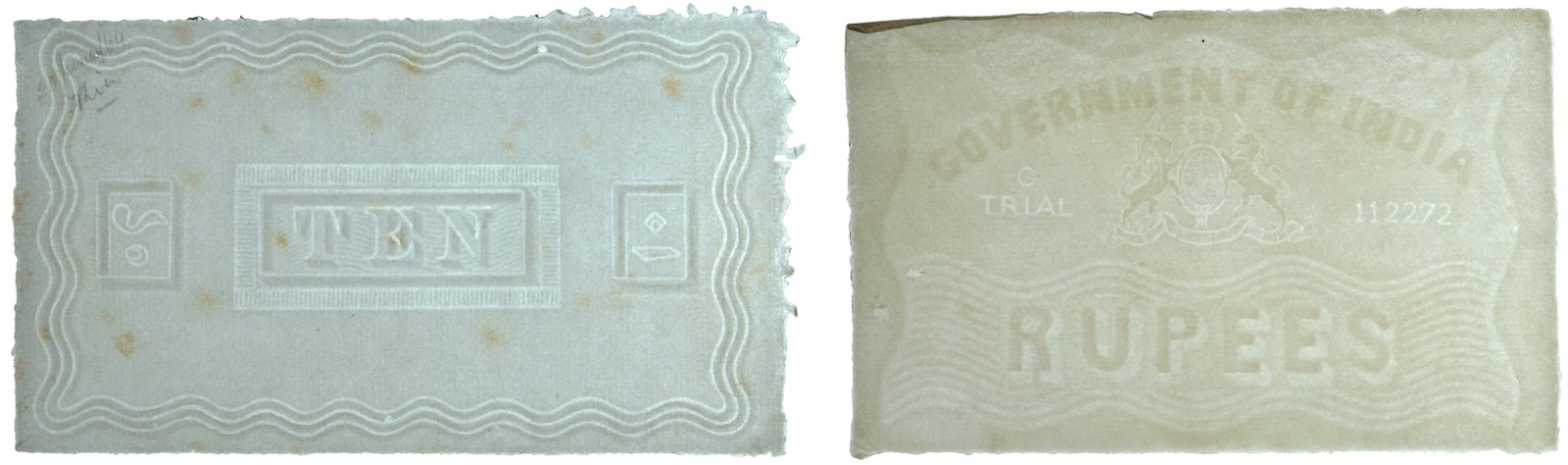
Two more trials carry such numbers. A pair for the 5 rupees has 51671 and TRIAL in the paper and a pencil date, "Augt 8.71", in the corner. A sheet with GOVERNMENT OF INDIA arched over the royal arms, a design that was never used, has C, TRIAL and 112272, and Noonans dates it circa 1872. All of these numbers end in 71 or 72. If they are dates, the three sheets of trials for the 5 rupees are of 1871, the year the 5 rupees was first issued, and not of about 1866, as they are dated in the catalogue now. That is a possibility we raise, not a finding.
Two trials show designs that went nowhere: INDIA between two borders of grape vines, and a large pair with INDIA over the royal arms, which Noonans thinks was meant for bills of exchange or bonds and not for notes.
1914 to 1917: the Star of India
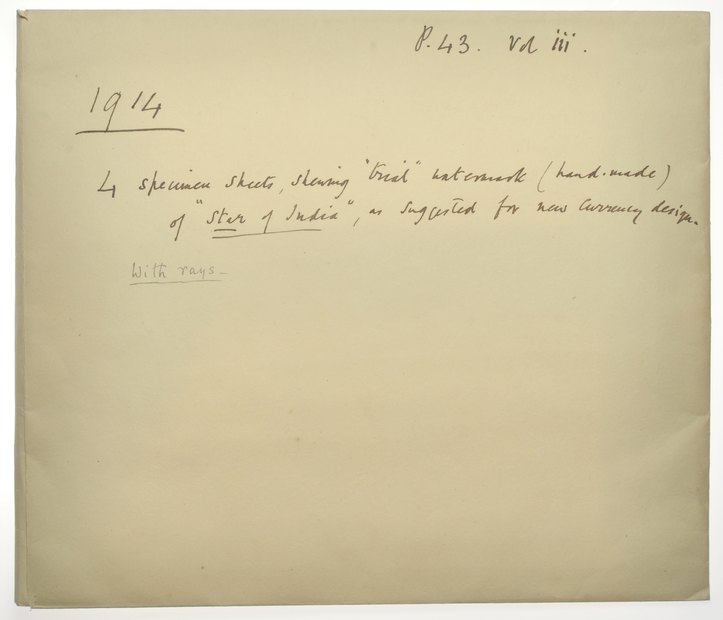
The small notes of 1917 brought a new kind of watermark: a device in a clear window, left unprinted on both sides. The Controller of the Currency's report for 1923-24 calls the 1 rupee and the 2 rupees 8 annas the trial of a new pattern decided on before the war, and the archive has the paper trial that goes with those words. A folder marked "P.43. Vol iii." and "1914" holds, in its own words, "4 specimen sheets, shewing 'trial' watermark (hand-made) of 'Star of India', as suggested for new Currency design", with "With rays" added in pencil. Each sheet has two versions of a rayed star and the words TRIAL 7 9 14 in the paper.
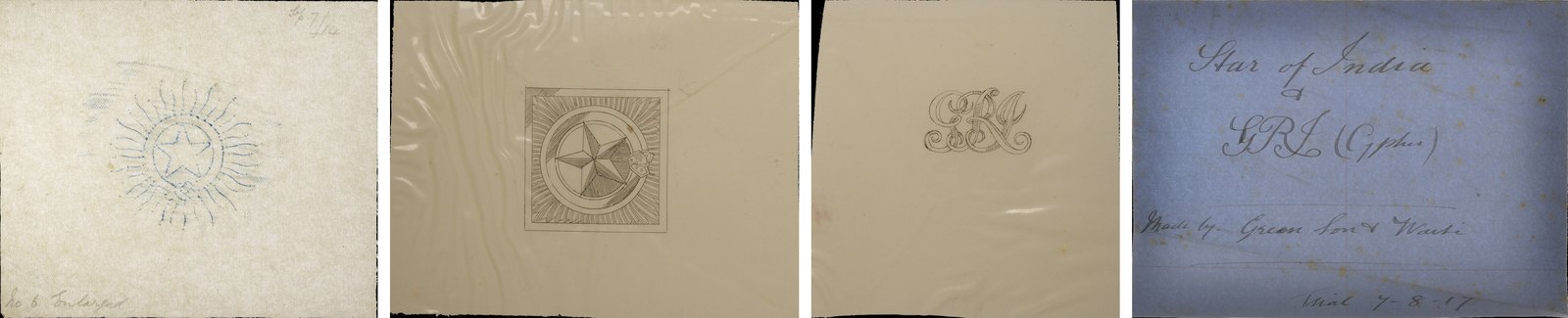
Three years later the star was being worked up for the 1 rupee. One group holds two workings of the rayed star on paper, one marked "No 6 Enlarged"; two ink drawings on a glossy film, the star in a roundel inside a rayed square and the script cypher GRI; and a blue sheet written in pencil "Star of India & GRI (Cypher)", "Made by - Green Son & Waite", "Trial 7-8-17". The pieces do not say what Green Son & Waite made.
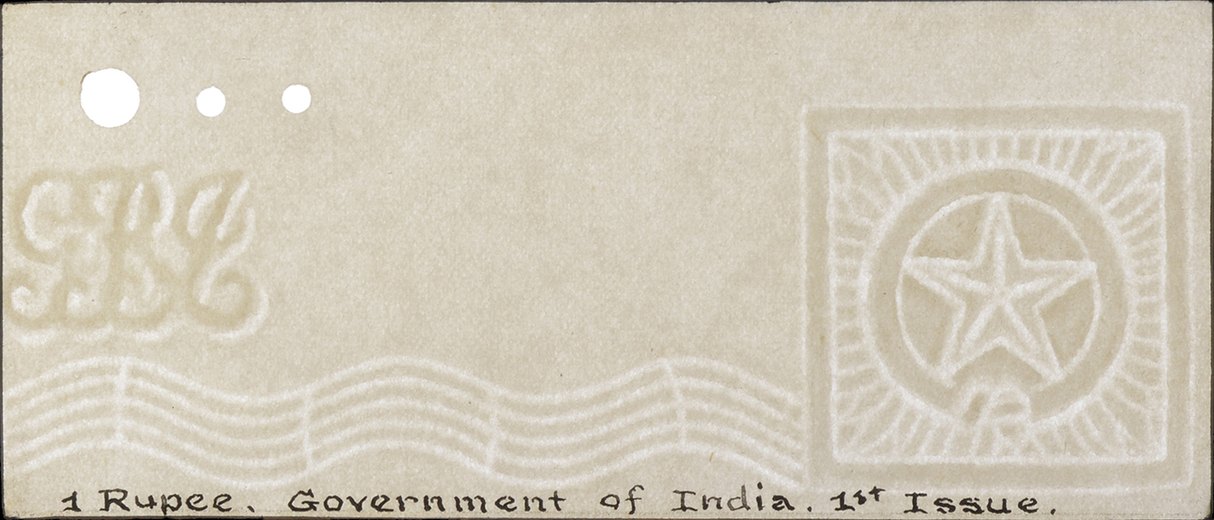
The last piece of the group is the paper itself, lettered "1 Rupee. Government of India. 1st Issue." The star in a square is one of the two watermarks of the note. A folder of whole sheets holds both: the "old" watermark with the star in its square, and the "new" one with the star in a sunburst and no square. On the page of the 1 rupee the same difference splits the rows of the note.
The paper of the older notes was still being made beside the new. An envelope marked "P. 96. Vol: 3" holds "1 Sheet 10 Rupee paper", "Machine made [not cut quite square]", one of six sheets of which five were sent to the Bank by hand. Its date is 12 November, and the year is probably 1917.
Hand made, mould made, machine made
The mill wrote on its samples how the paper was made, and the words change. The trial of 1914 is "hand-made". The 10 rupees sheet of about 1917 is "Machine made". A sheet for the 10 rupees of 1923, with the star in a box and the GRI cypher repeated across it, is annotated "10 R. Mould made. 1924". A 100 rupees paper with a date of 1925 in it is annotated "100 Rupees, Govt of India Note. Hand Made." The pieces give the words and no more; they do not say what set one kind of paper apart from another.
Trials went on in the same years. Two papers for the 50 rupees and two for the 100 rupees have the words that were adopted, GOVT OF INDIA, with a larger bust of George V in robes than the head that was used. The 50 rupees trials are annotated in pencil with a date of 1925.
A wax mould
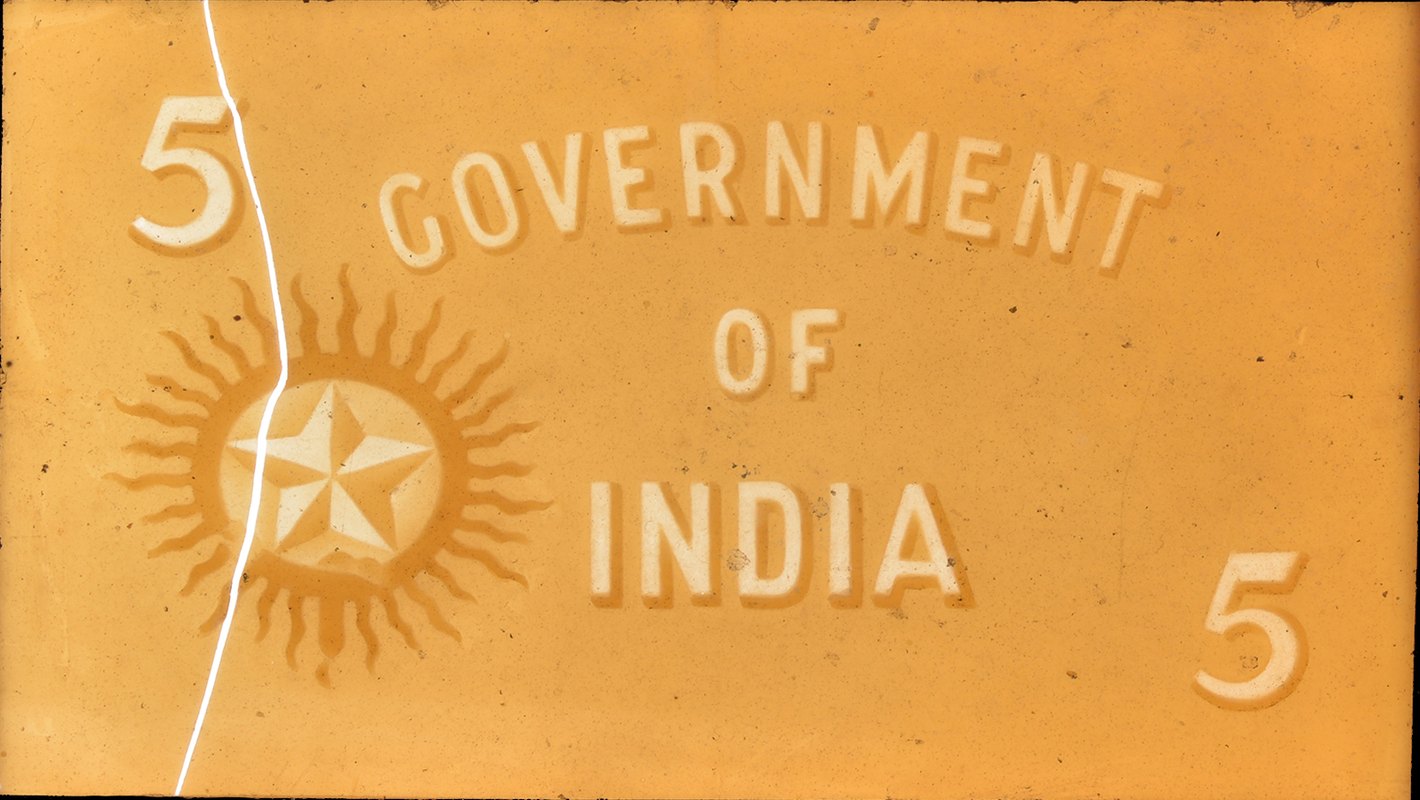
One piece is not paper. The catalogue records it as the original wax mould from which the watermark of the 5 rupees paper was made: a slab of amber wax between two panes of glass, showing in relief 5 at the upper left, GOVERNMENT OF INDIA, a star in a rayed sun, and 5 at the lower right. It reads the right way round. There is one crack in the wax, from the top through the star. The same design is in the paper of the 5 rupees of 1933.
The mill's samples: a frame, a title, three holes
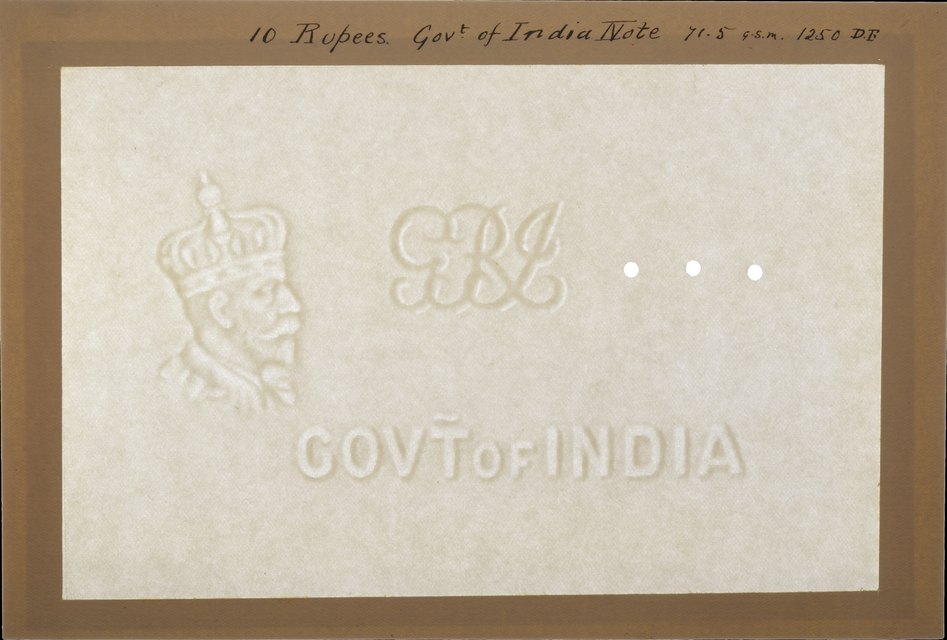
The mill's samples of the papers from 1917 on take one form. A piece of paper the size of a note is glued into a card frame, blue, black or cream. Three small holes are punched through it. A title is lettered in ink at the foot or on the frame, and often a number stands in a corner.
The titles name an "Issue":
| Value | Title on the sample | Watermark |
|---|---|---|
| 1 rupee | "1 Rupee. Government of India. 1st Issue." | star in a square, GRI cypher |
| 1 rupee | "1 Rupee India (2nd Issue)" | head of George VI |
| 5 rupees | "5 Rupees, Government of India (4th Issue)" | star in a sunburst, GOVT OF INDIA |
| 5 rupees | "5 Rupees, Government of India (5th Issue)" | star, GOVERNMENT OF INDIA, 5 in two corners |
| 5 rupees | "5 Rupees, Reserve Bank of India (6th Issue)" | George VI in profile, RESERVE BANK OF INDIA |
| 5 rupees | "5 Rupee India. (1946 Issue)" | George VI facing |
| 10 rupees | "10 Rupees, Government of India (6th Issue)" | head of George V, GRI, GOVT OF INDIA |
| 10 rupees | "10 Rupees, Government of India (7th Issue)" | head of George V, TEN RUPEES GOVERNMENT OF INDIA TEN RUPEES |
| 10 rupees | "10 Rupees, Reserve Bank of India (8th Issue)" | George VI in profile |
| 10 rupees | "10 Rupees India (1944 Issue)" | George VI facing |
| 50 rupees | "50 Rupees Government of India. 4th Issue." | head of George V in a wavy border |
| 100 rupees | "100 Rupees, Government of India. 2nd Issue." | wavy lines, 100, RUPEES, GOVERNMENT OF INDIA |
| 100 rupees | "100 Rupees, Government of India. 4th Issue." | head of George V in a wavy border |
| 100 rupees | "100 Rupees, Government of India (5th Issue)" | head of George V, no border |
| 100 rupees | "100 Rupees, Reserve Bank of India (6th Issue)" | George VI in profile |
| 100 rupees | "100 Rupees India. (5th Issue.)" | George VI facing |
| 1,000 rupees | "1000 Rupees, Reserve Bank of India. 4th Issue." | George VI in profile, chain border |
| 10,000 rupees | "10,000 Rupees, Government of India. 3rd Issue." | head of George V, Rs 10,000 Rs |
| 10,000 rupees | "10,000 Reserve Bank of India. 4th Issue." | George VI in profile, Rs 10,000 Rs |
Within each value the numbers rise as one paper follows another, and the numbers of one value do not match those of the next. So the mill seems to have counted the papers it made for each value. One title is out of step: the 100 rupees paper with the facing portrait is the "5th Issue", though the paper with the profile that came before it is the 6th. The 4th and 5th Issue papers of the 100 rupees of George V are the two that the note's page describes, one with a border of wavy lines round the sheet and one without; when the archive was sold, the bordered paper was described as the one used for the printing made in the United Kingdom.
Other titles give a weight in place of an issue: "71.5 g.s.m." or "71.5 Grs Sq M." on papers of 5, 10 and 100 rupees, "54 Grs Sq M." on a 100 rupees of the Reserve Bank, "70.5 Grs Sq.M." on the facing-portrait 10 rupees. Some add letters the pieces do not explain: "1250 D.F" and "1250 D.E" after the weight, "F.F." before it.
The corner numbers follow the value. The 5 rupees papers are numbered 46, under the Government of India and under the Reserve Bank alike; the 10 rupees papers 47, and one 47A; the 100 rupees papers 48. The 1 rupee of 1940 is 222, and the facing-portrait papers of 10 and 100 rupees are 247 and 274. Whatever the number counts, in India it stayed with a value while the watermark changed from a star to the King's head.
The holes are not always three in a row. Of three pieces of one 10 rupees paper, one has three holes at the top, one has two, and one has six along the foot.
The Reserve Bank's paper, and a wreck
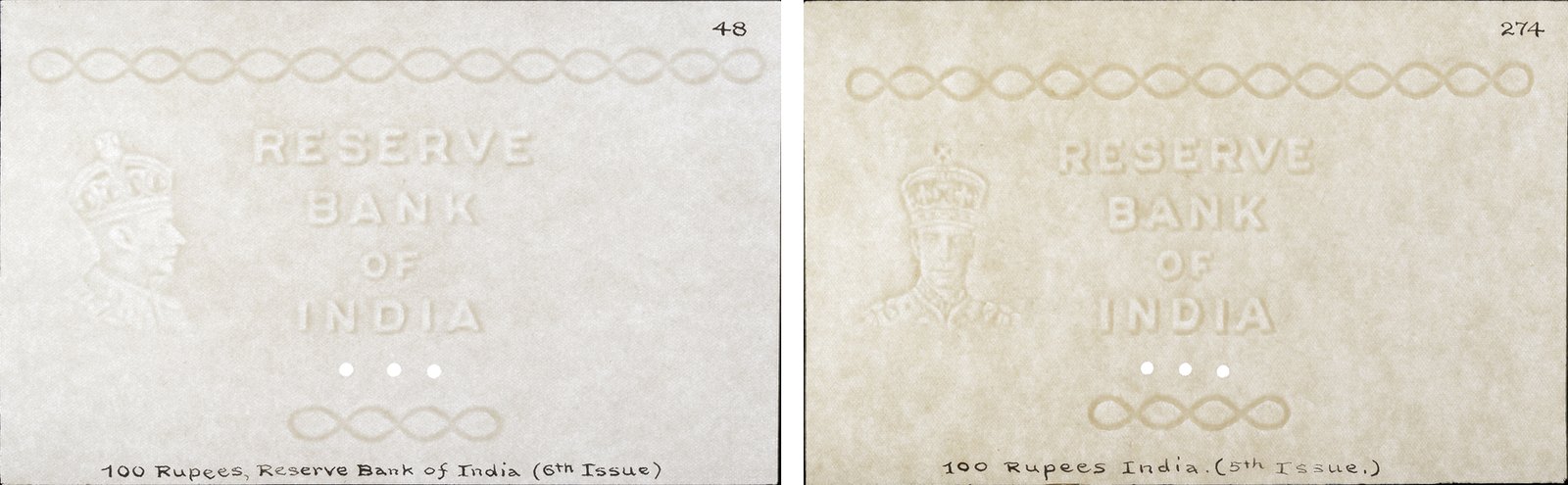
The papers of the Reserve Bank's notes show the head of George VI, first in profile and then facing, with the value and RESERVE BANK OF INDIA in words. Besides the mill's samples the archive holds many loose pieces of the 5 and 10 rupees paper, single, in pairs, in blocks of four and in whole sheets, and it can say where a good part of them came from.
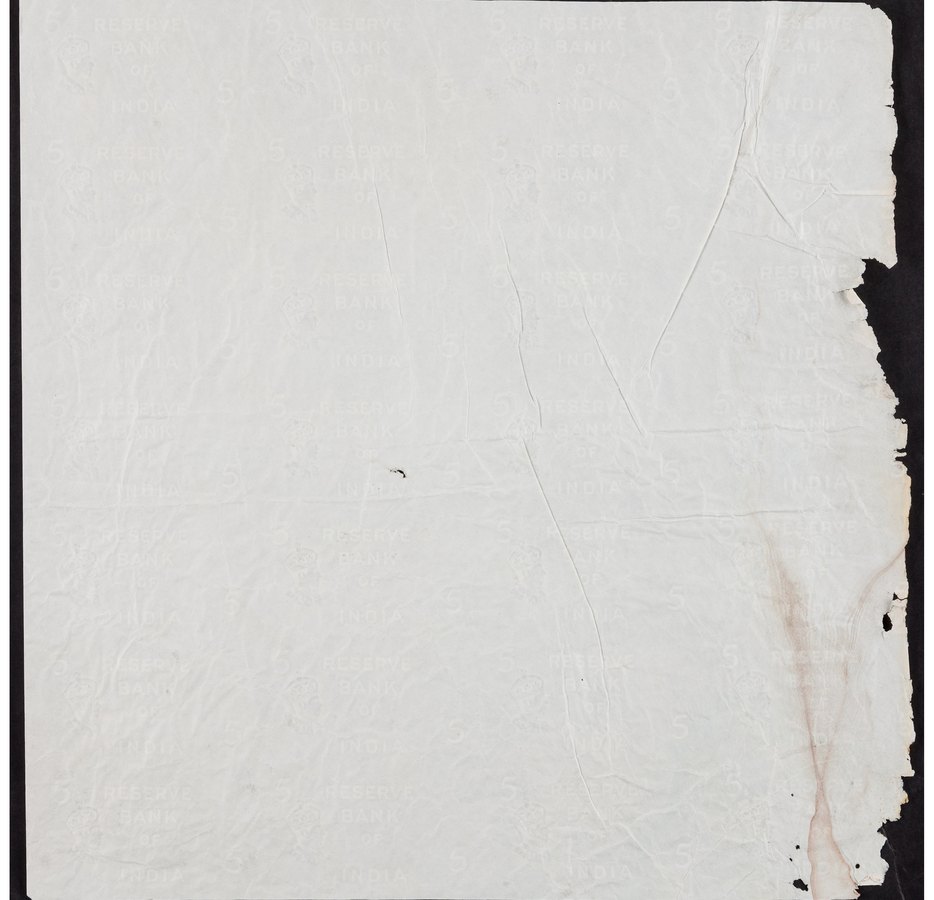
Two complete sheets, one of 50 pieces for the 5 rupees and one of 40 for the 10 rupees, were sold by Spink as paper made by Portals and salvaged from the S.S. Breda, which sank in December 1940 on its way to India. Two more were sold by Heritage Auctions, whose text says that divers of a local club found the cases of paper. Other lots are described only as recovered from a shipwreck: 22 sheets of the 5 rupees and 8 of the 10 rupees in one sale, and in another some 4,100 pieces cut into bundles of 100. Blank paper cannot be matched by eye, so the catalogue keeps each lot apart and does not say that any two are the same sheets.
One line on a note's page belongs to the same year. Sources mention that the paper of the 1 rupee of 1940 was ordered from Portals early in 1940 and shipped to the press at Nasik. The sample of that paper is the one titled "1 Rupee India (2nd Issue)".
The same mill, other territories
The Portals samples for other territories are made up in the same way: the frame, the title, the three holes and the number.
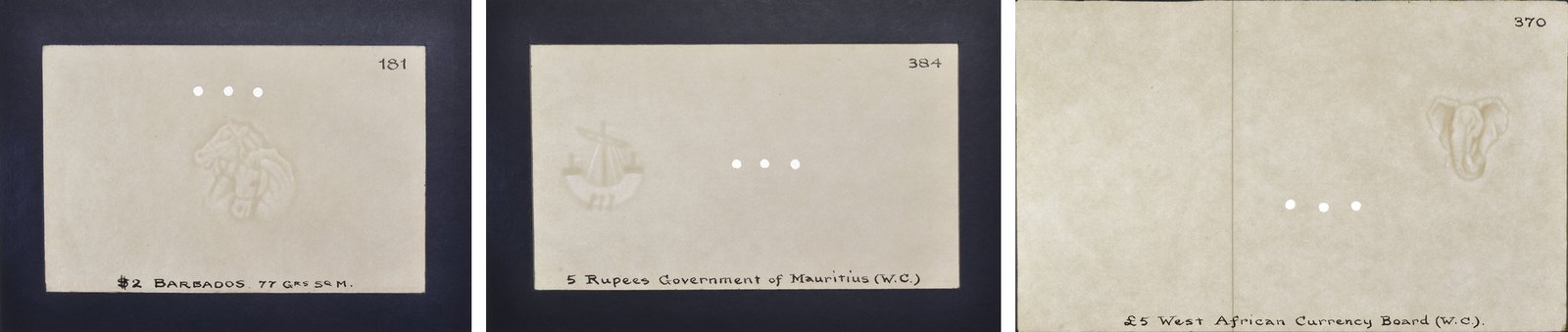
- Barbados. One sample for the 1 dollar and two for the 2 dollars of 1938 to 1949, in blue card. The catalogue describes the watermark as the heads of a pair of hippocampi, a little larger on the 2 dollars. The two 2 dollars samples are both numbered 181; one is titled "$2 Barbados" and the other "$2 Barbados. 77 grs sq m."
- British Caribbean Territories. Six samples on black card, one mount with the imprint PORTALS LIMITED. Three have the sailing ship and three the head of Queen Elizabeth II, with titles that date the change: "British Caribbean (1953). W.C." on the ship, "British Caribbeans Currency Board (1954) - 83 G.S.M." on the Queen. The numbers are 327, 377 and 413.
- British West Africa. Two samples for the 10 and 20 shillings of 1928 to 1951, with the palm tree and the Board's name in an arc, and three for the notes of 1953 to 1962, numbered 368, 369 and 370, with an elephant's head and a security thread in the paper. An earlier pair is from another mill: T. H. Saunders, whose own cancellation, SPECIMEN / T.H.S. & CO. LD, is perforated through one piece.
- Mauritius. Three samples for the notes of 1954, numbered 384, 385 and 386, with a sailing ship. The third is titled "25 & 1000 Rupees": one paper served both values.
- Malaya and British Borneo. Four lots of samples with a lion's head and a dashed thread, titled for the Malayan Currency Board at "83 G.S.M." and numbered 371, 373, 389 and 407. Here too one paper serves two values: the 50 and 100 dollars, and the 1,000 and 10,000 dollars.
- Palestine and Guernsey. A sample for the 1 pound with the olive sprig, at 75 grams, and a sample lettered "States of Guernsey", numbered 138.
Several of these titles end in "(W.C.)" or "W.C.". The pieces do not say what the letters stand for.
Straits Settlements: from a design to the paper
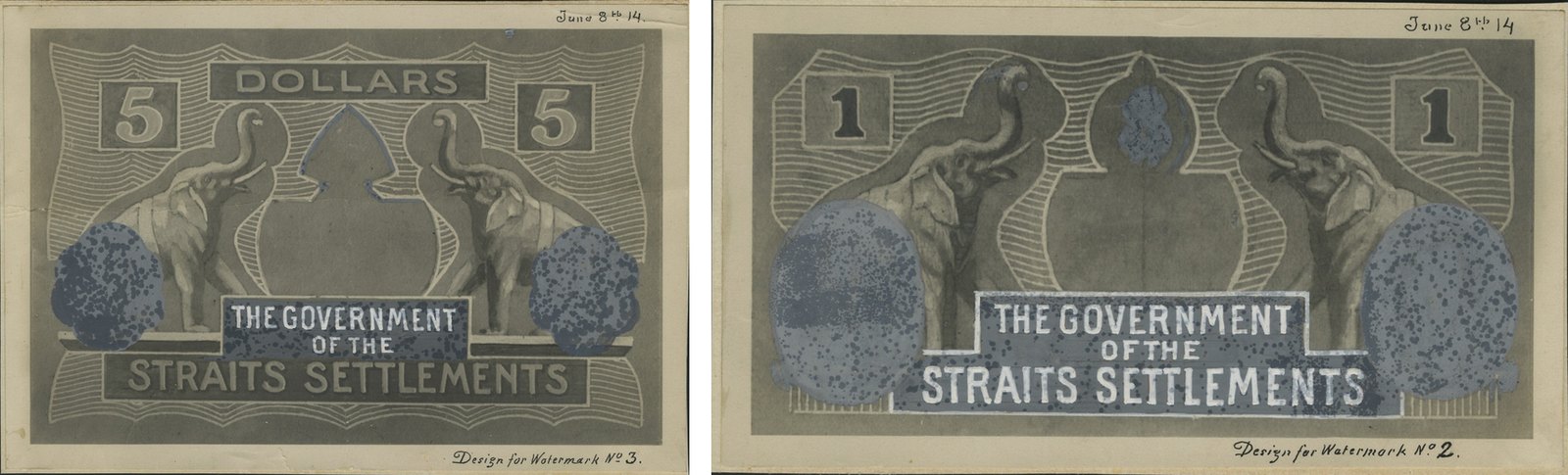
For the Straits Settlements the archive has the stage before the paper. Three photographs touched in by hand, each dated "June 8th 14" in ink, are designs for a watermark: two elephants facing a shield, THE GOVERNMENT OF THE STRAITS SETTLEMENTS below and the value in the corners, for the 5 dollars and the 1 dollar, and a third with leaf work. They are numbered as designs, "Design for Watermark No 3" and "No 2". They come from the collection of Frank Goon.
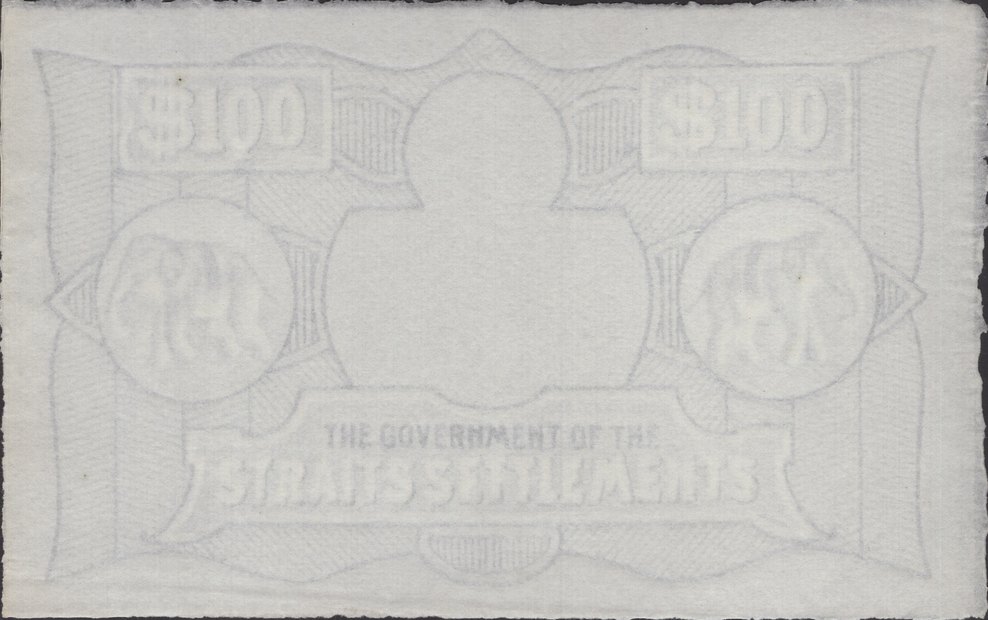
The elephants became the watermark of the large notes of 50 dollars and above from 1916. The archive has the paper of the 100 dollars, with an elephant in a roundel at each side and a blank oval in the middle for the portrait, and two sheets of the 50 dollars, one handstamped CANCELLED and one perforated CANCELLED.
Designs kept by the printer
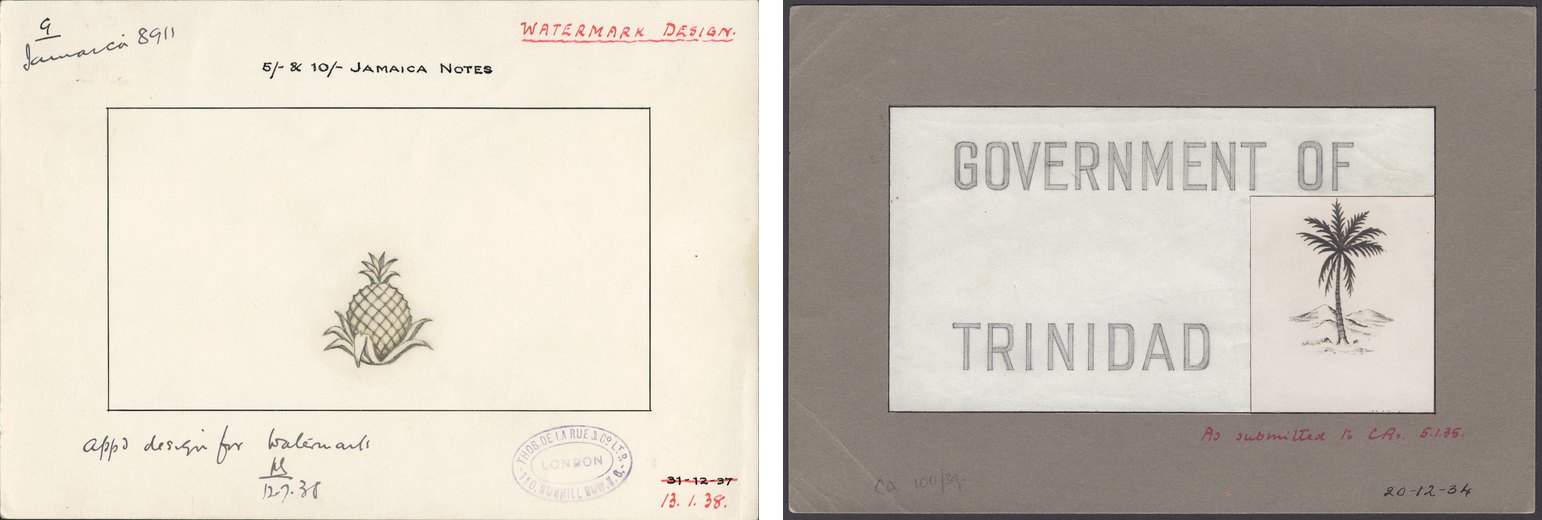
Two watermark designs are recorded under a printer, De La Rue, and not under the mill. The design for the 5 and 10 shillings of Jamaica, a pineapple drawn in pencil and wash, is headed WATERMARK DESIGN in red, carries the oval stamp of De La Rue, and is endorsed "appd design for watermarks" with initials and the date 12.7.38. The first notes on paper with this watermark are dated 2nd January 1939. The design for Trinidad, GOVERNMENT OF TRINIDAD lettered in pencil with a palm tree and hills, is dated 20-12-34 and marked in red "As submitted to CA 5.1.35"; it is the watermark of every note of the issue of 1935 to 1949.
Other territories have paper without a mill's name: a sheet for four 5 rupees of Ceylon with 1887 pencilled at the top, and the paper of the first 5 pounds of Mauritius, with "Cancelled" written across it in red ink. There are also unprinted papers for the Cyprus notes of 1917, for the Malta 2 and 5 shillings of 1918 and four more sheets for Ceylon, some of them perforated SPECIMEN.
What the pieces do not tell us
- How any of these papers was made, beyond the mill's own words "hand-made", "mould made" and "machine made".
- What the corner numbers count, and what "W.C.", "F.F.", "D.F" and "D.E" stand for.
- Who Green Son & Waite were, and what they made in 1917.
- Whether the numbers on the trial sheets (9171, 62971, 51671, 112272) are dates.
- Which printing of a note was made on which paper. The reports of the Controller of the Currency for 1926 to 1929, which record the move of printing to Nasik, say nothing on paper or watermark; and the Currency Department's report for 1910-11, writing of forged notes, says only that genuine paper is watermarked when it is made, in England.
Member comments
Log in or register to post a comment.