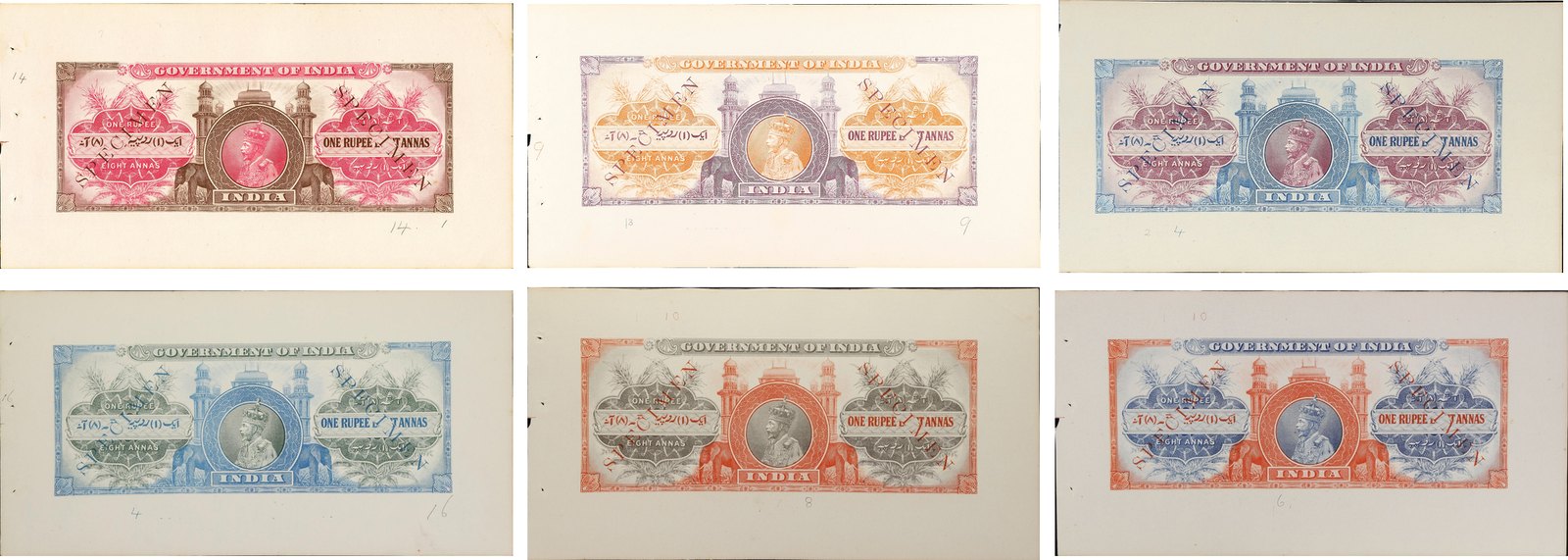
British India never issued a note of 1 rupee 8 annas. A design for one was engraved all the same, with King George V between two elephants, and it survives as a set of sheets on which the same plates were printed in one pair of colours after another. The design archive of this catalogue holds twenty-four of them: twenty-three with the King's portrait, no two in the same colours, and one with the portrait left out. All twenty-four were looked at again on 23 November 2026, sheet by sheet, for an audit of the archive. This article sets out what is on them.
The design
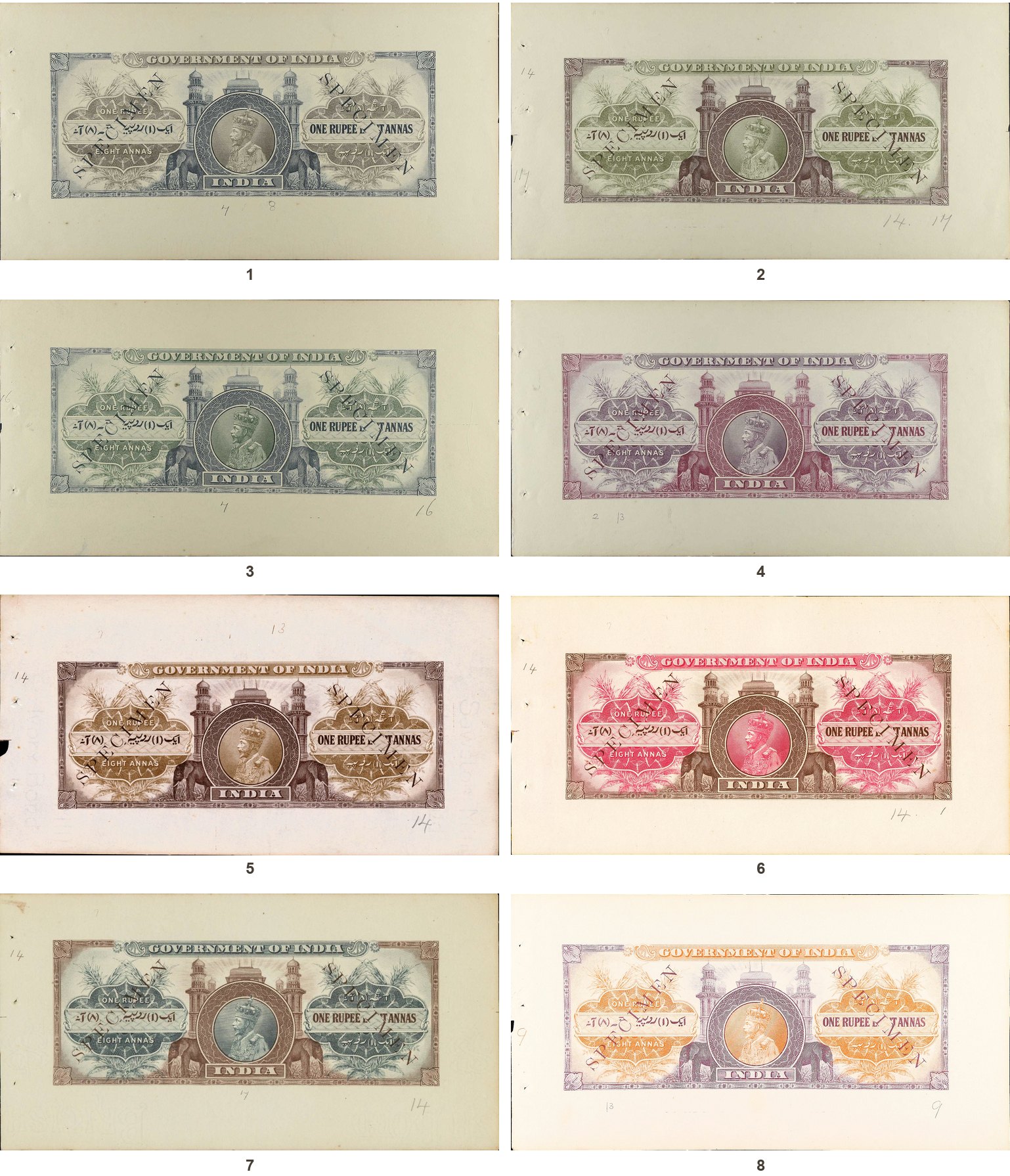
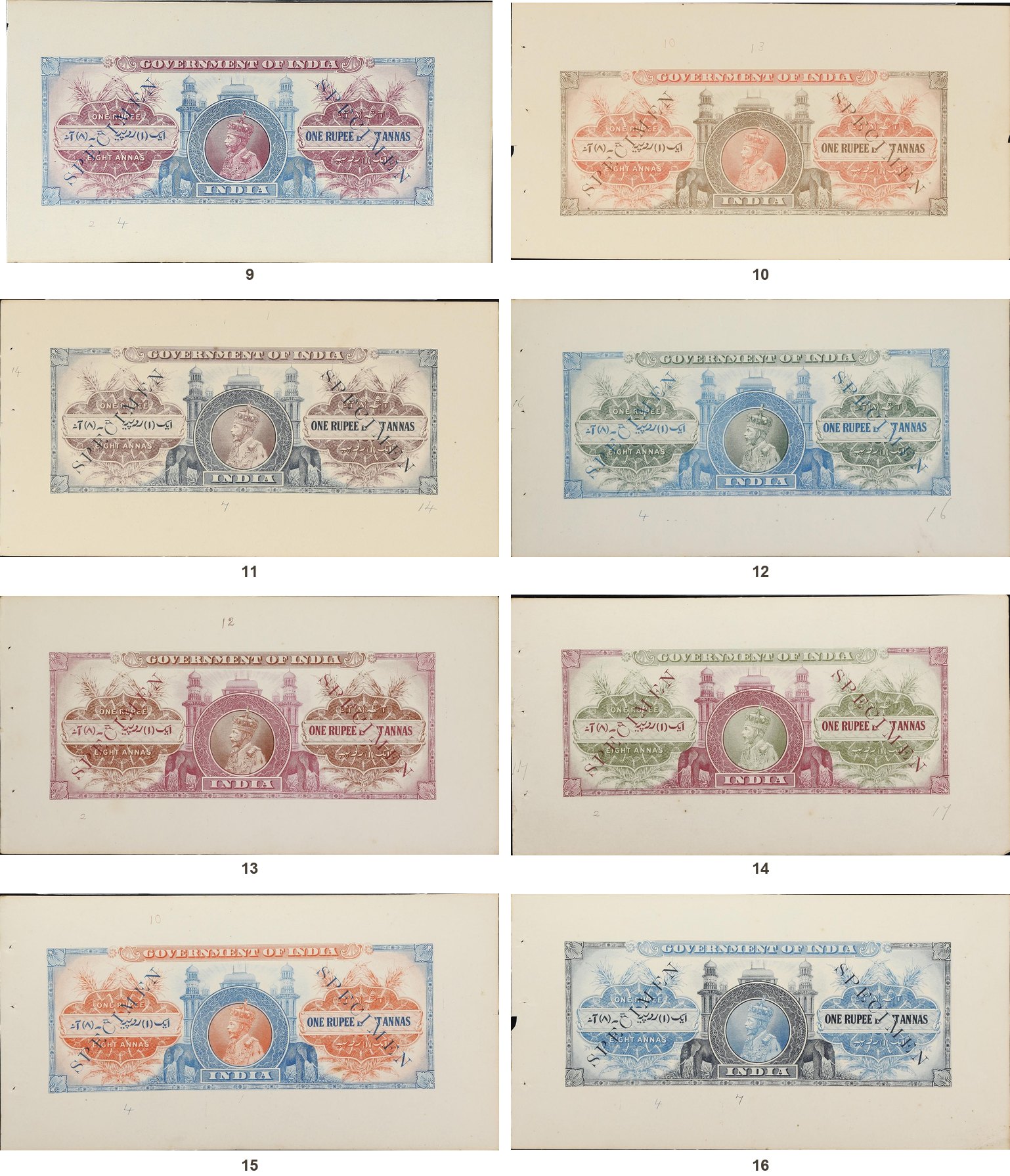
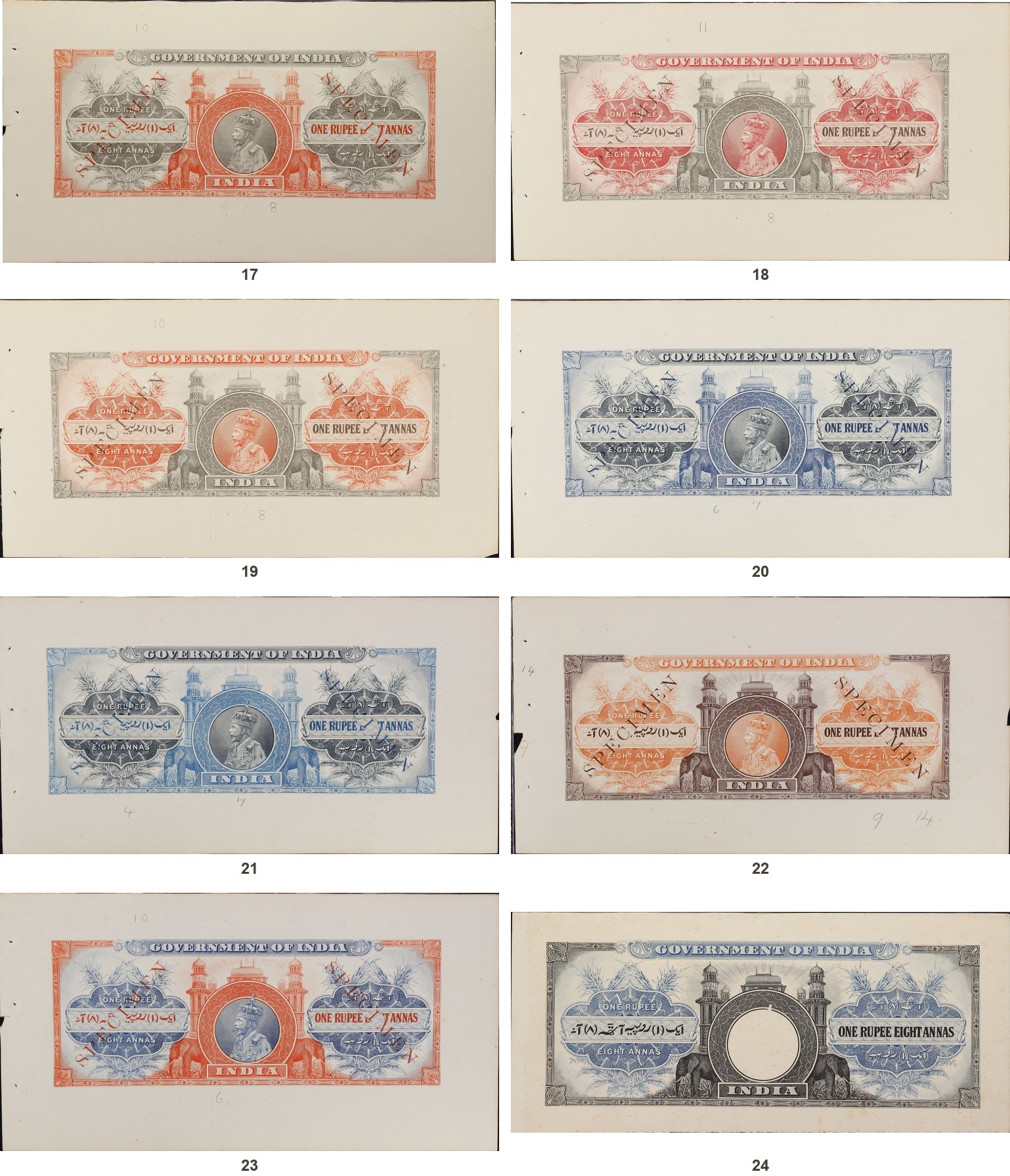
Every sheet shows the front only, printed on a sheet larger than the design, and the backs are blank. GOVERNMENT OF INDIA stands in a tablet at the top and INDIA in a tablet at the foot. In the middle a crowned portrait of George V sits in a roundel, with an elephant at each side in front of a domed building with two minarets. The value is in the side panels: ONE RUPEE and EIGHT ANNAS in English with the Urdu between them at the left, ONE RUPEE EIGHT ANNAS and the Urdu at the right.
There is no serial number, no signature, no date and no printer's name on any of them. Twenty-three are overprinted SPECIMEN twice, slanting across the two side panels.
Each sheet is printed in two colours. One colour takes the title, the two side panels, the portrait and the foliage: the table calls it the centre. The other takes the outer frame, the building, the elephants, the ring round the portrait and the INDIA tablet: the table calls it the frame.
Twenty-four sheets
The colour words below are ours, from the photographs. Auction houses and grading companies have used others for the same sheets. The pencil numbers are given as they were read on 23 November 2026, with their place on the sheet.
| No. | Centre | Frame | Pencil numbers | Page |
|---|---|---|---|---|
| 1 | brown | slate blue | 7 and 8 below | open |
| 2 | green | brown | 14 and 17 in the left margin; 14. 17 below | open |
| 3 | green | blue-grey | 16 at left, 7 below, 16 at lower right | open |
| 4 | purple | magenta red | 2 and 13 below | open |
| 5 | golden brown | purple-brown | 13 above, 14 at left, 14 at lower right | open |
| 6 | rose red | brown | 14 at left; 14. 1 below | open |
| 7 | slate blue | red-brown | 7 above, 14 at left, 7 (or 17) below, 14 at lower right | open |
| 8 | yellow-orange | purple | 9 at left; 13 and 9 below | open |
| 9 | claret | light blue | 2 and 4 below | open |
| 10 | orange-red | grey-brown | 1, 10 and 13 above | open |
| 11 | brown | slate blue-grey | 1 above, 14 at left, 7 below, 14 at lower right | open |
| 12 | olive green | light blue | 16 at left, 4 below, 16 at lower right | open |
| 13 | orange-brown | magenta | 12 above, 2 below | open |
| 14 | olive green | crimson | 17 at left, 2 below, 17 at lower right | open |
| 15 | orange-red | blue | 10 above, 4 below | open |
| 16 | light blue | slate black | 1, 4 and 7 below | open |
| 17 | grey-black | orange-red | 1 and 10 above, 8 below | open |
| 18 | red | grey | 11 above, in red; 8 below | open |
| 19 | orange-red | grey | 10 above, 8 below | open |
| 20 | grey-black | deep blue | 6 and 17 below | open |
| 21 | grey-black | light blue | 4 and 17 below | open |
| 22 | orange | dark brown | 14 and 9 in the left margin; 9 14. below | open |
| 23 | blue | orange-red | 10 above, in red; 6 below | open |
| 24 | blue, no portrait | black | none seen | open |
Some pairs are close. Nos. 18 and 19 are two reds on the same grey, Nos. 20 and 21 two blues round the same grey-black, and Nos. 6 and 13 use a red and a brown with their places changed. Nos. 1 and 11 are both a brown inside a slate blue, and on the photographs the browns differ. No two sheets carry the same set of pencil numbers.
Essay, colour trial or proof: what the holders call them
All but one of the sheets are in grading holders (No. 5 is not; No. 7 is recorded as PMG 53, but its label is not among the pictures), and the labels do not agree on a name. They are quoted here word for word.
- Nos. 1 to 4, in holders of PMG with the GANDHI COLLECTION label: "Printers Essay", "Pick# Unlisted1 Circa. 1917 - 1935 1 Rupee / 8 Annas", "Government Of India". The backs of the same labels call them colour trials: "Blue, Brown Color Trial", "Green, Brown Color Trial", "Green, Blue Color Trial" and "Purple, Red Color Trial". Three of the four backs add "Printer's Pencil Annotation".
- No. 8, PMG: "ND (ca. 1917-35) 1 Rupee, 8 Annas", "PROOF", with "Selvage Included" and a line on the Specimen overprint on the back.
- Nos. 6 and 9 to 23, in holders of PCGS: "India - British / Government of India - Face Proof", "Pick # Unlisted ND (1917-30) 1 Rupee 8 Annas - SPECIMEN Overprints", "Serial # N/A". Nine of these labels add "Printer: Security Press, Nasik (w/o imprint)", and several "George V at Center". The backs of eight of them say "As Made Binding Holes", and two of those "Printer's Annotations".
- No. 24, PCGS: "1 Rupee 8 Annas - Without George V", "Printer: Security Press, Nasik (w/o imprint) No Overprints", and on the back "Previously Mounted, Hinges".
So the same thing is an essay, a colour trial, a proof and a face proof, dated circa 1917 to 1935 on one label and 1917 to 1930 on another. The catalogue files all twenty-four as essays for a design that was not adopted, and dates them circa 1917-1935, which is the widest of the spans on the labels. It has no document that narrows it.
The printer is no more certain. The sheets carry no imprint, as the PCGS labels say themselves, and the labels do not say what the name of Nasik rests on. The sources this catalogue has read put the opening of the note press at Nasik on 14 April 1928 (the Controller of the Currency's report for 1928-29). They say nothing of essays made there.
A book of sheets
The sheets were once bound together. Nearly all have three small holes down the left edge, which PCGS calls binding holes "as made", and several have a notch in the same edge. When Stack's Bowers sold five of them at Chicago in August 2011 (Nos. 2, 3, 7, 4 and 1, in the order of the lots), the house described them as five essays from an original booklet, all five offered in that sale. No. 9 shows no holes and has a narrower left margin than the others. No. 24 has three hinges on its back.
The certificate numbers tell the same story of sheets kept together. Nine of the PCGS holders run without a gap from 56248048 to 56248056, and seven more from 59099048 to 59099054. The four PMG holders of the Gandhi Collection are numbered 1200609-001 to 1200609-004.
Two sheets are said to be on watermarked paper: No. 5, by the Lyn Knight sale of 2012, and No. 7, on which Stack's Bowers read BRITISH BOND in the paper. Nothing in the catalogue suggests the paper is that of an issued note.
The pencil numbers
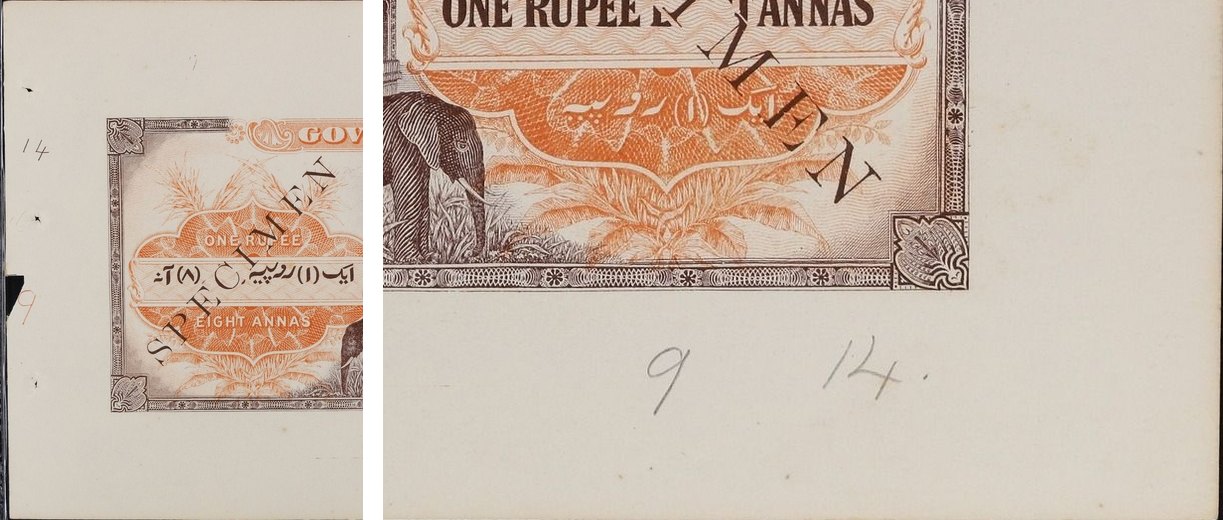
Twenty-three sheets have small numbers in pencil in the margins, between 1 and 17, usually two different numbers to a sheet and sometimes the same number twice. Nothing on the sheets, on the holders or in the sale descriptions says what they are.
Set beside the colours, most of the numbers keep to one colour:
| Number | Sheets | The colour those sheets share |
|---|---|---|
| 2 | 4, 9, 13, 14 | a crimson, claret or magenta |
| 4 | 9, 12, 15, 16, 21 | a light or middle blue |
| 6 | 20, 23 | a deeper blue |
| 7 | 1, 3, 7, 11, 16 | a slate blue or blue-grey |
| 9 | 8, 22 | an orange |
| 10 | 10, 15, 17, 19, 23 | an orange-red |
| 14 | 2, 5, 6, 7, 11, 22 | a brown |
| 16 | 3, 12 | a green |
The five sheets with an orange-red are the five with a 10, and the five sheets with a 4 all have a light or middle blue. One reader of the audit drew the inference that the numbers are ink numbers, one for each colour of the sheet. We give it as a possibility and not as a fact, because it does not fit everywhere. The number 17 stands on two sheets with a green (Nos. 2 and 14) and on two with a grey-black (Nos. 20 and 21). The number 13 stands on three sheets with a purple (Nos. 4, 5 and 8) and on one, No. 10, whose colours are an orange-red and a grey-brown. The number 8 goes with a grey on Nos. 18 and 19, with the grey-black of No. 17, and on No. 1 with a brown. A 1 is pencilled on five sheets (Nos. 6, 10, 11, 16 and 17) beside the other numbers, and no colour answers to it. The numbers 11 and 12 are found once each. Some numbers are hard to read: the 7 below the design of No. 7 may be a 17.
The sheet without the King
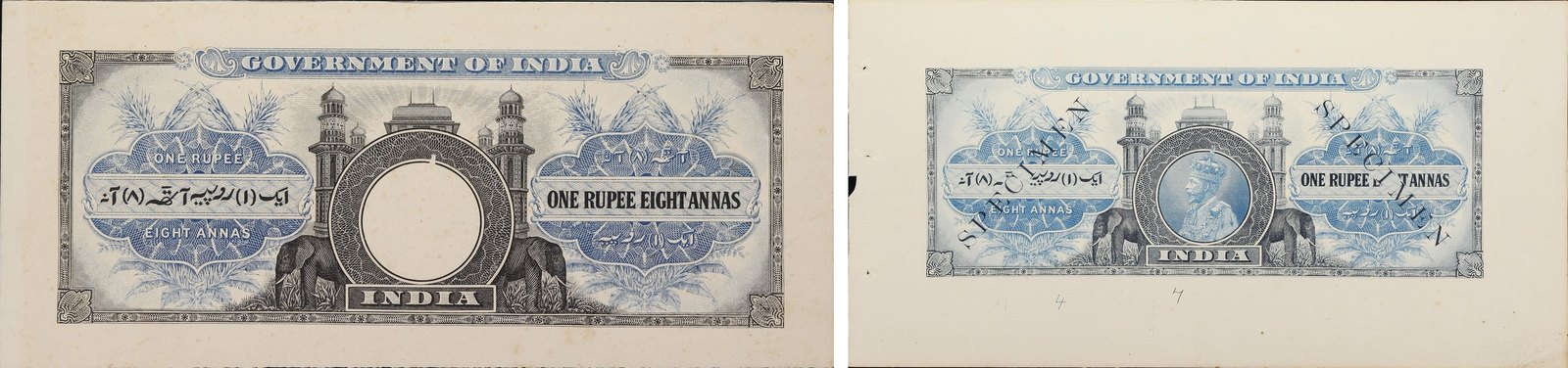
On one sheet the roundel is empty. The frame, the building, the elephants and the INDIA tablet are in black, the title and the side panels in blue, and there is no SPECIMEN overprint and no pencil number. The value in the right panel can be read in full here, ONE RUPEE EIGHT ANNAS, where the overprint covers part of it on the other sheets. The margins are narrower than on the others. What the sheet was made for is not recorded: PCGS describes it only as "Without George V".
Where they have been sold
The catalogue keeps one page for each sheet, because each is its own piece, and records its sales there. In short: five sheets from the booklet were sold by Stack's Bowers at Chicago in August 2011. Four of them were sold again by Lyn Knight at Memphis in 2012 and by Stack's Bowers at Maastricht in September 2022; they are the four in holders with the Gandhi Collection label. No. 5 was sold by Lyn Knight in 2012 and by Stack's Bowers in January 2024. The other eighteen came up one, two or three at a time in sales of Stack's Bowers between April 2023 and October 2026, most of them in Hong Kong, and No. 6 was sold again by Heritage Auctions in October 2026.
Why was the value never issued?
The catalogue cannot say. We have found no mention of a note of 1 rupee 8 annas in any of the official papers read for the India pages: the reports of the Currency Department and of the Controller of the Currency, and the reports of the currency committees. The sheets themselves give no date and no reason.
What those papers do record is the two small notes that were issued, and how short their lives were.
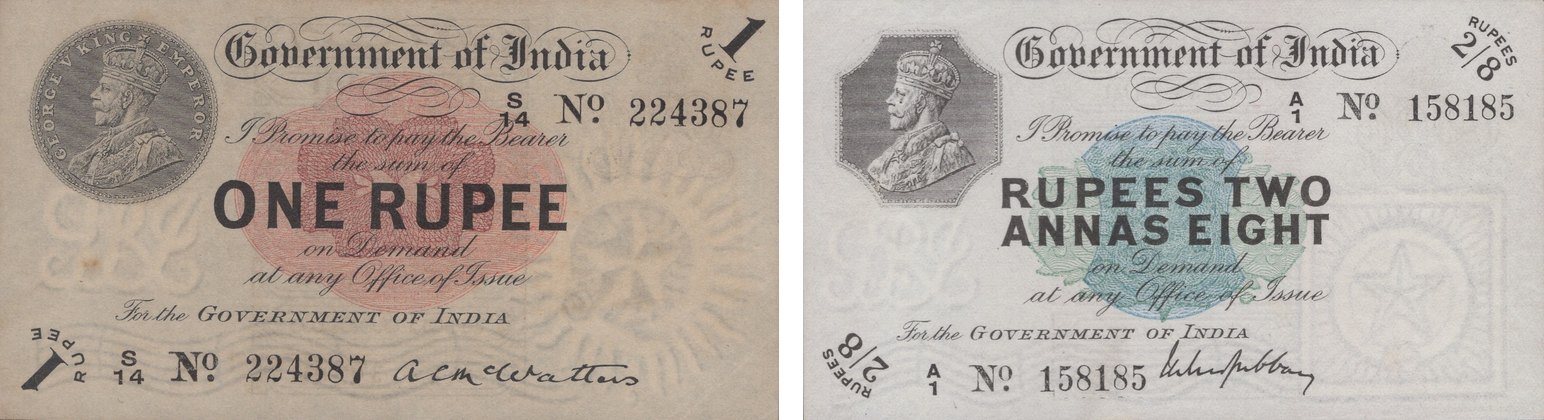
The 1 rupee was first issued on 1 December 1917, as G. Findlay Shirras, then Director of Statistics, gives the day, and the 2 rupees 8 annas on 2 January 1918. Until then the lowest Indian note was 5 rupees. The Currency Department's report for 1920-21 says the 2 rupees 8 annas had a very limited circulation and had never been popular. The papers printed by the Royal Commission on Indian Currency of 1926 show that the Government of India decided in August 1923 to stop issuing the 1 rupee, because it cost more than the silver rupee, and the Controller of the Currency's report for 1926-27 says its issue "was definitely discontinued from the 1st January 1926".
A value between the two would belong to the same story, but that is as far as the record goes. Whether the 1 rupee 8 annas was drawn before the two small notes, beside them or after them is not known.
What is not known
- When the sheets were printed, and by whom.
- Why the design went no further, and whether a back was ever designed for it.
- What the pencil numbers mean.
- How many sheets the book held. Twenty-four are recorded here; others may exist.
The same archive holds designs for a second value that was not issued in this form, a 2 rupees 8 annas of the Reserve Bank with George VI, known from photographs. They are not part of this article.
Member comments
Log in or register to post a comment.