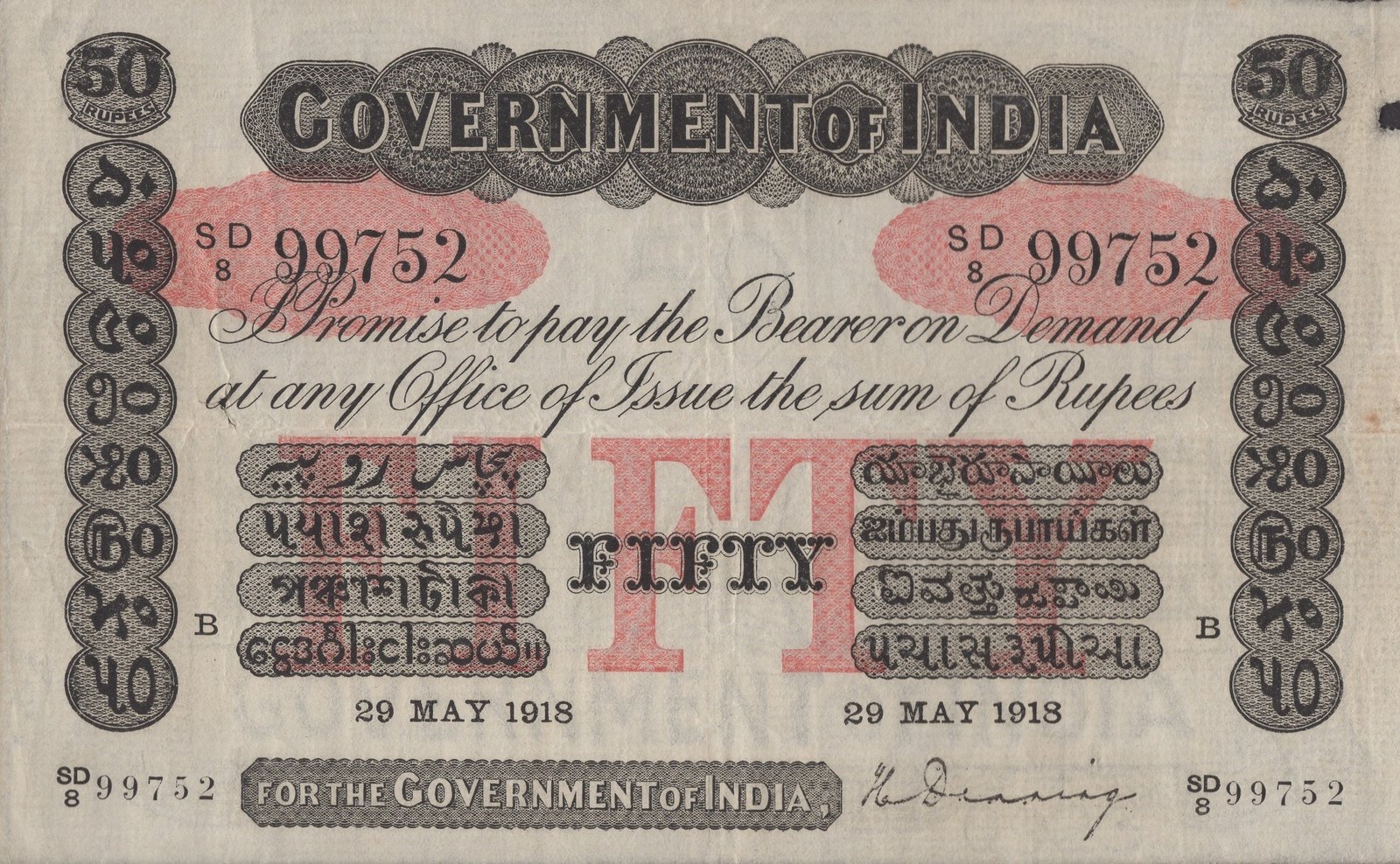
The notes of the Government of India rested on a line of Acts, and most of what a collector sees on a note goes back to one of them: the lowest value, the name of the town, the words about Burma on the 5 rupees, the end of the 20 rupees. This article sets the laws out in order of time. It is drawn from B. B. Das Gupta's Paper Currency in India (1927), which lists 39 enactments and prints the Acts of 1861 and 1923; from G. Findlay Shirras's Indian Finance and Banking (1920); from the memorandum on the paper currency and the evidence printed by the Royal Commission on Indian Finance and Currency of 1913; from the papers of the Royal Commission on Indian Currency and Finance of 1926; and from the yearly reports of the Currency Department and of the Reserve Bank of India. The story of the notes themselves is in four other articles, beginning with The first notes of the Government of India, 1861 to 1866.
Before 1861: the notes of the three banks
The memorandum on the paper currency printed by the Commission of 1913 (Appendix VIII, pp. 239 to 240) begins with the Presidency Banks. Acts VI of 1839, III of 1840 and IX of 1843 allowed the Banks of Bengal, Bombay and Madras to issue notes payable on demand. Those notes were not legal tender. The issues were limited to two crores of rupees each for Bengal and Bombay and one crore for Madras. Act XIX of 1861 repealed the three Acts.
The Pick pages and the earlier articles give the writer of this memorandum as A. M. Newmarch. The heading of the memorandum, as it was read on the Commission's page, is "Memorandum on the Paper Currency Reserve submitted by Mr. F. W. Newmarch, Financial Secretary". The initials are left open here.
The Bill of 1860 and Act XIX of 1861
James Wilson's Bill of 1860 proposed notes of 5, 10, 20, 50, 100, 500 and 1,000 rupees. In the speech of March 1860, reprinted by the Commission of 1913, Wilson said the notes would start at five rupees, the limit then in use in Ceylon and Mauritius. Each note was to show its value in English and in the two languages most used in the district where it would pass. It was to be payable at the centre that issued it and at Calcutta, Bombay or Madras, and receivable at every Government treasury of its circle. Shirras adds that Wilson thought of 40 to 50 circles.
The Act that passed was narrower. Das Gupta (Chapter IX) tells how: the Select Committee wanted no note below 20 rupees, Sir Bartle Frere moved to bring the lowest note down to 5 rupees and lost on a division of 6 to 2, and the Act fixed 10 rupees. The Act passed the Legislative Council on 13th July 1861, was assented to on 16th July, and came into force on 1st March 1862, when the banks stopped issuing. The catalogue records a 5 rupees of the portrait design, dated 1858, only as a specimen.
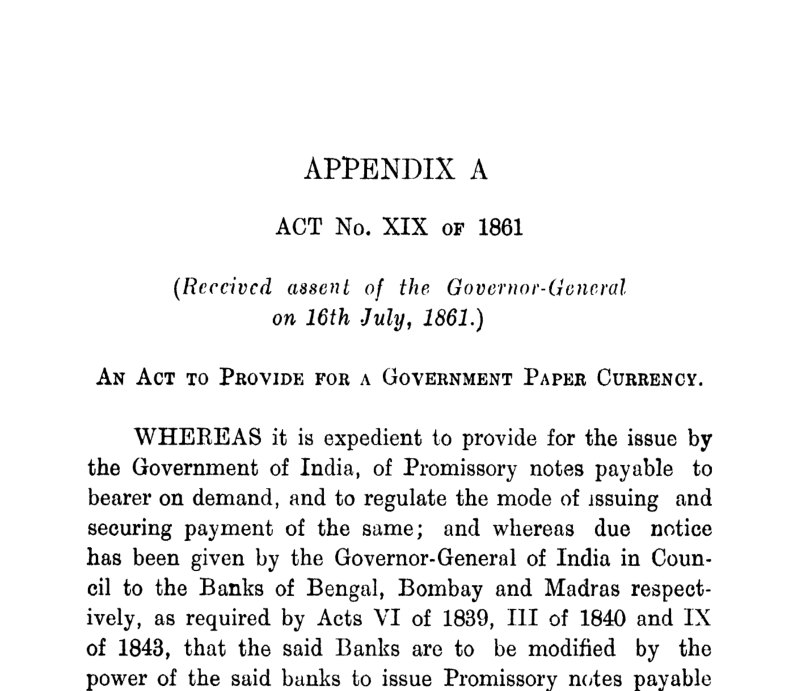
Das Gupta prints the Act. The sections that bear on a note are these.
- Sections III, IV and IX. No note of less than 10 rupees. The Head Commissioner might be the Master of the Calcutta Mint, and the Mint Masters of Madras and Bombay the Commissioners there.
- Section VIII. The notes were to be made on paper specially manufactured for the purpose. Every note was to bear the name of the city or town from which it was issued, and was payable only at the office of that town and at the Presidency town of its Presidency.
- Section XVI. A note was legal tender only within its own circle, and not for a payment by the Government at an office of issue.
- Section XVII. The name of the Head Commissioner, of a Commissioner, of a Deputy Commissioner or of any other person authorised to sign might be put on the notes by machinery.
The notes that may be issued against securities, and not against coin, were limited to 4 crores of rupees.
Act XXIV of 1861: the banks as agents
A second Act of 1861 let the Presidency Banks manage the issue, payment and exchange of the notes for the Government. Under it, Das Gupta says, agreements made the banks agents for five years, the office of the Commissioner of each circle sitting in the bank, and the banks were paid a commission. Where a bank had branches, a branch cashed notes only to the utmost of its power. Shirras says that in September 1862 the Secretary of State ordered the Paper Currency Department to be separated from the banks.
The sources do not agree on when the agency ended.
| Source | What it says |
|---|---|
| Das Gupta, in the text | new agreements from 2nd June 1866 |
| Das Gupta, in a footnote | Bengal to 31st December 1865; Madras and Bombay to 28th February 1867 |
| Shirras | new agreements with effect from 2nd January 1866, compensation paid to 1st March 1867 |
| The papers of the Commission on Act XIX of 1861, Vol. II, Appendix XXVI | a circular of the Bank of Bengal of 16th January 1866 says the management of the currency had been withdrawn from the Bank since the 1st of that month; a note gives 31st December 1865 as the day it passed from the Bank to the Mint |
The Acts, 1866 to 1925
Das Gupta's list (pp. 244 to 251) has 39 entries from 1861 to 1925. Most of them change the reserve: how much of it may be invested, in what, and where the coin may lie. The table keeps the entries that touch the notes, in Das Gupta's own numbering of the Acts.
| Act | What it did for the notes |
|---|---|
| Act 19 of 1861 | founded the Government paper currency |
| Act 24 of 1861 | let the Presidency Banks manage the issue and payment of the notes |
| Act 30 of 1867 | let the Governor-General move a town from one Presidency to another for the purposes of the Act, so that a circle could cross a provincial frontier |
| Act 15 of 1870 | made the Head Commissioner an officer apart from the Mint Master |
| Act 3 of 1871 | lowered the lowest note to 5 rupees; gave the power to make rules |
| Act 20 of 1882 | the Indian Paper Currency Act 1882: extended the paper currency to Burma; currency agencies |
| Act 8 of 1893 | stopped the issue of notes for silver bullion; removed the limit on notes issued for gold |
| Act 12 of 1899 | new sections of the Indian Penal Code on the forgery of currency notes |
| Act 22 of 1899 | notes might be issued for gold coin as well |
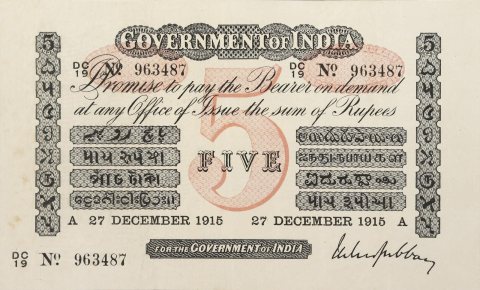
| Act 6 of 1903 | made the 5 rupees universal, except in Burma |
| Act 3 of 1905 | the Indian Paper Currency Act 1905: old notes reckoned out of circulation after a term of years; the office of issue moved from Allahabad to Cawnpore |
| Act 2 of 1909 | took away the exception of Burma for the universal 5 rupees |
| Act 2 of 1910 | notes up to 50 rupees universal, and others by notification; Lahore, Cawnpore and Karachi added to the circles of Calcutta, Madras, Bombay and Rangoon; earlier Acts repealed |
| Act 19 of 1917 | the issue of universal notes of 1 rupee and 2½ rupees |
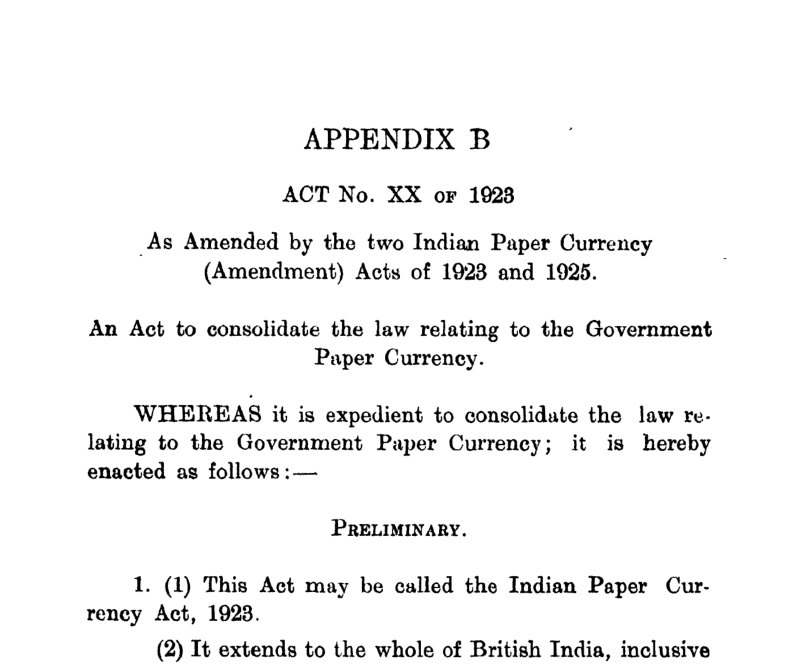
| Act 10 of 1923 | consolidated the law, without change |
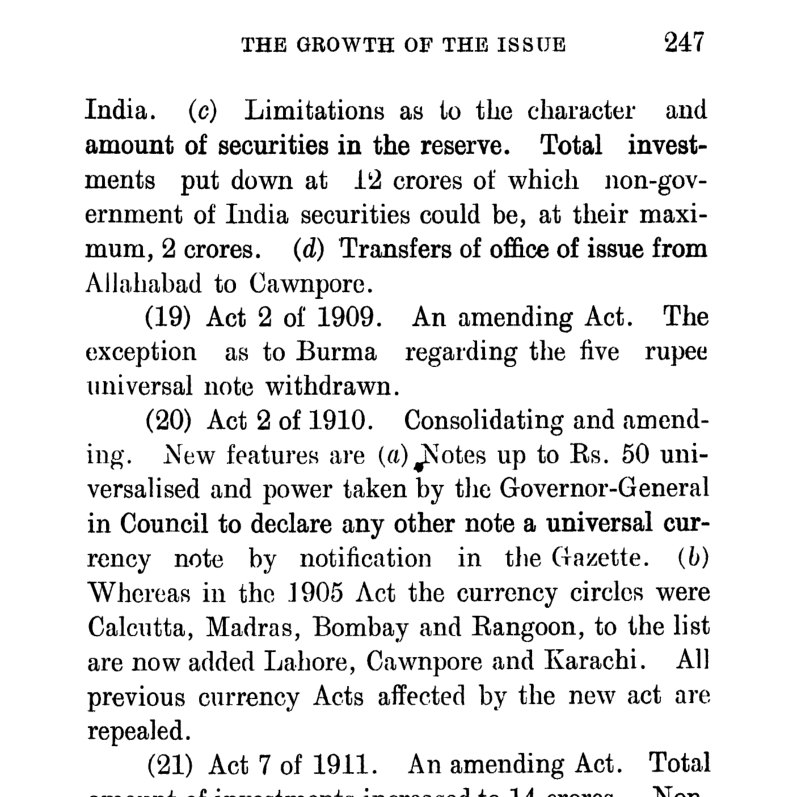
Das Gupta's own pages slip in places, and the slips are worth knowing. The appendix that prints the Act of 1923 heads it "Act No. XX of 1923", while the list calls it Act 10 of 1923; the Controller of the Currency's reports cite it as Act X of 1923. One page says the currency agencies began in 1871 and another that the Act of 1882 brought them in. One page says the Act of 1910 ended the sub-circles and another that the Act of 1905 moved the office from Allahabad to Cawnpore.
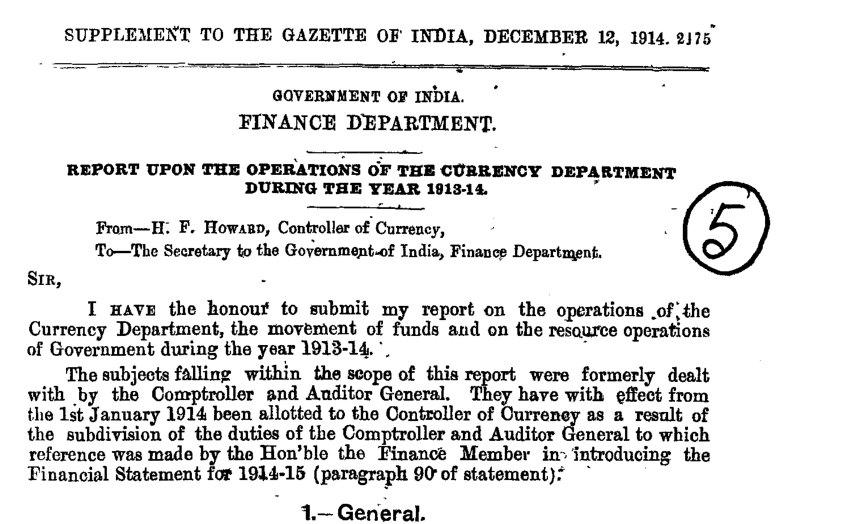
From 31st August 1870, Das Gupta says, the Comptroller-General was Head Commissioner of Paper Currency. The Currency Department's report for 1913-14 says the work passed to the Controller of Currency with effect from 1st January 1914.
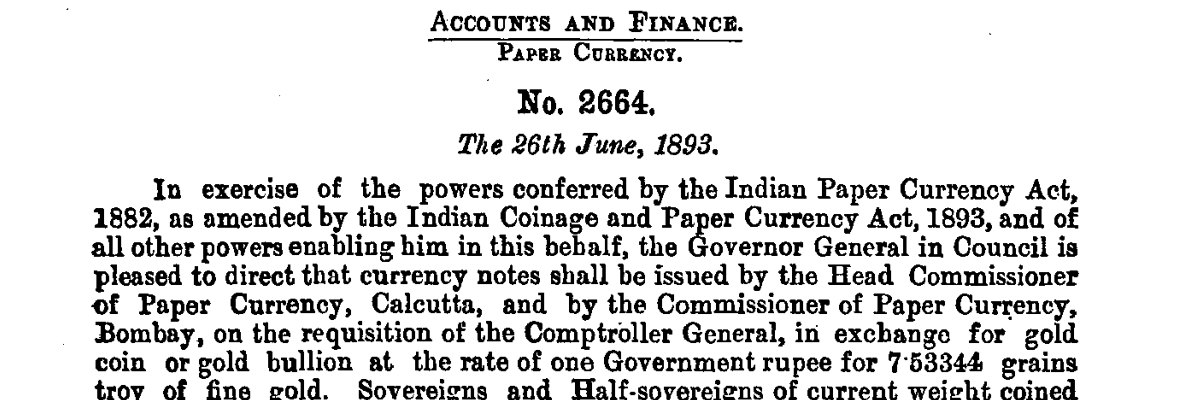
Two further facts from the papers of 1893 belong here. Notification No. 2664 of 26th June 1893 directed that currency notes be issued by the Head Commissioner of Paper Currency at Calcutta and by the Commissioner at Bombay in exchange for gold coin or bullion. And the Herschell Committee's report, printed with those papers, counts notes for 26,40,18,200 rupees in issue on 31st March 1893, in eight circles.
Burma
Shirras and Das Gupta both say that Act XX of 1882 brought Burma within the Paper Currency Act. Das Gupta adds that a circle office at Rangoon came only by a notification of the Government of India of 24th February 1893. The Report on the Administration of Burma for 1896-97 says the Rangoon office was first opened in August 1883 and gives its circulation on 31st March of every year from 1884. Neither source explains the ten years between the two dates.
Universal notes: 1903 or 1905
Until 1903 every note was a note of its circle. The steps by which the lower values were made payable at every office are told in The green underprint notes of the Government of India, 1867 to 1927. On the first step the sources differ.
| Source | The 5 rupees made universal outside Burma |
|---|---|
| The memorandum of 1913, para 10 | "By Act III. of 1905" |
| The report of the Commission of 1913, para 102 | "universalised outside Burma in 1903" |
| Shirras | Act VI of 1903 |
| Das Gupta | 1903; Act 6 of 1903 in the list |
| Harrison and Begbie, witnesses before the Commission | both remembered 1905 |
| Rointon H. Andhyarujina, IBNS Journal 34:1, 1995, p. 25 | the 5 rupees with the words about Burma was issued from 1905 to 1907, and the words are on the 5 rupees only |
| The 5 rupees of 1905 to 1907 | the Pick page cites the Paper Currency Act 1903 for the words "not situated in Burma" |
Act III of 1905 was the consolidating Act of that year, and the same memorandum names it for the reserve as well, so the "1905" may be a slip for the Act of 1903. That is a reading, and no source read says so.
Harrison told the Commission how it came about. About 1900 Harrison had written a long note proposing to make the 5 rupees and the 10 rupees universal. It was carried against the Bank of Bengal and the Comptroller-General of the day, but the Finance Member, Sir Edward Law, in the end made only the 5 rupees universal. In 1909 Harrison proposed going up to 100 rupees. The Secretary of State agreed to 50 rupees, with leave to add the 100 rupees, which followed within about a year.
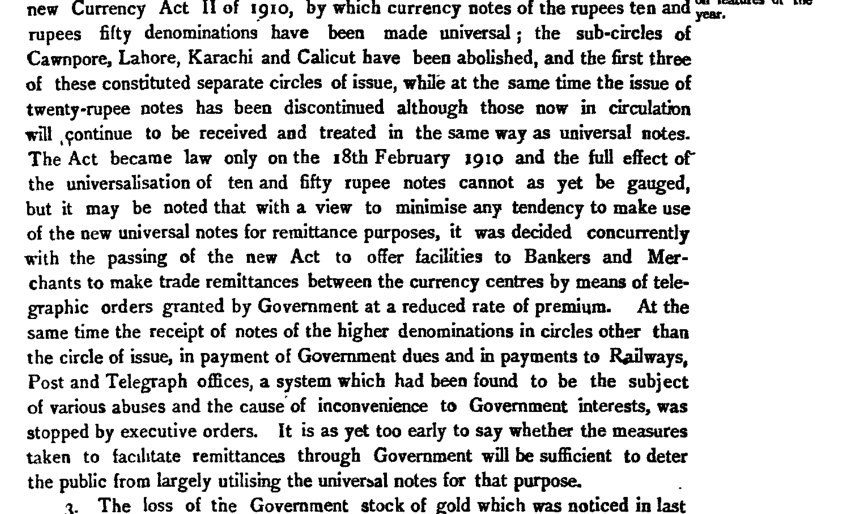
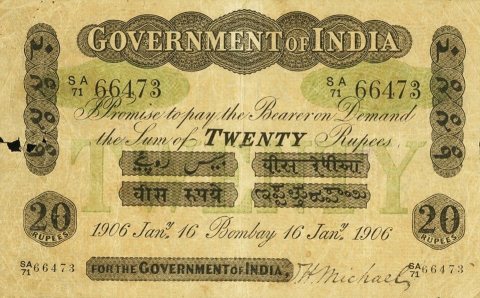
The later steps are not in dispute: Burma by Act II of 1909; the 10 and 50 rupees by Act II of 1910, which the Currency Department's report for 1909-10 says became law on 18th February 1910; the 100 rupees from 1st April 1911, by a notification under that Act. On the same 18th February 1910 another notification discontinued the issue of the 20 rupees.
The Commission of 1913 recommended in its report of 1914 that the 500 rupees be made universal at once. It was not done. H. Denning, Controller of the Currency, said in November 1925, in evidence to the Royal Commission on Indian Currency and Finance, that a Lahore 500 rupees was still legal tender only in the Punjab and the North-West Frontier Province.
The Act of 1923
The Indian Paper Currency Act of 1923, as Das Gupta prints it, put the rules of sixty years in one place.
- Section 2. A "universal currency note" is a note of 1 rupee, 2½ rupees, 5, 10, 50 or 100 rupees.
- Section 5. Seven circles, which include the towns of Calcutta, Madras, Bombay, Rangoon, Lahore, Cawnpore and Karachi.
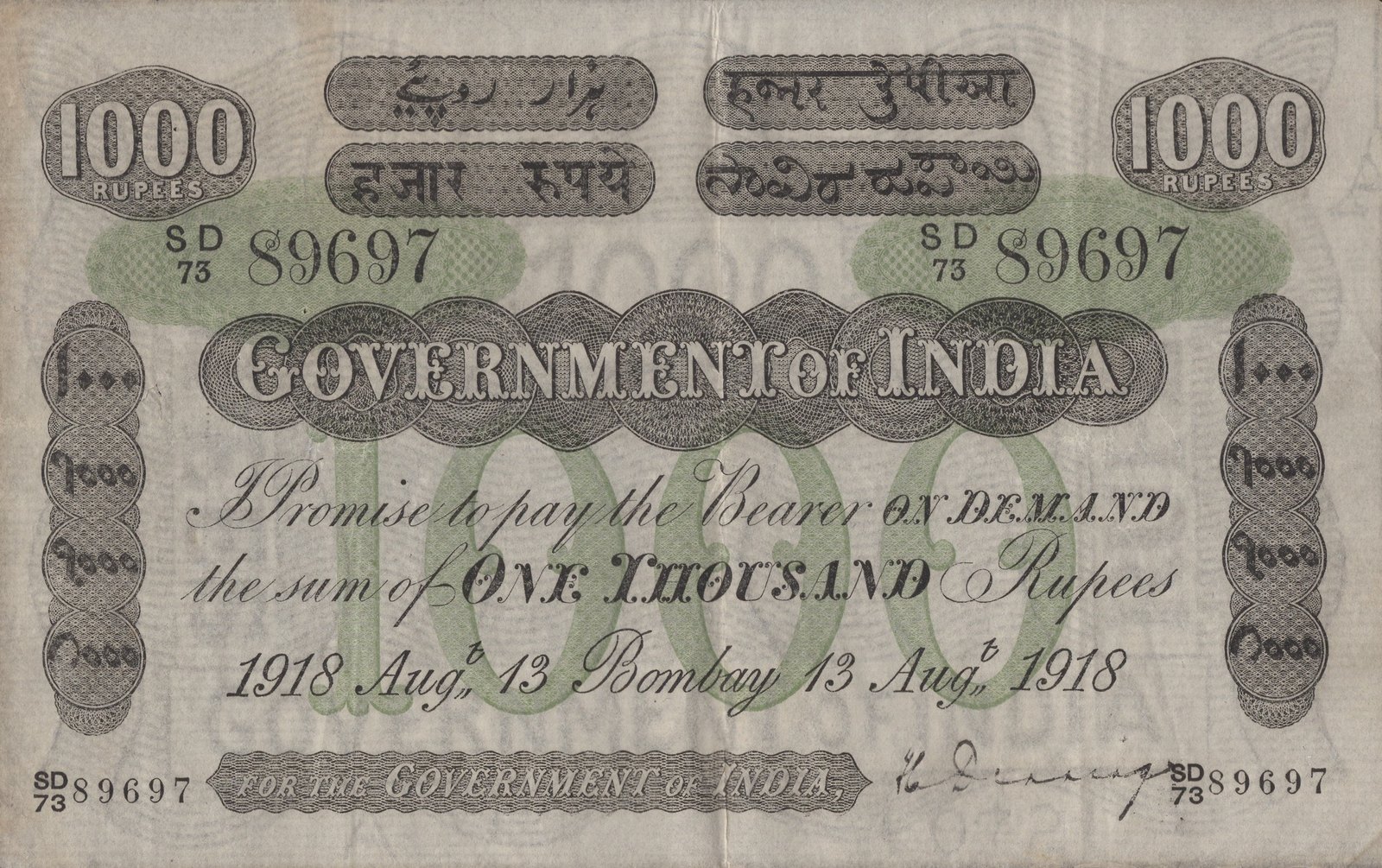
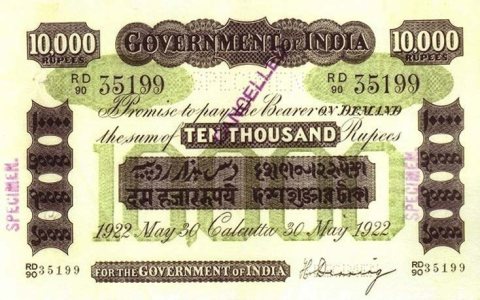
- Section 9. Every note other than a universal note must bear the name of the town from which it is issued. This is why the 500 rupees, 1,000 rupees and 10,000 rupees go on naming an office when the lower values no longer need to.
- Section 10. The name of the Controller of the Currency, of a Deputy Controller or of a person authorised may be printed on the notes.
- Sections 14 and 15. A universal note is legal tender anywhere in British India, any other note only within its circle. A note issued before 18th February 1910 from the office at Cawnpore or Lahore is also payable at Calcutta, and one from Karachi at Bombay. Das Gupta notes that no currency note was legal tender at an office of issue.
- Old notes. A note of 50 or 100 rupees not presented within forty years, and a note above 100 rupees not presented within one hundred years, is deemed not in circulation.
- Lost notes. No one has a right to recover the value of a lost, mutilated or imperfect note. The Governor-General in Council may make rules under which the value is refunded as of grace.
The counts of claims and of notes written off under these last two rules are in Lost in the post, cut in half, written off.
Shirras, writing in 1920, lists the values then issued as 1 rupee, 2 rupees 8 annas, 5, 10, 50, 100, 500, 1,000 and 10,000 rupees, and says the notes from 1 to 100 rupees were universal and the others payable only at the currency office that issued them, under section 16 of Act II of 1910.
Two writers in the IBNS Journal carry the story past the Act. Michael Robinson (30:4, 1991, p. 22) says the 500 and 1,000 rupees were made universal in 1931 or 1932. Rezwan Razack (49:2, 2010, p. 41) says the new two-sided 1,000 rupees and 10,000 rupees printed at Nasik from 1931-32 were payable at any office, whatever circle was printed on them. No Act or notification for that step is among the papers read.
The Reserve Bank: the plan of 1926 and the Act of 1934
The Royal Commission on Indian Currency and Finance of 1926 drew a plan for a Reserve Bank that differs from what was done. It proposed that the Bank have the sole right of note issue for a term of years, for which it suggested 25, that the Government of India's notes cease to be legal tender, except at Government treasuries, within five years of the charter, and that the Bank issue notes of 1, 5, 10, 50, 100, 500, 1,000 and 10,000 rupees. It printed a suggested form of note, headed RESERVE BANK OF INDIA, GUARANTEED BY THE GOVERNMENT OF INDIA, ONE HUNDRED RUPEES, to be signed by a Chief Cashier. The Bank was not to pay out again notes that were torn, partly defaced or soiled.
The notes of 1938 are signed by the Governor, and the 1 rupee was never a note of the Bank. The Reserve Bank's Reports on Currency and Finance give the later law as it touched the notes.
- Section 34 of the Reserve Bank of India Act. A note not presented within 40 years of its issue is deemed no longer in circulation (the report for 1943-44, para 76).
- The Currency Ordinance, No. IV of 1940, of 24th July 1940. Under it the Government of India 1 rupee notes count as rupee coin (the reports for 1950-51 and 1951-52). The reports do not say which note that was. The catalogue takes it to be the 1 rupee dated 1935.
- February 1943. Three reports in a row date the 2 rupees to that month. The Pick page says the Reserve Bank of India Act had to be amended to allow the value.
- The High Denomination Bank Notes (Demonetisation) Ordinance of 12th January 1946. Notes of 500 rupees and above ceased to be legal tender at the end of that day. The time limits for exchanging them are in The Reserve Bank of India's King George VI notes, 1938 to 1950. The report for 1945-46 (para 80) adds that notes for 123,36,52,500 rupees had been exchanged by 31st March 1946. The report for 1950-51 (para 26) says the share of the 100 rupees in the circulation fell from 45.5 per cent at the close of 1945 to 38.9 per cent at the close of 1946, mainly because the public feared that value would be demonetised next.
- Notification of 7th September 1949. The 100 rupee notes of the Karachi and Lahore offices were demonetised in India from 12th September 1949 (the report for 1949-50, para 99). More on this is in The King George V notes of the Government of India, 1917 to 1935.
What the sources leave open
- Whether the 5 rupees was made universal by an Act of 1903 or of 1905. The text of Act VI of 1903 would settle it.
- The day on which the Presidency Banks ceased to be the Government's agents, bank by bank.
- What happened at Rangoon between August 1883 and February 1893.
- The law or notification that made the two-sided 1,000 and 10,000 rupees payable everywhere.
- The term of years after which a note below 50 rupees was written off under the Act of 1923.
- The initials of the Newmarch who wrote the memorandum of 1913.
Sources
- B. B. Das Gupta, Paper Currency in India, 1927: Chapter V and Chapter IX, the list of legislation on pp. 244 to 251, and the Acts of 1861 and 1923 printed as appendices.
- G. Findlay Shirras, Indian Finance and Banking, 1920: the chapter on the paper currency.
- Royal Commission on Indian Finance and Currency, 1913 to 1914: Appendix VIII, the memorandum on the paper currency, paras 2, 8 and 10 (pp. 239 to 240); Wilson's speech of March 1860 reprinted in the Appendices; the Report, para 102; the evidence of Harrison and Begbie.
- Royal Commission on Indian Currency and Finance, 1926: the report (paras 141, 142 and 155) and the evidence of H. Denning (questions 1194 to 1197).
- Papers relating to changes in the Indian Currency System, 1893: Notification No. 2664 of 26th June 1893 and the report of the Herschell Committee.
- The papers of the Commission on Act XIX of 1861, Vol. II, 1867.
- Report on the Administration of Burma for 1896-97, para 246.
- The Currency Department's reports for 1909-10 and 1913-14.
- The Reserve Bank of India's Reports on Currency and Finance for 1943-44 (para 76), 1944-45, 1945-46 (para 80), 1949-50 (para 99), 1950-51 (para 26) and 1951-52.
- Michael Robinson in IBNS Journal 30:4, 1991, p. 22; Rezwan Razack in IBNS Journal 49:2, 2010, p. 41; Rointon H. Andhyarujina in IBNS Journal 34:1, 1995, p. 25.
Member comments
Log in or register to post a comment.