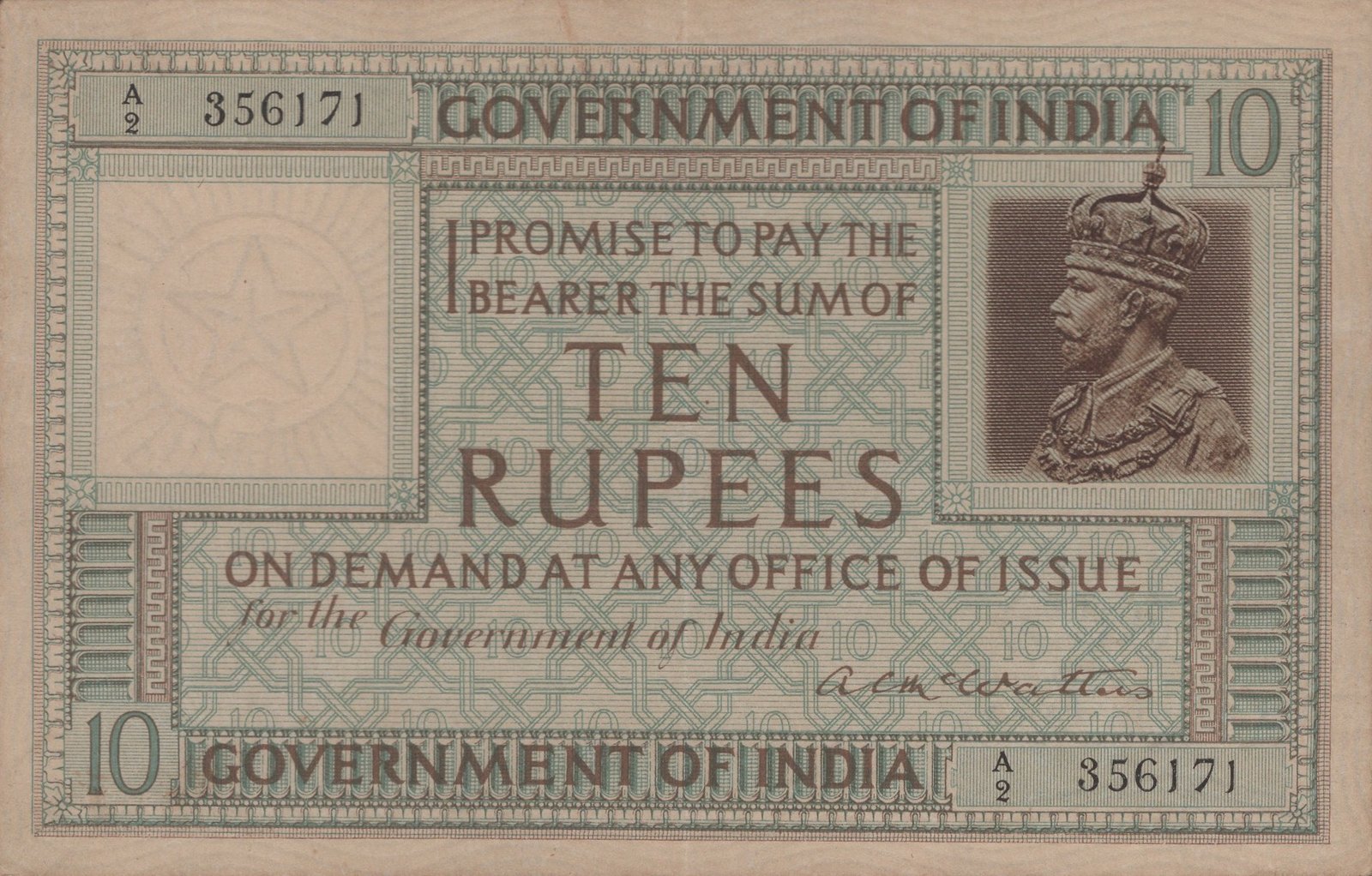
Between 1917 and 1935 the Government of India put the portrait of King George V on its notes, from 1 rupee to 10,000 rupees. This article follows them in order of time. It rests on the reports of the Currency Department and of the Controller of the Currency, on G. Findlay Shirras's figures of 1920, on the papers of the Royal Commission on Indian Currency of 1926 and on the Reserve Bank's later Reports on Currency and Finance. Where an auction house or the Reserve Bank's museum page says something more, or something different, it is named.
The dates in one table
| Note | First issued | Source |
|---|---|---|
| 1 rupee, dated 1917 | 30 November 1917; Shirras gives 1st December 1917 | the Paper Currency (Amendment) Act 1917; G. Findlay Shirras |
| 2 rupees 8 annas | 2 January 1918 | the Pick page |
| 10 rupees, first form | May 1923 | the Controller of the Currency's report for 1923-24, para 39 |
| 5 rupees | October 1925 | the Foreign Office's note on its specimen in the British Library |
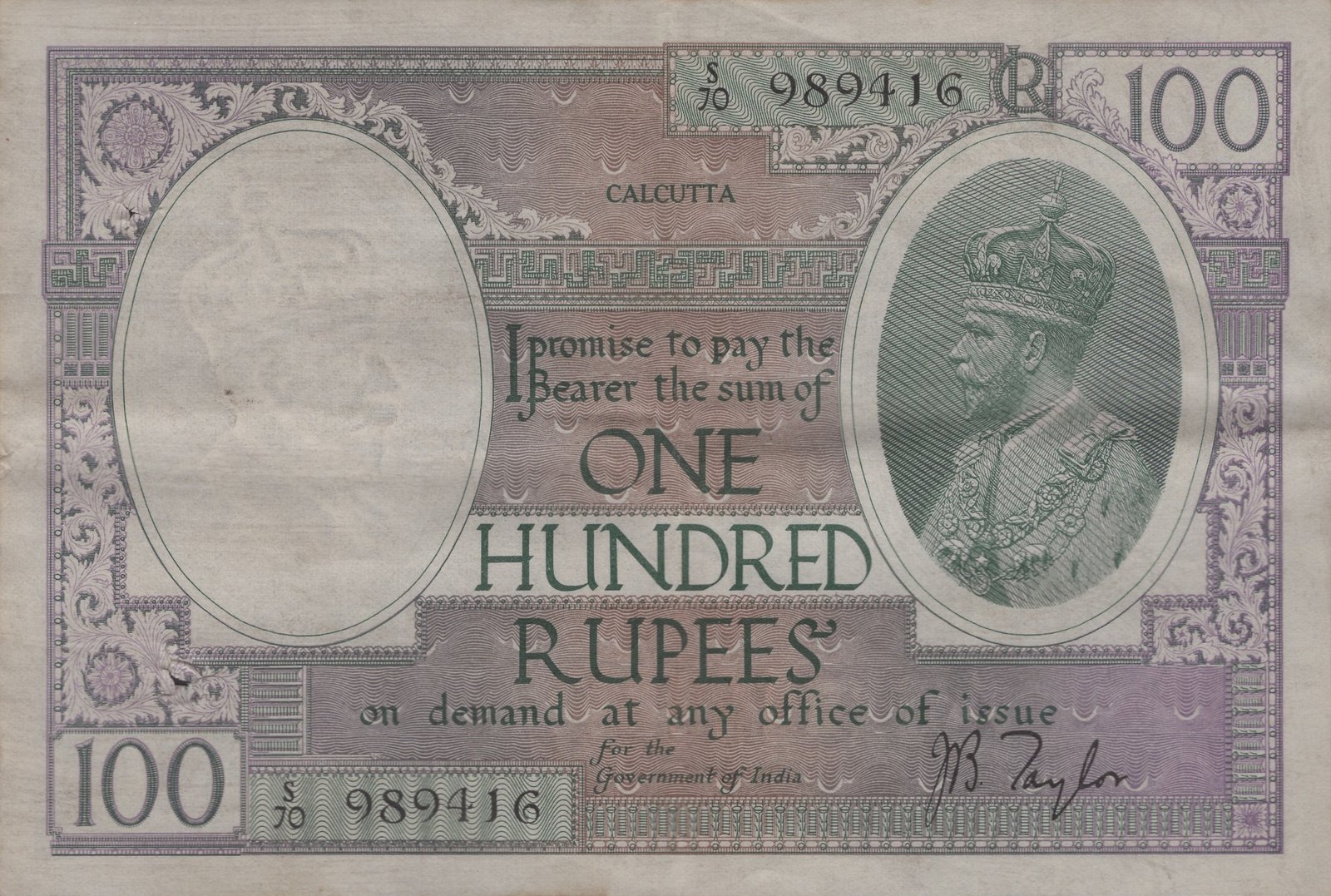
| 100 rupees | February 1927, at Rangoon | the Controller of the Currency's report for 1926-27 |
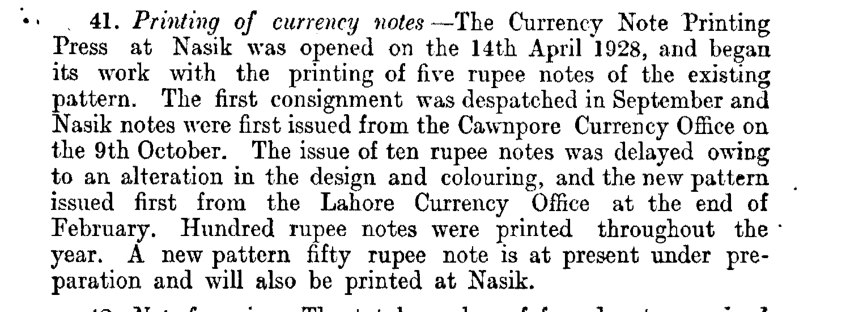
| 5 rupees printed at Nasik | 9th October 1928, at Cawnpore | the report for 1928-29, para 41 |
| 10 rupees, blue | end of February 1929, at Lahore | the report for 1928-29 |
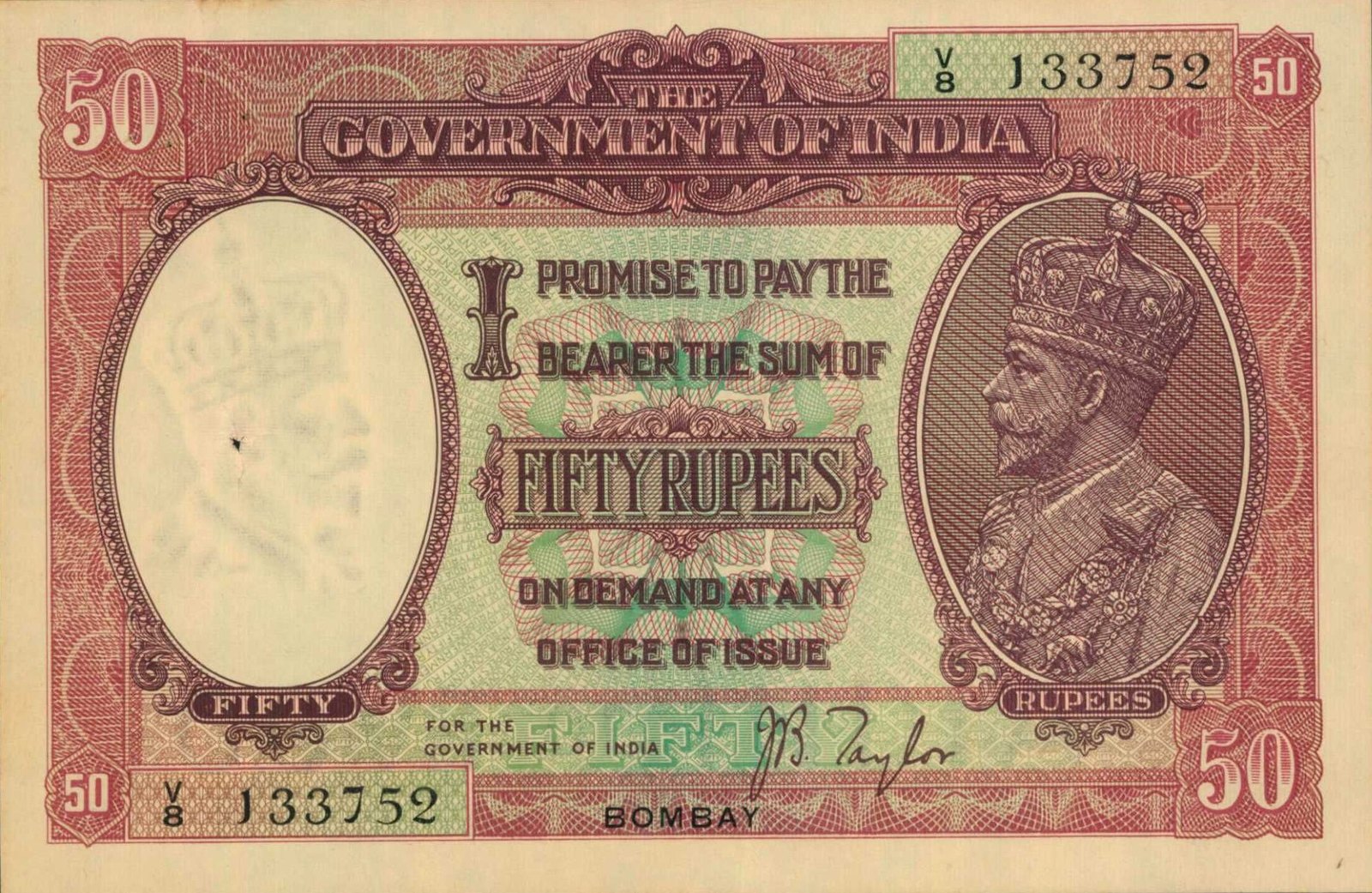
| 50 rupees | July 1930 | sources mention |
| 1,000 rupees and 10,000 rupees | 1931-1932; May 1931 on the Foreign Office's specimen of the 1,000 rupees | sources mention; the British Library specimen |
| 5 rupees, small | 8 March 1933 | sources mention |
| 10 rupees, small | 1 July 1933 | sources mention |
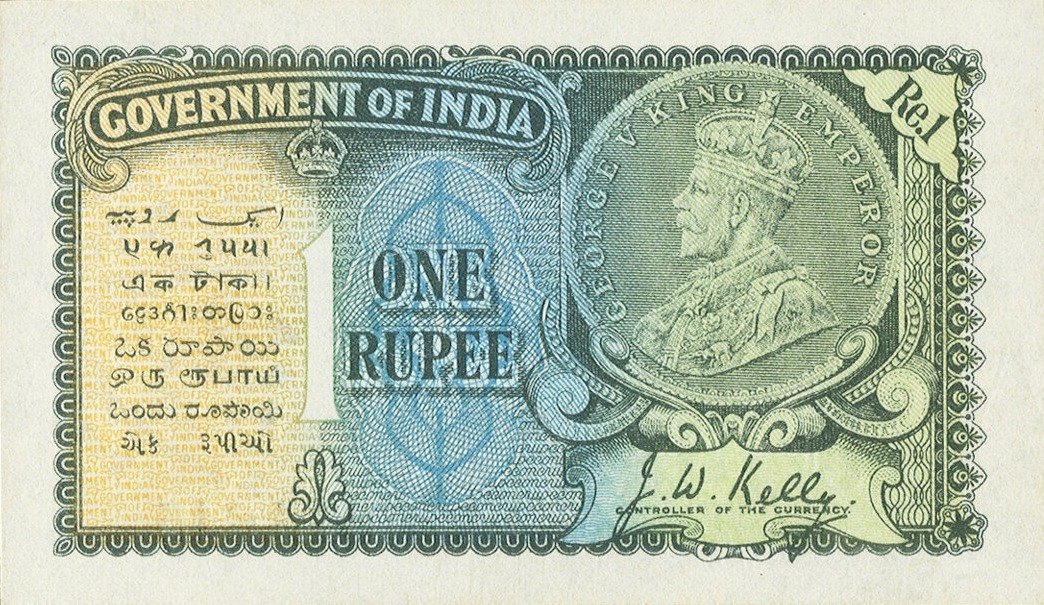
| 1 rupee, dated 1935 | 24th July 1940 | the Reserve Bank's Report on Currency and Finance for 1943-44 |
The Reserve Bank of India's museum page on the British India issues agrees on 30 November 1917 for the 1 rupee and on May 1923 for the first regular note with the King's portrait. It lists the values of the series as 5, 10, 50, 100, 500, 1,000 and 10,000 rupees. The Pick pages give no day of issue for the 500 rupees.
The two small notes of 1917 and 1918
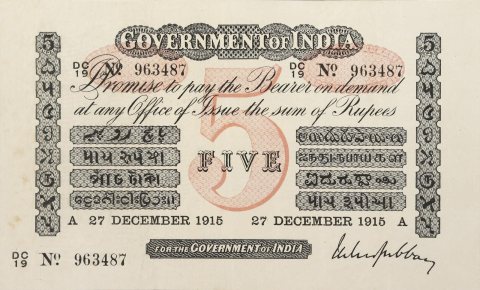
Sources mention that the 1 rupee and the 2 rupees 8 annas were introduced to save silver: during the First World War the public turned notes in for coin while silver ran short, and until then the lowest Indian note was 5 rupees. The 1 rupee was introduced on 30 November 1917 under the Paper Currency (Amendment) Act 1917, and sources mention that it was issued to the public at the Currency Offices from January 1918 and at the District Treasuries from April 1918.
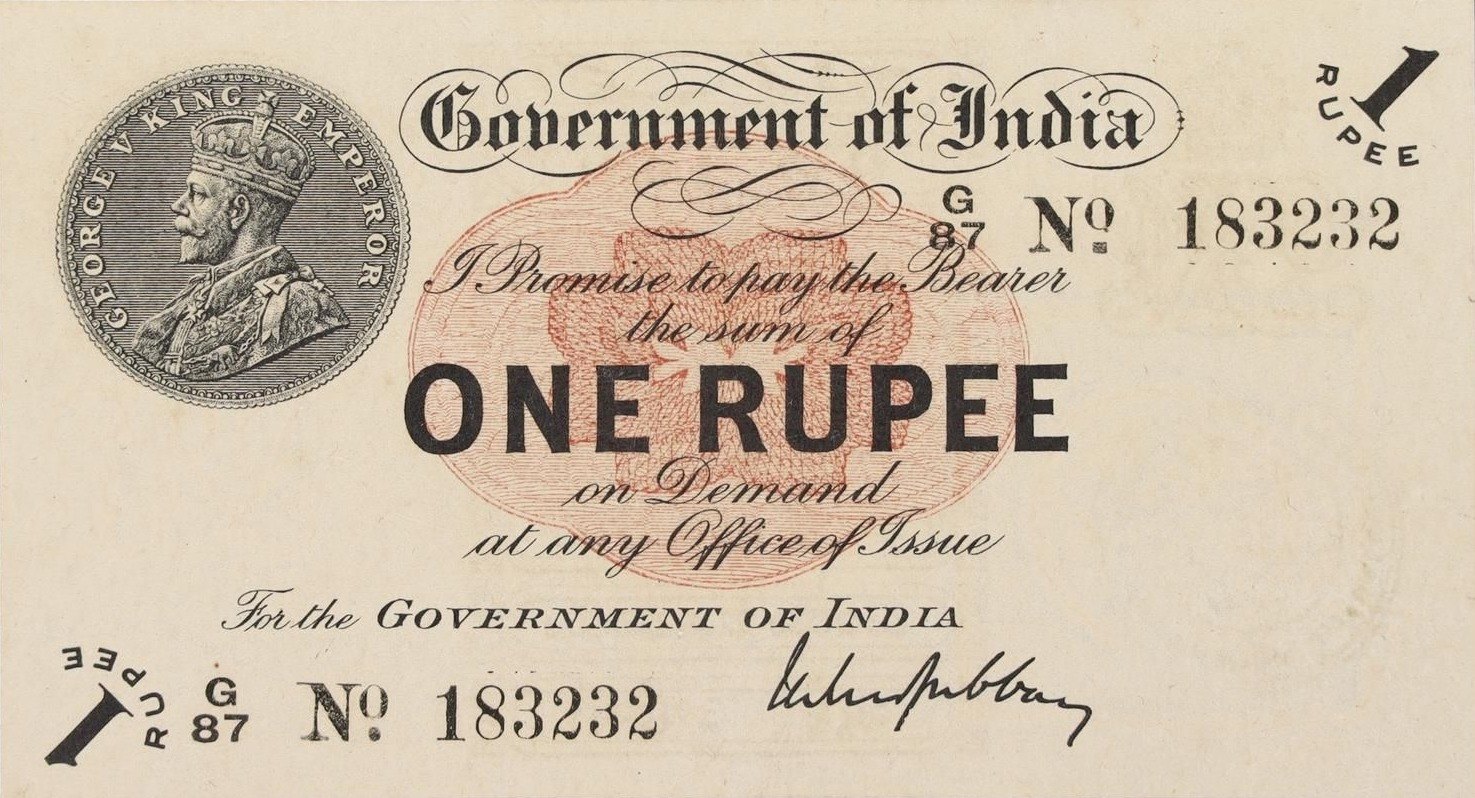
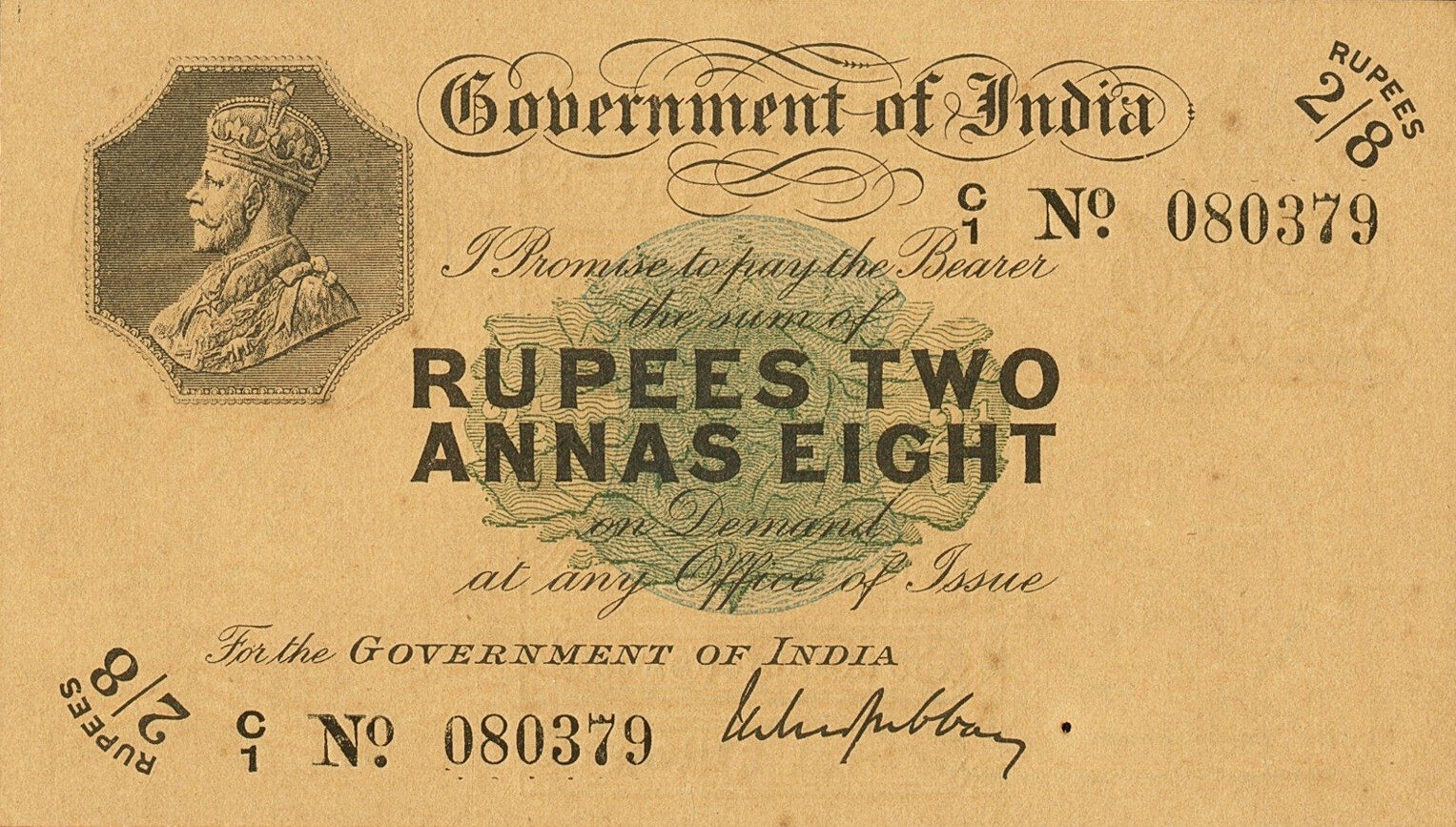
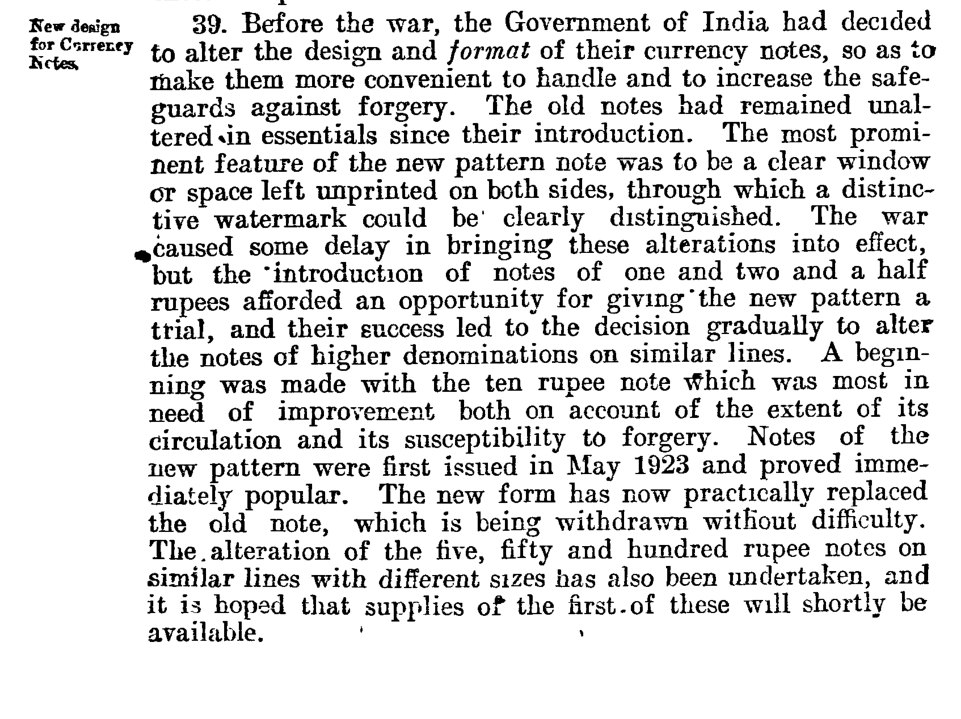
The Controller of the Currency's report for 1923-24 adds that the two small notes were the trial of a new pattern decided on before the war, with a clear window left unprinted on both sides for the watermark, and that their success led to the new 10 rupees of 1923.
Sources mention that the first 1 rupee notes were issued in loose packets of 25, and that from 1919 the 25 notes were stapled or stitched into booklets with a red printed cover. The books of 25 cost a little more to make than loose notes and were used mainly in the towns. M. M. S. Gubbay, whose signature is on the first notes, was Controller of the Currency from 1916 to the end of 1919.
When they were first issued in quantity in 1918 the two small notes passed at a discount, as much as 19 per cent in the Central Provinces and 15 per cent in Bengal, falling to under 3 per cent in 1919 (report of the Indian Currency Committee of 1919).
Sources mention that a shipment of 1 rupee notes was lost when the SS Shirala was sunk in July 1918, and that some of its notes washed ashore on the south coast of England.
How much was in circulation
| Date | 1 rupee | 2 rupees 8 annas | Source |
|---|---|---|---|
| 31st March 1918 | 33 lakhs of rupees | 18 lakhs of rupees | Shirras, 1920 |
| 31st March 1919 | 1,051 lakhs of rupees | 184 lakhs of rupees | Shirras, 1920 |
| 31st March 1924 | not given | 7 lakhs of rupees | the Controller of the Currency's statement |
| 31st March 1927 | 4,420,634 notes outstanding | 61,754 notes outstanding | report for 1926-27 |
| 31st March 1928 | 3,870,850 notes outstanding | 54,670 notes outstanding | report for 1927-28 |
A 1 rupee note lasted about eight months from issue to cancellation. In Bengal the note had been used very largely to finance the jute crop (report for 1927-28).
The 2 rupees 8 annas never took hold. The Currency Department's report for 1920-21 says the note had a very limited circulation and had never been popular, and the Reserve Bank's Report on Currency and Finance for 1943-44 says that it never made up more than 0.4 per cent of the note circulation.
R. Leader, writing in Bank Note Reporter in November 1974, gives the notes still in circulation in 1923-24 as only about 700,000. The Controller of the Currency's own statement puts the 2 rupees 8 annas in circulation on 31st March 1924 at 7 lakhs of rupees, which is about 280,000 notes. Leader's 700,000 looks like the rupee value read as a number of notes.
Two auction houses add dates for the 2 rupees 8 annas. Spink's description of lot 307 in its sale of 12 January 2024 says the notes were printed in England and gives 9 November 1918 as the date they were "standardised". Stack's Bowers (19 October 2024, lot 31269) says they stayed in circulation until they were withdrawn on 1 January 1926. The Foreign Office noted on its specimens of both small notes that the issue was stopped in 1921-22.
How the 1 rupee ended
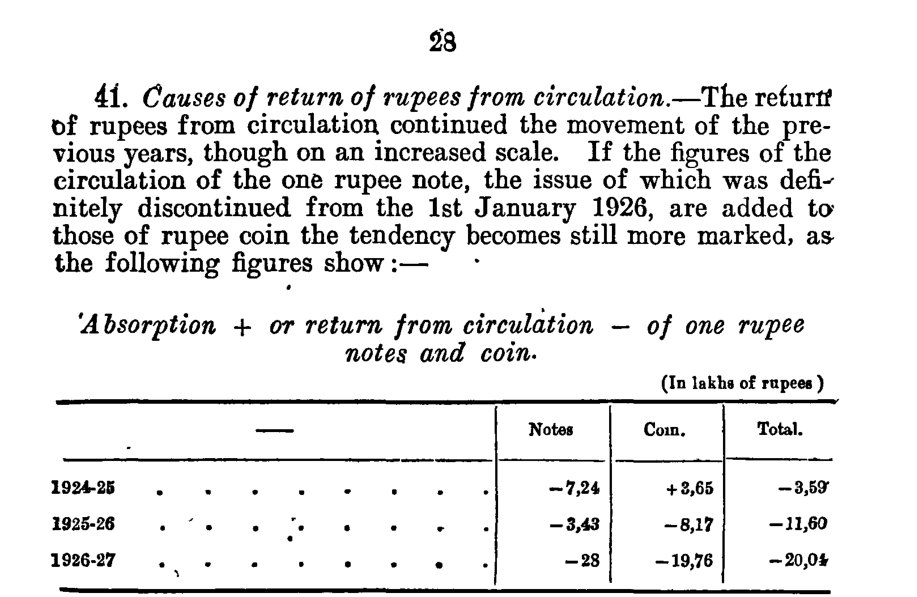
The papers printed by the Royal Commission on Indian Currency of 1926 show how it ended. The Government of India decided in August 1923, on the Retrenchment Committee's advice, to stop issuing the note because it cost more than the silver rupee. No notes were ordered from the Bank of England after the indent completed in May 1924, and the stock was practically used up by September 1925.
The Controller of the Currency's report for 1926-27 says the issue of the note was definitely discontinued from 1st January 1926. From then the notes were cancelled as they came in. Of the notes still outstanding in 1927 and 1928 many, the Controller thought, had long since been destroyed. The Reserve Bank's museum page gives the same day, 1 January 1926, and the same reason of cost.
The new pattern: 10 rupees of 1923, 5 rupees of 1925, 100 rupees of 1927
The first 10 rupees of the new design was put into circulation in May 1923, with a clear window, on front and back, through which the watermark shows. The Controller of the Currency's report for 1923-24 says the change had been decided before the war, that the 10 rupees came first because it was the most used and the most forged of the notes, and that by September 1924 the new note had practically replaced the old one, which was being withdrawn.
The 10 rupees exists in two layouts of the same design, the first with the serial numbers at upper left and lower right and the second with them at upper right and lower left. Heritage's description of lot 15620 in its sale of 7 September 2012 says the Bank of England printers moved the numbers because the edges of the notes were tearing when the numbers were put on.
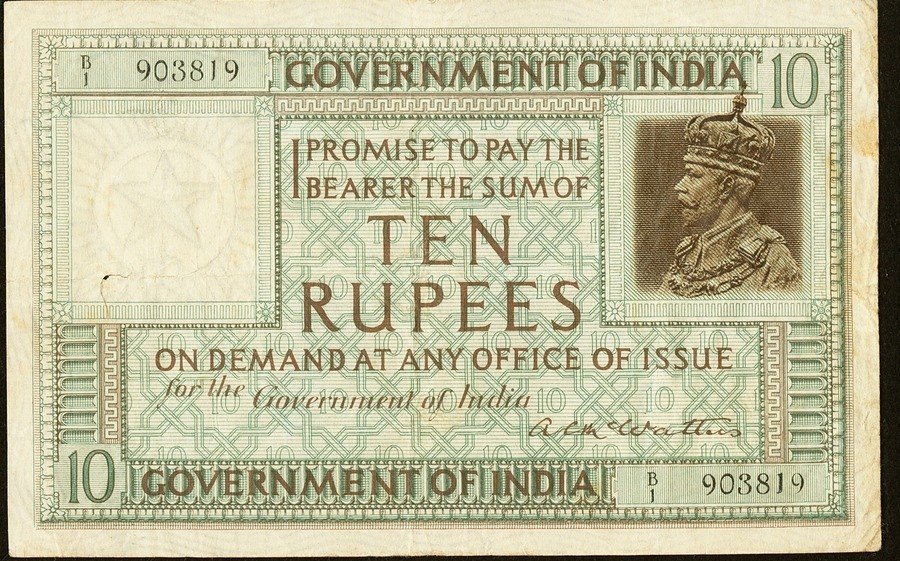
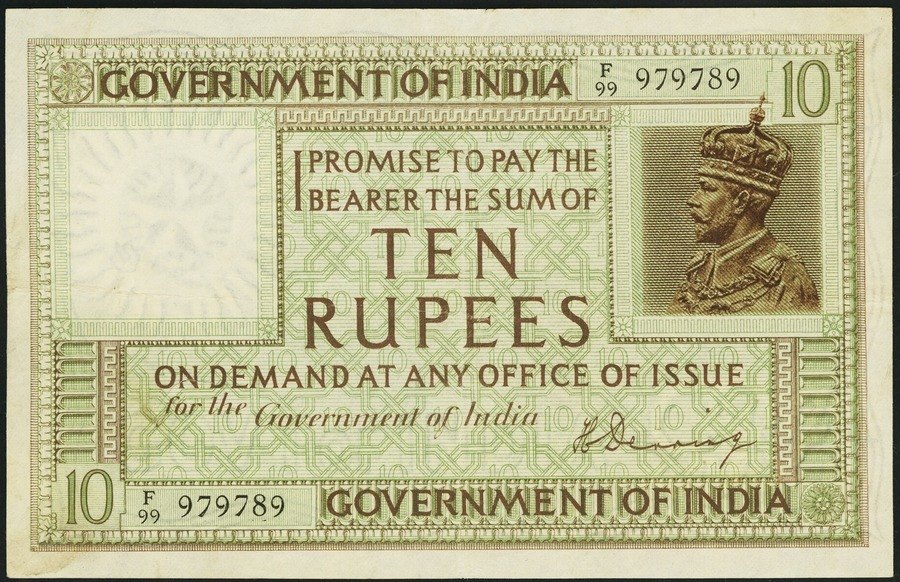
The 5 rupees followed in October 1925 and the 100 rupees in February 1927. A 5 rupee note then lasted about six and a half months in the public's hands before it was cancelled (the Controller of the Currency's report for 1927-28). The report for 1926-27 says forgeries had cost the old 5 rupees its popularity, which the new note won back.
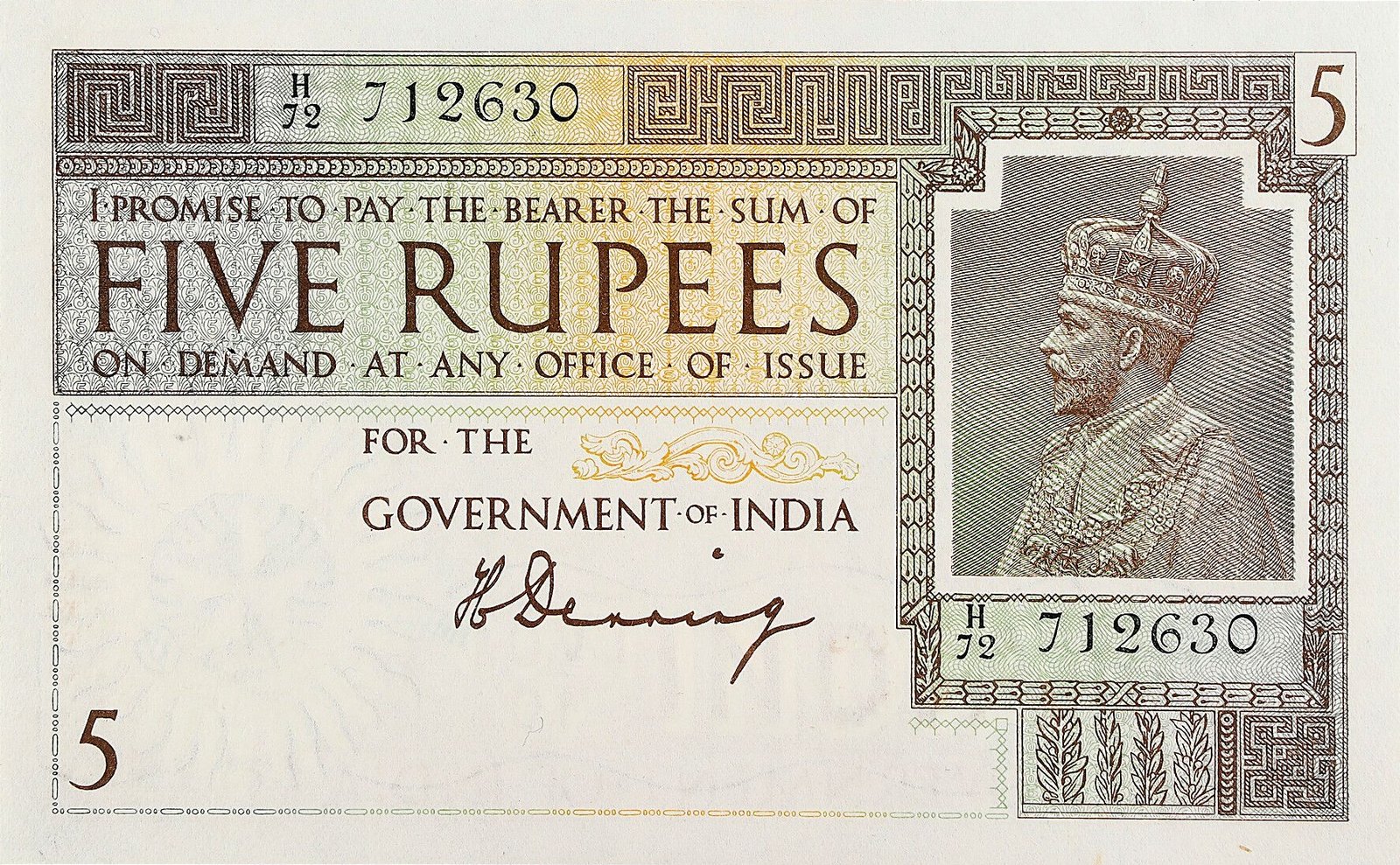
A 5 rupees in other colours and a large 50 rupees are known only as trials and specimens. The report for 1923-24 says a new 50 rupees on the lines of the new 10 rupees had been undertaken. The report for 1926-27 says the re-design was given up because the stock of the old note was sufficient.
From the Bank of England to Nasik
The Bank of England's contract to print the notes, due to run to June 1929, was ended on 1st January 1928 so that the Security Press at Nasik could take over (the Controller of the Currency's report for 1925-26, as B. B. Das Gupta quotes it). The report for 1926-27 puts it as an intention: six months' notice to be given on 1st January 1928, for notes of values up to 100 rupees, with Nasik notes ready by 1st July 1928. The report for 1927-28 says the 5, 10 and 100 rupees would in future be printed at Nasik and the other values still come from the Bank of England until new designs were approved.
The press was opened on 14th April 1928 and began with 5 rupee notes of the existing pattern. The first consignment left in September, and Nasik notes were first issued from the Cawnpore Currency Office on 9th October 1928. The 10 rupees from Nasik came in an altered design and colouring at the end of February 1929, from Lahore. Hundred rupee notes were printed at Nasik throughout 1928-29 (the report for 1928-29). The Reserve Bank's museum page says that by 1932 the press was printing the full range of notes. The three reports are read against the notes in Nasik, 1928: the year India began to print its own notes.
Which prefixes of the 5 and 10 rupees are Nasik printings is not recorded. The auction houses disagree. Spink (2 October 2013, lots 687, 688, 692 and 693) calls some 5 rupee notes signed by Taylor and some 10 rupee notes of the E prefixes Nasik printings. Classical Numismatic Gallery (15 August 2014, lots 60 and 72) describes notes of the same groups as printed in England by the Bank of England Press.
The 50 rupees of 1930 and the high values
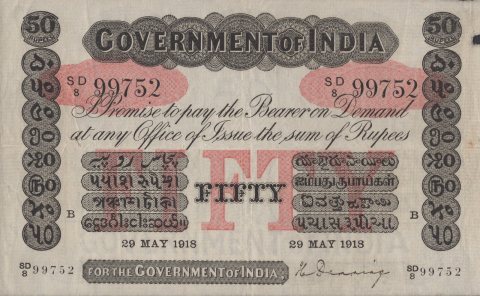
The report for 1928-29 says the old uniface 50 rupees, large and easily taken for the old 10 rupees, was less and less liked, and that a much smaller note was being prepared for printing at Nasik. Sources mention that the new 50 rupees was first issued in July 1930.
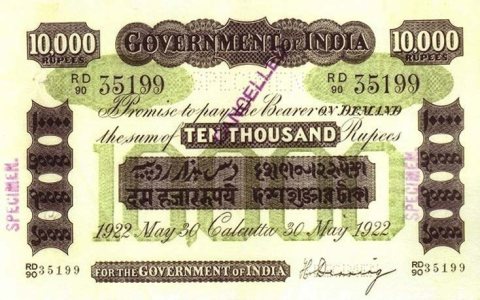
Sources mention that the 1,000 and 10,000 rupees, first issued in 1931-1932, were the first of their value printed on both sides, and that they could be cashed at any office of issue, whatever office they name. The earlier one-sided notes were payable only at their own office.
For the 1,000 rupees the lists of offices grew as notes came to light. Spink (29 September 2006, lots 700 to 704) offered five consecutive Madras notes and said that neither Pick nor Jhunjhunwalla then recorded the Madras office. Stack's Bowers' description of lot 60354 in its sale of 19 August 2019 counts 17 certified examples of the 1,000 rupees, of all offices together, in the PMG census at that time.
The small notes of 1933 and the 1 rupee of 1935
Sources mention that the smaller 5 rupees was issued on 8 March 1933 and the smaller 10 rupees on 1 July 1933, on thin paper to save printing costs, and that the thicker paper came back within a year.
The 1 rupee dated 1935 was printed from 1935 but held back after the death of King George V in January 1936. Other sources mention that the notes were printed because of the rise in silver after 1934 and stored once it eased. A consignment reached Bombay in July 1940 and was issued at once. The Reserve Bank's Report on Currency and Finance for 1943-44 gives 24th July 1940 as the day the Government of India 1 rupee notes were first issued, the day of the Currency Ordinance (No. IV of 1940) under which they count as rupee coin. The Reserve Bank's museum page says the 1 rupee was brought back in August 1940 under that Ordinance.
The signers
Gubbay, Controller of the Currency from 1916 to the end of 1919, signs the first small notes. McWatters and Denning follow on the 1 rupee and on the 10 rupees of 1923. From 1927 two signatures alternate: J. B. Taylor signed the Controller of the Currency's reports of 18th June 1927 and 5th July 1929 as Officiating Controller, and H. Denning that of 2nd June 1928 as Controller. Kelly signs the latest notes. The years in which each began to sign notes are not recorded.
Rules on cut notes, and the end of the Karachi and Lahore 100 rupees
From 1st July 1927 the Currency Notes (Refund) Rules were tightened to stop the cutting of notes: a half note of 50 rupees or more was paid at half its value, and halves of 5 and 10 rupee notes not at all (the Controller of the Currency's report for 1927-28).
All 100 rupee notes of the KARACHI and LAHORE offices, of the Government of India and of the Reserve Bank alike, were demonetised in India from 12th September 1949 by a notification of 7th September 1949, because those offices had passed to the State Bank of Pakistan on 1st July 1948. The Reserve Bank's offices and the treasuries still exchanged them (the Reserve Bank's Report on Currency and Finance for 1949-50).
The notes of 500, 1,000 and 10,000 rupees ceased to be legal tender on 12 January 1946; see The Reserve Bank of India's King George VI notes.
Forged notes in the reports
The series named year by year are set out in The forged series of British India, 1909 to 1929. This is what the reports say of the King George V notes.
1 rupee. The Currency Department's report for 1920-21 counts 2,033 forged 1 rupee notes received that year, nearly all in the Calcutta and Rangoon circles. At Calcutta they were process-made forgeries of the series M/13 and E/53. The E/53 forgery is printed from blocks on fairly good paper with an imitation watermark, and its serial letters are thicker than on a genuine note. At Rangoon most were older forgeries of the series R/5 and E/4. Later reports of the Controller of the Currency name J/53 at Madras, thought to come in from Penang with returning emigrants, and O/93 at Bombay, first seen in September 1923 and very well made (1923-24, when 1,681 forged 1 rupee notes came in). N/89, Y/99 and J/53, with E/53 again in 1928-29, were the bulk of the old forgeries still reaching the Rangoon, Madras and Calcutta offices from 1926 to 1929.
2 rupees 8 annas. Forged notes were few: 62 in 1923-24, none in 1926-27, 9 in 1927-28 and 4 in 1928-29, at Calcutta, Cawnpore and Lahore. The reports name no series.
5 rupees. The report for 1926-27 says no forgery of the new note had yet appeared. In 1927-28 there were 29, all but two of the series H/54, and in 1928-29 there were 45, mostly of H/54 again.
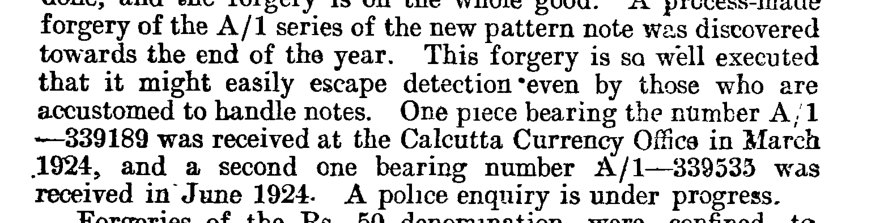
10 rupees. A process-made forgery of the first prefix, A/1, was found towards the end of 1923-24. The report for 1923-24 calls it
The pieces A/1 339189 and A/1 339535 reached the Calcutta Currency Office in March and June 1924. Later reports name forged notes of the new pattern of the series C/57, D/12, D/15, D/64, D/78, D/90 and D/98, all well made (1926-27); C/98, F/4, E/23 and B/12, with E/2 and C/76 (1927-28); and F/49, E/35, D/5 and C/6 (1928-29). Most of the forged 10 rupee notes came in at Rangoon, where the police seized 11,209 with the printing outfit in 1928-29 and a gang was arrested in August 1928 for the E/23 and F/49 notes.
100 rupees. No forgery of the new note had appeared by March 1929.
Who printed the first notes
The papers of the Royal Commission of 1926 speak of 1 rupee notes ordered from the Bank of England, and the Controller's reports of the Bank of England's contract. Spink's description of lot 213 in its sale of 29 October 2025 says the 1 rupee was printed by Thomas De La Rue in London. The catalogue's printer field for the notes of 1917 to 1929 also names Thomas de la Rue. The reports on the Pick pages do not name De La Rue.
What is not known
- Which prefixes of the 5 and 10 rupees were printed at Nasik, and how a Nasik note is told from a Bank of England one.
- The year in which each signer began to sign notes.
- The day of issue of the 500 rupees.
- Whether the 1 rupee and the 2 rupees 8 annas were stopped in 1921-22, as the Foreign Office noted on its specimens, or later. The official papers put the decision on the 1 rupee in August 1923.
Sources
- The Currency Department's report for 1920-21.
- The reports of the Controller of the Currency for 1923-24, 1925-26 (as B. B. Das Gupta quotes it), 1926-27, 1927-28 and 1928-29.
- G. Findlay Shirras, 1920.
- Report of the Indian Currency Committee of 1919.
- The papers printed by the Royal Commission on Indian Currency of 1926.
- The Reserve Bank of India's Reports on Currency and Finance for 1943-44 and 1949-50.
- The Foreign Office's notes on its specimens in the British Library.
- R. Leader in Bank Note Reporter, November 1974.
- Spink, 29 September 2006, lots 700 to 704; 2 October 2013, lots 687, 688, 692 and 693; 12 January 2024, lot 307; 29 October 2025, lot 213.
- Stack's Bowers, 19 August 2019, lot 60354; 19 October 2024, lot 31269.
- Heritage Auctions, 7 September 2012, lot 15620.
- Classical Numismatic Gallery, 15 August 2014, lots 60 and 72.
- Reserve Bank of India, Museum, "British India Issues", https://www.rbi.org.in/Scripts/pm_britishindia.aspx
- The Pick pages of the catalogue.
Member comments
Log in or register to post a comment.