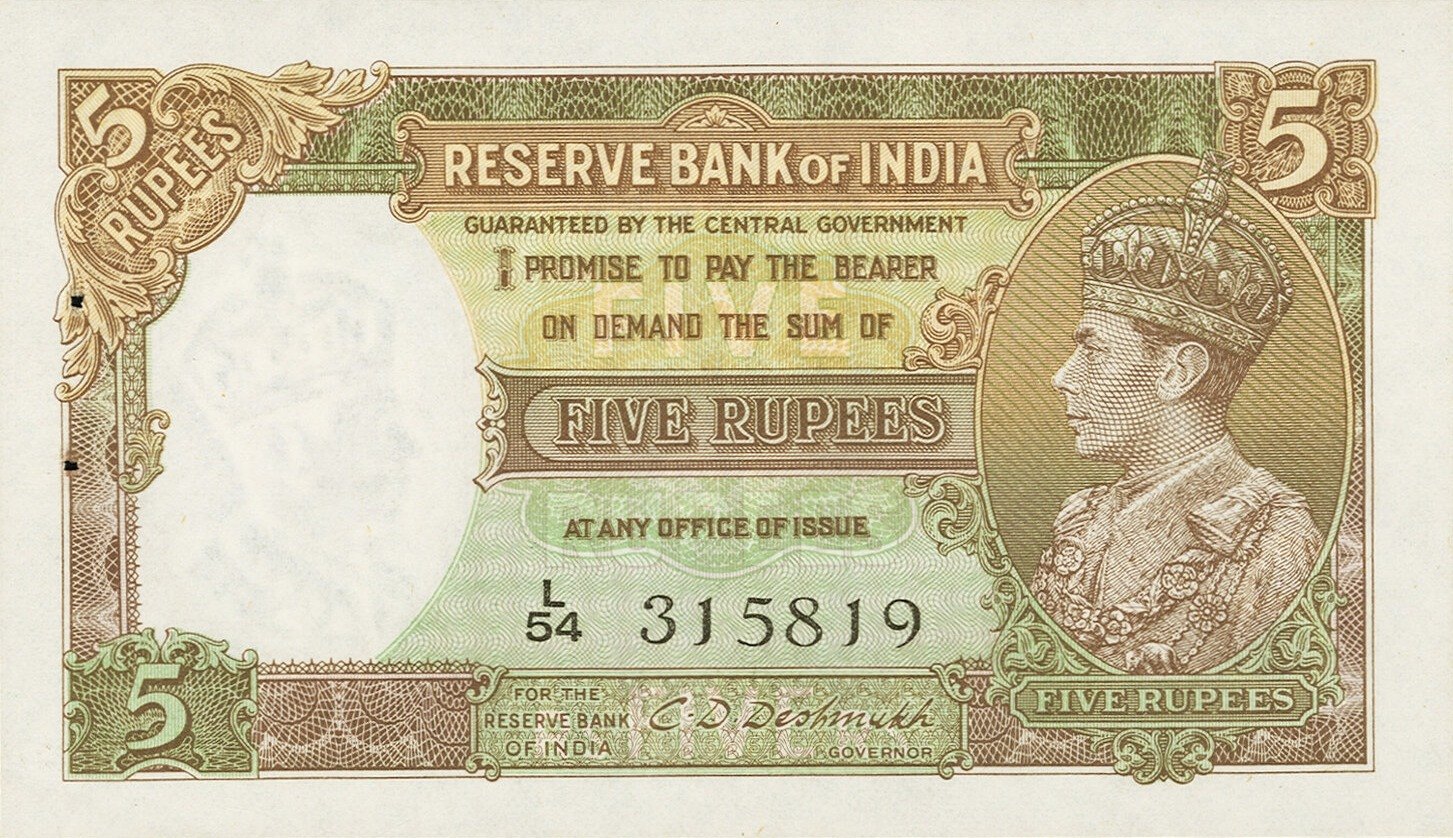
The Reserve Bank of India issued its own notes from January 1938, all with the portrait of King George VI, and they stayed legal tender after the Asoka Pillar notes replaced them in 1950. This article sets the notes of British India in order of time from the days of issue in the Reserve Bank's Reports on Currency and Finance, with the Foreign Office's notes on its specimens in the British Library, the Reserve Bank's museum page and a few auction descriptions. It also tells of the Ordinance of 1946 that ended every note of 500 rupees and above, old and new.
The Bank takes over, 1935 to 1938
The Reserve Bank of India's museum page on the British India issues says the Bank was inaugurated on 1 April 1935 with its Central Office in Calcutta, that it took over the functions of the Controller of Currency, and that the currency offices at Calcutta, Bombay, Madras, Rangoon, Karachi, Lahore and Cawnpore became branches of its Issue Department. The page says that Section 22 of the Reserve Bank of India Act, 1934, empowered the Bank to go on issuing Government of India notes until its own were ready, and that notes with the portrait of Edward VIII were planned for the summer of 1937 and were delayed by the abdication.
The page also says the first Governor, Sir Osborne Smith, signed no notes, and that the first issues were signed by the second Governor, Sir James Taylor. James Braid Taylor was Governor from 1 July 1937 and died in office on 17 February 1943.
The first issue, 1938
| Note | First issued | Source |
|---|---|---|
| 5 rupees | January 1938, the first note of the Reserve Bank | the Pick page; the Reserve Bank's museum page |
| 10 rupees | February 1938 | the Foreign Office's note on its specimen; the museum page |
| 100 rupees | March 1938 | the Pick page; the museum page |
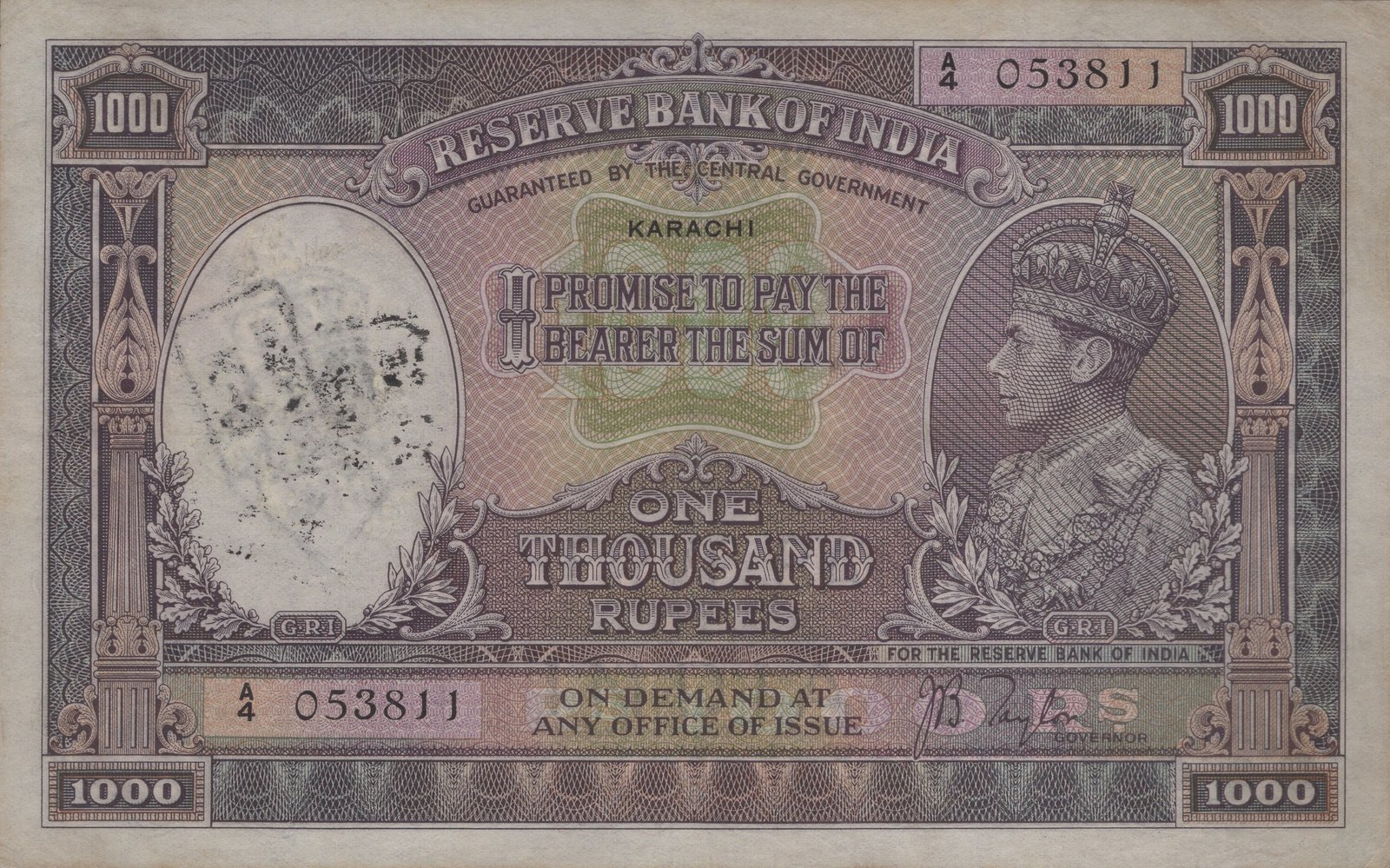
| 1,000 rupees | May 1938 on the Foreign Office's specimen; June 1938 on the museum page | both named |
| 10,000 rupees | June 1938 | the Foreign Office's note on its specimen; the museum page |
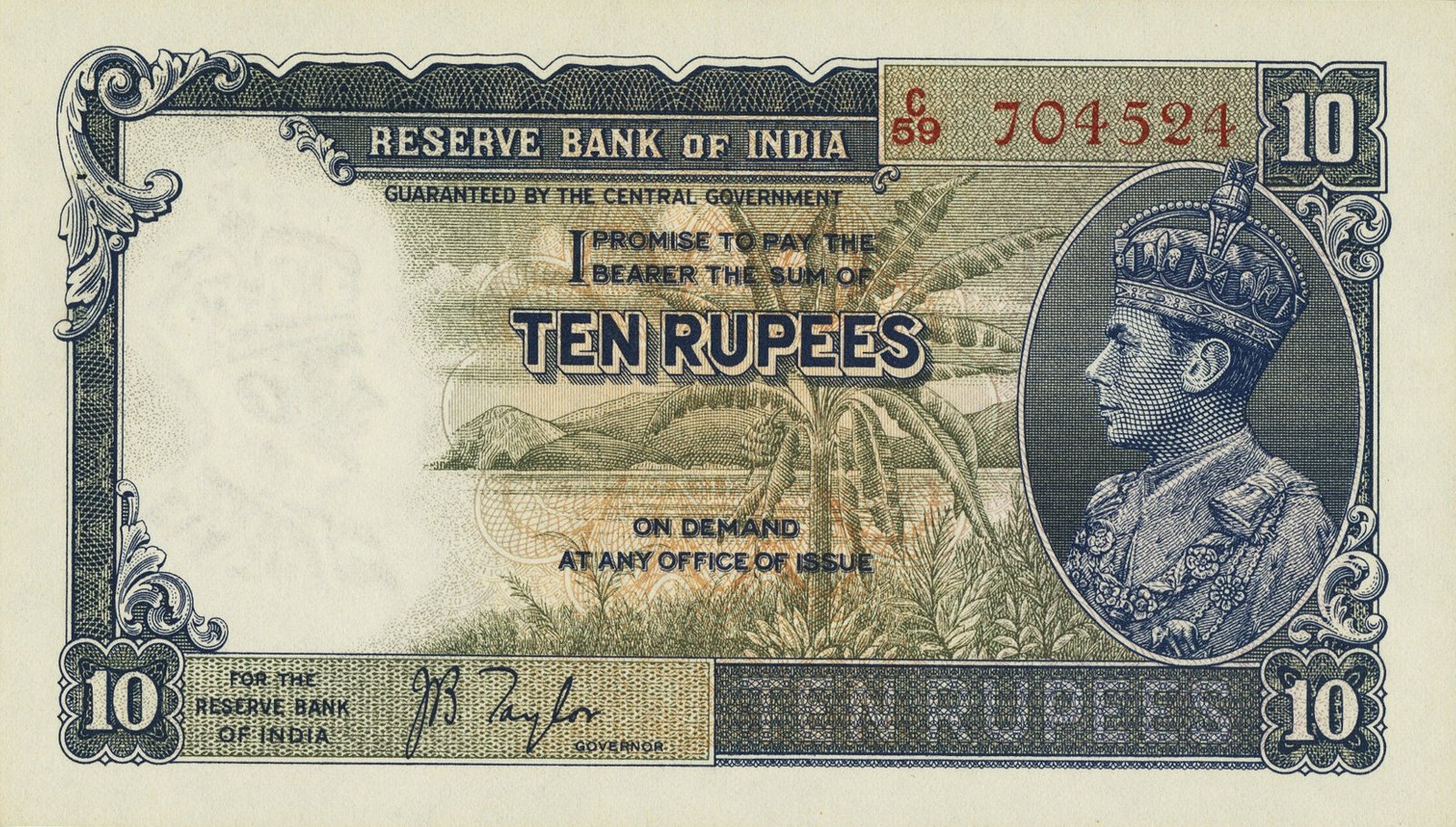
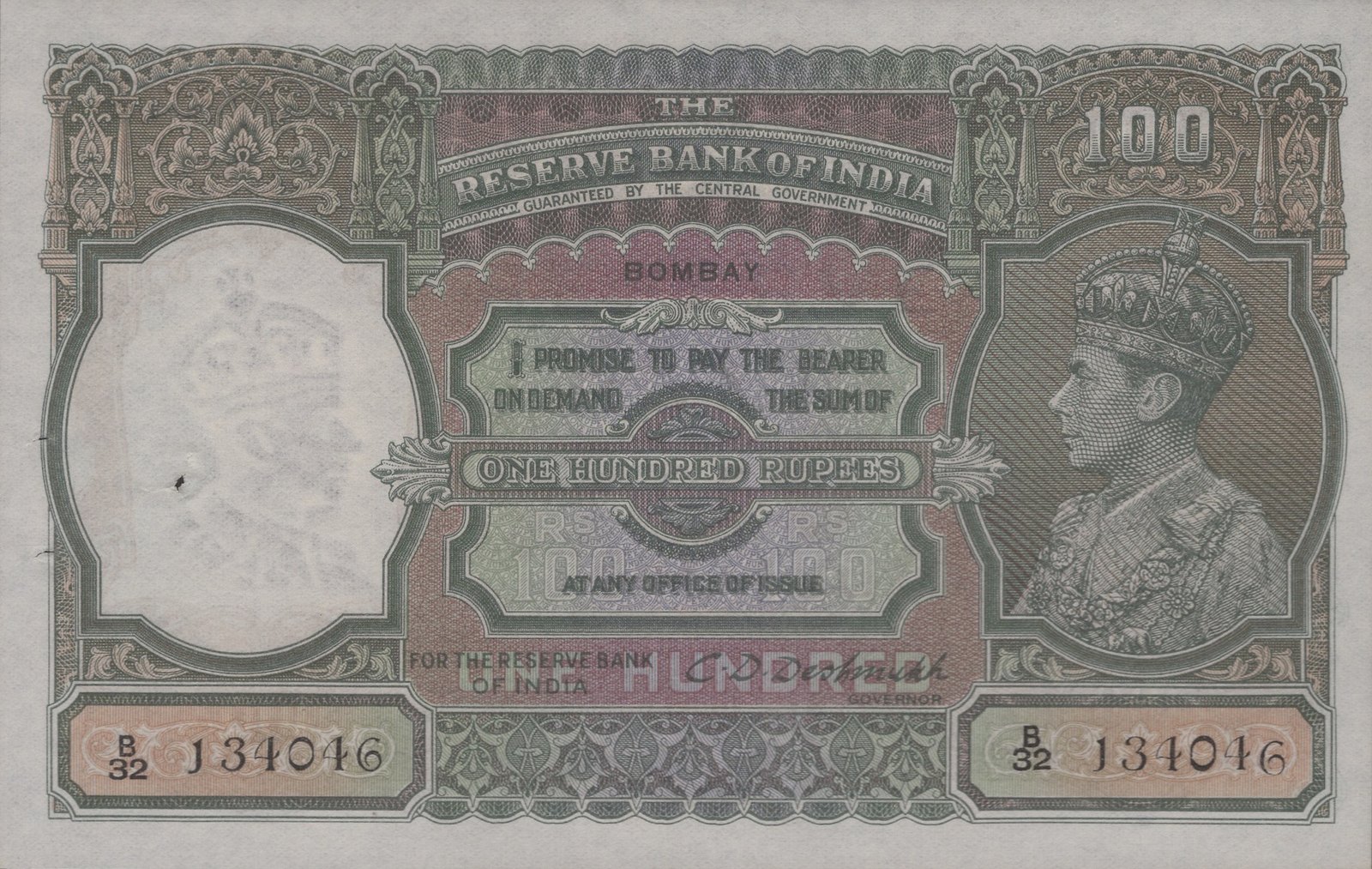
The language panel of these side-face notes has 8 languages, Burmese among them. The 100 rupees was issued at Bombay, Calcutta, Cawnpore, Karachi, Lahore and Madras, and later at Delhi. Sources mention nearly 190 million notes of 100 rupees printed at Nasik. The 1,000 rupees was issued at six offices, and Stack's Bowers' description of lot 20419 in its sale of 2 October 2024 says, as the Pick page does, that every 1,000 rupees is signed by Taylor.
The 1 rupee of the Government of India, 1940
The 1 rupee was not a note of the Bank. Under the Reserve Bank of India Act the 1 rupee note counted as a coin, so the 1 rupee dated 1940 was issued by the Government of India and is signed by the Finance Secretary. It carries no promise to pay.
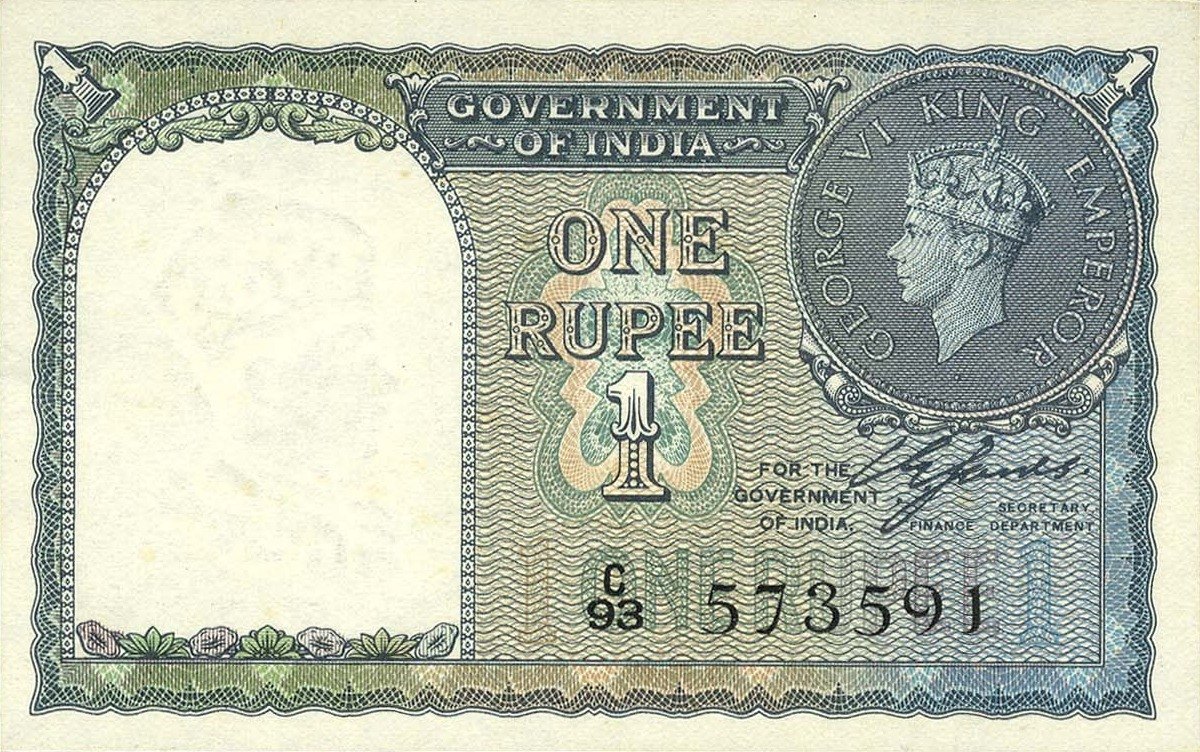
The first 1 rupee notes of the war were the King George V notes dated 1935, issued from 24th July 1940, the day of the Currency Ordinance (No. IV of 1940), as the Reserve Bank's Report on Currency and Finance for 1943-44 says. The museum page gives August 1940 for the return of the 1 rupee under that Ordinance. Sources mention that the paper for the note dated 1940 was ordered from Portals in early 1940 and shipped to the India Security Press at Nashik Road, as silver rupees ran short. The Foreign Office noted on its specimen that the note dated 1940 was released in July 1941.
Red serial numbers were adopted in 1942 as a wartime step for the notes meant for Burma, mainly to control their entry into India. Sources mention that notes without the Burma overprint ceased to be legal tender in Burma on 1 July 1948.
The Reserve Bank's Reports on Currency and Finance show the Government of India 1 rupee as the note most often forged in the war years: 8,560 of the 13,239 forged notes received in 1943-44, and 12,306 of the record 23,792 in 1945-46, 9,145 of them at Lahore.
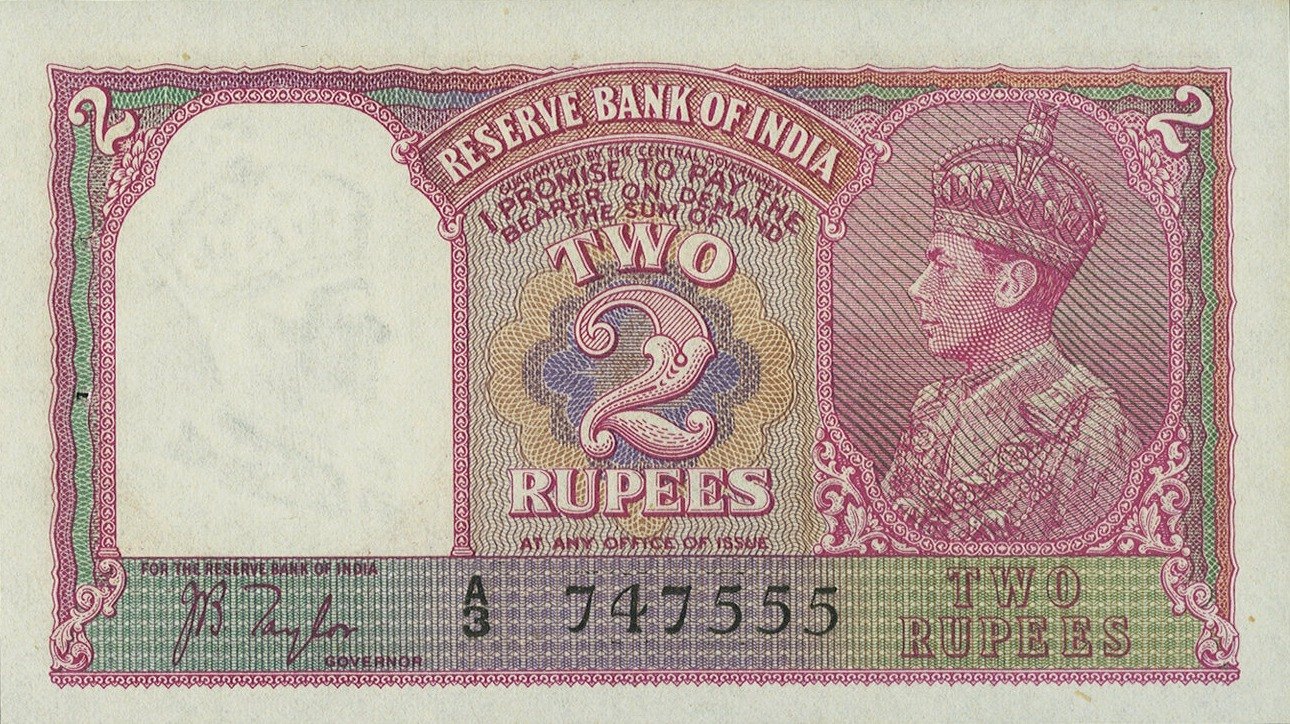
The 2 rupees of 1943
The 2 rupees came last. The Reserve Bank of India Act had to be amended to allow it, and the note was introduced in February 1943 with Taylor's signature, according to the Reserve Bank's Reports on Currency and Finance for 1943-44 and later years. Sources mention 3 March 1943, and so does the museum page, which adds that the 2 rupees took the place of a planned note of 2 rupees 8 annas. Taylor died on 17 February 1943, in the month the reports give for the note.
1944: Deshmukh's signature and the full-face portrait
The Reports on Currency and Finance for 1943-44 and 1944-45 give the day and the office at which each note with C. D. Deshmukh's signature first went out.
| Note | First issued with Deshmukh's signature |
|---|---|
| 10 rupees | Calcutta, 29th February 1944 |
| 2 rupees | Calcutta, 3rd March 1944 |
| 100 rupees | Karachi, 5th May 1944 |
| 5 rupees | Delhi, 2nd June 1944 |
| 10 rupees with the facing portrait | Bombay, 5th October 1944; the Foreign Office noted September 1944 on its specimen |
| 1 rupee with green numbers and plate letter A | Bombay, 1st December 1944 |
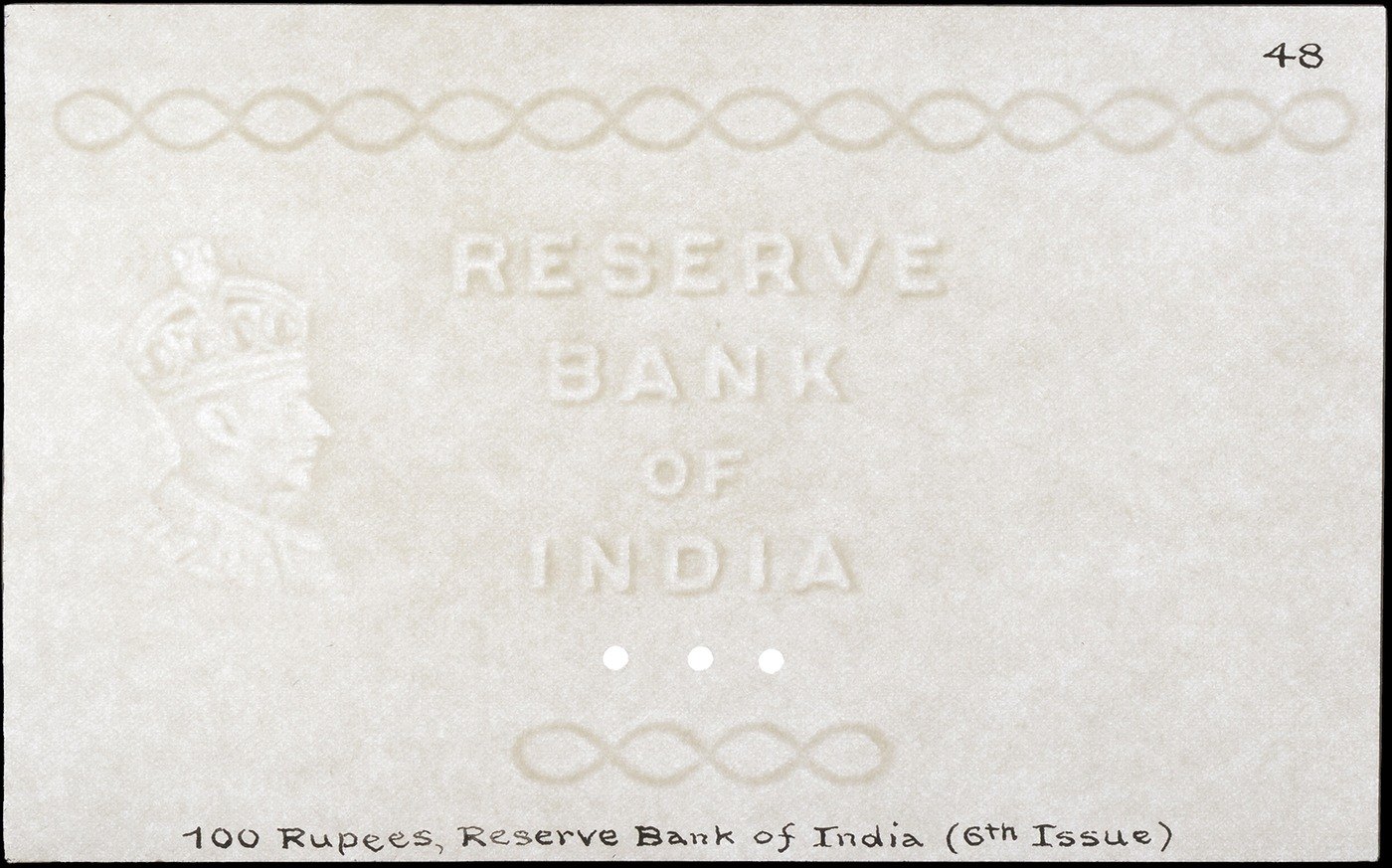
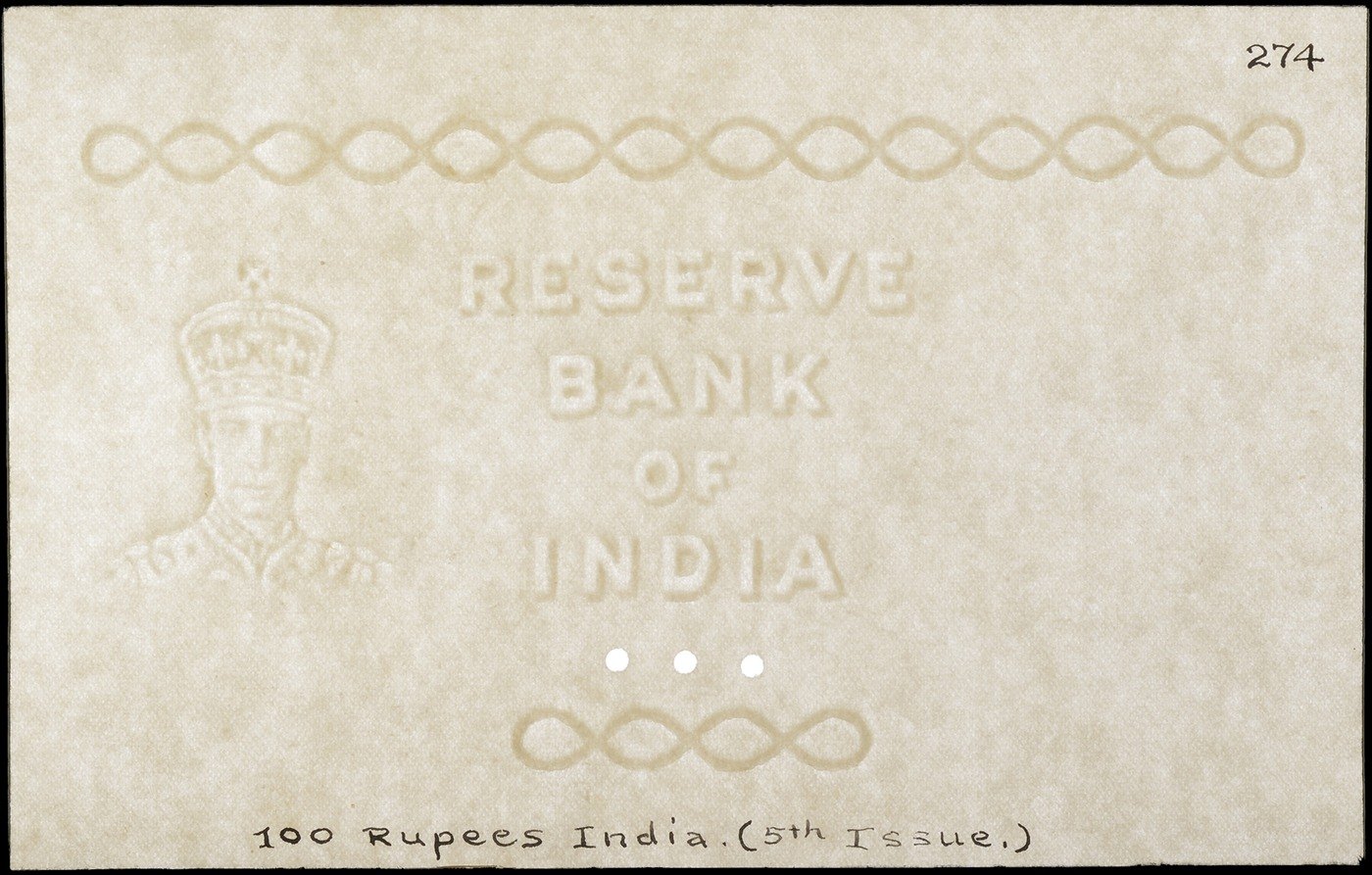
The 5 rupees and 10 rupees of the second issue show the King full face. Their language panel has 7 languages, without Burmese.
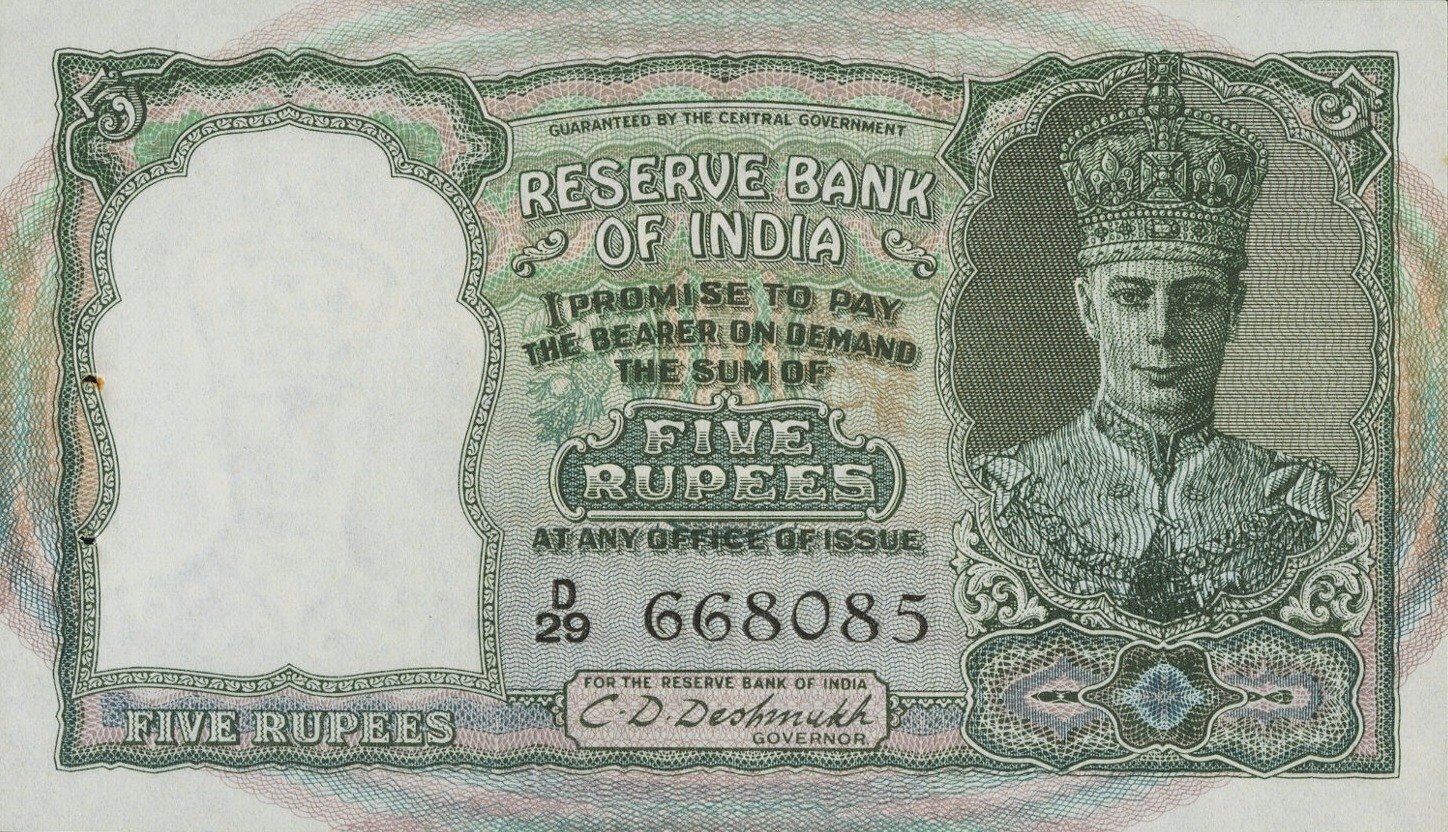
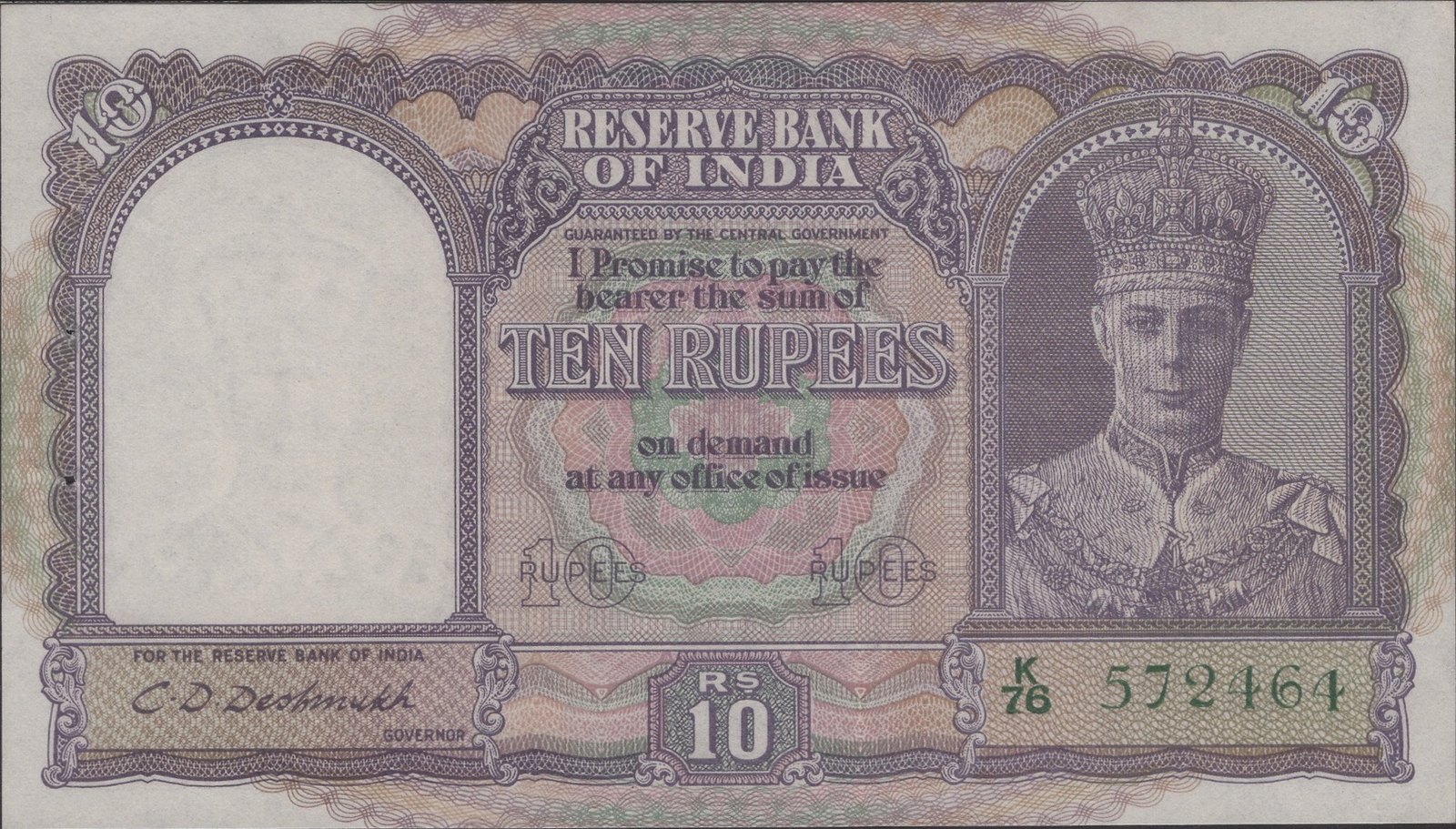
Why the portrait was changed is told in more than one way. Sources mention that the change of the watermark of the 100 rupees followed a Japanese attempt to counterfeit the note in 1942; other sources name the forged note as the 10 rupees. Heritage's description of lot 28154 in its sale of 25 April 2019 names the 100 rupees. The Reserve Bank's museum page speaks of forged 10 rupee notes with Deshmukh's signature, and says the watermark and the front were then changed from the profile to the full-face portrait and that the security thread was used in India for the first time.
The high values end, 12th January 1946
All 500, 1,000 and 10,000 rupee notes ceased to be legal tender on 12 January 1946. Under the High Denomination Bank Notes (Demonetisation) Ordinance of 12th January 1946 holders had ten days to exchange their notes on a declaration. The Reserve Bank's offices could allow later exchanges for good reason up to 9th February 1946, and its Governor and Deputy Governor up to 26th April 1946 (the Reserve Bank's Report on Currency and Finance for 1945-46).
The Ordinance reached back over eighty years of notes:
- the uniface 500 rupees of 1867 to 1880 and of 1904 to 1922;
- the uniface 1,000 rupees of 1867 to 1900 and of 1901 to 1927;
- the uniface 10,000 rupees;
- the King George V 500 rupees, 1,000 rupees and 10,000 rupees;
- the Reserve Bank's own 1,000 and 10,000 rupees of 1938.
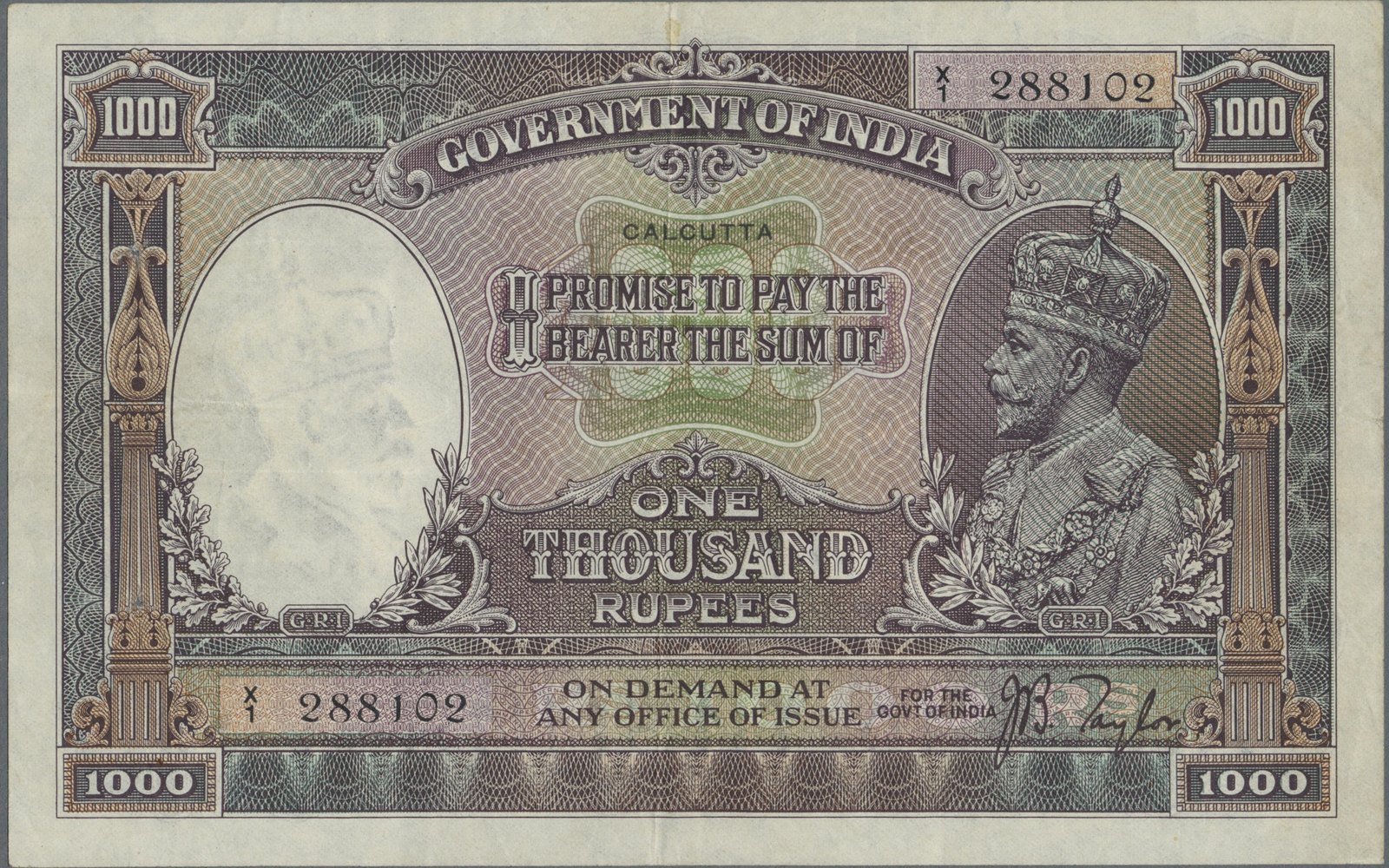
Some 1,000 rupee notes of 1938 carry PAYMENT REFUSED UNDER ORDERS OF THE CENTRAL GOVERNMENT handstamps of that demonetisation. Heritage's description of lot 28169 in its sale of 25 April 2019 makes the same point about the 1,000 rupees of 1938: a note of that value had to come through the war and then the demonetisation of January 1946.
Burma and Pakistan
Blocks of the Reserve Bank's notes were overprinted for Burma, and from 1 April 1948 others were issued with the GOVERNMENT OF PAKISTAN inscription. The Pick pages list the prefixes of each. Sources mention India notes withdrawn in Pakistan after 1948 with a GOVERNMENT OF WEST PAKISTAN handstamp, a MANAGER D.L.O. LAHORE handstamp with Destroyed written by hand, or a PAID handstamp with cancelled, initials and a date.
All 100 rupee notes of the KARACHI and LAHORE offices, of the Government of India and of the Reserve Bank alike, were demonetised in India from 12th September 1949 by a notification of 7th September 1949, because those offices had passed to the State Bank of Pakistan on 1st July 1948. The Reserve Bank's offices and the treasuries still exchanged them (the Reserve Bank's Report on Currency and Finance for 1949-50). This touched the King George V 100 rupees as well as the Reserve Bank's.
A Government of India press communique of 16th September 1950 warned that Burma 100 rupee notes were being passed in India with the overprint skilfully erased (the Reserve Bank of India's Report on Currency and Finance for 1950-51).
1949: new colours for the numbers, and a new watermark
The Report on Currency and Finance for 1949-50 records a run of changes.
- The 100 rupees on paper with the facing watermark was first issued at Bombay on 31st May 1949. Later that year its serial numbers were changed from black to green, to help the sorting and listing of notes. Sources mention April 1948 for the change of watermark.
- The numbers of the 5 rupees were changed from black to red during that year, after 31st May 1949.
- The 2 rupees has red serial numbers from May 1949. Heritage's description of lot 28393 in its sale of 18 September 2020 says the red numbers are found on the H prefix only, which is what the Pick page records.
- The serial numbers of the 1 rupee were changed from green to black during that year.
1950 and after
The King's portrait notes were replaced by the Asoka Pillar notes of the Republic of India from 26th January 1950 but remained legal tender (the Reserve Bank's Report on Currency and Finance for 1949-50). Sources mention withdrawal on 27 October 1957. The museum page says the King George VI series ran until 1947 and was then frozen until 1950.
What the sources leave out
- The prefixes of five of the six offices of the 10,000 rupees of 1938 are not recorded.
- The Pick pages quote no report on how many notes of each value were printed. The one figure, nearly 190 million notes of 100 rupees, comes from sources the Pick page does not name.
- The Pick pages quote no report on the reason for the change of portrait in 1944. The two accounts above name different notes.
- The sources differ on the month of the 1,000 rupees of 1938 and on the day of the 2 rupees of 1943.
Sources
- The Reserve Bank of India's Reports on Currency and Finance for 1943-44, 1944-45, 1945-46, 1949-50 and 1950-51.
- The Foreign Office's notes on its specimens in the British Library.
- Stack's Bowers, 2 October 2024, lot 20419.
- Heritage Auctions, 25 April 2019, lots 28154 and 28169; 18 September 2020, lot 28393.
- Reserve Bank of India, Museum, "British India Issues", https://www.rbi.org.in/Scripts/pm_britishindia.aspx
- The Pick pages of the catalogue.
Member comments
Log in or register to post a comment.