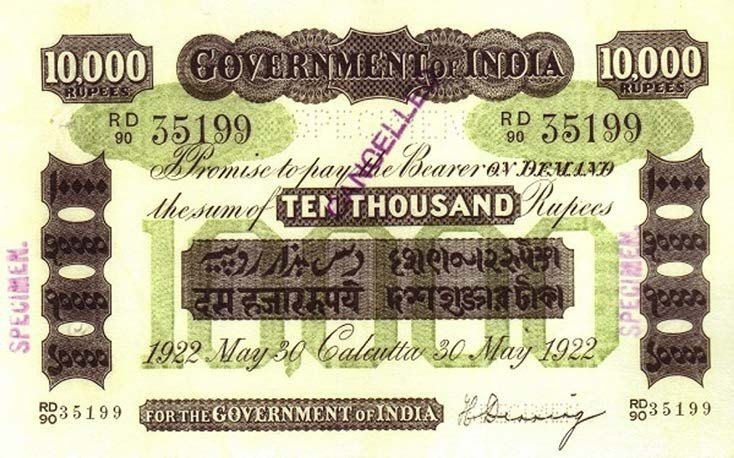
The yearly reports of the Paper Currency Department, and from 1914 of the Controller of the Currency, carried a statement of the notes in circulation on 31st March by value. This article sets those tables out for the notes of the Government of India: the number of notes where the reports give it, the sum in rupees where they give only that, the share of each value, and the life of a note. The sources are the Currency Department's reports for 1909-10 to 1913-14 and for 1920-21, the reports of the Controller of the Currency for 1923-24 and 1926-27 to 1928-29, and the memorandum on the paper currency printed in the Appendices of the Royal Commission on Indian Finance and Currency of 1913. The articles on the green underprint notes and the King George V notes quote a few of these figures. Here are the tables whole.
Two things to know before reading them. A lakh is 100,000 rupees, and the reports print lakhs with the comma two places from the end, so that 17,94 lakhs is 1,794 lakhs. And "circulation" in these tables is the gross circulation: every note issued and not yet returned, whether it was in a pocket, a bank, a treasury or a currency chest.
Five years from 1872 to 1912
Newmarch's memorandum for the Royal Commission of 1913 (Appendices, p. 240) gives the number of notes of each value in circulation on the last day of five years.
| Year | 5 rupees | 10 rupees | 20 rupees | 50 rupees | 100 rupees | 500 rupees | 1,000 rupees | 10,000 rupees |
|---|---|---|---|---|---|---|---|---|
| 1872-73 | 310,001 | 970,517 | 441,871 | 157,965 | 214,110 | 27,957 | 57,635 | 576 |
| 1882-83 | 475,457 | 1,955,081 | 264,819 | 173,132 | 301,585 | 28,513 | 38,158 | 2,661 |
| 1892-93 | 495,456 | 3,917,336 | 330,083 | 232,482 | 568,068 | 50,648 | 67,981 | 5,403 |
| 1902-03 | 872,414 | 5,960,226 | 462,952 | 263,866 | 898,724 | 56,348 | 65,653 | 8,712 |
| 1911-12 | 2,599,877 | 15,090,740 | 65,633 | 379,255 | 1,652,209 | 56,102 | 92,971 | 14,320 |
The 5 rupees was first issued in 1871, so the 310,001 of 1872-73 are notes of the 5 rupees of 1871 to 1901. B. B. Das Gupta (Paper Currency in India, 1927) dates the first 10,000 rupees to 1872, and the 576 notes of 1872-73 fit that.
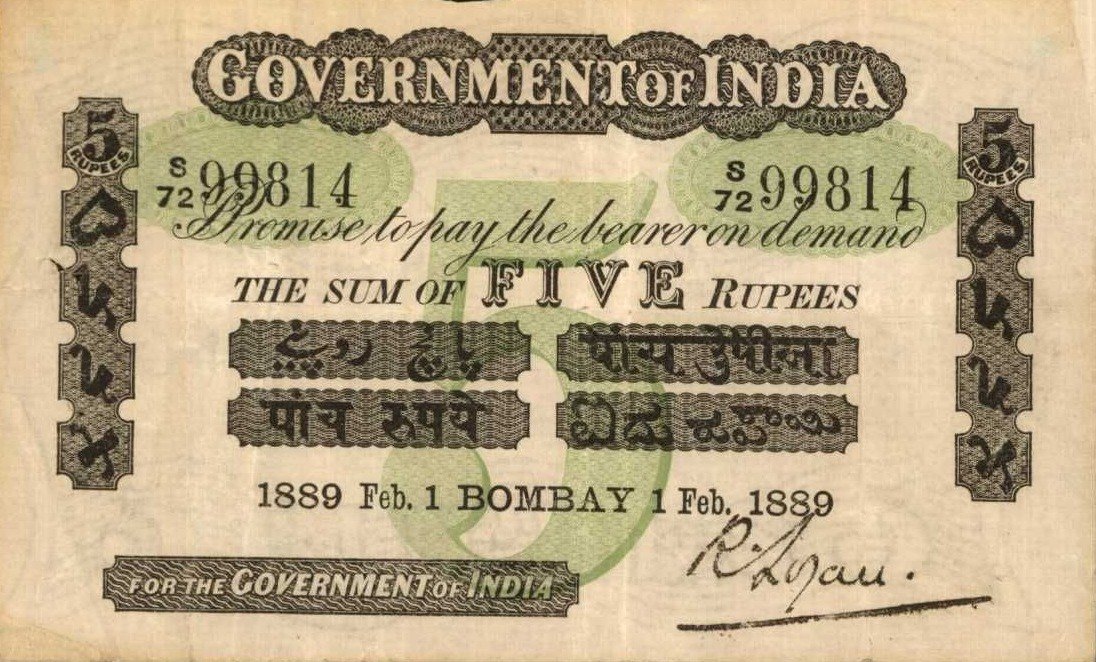
Every year from 1908 to 1914
The Currency Department's reports give the number of notes on 31st March of each year. The rows for 1908, 1909 and 1910 are from the report for 1909-10 (para 7), that for 1911 from the report for 1911-12 (Statement XVI), and the others from the Statement XVI of their own year.
| 31st March | 5 rupees | 10 rupees | 20 rupees | 50 rupees | 100 rupees | 500 rupees | 1,000 rupees | 10,000 rupees | All notes |
|---|---|---|---|---|---|---|---|---|---|
| 1908 | 1,597,355 | 9,141,173 | 487,502 | 269,668 | 1,241,364 | 63,484 | 72,130 | 11,821 | 12,884,497 |
| 1909 | 1,869,545 | 9,820,544 | 506,307 | 280,814 | 1,245,600 | 60,265 | 74,117 | 9,435 | 13,866,627 |
| 1910 | 2,269,962 | 11,598,068 | 420,848 | 342,514 | 1,436,406 | 62,021 | 88,350 | 12,821 | 16,230,990 |
| 1911 | 2,425,778 | 12,528,018 | 106,731 | 526,488 | 1,406,613 | 56,305 | 85,464 | 12,976 | 17,148,363 |
| 1912 | 2,599,877 | 15,090,740 | 65,633 | 379,255 | 1,652,209 | 56,102 | 92,971 | 14,320 | 19,951,107 |
| 1913 | 2,954,978 | 17,941,958 | 49,066 | 344,337 | 1,776,201 | 54,347 | 90,392 | 18,220 | 23,229,499 |
| 1914 | 3,222,891 | 17,726,423 | 38,415 | 357,059 | 1,781,370 | 52,774 | 91,712 | 15,294 | 23,285,938 |
Three things show in these seven rows.
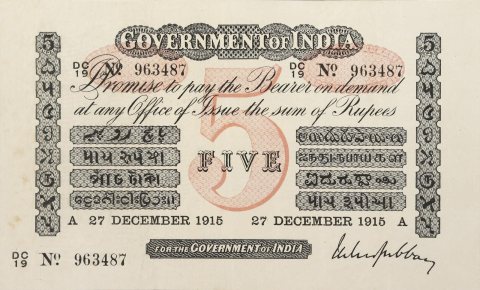
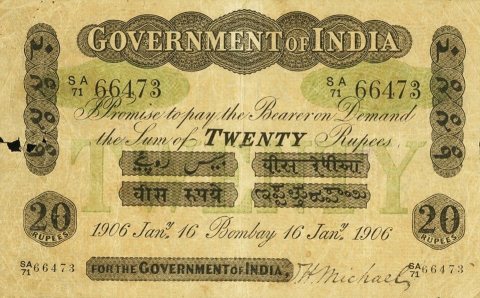
- The 20 rupees. Its issue was discontinued from 18th February 1910. Six weeks later 420,848 notes were still out, a year after that 106,731, and by 1914 only 38,415. See the 20 rupees of 1902 to 1906.
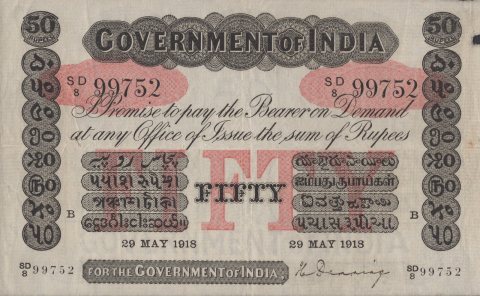
- The 50 rupees. It was made payable at every office in February 1910, and the notes in circulation went from 342,514 to 526,488 within a year, then fell back.
- The 10 rupees. The universal 10 rupees arrived in 1910-11, and the tens went from 12,528,018 in 1911 to 17,941,958 in 1913.
The statement of 31st March 1911 in the report for 1910-11 itself is too soft a scan to read by circle, so the row for 1911 is the one printed a year later.
One year circle by circle: 31st March 1910
The report for 1909-10 (para 7) gives each of the seven circles. Six weeks earlier, on 18th February 1910, the Act of 1910 had made Cawnpore, Lahore and Karachi circles of their own.
| Circle | 5 rupees | 10 rupees | 20 rupees | 50 rupees | 100 rupees | 500 rupees | 1,000 rupees | 10,000 rupees | All notes |
|---|---|---|---|---|---|---|---|---|---|
| Calcutta | 228,540 | 6,980,939 | 43,510 | 50,624 | 466,519 | 24,901 | 33,154 | 6,453 | 7,834,640 |
| Cawnpore | 67,464 | 211,256 | 21,583 | 22,550 | 68,497 | 7,596 | 5,298 | 252 | 404,496 |
| Lahore | 288,241 | 521,142 | 82,836 | 39,035 | 113,513 | 12,582 | 5,046 | 553 | 1,062,948 |
| Bombay | 1,142,425 | 2,076,811 | 185,395 | 169,976 | 206,934 | 10,765 | 37,625 | 3,775 | 3,833,706 |
| Karachi | 21,295 | 284,601 | 26,039 | 12,179 | 22,110 | 2,245 | 3,434 | 457 | 372,360 |
| Madras | 480,985 | 482,938 | 46,796 | 43,140 | 346,736 | 3,780 | 2,409 | 1,127 | 1,407,911 |
| Rangoon | 41,012 | 1,040,381 | 14,689 | 5,010 | 212,097 | 152 | 1,384 | 204 | 1,314,929 |
| All circles | 2,269,962 | 11,598,068 | 420,848 | 342,514 | 1,436,406 | 62,021 | 88,350 | 12,821 | 16,230,990 |
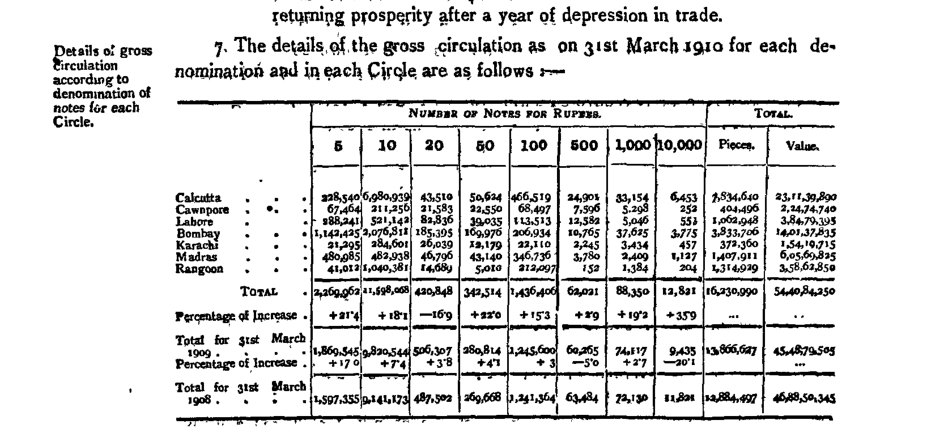
Calcutta had 6,980,939 of the 11,598,068 notes of 10 rupees. Bombay had 1,142,425 of the 2,269,962 notes of 5 rupees, and Madras 480,985. The table also bears on the 10,000 rupees, of which the catalogue records notes of Calcutta only: on this day every circle had 10,000 rupee notes in its circulation, 252 at Cawnpore and 204 at Rangoon among them. The table says where the notes stood in the accounts. It does not say what office name was printed on them.
For Rangoon the Report on the Administration of Burma for 1909-10 prints slightly different figures for the same day: 41,328 notes of 5 rupees, 1,044,368 of 10 rupees and 212,436 of 100 rupees. Neither report explains the difference.
Notes for every 10,000 people, 1913-14
The report for 1913-14 (para 54) set the notes of each circle against its population.
| Circle | 5 rupees | 10 rupees | 50 rupees | 100 rupees | 500 rupees | 1,000 rupees |
|---|---|---|---|---|---|---|
| Calcutta | 32 | 1,119 | 5 | 61 | 2.5 | 4 |
| Cawnpore | 18 | 33 | 4 | 22 | 1.3 | 1 |
| Lahore | 137 | 181 | 15.5 | 32.5 | 2.2 | 1.5 |
| Bombay | 172 | 290 | 19.8 | 81 | 1.4 | 5.7 |
| Karachi | 66 | 691 | 38 | 28 | 2 | 7 |
| Madras | 124 | 133 | 7 | 78.5 | 0.6 | 0.4 |
| Rangoon | 91 | 1,450 | 4.5 | 139 | not given | 1 |
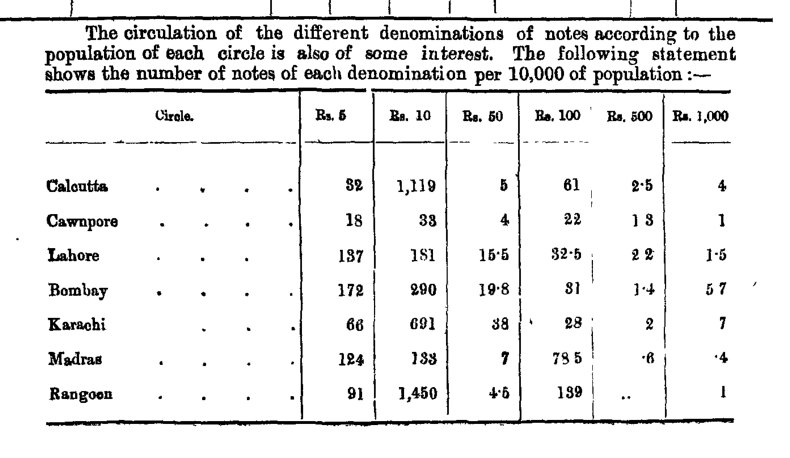
The report remarks that in Burma the circulation of tens and hundreds was substantially higher than in any other circle.
The share of each value, 1901-02 to 1928-29
The reports give each value as a percentage of the gross circulation by value on 31st March, leaving out the 10,000 rupees. The rows to 1911-12 are from the report for 1913-14 (para 54), those for 1912-13 to 1923-24 from Statement XIV of the Controller's report for 1923-24, and the last five from the reports for 1927-28 and 1928-29.
| Year | 1 rupee | 2 rupees 8 annas | 5 rupees | 10 rupees | 20 rupees | 50 rupees | 100 rupees | 500 rupees | 1,000 rupees |
|---|---|---|---|---|---|---|---|---|---|
| 1901-02 | 1.7 | 23.4 | 3.6 | 5.1 | 32.6 | 10.7 | 22.9 | ||
| 1909-10 | 2.7 | 27.9 | 2.0 | 4.1 | 34.5 | 7.5 | 21.3 | ||
| 1910-11 | 2.9 | 29.8 | 0.5 | 6.3 | 33.5 | 6.7 | 20.3 | ||
| 1911-12 | 2.8 | 32.1 | 0.3 | 4.0 | 35.1 | 5.9 | 19.8 | ||
| 1912-13 | 2.9 | 35.3 | 0.2 | 3.4 | 35.0 | 5.4 | 17.8 | ||
| 1913-14 | 3.2 | 34.9 | 0.2 | 3.5 | 35.0 | 5.2 | 18.0 | ||
| 1914-15 | 3.4 | 32.6 | 0.1 | 3.8 | 35.0 | 5.1 | 20.0 | ||
| 1915-16 | 4.0 | 34.2 | 0.1 | 4.2 | 37.0 | 4.2 | 16.3 | ||
| 1916-17 | 4.9 | 33.5 | 0.1 | 3.7 | 37.5 | 3.6 | 16.7 | ||
| 1917-18 | 0.4 | 0.2 | 6.4 | 31.9 | not shown | 4.1 | 38.0 | 2.9 | 16.1 |
| 1918-19 | 7.8 | 1.4 | 6.8 | 34.8 | not shown | 3.6 | 32.5 | 1.9 | 11.2 |
| 1919-20 | 8.7 | 0.7 | 7.4 | 35.3 | not shown | 3.2 | 32.5 | 1.7 | 10.5 |
| 1920-21 | 6.4 | 0.4 | 9.5 | 35.5 | not shown | 2.6 | 31.9 | 1.7 | 12.0 |
| 1921-22 | 6.2 | 0.2 | 10.0 | 36.3 | not shown | 2.5 | 34.2 | 1.3 | 9.3 |
| 1922-23 | 6.7 | 0.1 | 10.0 | 34.7 | not shown | 2.3 | 36.4 | 1.0 | 8.8 |
| 1923-24 | 6.6 | not shown | 9.3 | 33.4 | not shown | 1.8 | 40.5 | 0.9 | 7.5 |
| 1924-25 | 2.5 | not shown | 9.3 | 40.5 | not shown | 1.5 | 37.7 | 0.8 | 7.7 |
| 1925-26 | 0.4 | not shown | 9.2 | 45.2 | not shown | 1.3 | 35.4 | 0.7 | 7.8 |
| 1926-27 | 0.3 | not shown | 9.9 | 43.7 | not shown | 1.3 | 36.1 | 0.7 | 8.0 |
| 1927-28 | 0.2 | not shown | 10.7 | 43.2 | not shown | 1.2 | 35.7 | 0.6 | 8.4 |
| 1928-29 | 0.2 | not shown | 13.2 | 41.4 | not shown | 1.1 | 36.5 | 0.6 | 7.0 |
In the reports for 1910-11 and 1912-13 three of these cells (the 50 rupees of 1910-11, and the 10 rupees and the 1,000 rupees of 1912-13) are printed in a type where 3 and 8 cannot be told apart, so it is not certain whether those two reports give the same figures as the later ones.
In 1901-02 the 500 rupees was 10.7 per cent and the 1,000 rupees 22.9 per cent of the circulation by value. In 1928-29 they were 0.6 and 7.0 per cent, and the 10 rupees had gone from 23.4 to 41.4 per cent. The report for 1912-13 gives one reason for the fall of the high values: once the treasuries stopped taking the notes of other circles, the banks moved funds between circles in the universal notes of 10, 50 and 100 rupees and no longer in local notes of 500 and 1,000 rupees.
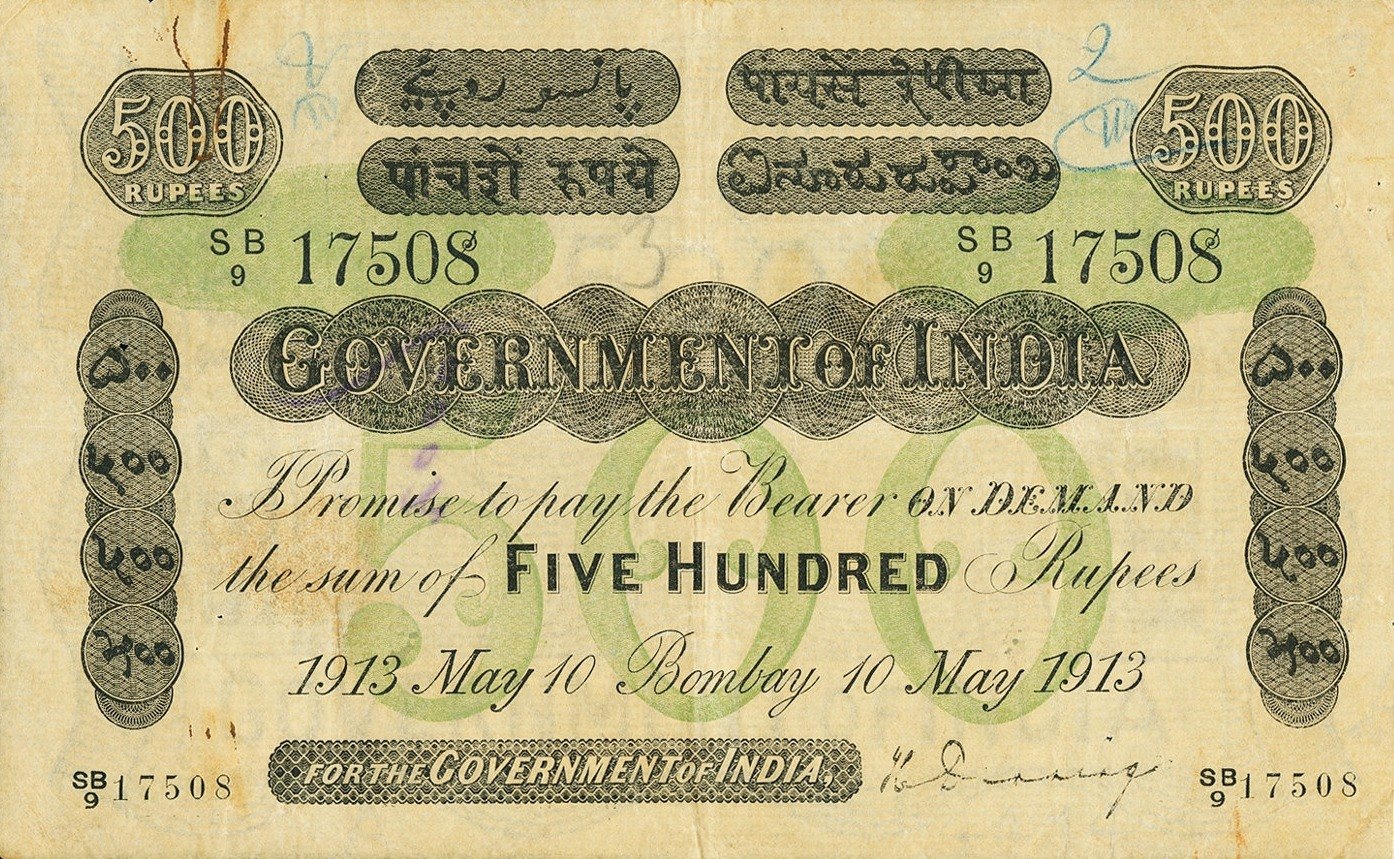
The 1 rupee reached its highest share, 8.7 per cent, on 31st March 1920. The 2 rupees 8 annas never passed the 1.4 per cent of 1918-19.
The sum of each value, 1912-13 to 1928-29
The same statements give the sum in circulation, in lakhs of rupees. No report read gives the number of notes of each value on 31st March after 1914, so for these years a number of notes can only be had by dividing, and the lakhs are rounded.
| 31st March | 1 rupee | 2 rupees 8 annas | 5 rupees | 10 rupees | 20 rupees | 50 rupees | 100 rupees | 500 rupees | 1,000 rupees |
|---|---|---|---|---|---|---|---|---|---|
| 1913 | 1,48 | 17,94 | 10 | 1,72 | 17,76 | 2,72 | 9,04 | ||
| 1914 | 1,61 | 17,73 | 8 | 1,78 | 17,81 | 2,64 | 9,17 | ||
| 1915 | 1,56 | 14,99 | 6 | 1,75 | 16,05 | 2,36 | 9,20 | ||
| 1916 | 2,25 | 18,80 | 5 | 2,24 | 20,39 | 2,33 | 8,99 | ||
| 1917 | 3,31 | 22,60 | 5 | 2,52 | 25,32 | 2,45 | 11,24 | ||
| 1918 | 33 | 18 | 5,45 | 27,33 | 4 | 3,46 | 32,53 | 2,50 | 13,80 |
| 1919 | 10,51 | 1,84 | 9,20 | 46,90 | 3 | 4,90 | 43,81 | 2,48 | 15,11 |
| 1920 | 13,49 | 1,08 | 11,45 | 54,73 | 3 | 4,90 | 50,88 | 2,63 | 16,20 |
| 1921 | 9,52 | 51 | 14,05 | 52,67 | 3 | 3,84 | 47,22 | 2,53 | 17,81 |
| 1922 | 9,93 | 27 | 15,84 | 57,51 | 3 | 4,05 | 54,28 | 2,05 | 14,68 |
| 1923 | 10,88 | 13 | 16,27 | 56,71 | 2 | 3,76 | 59,43 | 1,74 | 14,41 |
| 1924 | 11,39 | 7 | 15,90 | 57,18 | 2 | 3,12 | 69,41 | 1,62 | 12,67 |
| 1925 | 4,15 | 4 | 15,83 | 68,57 | 2 | 2,61 | 63,87 | 1,32 | 13,11 |
| 1926 | 72 | 2 | 15,66 | 76,88 | 2 | 2,23 | 60,22 | 1,19 | 13,20 |
| 1927 | 44 | 2 | 16,49 | 72,86 | 2 | 2,15 | 60,09 | 1,10 | 13,42 |
| 1928 | 39 | 1 | 18,91 | 76,27 | 2 | 2,09 | 63,07 | 1,05 | 14,90 |
| 1929 | 36 | 1 | 23,77 | 74,55 | 2 | 2,01 | 65,76 | 99 | 12,69 |
The rows to 1924 are as the report for 1923-24 prints them (Statement XIV), the rest as the reports for 1926-27, 1927-28 and 1928-29 print them. Three cells differ between reports. The reports for 1926-27 and 1927-28 give the 1,000 rupees of 1924 as 12,87, not 12,67. The reports for 1926-27 and 1927-28 give the 1,000 rupees of 1919 as 15,12, where the reports for 1920-21 and 1923-24 have 15,11. The reports for 1920-21 (Statement XVI), 1926-27 and 1927-28 give the 100 rupees of 1920 as 50,38, not 50,88. G. Findlay Shirras's table of 1920 (Indian Finance and Banking, Table 18) has 15,11 for the 1,000 rupees of 1919. It differs from the statements in four other cells: 1,57 for the 5 rupees of 1915, 4 for the 20 rupees of 1917, and 3,45 for the 50 rupees and 2,49 for the 500 rupees of 1918. It also adds the one value the statements leave out: 18,68 lakhs of rupees in notes of 10,000 rupees on 31st March 1919.
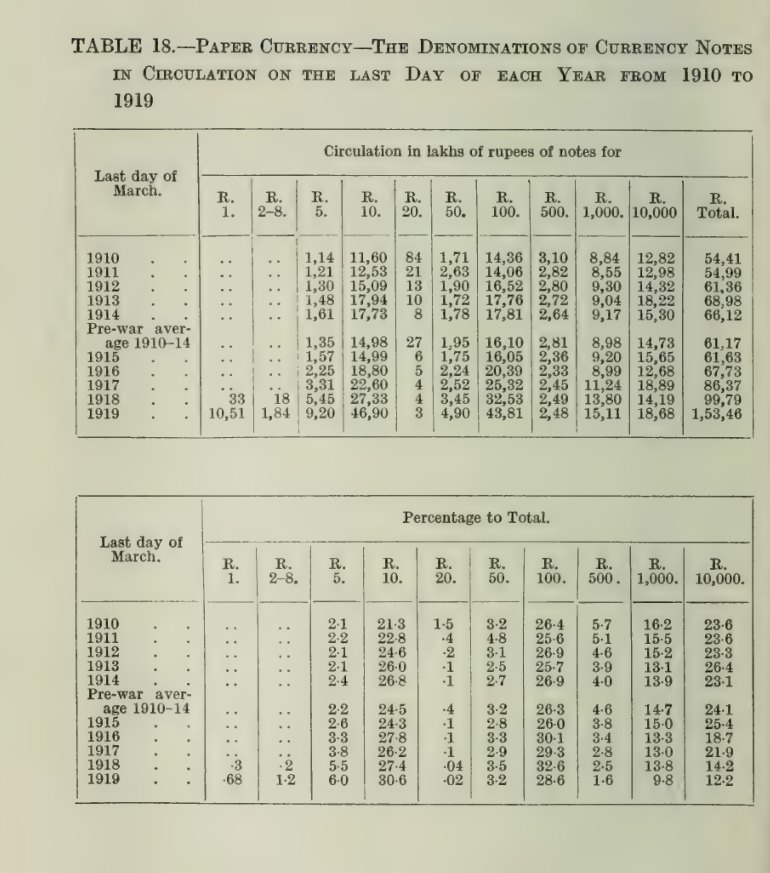
In sum the 100 rupees stood above the 10 rupees from 1914 to 1918 and again in 1923 and 1924. The 1 rupee went from 11,39 lakhs in March 1924 to 72 lakhs two years later: its issue was stopped, and the stock was practically used up by September 1925 (A. C. McWatters's memorandum for the Royal Commission on Indian Currency and Finance of 1926, Appendix 3).
How long a note lasted
The reports measured the life of a note by setting the notes cancelled in a year against the notes in circulation.
The report for 1912-13 (para 68) gives the count for that year.
| 1912-13 | 5 rupees | 10 rupees | 20 rupees | 50 rupees | 100 rupees | 500 rupees | 1,000 rupees | 10,000 rupees |
|---|---|---|---|---|---|---|---|---|
| Notes cancelled in the year | 4,497,579 | 19,049,308 | 16,659 | 793,305 | 5,041,951 | 201,334 | 622,369 | 82,493 |
| In circulation on 31st March 1912 | 2,599,877 | 15,090,740 | 65,633 | 379,255 | 1,652,209 | 56,102 | 92,971 | 14,320 |
| Cancelled, per cent of the circulation | 173 | 126 | 25 | 209 | 305 | 359 | 669 | 576 |
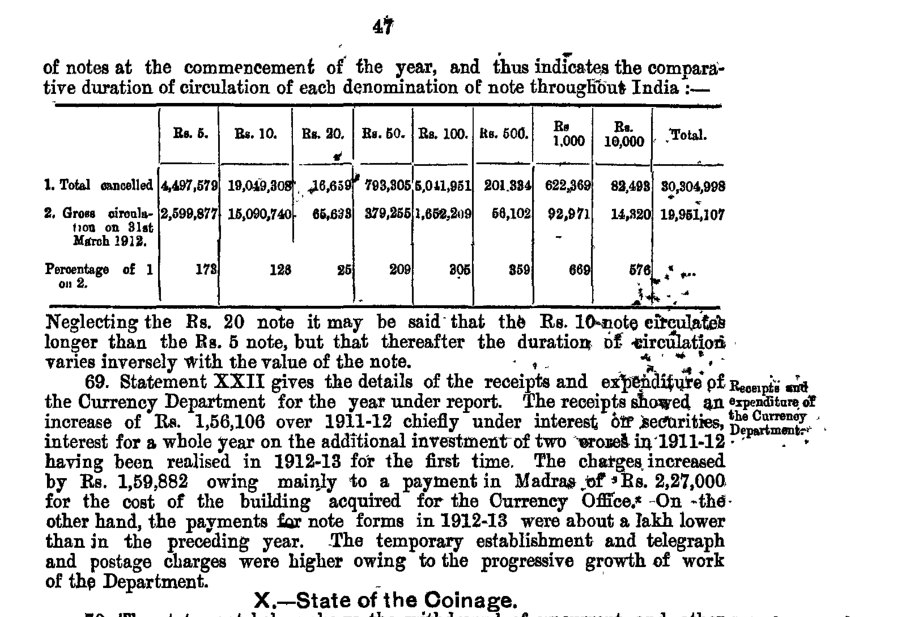
In all 30,304,998 notes were cancelled that year. The 1,000 rupee notes cancelled came to 669 per cent of those in circulation, the 20 rupee notes, no longer issued, to 25 per cent. The report for 1913-14 (para 59) says the life of the 5 rupees had dropped from over 8 months to 7, and that of the 10 rupees from about 10 months to 9.
The report for 1920-21 (para 41) gives the same count in thousands of notes.
| 1920-21, thousands of notes | 1 rupee | 2 rupees 8 annas | 5 rupees | 10 rupees | 50 rupees | 100 rupees | 500 rupees | 1,000 rupees | 10,000 rupees |
|---|---|---|---|---|---|---|---|---|---|
| Cancelled in the year | 223,366 | 7,613 | 32,136 | 51,451 | 2,044 | 11,290 | 213 | 905 | 72 |
| Mean circulation | 115,063 | 3,170 | 25,499 | 53,696 | 873 | 4,880 | 51 | 170 | 19 |
In that one year 223 million notes of 1 rupee were cancelled. A despatch of the Government of India of 16th August 1923, printed by the Royal Commission on Indian Currency and Finance of 1926 (Appendix 63), says that over 200 million small notes were handled and cancelled each year, and that the 1 rupee, little more than 6 per cent of the circulation, cost nearly a third of what all the note forms cost.
From 1921-22 the Controller's reports give the life in months. In this table notes lying in currency chests are counted as in circulation.
| Year | 1 rupee | 2 rupees 8 annas | 5 rupees | 10 rupees | 50 rupees | 100 rupees | 500 rupees | 1,000 rupees | 10,000 rupees |
|---|---|---|---|---|---|---|---|---|---|
| 1921-22 | 9 | 14 | 13 | 18 | 11 | 8 | 4½ | 4 | 2 |
| 1922-23 | 9 | 13½ | 14 | 17½ | 11 | 10 | 5½ | 3 | 2 |
| 1923-24 | 9 | 13½ | 14 | 15 | 12 | 11 | 7 | 2½ | 1½ |
| 1924-25 | 13 | 13½ | 11½ | 11 | 7 | 2 | 3 | ||
| 1925-26 | 12½ | 12½ | 11½ | 10½ | 8 | 2 | 3½ | ||
| 1926-27 | 12½ | 12 | 11¼ | 11 | 10 | 2½ | 3¼ | ||
| 1927-28 | 13¼ | 12 | 11½ | 10¼ | 9¾ | 2¼ | 2½ | ||
| 1928-29 | 13¾ | 15¼ | 11½ | 9¾ | 10½ | 2 | 1 |
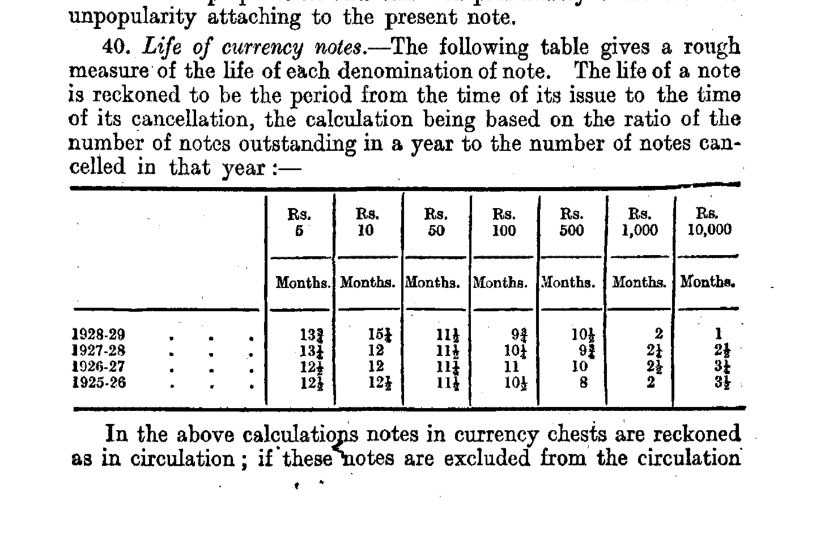
Leaving out the notes in the chests gives the time a note spent in the public's hands, and it is much shorter.
| Year, chests left out | 1 rupee | 2 rupees 8 annas | 5 rupees | 10 rupees | 50 rupees | 100 rupees | 500 rupees | 1,000 rupees | 10,000 rupees |
|---|---|---|---|---|---|---|---|---|---|
| 1923-24 | 5 | 3½ | 8 | 10 | 6 | 6½ | 3 | 2 | 1½ |
| 1927-28 | 6½ | 7½ | 5½ | 5½ | 3¼ | 1½ | 2 | ||
| 1928-29 | not given | 9½ | 5½ | 5½ | 3¾ | 1½ | 1 |
The fractions of 1928-29 are read at the limit of the scan. The report for 1926-27 has such a line too, but two of its figures could not be read safely.
The work behind the figures
Statement XXIII of the report for 1910-11 counts the work of the seven currency offices in that year: 31,870 thousand notes issued, 24,880 thousand cancelled and 27,416 thousand note forms used, against 29,223, 21,174 and 24,448 thousand the year before. On an average working day the offices issued 1,08,693 notes (108,693) and cancelled 86,057. Calcutta alone issued 11,170 thousand notes in the year and Karachi 470 thousand.
The report for 1920-21 (para 39) explains one gap in every table of shares: the 10,000 rupee notes "do not enter into active circulation" and were left out.
What the tables do not tell
- The number of notes printed. The reports count note forms used and notes issued, never the notes ordered from the Bank of England by value or by prefix.
- Which plates, dates or prefixes were in circulation. A figure for the 10 rupees of 1910 covers every 10 rupee note then out, old and new.
- The number of notes by value after 31st March 1914, and any figure by circle after 1914, in the reports read.
- How many notes survive.
Sources
- Royal Commission on Indian Finance and Currency, 1913, Appendices, p. 240: Newmarch's memorandum on the paper currency.
- Report on the Paper Currency Department for 1909-10, para 7.
- The Currency Department's reports for 1910-11 (para 37 and Statement XXIII), 1911-12 (Statement XVI), 1912-13 (paras 52 and 68, Statement XVI) and 1913-14 (paras 54 and 59, Statement XVI).
- The Currency Department's report for 1920-21, paras 39 and 41 and Statement XVI.
- The reports of the Controller of the Currency for 1923-24 (para 38, Statement XIV), 1926-27 (para 46, Statement XIII), 1927-28 (para 42, Statement XIV) and 1928-29 (para 40, Statement XXXVII).
- Report on the Administration of Burma for 1909-10.
- Royal Commission on Indian Currency and Finance, 1926, Appendix 3 (A. C. McWatters's memorandum) and Appendix 63 (despatch of the Government of India of 16th August 1923).
- G. Findlay Shirras, Indian Finance and Banking, 1920, Table 18.
- B. B. Das Gupta, Paper Currency in India, 1927.
Member comments
Log in or register to post a comment.