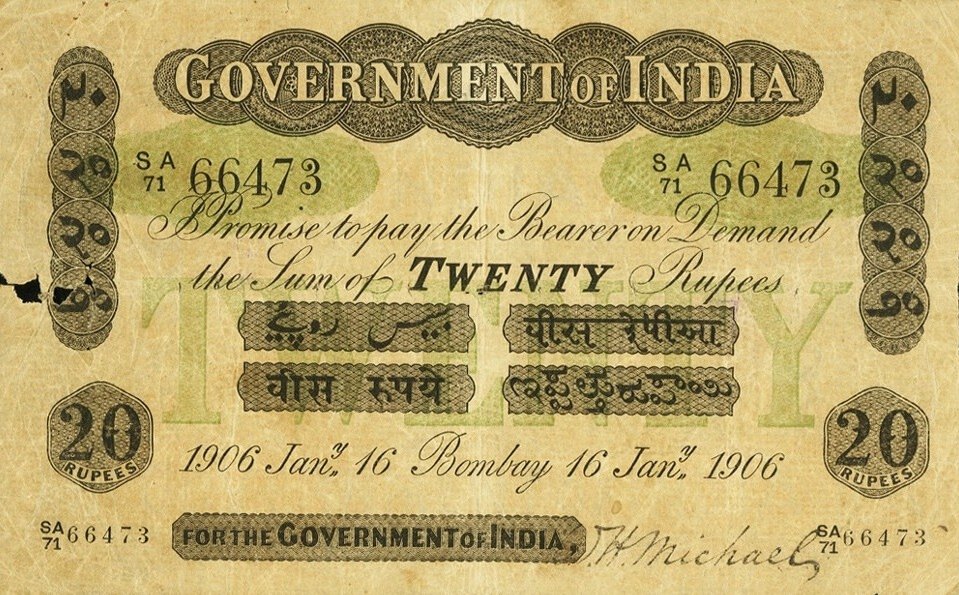
The weekly lists of lost notes in the Gazettes stop in 1889, and they are told in 46,463 lost currency notes in the gazettes of British India, 1865 to 1889. This article takes up the story where the yearly reports begin: the Currency Department's reports for 1909-10 to 1913-14 and for 1920-21, the reports of the Controller of the Currency for 1923-24 and 1926-27 to 1928-29, and the Reserve Bank of India's Reports on Currency and Finance for 1943-44 to 1945-46 and 1949-50 to 1951-52. They print no numbers of lost notes. What they give is counts: claims admitted, old notes written off, and the rules. The reports for 1914-15 to 1919-20, 1921-22, 1922-23, 1924-25, 1925-26 and 1929-30 to 1942-43 were not read, so some years come only from the look back of a later report, and some not at all.
Sums of rupees are given as the reports print them, in the Indian way: 1,82,480 is 182,480 rupees.
A whole note lost: the "stopped" note
The Currency Department's report for 1909-10 (para 33) sets out the rule for a whole note reported lost or stolen. Its number went on a list at the currency office, and the note was a "stopped" note. Payment of a stopped note could not be refused when it was presented, but a presenter who was not known was pointed out to the police. On 31st March 1910 there were 1,125 stopped notes on the Calcutta list, and 335 such notes had been presented in the year.
A note proved to have been wholly destroyed was paid after 20 years. Its value was invested in the meantime and was paid with the interest.
The lists were ended by Finance Department Resolution No. 523-F of 12th November 1912 (the report for 1912-13, para 63). After that the reports speak only of claims.
Claims admitted, year by year
The table gives the number of notes on which a claim was admitted. The first five rows are from the Currency Department's reports for 1909-10 to 1913-14, the rows for 1917-18 to 1920-21 from the report for 1920-21 (para 43), and the rest from the reports of the Controller of the Currency for 1923-24 (para 41), 1926-27 (para 48), 1927-28 (para 45) and 1928-29 (para 43).
| Year | Whole notes destroyed | Half notes lost by post | Half notes lost otherwise | Mutilated notes |
|---|---|---|---|---|
| 1909-10 | 45 | 1,378 | 1,097 | 592 |
| 1910-11 | 23 | 1,390 | 1,079 | 897 |
| 1911-12 | 27 | 898 | 1,163 | 516 |
| 1912-13 | 71 | 582 | 856 | 675 |
| 1913-14 | 23 or 28 | 652 | 1,594 | 794 |
| 1917-18 | 88 | 462 | 1,030 | 1,506 |
| 1918-19 | 206 | 482 | 1,217 | 1,741 |
| 1919-20 | 158 | 740 | 1,804 | 1,807 |
| 1920-21 | 111 | 1,720 | 2,694 | 2,399 |
| 1921-22 | 25 | 2,042 | 2,422 | 2,562 |
| 1922-23 | not read safely | not read safely | 2,083 | 583 |
| 1923-24 | 26 | 1,579 | 1,958 | 484 |
| 1924-25 | 7 | 774 | 1,898 | 448 |
| 1925-26 | 6 | 1,709 | 2,082 | 625 |
| 1926-27 | 34 | 1,314 | 1,173 | 710 |
| 1927-28 | 85 | 362 | 873 | 394 |
| 1928-29 | 282 | 96 | 1,159 | 9,144 |
The last digit of the whole notes destroyed in 1913-14 is not clear on the scan. Two cells of 1922-23 could not be read on the scan of the report for 1923-24. No report read gives the years 1914-15 to 1916-17.
For 1909-10 the report also gives the claims by value. In all 3,112 notes were admitted, worth 1,82,480 rupees, against 2,864 notes worth 2,32,595 rupees in 1908-09.
| Nature of loss, 1909-10 | 5 rupees | 10 rupees | 20 rupees | 50 rupees | 100 rupees | 500 rupees | 1,000 rupees | Notes |
|---|---|---|---|---|---|---|---|---|
| Whole notes destroyed | none | 1 | none | 2 | 35 | 7 | none | 45 |
| Half notes lost by post | 150 | 549 | 66 | 107 | 480 | 20 | 6 | 1,378 |
| Half notes lost accidentally | 20 | 392 | 45 | 75 | 525 | 26 | 14 | 1,097 |
| Mutilated notes | 10 | 518 | 13 | 6 | 45 | none | none | 592 |
| Total for 1909-10 | 180 | 1,460 | 124 | 190 | 1,085 | 53 | 20 | 3,112 |
| Total for 1908-09 | 91 | 1,303 | 93 | 167 | 1,069 | 78 | 63 | 2,864 |
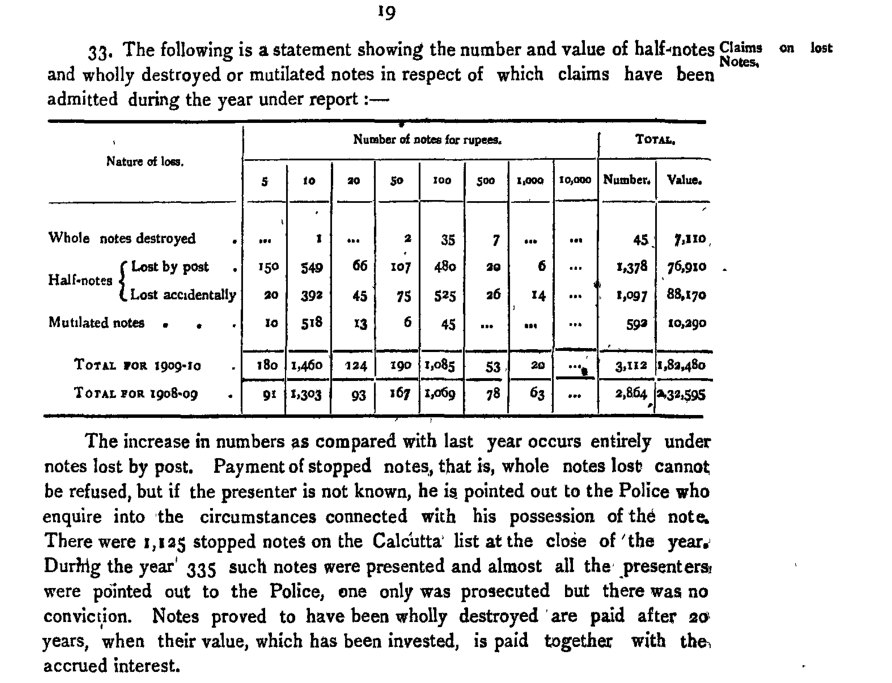
No claim was admitted on a note of 10,000 rupees in either year. Most of the halves were of 10 rupee notes and of 100 rupee notes, and nearly all the mutilated notes were of 10 rupees.
Halves in the post
Notes went by post cut in two, the second half following when the first was acknowledged. The reports show what went wrong with that.
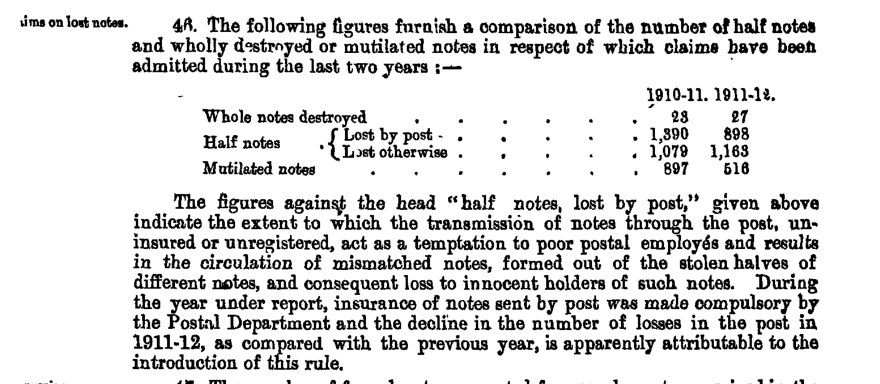
The report for 1910-11 (para 46) says that sending notes through the post uninsured or unregistered was a temptation to poor postal servants, and that the stolen halves of different notes were joined into "mismatched notes" and passed; the report for 1911-12 (para 46) says the same again. The report for 1910-11 gives the figures: half notes lost by post had averaged a little over 800 a year before 1907-08, nearly 1,200 in the two years after, and 1,390 in 1910-11. In the Calcutta Currency Office alone the claims received in 1910-11 numbered 1,026, more than double the 497 of 1905-06. The first digit of the "800" is smudged on the scan.
In 1911-12 the Postal Department made the insurance of notes sent by post compulsory, and the reports for 1911-12, 1912-13 and 1913-14 all put the fall in postal losses down to that rule. The report for 1912-13 (para 61) adds that mismatched notes meant a loss to holders who took them in good faith.
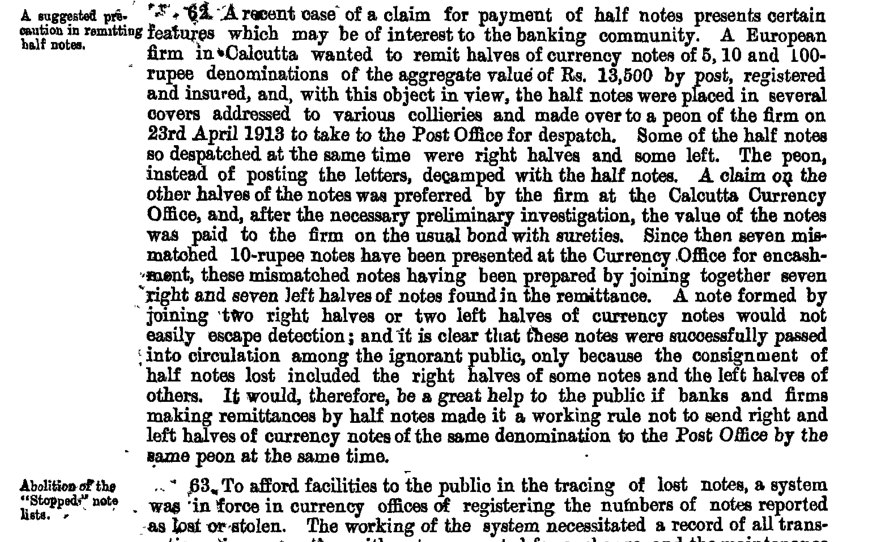
The same report (para 62) tells of a Calcutta firm's peon who made off on 23rd April 1913 with half notes of 5, 10 and 100 rupees worth 13,500 rupees. Seven mismatched 10 rupee notes, made by joining seven right and seven left halves from that remittance, were afterwards presented at the Currency Office. The report asked banks not to send the right and left halves of notes of one value by one peon at one time. The date is printed so, though it falls after the year of the report.
The report for 1913-14 (para 62) records that notes made of two right halves or two left halves of different notes were being tendered, and that it had been decided not to pay them until the missing halves came in. It also says (para 58) that about 95 per cent of the 100 rupee notes of other circles cashed at Bombay, and about 60 per cent of Bombay's own, came in cut in half.
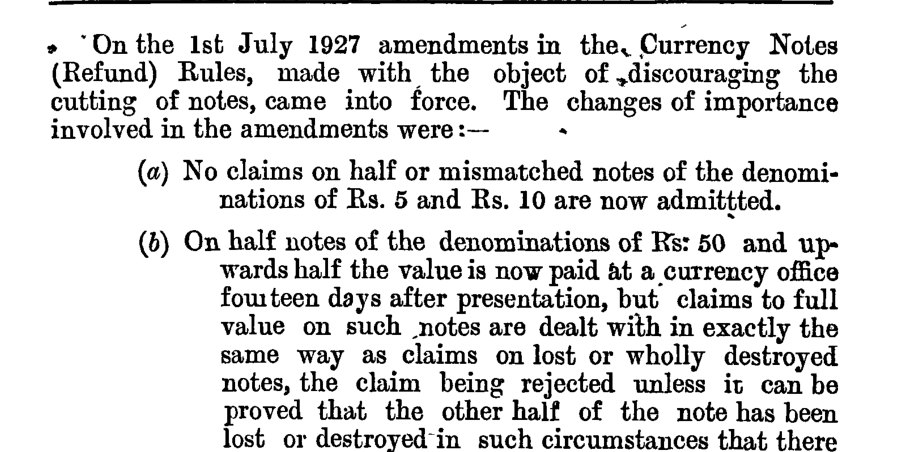
From 1st July 1927 the Currency Notes (Refund) Rules were changed to discourage cutting. No claim was admitted any longer on a half or mismatched note of 5 or 10 rupees. On a half note of 50 rupees or more half the value was paid at a currency office fourteen days after presentation (the Controller of the Currency's report for 1927-28, para 45). The table shows what followed: 362 halves lost in the post in 1927-28 and 96 in 1928-29, against 1,314 the year before the change. Claims on mutilated notes rose from 394 to 9,144 in 1928-29.
Oiled notes, altered notes and false claims
Rules of 1911 had sent every oiled note to a currency office with a list of questions, because there were grounds to believe that notes were being soaked in oil or chemicals to make them easier to copy. In 1913-14 the orders were narrowed to oiled notes believed to be counterfeit or not identifiable, after railway booking offices had refused slightly oiled notes (the report for 1913-14, para 62).
The report for 1909-10 (para 35) says some 10 rupee notes of the Rangoon circle, altered by hand to read 50 and 100 rupees, had reached the Rangoon Currency Office. In 1913-14 two altered notes were impounded, both in Burma: a mismatched 10 rupees with the top numbers changed on both halves, and a 10 rupees altered to look like a 100.
False claims were prosecuted. The report for 1913-14 counts ten prosecutions for fraudulent claims on half and mutilated notes, seven of them at Calcutta, and five convictions. The Controller of the Currency's reports count 65 cases of false claims on defective notes in 1923-24 (24 prosecutions, 11 convictions), 69 cases in 1926-27 (18 prosecutions, 6 convictions) and 45 in 1927-28 (29 prosecutions, 6 convictions).
Old notes written off
A note that stays out long enough is taken off the books. B. B. Das Gupta's list of the paper currency laws (Paper Currency in India, 1927, pp. 244 to 251) puts the rule first in the Indian Paper Currency Act of 1905 (Act 3 of 1905): notes beyond a certain number of years were to be reckoned as out of circulation, and if presented afterwards were paid from the general revenues. The reports cite section 19 of Act II of 1910 and, from 1923-24, section 19 of Act X of 1923. The Act of 1923, as Das Gupta prints it, set the term at forty years for notes of 50 and 100 rupees and at one hundred years for notes above 100 rupees, counted from the 1st April after the issue. The passage read gives no term for notes below 50 rupees. Section 34 of the Reserve Bank of India Act made it forty years from the date of issue for every note (the Reserve Bank's Report on Currency and Finance for 1943-44, para 76).
| Year | Value written off, in rupees | Source |
|---|---|---|
| 1907-08 | 53,400 (2,286 notes) | report for 1909-10, para 19 |
| 1908-09 | 44,370 (2,154 notes) | report for 1909-10, para 19 |
| 1909-10 | 44,250 (2,020 notes) | report for 1909-10, para 19 |
| 1910-11 | 43,080 | reports for 1910-11 and 1913-14 |
| 1911-12 | 43,700 | reports for 1911-12 and 1913-14 |
| 1912-13 | 49,830 | report for 1912-13 |
| 1913-14 | 51,300 | report for 1913-14 |
| 1917-18 | 66,740 | report for 1920-21, para 43 |
| 1918-19 | 81,755 | report for 1920-21, para 43 |
| 1919-20 | 65,630 | report for 1920-21, para 43 |
| 1920-21 | 44,360 | report for 1920-21, para 43 |
| 1921-22 | 45,650 | report for 1923-24 |
| 1922-23 | 36,970 | report for 1923-24 |
| 1923-24 | 12,820, or 26,800 | report for 1923-24; report for 1926-27 |
| 1924-25 | 34,050 | report for 1926-27, para 50 |
| 1925-26 | 35,850 | report for 1926-27, para 50 |
| 1926-27 | 32,850 | report for 1926-27, para 50 |
| 1927-28 | 32,700 | report for 1927-28, para 47 |
| 1928-29 | 43,550 | report for 1928-29 |
| 1941-42 | 1,01,880 | Reserve Bank's report for 1943-44, para 76 |
| 1942-43 | 1,22,740 | Reserve Bank's report for 1943-44, para 76 |
| 1943-44 | 2,11,260 | Reserve Bank's report for 1943-44, para 76 |
| 1944-45 | 1,29,180 | Reserve Bank's report for 1944-45, para 71 |
| 1945-46 | 1,40,150 | Reserve Bank's report for 1945-46, para 81 |
| 1949-50 | 1,17,370 | Reserve Bank's report for 1949-50, para 103 |
| 1950-51 | 1,16,900 | Reserve Bank's report for 1950-51, para 99 |
| 1951-52 | 1,09,850 | Reserve Bank's report for 1951-52, para 107 |
The two reports that give 1923-24 do not agree, and nothing read says which is right.
The report for 1909-10 gives the notes of that year by value and circle. All 2,020 were notes of 10, 20, 50 and 100 rupees: 1,200 tens, 540 twenties, 131 fifties and 149 hundreds. Calcutta wrote off 1,184 notes, Bombay 547, Lahore 93, Madras 90, Cawnpore 64, Karachi 27 and Calicut 15. Rangoon is not in the table. The report does not say how old a note had to be.
Later reports give the sum by circle. In 1920-21 it was 18,210 rupees at Calcutta, 9,870 at Lahore, 7,030 at Bombay, 5,870 at Madras, 1,890 at Karachi, 1,490 at Cawnpore and nothing at Rangoon (Statement XXI). In 1928-29 it was 15,800 at Calcutta, 9,450 at Madras, 7,450 at Rangoon, 5,350 at Bombay, 2,800 at Lahore, 2,100 at Cawnpore and 600 at Karachi (Statement XL).
A written-off note was still paid if it turned up. The Reserve Bank's reports count the written-off notes presented and paid each year: 5,320 rupees in 1941-42, 7,180 in 1942-43, 900 in 1943-44, 8,840 in 1944-45, 6,710 in 1945-46, 16,910 in 1949-50, 2,580 in 1950-51 and 3,100 in 1951-52.
Notes that never came back
Some values went on standing in the tables of circulation long after their issue had ended.
- 20 rupees. The issue of the 20 rupees was discontinued from 18th February 1910. Statement XVI of the report for 1920-21 puts the notes still out at 10 lakhs of rupees in 1912-13, 8 in 1913-14, 6 in 1914-15, 5 in 1915-16 and 1916-17, 4 in 1917-18 and 3 in each of the three years to 1920-21, 1 lakh each in the Calcutta, Lahore and Bombay circles in the last three of those years. The Controller's later statements carry 3 lakhs in 1921-22 and 2 lakhs from 1922-23 to 1928-29. The Reserve Bank's statements show 2 lakhs on each 31st March from 1930 to 1935, 1 lakh at the end of each year from 1935 to 1944 and nothing at the end of 1945.
- 1 rupee of 1917. The issue of the 1 rupee ended on 1st January 1926. On 31st March 1927 there were 44,20,634 notes outstanding, and the Controller's report for 1926-27 says a large proportion of them must in reality have been destroyed, in which case the value would in the end be credited to Government. The Reserve Bank's statements still show 32 lakhs of rupees of old 1 rupee notes at the end of 1943, 1944, 1945 and 1949, and 31 lakhs at the end of 1950 and 1951.
- 2 rupees 8 annas. Of the 2 rupees 8 annas 51 lakhs of rupees were out in March 1921, and 1 lakh is shown in every statement read from 1928 to the end of 1951.
- The old 50 rupees. The Reserve Bank's statements show 10 lakhs of rupees of 50 rupee notes at the end of 1949 and 8 lakhs at the end of 1950 and 1951. The catalogue lists no 50 rupees among the Reserve Bank's own notes.
These are book figures of notes not returned. They do not say that the notes were still in use, and they do not say how many survive.
The Reserve Bank's counts, 1943 to 1952
The Reserve Bank counted claims, pieces and rupees. Its reports for 1943-44 (para 77), 1944-45 (para 72) and 1945-46 (para 82) give three classes.
| Year | Lost or wholly destroyed notes | Half notes | Mutilated notes |
|---|---|---|---|
| 1943-44 | 192 claims, 384 pieces, 72,250 rupees | 882 claims, 2,375 pieces, 3,03,980 rupees | 52,095 claims, 2,14,790 pieces, 14,75,963 rupees |
| 1944-45 | 297 claims, 677 pieces, 1,43,800 rupees | 1,216 claims, 3,406 pieces, 6,65,380 rupees | 59,188 claims, 2,96,083 pieces |
| 1945-46 | 419 claims, 1,688 pieces, 4,31,500 rupees | 1,212 claims, 2,770 pieces, 7,51,550 rupees | 84,213 claims, 5,65,654 pieces |
From 1949-50 the mutilated notes are split into registered claims, for notes of 20 to 100 rupees, and unregistered ones, for notes of 1 to 10 rupees, and the Government of India 1 rupee notes are counted apart. The figures are for the Indian Union.
| Year | Lost or wholly destroyed | Half notes | Mutilated, 20 to 100 rupees | Mutilated, 1 to 10 rupees | Government of India 1 rupee notes |
|---|---|---|---|---|---|
| 1949-50 | 628 claims, 1,165 pieces | 1,307 claims, 2,312 pieces | 6,660 claims, 13,319 pieces | 50,970 claims, 4,95,733 pieces | 27,273 claims, 4,83,018 pieces |
| 1950-51 | 614 claims, 1,252 pieces | 1,137 claims, 1,928 pieces | 5,801 claims, 10,914 pieces | 52,228 claims, 4,93,514 pieces | 28,226 claims, 4,09,653 pieces |
| 1951-52 | 558 claims, 919 pieces | 1,216 claims, 2,174 pieces | 6,960 claims, 14,343 pieces | 53,196 claims, 5,56,536 pieces | 28,743 claims, 4,42,872 pieces |
The Currency Department's table of 1909-10 counted 3,112 notes in a year. Forty years on, the mutilated notes alone ran to several hundred thousand pieces a year.
What the reports do not give
- No report prints the number of a lost, stolen or destroyed note. After 1889 there is no list to set a surviving note against.
- The reports count claims admitted, not claims made, and do not say how many were refused.
- The years 1914-15 to 1916-17, 1929-30 to 1940-41 and 1946-47 to 1948-49 are missing from every table above.
- The reports do not say which issue an old note written off belonged to. The report for 1909-10 states no term of years.
- The accounts of 1909-10, 1913-14 and 1920-21 also carry a receipt called "unclaimed currency notes" (56,354 rupees in 1909-10, 34,193 in 1913-14, 64,377 in 1920-21). The reports read do not explain what it was.
Sources
- Report on the Paper Currency Department for 1909-10, paras 19, 33 and 35.
- The Currency Department's reports for 1910-11 (para 46), 1911-12 (para 46), 1912-13 (paras 61 to 63) and 1913-14 (paras 58 and 62).
- The Currency Department's report for 1920-21, para 43 and Statements XVI and XXI.
- The reports of the Controller of the Currency for 1923-24 (para 41), 1926-27 (paras 48 and 50), 1927-28 (paras 45 to 47) and 1928-29 (para 43 and Statement XL).
- The Reserve Bank of India's Reports on Currency and Finance for 1943-44 (paras 76 and 77, Statement XXXVIII), 1944-45 (paras 71 and 72), 1945-46 (paras 81 and 82, Statement XLIII), 1949-50 (para 103, Statement 85), 1950-51 (para 99, Statement 22) and 1951-52 (para 107, Statement 22).
- B. B. Das Gupta, Paper Currency in India, 1927, pp. 244 to 251 and the Act of 1923 printed as an appendix.
Member comments
Log in or register to post a comment.