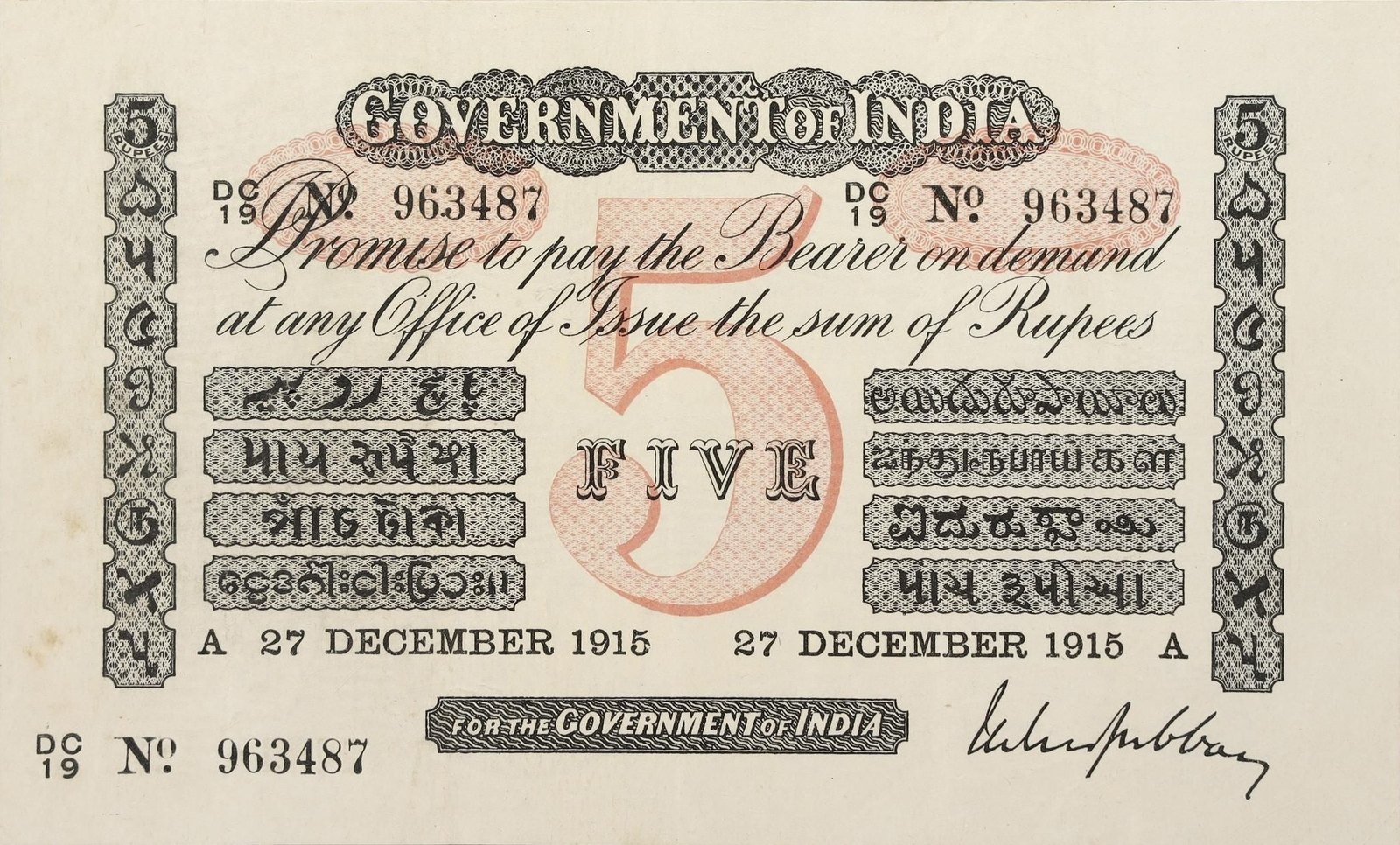
Much of what is known of the notes of British India was first set down by collectors, in the Journal of the International Bank Note Society (IBNS) and in the collectors' newspaper Bank Note Reporter. On the Pick pages their statements usually stand behind the words "sources mention". This article names them: the writer, the issue and the page, what was said, and how it stands today against the yearly currency reports, the papers of the commissions and the notes on record.
The articles
| Year | Where | Writer | Subject |
|---|---|---|---|
| 1972 | IBNS Journal 11:3 | R. Leader | "Some Notes of India 1791-1949" |
| 1974 | Bank Note Reporter, June and November | R. Leader | "The Bank Notes of India", in two parts, the second on 1900 to 1920 |
| 1991 | IBNS Journal 30:4 | Michael Robinson | printed dates and watermark dates on the notes of the Bank of England and of the Government of India |
| 1995 | IBNS Journal 34:1 | Rointon H. Andhyarujina | "British India Uniface Bank Notes" |
| 2004 | Bank Note Reporter, June | Alan Herbert | "British India note features perforated edge" |
| 2009 | IBNS Journal 48:4 | Anil R. Bohora | "The Indian Rupee: Used Around the World" |
| 2010 | IBNS Journal 49:2 | Rezwan Razack | "The Currency Note Press, Nasik - The Beginning" |
| 2010 | IBNS Journal 49:4 | Rezwan Razack | "India's King George V, One Rupee - 1917 Issue" |
| 2012 | IBNS Journal 51:3 | Malik Aftab Maqbool Joiya | "The Special Notes of Pakistan Since 1947 - Overprints Both Official and Private" |
| 2012 | IBNS Journal 51:4 | Rezwan Razack | "Varieties of Portrait Notes in India's King George VI 100 Rupee Series" |
| 2014 | IBNS Journal 53:4 | Rezwan Razack | "The Banknotes of India for Burma Before and After Separation" |
| 2015 | IBNS Journal 54:3 and 54:4 | Anil R. Bohora in 54:3; Rezwan Razack and Joseph E. Boling in 54:4 | "The Facts on High Denomination British India Banknotes with Burma Overstamps", and two letters in reply |
| 2017 | IBNS Journal 56:2 and 56:3 | Anil R. Bohora in 56:2; Steve Desouza in 56:3 | "A Story of a WWII Soldier, Told Through Short Snorter Banknotes"; "Crazy World of Fancy Number - A glimpse into British India Fancies" |
| 2019 | IBNS Journal 58:3 | Rezwan Razack | "Portrait Notes of Queen Victoria for India" |
| 2020 | IBNS Journal 59:2 | Nilaish | "Forged Notes During the Company & British Raj in India" |
| 2023 | IBNS Journal 62:4 | Anil R. Bohora | "Royal Cypher Printed on Banknotes of British India" |
| 2026 | IBNS Journal 65:1 and 65:2 | Anil R. Bohora | "Story of the Enigmatic One Rupee British India Banknotes with Serial Numbers in Red"; "British India: Issue of Currency Notes from Rs. 5 to Rs. 10,000" |
R. Leader, 1972 and 1974
Leader's figures for the first issue of 1st March 1862 (Bank Note Reporter, June 1974) are set out in The first notes of the Government of India, 1861 to 1866. The second part, in November 1974, covers 1900 to 1920.
- The 2 rupees 8 annas. Leader wrote that by 1923-24 the circulation had dropped to 700,000 pieces. The Controller of the Currency's own statement gives 7 lakhs of rupees, which is a sum and not a number of notes. Leader also explained why so many collectors had the note: a block of some fifty uncirculated notes had been found and had gone from Bombay to England, Canada, Australia, California and Kansas. Leader calls them "C over 1s".
- Green to red on the 5 rupees. On the 5 rupees of 1905 to 1907 Leader thought the change of the seals and the large figure 5 from green to red was, more than likely, an answer to the forgeries of the green notes. That is Leader's view. No report read gives a reason for the colour.
- The office letter. Leader has the office letter dropped from the 5 rupees in the spring of 1915 and from the 10 and 50 rupees "some four to five years later". The catalogue's dated notes show the letter down to 1916 to 1918 (see the 5 rupees of 1914 to 1925), and its first 10 rupees without a letter is dated 2 January 1919.
- A Denning 1 rupee with a perforated edge. None was known to Leader in 1974. The catalogue now records Denning notes with staple holes.
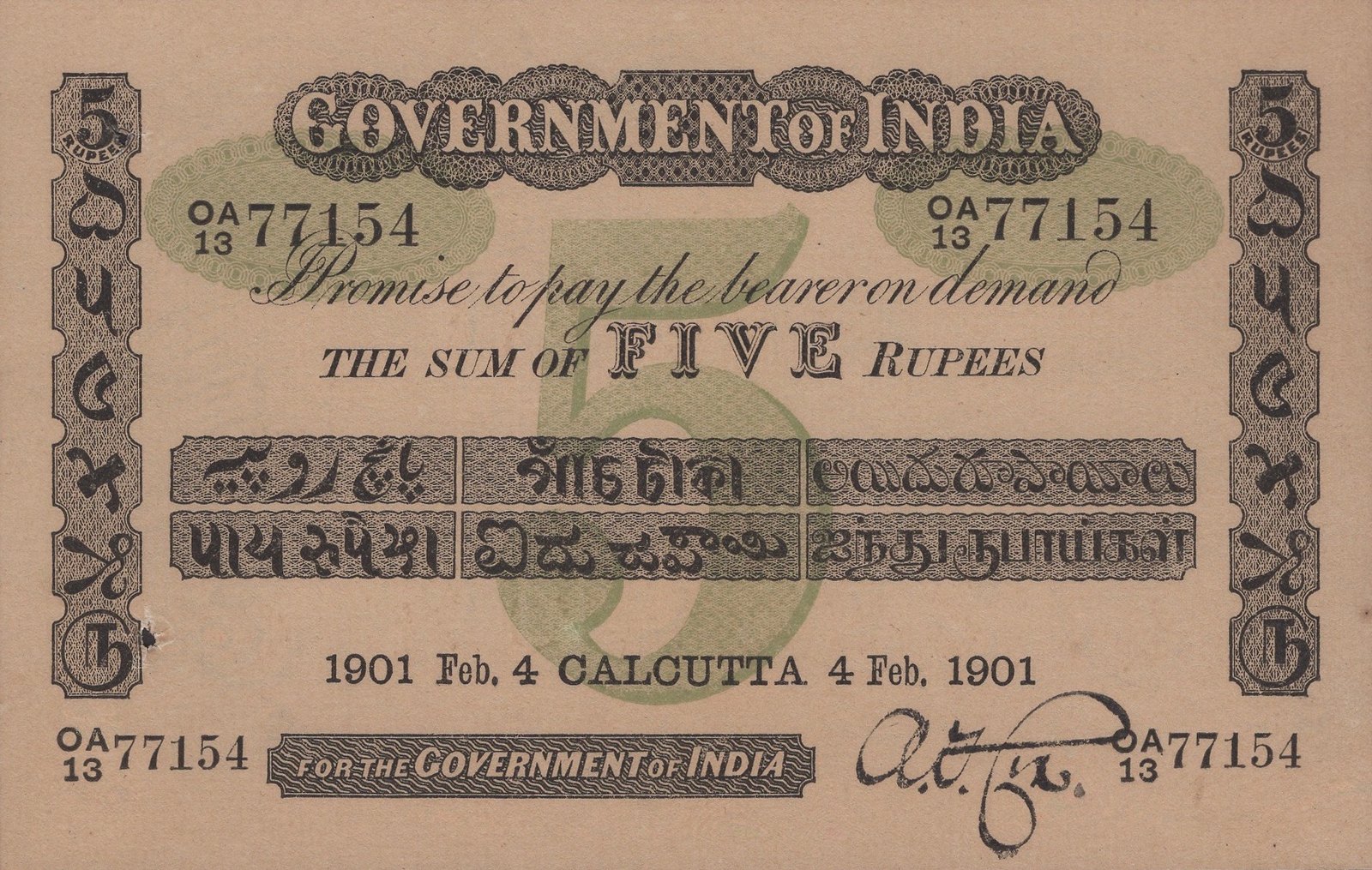
- A Calcutta 5 rupees signed Barrow of about 4 February 1901. This does not fit the 5 rupees of 1901 to 1903 as the catalogue has it, with Cox as the Calcutta officer. Leader gives no number, and nothing was changed.
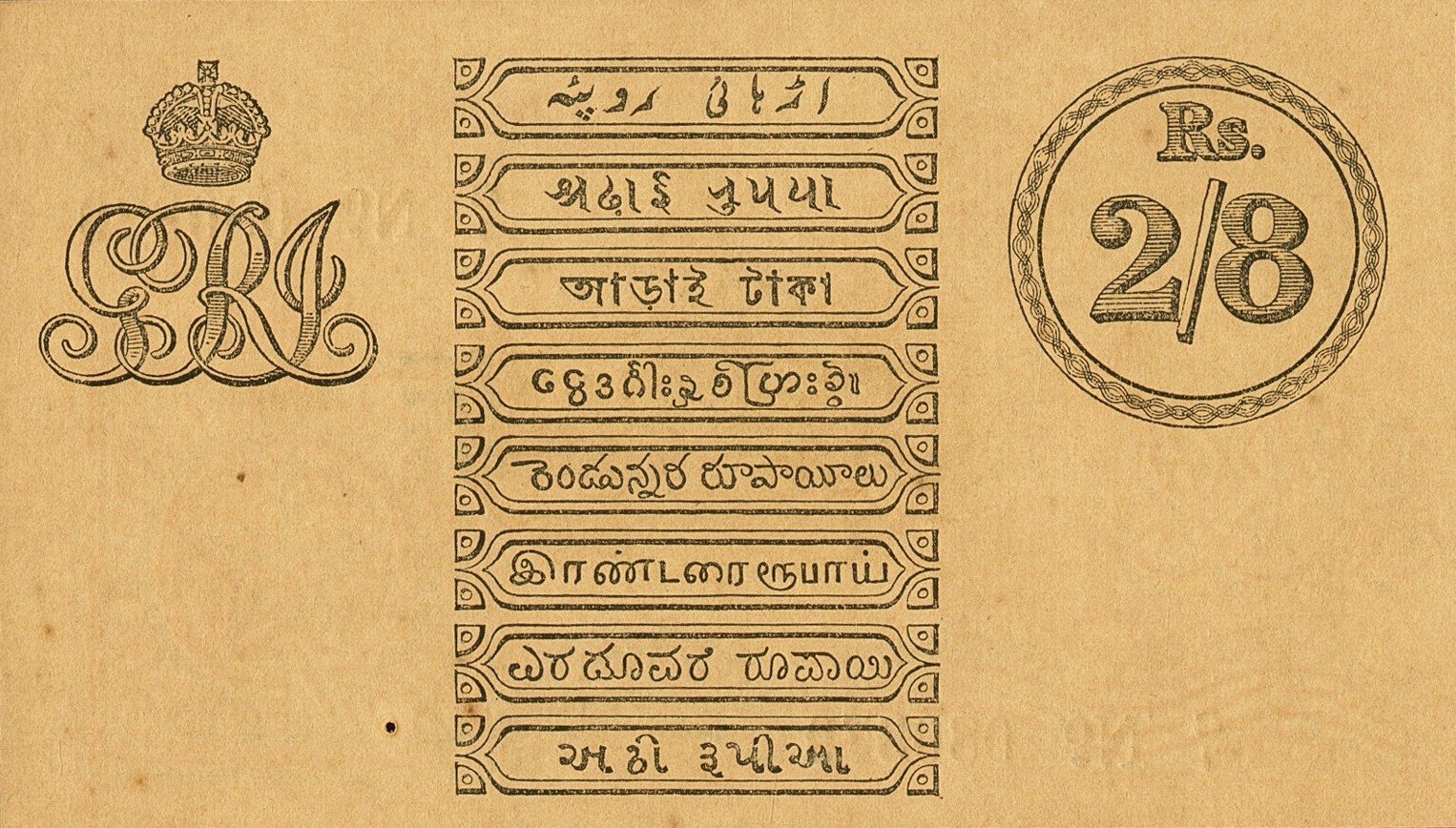
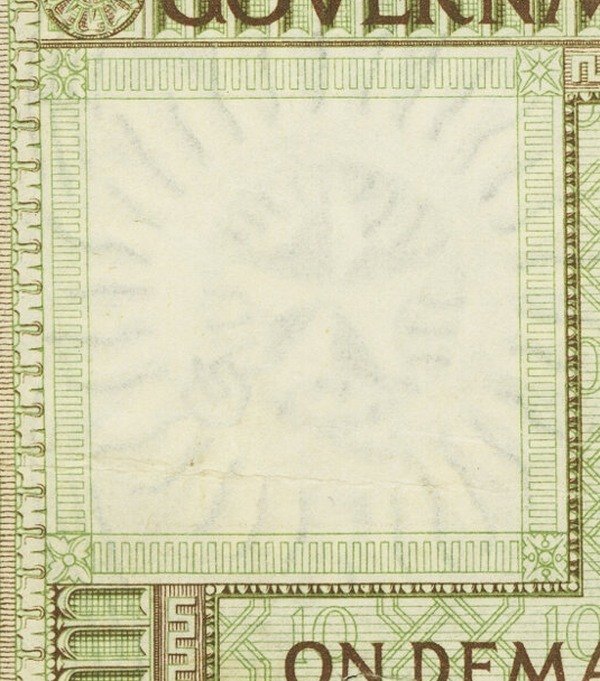
In the IBNS Journal of 1972 (11:3, pp. 144 to 146) Leader had already written that the Kelly 1 rupee was printed in 1935 and issued in 1940, in booklets of 25, and that the first 2 rupees was issued in February 1943. The Reserve Bank's Reports on Currency and Finance for 1943-44, 1944-45 and 1945-46 give the same month for the 2 rupees, against the 3 March 1943 of other sources. Leader also passed on what collectors reported of the star in the watermark: flat inside a double ring on the first 10 rupees of 1923, shaded on the second.
Alan Herbert's short piece in Bank Note Reporter of June 2004 pictures a 1 rupee dated 1935 signed Kelly. On the newspaper's picture the perforated left edge of the title cannot be made out.
Michael Robinson, 1991: two dates on one note
Robinson's article (IBNS Journal 30:4, pp. 22 to 24) is the source for a rule now on several Pick pages. The paper the Bank of England used for these notes, made by Portals, carries down to the early 1920s a mould letter and four figures, the week and the year the paper was made: A 41 06 is week 41 of 1906. The printed date belongs to the serial prefix, one working day to a prefix number, and can be up to about three years before the paper was made. Robinson read paper of 1921 and 1922 under 10 rupee notes that carry the signature of M. M. S. Gubbay, two of them with printed dates after Gubbay's last day in office, which Robinson gives as 4th May 1920. So neither the printed date nor the signature says when a note was made.
Robinson also listed the officers and their terms, the Rangoon ones from the Indian Civil Lists and the others from what the staff of the India Office Library supplied. The table sets Robinson's terms for Calcutta beside what the official papers show.
| Officer | Robinson's term | The official papers |
|---|---|---|
| A. F. Cox | December 1898 to 1906 | |
| O. T. Barrow | 1906 to 1910 | signs the Currency Department's report of 30th June 1910 as Head Commissioner |
| R. W. Gillan | 1910 to 1912 | signs the report of 10th October 1911 as Comptroller General and Head Commissioner |
| none | 1912 to 1914: "Vacant (M.F Gauntlett officiating, but did not sign notes)"; Robinson adds that Gauntlett signed the annual reports of 1912 and 1913 | M. F. Gauntlett signs the reports for 1911-12 and 1912-13 as Comptroller General and Head Commissioner |
| H. F. Howard | Controller of Currency, 10th April 1914 to 1st July 1916 | signs the report for 1913-14 as Controller; the work passed to the Controller "with effect from the 1st January 1914" |
| M. M. S. Gubbay | officiating from 2nd July 1916; Controller, 12th May 1917 to 4th May 1920 | Gubbay to the Commission of 1926: "I was Controller of Currency from 1916 till the end of 1919" |
| E. M. Cook | 5th May 1920 to 31st March 1921 | |
| A. C. McWatters | officiating from 4th December 1920; Controller, 26th May 1921 to 14th January 1924 | signs the report for 1920-21 as Controller on 2nd September 1921 |
| H. Denning | officiating from 31st March 1923; Controller, 15th January 1924 to 27th October 1929 | signs the report of 2nd June 1928 as Controller; A. V. V. Aiyar signs that of 27th September 1924 and J. B. Taylor those of 18th June 1927 and 5th July 1929 as Officiating Controller |
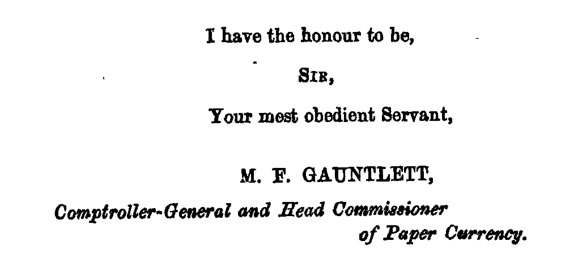
The years of the catalogue's rows follow the printed dates of the notes, not these terms. Its notes signed by Howard carry printed dates from 1909, and those signed by Gubbay from 1913, years before either took office on any reckoning.
For Bombay Robinson gives the Accountants General, among them Ballard 1862 to 1870, J. L. Lushington 1870 to 1876, Chapman 1877 to 1879, Gay 1879 to 1887, Tupps 1888, Jacob 1889 to 1890, Logan 1890 to 1892, Cox 1892 to March 1894, and Barrow from March 1894 to 1903 and in 1904 to 1905. Robinson thought the signer whom the Pick catalogue calls "Sundtrayton" was probably J. L. Lushington. For Rangoon Robinson gives Wells from 1st August 1883 to 24th March 1885 and from 25th June 1885 to 26th February 1887, and Hamilton from 15th November 1898 to 22nd December 1902, and says, on the word of Dr. P. L. Gupta from papers in the National Archives at New Delhi, that the first shipment of Rangoon notes left England about October 1883 and reached Rangoon at the end of January 1884. The Report on the Administration of Burma for 1896-97 says the Rangoon office was first opened in August 1883, which fits Wells's first day.
One of Robinson's two explanations for the Cox notes of Bombay has not held. Because Cox left Bombay in 1894 and was at Calcutta from 1898 to 1906, Robinson held that a Bombay 5 rupees of 1899 to 1903 with the Cox signature could not have been signed at Bombay: either such notes were Calcutta notes, or they were issued after the 5 rupees was made universal. A note on the 5 rupees of 1901 to 1903 page, dated Bombay, 4 August 1903, shows both the word BOMBAY and the Cox signature, so they are not Calcutta notes. The Pick page follows Robinson's second explanation.
Rointon H. Andhyarujina, 1995: the uniface notes
Andhyarujina (IBNS Journal 34:1, p. 25) gives the earliest known 5 rupees as one dated 19th January 1872, of Allahabad or Calcutta, signed "Edward A. Harrison". The Gazette of India of 17th December 1870 prints the Head Commissioner's name as E. F. Harrison, and the catalogue's row on the 5 rupees of 1871 to 1901 follows the Gazette. No picture came with the statement.
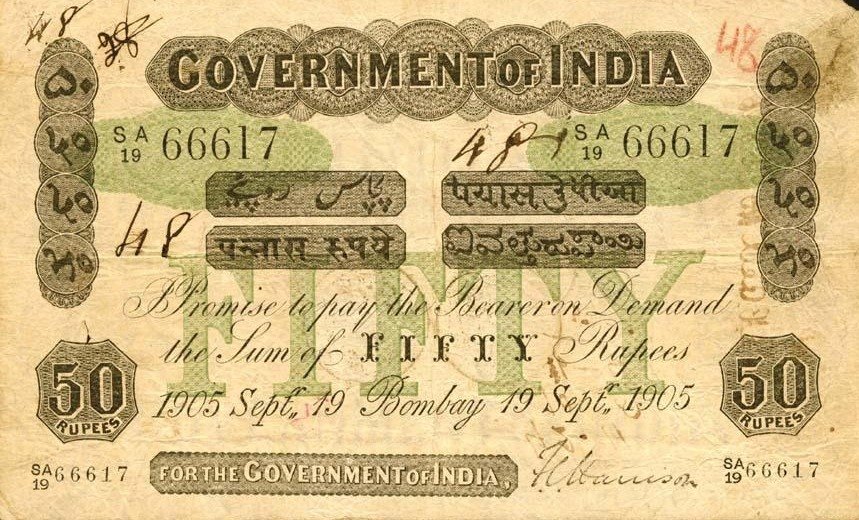
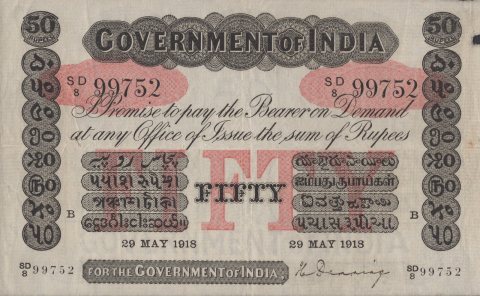
The same article is the source for the red underprint on 50 rupee notes dated from 1913. The 50 rupees of 1905 to 1920 page records a note of 19th September 1905 with a green underprint. The Report on the Administration of Burma tells of a "new pattern" 50 rupees at Rangoon already in 1911-12, with colouring and design resembling those of the 10 rupee note. No note is recorded that settles which year is right.
Rezwan Razack, 2010: Nasik and the 1 rupee
Razack's article on the Currency Note Press (IBNS Journal 49:2, p. 41) gave the order of the work at Nasik before the Controller's reports were read for the catalogue: first the 5 rupees of the pattern printed in England since 1925, released from the Cawnpore circle on 9th October 1928; then the 100 rupees; smaller 5 and 10 rupees on 8th March 1933 and 1st July 1933, on thinner paper to cut costs, with the thick paper back within a year. The Controller of the Currency's report for 1928-29 confirms the 9th October 1928 and Cawnpore. On one point the two differ: Razack has new-pattern 10 and 50 rupees issued in July 1930, while the report for 1928-29 has a 10 rupees of altered design and colouring first issued at Lahore at the end of February 1929. The whole story is in Nasik, 1928.
In the article on the 1 rupee of 1917 (IBNS Journal 49:4, pp. 31 to 34) Razack wrote that the note went to the public at the Currency Offices from January 1918 and at the District Treasuries from April 1918, first in loose packets of 25 and from 1919 in stapled or stitched booklets with a red cover, and that it was discontinued on 1st January 1926.
- Borne out. The Controller of the Currency's report for 1926-27 has the note "definitely discontinued" from 1st January 1926. The Indian Currency Committee of 1919 confirms the discount of up to 19 per cent in 1918.
- Differs by a day. Razack's table gives 30th November 1917 for the first issue. G. Findlay Shirras, Director of Statistics at the time, gives 1st December 1917.
- Not consistent. Razack tells of the SS Shirala, torpedoed in July 1918 with 1 rupee notes of the prefixes A, K, L, M and R. The text calls them the second printing and the table the first. The text says that, a quantity of notes with these prefixes being already in circulation, "they were withdrawn from issue". The catalogue records notes of those prefixes, all signed Gubbay.
- Not proved. Razack says the prefixes X, Y and Z were used in British East Africa. Anil R. Bohora (48:4, p. 47) says only that this is believed of X and Y. Neither gives a document.
The Queen Victoria portrait notes, 2019
Rezwan Razack's article in IBNS Journal 58:3 (pp. 25 to 31) pictured the trials before the first issue: a 5 rupees with the place Hull, a manuscript Specimen dated 8th October 1860 and the name of W. S. Portal, the paper maker; a 10 rupees trial of Delhi dated 23rd July 1858, on paper of an unadopted watermark dated 1st March 1860 with Wilson's facsimile signature alone; and the London trial of 27th January 1860, signed by W. P. Gattie, Chief Cashier of the Bank of England. It gave the size of the 10 rupees as 21.5 by 13 centimetres, the first printed date as 8th July 1861, the prefix letters as A for Calcutta, B for Madras and C for Bombay, and the dates on the notes as falling from May to August of the years 1861 to 1865.
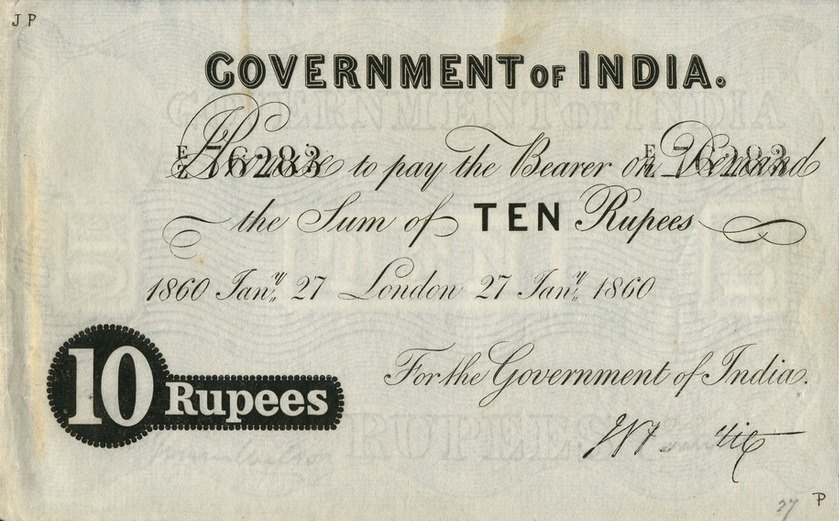
It also says that redeemed notes were not paid out again. The Head Commissioner told the Commission on Act XIX of 1861 in February 1866 that notes paid in at Calcutta were issued again until worn out. The Commission's volume was read for the catalogue in November 2026, after the article. Both statements are set out in The first notes of the Government of India, 1861 to 1866.
Forgeries, 2020
Nilaish's article in IBNS Journal 59:2 (pp. 54 to 58) pictures forged notes of the red underprint and of the Kings' portrait issues and describes how the red underprint forgeries were made: the main plate first, then the frames and the red underprint from wooden blocks, the numbers stamped in, the signature last, on paper without a watermark. It says examples are kept in the museum of the Maharashtra Police Academy at Nasik. It pictures a forged 1 rupee dated 1940, which it puts in 1944, and says it is believed that such forged notes were smuggled from Rangoon to Calcutta by the Japanese army or with its support.
Two of its statements can be set against other sources.
- It gives a 10 rupees of the prefix AL/22, dated 11th April 1920, as a forgery, and says, after Razack and others (2012), that the AL prefix did not come into circulation. The Controller of the Currency's report for 1923-24 names AL/22 among the new forged series of that year.
- It gives the Lahore 100 rupees numbered ED/22 37524, dated 21st March 1916 and signed D. Hastings, as a forgery, on the authority of Razack and others (2012, p. 140), and says no genuine note with that signature survives. The signature table of the website Banknote Index counts Hastings as a confirmed signer of a Lahore 100 rupees of the prefix ED. The article does not picture the note, and the catalogue has no picture of it. The Pick page keeps the row as a counterfeit and marks the point as not yet settled.
The King George VI notes and after
- 100 rupees, IBNS Journal 51:4 (2012), pp. 25 to 31. Rezwan Razack's article has the 100 rupees first issued in March 1938, Deshmukh's notes from 5th May 1944, nearly 190 million notes printed at Nasik and the withdrawal on 27th October 1957. The Reserve Bank's Report on Currency and Finance for 1944-45 confirms 5th May 1944 and adds the office, Karachi. The article puts the paper with the facing watermark in April 1948; the report for 1949-50 says that note was first issued at Bombay on 31st May 1949.
- Pakistan, IBNS Journal 51:3 (2012), pp. 36 to 41. Joiya pictured the handstamps put on India notes retired in Pakistan and gave the India notes retired there from 1st July 1948 to 30th June 1949 and sent to the Reserve Bank as 1,231.8 million rupees, of which 1,230 million had been returned by 30th June 1949. The figure is read from a scan of the page, and its third digit has also been read as a 5 (1,251.8). The Reserve Bank's report for 1949-50 (p. 158) counts India notes returned from Pakistan at 127.18 crores of rupees to February 1949. The two figures are for different spans and are not the same count.
- The 1 rupee of 1940, IBNS Journal 65:1 (2026), pp. 32 to 38. Anil R. Bohora's article prints a letter of the Reserve Bank's Chief Accountant of 7th September 1945: red numbers were adopted in 1942 for the notes supplied to Burma, as a wartime step, mainly to control their entry into India. A stock of the red notes was kept at Calcutta under an instruction of 20th November 1943; its destruction was proposed on 1st April 1946 and approved on 12th April. Bohora reckons from the prefixes that about 14 million rupees of red notes were printed. For the green-numbered 1 rupee with the plate letter A the article has a Reserve Bank press release, shortly after 2nd November 1944; the Bank's report gives the first issue as Bombay, 1st December 1944.
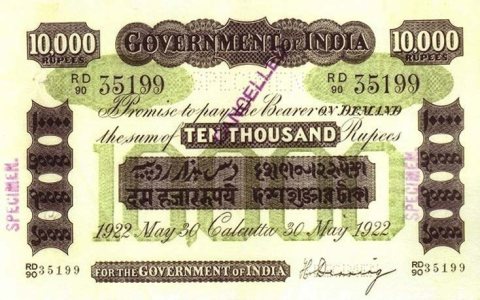
- Burma, IBNS Journal 53:4 (2014) and 54:4 (2015). Razack's article of 2014 says (p. 10) that in Burma the lower left corner of notes of 100, 1,000 and 10,000 rupees was commonly kept for the accounts when the notes were exchanged for the Reserve Bank's notes for Burma, and pictures such a corner of a 10,000 rupees. It says (p. 13) that from 1st July 1948 the Government of Burma ended the legal tender in Burma of notes without the Burma overprint. In two letters in 54:4 (pp. 10 and 11) Razack writes that no Rangoon 1,000 rupees signed Kelly has been seen without the Burma stamp, and Joseph E. Boling that there is no guarantee that every note in the range was stamped.
- A dated 1 rupee, IBNS Journal 56:2 (2017), p. 40. Anil R. Bohora shows a 1 rupee of 1940 with a date written in ink: paid out at Bombay on 1st February 1944.
- A record of 1874, IBNS Journal 65:2 (2026), pp. 53 to 54. Bohora prints from the Financial Department Proceedings in the National Archives of India: Notification No. 4035 of 31st December 1873, in force on 17th January 1874, made every value from 5 to 10,000 rupees issuable at all offices, and the Head Commissioner, E. F. Harrison, reported on 8th December 1873 that 10,000 rupee notes stamped with the circle names had been sent to each interior circle. No such note is recorded.
- The royal cypher, IBNS Journal 62:4 (2023), p. 33. Bohora's table sorts the notes by the King's cypher: the monogram GRI under a crown, the monogram without the crown, or plain initials.
How it stands
| Statement | Writer | Today |
|---|---|---|
| 2 rupees first issued in February 1943 | Leader, 1972 | the Reserve Bank's reports say the same |
| 700,000 notes of 2 rupees 8 annas in 1923-24 | Leader, 1974 | the Controller's figure is 7 lakhs of rupees |
| The printed date can be years before the paper | Robinson, 1991 | holds on the notes read |
| Bombay notes of Cox must be Calcutta notes | Robinson, 1991 | a Bombay note of 1903 with Cox's signature is on record |
| Controllers' terms of office | Robinson, 1991 | the report for 1913-14 and Gubbay's own evidence differ on Howard's first day and Gubbay's last |
| First Nasik notes at Cawnpore, 9th October 1928 | Razack, 2010 | the Controller's report for 1928-29 says the same |
| 1 rupee discontinued on 1st January 1926 | Razack, 2010 | the Controller's report for 1926-27 says the same |
| Shirala prefixes "withdrawn from issue" | Razack, 2010 | first printing in the table, second in the text; notes of those prefixes are on record |
| Redeemed notes of 1861 not issued again | Razack, 2019 | the Head Commissioner said in 1866 that they were |
| AL/22 a forged series | Nilaish, 2020 | named in the Controller's report for 1923-24 |
| Hastings never signed a genuine note | Nilaish, 2020, after Razack and others, 2012 | open |
| 100 rupees with the facing watermark, April 1948 | Razack, 2012 | the Reserve Bank's report: Bombay, 31st May 1949 |
Sources
- R. Leader, "Some Notes of India 1791-1949", IBNS Journal 11:3, 1972, pp. 144 to 146, and in Bank Note Reporter, June 1974 and November 1974 (pp. 1 and 7).
- Michael Robinson in IBNS Journal 30:4, 1991, pp. 22 to 24.
- Rointon H. Andhyarujina, "British India Uniface Bank Notes", IBNS Journal 34:1, 1995, p. 25.
- Anil R. Bohora, "The Indian Rupee: Used Around the World", IBNS Journal 48:4, 2009, p. 47.
- Rezwan Razack, "The Currency Note Press, Nasik - The Beginning", IBNS Journal 49:2, 2010, p. 41; Rezwan Razack, "India's King George V, One Rupee - 1917 Issue", IBNS Journal 49:4, 2010, pp. 31 to 34.
- Malik Aftab Maqbool Joiya, "The Special Notes of Pakistan Since 1947 - Overprints Both Official and Private", IBNS Journal 51:3, 2012, pp. 36 to 41.
- Rezwan Razack in IBNS Journal 51:4, 2012, pp. 25 to 31; in 53:4, 2014, pp. 10 and 13; and in 58:3, 2019, pp. 25 to 31.
- Rezwan Razack and Joseph E. Boling, letters in IBNS Journal 54:4, 2015, pp. 10 and 11.
- Anil R. Bohora in IBNS Journal 56:2, 2017, p. 40; in 62:4, 2023, p. 33; in 65:1, 2026, pp. 32 to 38; and in 65:2, 2026, pp. 53 to 54.
- Nilaish, "Forged Notes During the Company & British Raj in India", IBNS Journal 59:2, 2020, pp. 54 to 58.
- Alan Herbert, "British India note features perforated edge", Bank Note Reporter, June 2004.
- The Currency Department's reports for 1909-10 to 1913-14 and 1920-21; the reports of the Controller of the Currency for 1923-24, 1926-27, 1927-28 and 1928-29.
- The Reserve Bank of India's Reports on Currency and Finance for 1943-44, 1944-45, 1945-46 and 1949-50.
- The evidence of M. M. S. Gubbay to the Royal Commission on Indian Currency and Finance, 1926; the report of the Indian Currency Committee of 1919; G. Findlay Shirras, Indian Finance and Banking, 1920.
- The proceedings of the Commission on Act XIX of 1861, 1866; the Gazette of India, 17th December 1870, p. 279; the Reports on the Administration of Burma.
- The signature table "India Series A" of the website Banknote Index.
Member comments
Log in or register to post a comment.