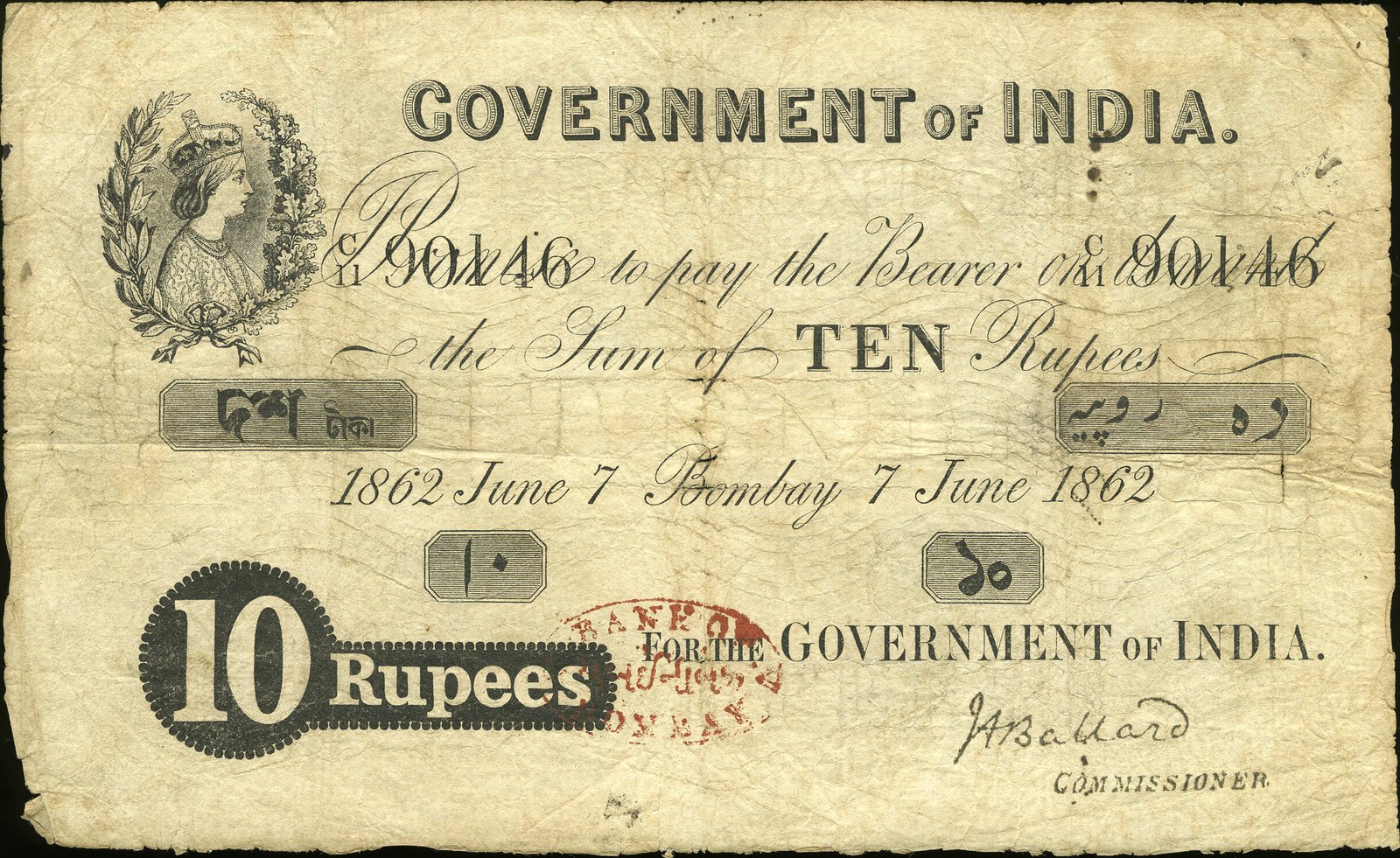
The first notes of the Government of India carried the portrait of Queen Victoria. The catalogue dates them 1861 to 1865, and the first issue was made on 1st March 1862. This article sets out what the catalogue's pages hold on that issue: the law, the offices, the size of the first issue, and the circulation of each office on one day in 1866. Most of it comes from the report and proceedings of the Commission on Act XIX of 1861, which sat in 1866; two articles by R. Leader in Bank Note Reporter, two auction descriptions and the Reserve Bank of India's museum page add the rest.
The Bill of 1860 and the Act of 1861
Introducing the Bill in March 1860, James Wilson showed the Legislative Council a specimen 10 rupees made by the Bank of England. Its watermark read Government of India along the top, Ten in the centre and Rupees below. Wilson's plan was for notes of 5 to 1,000 rupees, but the Act of 1861 set the lowest note at 10 rupees.
The Paper Currency Act of 1861 (Act No. XIX of 1861) was assented to on 16th July 1861. It made the note issue a government monopoly from 1st March 1862.
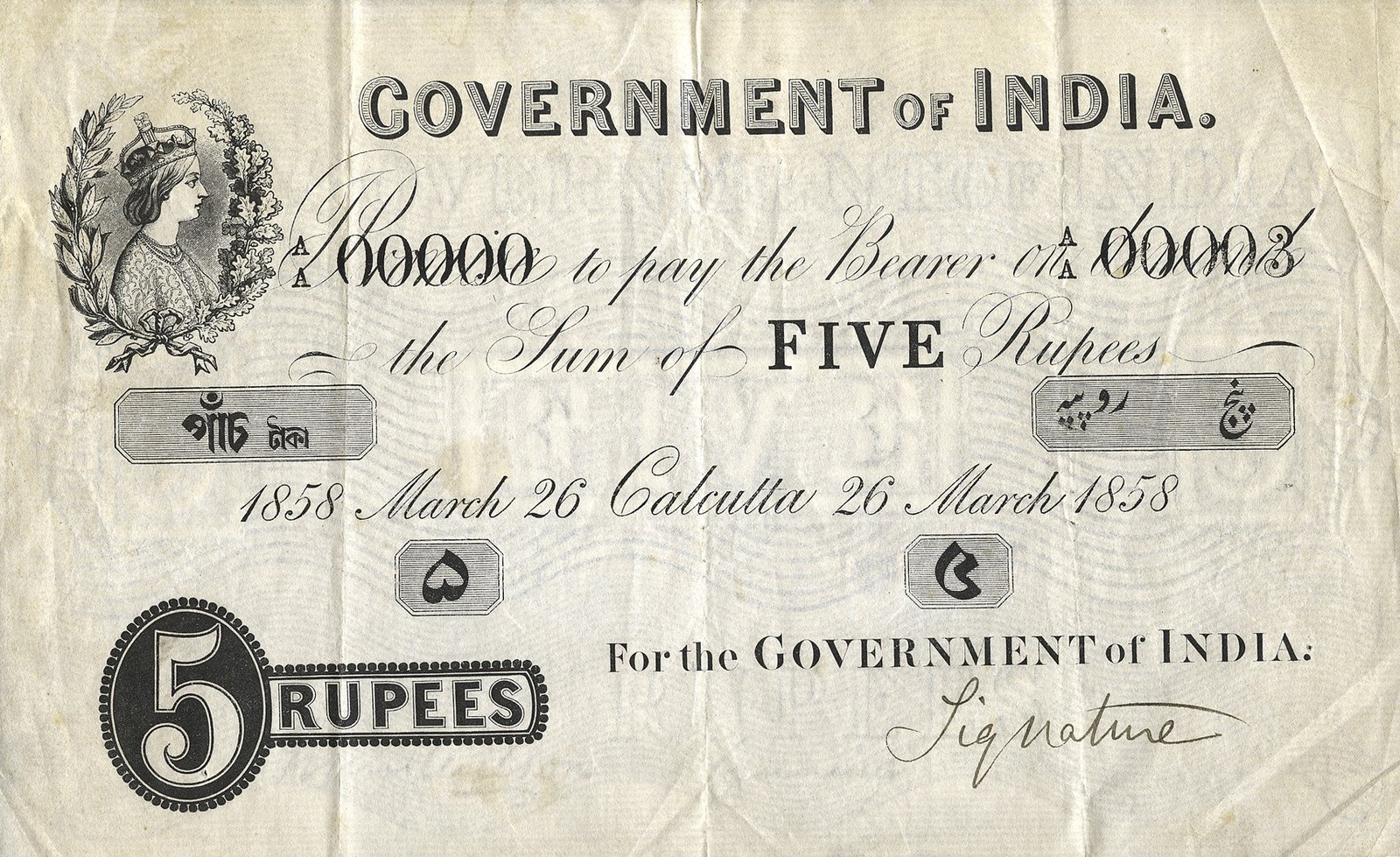
A 5 rupees of the portrait design, dated Calcutta 26 March 1858, is recorded only as a specimen. No 5 rupees was issued until 1871, in the later design without the portrait.
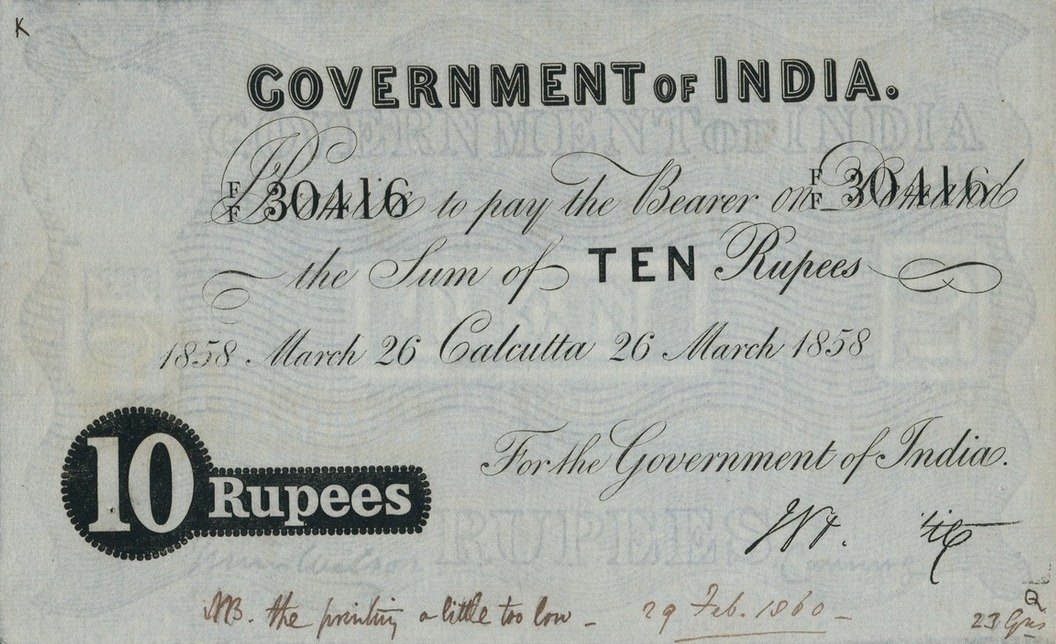
Two progressive proofs of the 10 rupees, dated 26 March 1858 and 27 January 1860, came before the issue. Spink's description of lot 1062 in its sale of 2 October 2019 says the proof dated 26 March 1858, numbered F/F 30416, has the printed signature of Gattie, who signed Bank of England notes from 1860 to 1864, and a printer's note in the lower margin that the printing was a little too low, with the handwritten date 29 Feb 1860. Spink says it is not clear why the date of 1858 was printed on a note made in 1860.
Six values, one design
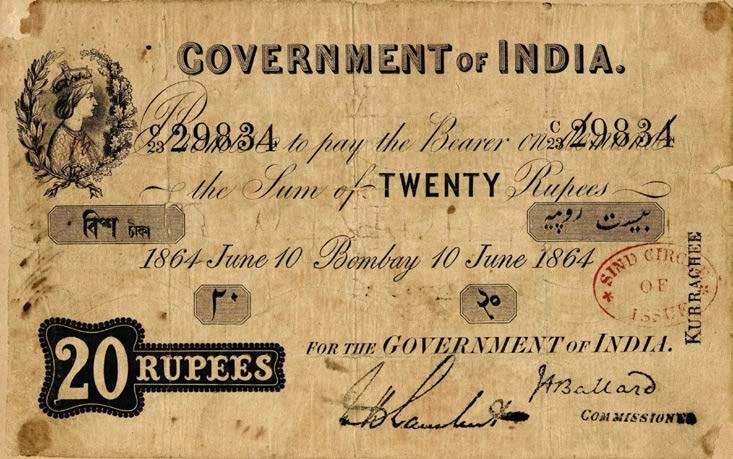
The issue is recorded in six values: 10 rupees, 20 rupees, 50 rupees, 100 rupees, 500 rupees and 1,000 rupees. The Reserve Bank of India's museum page on the British India issues lists the Victoria Portrait Series as 10, 20, 50, 100 and 1,000 rupees, without the 500 rupees. The Commission's Appendix XXV and Leader's figures both count notes of 500 rupees, and a fragment of one is recorded in the catalogue.
All the notes are uniface and were printed by the Bank of England. Each carries a printed date and was signed at the office of issue. The Reserve Bank's museum page says the paper was hand moulded at the Laverstock mills (Portals). Heritage's description of lot 28369 in its sale of 18 September 2020 points to the likeness to the Bank of England's own white notes, down to the black tablet around the value.
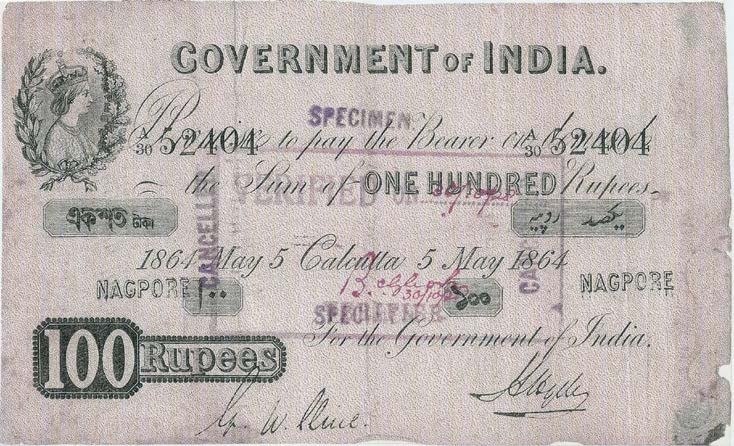
Sources mention that the two facsimile signatures in the watermark are those of the Finance Member at left (James Wilson) and the Governor-General at right (Canning), and that Wilson's was kept on the paper of 1861 and replaced by Samuel Laing's on paper of later years.
The notes of the different circles were made to look almost alike by order of the Home Government (Financial Despatch No. 158 of 15th September 1862, as the Allahabad currency office quotes it). The name of the circle and the numbers stood in English only, and the value alone was repeated in the language of the place where the note was to pass. All six values looked alike too. In March 1866 Henry Rivett-Carnac asked the Commission for a different colour and design for each value.
The first issue of 1st March 1862
R. Leader, writing in Bank Note Reporter in June 1974, gives the first issue of 1st March 1862 as 42,460,500 rupees in all.
| Value | Rupees issued on 1st March 1862 |
|---|---|
| 10 rupees | 2,550,000 |
| 20 rupees | 2,432,000 |
| 50 rupees | 4,630,000 |
| 100 rupees | 9,748,500 |
| 500 rupees | 6,450,000 |
| 1,000 rupees | 16,650,000 |
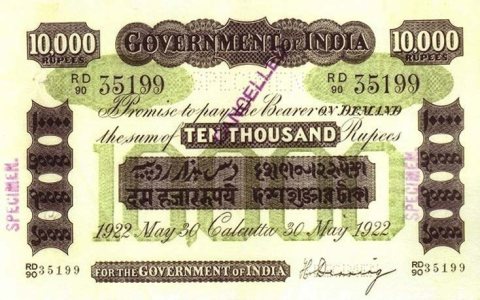
| 10,000 rupees | none |
The offices as they opened
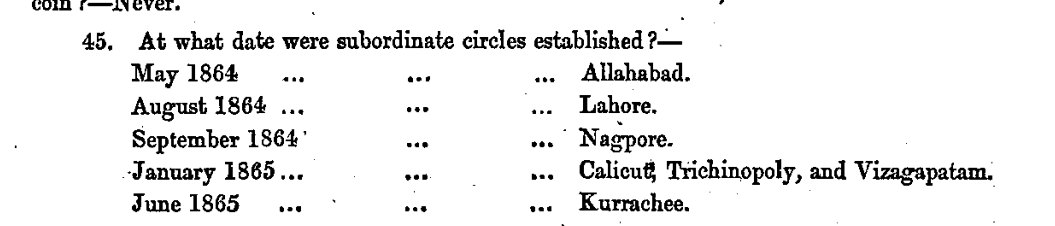
The first office of issue, at Calcutta, opened on 3rd January 1862 in the Bank of Bengal. Offices under it and under Bombay and Madras followed, as Major Hyde, Head Commissioner, told the Commission on 6th February 1866:
- Allahabad in May 1864. The circle was constituted by Notification No. 1846 of 8th April 1864 and its notes were legal tender from 1st May.
- Lahore in August 1864.
- Nagpore in September 1864.
- Calicut, Trichinopoly and Vizagapatam in January 1865.
- Kurrachee in June 1865.
Three treasury officers of Berar told the Commission in March 1866 that the Act was not yet in force there, so the Akola circle came later.
Sources mention that until 1866 the Presidency Banks of Bengal, Bombay and Madras handled the notes as the government's agents. The papers of the Commission say that the Bank of Bengal issued the Calcutta notes as the Government's agent until the end of 1865. The Reserve Bank's museum page puts the end of the agency agreements in 1867.
Major Hyde, Mint Master at Calcutta and Head Commissioner, left for England in February 1866. Colonel Ballard, till then Commissioner at Bombay, was Officiating Head Commissioner at Calcutta by March 1866 (the proceedings of the Commission).
The circulation on 28th February 1866
Four years after the first issue, the notes of all six values in circulation came to 70,732,520 rupees, against a peak of 93,621,750 rupees on 23rd September 1865. The numbers of notes below are worked out from the values in Appendix XXV of the Commission's report.
| Office | 10 rupees | 20 rupees | 50 rupees | 100 rupees | 500 rupees | 1,000 rupees |
|---|---|---|---|---|---|---|
| Calcutta | 170,727 | 102,949 | 54,562 | 50,891 | 6,598 | 11,464 |
| Bombay | 191,000 | 94,000 | 46,300 | 61,500 | 4,604 | 15,148 |
| Madras | 23,890 | 17,985 | 12,860 | 13,589 | 2,007 | 1,896 |
| Allahabad | 21,865 | 12,722 | 7,401 | 5,646 | 1,038 | 456 |
| Lahore | 17,868 | 12,822 | 14,450 | 11,468 | 1,770 | 561 |
| Nagpore | 9,778 | 3,725 | 3,697 | 953 | 112 | 462 |
| Vizagapatam | 4,284 | 2,381 | 1,155 | 800 | 119 | 105 |
| Kurrachee | 3,329 | 1,632 | 1,150 | 1,628 | 254 | 674 |
| Calicut | 2,151 | 1,532 | 1,175 | 881 | 91 | 60 |
| Trichinopoly | 1,338 | 1,088 | 808 | 680 | 149 | 75 |
| All ten offices | 446,230 | 250,836 | 143,558 | 148,036 | 16,742 | 30,901 |
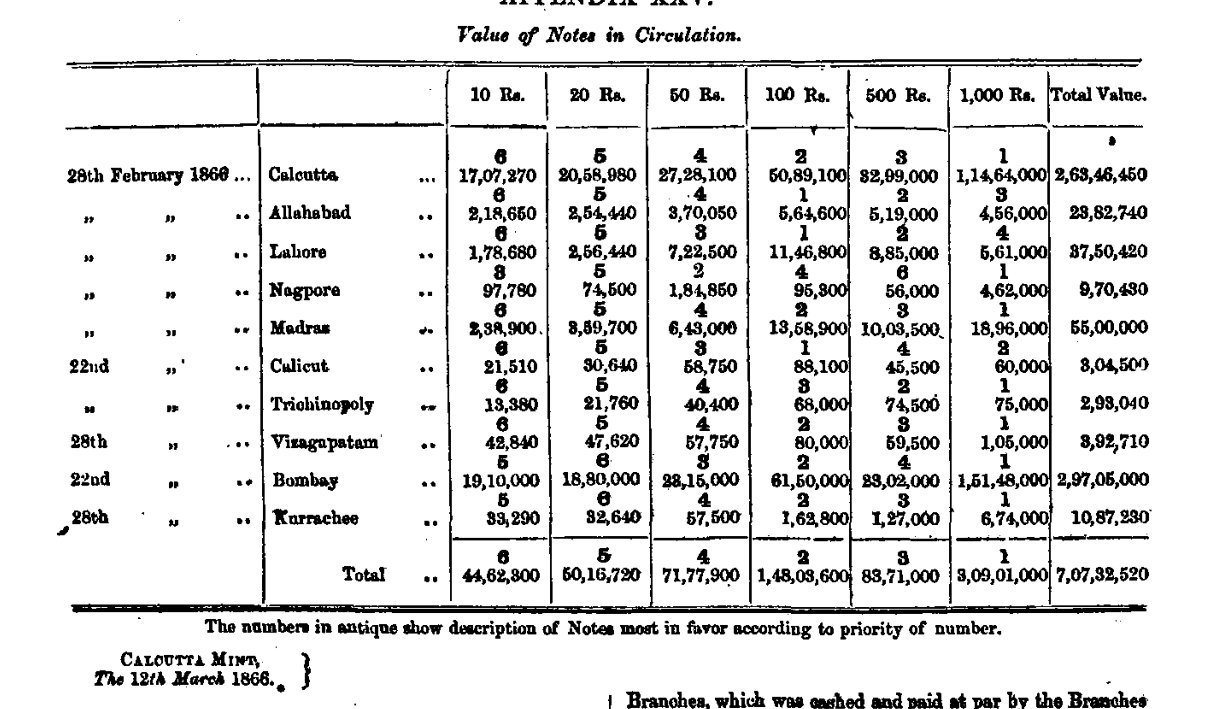
In value the 1,000 rupees was then the largest part of the circulation at most offices.
Marks put on the notes
The Bank of Bengal's branch marks
From 1st March 1862 the notes the Bank of Bengal sent to its branches carried a distinguishing mark stamped in colour: a P in blue, an R in black for Rangoon, an M in red for Mirzapore, a B in black for Benares and a D in green for Dacca, each letter inside an ornamental frame. Notes of the head office had no mark (the Bank's circular of 20th February 1862, printed by the Commission, Appendix XXVI). The circular does not name the branch of the letter P. Patna is the only branch on the Bank's list that begins with it.
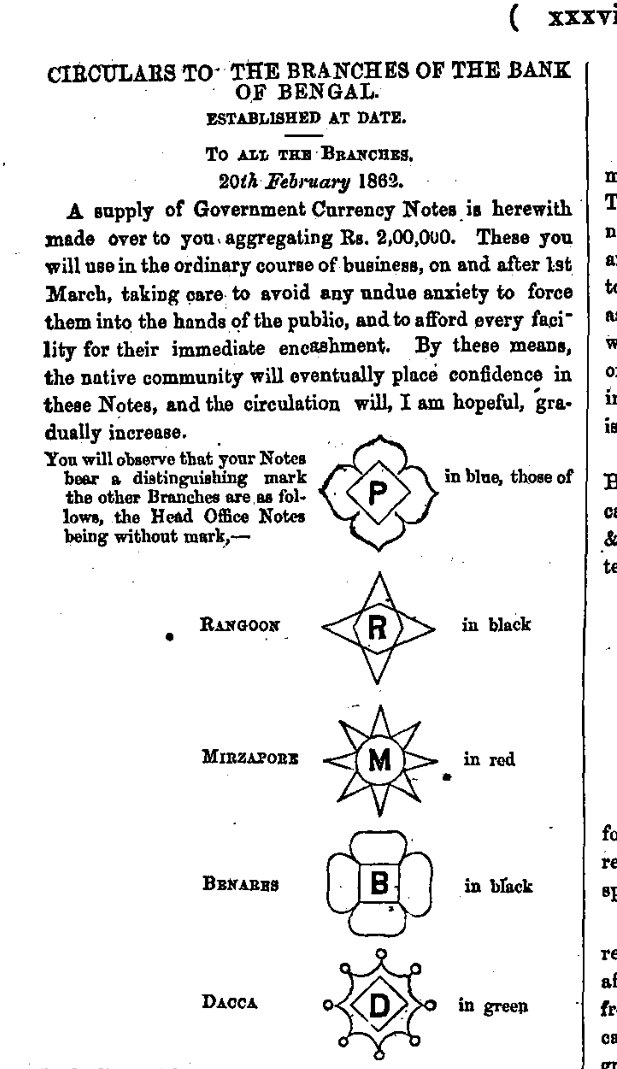
When the Allahabad circle opened, the notes issued through the Mirzapore and Benares branches were called in for coin or for Allahabad notes from 1st May 1864 (Notification No. 316 of 21st April 1864, signed by H. Hyde as Head Commissioner).
The agents of the Bank of Bombay likewise marked the notes they issued with their branch stamp, and the Bank of Madras cashed at each branch the notes that bore its stamp. That is what the bank handstamps on the Bombay and Madras notes of this issue are. No note with a Bank of Bengal branch mark is recorded in the catalogue.
The "No. 1" notes of Assam
Inside the Calcutta circle a small local issue was kept apart for Assam. Hugh Sandeman, Accountant General of Bengal, described them to the Commission on 20th February 1866 as notes
They were current only at the treasuries of the Assam districts, Cachar and Sylhet, in the values of 10, 20, 50 and 100 rupees, and were supplied from Gowhatty (Sandeman's evidence, and the Board of Revenue's report for 1864-65 printed with it). About 250,000 rupees of them were out in February 1866, most of it lying in the treasuries, where 7,665 notes of 10 rupees, 277 of 20, 112 of 50 and 173 of 100 were in store at the end of 1864-65. The papers do not say what the mark looked like or where on the note it stood. No note with it is recorded in the catalogue.
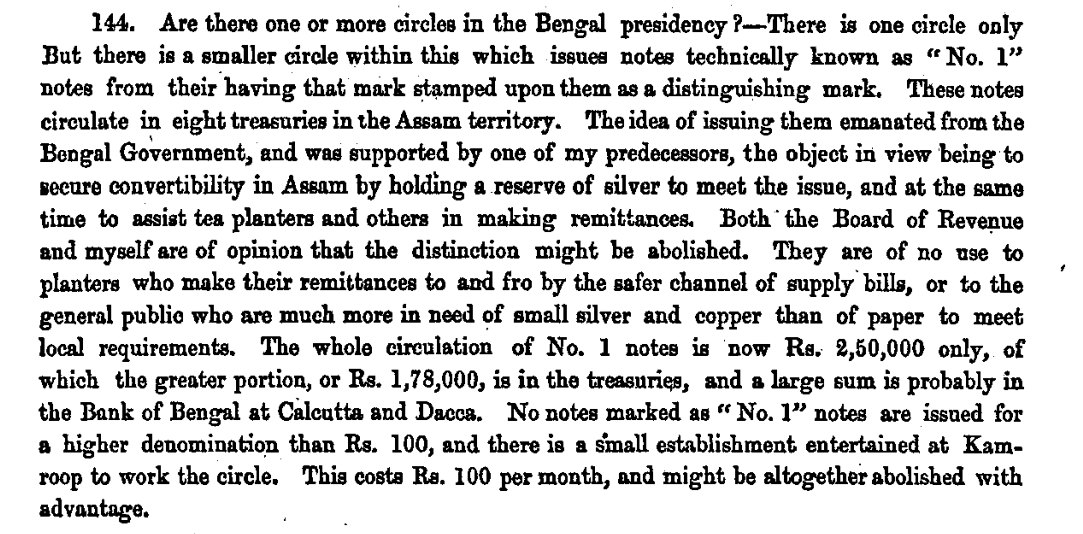
The marks, with drawings from the Commission's volume, have an article of their own: A letter in a frame.
Half notes, and names written on notes
Notes went by post cut in two. The treasury rules of Bengal ordered the left-hand halves to be sent first, in a registered cover, and the right-hand halves only when the first were acknowledged. The Allahabad currency office cut its 500 and 1,000 rupee notes in half before sending them to the treasuries (papers printed by the Commission, Appendix XVII and Mr. Gay's note of June 1866).
For a half lost on the way the Allahabad office asked three advertisements in the Gazettes, a bond for twice the value with two sureties and a wait of three months. A whole note lost was not made good.
People who paid a note in at a treasury were made to sign it, which is why names are found written on notes of this issue.
Were notes paid out a second time?
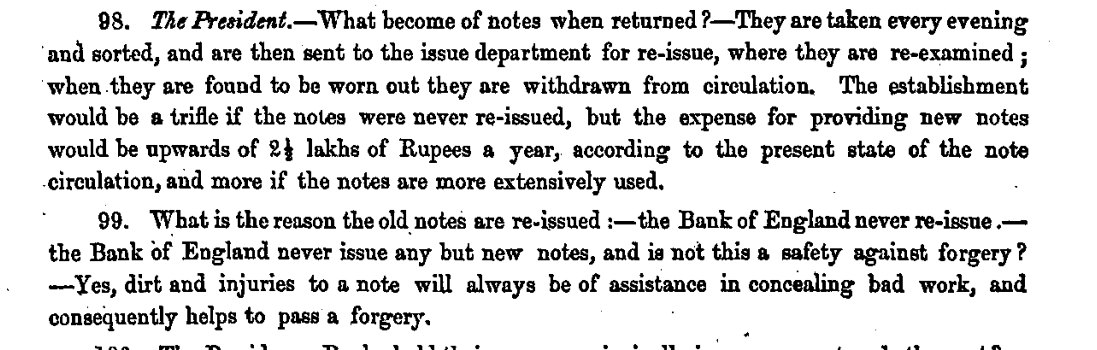
Sources mention that redeemed notes were not paid out again but cancelled with PAID or CANCELLED perforations or handstamps, the signature and part of the left serial number often cut or punched away.
The Head Commissioner told the Commission otherwise in February 1866. Notes paid in at Calcutta were checked against the list of stopped notes, entered in a register and sent back to be issued again, and only withdrawn when worn out. Never issuing a note twice, as the Bank of England did, would have cost upwards of 2½ lakhs of rupees a year in new notes.
Theft, forgery and the end of the issue
The Commission's papers record the theft in 1862 of watermarked paper being made for these notes, and a reward of 3,000 rupees paid at Bombay in 1865-66 for detecting forgers. They describe no forged note.
Sources mention that forgeries and weak paper led to the underprinted notes of 1867, each value on a stronger watermarked paper of its own. The Reserve Bank's museum page says the portrait series was withdrawn after a spate of forgeries and that the Underprint Series was introduced in 1867. Heritage's description of 18 September 2020 (lot 28369) gives 1866 for the start of the new issue. The story of those notes is told in The green underprint notes of the Government of India, 1867 to 1927.
What is not known
- What the "No. 1" mark of Assam looked like, and where on the note it stood.
- Which branch the letter P stood for.
- Whether any 10,000 rupees of the portrait design was made. Leader's figures for 1st March 1862 show none, and the figures taken from Appendix XXV for 1866 are for six values, 10 to 1,000 rupees.
- The year on the one 500 rupees fragment recorded. Its prefix points to 18 July 1861.
Sources
- Report and proceedings of the Commission on Act XIX of 1861, 1866: the evidence of Major Hyde (6th February 1866) and of Hugh Sandeman (20th February 1866), Appendices XVII, XXV and XXVI, Mr. Gay's note of June 1866, and the Board of Revenue's report for 1864-65 printed with them.
- Notification No. 1846 of 8th April 1864 and Notification No. 316 of 21st April 1864.
- Financial Despatch No. 158 of 15th September 1862, as the Allahabad currency office quotes it.
- R. Leader in Bank Note Reporter, June 1974.
- Spink, 2 October 2019, lot 1062.
- Heritage Auctions, 18 September 2020, lot 28369.
- Reserve Bank of India, Museum, "British India Issues", https://www.rbi.org.in/Scripts/pm_britishindia.aspx
- The Pick pages of the catalogue for the six values.
Member comments
Log in or register to post a comment.