British India 500 Rupees 1861-1865 P-A1D
P-A1D 1861-1865 1 variety
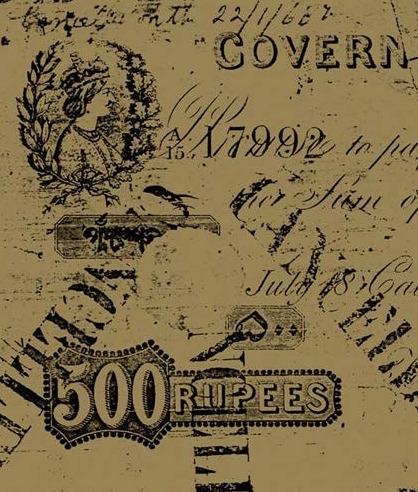
P-A1Dc, 500 Rupees, A/15 17992, left part of the note — obverse
Source: © The Banknote Book (Greysheet)
Notes
Front
Queen Victoria in profile within a wreath of oak and bay at upper left, 2 language panels, 2 serial numbers, value 500 Rupees in a black tablet at lower left.
The issue
Part of the first Government of India issue under the Paper Currency Act of 1861 (Act No. XIX of 1861, assented to on 16th July 1861), which made the note issue a government monopoly from 1st March 1862. Uniface and printed by the Bank of England; each note carries a printed date and is signed at the office of issue.
The rows
One variety per office and signer; the printed date of each note is recorded with the note, not with the variety. The one note recorded is a fragment dated 18 July, the year not legible; its prefix A/15 lies between the Calcutta prefixes A/11 (13 July 1861) and A/19 (9 May 1862) recorded on the other values of the issue, which points to 18 July 1861.
Design
Sources mention that the two facsimile signatures in the watermark are those of the Finance Member at left (James Wilson) and the Governor-General at right (Canning), and that Wilson's was kept on the paper of 1861 and replaced by Samuel Laing's on paper of later years.
In circulation
On 28th February 1866, 16,742 notes of 500 rupees were in circulation from ten offices (worked out from the values in Appendix XXV of the report of the Commission on Act XIX of 1861).
Branch marks
From 1st March 1862 the notes the Bank of Bengal sent to its branches carried a distinguishing mark stamped in colour: a P in blue, an R in black for Rangoon, an M in red for Mirzapore, a B in black for Benares and a D in green for Dacca, each letter inside an ornamental frame; notes of the head office had no mark (the Bank's circular of 20th February 1862, printed by the Commission on Act XIX of 1861, Appendix XXVI). The agents of the Bank of Bombay likewise marked the notes they issued with their branch stamp, and the Bank of Madras cashed at each branch the notes that bore its stamp, which is what the bank handstamps on the Bombay and Madras notes of this issue are. No note with a Bank of Bengal branch mark is recorded here.
Half notes
Notes went by post cut in two, and the Allahabad currency office cut its 500 and 1,000 rupee notes in half before sending them to the treasuries (papers printed by the Commission on Act XIX of 1861, Appendix XVII and Mr. Gay's note of June 1866). People who paid a note in at a treasury were made to sign it, which is why names are found written on notes of this issue.
Pick varieties list (1)
One row per variety. Press a variety’s button for its own page, with its sales history and its serial register.
| # | Variety | Comment | On record |
|---|---|---|---|
| Issued notes 1 Released into circulation | |||
| 1 | P-A1Dc | Serial prefix A/15 office CALCUTTA; signature unknown; date not recorded | 11 photograph11 serial number recorded00 sales recorded11 museum, published, archive or collection record |
Pick numbers follow the standard numismatic literature — see the references used on this site.

Research
14 articles on the notes of British India, with their sources.
- The first notes of the Government of India, 1861 to 1866 The Queen Victoria issue in the papers of the Commission on Act XIX of 1861
- What collectors wrote about the notes of British India The IBNS Journal and Bank Note Reporter, 1972 to 2026
- The Paper Currency Acts of India, 1861 to 1946 What each law said about the notes
- How many notes of each value The Government of India's circulation in the tables of the currency reports, 1872 to 1929
- Lost in the post, cut in half, written off The claims on Government of India notes in the currency reports, 1907 to 1952
Sales history Pro
What each variety of this pick has sold for, on its own page. 1 published record on record. Pro shows where these records are held or published, with their photographs and sources.
Serial register Pro
The serial numbers logged for each variety, on its own page. 1 serial number on record.
See Pro plans Already have Pro? Log in