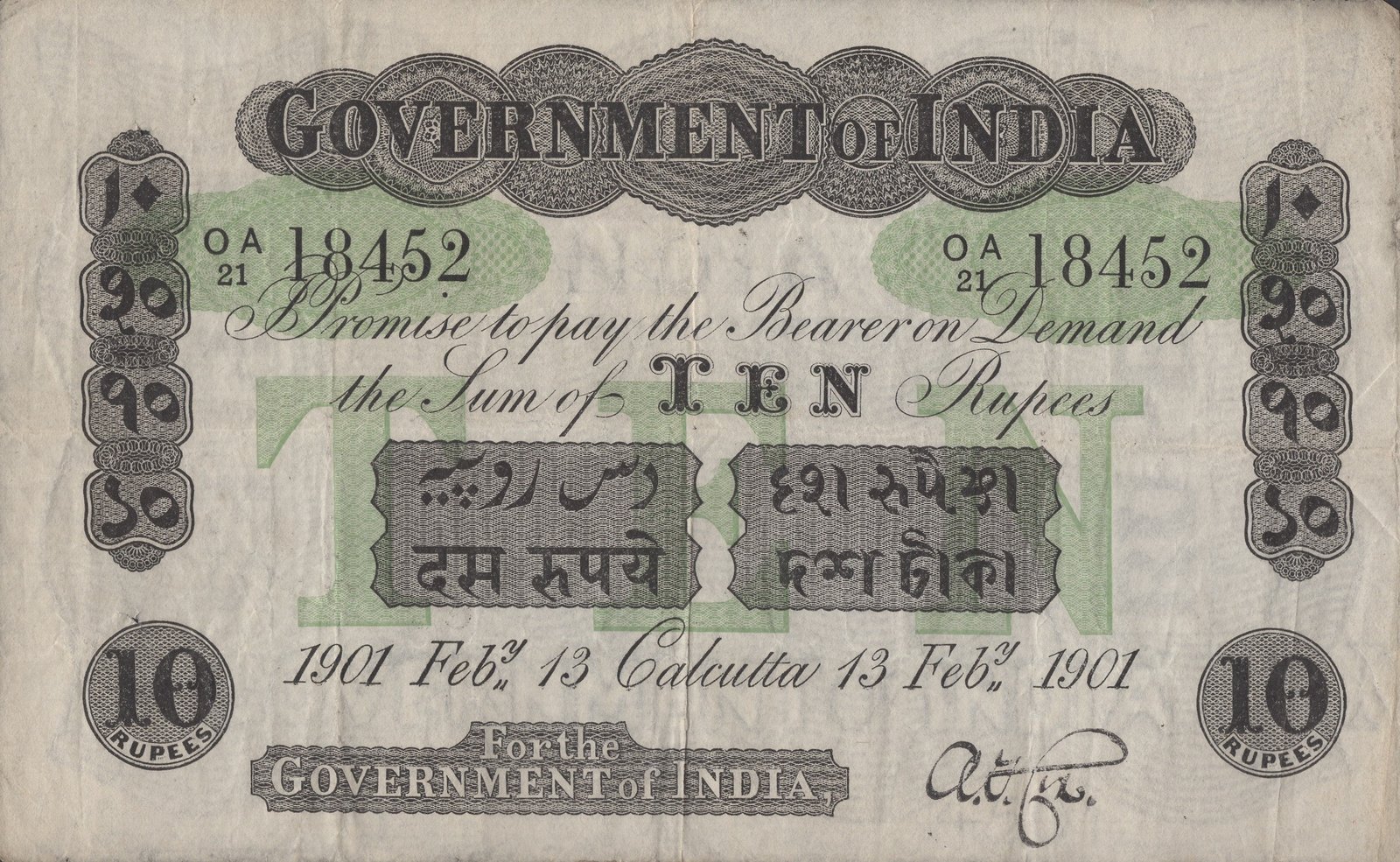
From 1867 to the 1920s the Government of India issued large uniface notes with a coloured underprint, printed by the Bank of England, each with a printed date. This article gathers what the catalogue's pages hold on how they were issued and used: the circles, the laws that made the lower values payable at every office, the numbers in circulation, and the forgeries. The sources are the Currency Department's yearly reports, the papers of two Royal Commissions, the Gazette of India and two articles by R. Leader. One auction lot and the Reserve Bank of India's museum page add a few points.
The notes
Sources mention that forgeries and weak paper led to the underprinted notes of 1867, each value on a stronger watermarked paper of its own. The Reserve Bank's museum page says the Underprint Series was introduced in 1867, that the green notes have four language panels and the red notes eight, and that the series stayed largely unchanged until the King's portrait notes of 1923. Spink's description of lot 226 in its sale of 26 September 2023 says the paper is moulded paper.
The catalogue lists the plates by value:
- 5 rupees: 1871 to 1901, 1901 to 1903, 1905 to 1907, 1907 to 1915 and 1914 to 1925.
- 10 rupees: the two green plates of 1867 to 1901, with two language panels and with four, the plates of 1903 to 1906 and 1902 to 1908, and the universal note of 1910 to 1920.
- 20 rupees: Bombay, Madras and Rangoon and Calcutta to 1901, and the four-serial plates of 1902 to 1906.
- 50 rupees: to the note of 1913 to 1922.
- 100 rupees: to the note of 1904 to 1927.
- 500, 1,000 and 10,000 rupees: see the section on the high values below.
No 5 rupees was issued until 1871. A. M. Newmarch's memorandum for the Royal Commission of 1913 counts 310,001 notes of 5 rupees in circulation at the end of 1872-73.
The circles of issue
A note was a note of its circle. Sources mention ten circles of issue in April 1873, Calcutta, Bombay, Madras, Allahabad, Lahore, Kurrachee, Akola, Calicut, Nagpore and Coconada, and that from 17 January 1874 every value from 5 to 10,000 rupees could be issued at each of them. Akola was the last of the ten: three treasury officers of Berar told the Commission on Act XIX of 1861 in March 1866 that the Act was not yet in force there.
Eight circles are counted in 1893 and in 1900. The Paper Currency Act of 1905 moved the Allahabad office to Cawnpore. The Act of 1910 fixed seven circles, Calcutta, Bombay, Madras, Rangoon, Karachi, Cawnpore and Lahore, with no offices under them. Calicut was a separate sub-circle until 18th February 1910, when it was merged in Madras and its currency office closed. The older notes of the sub-circles stayed payable at the head offices, those of Cawnpore and Lahore at Calcutta and those of Karachi at Bombay (the Currency Department's reports for 1909-10 and 1911-12).
The Currency Department's report for 1909-10 also names the agencies where the public could exchange notes: Rawal Pindi, Simla, Amballa, Multan, Sialkot and Dera Ghazi Khan in the Punjab, Peshawar, Bannu, Dera Ismail Khan and Kohat in the North-West Frontier Province and Mandalay in Burma, with an office for exchanges at Allahabad. In 1913 the Currency Agencies at Allahabad, in the Punjab and at Mandalay issued notes that were, in the words of the evidence to the Royal Commission on Indian Finance and Currency, usually given a distinctive mark. No note with such a mark has been identified in the catalogue.
Universal notes, 1903 to 1911
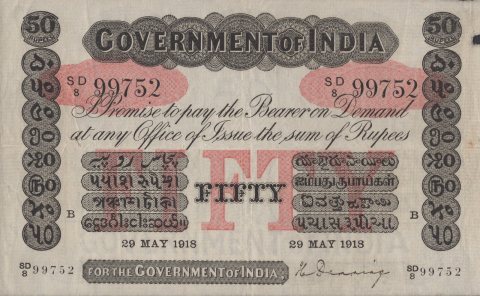
The Reserve Bank's museum page says that between 1903 and 1911 the notes of 5, 10, 50 and 100 rupees were made payable outside their circle of issue. The Pick pages give the steps.
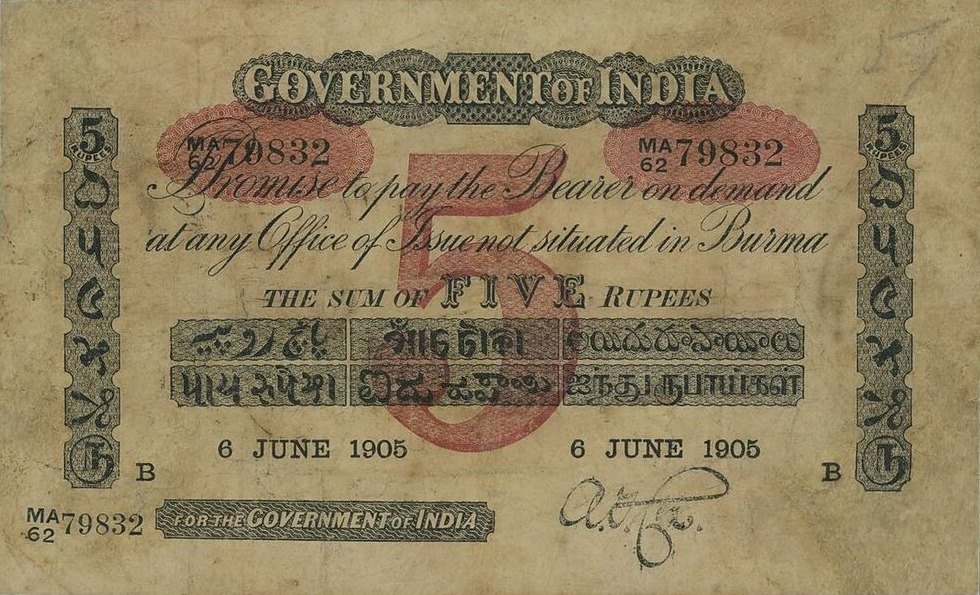
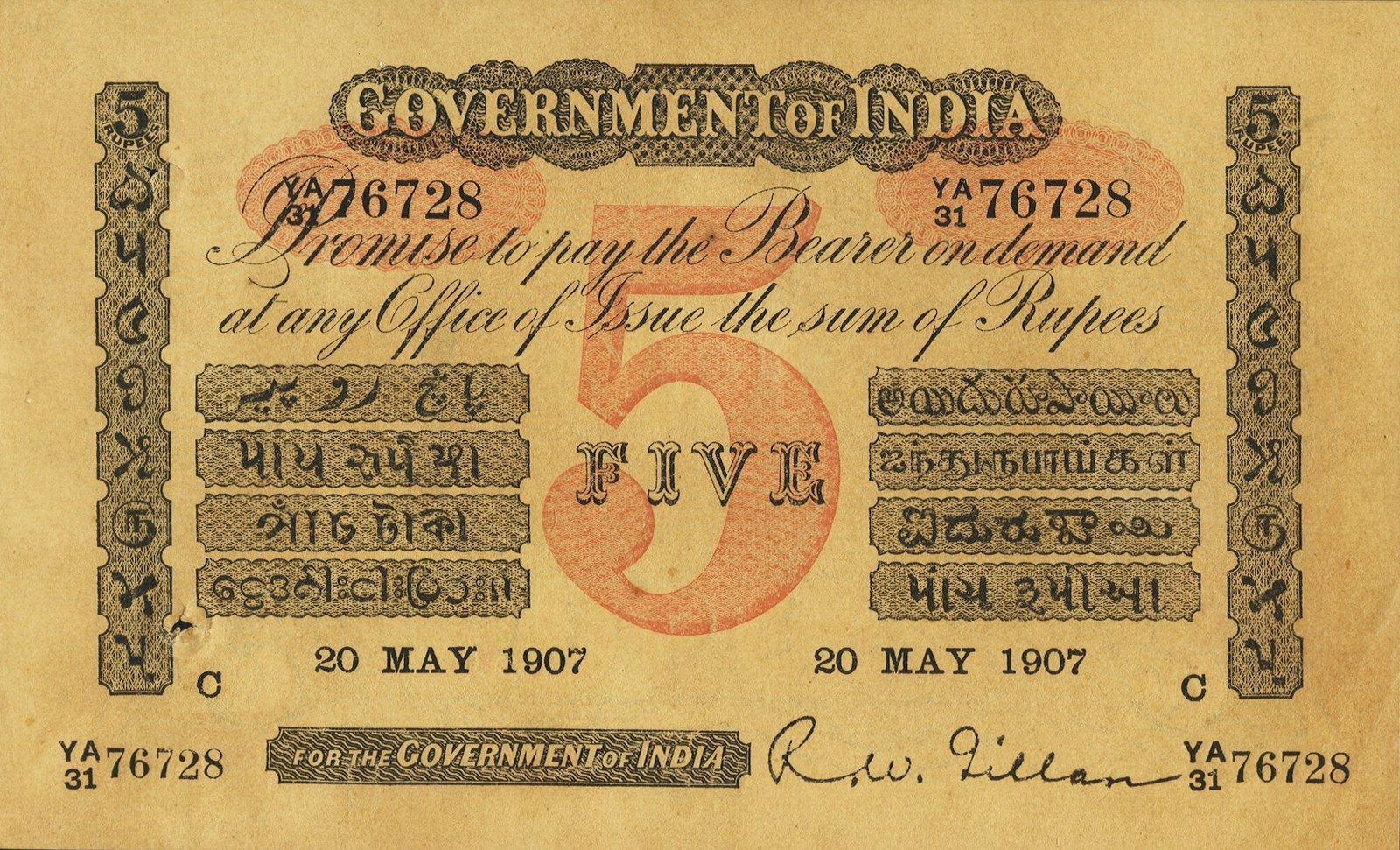
- 5 rupees. The note of 1905 to 1907 promises payment at any office of issue not situated in Burma (Paper Currency Act 1903), and its red underprint marks the wider circulation. From 20 May 1907 the promise reads "at any Office of Issue", without the words about Burma.
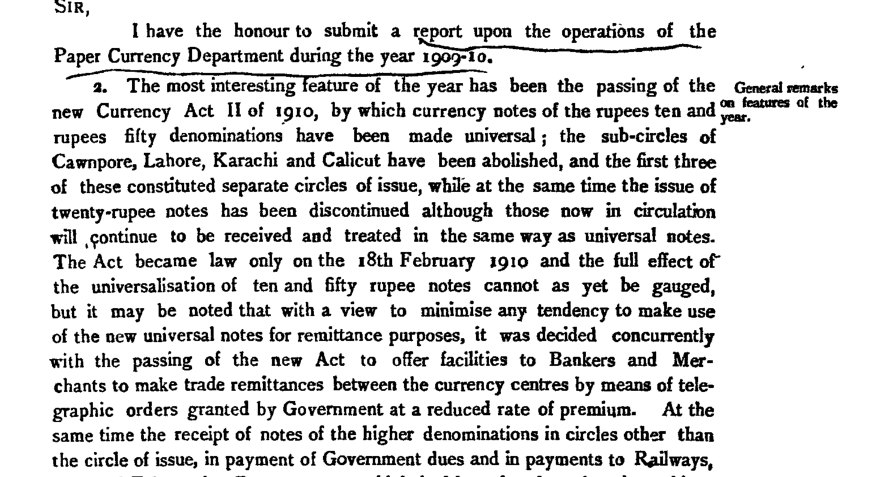
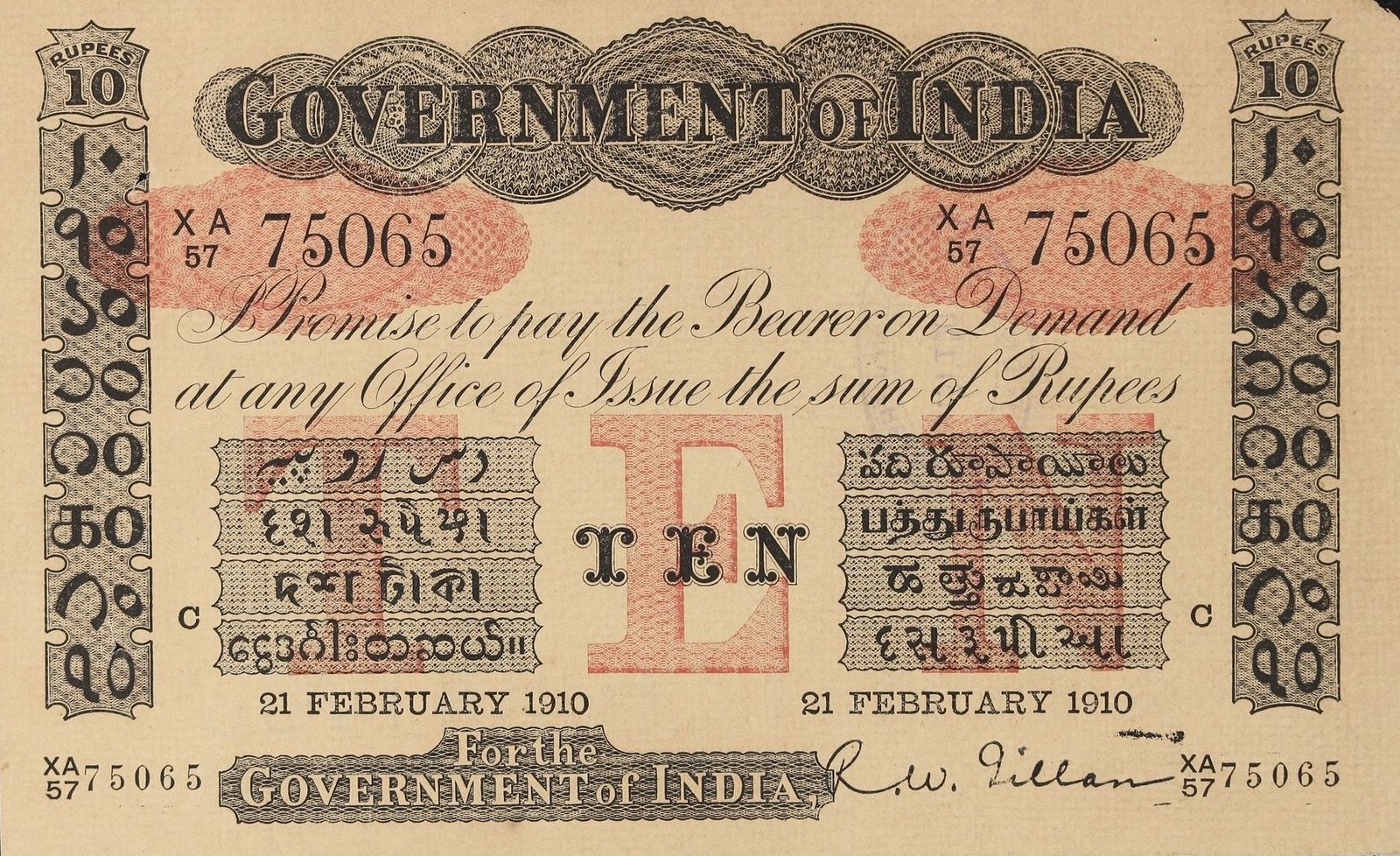
- 10 and 50 rupees. Both were made payable at every office of issue, and legal tender throughout British India, by the Paper Currency Act of 1910 (Act II of 1910), which became law on 18th February 1910 (the Currency Department's report for 1909-10).
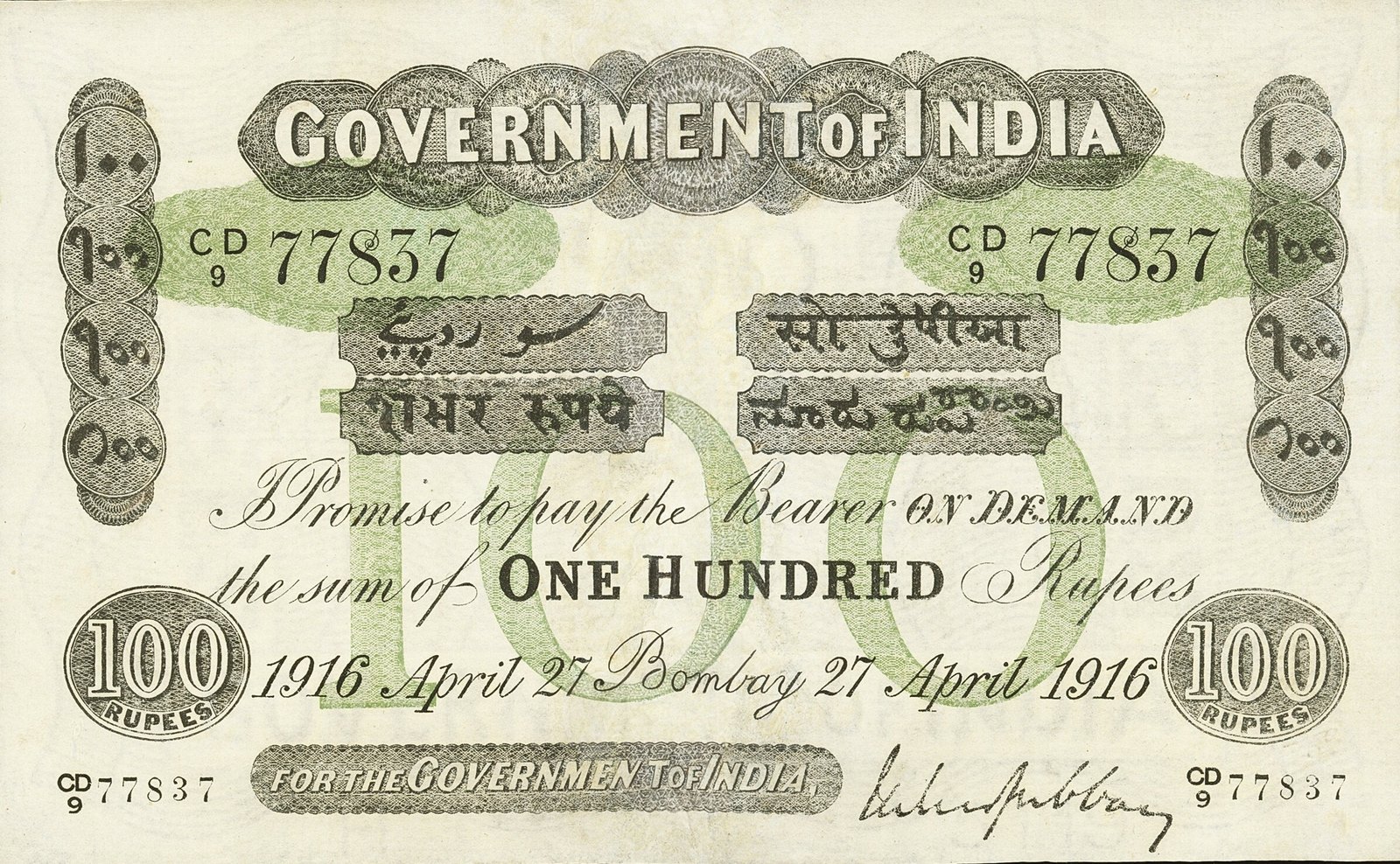
- 100 rupees. It was made payable at every office of issue from 1st April 1911, by a notification under the Act of 1910. Notes of 500 rupees and above stayed notes of their own circle.
From February 1910 a note that was not universal could be cashed only in its own circle, except that the old sub-circle notes of Cawnpore and Lahore were still paid at Calcutta and those of Karachi at Bombay (the Currency Department's reports for 1911-12 and 1913-14). Spink's description of 26 September 2023 (lot 226) says that in practice notes had been cashed outside their circle within reasonable limits.
R. Leader, writing in Bank Note Reporter in November 1974, thought the change of the seals and the large figure 5 from green to red on the 5 rupees was also, more than likely, a guard against the many forgeries of the earlier green notes, which had led some people in Calcutta to refuse five rupee notes. Uttering a forged note then carried ten years' imprisonment, and the forgers themselves were transported for life.
The report for 1910-11 says supplies of the lower values had been kept low "pending the arrival of notes in the new universal form". The cost of note forms rose from 608,248 rupees in 1909-10 to 1,619,917 in 1910-11.
How many were in circulation
| Value | Date | Notes in circulation | Source |
|---|---|---|---|
| 5 rupees | end of 1872-73 | 310,001 | Newmarch's memorandum, 1913 |
| 5 rupees | end of 1902-03 | 872,414 | Newmarch's memorandum, 1913 |
| 10 rupees | end of 1872-73 | 970,517 | Newmarch's memorandum, 1913 |
| 10 rupees | end of 1892-93 | 3,917,336 | Newmarch's memorandum, 1913 |
| 10 rupees | end of 1902-03 | 5,960,226 | Newmarch's memorandum, 1913 |
| 10 rupees | end of 1911-12 | 15,090,740 | Currency Department's report |
| 10 rupees | 31st March 1913 | 17,941,958 | report for 1912-13 |
| 10 rupees | 31st March 1914 | 17,726,423 | report for 1913-14 |
| 20 rupees | end of 1911-12 | 65,633 | Currency Department's reports |
| 20 rupees | a year later | 49,066 | Currency Department's reports |
| 20 rupees | 31st March 1914 | 38,415 | Currency Department's reports |
| 50 rupees | before the Act of 1910 | 342,514 | reports for 1909-10 and 1910-11 |
| 50 rupees | a year after it | 526,488 | reports for 1909-10 and 1910-11 |
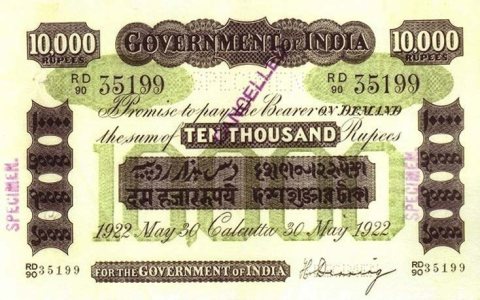
| 10,000 rupees | end of 1872-73 | 576 | Newmarch's memorandum, 1913 |
| 10,000 rupees | end of 1911-12 | 14,320 | Newmarch's memorandum, 1913 |
The 10 rupees was always the most numerous note. The figure for the end of 1911-12 is two and a half times that of 1902-03. A 10 rupee note then lasted about nine months from issue to cancellation (the Currency Department's reports for 1912-13 and 1913-14).
The 100 rupees was the note most sent by post, and it was usually cut in two for the journey: in 1913-14 about 95 in every 100 of the notes of other circles cashed at Bombay came in as halves (the Currency Department's report for 1913-14).
The end of the 20 rupees
The issue of the 20 rupees was discontinued from 18th February 1910 by a notification under the Paper Currency Act of 1910. Sources mention that it was never made payable at every office. The Currency Department's report for 1909-10 says that the notes already out would still be received and treated in the same way as universal notes. The table above shows how fast they came in. About 10,000 were still counted as outstanding in 1924.
Signatures and dates
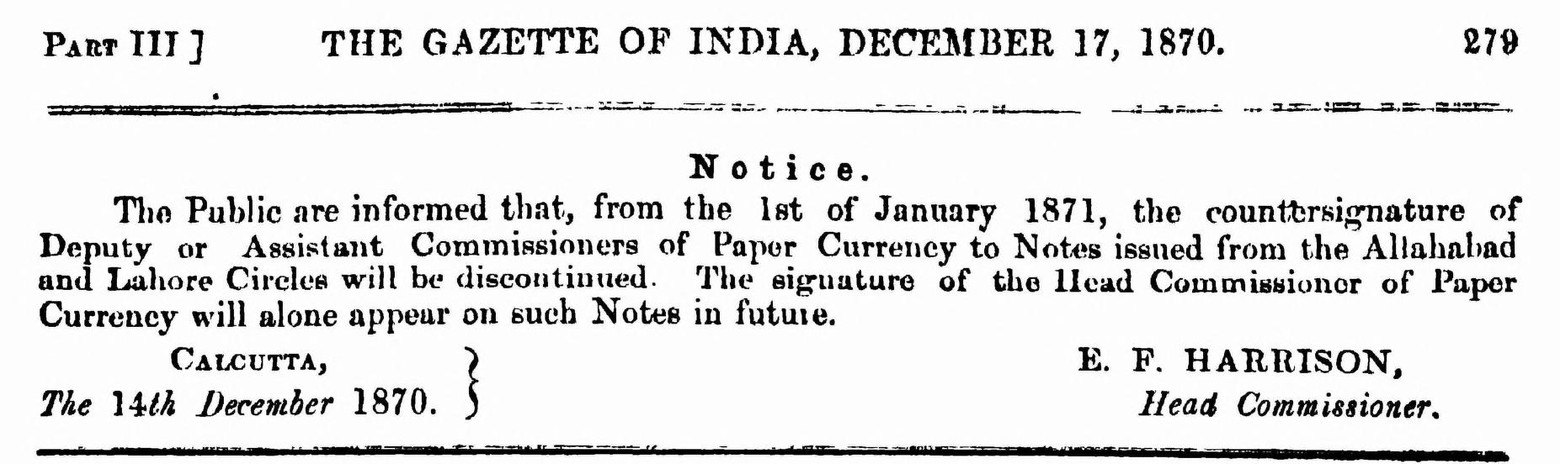
Each note carries a printed date and was signed at the office of issue. A notice of E. F. Harrison, Head Commissioner of Paper Currency, dated Calcutta, 14th December 1870 (Gazette of India, 17 December 1870, p. 279), ended the countersignature of the Deputy or Assistant Commissioners on notes of the Allahabad and Lahore circles from 1st January 1871.
On the universal 10 rupees the signature is that of the Head Commissioner of Paper Currency at Calcutta (from 1914 the Controller of Currency) whatever the office. The Currency Department's reports for 1911-12 and 1913-14 speak of the Head Commissioner's signature on 10 rupee notes of Karachi, Madras and Rangoon.
Sources mention that the paper of these notes carries a watermark date, a mould letter followed by the week and the year the paper was made, and that the printed date goes with the serial prefix, so it can be up to about three years before the paper was made. Sources also mention that Gubbay left office as Controller of Currency on 4 May 1920 and that Gubbay's signature was still used on notes made after that.
The list of stopped notes
The weekly lists of lost, stolen and destroyed notes in the Gazette of India and the Calcutta Gazette, 1865 to 1889, are the subject of the article on the lost-note lists. The currency offices went on keeping a list of such "stopped" notes, against which every note presented was checked, until Finance Department Resolution No. 523-F of 12th November 1912 ended it. A stopped note still had to be paid, the presenter being pointed out to the police if not known (the Currency Department's reports for 1909-10 and 1912-13).
Two shipwrecks
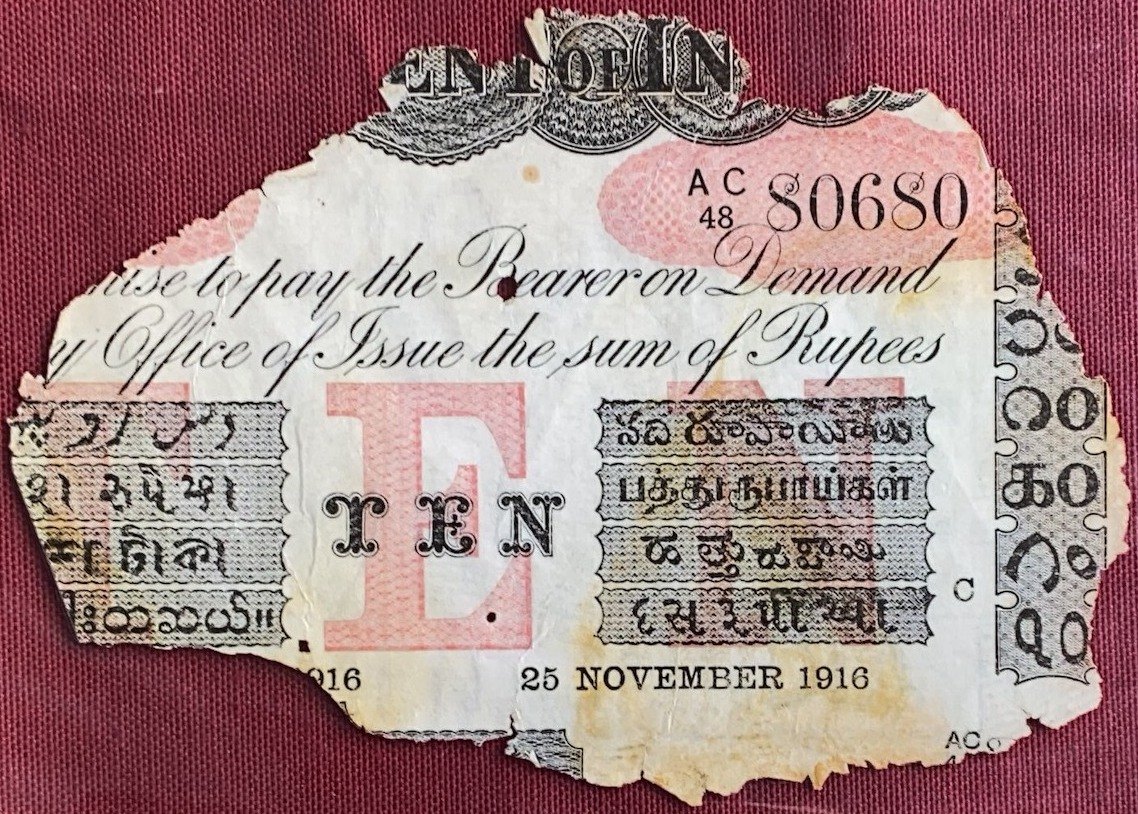
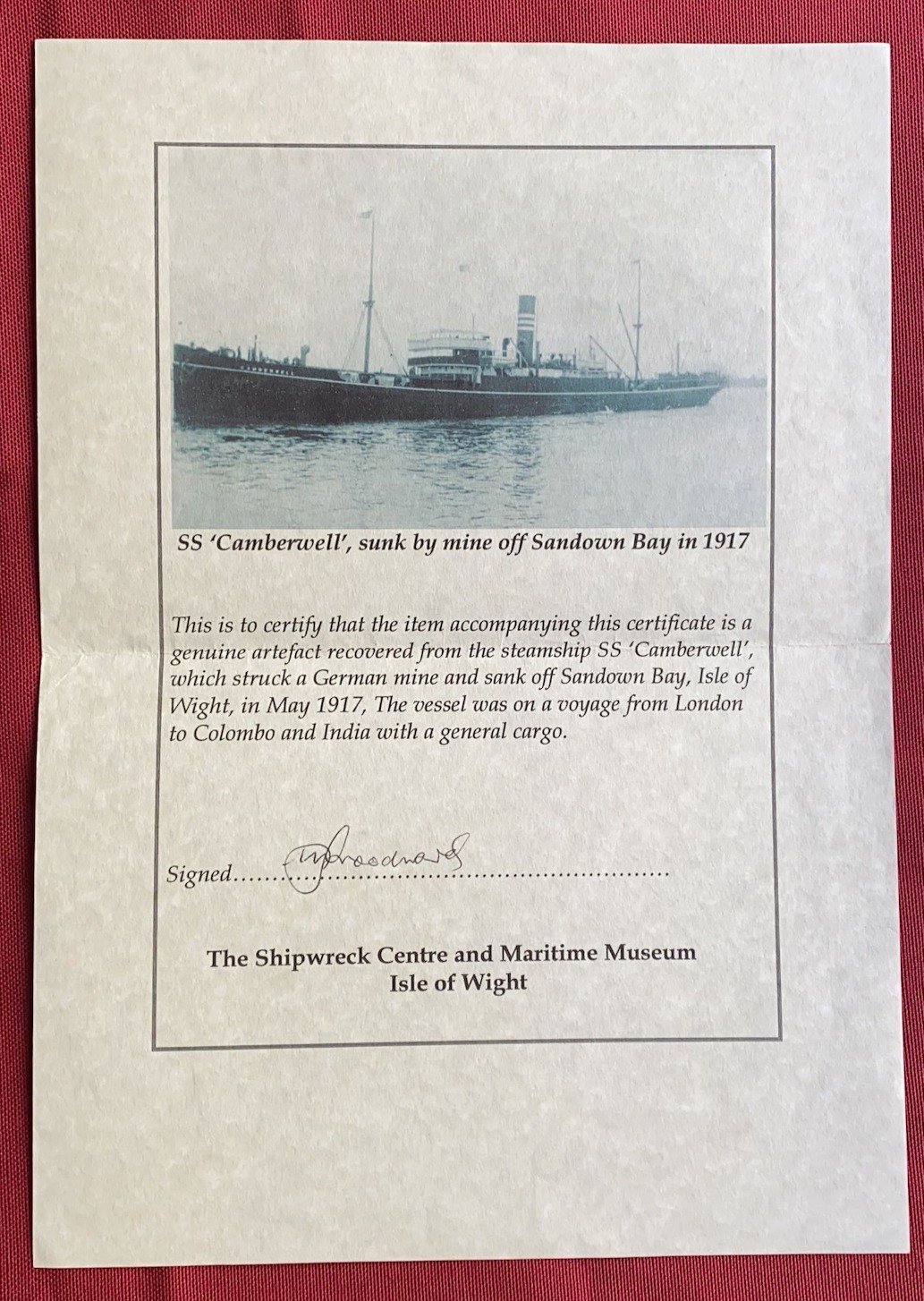
Two rows of the 5 rupees of 1907 to 1915 are unsigned notes recovered from the SS Shirala, sunk on 2 July 1918. One unsigned row of the universal 10 rupees is a note recovered from the SS Camberwell, sunk on 18 May 1917. The card of the Shipwreck Centre and Maritime Museum, Isle of Wight, sold with the Camberwell note by Green Apple (25 June 2021, lot 850), says the ship was mined off Sandown Bay, Isle of Wight, in 1917, carrying a general cargo from London to Colombo and India.
The high values
The 500 rupees of 1867 to 1880 and of 1904 to 1922, the 1,000 rupees to 1900 and from 1901 and the 10,000 rupees stayed notes of their own circle. Sources mention that these high values were kept in store after printing and signed only when issued, so that Kelly, who signed about 1930-1931, put a signature to notes dated 1907.
The Currency Department's report for 1920-21 says the 10,000 rupee notes did not enter active circulation: they passed between the Government, the banks and the currency chests. Heritage's description of lot 28382 in its sale of 18 September 2020 tells of the practice of cutting a note in two and sending the second half only when the first was acknowledged, and says its 1,000 rupees was cut in that way and joined again.
All notes of 500 rupees and above ceased to be legal tender on 12 January 1946. That is told in The Reserve Bank of India's King George VI notes.
Forged notes in the reports
The forged series, value by value, are set out in The forged series of British India, 1909 to 1929. What follows is what the reports say of the forgeries of the 5, 10 and 100 rupees.
5 rupees
The Currency Department's reports name a hand-made forgery of the series EB/38, of the Lahore circle (1911-12), and another of TB/19, purporting to be of Madras (1912-13). Only two to six forged 5 rupee notes a year came in then.
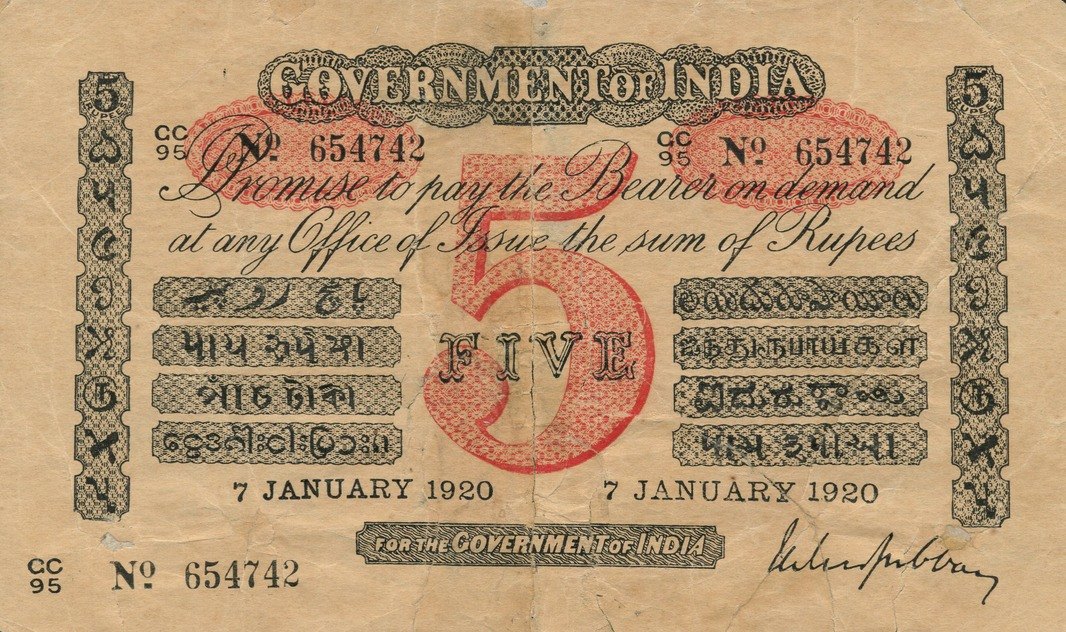
The report for 1920-21 counts 1,743 forged 5 rupee notes received that year, most in the Calcutta, Lahore and Bombay circles. Many were of the series FC/15. Men arrested at Nowshera for them were convicted at Peshawar but freed on appeal. Older, well-made forgeries of the series YB/33, YB/34, LC/60 and LC/61 were still coming in. A new forgery of the series RC/61, received in large numbers at Calcutta, is lithographed on plain paper without a watermark, with faint black printing and a duller red than a genuine note. Some of these prefixes, YB/34 among them, are also found on genuine notes.
The reports of the Controller of the Currency count 4,543 forged 5 rupee notes in 1923-24, most of them at Rangoon, of the series UN/40, GC/19, SD/84 and GC/18, the last spread widely over Upper Burma. A well-made lithographed forgery of the series GC/95 first appeared at the Bombay Currency Office in November 1923. Some of its makers were later convicted in Gujrat. Later reports name SD/84, GC/95, PF/19, GD/7 and CD/78 (1926-27, when the gang behind RC/61 and SD/84 was taken at Howrah), SD/84, GC/46, GD/7, CD/22 and UN/40, hand-made and crude (1927-28), and SD/84, GD/7 and a series printed like GD/94 (1928-29). The report for 1926-27 says the forgeries had cost the old 5 rupees its popularity, which the new King George V note won back.
10 rupees
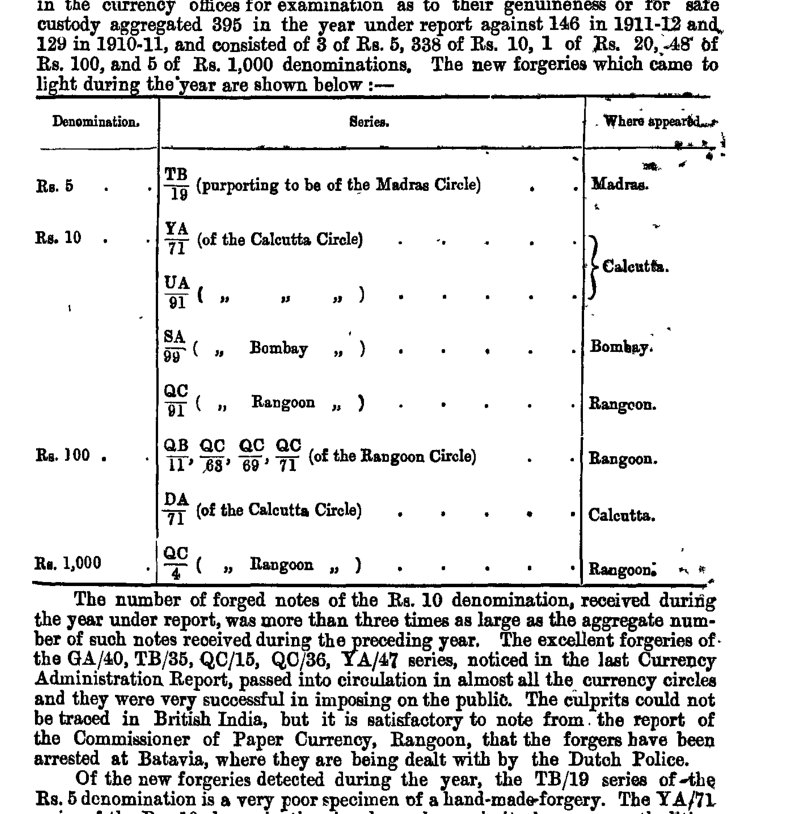
For 1911 to 1914 the Currency Department's reports describe a family of well-made forgeries of the new universal 10 rupees, of the series GA/40 (Karachi), TB/35 (Madras), QC/15 and QC/36 (Rangoon) and YA/47. They were photo-lithographed, with the serial letters and numbers and the Head Commissioner's signature printed separately and in slightly thicker type. They passed in almost every circle, forged 10 rupee notes rising from 109 in 1911-12 to 338 in 1912-13, and the makers were arrested at Batavia by the Dutch police. Clumsier forgeries of YA/71, UA/91 and SA/99 (1912-13) and of AB/37, WA/40 and DA/92 (1913-14) are also named.
The report for 1920-21 counts 382 forged 10 rupee notes received that year, many of them drawn by hand in pen and ink. The process-made forgery of the series AC/59, from the Calcutta circle, is printed from metal blocks on plain paper with an imitation watermark. Its red is fainter and its serial letters, numbers and black medallions are blurred, while the signature is a fair copy. A Rangoon forgery of the series QD/90 is lithographed on thin paper with an imitation watermark, its serial letters and numbers uneven and thicker than on a genuine note.
The Controller of the Currency's report for 1923-24 names AC/54, ND/55, RC/98, YC/48, LG/62 and AL/22, the last three new and clever. LG/62 is process-made on good paper with a faint watermark, its red medallion and the word Ten a little off colour and the words Government of India darker than on a genuine note. The reports for 1926-27 and 1927-28 add CD/73, CD/37, JD/73, RG/94 and BH/12.
100 rupees
The Currency Department's report for 1912-13 records a 100 rupees of the series DA/71, of the Calcutta circle, made of a genuine right half with O. T. Barrow's signature joined to a left half struck from wood blocks.
The report for 1920-21 counts 327 forged 100 rupee notes received that year. Very well-made forgeries of the series WC/16, WC/26, ZC/95, ZC/96 and ZC/97 appeared first in the Bombay circle in the winter of 1920-21 and spread to other circles. They are printed from blocks on thin paper with an imitation watermark, the green deeper or lighter than on a genuine note and the black medallions different, while the promise and the signature are cleverly copied.
The Controller of the Currency's report for 1923-24 names new and clever forgeries of LE/78, YC/82, LD/39, VD/35, PD/76, OD/88 and OC/2, the arrest in the Punjab of the makers of VD/88 and DV/88, and two men tried at Bombay for doubling 100 rupee notes of the series SD/23, SD/34, SD/44 and DC/85 by photographing them. Later reports name DV/88, ND/85, ND/60, QE/7 and QE/37, then ND/90, WW/11, ZZ/53 and RE/53 at Calcutta (1927-28) and RE/55, DD/21, DI/2, DP/1 and WD/55 (1928-29). Forged 100 rupee notes fell from 1,262 in 1923-24 to 398 in 1928-29.
What the sources leave out
- The reports name a forged series but seldom say which plate it copied.
- No report describes the distinctive mark of the Currency Agencies.
- The number of circles between 1874 and 1893 is not given on the pages.
- The years in which many signers began to sign are not recorded. The notes themselves give the earliest and latest dates read so far.
Sources
- The Currency Department's reports for 1909-10, 1910-11, 1911-12, 1912-13, 1913-14 and 1920-21.
- The reports of the Controller of the Currency for 1923-24, 1926-27, 1927-28 and 1928-29.
- A. M. Newmarch's memorandum for the Royal Commission of 1913, and evidence to the Royal Commission on Indian Finance and Currency.
- The proceedings of the Commission on Act XIX of 1861 (the Berar officers, March 1866).
- Gazette of India, 17 December 1870, p. 279 (notice of E. F. Harrison).
- Finance Department Resolution No. 523-F of 12th November 1912, as the Currency Department's report gives it.
- R. Leader in Bank Note Reporter, November 1974.
- Spink, 26 September 2023, lot 226.
- Green Apple, 25 June 2021, lot 850 (the card of the Shipwreck Centre and Maritime Museum, Isle of Wight).
- Heritage Auctions, 18 September 2020, lot 28382.
- Reserve Bank of India, Museum, "British India Issues", https://www.rbi.org.in/Scripts/pm_britishindia.aspx
- The Pick pages of the catalogue.
Member comments
Log in or register to post a comment.