British India 10 Rupees ND (1929-1930) P-7
P-7 ND (1929-1930) 4 varieties

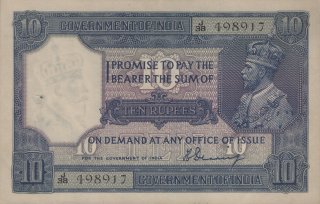
P-7a, 10 Rupees, J/38 498917 - obverse
Source: © Noonans
Signatures
- Howard Denning On one undated variety
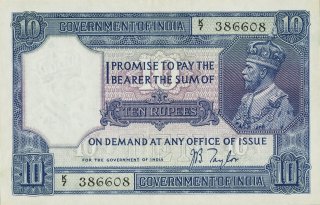
- James Braid Taylor On one undated variety
Notes
The issue
Part of the 1917-1930 George V issue of the Government of India.
Release
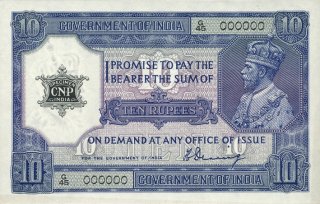
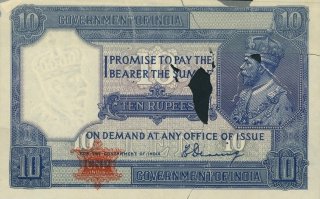
The Controller of the Currency's report for 1928-29 says that the issue of 10 rupee notes from the new press at Nasik "was delayed owing to an alteration in the design and colouring, and the new pattern issued first from the Lahore Currency Office at the end of February" 1929. The report does not describe the note; this blue note, which follows the green and brown P-6 at prefix G/45 and whose specimens are overprinted for the Currency Note Press, is the only 10 rupees it can be.
The rows
The row of a later signer carries the years of the whole page; the year in which he began to sign is not recorded. J. B. Taylor signed the Controller of the Currency's reports of 18th June 1927 and 5th July 1929 as Officiating Controller, and H. Denning that of 2nd June 1928 as Controller, so the two signatures alternate from 1927.
Telling them apart
P-6 and P-7 meet at prefix G/45. P-7 is the blue note with King George V's head in the watermark area at the left of the front; P-6 is the green and brown note with the rayed star there. The head is George V and the issuer is the Government of India on both.
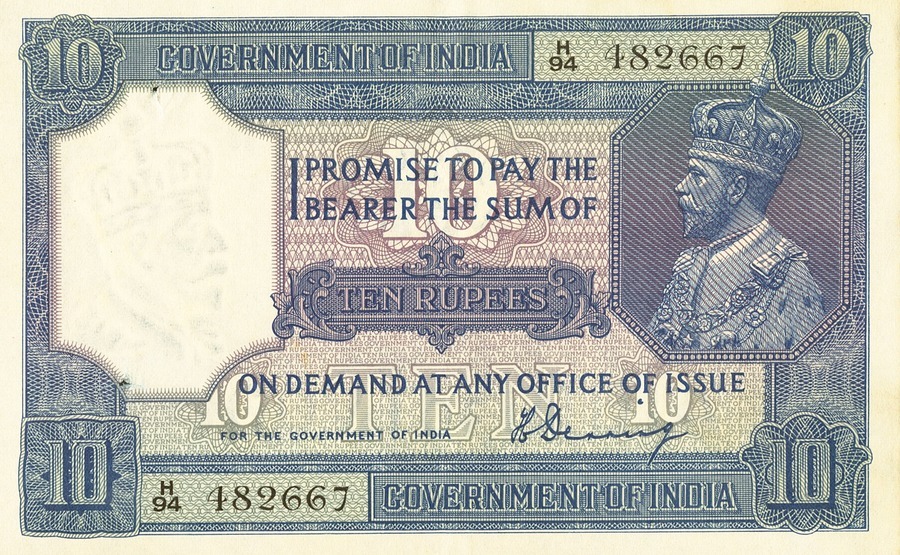
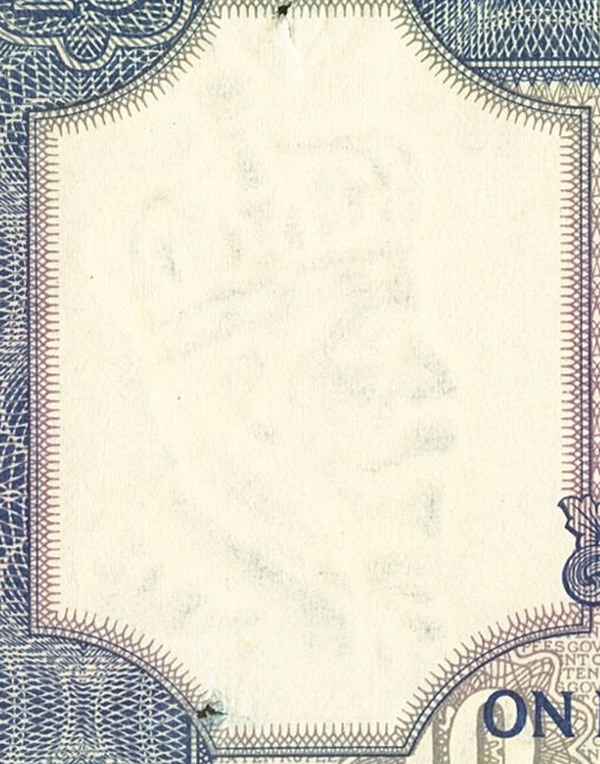
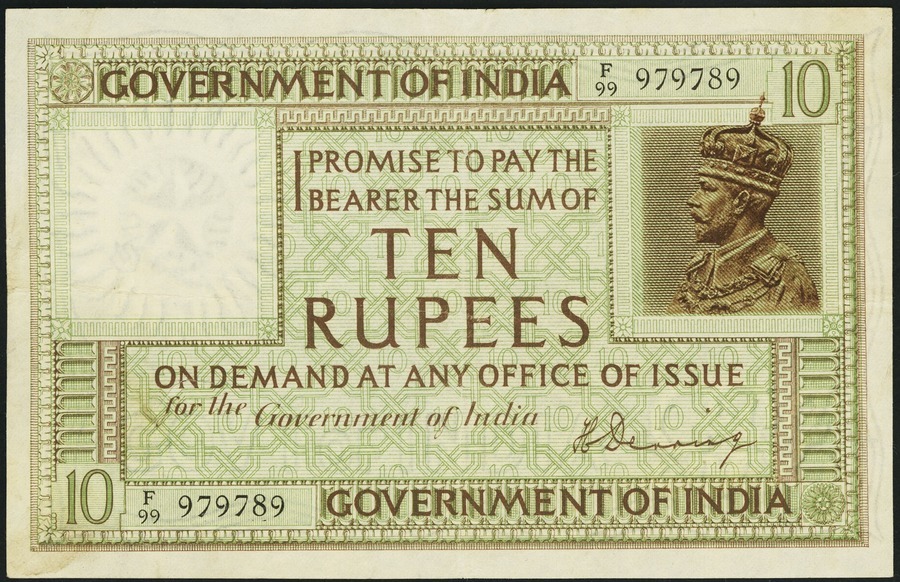
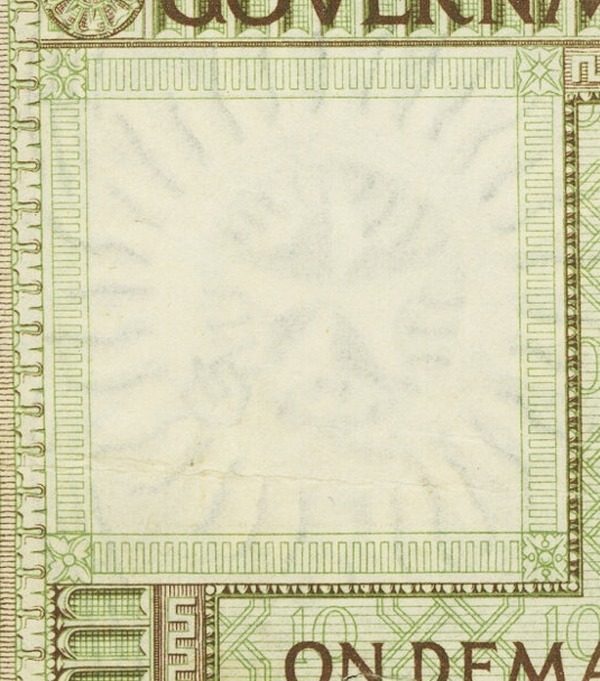
Denning signs up to prefix J/40 and Taylor from J/41
both signatures occur in the J block, so on a J note the signature, not the prefix letter, decides between P-7a and P-7b.
Pick varieties list (4)
One row per variety. Press a variety’s button for its own page, with its sales history and its serial register.
| # | Variety | Date | Signatures | Comment | On record |
|---|---|---|---|---|---|
| Issued notes 2 Released into circulation | |||||
| 1 | P-7a | ND (1929) | Denning | Serial prefixes G/45 - J/40 | 55 photographs8989 serial numbers recorded127127 sales recorded11 museum, published, archive or collection record |
| 2 | P-7b | ND (1929-1930) | Taylor | Serial prefixes J/41 - L/62, L/64, L/66 - L/67 | 22 photographs320320 serial numbers recorded460460 sales recorded11 museum, published, archive or collection record |
| Specimens 2 Printer's specimens — never released into circulation | |||||
| 3 | P-7s | ND (1929) | Denning | Serial prefix G/45 black SPECIMEN C.N.P. INDIA ornamental overprint in the watermark area; all-zero serial number | 11 photograph00 serial numbers recorded11 sale recorded |
| 4 | P-7s | ND (1929) | Denning | No serial number; red SPECIMEN C.N.P. INDIA ornamental overprint lower left front | 11 photograph00 serial numbers recorded11 sale recorded |
Pick numbers follow the standard numismatic literature — see the references used on this site.
Research
14 articles on the notes of British India, with their sources.
- Nasik, 1928: the year India began to print its own notes
- What collectors wrote about the notes of British India The IBNS Journal and Bank Note Reporter, 1972 to 2026
- The Paper Currency Acts of India, 1861 to 1946 What each law said about the notes
- How many notes of each value The Government of India's circulation in the tables of the currency reports, 1872 to 1929
- Lost in the post, cut in half, written off The claims on Government of India notes in the currency reports, 1907 to 1952
Is your 10 Rupees on record?
Type its serial number to see which variety it belongs to and whether the note is on the register. Looking a number up needs a free account.
Sales history Pro
What each variety of this pick has sold for, on its own page. 589 sales and 2 collection records on record. Pro shows where these records are held or published, with their photographs and sources.
Serial register Pro
The serial numbers logged for each variety, on its own page. 409 serial numbers on record.
See Pro plans Already have Pro? Log in