A banknote is drawn many times before it is printed once. Between the first pencil lines and the note that reaches a bank counter stand the painted essay, the paste-up, the engraver's proofs, the photographs kept in the printer's files, the model sent for approval, the trials of colour and the specimen. Most of that work was never meant to leave the printing works. Some of it did, and the design archive of this catalogue records what has been seen of it.
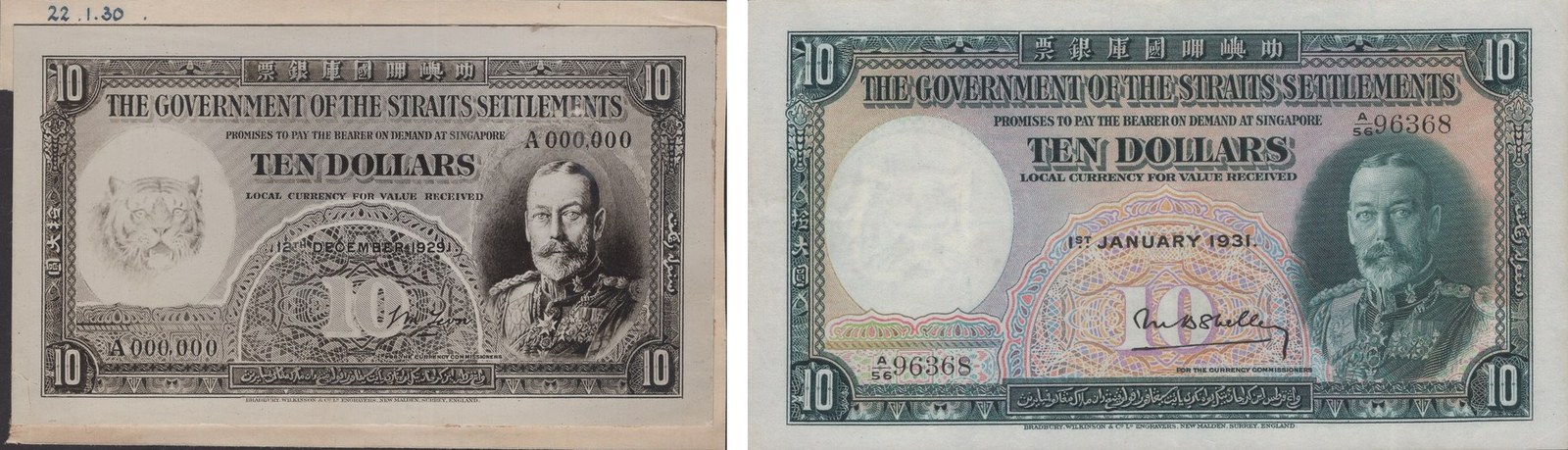
This article takes the stages in order and shows real pieces for each. It ends with one note for which nearly every stage is on record, the Straits Settlements 10 dollars of 1931, followed from a photograph of December 1929 to the note in the hand.
Everything here is taken from the pieces themselves as the archive records them: what is drawn, printed and pencilled on them, and what was said of them when they were sold. The short meanings given for each kind of piece are the ones the archive pages use. Dates printed on a design are written as "12th December 1929"; days of events as "22 January 1930".
The stages at a glance
| Stage | What it is | Shown here |
|---|---|---|
| Pencil sketch | The layout blocked out on paper, with notes of sizes and colours | Gibraltar 2 shillings, 1914; British Guiana 1 dollar |
| Essay drawn or painted by hand | The proposal worked up to look like a note | Gibraltar 10 shillings, 1914; Malaya 1 dollar, about 1937 and 1938 |
| Composite essay | A design built from separate parts pasted together | Straits Settlements 10 dollars, 1930; East Africa 20 shillings |
| Engraved portrait, vignette, die proof | The engraving on its own, proofed from the die | Mauritius, George V; Malaya, 1942 |
| Archival photograph | The printer's record of a design at one stage | Straits Settlements 10 dollars, 1929 and 1930 |
| Printer's model | The mock-up submitted for approval | Belize 10 dollars, 1979 |
| Stage proofs | The printing taken apart, plate by plate | Straits Settlements 10 dollars, 1930; Fiji, 1937 |
| Colour trial | The adopted design in other colours | Straits Settlements 10 dollars |
| Specimen | The finished note, marked so that it cannot be spent | Straits Settlements 10 dollars, 1931 |
The order is not a rule. A printer photographed a design whenever there was something to record, and a paste-up could follow a photograph as easily as come before it. The Straits Settlements pieces below show exactly that.
1. The pencil sketch
The earliest piece of any design is the hardest to find, because nobody kept it for its looks. The archive has two.
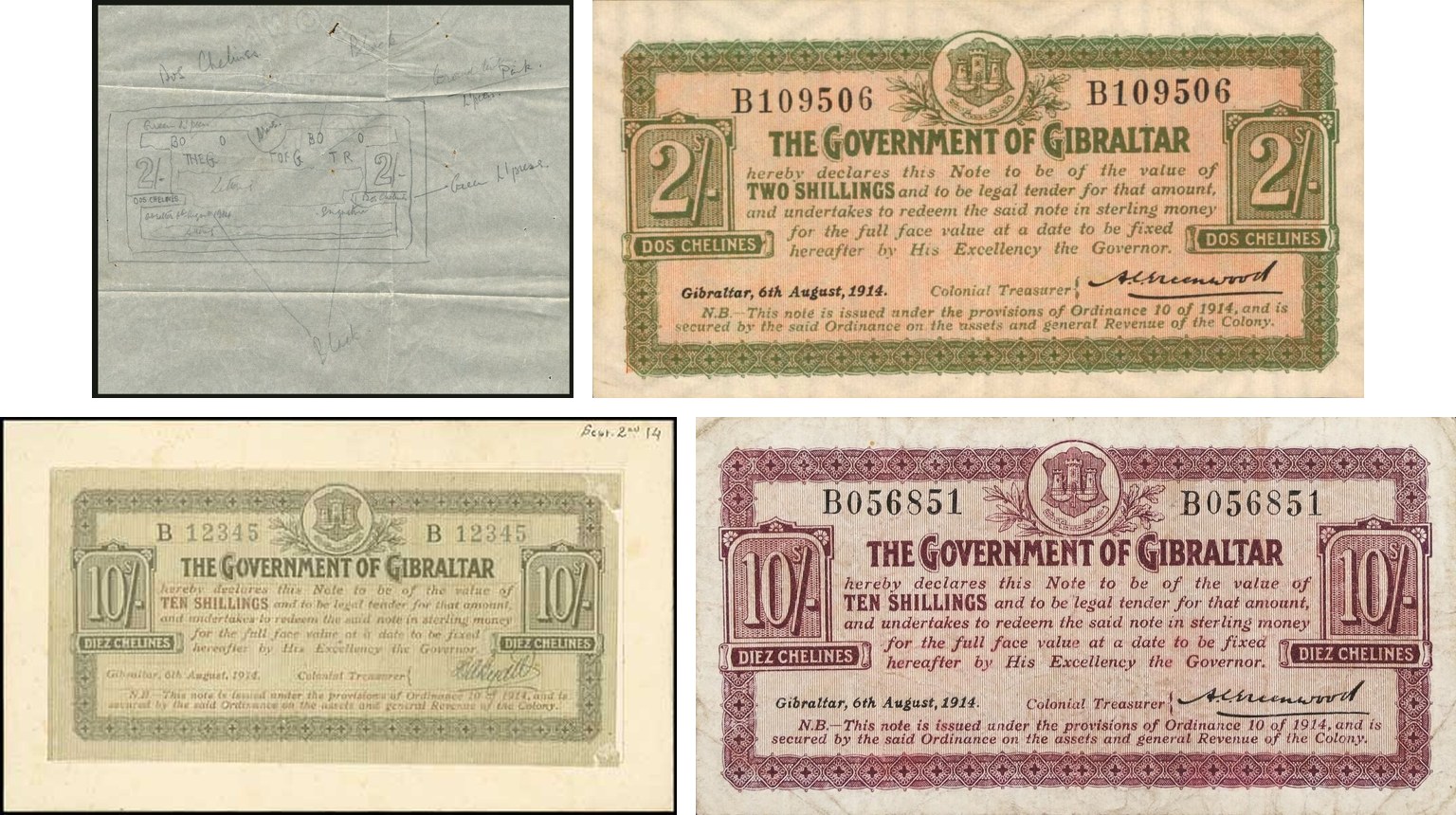
The first is a pencil layout for the Gibraltar 2 shillings of 1914, on thin paper watermarked Crown Agents. The design is only blocked out: the value, the DOS CHELINES tablets, and spaces for the date and the signature. Round it are written the colours and processes intended: green letterpress, black, brown lithography, a pink underprint. The 2 shillings was part of the emergency issue dated 6th August 1914, and the note as issued is printed green on pink.
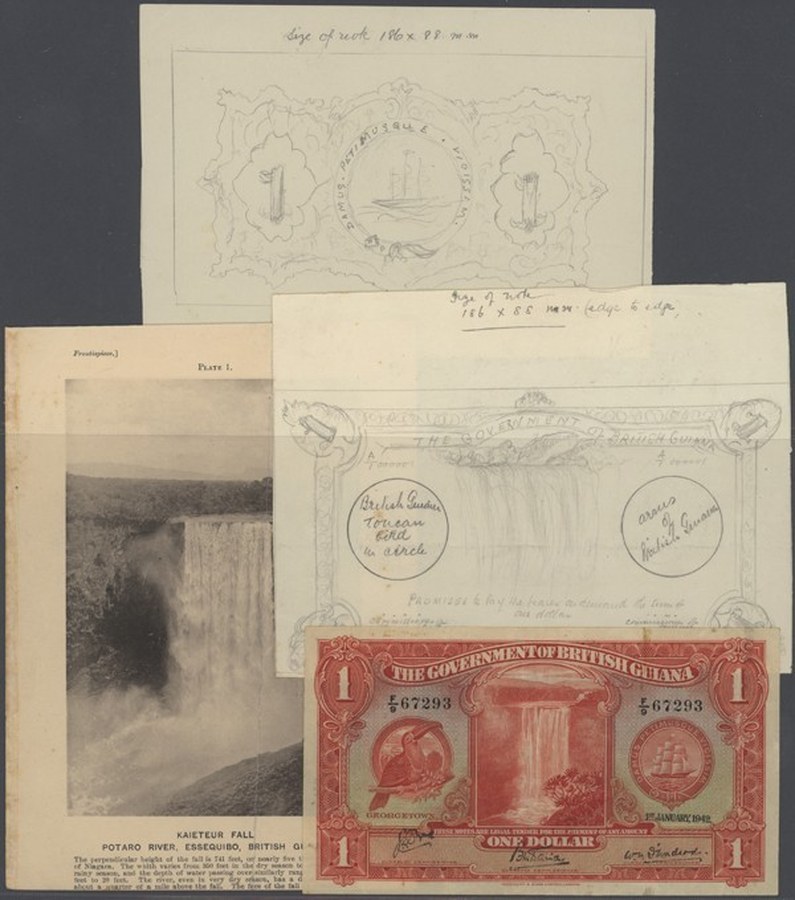
The second is a pair of pencil layouts for the British Guiana 1 dollar, each headed "Size of note 186 x 88 mm". One has the colony's seal with its ship at the centre between two figures of 1. The other is a front with the name of the Government in a scroll over a waterfall, and two circles in which the draughtsman has simply written what is to go there: "British Guiana toucan bird in circle" and "arms of British Guiana". They were sold with a printed plate of Kaieteur Fall, the picture the waterfall was to be drawn from. The house that sold them called them original sketches from the printing works made before production. The 1 dollar of 1st January 1929, printed by Waterlow and Sons, has the toucan at the left and Kaieteur Falls at the centre.
A few more sketches are recorded without being in a collector's hands. Two pencil sheets for the Fiji 1 penny of 1942, lettered A and B, are placed by sources in the archives of the Reserve Bank of Fiji; and four pencil essays of 1st February 1948 for a Central Bank of Ceylon have their two ovals left empty.
2. The essay drawn or painted by hand
The next step is a drawing that looks like a note. At Gibraltar it followed within weeks. Two essays for the same emergency series, a 10 shillings and a 5 pounds, are drawn and lettered by hand and mounted on board. Each has the number B 12345, and each is dated "Sept. 2nd 14" in ink at the top right. Both carry the signature of Byatt as Colonial Treasurer; the notes that were issued are signed by Greenwood. Sources mention that the series was put into circulation on 13th October 1914. The date printed on the notes, the date inked on the essays and the day the notes are said to have gone into circulation lie within ten weeks of each other.
An essay is a proposal, and a proposal can be sent back. The archive's own line for an unadopted essay is short: "A proposal the issuing authority turned down. The note it would have been never existed." Many essays in the archive are of that kind. Others are earlier states of a design that went on.
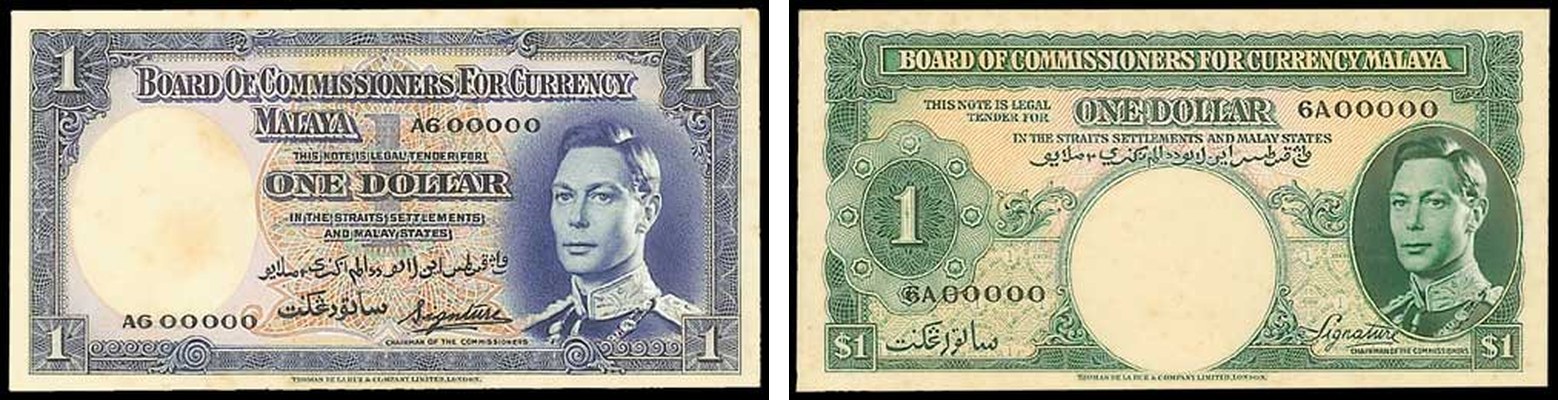
The Malaya dollar notes show a design being moved about between two rounds of essays. In the first round, of about 1937, the 1 dollar, the 5 dollars and the 10 dollars each have the value large in all four corners, the value in words on a tablet at the centre, and an oval left blank at the left for the watermark. In the second round, of about 1938, the 1 dollar, the 5 dollars and the 10 dollars have the figure once, in an ornate frame at the left, and the blank watermark circle at the centre. The archive calls the second 1 dollar "the layout of the notes as issued". The 1 dollar dated 1st January 1940 was printed and never issued; of that series only the 10 dollars reached the public, in March 1941.
Some essays are paintings in their own right. For Ceylon, De La Rue prepared a series of designs dated 1st January 1928, each a different view inside the same kind of frame: two fishermen poling a boat, Sigiriya rock, an elephant in the forest, a bullock cart by a lake. None was adopted.
And some essays are simply the adopted note before its date was settled. The hand-made essay for the Seychelles 5 rupees is dated 1st October 1965 and already has the black parrot at the left. The note that came out on 1 January 1968 kept the parrot and the portrait and dropped the date. The mount is pencilled with a job reference, BN/29·9·65/321; references of this kind give the day the work was booked at the printer's and are often the only date a design carries.
3. The composite essay
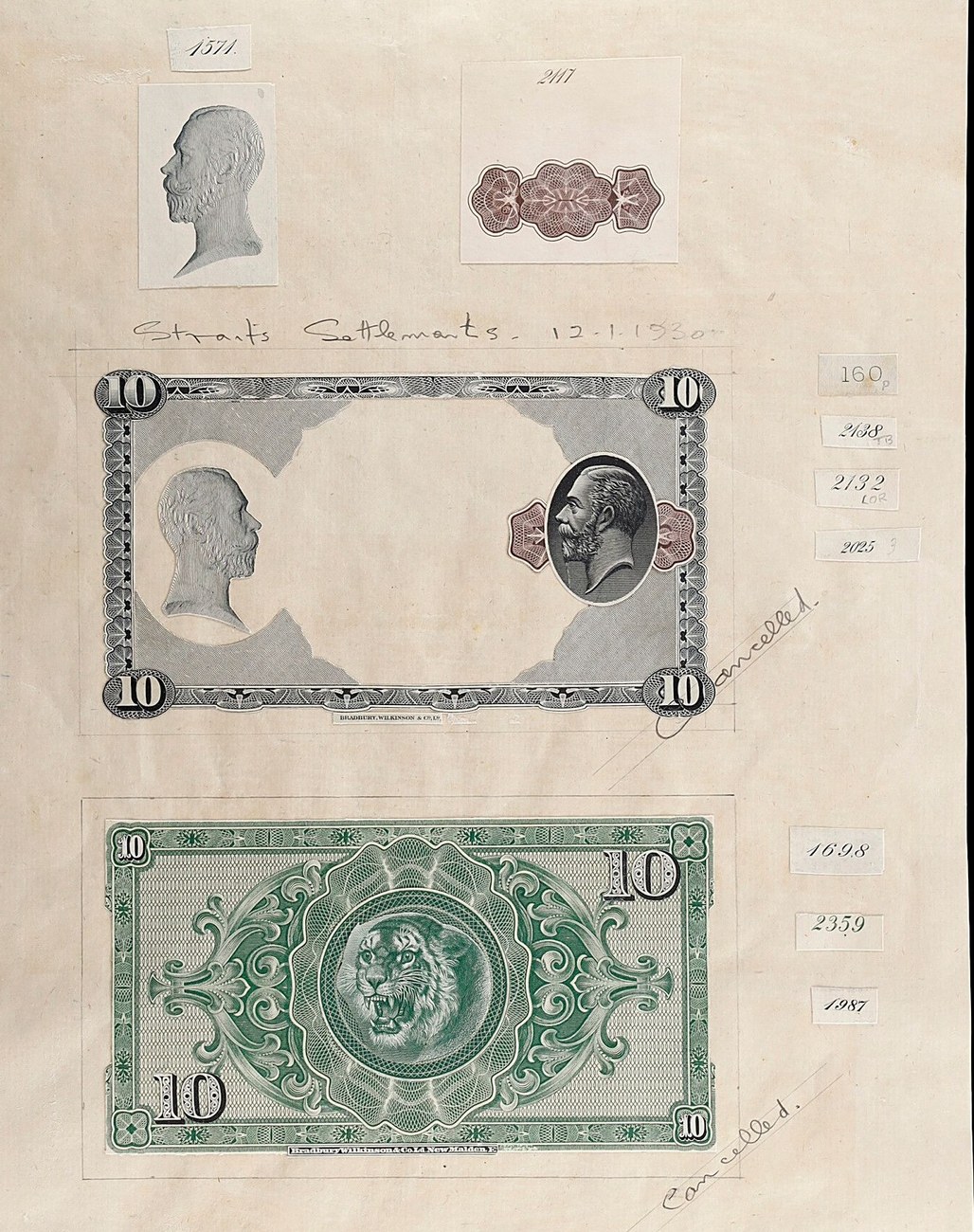
A composite essay is a design put together from parts: a printed frame, a portrait proofed from its die, a photograph of a vignette, lettering drawn by hand, all cut out and pasted in place. It lets the printer try an arrangement without engraving anything new.
The plainest example in the archive is a Bradbury Wilkinson working sheet headed in pencil "Straits Settlements 12-1-1930". On it is a proof frame for a 10 dollars with 10 in each corner. A profile head of George V is pasted into the circle at the left, and a smaller portrait in an oval, over a rosette, at the right. Above the frame the same parts are pasted separately, each with its number in the printer's stock: the larger profile numbered 1571 and the rosette numbered 2117. At the right are four slips with further die references: 160 P, 2138 TB, 2132 LOR and 2025. Lower on the sheet is a back for the 10 dollars in green with a tiger's head at the centre. Both are marked "Cancelled". The sheet shows how such a design was made, from what the printer already had on the shelf, and it shows the answer it got.
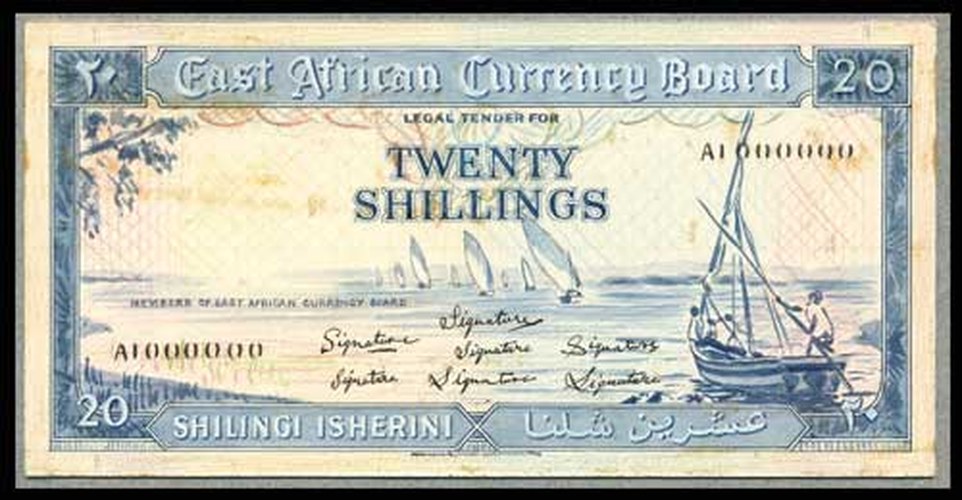
A composite essay can also date itself by what is not yet decided. An East African 20 shillings with a dhow has room ruled for seven signatures, filled with the word "Signature" seven times. The notes issued in 1964 carry two, so the essay was made before the Board settled on two. The dhow was kept for the 20 shillings of 1964.
On later essays the pencilled job references let the work be followed. The essay for the back of the Jersey 20 pounds of 1976, with Gorey Castle, has two references on its mount, Bn/22-5-74/136 and Bn/5-11-74/335: the back was on the printer's table from May to November 1974. An essay for the Jersey 5 pounds with the references Bn/29.4.86/118 and Bn/1.6.87/103 shows a front that differs markedly from the note issued in 1989, and a back, La Corbière lighthouse at sunset, as it was adopted.
4. The engraving: portrait, vignette and die proof
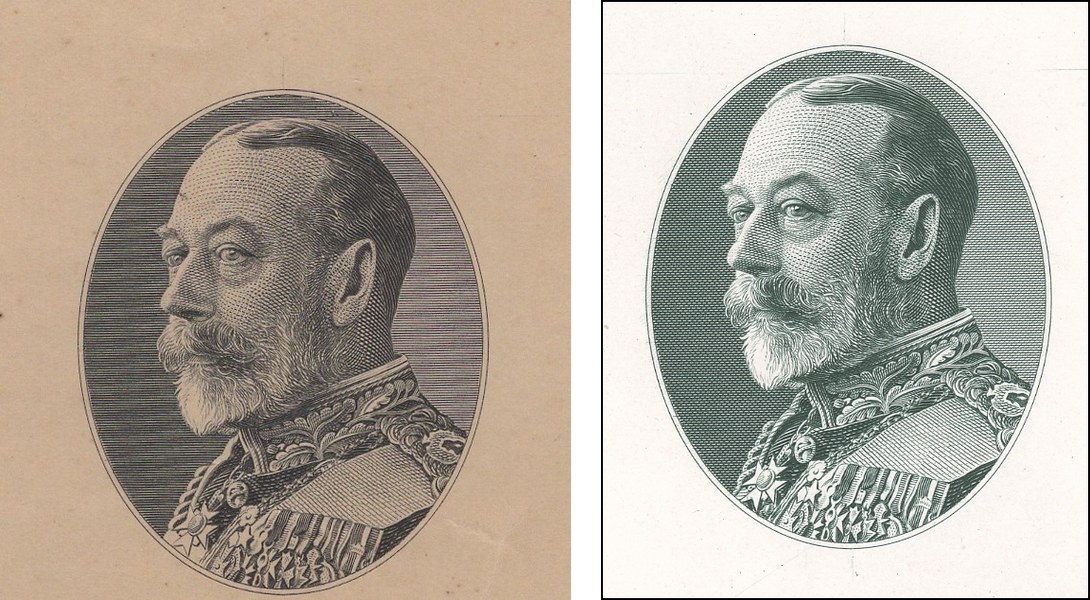
While the layout is argued over, the engraver cuts the parts that will be printed from steel: the portrait and the pictures. Each is proofed on its own before it is combined into a note. The archive's lines for these are: for an engraved portrait, "The portrait engraving on its own, pulled as a proof from the die before being combined into a note design"; for a vignette, "A single engraved scene or portrait, printed on its own from the die before it was combined into a note"; and for a die proof, "A trial impression pulled from the engraved die to check the work before printing".
Two proofs of one die show what such a trial was for. The portrait of George V that stands at the right of the Mauritius 5 and 10 rupees of the 1930s is recorded as a proof in black on card, with a number blind-embossed at the top and a pencilled initial of approval. The same die printed in green is pencilled "Jan 2/34". The archive's note on it says this is how a printer tried a vignette against the colour a note was to be printed in.
Approval of a portrait could be an event of its own. A case of George VI portraits for the Malaya 1, 5 and 10 dollars, four vignettes in green, blue and purple and initialled under each pair, is held in the Crown Agents' Philatelic and Security Printing Archive at the British Library; the archive dates it to about 30 March 1939. Two cards with the engraved portrait of Queen Elizabeth II after Dorothy Wilding's photograph are lettered "AS SUBMITTED 12. 8. 52" and "Approved", signed and dated 29/8/52: seventeen days from submission to approval.
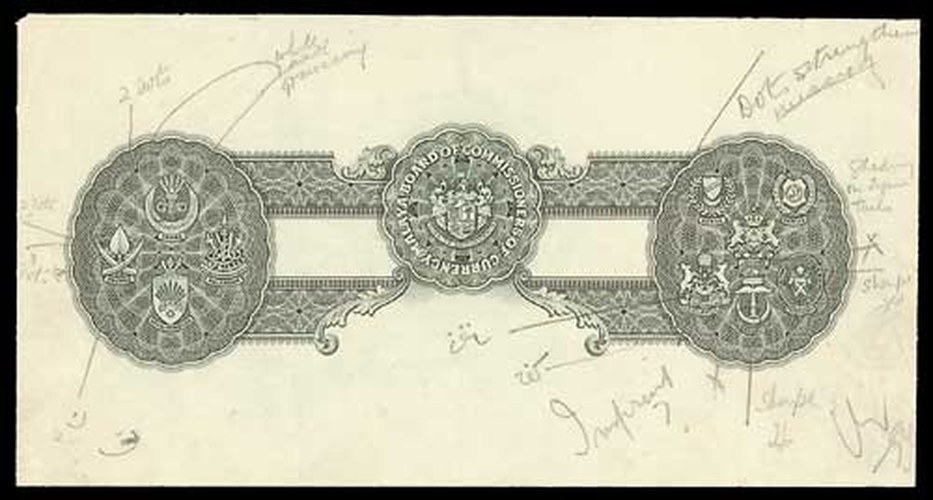
A die proof is also where the engraver is corrected. The proof of the arms panel used on the back of the Malaya 50 and 100 dollars of 1942 is covered in pencil: where a dot is to be strengthened, where shading is wanted, what is improved. A proof of the front of the Malaya and British Borneo 10 dollars with the buffalo and ploughman is the engraved plate alone, without underprint or numbers, and the frame round the watermark space is not yet there.
5. The archival photograph
The archive's line: "A photographic record of a design at one stage of its development, kept in the printer's files." Its note on a Bahamas design adds what the photographs were for: they were made as the design progressed, so that each stage could be recorded and passed round for approval.
Photographs are the most numerous kind of piece in the archive, and they are where the versions of a design can be counted.

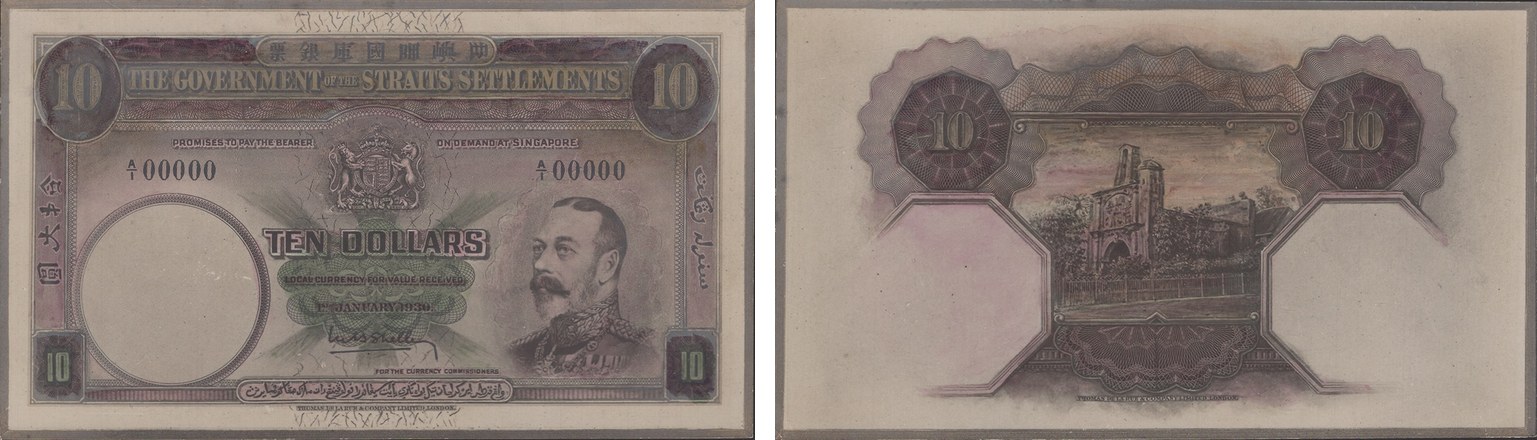
For the Straits Settlements 10 dollars there are three, all with the date 12th December 1929 on the design, George V at the right, a tiger's head drawn where the watermark will be, the number A 000,000 and the signature of McLean:
- the first has the value in words at the centre over a half-round panel with a large 10, and the number in both lower corners;
- the second is the same design with the number moved to the upper right and lower left. It is inked 22.1.30 in the top margin;
- the third is another arrangement: the title in two lines, and a large 10 behind the word DOLLARS at the centre.
A photograph could be coloured by hand to show what was meant. A pair for a 10 dollars dated 1st January 1930, front and back, is tinted in purple and green over the print. It is a different design again, with the royal arms at the top centre and a blank circle for the watermark, and it was not adopted.
6. The printer's model
The archive's line: "The mock-up a security printer submits for approval, usually with the design elements cut out and pasted onto card."
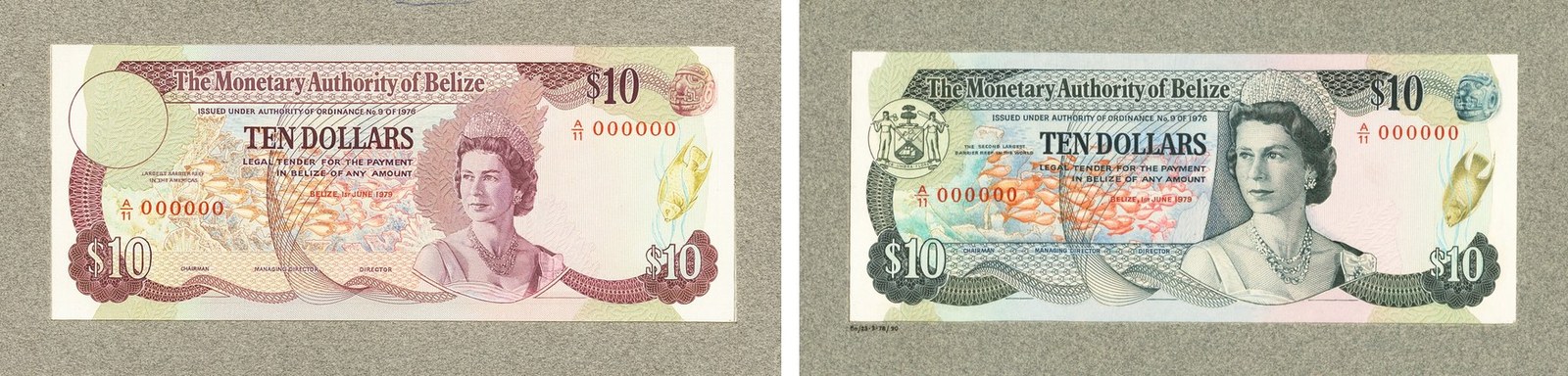
A model is the design as the customer is asked to approve it, and more than one may be sent. Two front models for the 10 dollars of the Monetary Authority of Belize are dated 1st June 1979, a year earlier than any note that reached circulation. One is in the maroon and orange finally adopted. The other is in green and blue, and its legend reads THE SECOND LARGEST BARRIER REEF IN THE WORLD where the issued note reads LARGEST BARRIER REEF IN THE AMERICAS: the wording was turned down along with the colour.
Models are recorded for notes that were issued as designed, too: the 10 shillings and 1 pound of the Bahamas issue of 1953, each a front and a back with the number A/9 000000, and the Bermuda 5 dollars of 20th February 1989, whose mounts carry job references of April and June 1988.
7. Proofs by stages
Once the plates exist, the printing is proofed one plate at a time. The pieces go by several names in the archive: stage proofs, progressive proofs, die proofs of the front and back.

For the Straits Settlements 10 dollars a complete set on five sheets is recorded: a die proof of the front, a die proof of the back and three stages of the underprint. Set beside the photographs of 1929 they show the design after it was settled: the engraved front has the portrait, the title and the value, and nothing else; the half-round panel with its large 10, which the photographs show in grey, turns out to be part of the coloured underprint, printed from other plates.
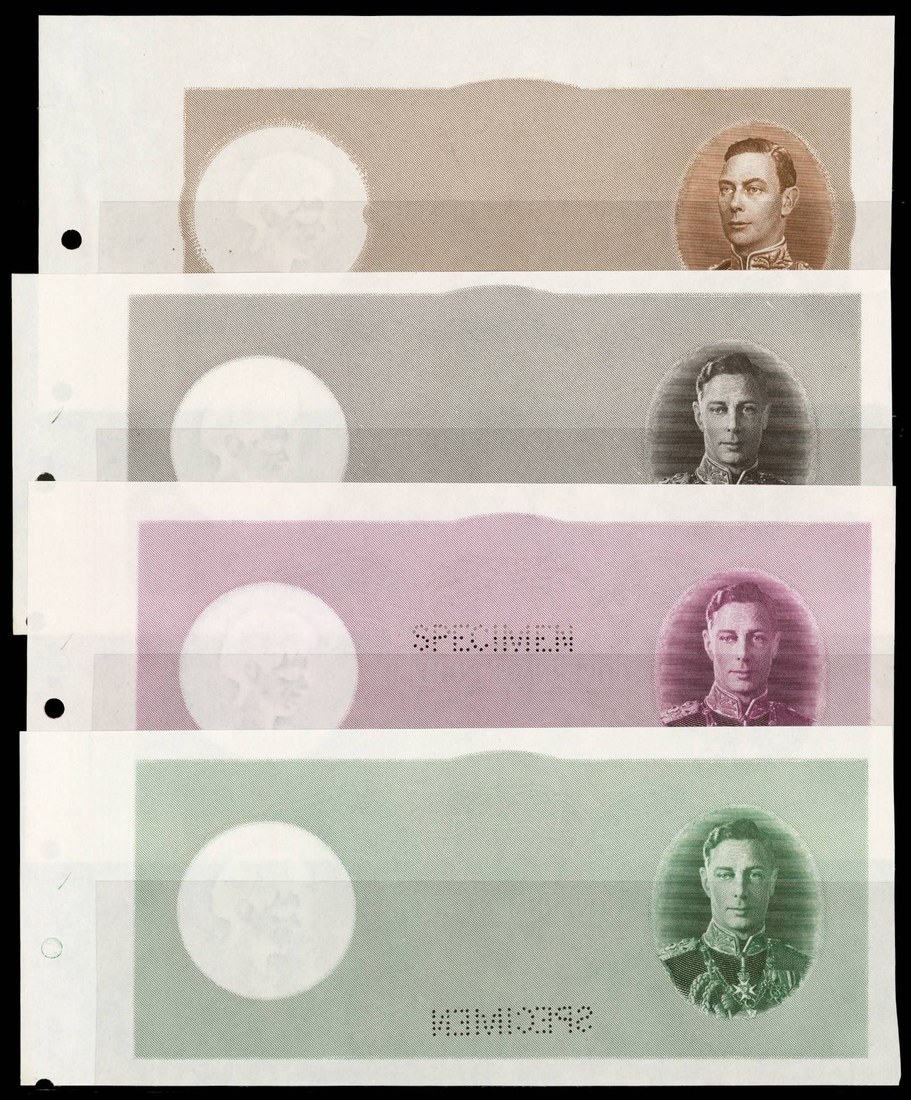
Four stage proofs for the George VI notes of Fiji show only the tint and the portrait in its oval, in brown, black, purple and green, with no value on them. Six progressive proofs for the Barbados 1 dollar of 1938 each print one or two of the underprint plates, and their margins are pencilled with the inks used and the date "Jan 6th 38".
8. The colour trial and the specimen
The archive's line for a colour trial: "The adopted design printed in colours other than the issued ones, so the authority could choose."
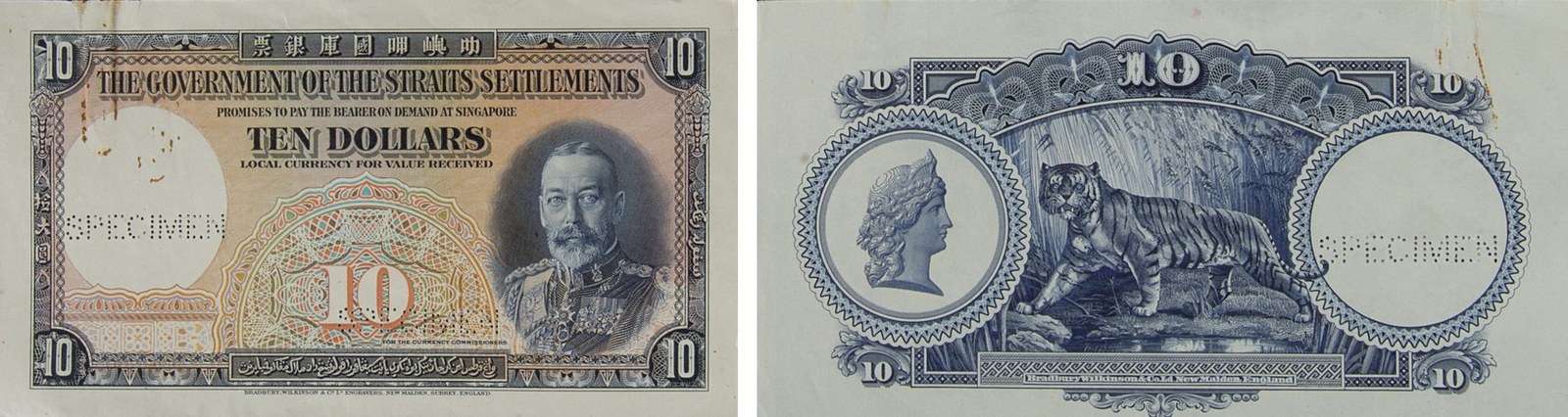
The colour trial of the Straits Settlements 10 dollars is in blue and orange, the front and the back on separate pieces, with no number, date or signature. The note as issued is green and mauve.
The specimen closes the work. It is the note as printed, marked so that it cannot pass. On the 10 dollars the printer's own record specimens are perforated CANCELLED and printed with the first and last number of a run, such as A/21 00001 to A/65 100000; each prefix held 100,000 notes. One auction house says that only two of these were made for each print run, with the order number and date inked in the top margin.
One note from start to finish: the Straits Settlements 10 dollars of 1931
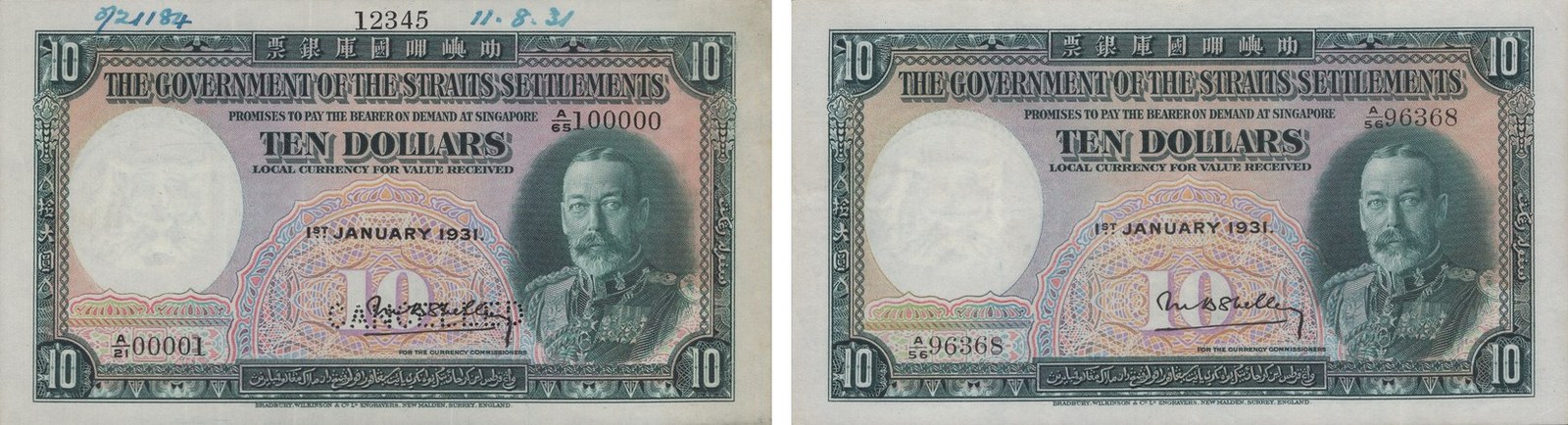
Put in order, the pieces recorded for this one note are:
| Date on the piece | Stage | What it shows |
|---|---|---|
| 12th December 1929 on the design | Photograph | Proposed front, number in both lower corners |
| 12th December 1929 on the design; inked 22.1.30 | Photograph | The same, number at upper right and lower left |
| 12th December 1929 on the design | Photograph | Another arrangement, a large 10 behind DOLLARS |
| Pencilled 12-1-1930 | Composite design sheet | A frame with profile heads and numbered die prints; marked Cancelled |
| 1st January 1930 on the design | Tinted photographs | Another design, front and back; not adopted |
| No date (1930) | Stage proofs | Front die proof, back die proof, three stages of underprint |
| No date | Colour trial | Blue and orange, front and back |
| 1st January 1931 | Record specimens | Perforated CANCELLED, printed with the range of a run |
| 1st January 1931 | The note | Prefixes A/1 to A/65, signed by Shelley |
Three things can be read from the table. The design was not drawn once and approved: between the date on the first photographs, 12th December 1929, and the ink date of 22 January 1930 the files record five different fronts. The paste-up of January 1930 and the tinted pair were both dead ends. And the note that was issued is closest, in what the pictures show, to the photograph inked 22.1.30: the title in one line, the value in words, the half-round panel with its 10 below, the number at upper right and lower left. The date on it had by then moved from 12th December 1929 to 1st January 1931, and the signature from McLean to Shelley.
The same files hold companions for the other two values: photographs of proposed fronts for the 5 dollars, also dated 12th December 1929, one of which the archive calls the embryo of the 5 dollars issued from 1931.
What is not there
No pencil sketch and no painted essay is recorded for the Straits Settlements note, and no engraved portrait on its own. For Gibraltar there is the sketch and the essay and nothing between the essay and the note. That is the usual state of things: the printers kept what they needed and threw away the rest, and what was kept has been sold piece by piece. Few designs in the archive have as many stages on record as this one.
Each country's page has an Archive section where these pieces are listed by kind, with the notes they belong to.


Member comments
Log in or register to post a comment.