From 1952 the printers drew the portrait of Queen Elizabeth II for many notes that were never issued: for banks that never opened, for names that were never used, for contracts that went to another firm, and for countries that chose another face before the note was ready. The design archive of this catalogue records them as hand-painted essays, printer's models and the photographs the printers kept.
This article goes through those designs. Everything in it is taken from the pieces themselves, as they are recorded in the archive and on the pages of the notes: what is printed and pencilled on them, and what was said of them when they were sold. Where that record gives a reason for a design being set aside, the reason is given here; where it gives none, none is guessed. Dates printed on a design are written as "1st March 1952"; days of events as "1 January 1968".
March 1952: a portrait that was not used
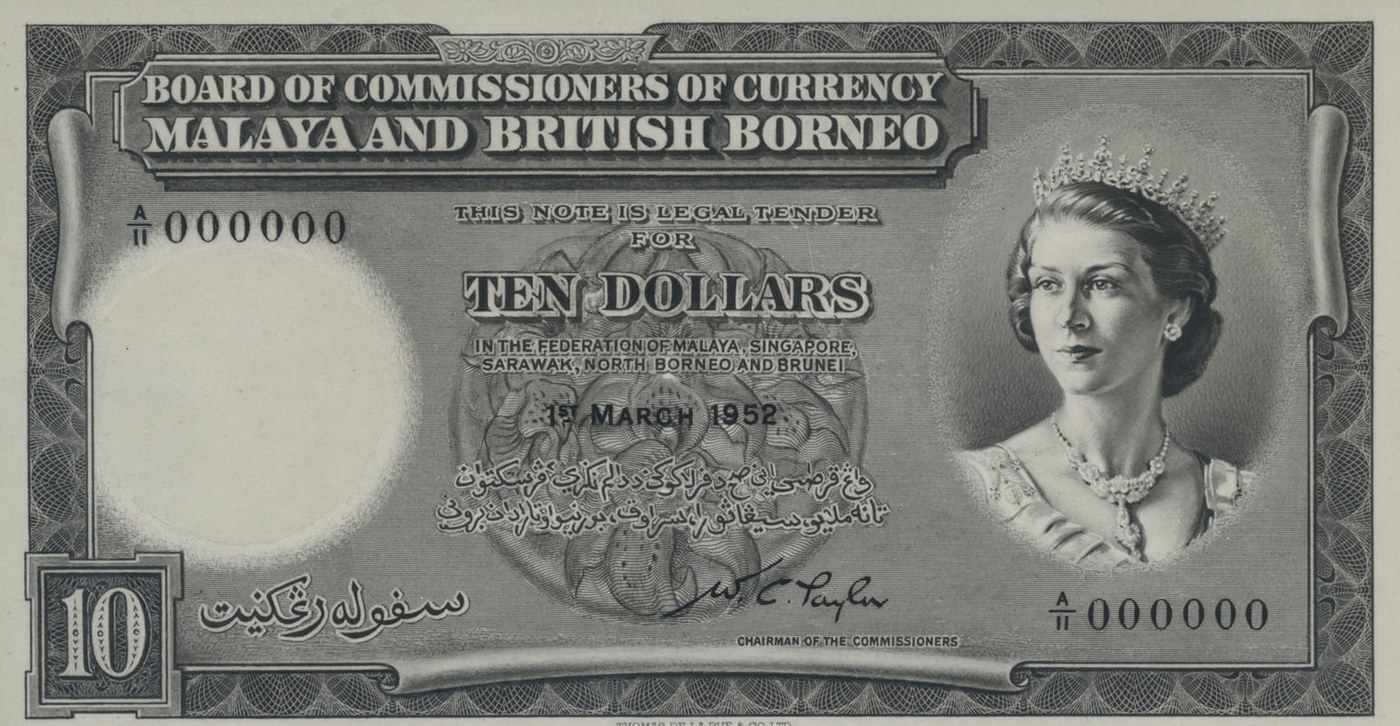
The earliest are for Malaya and British Borneo, and they are dated 1st March 1952, a year before the series that was issued. De La Rue photographed a 10 dollars with a three-quarter portrait of the Queen in a tiara at the right, the number A/11 000000 and Taylor's signature. The portrait was not used. Six examples of the photograph are recorded in the archive, and one of them is stamped on the back "DLR-Studio Photographed 29 APR 1952". The same firm photographed a 100 dollars and a 1,000 dollars of the same date, the second with orchids and a choice of backs.
Bradbury Wilkinson put in designs of its own with the same date: a 10 dollars with the young Queen in the oval portrait the firm used for Jamaica and Cyprus, its back reworked from a design made for George VI, and a 10,000 dollars. The contract went to De La Rue, and the 10,000 dollars that was issued is a different design.
1953 to 1957: the new head is offered round
In the first years of the reign the printers offered the new portrait to one territory after another.
Gold Coast, 1953. Five designs were prepared for the Bank of the Gold Coast, set up that year: a 5 shillings with the Queen in profile, and a 10 shillings, 1 pound, 5 pounds and 100 pounds with the Queen wearing the diadem, each with a palm tree in the centre. They are known only as printer's models numbered 123456. The Gold Coast went on using the notes of the West African Currency Board until the Bank of Ghana's issue of 1958.
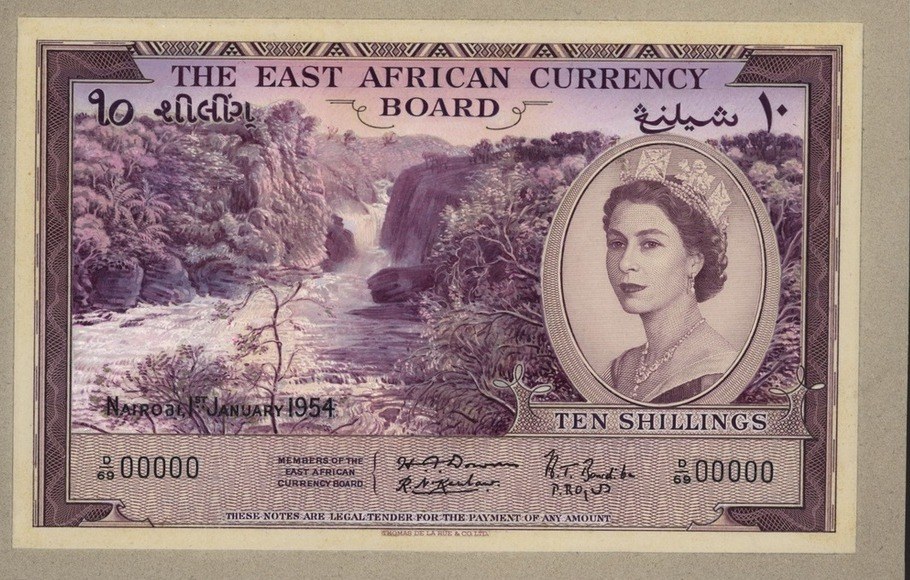
East Africa, 1954. Two models for the front of notes dated Nairobi, 1st January 1954 carry the Queen at the right: a 10 shillings in purple with a waterfall, and a 20 shillings with a landscape of granite rocks. No note of either design was issued.
Hong Kong, 1954. De La Rue photographed a 1 dollar for the Government of Hong Kong with the Queen's portrait; the backs of the photographs are stamped 26 APR 1954. The design was not adopted, and the Government 1 dollar stayed with Bradbury Wilkinson's design.
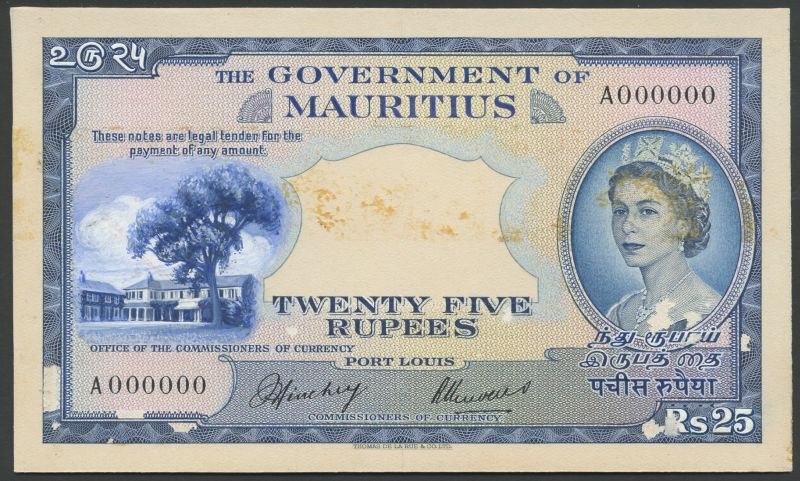
Mauritius, about 1954. A 25 rupees painted on board shows a Government building behind a large tree and the Queen in a portrait quite unlike the one on the issued note. Its imprint is De La Rue's. The 25 rupees that Mauritius issued in 1954 was printed by Bradbury Wilkinson, so this is the proposal that was not taken up.
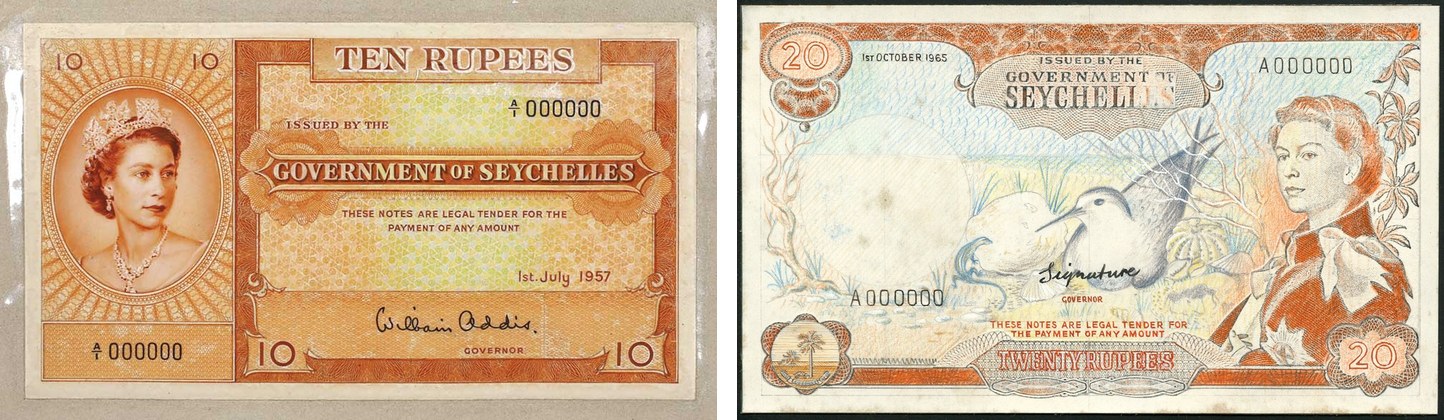
Seychelles, 1957 and 1965. A 10 rupees in orange, dated 1st July 1957 with the printed signature of the Governor, Addis, differs from the 10 rupees that was issued. Eight years later a whole new series was drawn with the date 1st October 1965: a 5 rupees with a parrot, a 20 rupees with a tern on the shore, and a 50 rupees with flying fish. The date was given up; the series came out on 1 January 1968. The parrot was kept. The flying fish never reached a note: the 50 rupees of 1968 carries a schooner.
Banks that never opened, names that were never used
Many of the designs fail on their first line: the name of the issuer.
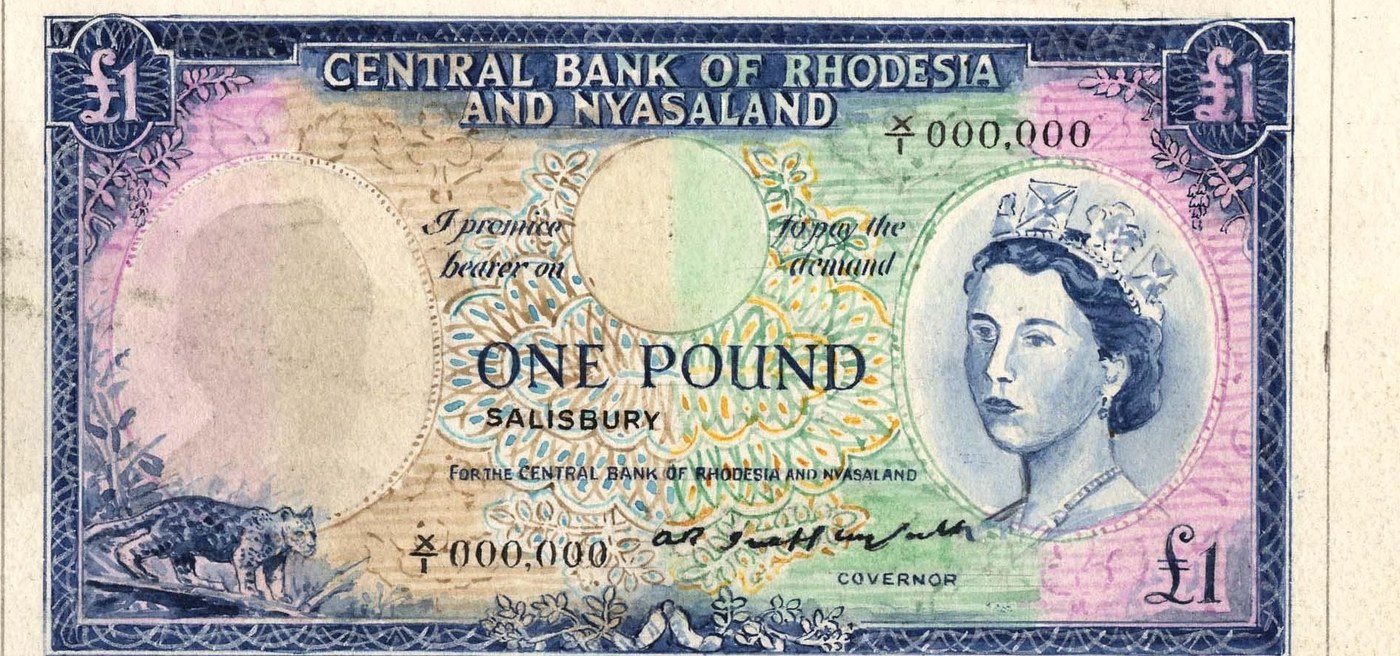
Rhodesia. Three painted essays, a 10 shillings with a fish eagle, a 1 pound with a leopard and a 5 pounds with a sable antelope, are lettered CENTRAL BANK OF RHODESIA AND NYASALAND. They are not dated; the auction house put them at about 1955 to 1956, before the notes that the Bank of Rhodesia and Nyasaland issued under that shorter name. Bradbury Wilkinson then made models dated Salisbury, 23rd February 1963 for a Bank of Southern Rhodesia, and a 10 pounds of the same date for a Bank of Rhodesia. No note was issued under either name. The 10 shillings model carries a portrait of the Queen that the firm never used on an issued note.
The West Indies. In 1957 Bradbury Wilkinson took the British Caribbean Territories 1 dollar and changed the name along the top to THE WEST INDIES, for the federation that was to begin in January 1958. A second board reads THE BRITISH CARIBBEAN FEDERATION. Neither was issued: the Currency Board went on issuing its own notes, and the federation ended in May 1962.
The eastern Caribbean. A 20 dollars dated 3rd January 1963 is headed EAST CARIBBEAN CURRENCY BOARD, a name used before the Currency Authority was named. In 1969 Bradbury Wilkinson photographed a 1 dollar and a 5 dollars for a Central Bank of the East Caribbean, issued "in accordance with the Central Bank Act of the East Caribbean 1969", with a modern bank building beside the Queen. That bank was never set up, and the Currency Authority went on issuing the notes of 1965.
Jamaica. Essays of 1959 and 1960, some with Bradbury Wilkinson's imprint, are headed THE CENTRAL BANK OF JAMAICA, with palm trees at the left and the Queen at the right. The bank opened as the Bank of Jamaica, and its notes of 1961 put the portrait at the left.
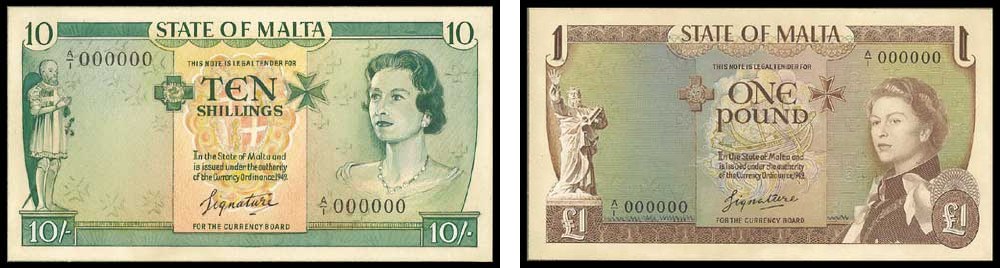
Malta. Two essays dated 16 June 1964, a 10 shillings with a knight in armour and a 1 pound with a statue of St Paul, are headed STATE OF MALTA. That series was never issued.
Fiji. Two 1 dollar essays of about 1974 and 1975 are headed CENTRAL BANK OF FIJI, a title that was debated for the new bank and never adopted; on the earlier one the Queen's face is blocked in but not finished. A 50 cents for the Central Monetary Authority was prepared and never issued, and is known only as specimens (P-70).
The printer that lost
Other designs are complete and correctly named, and simply came second.
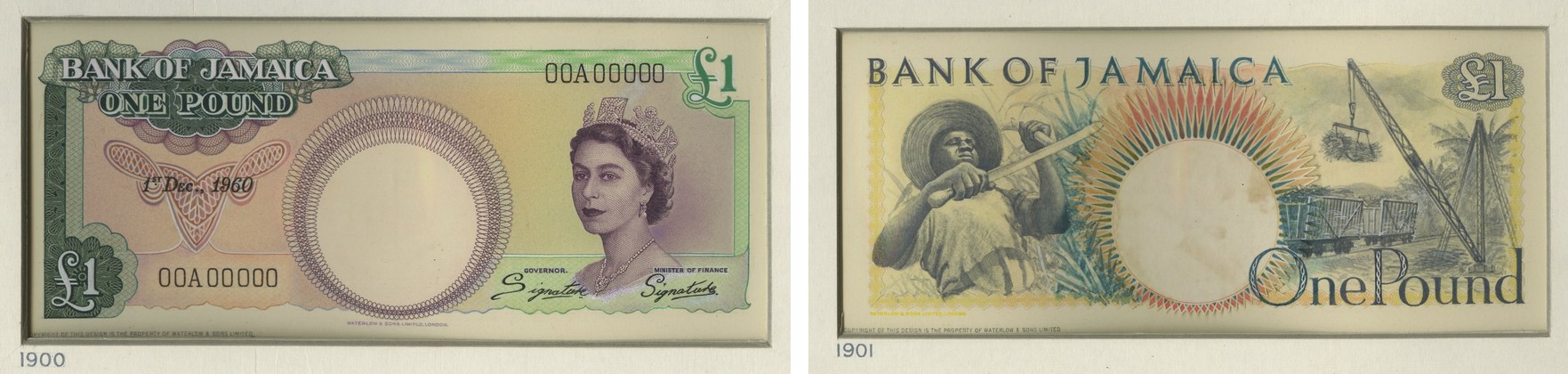
Waterlow & Sons made models of a Bank of Jamaica 1 pound dated 1st Dec. 1960, with the Queen in a diadem at the right, places for two signatures and, on the back, a cane cutter and cane being lifted on to railway wagons. Each carries the line COPYRIGHT OF THIS DESIGN IS THE PROPERTY OF WATERLOW & SONS LIMITED. The bank's first notes were printed by De La Rue, with the portrait at the left and the Governor's signature alone.
For Malta, Bradbury Wilkinson photographed a 5 pounds marked 4.4.60 that was never used, and De La Rue made models of a 1 pound in 1961; the 1 pound issued in 1963 was printed by Bradbury Wilkinson to a different design.
For Bermuda's change to dollars, Bradbury Wilkinson prepared a full set: photographs of a 5, 10, 20 and 50 dollars, pencilled 3.3.69, and models with a cahow in flight, a longtail over Somerset Bridge, a lighthouse and a sailing dinghy. The decimal system came in on 6 February 1970, and the notes issued for it were printed by De La Rue.
Portraits used nowhere else
A few of these designs carry portraits of the Queen that are not found on the issued notes of the territory, or on any note.
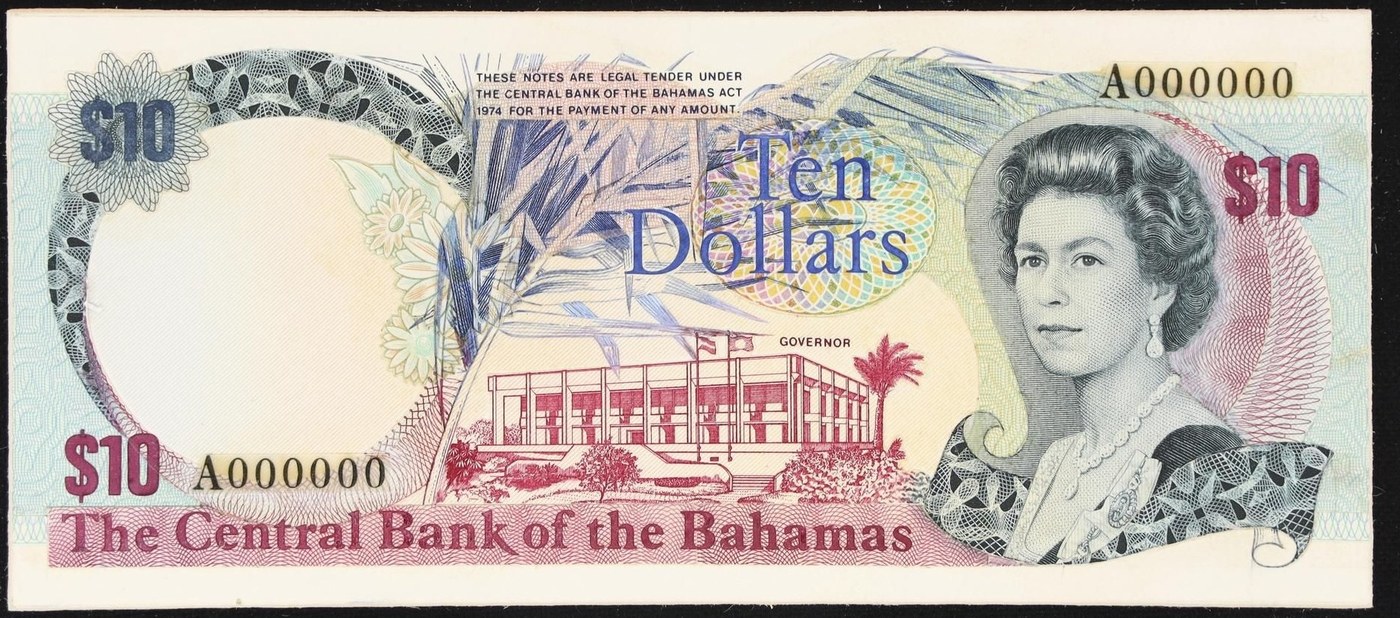
The Bahamas has two sets. The designs drawn for the decimal currency of 1965 show a young Queen in a tiara and necklace, facing left, which the archive's entry calls a portrait that appears on no issued banknote anywhere; one of them is a 100 dollars, a value the Bahamas Government never issued. About 1974 models were made of a 10 dollars, a 20 dollars and a 100 dollars for the Central Bank of The Bahamas, the 100 dollars at Bradbury Wilkinson. The portrait on the 10 dollars, engraved from a photograph taken by Anthony Buckley about 1966, was used on notes of Fiji, the Isle of Man and St Helena, but on no note of the Bahamas.
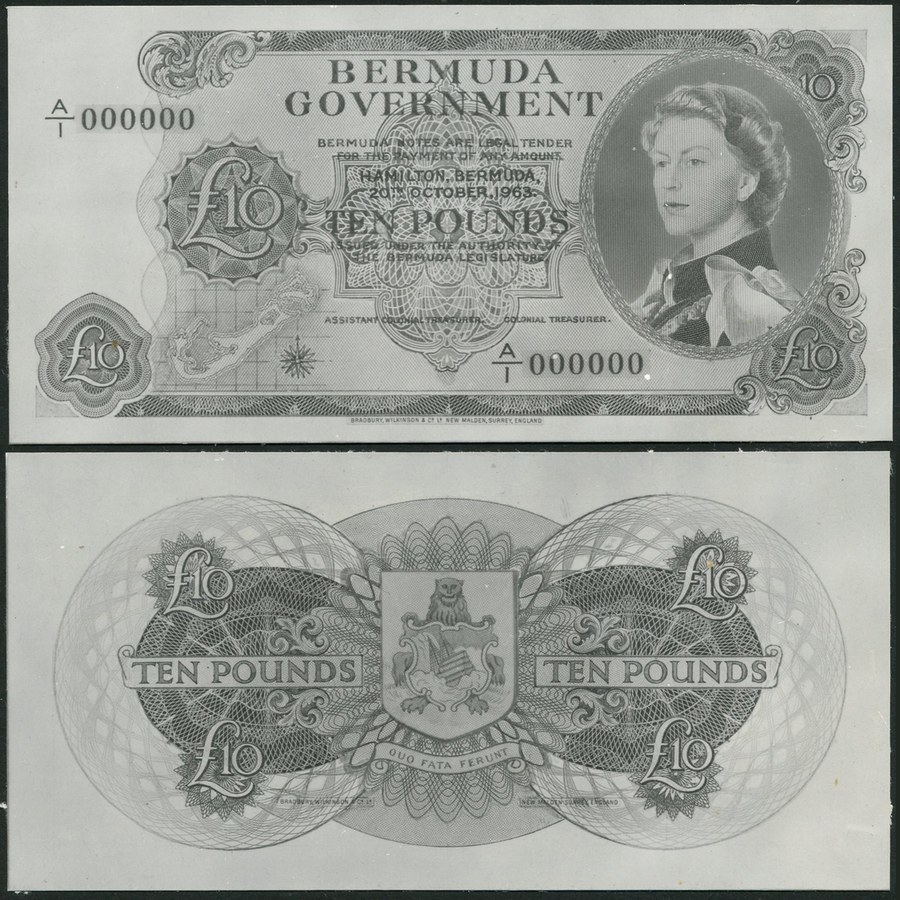
Bermuda's is a 10 pounds dated 20 October 1963 with Pietro Annigoni's portrait of the Queen, which was never used on a Bermuda note. The design is otherwise close to the 10 pounds issued in 1964. And for Fiji, a 10 dollars of 1976 sets the Queen against a large diamond-patterned panel; neither the portrait nor the layout was adopted.
When the Queen gave way
The last group shows the portrait being replaced while the design was still on the drawing board.
Jamaica. Photographs of a 2 dollars and a 10 dollars for the decimal issue, both marked 25.10.67 in ink, have the Queen in a tiara at the right. In March 1968 the same layouts were photographed again with Paul Bogle on the 2 dollars and George William Gordon on the 10 dollars in place of the Queen.
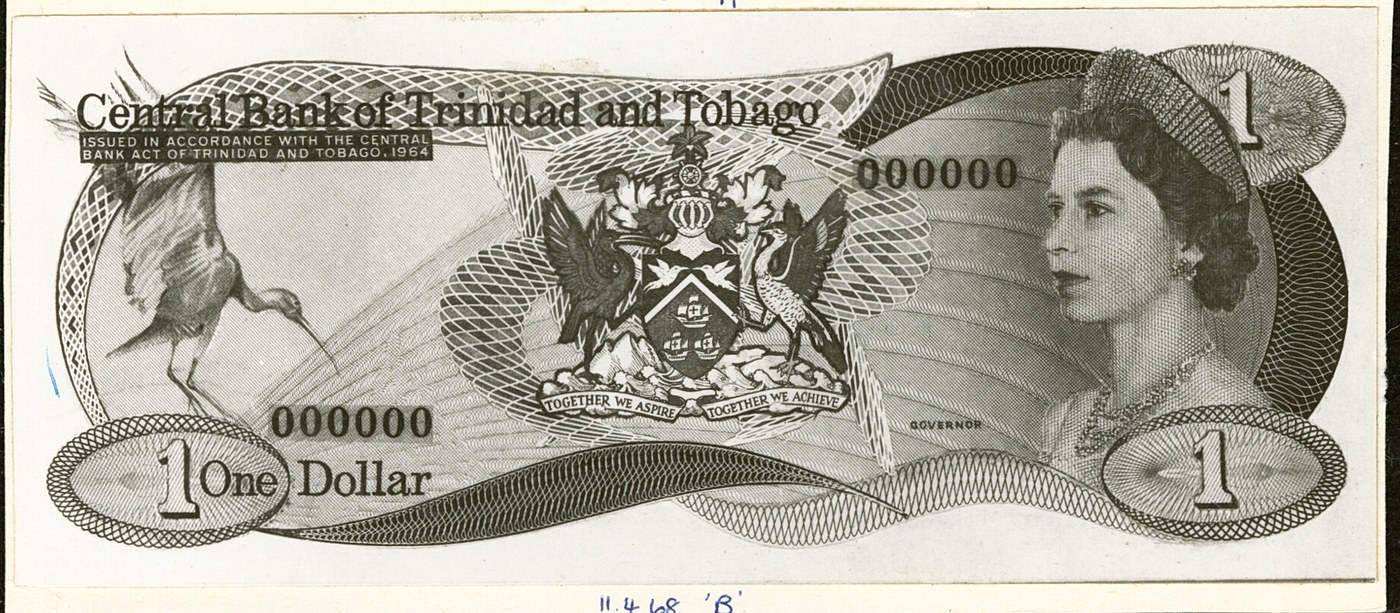
Trinidad and Tobago. Designs pencilled 8 1 63 for the new Central Bank put the Queen at the side; the notes that were issued have the portrait in the centre. A 1 dollar marked 11.4.68 has the Queen at the right, the arms in the centre and a scarlet ibis at the left. A photograph of the same layout marked 14.2.70 has a portrait of a man in dark glasses where the Queen had been, with a slip reading "Different view of portrait submitted". The archive does not name the man. A 100 dollars of the first series, with the Queen in the centre, was prepared and never issued.
Zambia. Harrison and Sons made a 1 pound for a Bank of Zambia in 1963, while the territory was still Northern Rhodesia, which is why the Queen is on it. Nothing on it is real but the design: the place of issue is printed TOWN and the signature reads A. B. Smith. Independence came on 24 October 1964, the notes issued that year carried the arms and wildlife, and no Zambian note ever bore the Queen.
Cyprus and Malaya. A 5 pounds for Cyprus of February 1959 keeps the colonial layout but has a bust of Zeno where the Queen would be. For Malaya and British Borneo, painted designs for a 50 dollars dated 21st March 1953 and a later printer's design for a 1 dollar put Tunku Abdul Rahman in place of the Queen; neither was made.
Others on record
- Sarawak, Brunei and North Borneo: Bradbury Wilkinson's photographs of a 1, 5 and 10 dollars dated 21st March 1958, with the Annigoni portrait, for a Board of Commissioners of Currency under that name.
- Cayman Islands: a 25 dollars of about 1970 for the Currency Board, with a map of the three islands on the back.
- Jersey: hand-drawn essays of about 1960 for a 5 pounds and a 10 shillings of the States of Jersey.
- Gibraltar: essays by Harrison & Sons for a 10, 20 and 50 pounds in the 1980s, and designs for a 5 pounds dated 18th February 1991.
- East Caribbean Central Bank: a 100 dollars of about 1980 with a map of the islands and a block of geometric shapes.
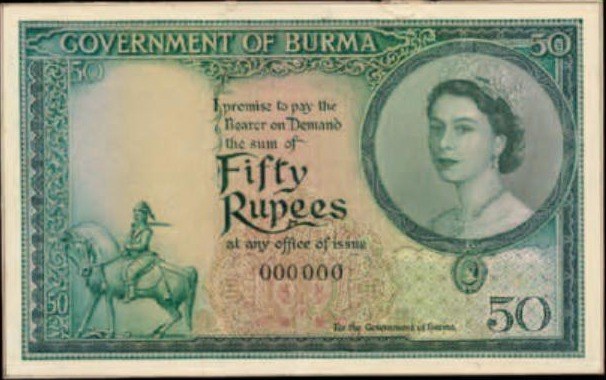
- Burma: an essay for a 50 rupees headed GOVERNMENT OF BURMA with the Queen's portrait. It is known here only from an advertisement for a sale of October 2012, and nothing more is recorded of it.
The reasons, side by side
| Territory | Design | Date on it | What the record says |
|---|---|---|---|
| Malaya and British Borneo | 10 dollars, De La Rue | 1st March 1952 | the portrait was not used |
| Gold Coast | 5 shillings to 100 pounds | 1953 | models only; the Currency Board's notes stayed in use |
| East Africa | 10 and 20 shillings | 1st January 1954 | never issued |
| Mauritius | 25 rupees, De La Rue | about 1954 | the issued note came from another printer |
| Rhodesia and Nyasaland | 10 shillings, 1 and 5 pounds | about 1955 to 1956 | a name the bank did not issue under |
| The West Indies | 1 dollar | 1957 | the federation never had its own notes |
| Jamaica | 1 pound, Waterlow | 1st Dec. 1960 | the order went to De La Rue |
| Southern Rhodesia | 10 shillings to 5 pounds | 23rd February 1963 | a bank that never issued a note |
| Zambia | 1 pound, Harrison | 1963 | a printer's trial; independence came first |
| Malta | 10 shillings and 1 pound | 16 June 1964 | the State of Malta series was never issued |
| Seychelles | 5, 20 and 50 rupees | 1st October 1965 | the date was given up; the flying fish was dropped |
| Jamaica | 2 and 10 dollars | marked 25.10.67 | the Queen replaced by Bogle and Gordon in 1968 |
| East Caribbean | 1 and 5 dollars | 1969 | a central bank that was never set up |
| Bermuda | 5 to 50 dollars | marked 3.3.69 | the issued notes came from another printer |
Each piece named here has its own page in the archive of its territory, or on the page of the note, with every photograph on record.


Member comments
Log in or register to post a comment.