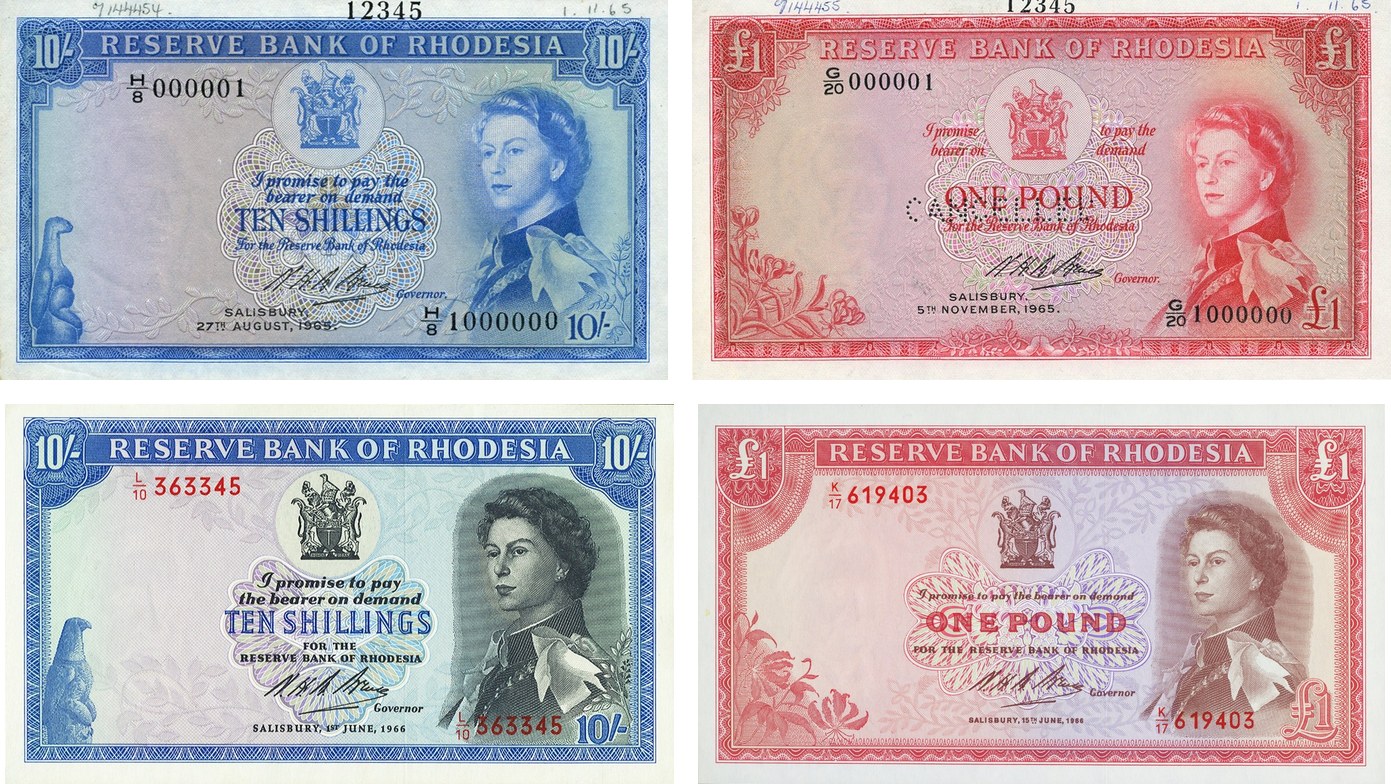
Between October 1965 and November 1967 the Reserve Bank of Rhodesia had its pound notes printed three times, in three cities. The London printing was finished, paid for and burned. The Munich printing was stopped half-way and burned. Only the third, made in Salisbury, reached the public.
Steve Milner told the story from the Bank of England's papers in "A Tale of Three Cities" (I.B.N.S. Journal, vol. 52 no. 2, 2013), and most of what follows rests on his article. This piece adds what the debates at Westminster, the Rhodesia Government Gazette and Tinashe Nyamunda's thesis "Financing Rebellion" (University of the Free State, 2015) say, and then asks the collector's question: what is left of each printing, and how is it told apart?
The three printings at a glance
| London, 1965 | Munich, 1966 | Salisbury, 1967 | |
|---|---|---|---|
| Printer | Bradbury Wilkinson | Giesecke and Devrient | the Reserve Bank's own works |
| Ordered | October 1965 | 7 April 1966, in secret | printed from 1967 |
| Notes ordered | 20 million, face value 20 million pounds | 25 million, face value 29 million pounds | not published |
| Prefixes | H/8 on and G/14 on; the 5 pounds not recorded | L/1 to L/9, K/1 to K/16, J/1 and J/2 | from L/10, K/17 and J/3 |
| What happened | finished in May 1966, export refused, burned in June 1973 | stopped in December 1966, burned in September 1969 | issued from 19 July 1967 |
| Recorded in this catalogue | range specimens only | no piece that is certain | 526 notes on the register |
The counts in this article are those of 23 November 2026.
London, 1965: finished, paid for and burned
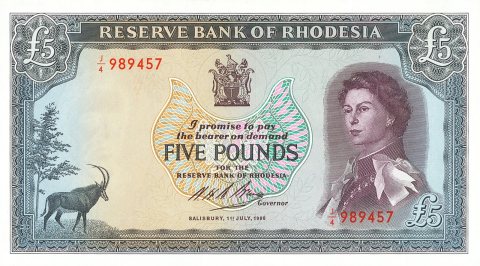
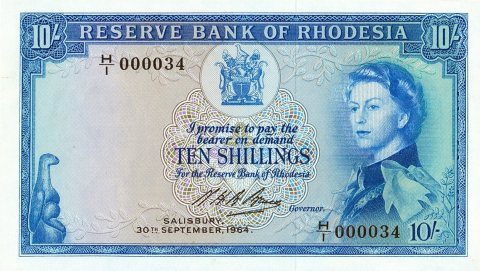
The Reserve Bank's first notes, the 10 shillings, 1 pound and 5 pounds of 1964, came from Bradbury Wilkinson and were issued from 16 November 1964. In October 1965 Salisbury ordered more: 8 million of 10 shillings, 11 million of 1 pound and 1 million of 5 pounds, for delivery in 1966.
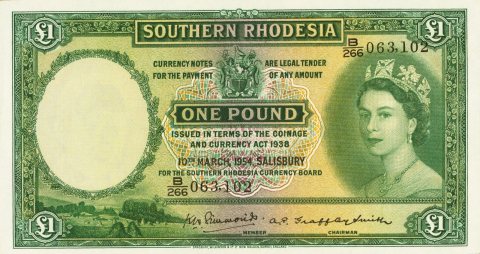
Rhodesia declared independence on 11 November 1965. On 3 December the British government suspended the Bank's board in Salisbury and appointed one in London under Sir Sydney Caine. One of its six members was Sir Gordon Munro, whose signature as Chairman is on the Southern Rhodesia Currency Board notes of 1950 to 1952.
The printer was by then at work, but the notes still lacked the Governor's signature and their dates. Milner sets out what followed. Salisbury asked for dates from 27th August to 3rd December 1965. London would not have Bruce's signature beside the date of the Order that removed him, so the last date was moved back to 1st December, and the printing was completed with signature and dates. A Bank of England memorandum warned that stopping the export would be "an unhappy blot on the history of note production in this country". It was stopped all the same.
The notes were finished in May 1966, boxed, and kept at the printer's works at New Malden. Salisbury refused to pay for notes it could not have, and the London board paid Bradbury Wilkinson's bill of 64,337 pounds 10 shillings out of the Bank's funds frozen in London (in July 1966 by Milner's account, in August by Nyamunda's). In 1967 the 210 boxes went to the Bank of England. They were burned at its Debden printing works between 18 and 26 June 1973.

What is left of it
No issued note of 1965 is recorded, and none should exist. What survives are the printer's range specimens: one note for each prefix, carrying the first number of the run at the upper left and the last at the lower right.
| Value | Prefix | Date on the note | Range specimen |
|---|---|---|---|
| 10 shillings | H/8 | 27th August 1965 | recorded, no perforation |
| 10 shillings | H/9 | not recorded | sold in 2013, not photographed |
| 10 shillings | H/10 | 24th September 1965 | recorded, no perforation |
| 10 shillings | H/11 | 8th October 1965 | recorded, no perforation |
| 10 shillings | H/12 | 22nd October 1965 | recorded, no perforation |
| 10 shillings | H/13 | 5th November 1965 | recorded, two cancellation holes |
| 1 pound | G/14, G/15, G/17 | September and October 1965, day not recorded | sold in 2013, not photographed |
| 1 pound | G/16 | 8th October 1965 | recorded, no perforation |
| 1 pound | G/18 | 22nd October 1965 | recorded, no perforation |
| 1 pound | G/19 | 29th October 1965 | recorded, no perforation |
| 1 pound | G/20 | 5th November 1965 | recorded, perforated CANCELLED |
| 1 pound | G/21 | 12th November 1965 | recorded, perforated CANCELLED |
| 1 pound | G/22 | 19th November 1965 | recorded, perforated CANCELLED |
| 1 pound | G/23 | 26th November 1965 | recorded, perforated CANCELLED |
Three things are worth knowing.
- The order was larger than what is recorded. At a million notes to a prefix, 8 million of 10 shillings would run from H/8 to H/15 and 11 million of 1 pound from G/14 to G/24. The specimens recorded stop at H/13 and G/23, and no 5 pounds of 1965 is recorded at all.
- Some dates are earlier than the order. The order was placed in October 1965, but the dates begin on 27th August. They were chosen afterwards, in December.
- One piece shows the printing as it stood before the dates were settled. A 10 shillings with no serial number, no date and no signature, only the word "Governor" where the signature belongs, was sold with two of the range specimens in 2013. It matches Milner's account of notes printed first without signature or dates. The specimens of H/8 and G/20 and this piece all carry the same ink date, 1.11.65, in the top margin. What that date stands for is not known.
Munich, 1966: ordered in secret, stopped by a court case
On 7 April 1966 Salisbury ordered a new supply from Giesecke and Devrient of Munich without London's knowledge: 8 million of 10 shillings, 15 million of 1 pound and 2 million of 5 pounds. Nyamunda adds that Rhodesia's intelligence service helped with the order.
London learned of it in the middle of December 1966, when a consignment of 10 shillings notes was about to be flown from Frankfurt. The London board had the notes seized. A member told the House of Commons on 18 April 1967 that 28 tons of notes had been stopped. Three German courts in turn declined to uphold the seizure, holding that the government in Salisbury was the one in control there.
So London settled. By the agreement of 6 March 1967 the London board paid the printer DM 3 million, about 275,000 pounds, again out of the Bank's own frozen funds. The notes and the printing materials went into a Munich bank, the Bayerische Hypotheken- und Wechsel-Bank, in the joint names of both sides. They were to be destroyed after two years if nothing else had been agreed, and the printer undertook to print nothing more for Rhodesia for two and a half years unless there was a political settlement.
In September 1969 the plates were destroyed at the printer's works, the unused paper at a Munich power station, and the notes, finished and unfinished, in the incinerator of the Bundesbank at Frankfurt.
When the printing stopped it had reached this point, by the printer's own lists as Milner gives them:
| Value | Printed | Numbers |
|---|---|---|
| 10 shillings | 8,675,000 finished | L/1 000,001 to L/9 675,000 |
| 1 pound | 5,000,000 finished, 7,140,000 more partly printed | K/1 000,001 to K/5 1,000,000 finished; K/6 to K/16 set aside for the rest |
| 5 pounds | not begun | J/1 and J/2 set aside |
That is why the Salisbury notes begin at L/10, K/17 and J/3.
What is left of it
Milner records that 100 specimens of the German 10 shillings were sent to Salisbury on 29 November 1966, and that none is known to have reached collectors. None is recorded in this catalogue either.
Two pieces deserve a second look. Both were sold by Noonans on 24 June 2003, both are printed on one side only on plain paper, and both are in the design of the notes later issued from Salisbury.
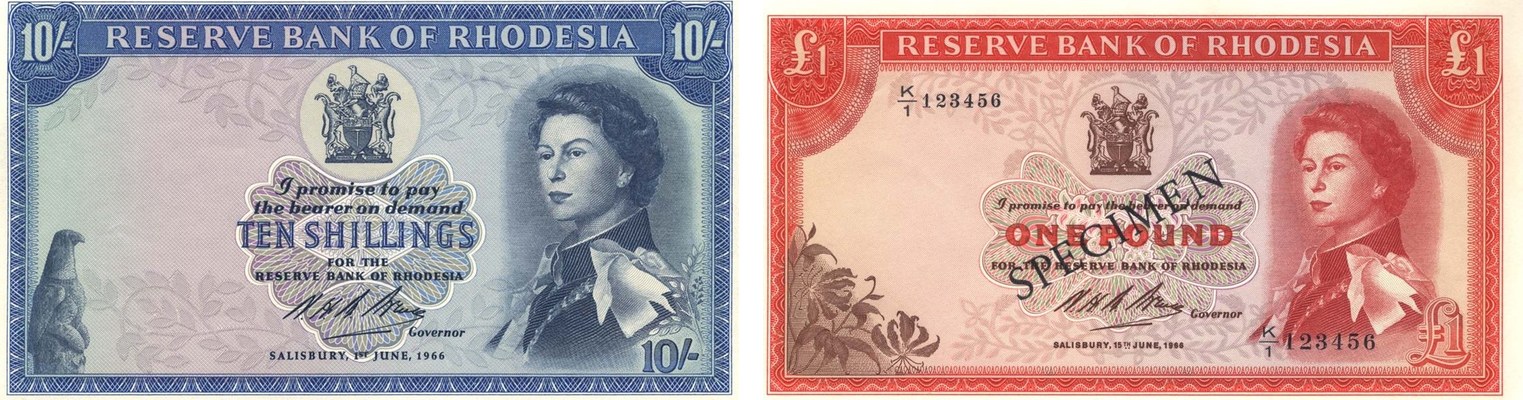
- The 1 pound is dated 15th June 1966 and numbered K/1 123456 in black, small at the upper left and full size at the lower right, with a SPECIMEN overprint. The portrait is in the red of the 1964 note, not the dark portrait of the issued note. K/1 is a prefix of the Munich printing: the Salisbury notes begin at K/17.
- The 10 shillings is dated 1st June 1966 and has no number. Its portrait is blue, where the issued note has a dark one.
The auction house named no printer for either piece, and this catalogue lists them with the Salisbury notes. Whether either was made in Munich is not settled. One more observation points the same way without proving it: the first dates on the Salisbury notes, 1st June, 15th June and 1st July 1966, fall within three months of the Munich order and more than a year before any Salisbury note was issued.
Salisbury, 1967: the notes that were issued
With no printer abroad, the Reserve Bank set up its own works. Two accounts of how the press arrived are in print. Klaus Bender (Moneymakers, 2006, quoted by Milner) says the head of Giesecke and Devrient sold two old presses through a South African company, and that they were shipped to South Africa and taken north. Ken Flower, the head of Rhodesia's intelligence service, wrote in Serving Secretly (1987, quoted by Nyamunda) that West Germans arranged for a press to be flown in aboard a disguised Rhodesian Air Force aircraft. By 9 May 1967 Bradbury Wilkinson had heard of it and told the Bank of England.
The Governor, N. H. B. Bruce, announced each value as it came out:
| Value | First issued | First date on the note | First prefix |
|---|---|---|---|
| 1 pound | 19 July 1967 | 15th June 1966 | K/17 |
| 10 shillings | 11 September 1967 | 1st June 1966 | L/10 |
| 5 pounds | 10 November 1967 | 1st July 1966 | J/3 |

The old and new notes were left to circulate side by side. London's Governor, Caine, drafted a notice that any such issue would be invalid. In Rhodesia the notes were money all the same. They stayed in use until the change to the dollar on 17 February 1970, and no notice calling them in has been found in the Gazette up to 1973.
The Bank of England and Bradbury Wilkinson both examined the new 1 pound in 1967. Their findings, as Milner reports them: printed throughout by offset, with none of the raised intaglio printing of the London notes; the red numbers added in a separate working; good paper from the Italian mill Miliani, with a watermark of Cecil Rhodes and a security thread.
Telling a London note from a Salisbury note
The two issues share their designs, so the three values are easily confused. Four points settle it.
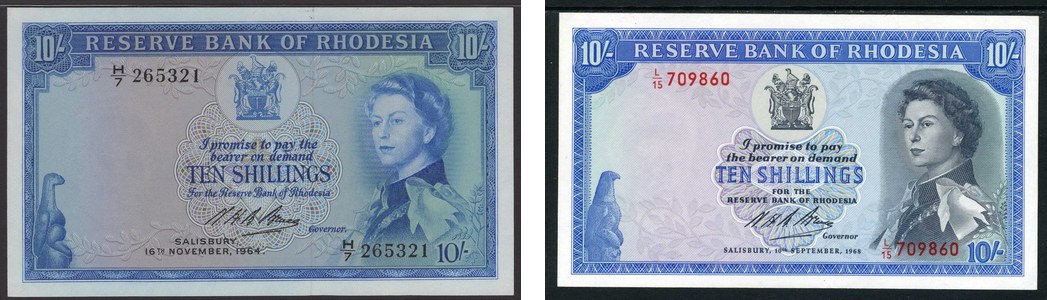
- The numbers. Black on the London notes, red on the Salisbury notes.
- The portrait. In the colour of the note on the London printing; darker, and redrawn, on the Salisbury printing.
- The date. On two lines on the London notes; on one small line on the Salisbury notes.
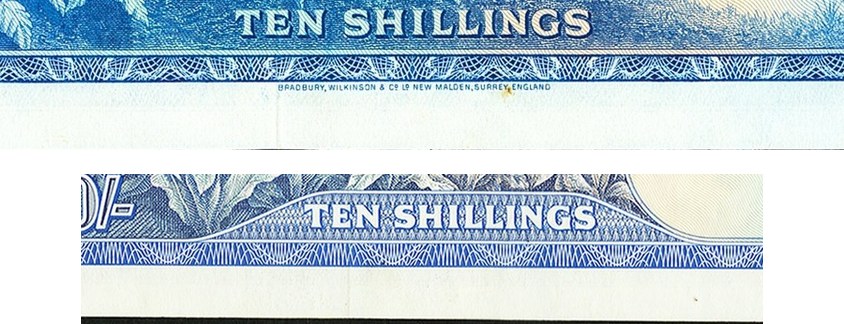
- The back. The London notes carry the imprint BRADBURY, WILKINSON & Co Ld NEW MALDEN, SURREY, ENGLAND in the lower margin. The Salisbury notes have no imprint at all.
What a collector can find today
- The 1964 notes from London are the common ones: 734 issued notes are on this catalogue's register across the three values.
- The 1965 printing exists only as range specimens and the unsigned 10 shillings: twelve prefixes are photographed, and four more were sold without a photograph. A note of 1965 offered as "issued" would need a very good explanation.
- The Munich printing has no piece that is certain. A 10 shillings or 1 pound in the Salisbury design with a prefix from L/1 to L/9 or K/1 to K/16 would be the first.
- The Salisbury notes are well recorded: 526 notes on the register, from L/10, K/17 and J/3 upwards.
Sources
- Steve Milner, "A Tale of Three Cities: the Story of Rhodesian Banknotes from 1965 to 1967", I.B.N.S. Journal, vol. 52 no. 2 (2013), pp. 41-45: the Bank of England's papers on all three printings.
- Tinashe Nyamunda, "Financing Rebellion: The Rhodesian State, Financial Policy and Exchange Control, 1962-1979", doctoral thesis, University of the Free State, 2015: the London board, the payments, the settlement.
- House of Commons debates of 14 December 1965 and 18 April 1967: the London board and the German settlement.
- Rhodesia Government Gazette, 1964 to 1970: the Reserve Bank of Rhodesia Act, the first issue of 16 November 1964, decimal day.
- The sale records and photographs of this catalogue for the pieces shown.
Member comments
Log in or register to post a comment.