Ruth Walden Hill was born in Texas in 1898 and died in St. Louis in January 1995, aged 96. She came to paper money in the 1950s, after the death of her husband Adolph, whose work had brought him into contact with the Banco de México, and she went on to collect the notes of every country except the United States. Collectors called her the "Grand Old Lady of Paper Money Collecting in North America". She served the Society of Paper Money Collectors and the International Bank Note Society, was a fellow of the American Numismatic Society, and is credited with keeping the young I.B.N.S. alive when it ran out of money in 1966. In 2010 the Society made her an Honorary Life Member and an Honorary Director for Life and placed her in its Hall of Fame.
Nineteen years after her death, Heritage Auctions sold her world notes in a series of sales through 2014, beginning at the Central States convention in April, with the last large part at Long Beach in September. Many of the lots were groups of notes sold together, with no serial numbers given.
What is less well known is that she wrote the whole collection down herself.
The inventory
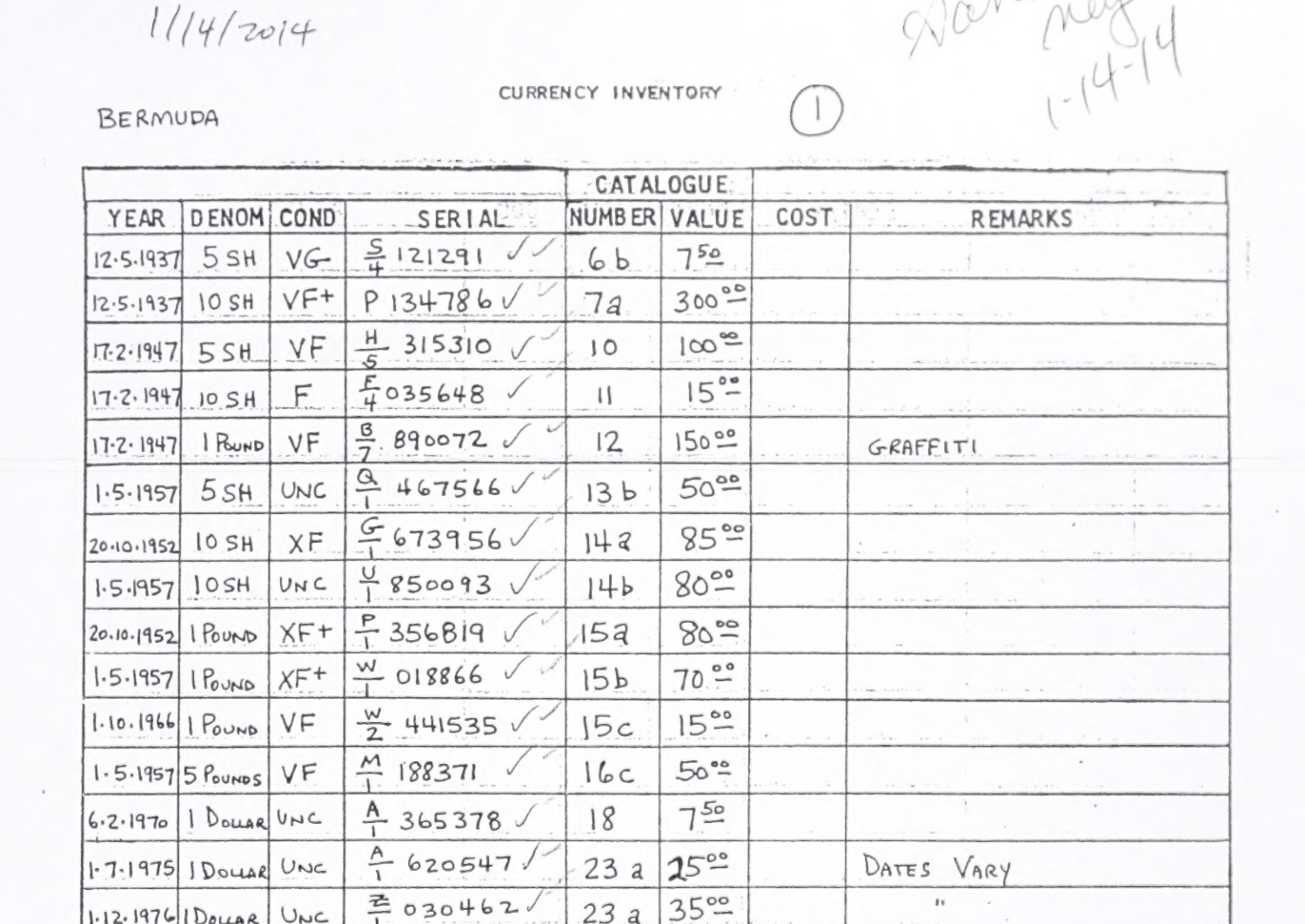
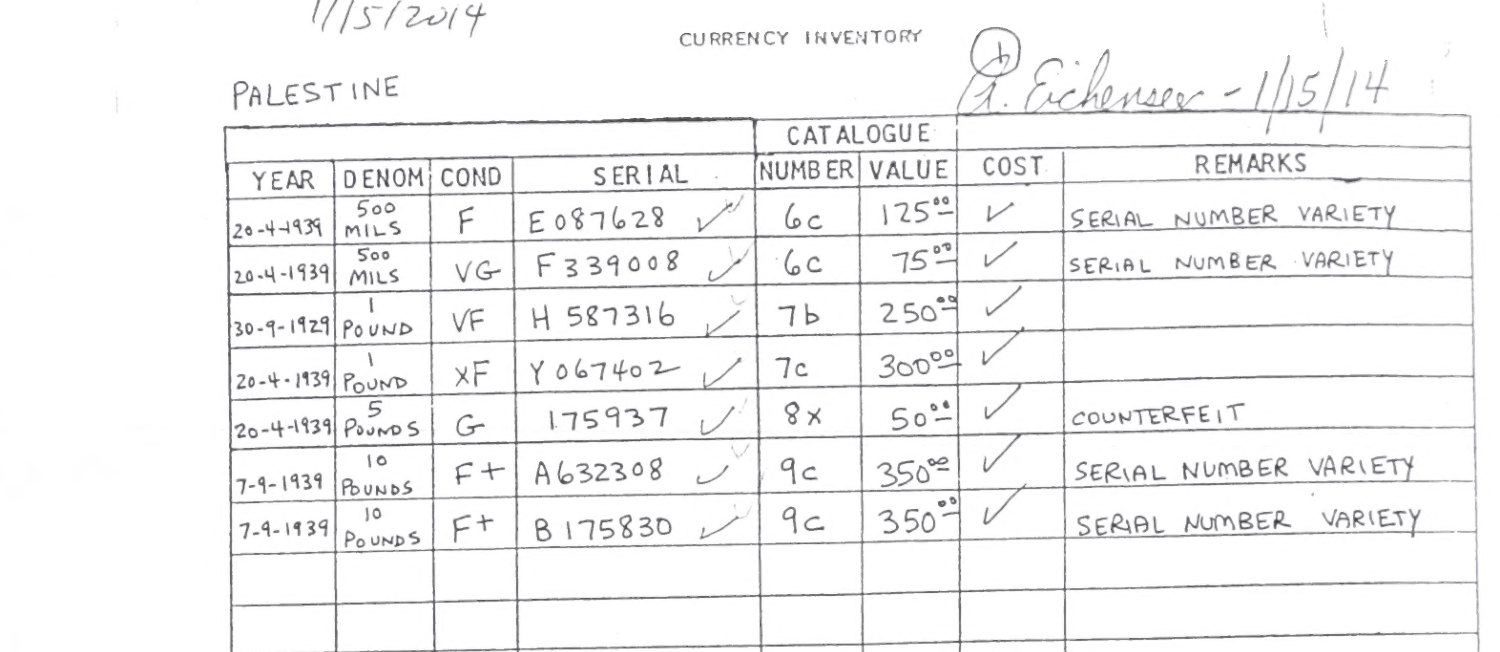
Her inventory survives as 42 scanned volumes on the Newman Numismatic Portal: 1,220 pages of a printed form headed "Currency Inventory", filled in by hand, country by country from Afghanistan to Zimbabwe. China alone takes four volumes and the Philippines two, and there are sheets for prisoner-of-war camp money, German notgeld, guerrilla notes and military issues.
Each line is one note. She gives the date on it, its value, her grade, its serial number with the prefix, her catalogue number and the value the catalogue of her day put on it. A last column holds her remarks: a signature or date variety, a replacement, a counterfeit, an overprint, or simply "stains". She did not write down what she paid or where a note came from, so the inventory proves that she owned a note and nothing about how it reached her.
The latest notes in it are dated 1994, the year before she died, so it shows the collection as it stood at the end of her life. Every sheet we read is also signed and dated 14 or 15 January 2014, when the sheets were checked before the sale: nineteen years, almost to the day, after her death.
Testing it against the notes
We read every sheet that covers the countries of this catalogue: 75 pages and 1,523 lines, for the Bahamas, Bermuda, British Honduras and Belize, British India, Burma, Ceylon, Cyprus, East Africa, the East Caribbean, the Falkland Islands, Fiji, Gibraltar, Guernsey, Hong Kong, Jamaica, Jersey, Malaya, Malta, Mauritius, Palestine, Rhodesia, the Straits Settlements, Trinidad and Tobago and a dozen more. Each serial was then compared with the register.
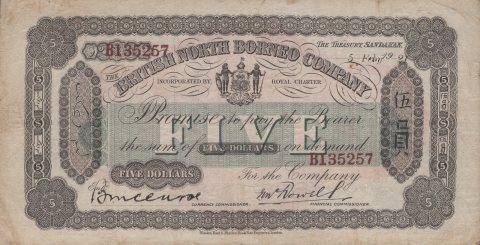
An owner's own list can rarely be tested. This one can, because so many of her notes were photographed when they were sold. Our sales records already credited 523 notes of these countries to her collection. 511 of them are in her ledger. Most of the rest belong to Malaya and British Borneo, which has no sheet in the scans. Either that sheet did not reach the scanned set, or she had not yet entered those notes in her inventory.
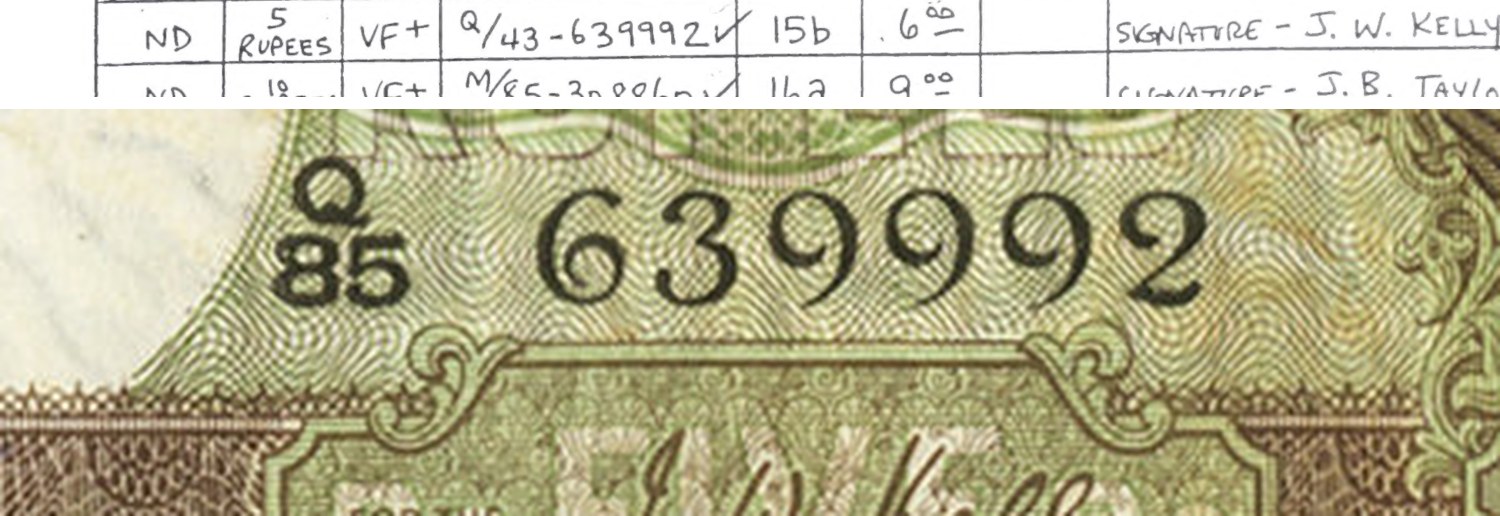
The test also shows how far a handwritten number can be trusted. On five notes she slipped by one character: a prefix written Q/43 for Q/85, E/7 for F/7, G/5 for G/6, and a digit wrong in two Ceylon numbers. In each case the photograph of the note settles it. That is about one line in a hundred.
What the ledger gives back
Her name on notes sold without it. 63 notes that came to auction with no owner named, some of them several times since 2014, are in her ledger. They now carry her provenance in the sales history.
Notes recorded for the first time. 156 notes of hers that our records had no number for, most of them sold in group lots that listed none, are now in the register, each tied to its line in the ledger. They include a booklet of twenty-four British India one rupee notes of 1917. It was sold in 2014 with no number recorded; her line gives them all, Y/58 922651 to 922674.

A digit nobody else could read. A Bermuda 20 dollars Collector Series replacement of 1984 was cancelled by two punch holes that pass through the fourth digit of both serial numbers. It is registered as Z/1 02x715. Her ledger gives the number in full.
A first record for every note. Each note in the register that stands in her inventory, 734 in all, now carries a record of its own line, with a picture of the line. We date those records 1994, the year of the latest notes she entered, so the register shows a note as hers before it ever came to auction. It is a record of ownership, not a sale, and it is not counted as one.
Everything in the inventory that falls within this catalogue as it stands today, and that could be placed on a note with certainty, has been added. The sheets for countries we do not cover yet were left unread; they are there for whoever works on them next.
One line we could not read
The last line of her second Fiji sheet is cut in half by the edge of the scan. Only the tops of the figures show. They fit a 2 dollars note that was later sold in a lot of six, and the other five notes of that lot are the five lines above it on her sheet. We have recorded it as the most likely reading, and the record says so.

If you hold a complete copy of that sheet, or a sheet of hers that is not in the scanned set, please tell us. And if you own a note with a Ruth W. Hill pedigree, its line in her own hand is probably in these volumes.
Pictures from the inventory are published here for research purposes.
Sources for her life: Coin World, Numismatic News and her Wikipedia entry.


Member comments
Log in or register to post a comment.