Most designs that were never issued are another way of drawing a note that did exist: a different portrait, a different back, a printer who lost the order. A smaller group is stranger. These are designs for a value the territory never had as a note at all: 7 rupees 50 cents in East Africa, 1 rupee 8 annas in India, sixpence in Fiji.
This article goes through them. The test is the catalogue's own list of notes for each territory: a value counts only if no note of that value is listed there as issued, in any design, in the years the catalogue covers. A second and shorter part, at the end, gives the values that were issued at another time but were dropped from the series a design was made for. Everything comes from the pieces as the design archive records them and from the catalogue's pages. Where the record gives a reason, the reason is given; where it gives none, none is guessed. Dates printed on a design are written as "1st December 1919"; days of events as "7 April 1920".
East Africa, 1919: 7 rupees 50 cents and 15 rupees
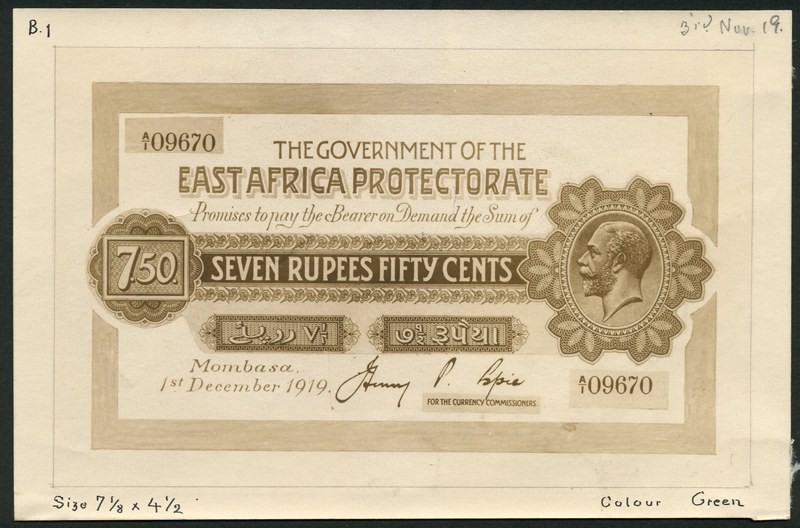
The oddest values in the archive are on ten bromide photographs made by Thomas de la Rue for the Government of the East Africa Protectorate. They record three notes: a 1 rupee, a 7 rupees 50 cents and a 15 rupees. Each is dated 1st December 1919 in the design and 3rd November 1919 by hand in the margin, and each photograph is marked with the size the note was to be and the colour of the layer it shows. The number on all of them is A/1 09670, which De La Rue used as a house specimen number, and the signature is Espie's, for the Currency Commissioners.
The Protectorate's own notes began at 5 rupees. Of the three values in the photographs only the 1 rupee came out, and not under the Protectorate's name: it was issued with the date 7th April 1920 by the East African Currency Board (P-7), whose stage proof carries the same number A/1 09670. Even that note had one printing only. The florin replaced the rupee in 1920 and, as the catalogue's page puts it, the change stopped any further printing.
No 7 rupees 50 cents and no 15 rupees is listed among the notes of East Africa, in rupees, florins or shillings. The photographs give no reason for the two values, and the archive offers none.
British India: 1 rupee 8 annas
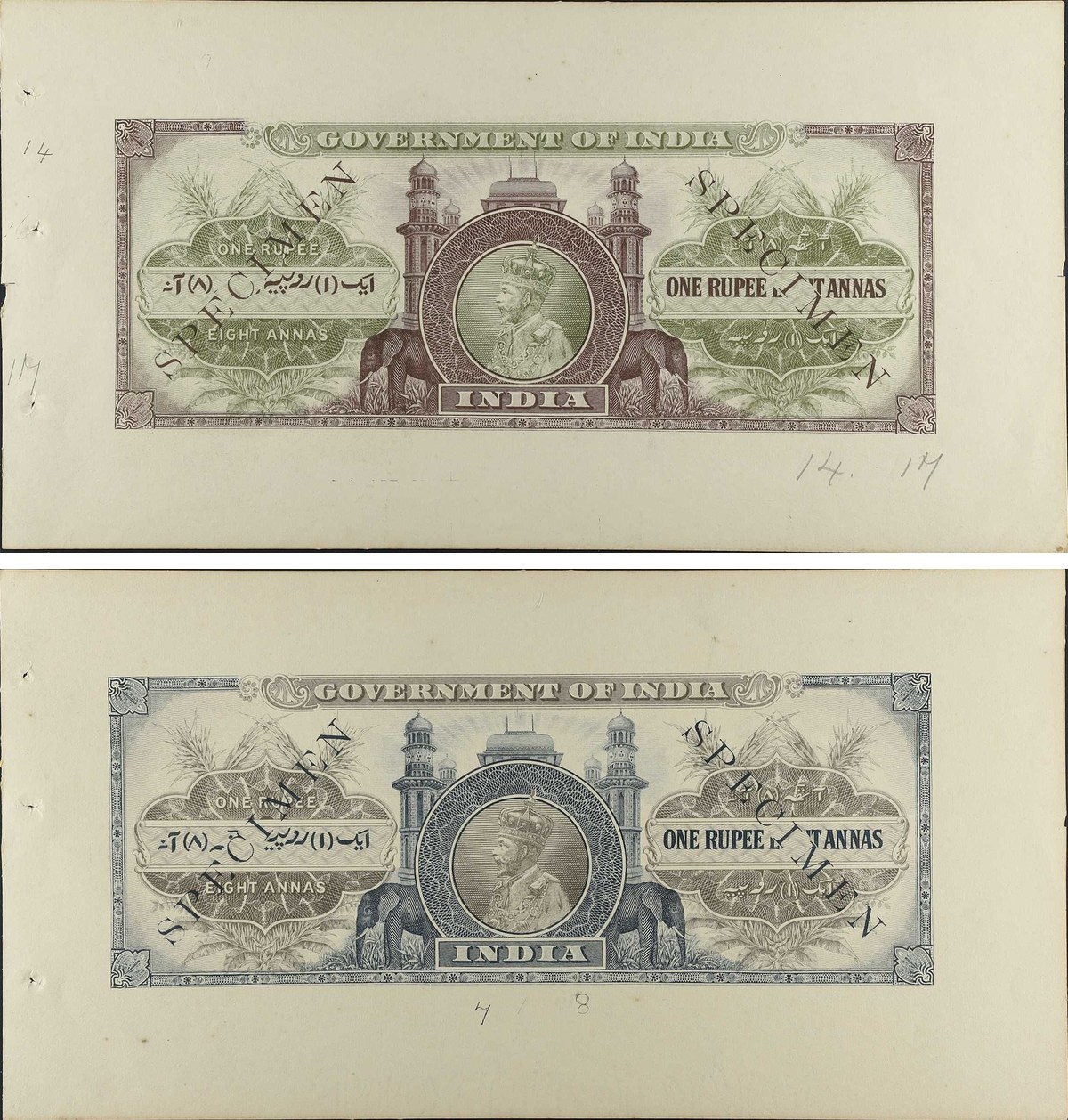
India had a 1 rupee note from 1917 and, from January 1918, a 2 rupees 8 annas. It never had the value between them. The design for one exists in more than twenty pieces: a uniface essay with a crowned portrait of George V in a roundel between two elephants, a domed building with minarets behind, GOVERNMENT OF INDIA above, INDIA below and ONE RUPEE EIGHT ANNAS in English and Urdu in the side panels.
The essays are the same design printed in different pairs of colours, most of them overprinted SPECIMEN twice and numbered in pencil in the margins: green and brown, blue and brown, slate blue with a red-brown frame, and so on through orange, olive, black and purple. Five of them were sold in 2011 as essays from an original booklet, and two of those are recorded with three spindle holes at the left. One in blue and black has the roundel empty, with no portrait in it.
None is dated. The grading labels put them at about 1917 to 1935, and one grading company names the Security Printing Press at Nasik as the printer of a piece. The record goes no further than that: it does not say who asked for a 1 rupee 8 annas, or when the idea was given up. What the catalogue does record is how the nearest value fared. The 2 rupees 8 annas had, in the words of the Currency Department's report for 1920-21, a very limited circulation and had never been popular, and its issue was stopped in 1921-22.
Nigeria: 2 shillings in 1958, and 10 and 50 pounds in 1909
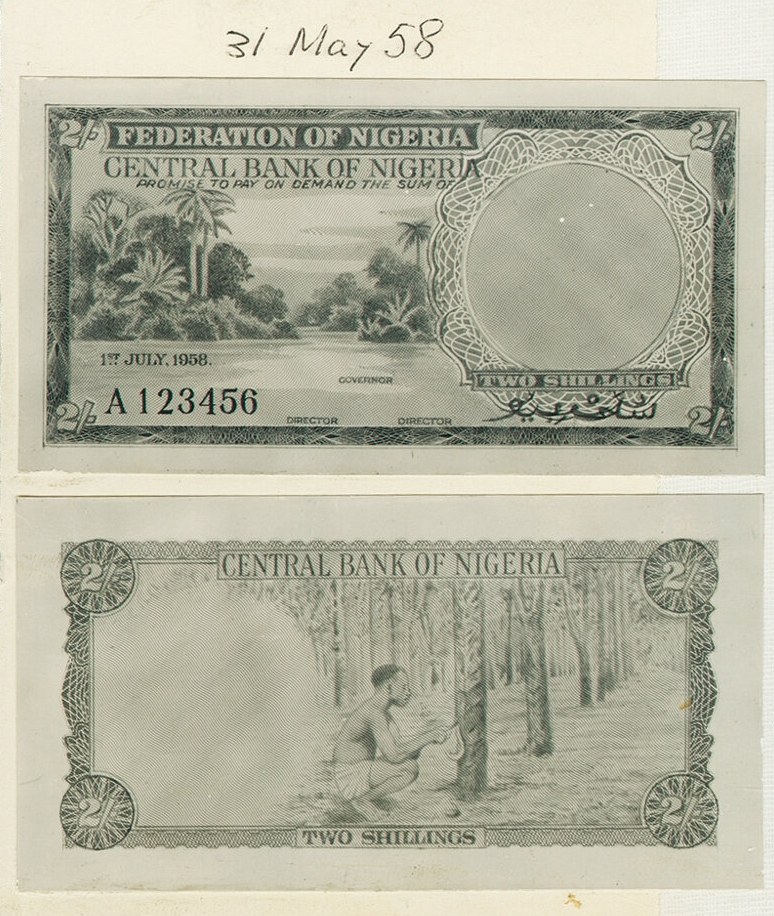
The first notes of the Central Bank of Nigeria, dated 15th September 1958, began at 5 shillings. A pair of photographs on one card shows that a smaller note was drawn: a 2 shillings headed FEDERATION OF NIGERIA and CENTRAL BANK OF NIGERIA, dated 1st July 1958, with a river fringed by palms on the face, the number A 123456, the titles of the signers without signatures, and a rubber tapper on the back. The card is marked 31 May 58 at the top. No 2 shillings note is listed for Nigeria.
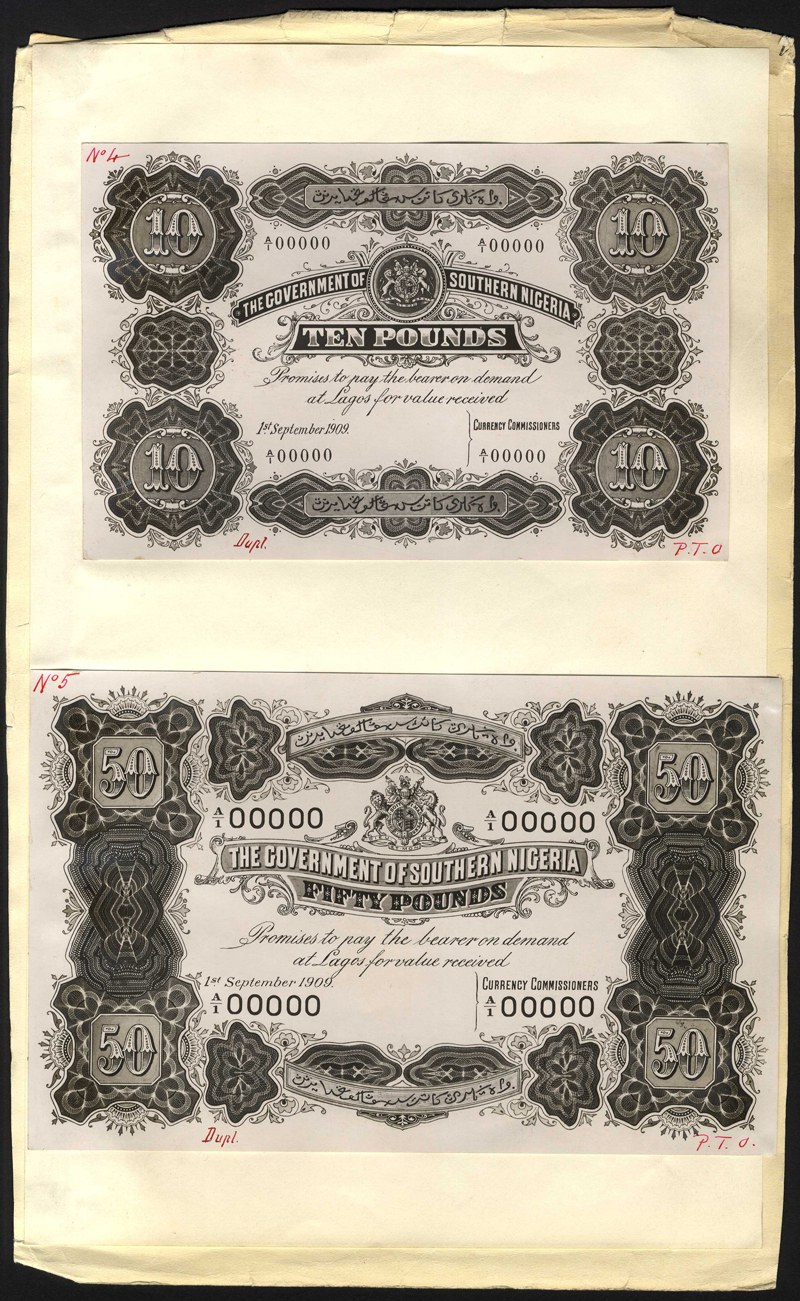
Fifty years earlier a whole issue had stopped at the same stage. In 1909 De La Rue sent designs for notes of The Government of Southern Nigeria to the Governor, Sir Walter Egerton, with a letter of 22 April 1909 explaining them. The bromides of the 10 pounds and the 50 pounds, numbered 4 and 5 in red ink, are dated 1st September 1909 and promise to pay the bearer at Lagos; the lot they were sold in also held fronts of a 10 shillings, 1 pound and 5 pounds and seven backs with a hippopotamus at the centre. The issue was never adopted, and no notes were issued for Southern Nigeria. The 10 and 50 pounds went with it: the highest note listed for Nigeria in the years this catalogue covers is 5 pounds.
Fiji, 1942: sixpence
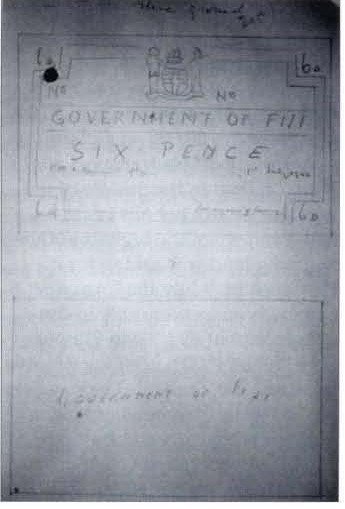
In 1942 coin ran short in Fiji, where many Commonwealth and American troops were stationed, and the Government issued notes of 1 penny, 1 shilling and 2 shillings to fill the gap. A sixpence to match the penny was designed too. What is left of it is a rough pencil design, drawn by Robertson, whose signature is on the penny, for the engraver of the Commonwealth Bank of Australia, which printed the penny. Here the record does give the reason: the sixpence note was designed but never printed, once Australian sixpences had been obtained. The sheet is placed in the archives of the Reserve Bank of Fiji.
Mauritius, 1932: 20 rupees
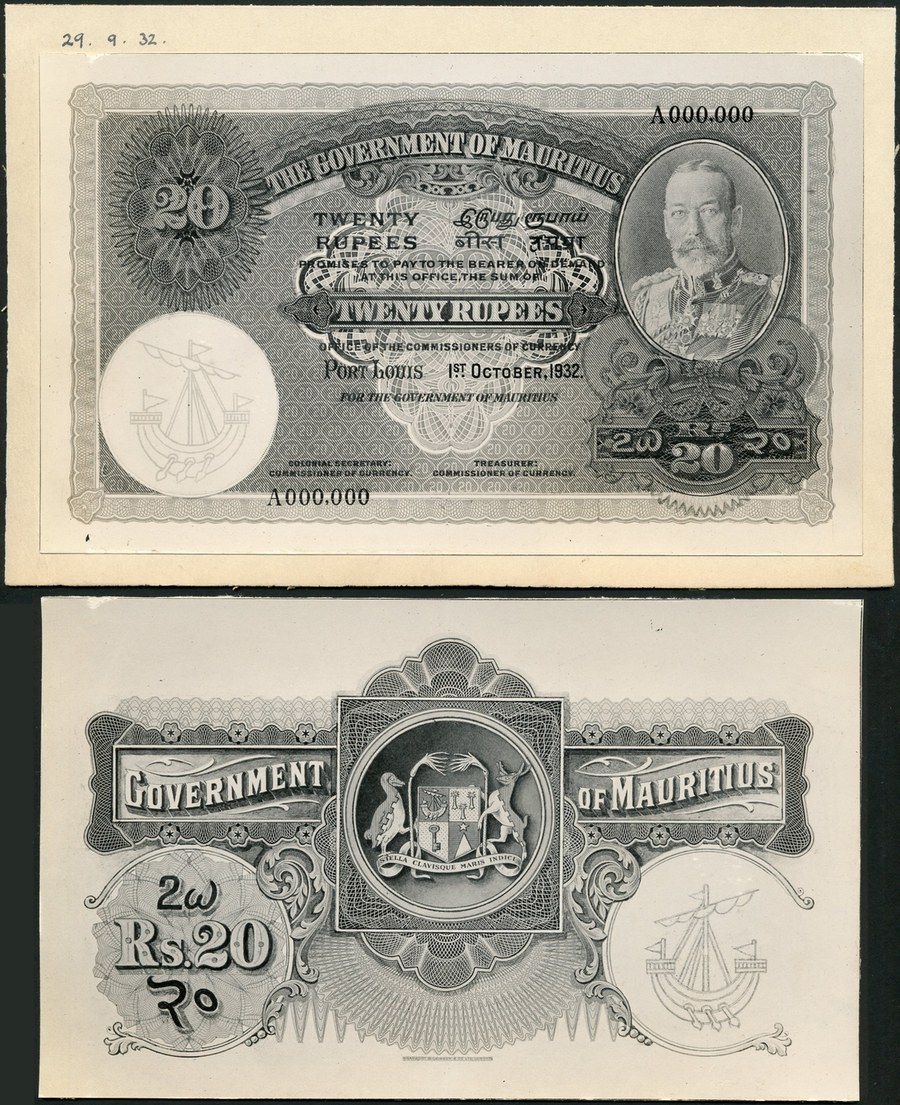
Bradbury Wilkinson prepared a 5, a 10 and a 20 rupees for Mauritius, all dated 1st October 1932, with King George V in uniform at the right and a sailing ship drawn where the watermark would fall. The three cards of photographs are marked 29. 9. 32. The Government chose Waterlow's designs instead, and when those notes came out in August 1934 they were a 5 rupees and a 10 rupees only; at the end of 1935 these were the only notes in circulation. So the 20 rupees lost twice, as a design and as a value. No 20 rupees is listed for Mauritius in the years this catalogue covers, which end in 1978.
High values that stopped at the specimen
Three notes in the catalogue itself, each with its own page, are of a value that was never put into circulation.
The 100 pounds of Cyprus, dated 1st November 1917, is the highest value recorded for the island; the issued notes of those years stop at 10 pounds. The catalogue's page says that the piece is held in the archives of the Central Bank of Cyprus, that no record shows the note in circulation, and that it seems never to have been given legal sanction.
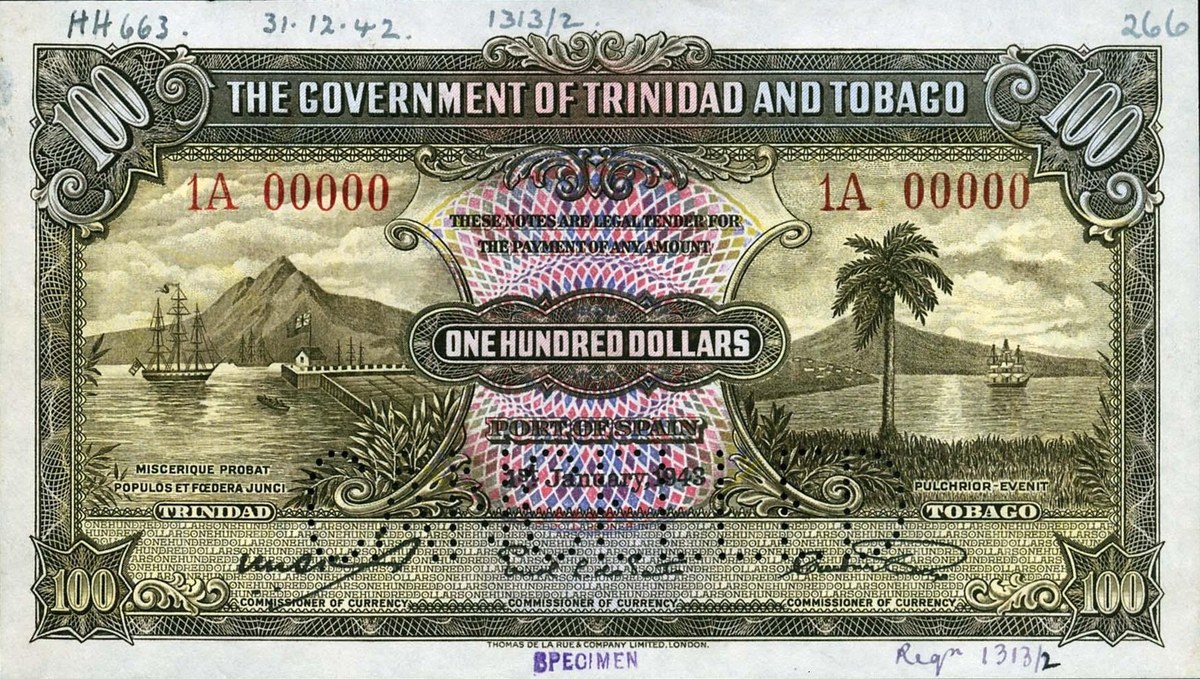
Trinidad and Tobago prepared a 100 dollars twice. The first, dated 1st January 1943 and signed by Wright, dos Santos and George, is known only as specimens; De La Rue's file copy is marked approved and dated 5/2/43. The second was made for the first notes of the Central Bank of Trinidad and Tobago: a specimen signed by Pierce, marked AS SUBMITTED 3RD DEC. 1963 and approved by letter of 17-2-64. The Central Bank's notes were issued on 14 December 1964 without it.
East Africa may have a fourth. The 1,000 rupees of 1905 is listed from a proof alone; no issued note has been traced, and the Board's statements of notes by value, printed in the Official Gazette, show that none had been issued by 1913.
Small change that was held back
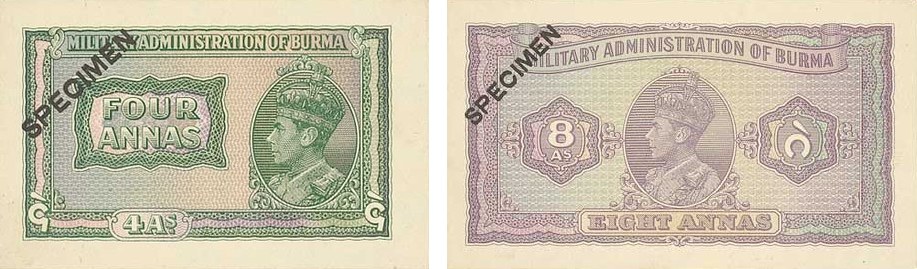
Burma's 4 annas and 8 annas went further than any other value here: they were printed. They were prepared in 1943, in booklets with perforated left edges, for use once the Japanese had been driven out of Burma. Fred Schwan, writing in Bank Note Reporter in August 1982 from Robinson and Shaw's book on the coins and notes of Burma, says that proofs went to London in May 1943 for the King's approval, given in June, and that the notes were then held in reserve against a shortage of coin and not issued; six million pieces of the two values are reported printed. Only specimens are known.
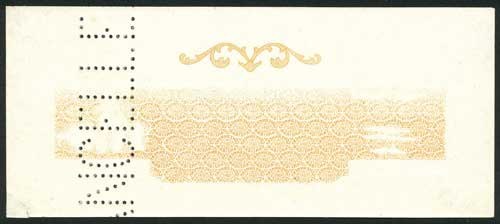
Zanzibar has a piece that may belong with them. A stage proof in brown, perforated CANCELLED, has the figure 10 in circles alternating with the words ZANZIBAR GOVERNMENT, and no unit. No issued note matches it. The auction house that sold it in 2012 suggested a 10 cents note for small change, prepared during the First World War; the value is not spelled out anywhere on the piece, so that stays a suggestion. Zanzibar's lowest note was the 1 rupee of 1920.
One more value has no territory at all. Back proofs in six colours for a 2 rupees headed STATE OF AFRICA, with St George and the dragon in a medallion, name no issuing authority. They are kept with East Africa because the auction house filed them there, and East Africa had no 2 rupees note.
Dropped from the series: values that were issued at another time
The pieces in this part are not unissued values in the strict sense, since each value was a note at some other date. They are here because the design shows a value being planned for a series that then came out without it.
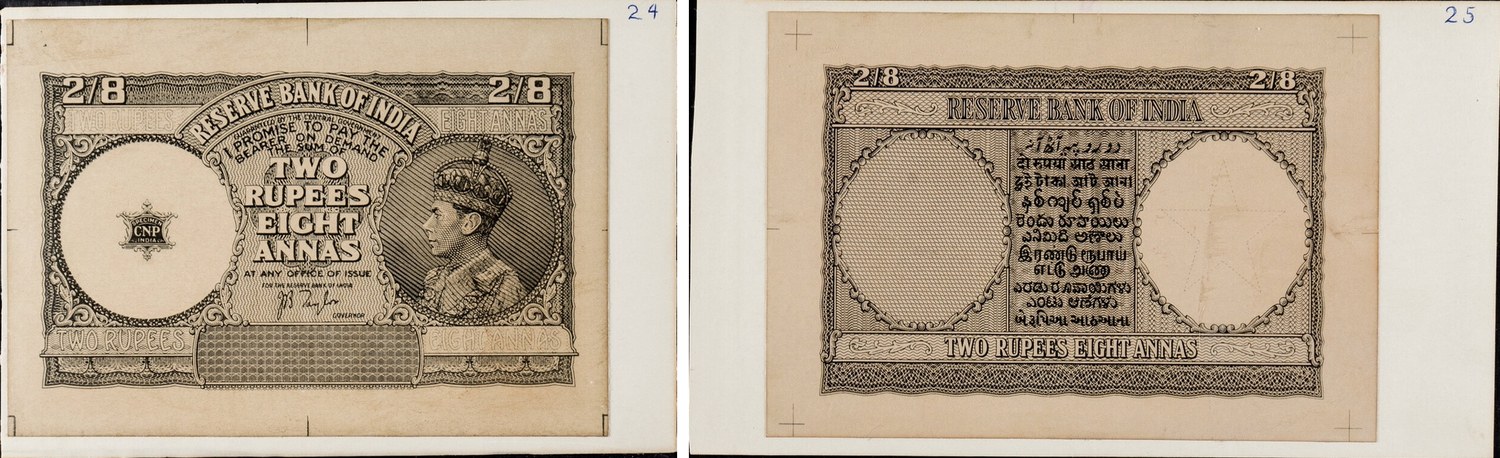
British India, 2 rupees 8 annas of the Reserve Bank. The Government of India's 2 rupees 8 annas was withdrawn in the 1920s. Photographic proofs from the Currency Note Press at Nasik show that the value was drawn again for the Reserve Bank of India: a face and back with George VI in an oval at the right, 2/8 in the upper corners, the words AT ANY OFFICE OF ISSUE and the signature of J. B. Taylor as Governor. The portrait and the signature place it between 1937 and 1943. The small note that the Reserve Bank did issue, from 1943, was a 2 rupees.
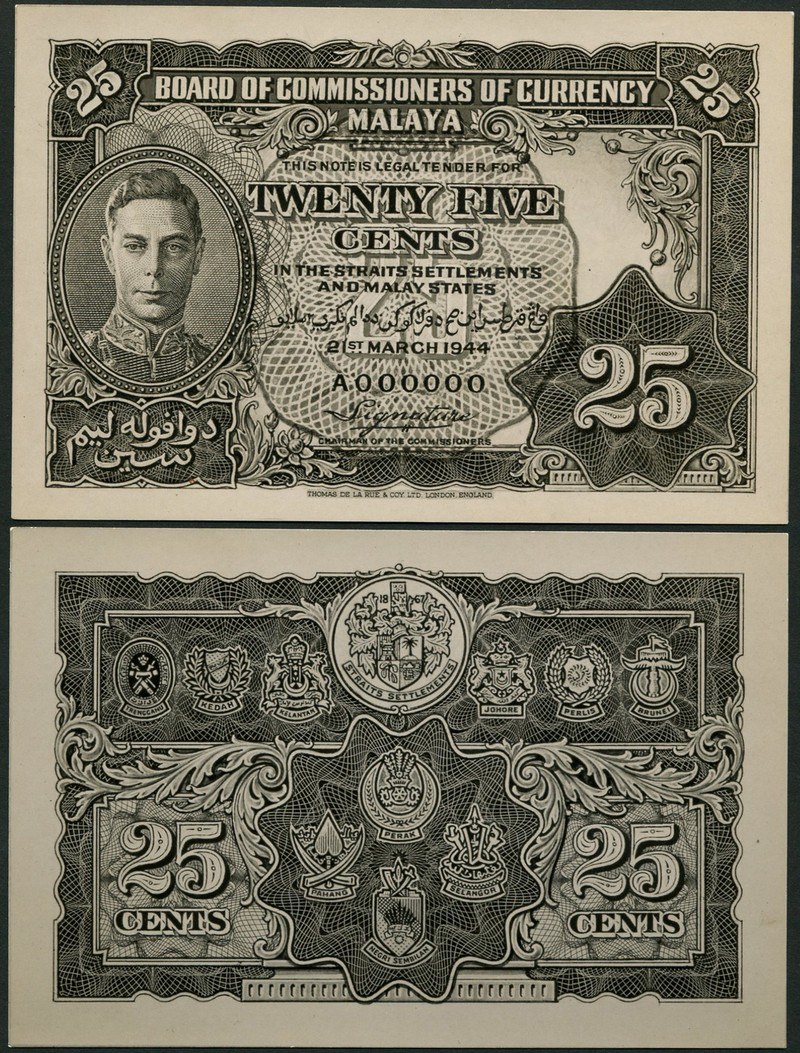
Malaya, 25 cents of 1944. Malaya had a 25 cents in 1940, a wartime note printed locally. The notes of 1941 had a 20 cents instead. During the occupation of Malaya, De La Rue prepared a new set dated 21st March 1944 that went back to the older value: photographs of a 25 cents with George VI at the left and a 25 in a star, and models of a 50 cents on which the panel under the portrait still carries the wording for 25 cents, noted in pencil. The models were approved on 20 September 1943, subject to the right wording being put in. No note dated 1944 was issued.
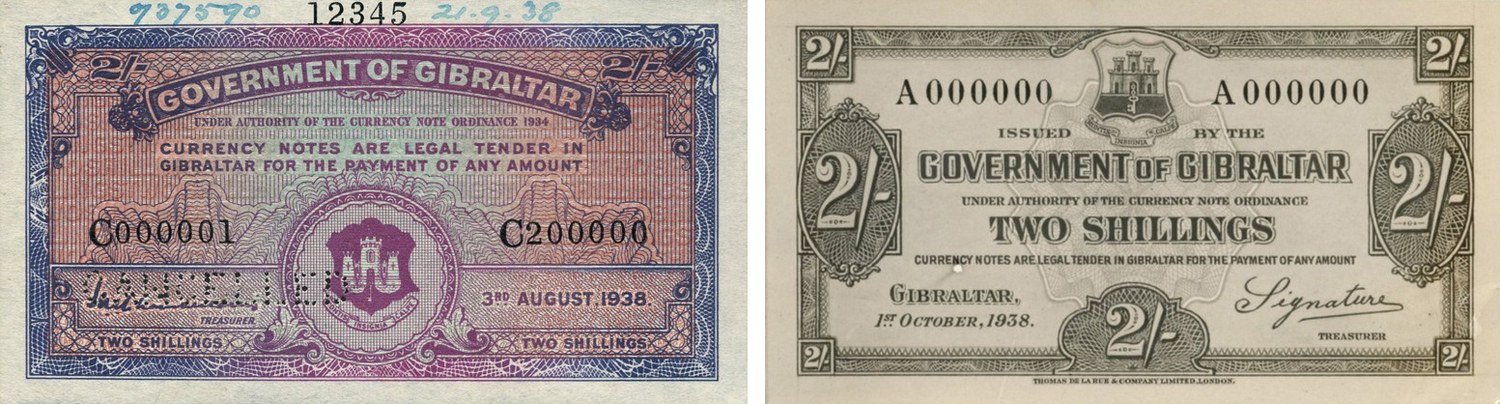
Gibraltar, 2 shillings of 1938. Gibraltar's only 2 shillings notes are the emergency issues of 1914. In 1938 the value was prepared again by two printers. Bradbury Wilkinson's 2 shillings dated 3rd August 1938 is recorded as a specimen for the numbers C 000001 to C 200000, and sources mention that nearly the whole printing was destroyed on 19 December 1968. De La Rue's 2 shillings dated 1st October 1938 is a proof with the word "Signature" where the Treasurer would sign. Neither was issued.
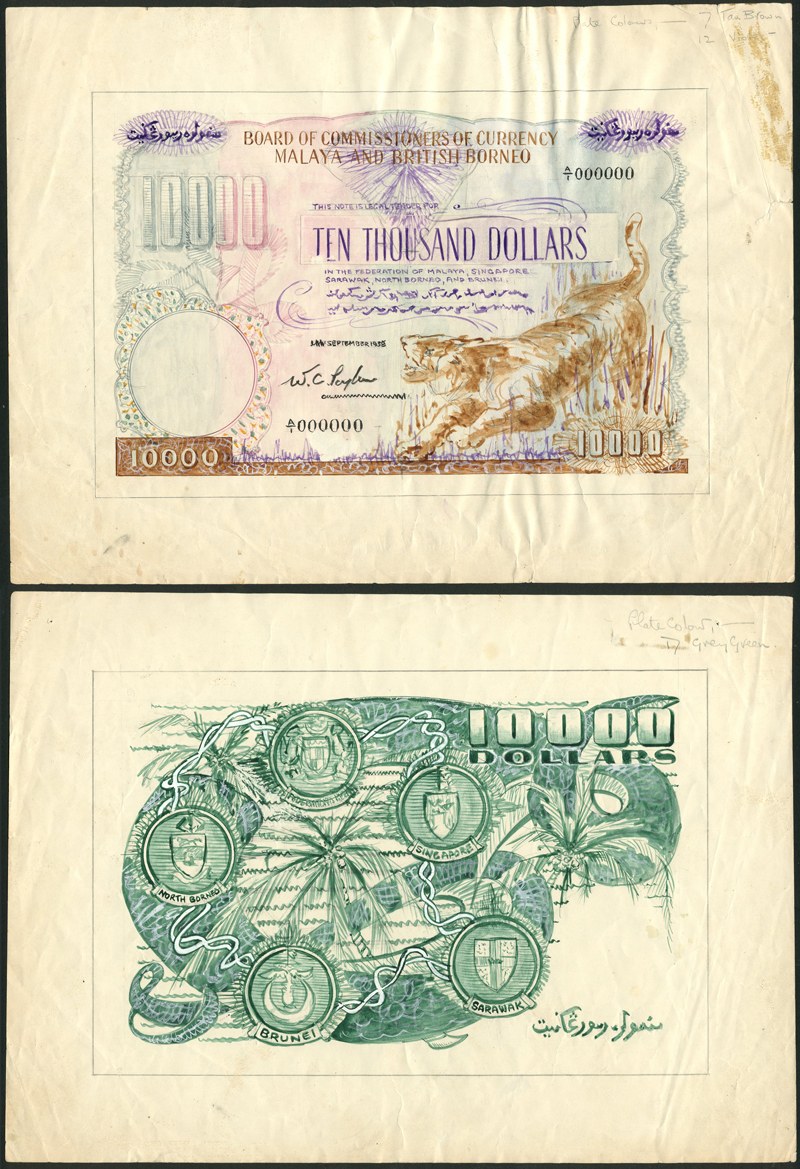
Malaya and British Borneo, 1,000 and 10,000 dollars of 1958. The Board's first notes, dated 21st March 1953 with the portrait of the Queen, ran from 1 dollar to 10,000 dollars. In 1958 a second series without the portrait was drawn in every value, much of it with animals on the fronts: a 1,000 dollars with water buffalo and a 10,000 dollars with a prowling tiger survive as hand-painted essays, and Bradbury Wilkinson's photographs of both are dated 20th September 1958. Of the new series only two values were issued, in other designs: the 1 dollar of 1959 with a sailing boat and the 10 dollars of 1961 with a farmer and a water buffalo. The Board made no high values again.
Three more can be named in a line each. The East Caribbean issue of 1965 was drawn with a 10 dollars, of which a back essay of March 1963 survives, and came out without one. The first notes of the Central Bank of Ceylon, with George VI, were issued in 1951 as a 1 and a 10 rupees only; the 2, 5, 50 and 100 rupees were sent to the Bank as proofs and came out in 1952 with the Queen. And Fiji's 50 cents was prepared for the Central Monetary Authority in 1974 and is known only as specimens.
The values, side by side
| Territory | Value | Date on the design | How far it got | Reason on record |
|---|---|---|---|---|
| Southern Nigeria | 10 pounds, 50 pounds | 1st September 1909 | bromide photographs | the issue was never adopted |
| Cyprus | 100 pounds | 1st November 1917 | a piece in the Central Bank's archives | seems never to have had legal sanction |
| East Africa | 7 rupees 50 cents, 15 rupees | 1st December 1919 | bromide photographs | none |
| British India | 1 rupee 8 annas | none | printed essays in many colours | none |
| Mauritius | 20 rupees | 1st October 1932 | photographs | another printer's designs were chosen |
| Fiji | 6 pence | none; 1942 | a pencil design | Australian sixpences were obtained |
| Trinidad and Tobago | 100 dollars | 1st January 1943; 1964 | specimens | none |
| Burma | 4 annas, 8 annas | none; 1943 | printed, known as specimens | held in reserve against a shortage of coin |
| Nigeria | 2 shillings | 1st July 1958 | photographs | none |
| Zanzibar | "10", perhaps 10 cents | none | a stage proof | none |
Read down the last column and the pattern is plain enough. Where a reason is known it is a practical one: coin arrived, another firm won, the law was never passed. Where none is known the design is all there is, and the two strangest values in the list, 7 rupees 50 cents and 15 rupees, are among those.


Member comments
Log in or register to post a comment.