A colony's own notes were seldom the only paper in its tills. The yearly reports that each colony sent to London say whose, in a sentence or two under "Currency". We have read those sentences in the reports for 1908 to 1929 and set them out by colony. The catalogue has pages only for the notes of Governments and currency boards, so the banks' notes named below have no pages of their own.
The source
The Colonial Reports - Annual are the yearly printed report of each colony to the Secretary of State, sold by H.M. Stationery Office, each with a number. Those used here are: Seychelles 1909 (No. 643); Bahamas 1909-10 (No. 650), 1928 (No. 1426) and 1929 (No. 1477); Fiji 1909 (No. 657); British Honduras 1922 (No. 1181); the Gambia 1909 (No. 641), 1910 (No. 679) and 1922 (No. 1160); Mauritius 1921 (No. 1149), 1922 (No. 1179) and 1929 (No. 1503); Brunei 1928 (No. 1449) and 1929 (No. 1492); Kelantan 1928 (No. 1429); British Guiana 1908-9 (No. 632); Grenada 1922 (No. 1168) and 1928 (No. 1443); Trinidad and Tobago 1922 (No. 1166); St. Lucia 1922 (No. 1169), 1928 (No. 1433) and 1929 (No. 1495); St. Vincent 1922 (No. 1177), 1928 (No. 1436) and 1929 (No. 1482); Nyasaland 1921 (No. 1156), 1928 (No. 1445) and 1929 (No. 1489); and Somaliland 1921 (No. 1152) and 1928 (No. 1451).
Before the colony's own notes
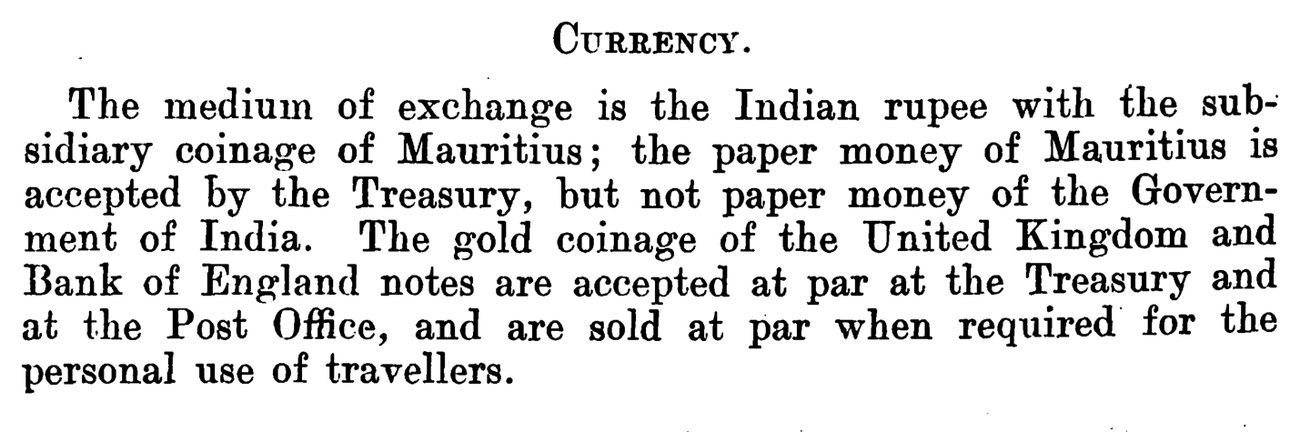
Seychelles, 1909. The Colony had no notes and no bank: the Government did some of a bank's work "in the absence of any banking institution". Of paper, "the paper money of Mauritius is accepted by the Treasury, but not paper money of the Government of India", and Bank of England notes were taken at par. That is five years before the emergency notes of 1914 and ten before the 50 cents of 1919.
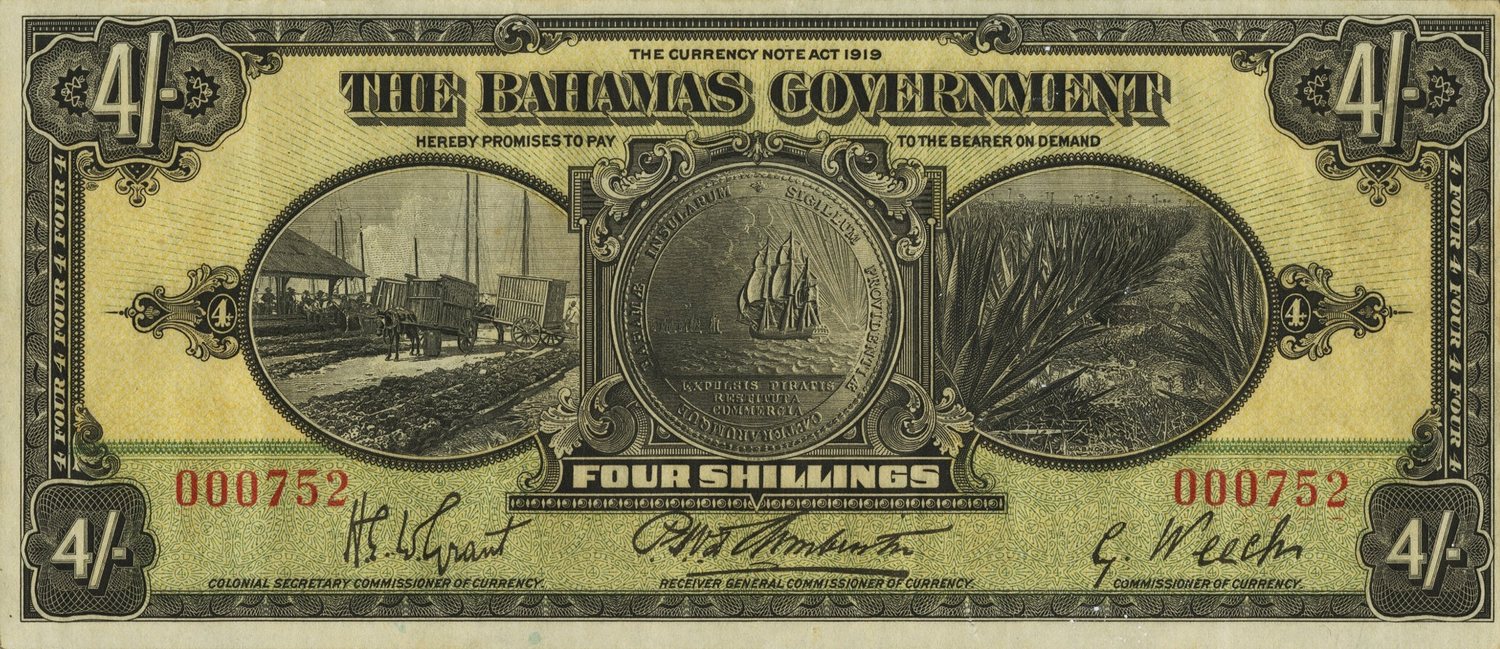
Fiji, 1909. "There is no Government note issue." The paper was that of two banks, the Bank of New Zealand and the Bank of New South Wales, each with "a private note issue", together estimated at 7,682 pounds in circulation at the end of the year. The Government's notes followed in December 1914, with the 1 pound among them: 10,010 pounds of them were in circulation by 10th December 1914, more than the banks' whole estimated issue of 1909.
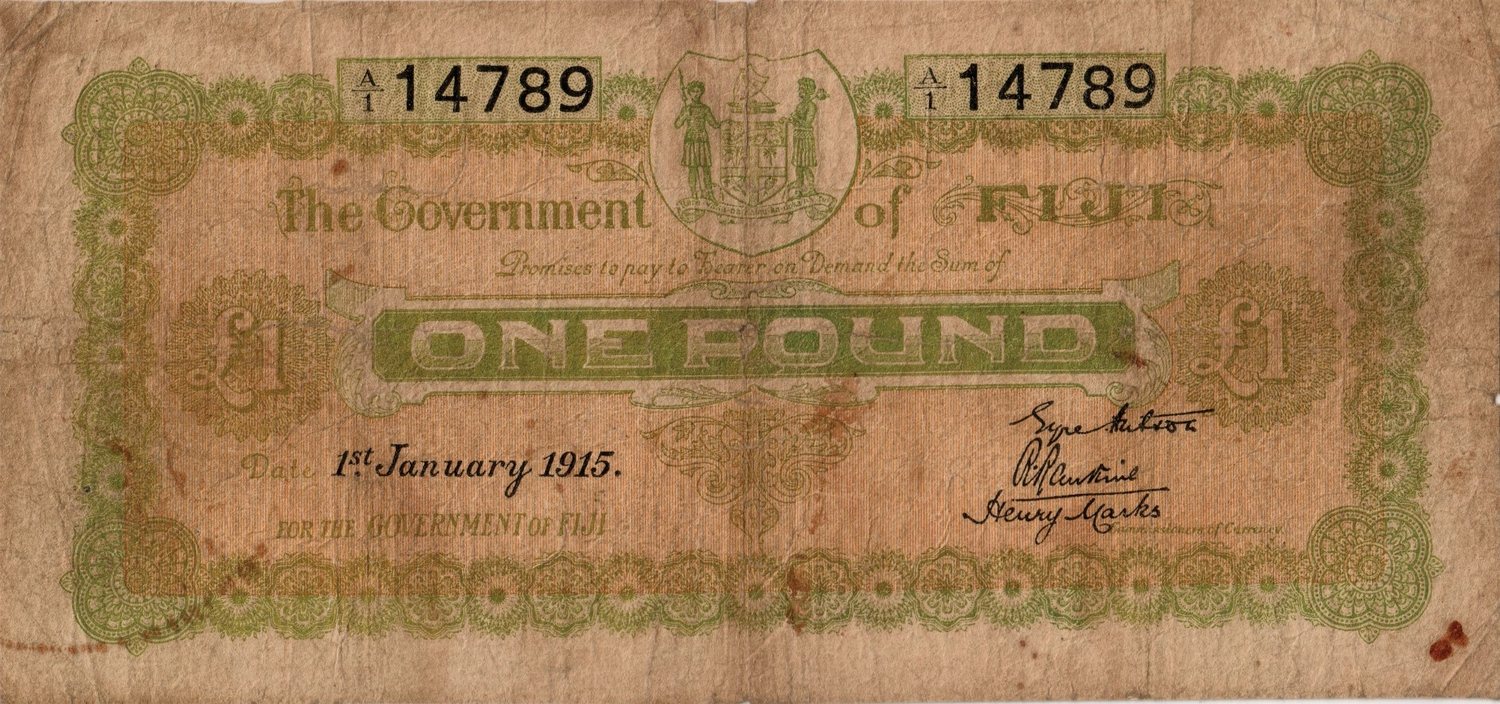
Bahamas, 1909-10. The Bank of Nassau had a note circulation of 6,500 pounds and "issues local notes of the values of £1 and four shillings". United States gold and silver certificates were not legal tender but were taken, those below 5 dollars "at the rate of four shillings to the dollar".
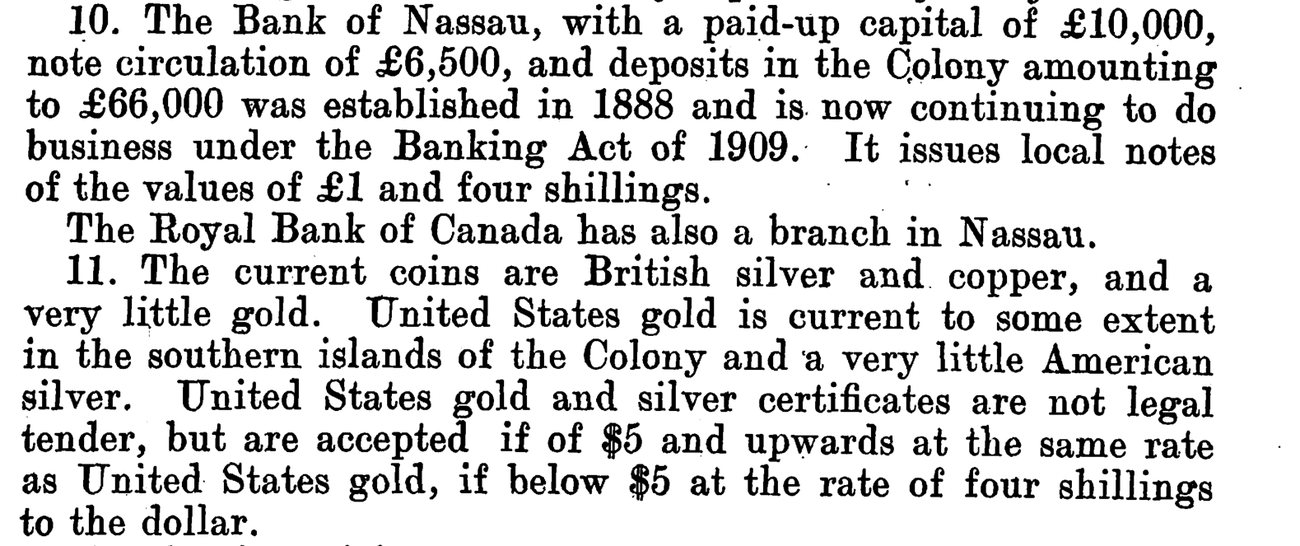
Ten years later the Bahamas Government issued notes of 4 shillings, 10 shillings and 1 pound. No report says why the lowest value was 4 shillings. It is our inference that the 4 shillings of 1919 follows the bank's note of the same value and the rate at which a small American dollar note passed. The reports for 1928 and 1929 say that "a large amount of United States currency and some British currency notes are also in circulation" beside Government notes to the total value of 110,000 pounds.
British Guiana, 1908-9. No Government note is named. "Notes are issued by the British Guiana and Colonial Banks in denominations of $5, $20, and $100." Our page ends the British Guiana Bank's notes in 1907; the report still names that bank as issuing, perhaps in a sentence carried over from earlier years.
Beside the colony's own notes
British Honduras, 1922. The Government issued notes of 10, 5, 2 and 1 dollars, and "Notes of the United States of America circulate freely." The Colony's one bank, the Royal Bank of Canada, "is not allowed to circulate its own notes, having to use the currency notes of the Government".
The Windward Islands and Trinidad. In Grenada the Government's small notes of 1920 stood at 10,254 pounds at the end of 1922; the notes of the Colonial Bank and the Royal Bank of Canada in the island came to about 30,000 pounds. The report for 1928 names only the banks' 5 dollar notes, now of Barclays Bank and the Royal Bank of Canada; it does not say that the Government notes had been withdrawn. In St. Lucia in 1922 Government notes of 5 and 10 shillings passed with the notes of the same two banks and those of the United States and Canada. In Trinidad and Tobago in 1922 the Government's notes in circulation were 149,175 pounds; the Colonial Bank's alone were estimated at 250,000 pounds, and two Canadian banks had authorised issues besides (see the table). St. Vincent had no Government notes: its paper in 1922 was the "five dollar notes of the Colonial Bank", in 1928 and 1929 those of Barclays Bank.
Mauritius, 1921 to 1929. Notes of the Government of India were legal tender beside the Colony's own, and the report for 1929 still lists them, "of all denominations", as legal tender to any amount. Another article tells that story.
Colonies that used a neighbour's notes
Brunei and Kelantan, 1928 and 1929. The report on Brunei says the currency "is that of the Straits Settlements", with currency notes "from $1 upwards"; the report on Kelantan for 1928 says Straits Settlements currency was in use.
Somaliland, 1921 and 1928. The reports name no notes of the Protectorate's own, and in 1921 no bank. Government of India notes were in circulation: an estimated 150,000 rupees of them at the close of 1921 and 300,000 rupees at the close of 1928.
The Gambia, 1909 to 1922. In 1909 and 1910 the only paper named is the Bank of England note, "not legal tender" but taken by the Bank of British West Africa at Bathurst: "The circulation is small." By 1922 the notes of the West African Currency Board were in use, and "French paper money finds its way into the Protectorate" from Senegal.
Nyasaland, 1921 to 1929. In 1921 "there are no notes in circulation"; in 1928 and 1929 "there is no note issue and notes of other parts of the Empire are not legal tender".
Side by side
| Colony | Year of report | Whose paper | What the report says of it |
|---|---|---|---|
| Seychelles | 1909 | Mauritius; Bank of England; Government of India | the first two accepted by the Treasury, the third not |
| Fiji | 1909 | Bank of New Zealand; Bank of New South Wales | private note issues, estimated at 7,682 pounds |
| Bahamas | 1909-10 | Bank of Nassau; United States certificates | 1 pound and 4 shillings, 6,500 pounds out; certificates below 5 dollars at 4 shillings to the dollar |
| Bahamas | 1928, 1929 | United States currency; British currency notes | "a large amount" and "some", in circulation |
| British Guiana | 1908-9 | British Guiana Bank; Colonial Bank | notes of 5, 20 and 100 dollars |
| British Honduras | 1922 | United States notes | "circulate freely"; the one bank may issue none |
| Grenada | 1922, 1928 | Colonial Bank (1922), Barclays Bank (1928); Royal Bank of Canada | about 30,000 pounds in 1922; 5 dollar notes in 1928 |
| St. Lucia | 1922 | Colonial Bank; Royal Bank of Canada; United States and Canadian notes | each bank issues notes; the others pass at their exchange value |
| St. Vincent | 1922 | Colonial Bank | 5 dollar notes, part of the currency |
| Trinidad and Tobago | 1922 | Colonial Bank; Royal Bank of Canada; Canadian Bank of Commerce | estimated 250,000 pounds; authorised 312,500 pounds; authorised 750,000 dollars |
| Mauritius | 1929 | Government of India | legal tender to any amount |
| Brunei; Kelantan | 1928, 1929; 1928 | Straits Settlements | the currency of Brunei; in use in Kelantan |
| Somaliland | 1921, 1928 | Government of India | in circulation; estimated 150,000, then 300,000 rupees |
| The Gambia | 1909, 1910, 1922 | Bank of England; French notes | not legal tender, circulation small; French paper from Senegal in 1922 |
| Nyasaland | 1921, 1928, 1929 | none | no notes in circulation; others' notes not legal tender |
What the reports do not say
- When, or how, the two banks' notes went out of use in Fiji: the reports for 1922, 1928 and 1929 name the banks and say nothing of their notes.
- Why the Bahamas chose 4 shillings.
- How much United States paper passed in the Bahamas or British Honduras.
The Blue Books of each colony and the banks' own returns would settle most of these; for the Bahamas, the papers of the Currency Note Act 1919 should give the reason for the 4 shillings.


Member comments
Log in or register to post a comment.