This article sets out the notes of Belize in order of time, from the first notes headed THE GOVERNMENT OF BELIZE, dated 1st January 1974, to the family of notes launched in August 2025. It is drawn from the Pick pages of this catalogue, from the annual reports of the Monetary Authority of Belize and the Central Bank of Belize for 1977 to 2025, and from the Central Bank's own history pages. A statement of an auction house is given as that house's statement.
Four other articles go further into single subjects: the Government of Belize notes of 1974 to 1976, the notes of 1980 to 1989, the signers and the circulation figures.
Before 1974: the Board of Commissioners of Currency
The Board of Commissioners of Currency was set up in 1894 and issued the colony's notes until 1976. The Central Bank's page "History of Belize Currency" says that up to 1894 there was no paper currency, that Ordinance No. 31 of 1894 put the currency on a gold basis, and that there was a local note issue of 1, 2, 5 and 10 dollars. The Bank's page "The Bank's History" says the Board's local currency was redeemed for sterling on demand.
Up to 1973 the Board's notes are headed THE GOVERNMENT OF BRITISH HONDURAS. They are catalogued under British Honduras and are not treated here.
1974 to 1976: the Government of Belize
British Honduras was renamed Belize in 1973. Heritage's description of lot 24064 in its sale of 23 March 2023 gives the day as 1st June 1973. From 1st January 1974 the Board's notes were headed THE GOVERNMENT OF BELIZE and signed by three Commissioners of Currency, Cain, Fonseca and Cattouse.
There are five values: the 1 dollar, the 2 dollars, the 5 dollars, the 10 dollars and the 20 dollars. The designs and colours are those of the British Honduras notes they replaced. Only the name, the dates and the signatures are new. The printer was Bradbury Wilkinson and Company. Sources mention that the portrait of the Queen follows a 1952 photograph by Dorothy Wilding, engraved by Bradbury Wilkinson.
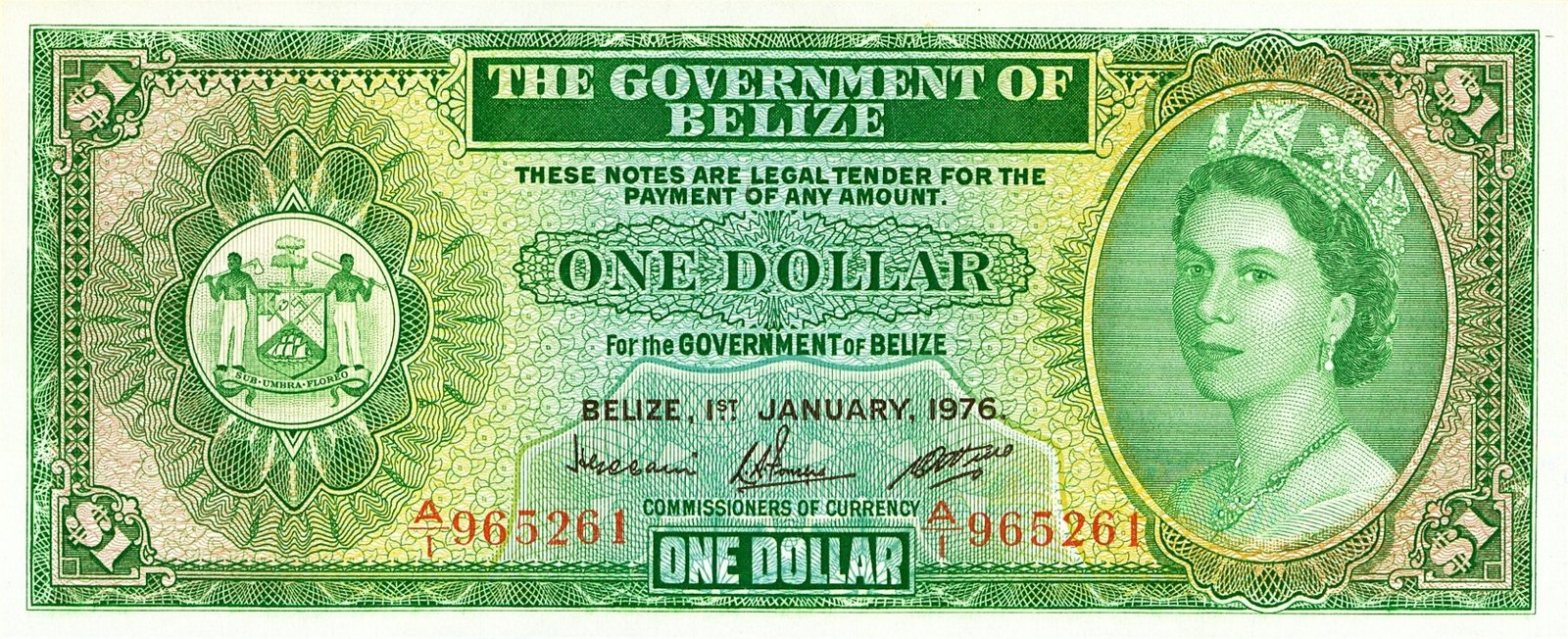
Three dates were printed, 1st January 1974, 1st June 1975 and 1st January 1976. The 5 dollars has only the last two. The prefix letter follows the denomination, A for the 1 dollar to E for the 20, and the first prefix of each value runs across all of its dates, so only the printed date places a note.
1976 to 1982: the Monetary Authority and the notes of 1980
The Monetary Authority of Belize was established on 1st November 1976. The Authority's annual report for 1977 says it took over the assets and debts of the Board of Commissioners of Currency on 1st January 1977. The Authority was allowed to pay out as its own the notes printed for the Board and still in stock, and these stayed legal tender until called in. The Central Bank's page "The Bank's History" says the Authority also regulated the commercial banks, managed the foreign exchange reserves and acted as banker to the government, and that from 16 June 1977 it set the lowest and highest selling rates for the commercial banks.
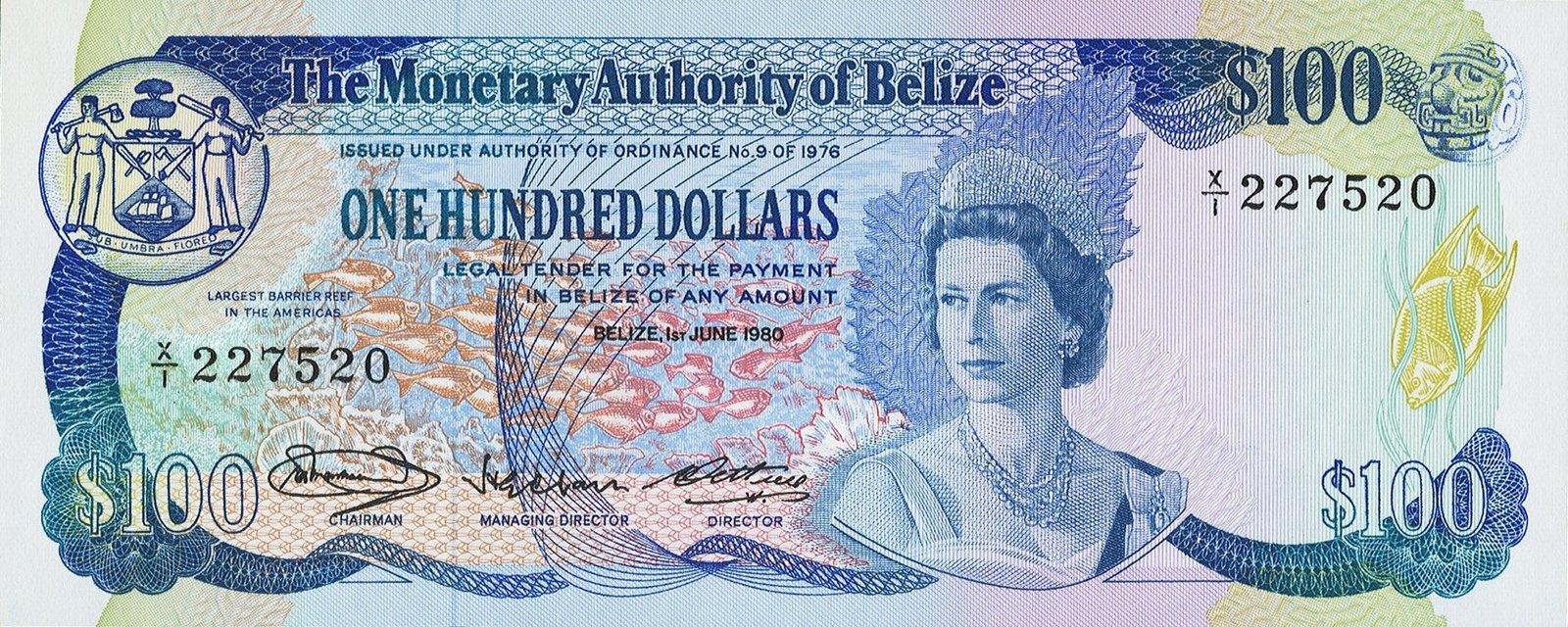
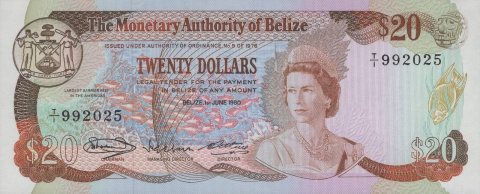
The Authority's own notes came four years later. The annual report for 1979 says the Managing Director visited Thomas De La Rue and the Crown Agents about them. The notes are dated 1st June 1980 and were issued under Ordinance No. 9 of 1976. The annual report for 1980 says they were put into circulation on 1st July 1980, a month after the date they carry, and that the banks had been given 2.1 million dollars of them two weeks ahead, on consignment. The accounts for 1980 put the cost of printing the new notes at 1,653,004 dollars.
There are five values again, but not the same five: the 1 dollar, the 5 dollars, the 10 dollars, the 20 dollars and a 100 dollars. There is no 2 dollars. The five share one design told apart by colour: on the front the arms, a new portrait of Queen Elizabeth II and the Maya jade head of Kinich Ahau from Altun Ha; on the back the National Assembly building in Belmopan and a jabiru stork, the Authority's emblem. The notes are signed by Marshalleck as Chairman, Cain as Managing Director and Cattouse as Director.
The notes of the Commissioners of Currency ceased to be legal tender with effect from 1st January 1981, six months after the Authority's notes came out. The Authority, and then the Central Bank, stayed bound to pay them at face value. The article on the Government of Belize notes follows what became of the notes that were never handed in.
1982 to 1989: the Central Bank keeps the design
The Central Bank of Belize was established on 1st January 1982 by the Central Bank of Belize Act, No. 15 of 1982. The Bank's page "The Bank's History" places this shortly after independence from Great Britain and calls the Bank the successor of the Monetary Authority.
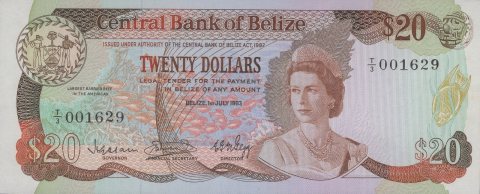
The Bank's first notes are dated 1st July 1983: a 1 dollar, a 10 dollars and a 20 dollars. They keep the Monetary Authority design with the Bank's name, the authority of the 1982 Act and a revised coat of arms, and are signed by Cain as Governor, Marshalleck as Financial Secretary and Gegg as Director.
From 1st November 1983 the coat of arms was revised again, with a darker wreath border and a larger tree. In this form the 1 dollar is dated 1st November 1983, 1st January 1986 and 1st January 1987; the 5 dollars and the 10 dollars 1st January 1987 and 1st January 1989; the 20 dollars 1st January 1986 and 1st January 1987; and the 100 dollars 1st November 1983 and 1st January 1989.
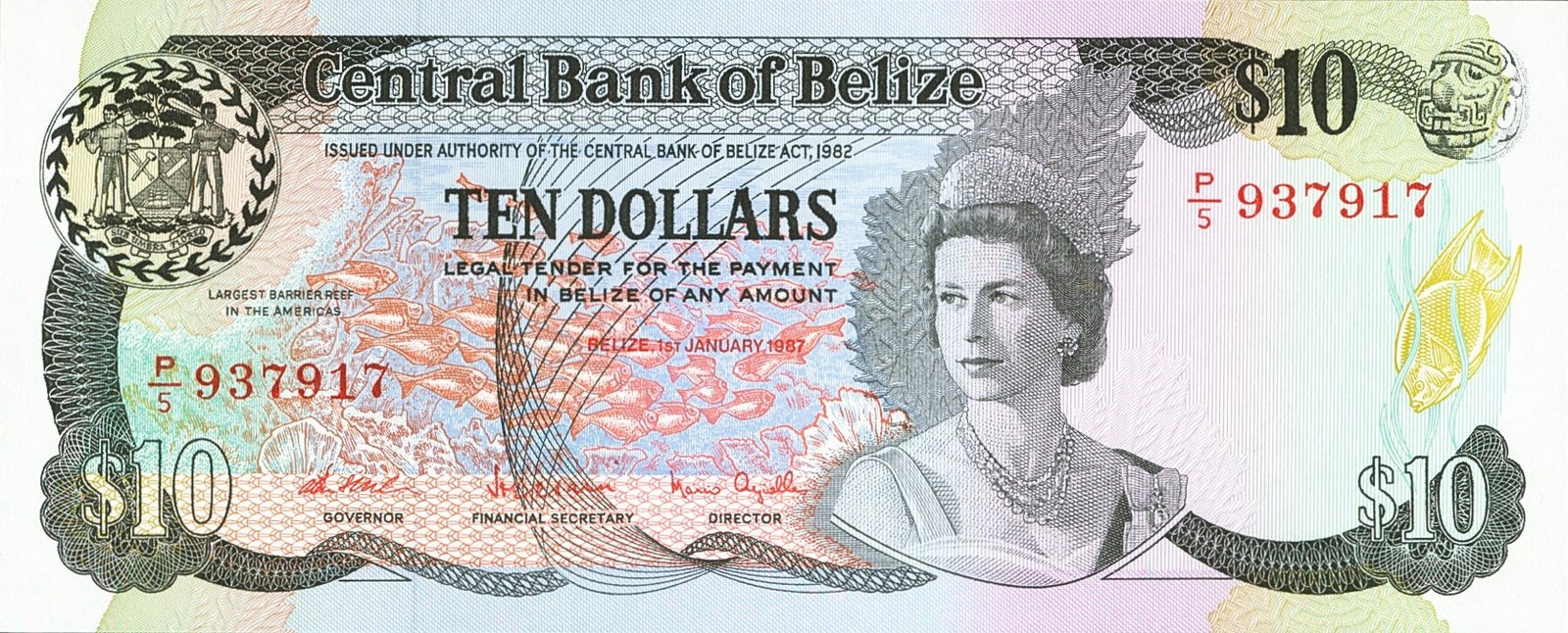
The annual reports for 1983 to 1989 say nothing of any of these notes: no day of issue, no values, no printer. The printer of the Central Bank notes of 1983 to 1989 is an open point. It is set out, with the prefixes that run on from the notes of 1980, in the article on the notes of 1980 to 1989.
1990 to 1996: a back for each value
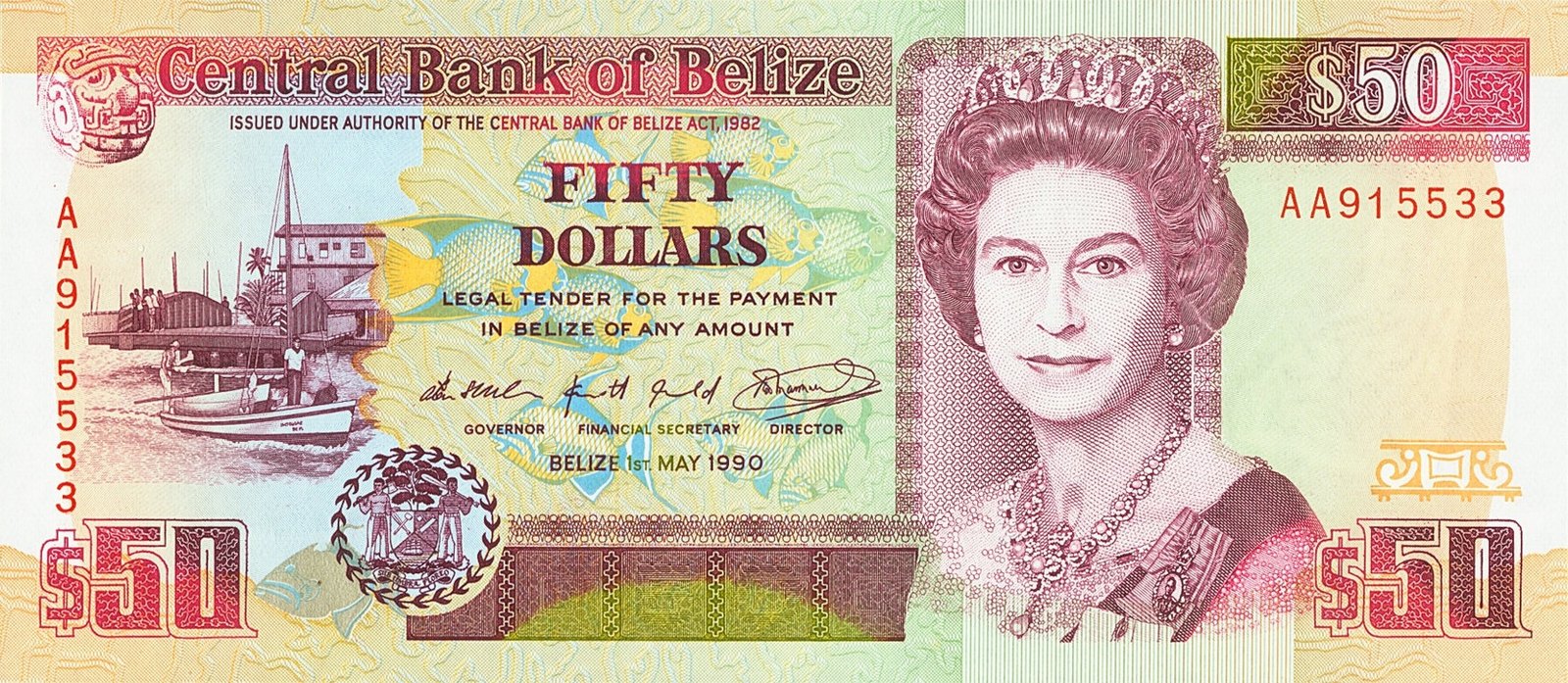
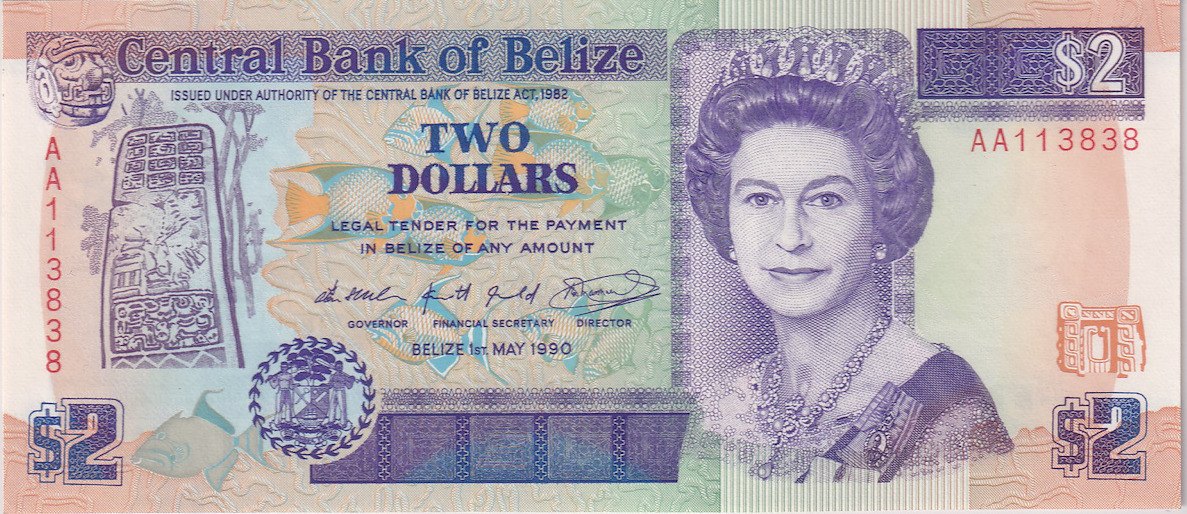
The Bank's annual report for 1990 says that a series of seven denominations "highlighting aspects of the natural and social history of Belize" was introduced that year. Each value now had its own back, showing the wildlife, culture and historic sites of Belize, with a new portrait of the Queen. Sources mention that the portrait follows Peter Grugeon's 1977 Silver Jubilee photograph, engraved by De La Rue. The serial numbers are printed both vertically and horizontally, and two-letter prefixes from AA replace the fractional prefixes of the earlier notes.
The seven values are the 1 dollar, the 2 dollars, the 5 dollars, the 10 dollars, the 20 dollars, the 50 dollars and the 100 dollars. The same report says three things of single values:
- A 1 dollar coin was issued for the first time, to circulate beside the 1 dollar note while the note was gradually withdrawn. The 1 dollar note carries one date, 1st May 1990, and no later series has one.
- The 2 dollars was brought back to fill the gap between the 1 and the 5 dollars. The Monetary Authority and the Central Bank had issued none before.
- The 50 dollars was introduced for the first time.
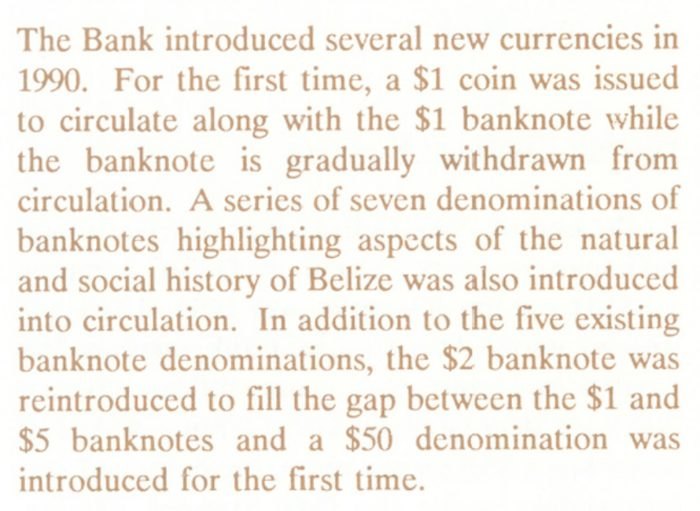
The report gives no day of issue. The notes are dated 1st May 1990 and 1st June 1991, and the 100 dollars also 1st May 1994. The 20 dollars is recorded only with the date 1st May 1990. The accounts show that printing notes and minting coins cost 2,190,517 dollars in 1990, against 663,972 dollars in 1989.
The 5 dollars and the 10 dollars of 1st March 1996 repeat the 1990 designs with a windowed security thread, a horizontal serial number at upper right in black figures of ascending size, and a different background screen pattern. The vertical number at left stays red. The annual report for 1996 does not mention them.
1997 to 2002: smaller notes
The notes of 1997 to 2002 are smaller: 140 x 70 mm for the 2 to 20 dollars and 150 x 75 mm for the 50 and 100. The registration devices are encircled and quartered, every value has a windowed thread and horizontal ascending serial numbers, the 100 dollars carries a hologram and the 50 a foil fish.
The dates came in steps. The 10 dollars, the 20 dollars, the 50 dollars and the 100 dollars are dated 1st June 1997. The 2 dollars and the 5 dollars follow with 1st January 1999. Second dates are 1st September 2000 on the 50 dollars, 1st October 2000 on the 20 dollars, January 2001 with no day on the 10 dollars, and 1st January 2002 on the 2 and 5 dollars. The 100 dollars has the one date.
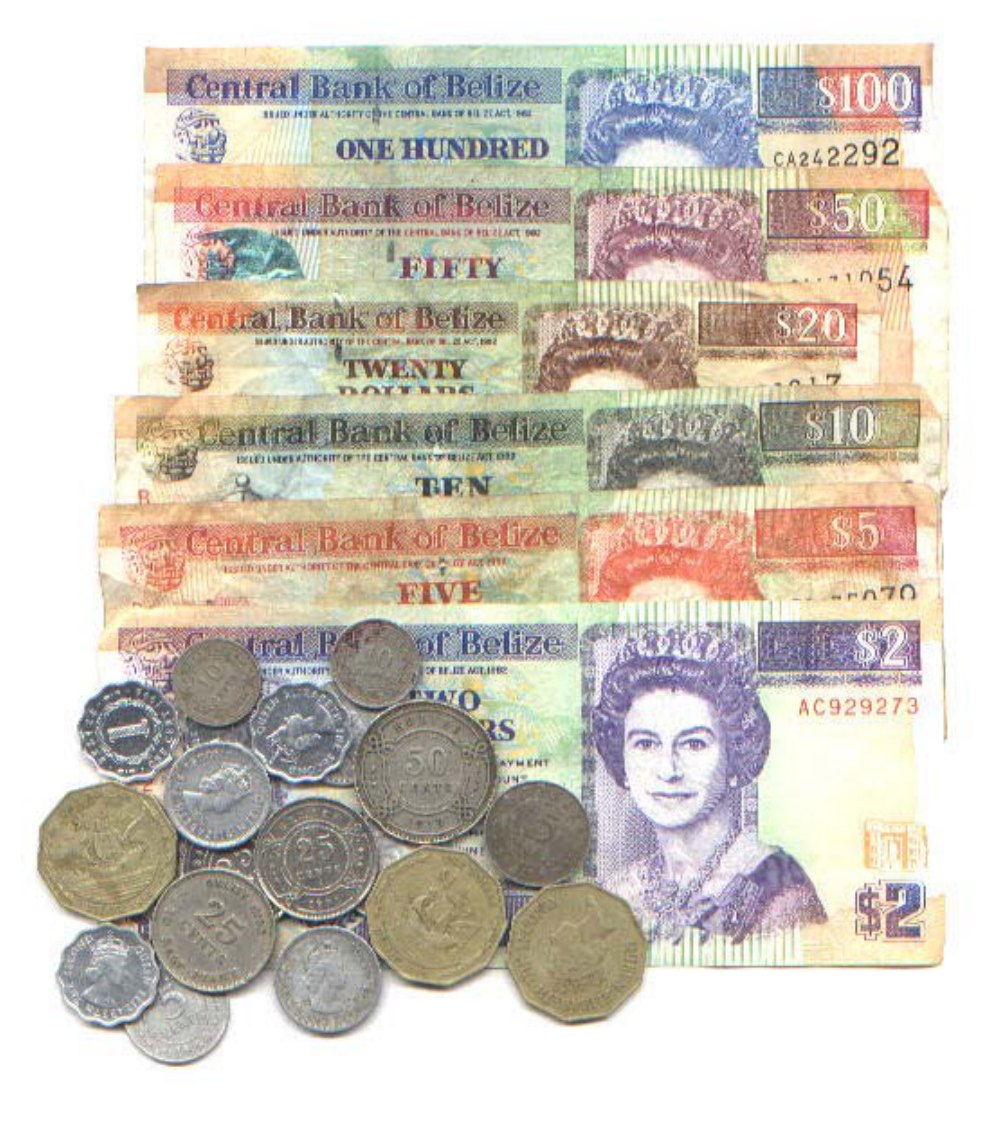
The annual reports for 1997 and 1999 say nothing of new notes. The Central Bank's page "History of Belize Currency" says the 1990 series was updated in 1998 and in 2003 with changes of size and security features. The first smaller notes carry the date 1st June 1997; whether they reached the public in 1997 or in 1998 is not settled by either source.
2003 to 2022: the last notes with the Queen
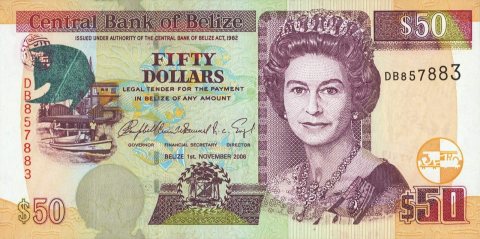
The notes of 2003 to 2022 add wider demetalised security threads, the denomination spelt out as an electrotype watermark and, on the 100 dollars, an intaglio periwinkle flower over the hologram. The values are the 2 dollars, the 5 dollars, the 10 dollars, the 20 dollars, the 50 dollars and the 100 dollars. Each repeats the design of 1997 to 2002. The watermark word shows faintly on the front, in the plain area to the left of the registration device at the right, where the earlier notes have nothing. On the 100 dollars the hologram decides: plain on the note of 1997, with the outline of a periwinkle flower in violet from 2003.
The imprint at the foot of the back reads THOMAS DE LA RUE AND COMPANY LIMITED on the 10, 20 and 100 dollars of 2003 to 2006, and DE LA RUE on the 2, 5 and 50 dollars from 2003 and on every De La Rue note from 2007. From 1st May 2016 the 5 and 10 dollars were printed by Oberthur Fiduciaire.
Counted value by value, the six values carry 42 printed dates, from 1st January 2003 to 1st December 2022. They are listed, each with its three signers, in the article on the signers. No annual report from 2003 to 2025 mentions any of these dates or names a printer.
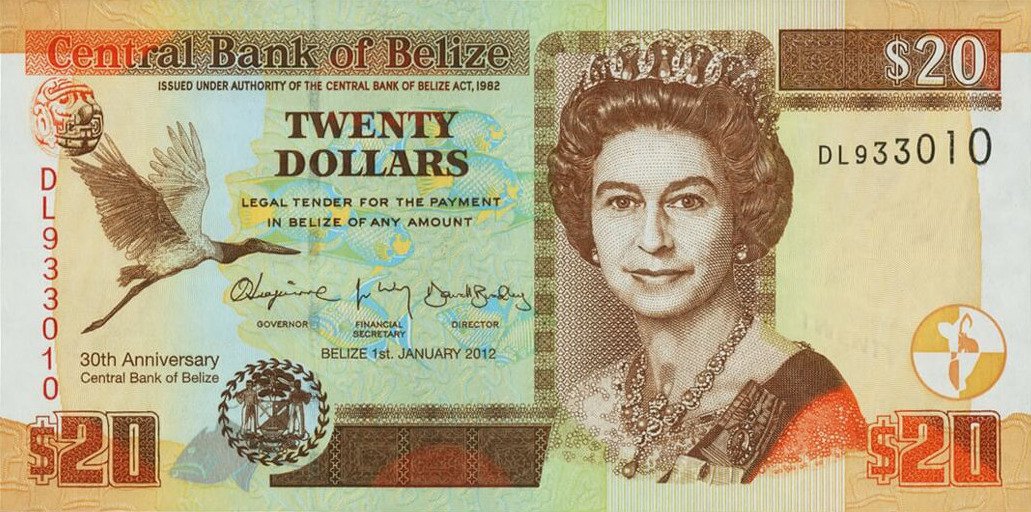
One note stands apart: the 20 dollars of 2012, a commemorative issue for the 30th anniversary of the Central Bank, dated 1st January 2012. It keeps the frame, colours and portrait of the 20 dollars of 2003 to 2022. The front shows a flying jabiru stork in place of the jaguar on a branch, and the back the Bank's headquarters in Belize City. The Pick page gives 1.5 million notes, introduced on 30th April 2012 with a new 1 dollar coin. The annual report for 2012 counts 15.8 million dollars of the commemorative notes issued during that year, which is 790,000 notes, and ties 30th April 2012 to the coin. The two figures are not reconciled.
2025: notes without the Queen
The annual report for 2024 says the Bank would issue a new family of notes in 2025 and pictures six fronts, 2, 5, 10, 20, 50 and 100 dollars, each dated 1st February 2025 and signed by the Governor, the Financial Secretary and the Chairman. The annual report for 2025 says the designs were revealed at a ceremony on 23rd January, and that in August 2025 the Bank launched the new family and began to take the notes with the Queen's portrait out of circulation.
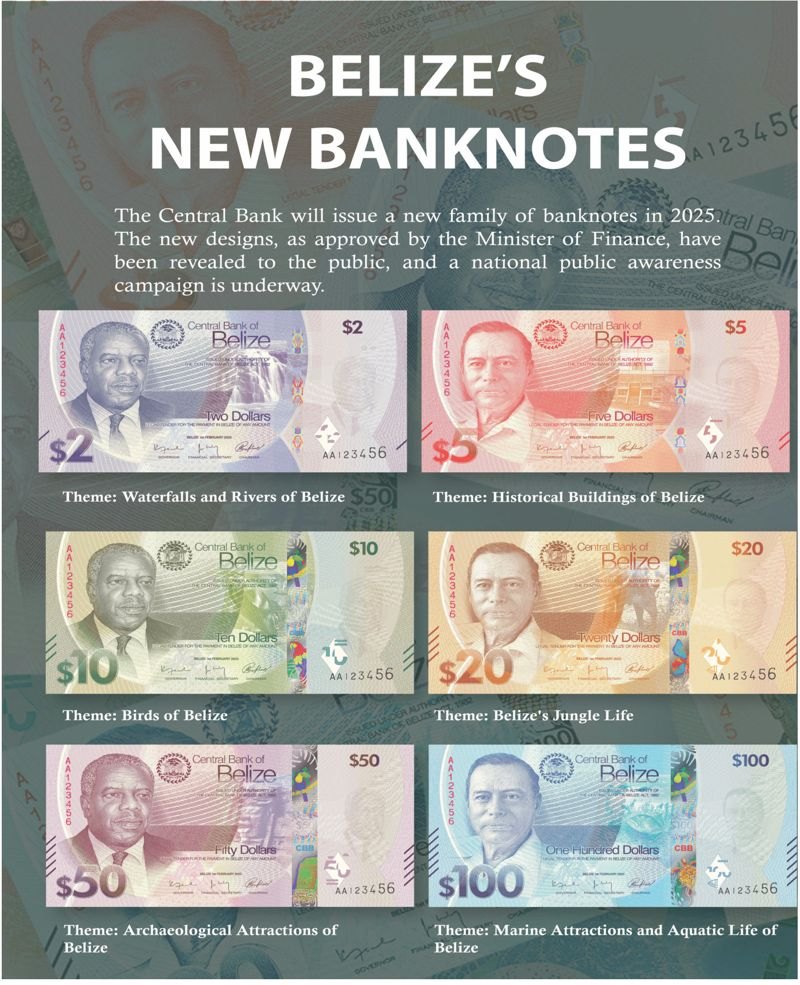
The annual reports speak of two national heroes without naming them. The Bank's page "History of Belize Currency" names George Cadle Price and Philip Goldson, whose portraits alternate across the six values, Goldson on the 2 dollars and Price on the 100. The Bank's "Frequently Asked Questions" page says the new notes keep the sizes of the old ones and are printed on cotton paper. Both pages say the earlier notes remain valid legal tender, the second adding that the change is expected to take several years. No source read names the printer or gives the day in August.
This catalogue has no Pick pages for the notes of 2025. A design of about 1973 that put an osprey in the place of the sovereign is described in From the monarch to national figures.
What the annual reports leave out
The 49 annual reports from 1977 to 2025 give the day of issue of one set of notes only, those of the Monetary Authority, on 1st July 1980. They give the series of 1990 by year, the commemorative 20 dollars of 2012 by a value issued, and the family of 2025 by month. They do not give the day of issue of any Central Bank note, the printer of the Central Bank notes, the numbers printed, the prefixes, the replacement notes, or the notes in circulation by denomination. Apart from the notes of the Commissioners of Currency in 1981, no report records the calling in of a series.
Sources
- The Pick pages of this catalogue for Belize, P-33 to P-72.
- Monetary Authority of Belize, annual reports for 1977, 1979 and 1980.
- Central Bank of Belize, annual reports for 1983 to 1990, 1996, 1997, 1999, 2012, 2024 and 2025.
- Central Bank of Belize, "History of Belize Currency" and "The Bank's History", pages of the Bank's website.
- Central Bank of Belize, the page of frequently asked questions on the new currency of 2025, on the Bank's website.
- Heritage Auctions, 23 March 2023, lot 24064.
Member comments
Log in or register to post a comment.