The Cayman Islands have had notes of their own since 1st May 1972. This article goes through them in order of time: the Currency Board and its three issues, the Monetary Authority and its C and D series, and the commemorative notes. It is drawn from the catalogue's note pages, the Cayman Gazette of 1975 to 1996, the annual reports of the Monetary Authority from 1997 to 2025, and the Authority's own web pages.
Before 1972, and the Currency Law of 1971
Until 1972 the islands used the currency of Jamaica. The Monetary Authority's page on the currency says that a committee studied a local currency and recommended it, that the United Kingdom gave formal approval in September 1970, and that the Bank of Jamaica did not oppose the plan and helped through the change.
The Cayman Islands Currency Board was set up by the Currency Law of 1st November 1971. The Cayman Gazette of 24th November 1975 names that law as Law 19 of 1971. The Board put out its first notes on 1st May 1972. By the end of June 1972, $710,895 in Jamaican notes and coins had been exchanged for Cayman money, and Jamaican currency stayed legal tender until 31st August 1972. The Monetary Authority's page adds how the exchange was done: the banks handed the Jamaican money to Barclays Bank International, the Board's agent; the Bank of Jamaica redeemed it at par; and the sterling credited to the Board's account with the Crown Agents in London became the backing of the new currency.
The first issue: 1, 5, 10 and 25 dollars of 1972
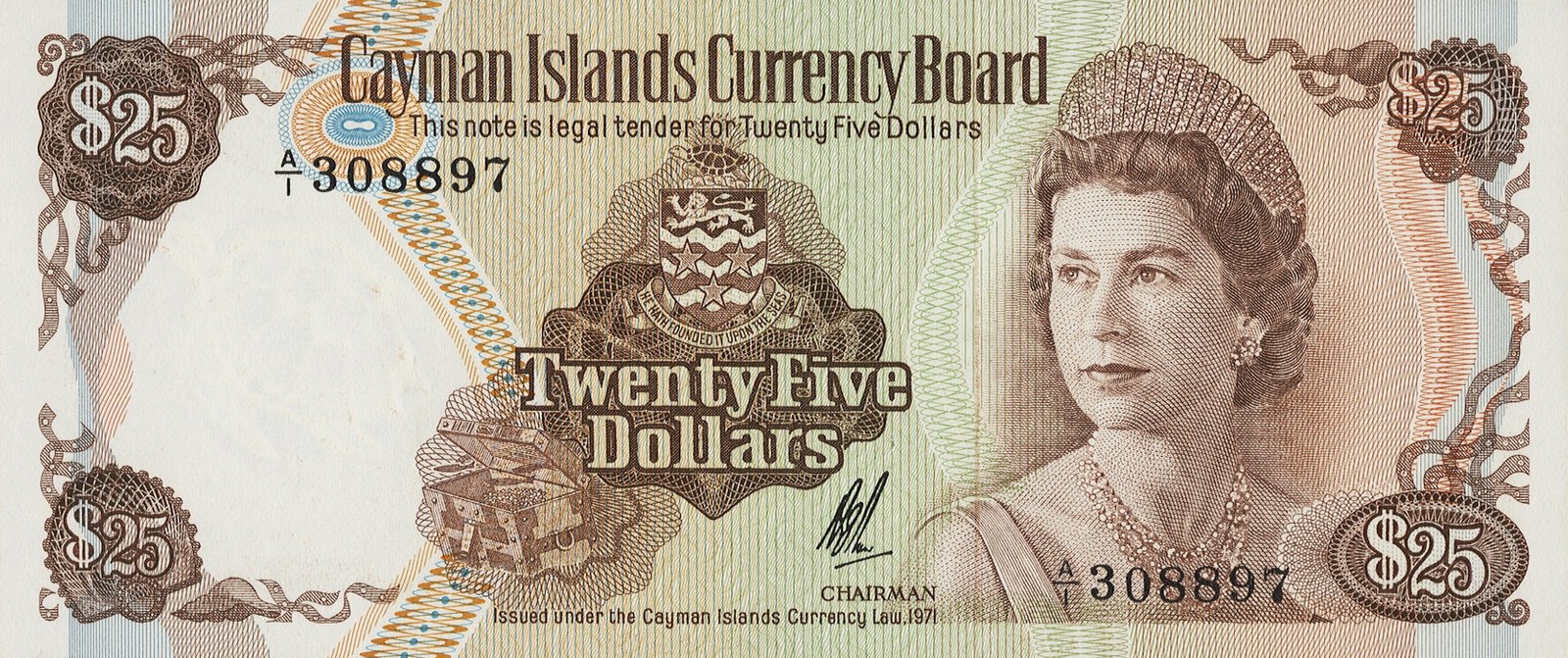
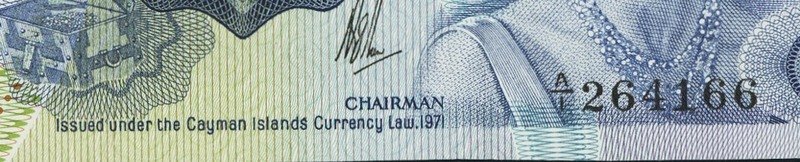
The first issue has four values: the 1 dollar, the 5 dollars, the 10 dollars and the 25 dollars. All were printed by De La Rue and each carries one signature, over CHAIRMAN. The law line at the foot of the front ends "Currency Law, 1971". Johnson signs every note.
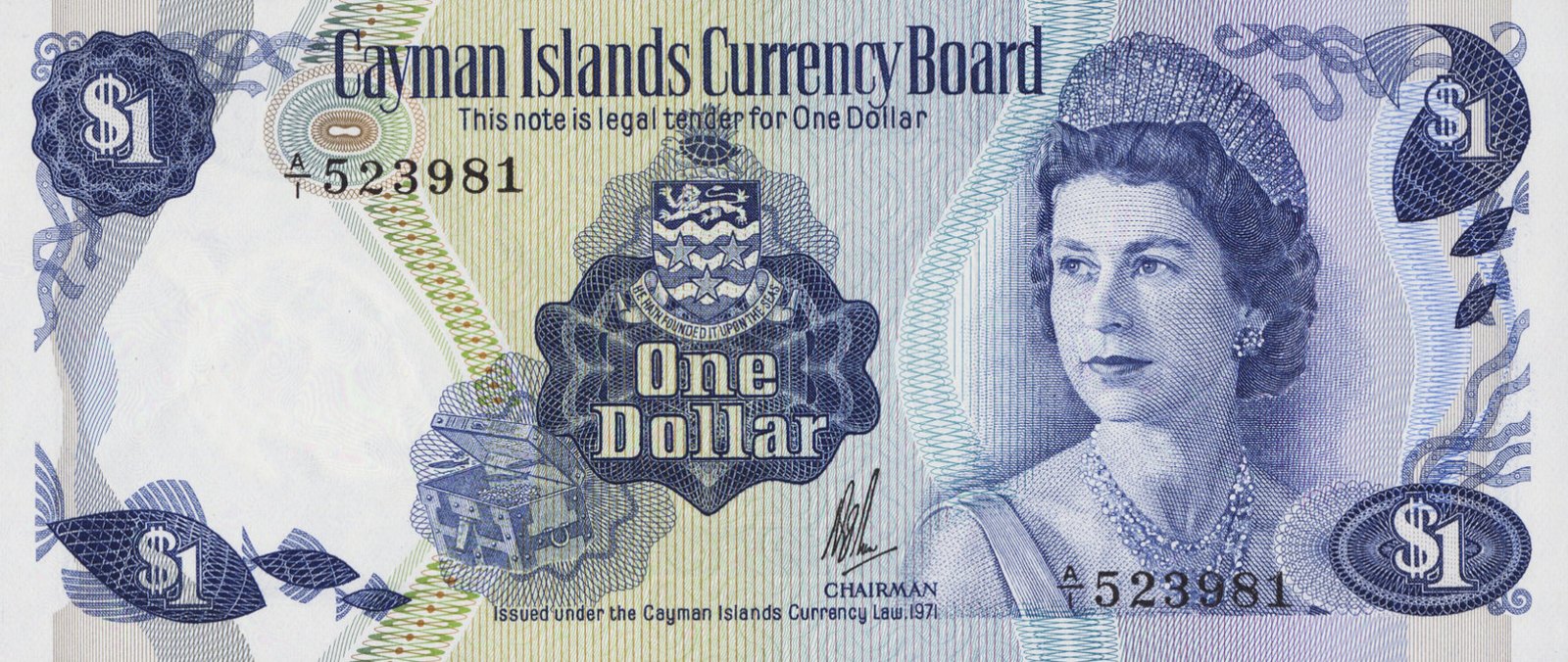
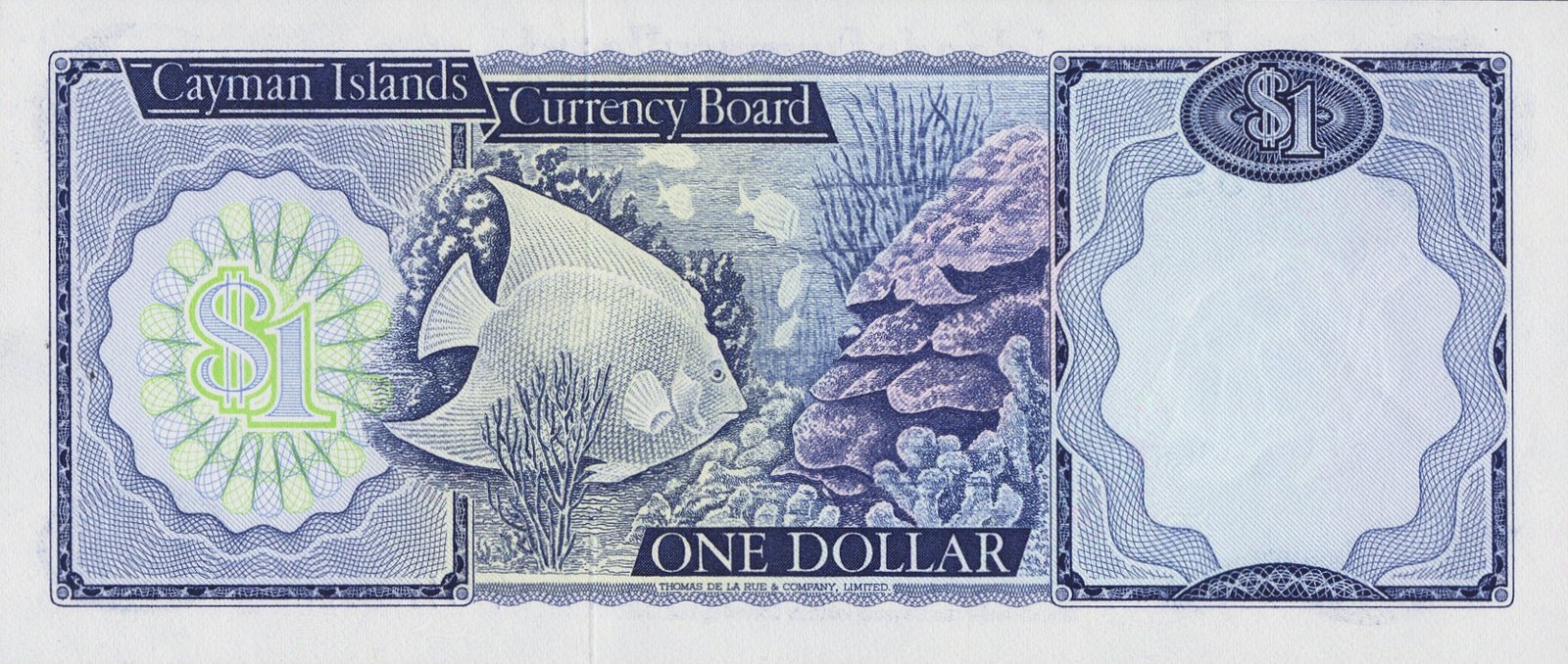
Sources mention that the notes of the 1971 and 1974 laws were designed at De La Rue by Ted Blackman. The portrait of the Queen is by Anthony Buckley; sources mention that it follows a photograph of October 1960 and was engraved by Stanley Doubtfire of De La Rue.
The Gazette shows who sat on the Board. The issue of 3rd February 1975 lists V. G. Johnson, Financial Secretary, as Chairman, with A. J. T. Williams and D. V. Watler as members, and the list of 1st January 1978 is the same. The half-yearly accounts were signed by the Chairman in 1975 and by the Board's Manager from the accounts of 31st December 1977, when the Manager was P. B. Balls.
The notes of the Currency Law, 1974
A second law, the Currency Law, 1974, is Law 1 of 1974 in the Gazette. The old designs went on under it, with the law line changed to end "Currency Law, 1974": the 1 dollar, the 5 dollars, the 10 dollars and the 25 dollars. The catalogue dates the first notes of this law to 1981. The Gazette cannot show the law line of a note, but it shows no new value in the years it covers: every statement of the Board from 30th June 1975 to 31st December 1977 lists notes of 1, 5, 10 and 25 dollars only, and the statements of 30th June 1978 to 30th June 1981 were not in the pages read.

Three values were added under the 1974 law.
- The 40 dollars was issued under this law only. Sources mention it coming out in October 1981, partly to fit the shop rate at which 50 US dollars went for 40 Cayman dollars; traders and banks disliked it. It is signed by Johnson and runs under prefix A/1.
- The 100 dollars came out in 1981 with the forty dollars, while Johnson was still in office. Its back shows George Town Harbour from the air.
- The 50 dollars is signed by Jefferson. It is blue, with an old Caymanian cottage on the back. Sources mention that it was added to fill the gap between the 25 and 100 dollars, as the 40 dollars was not accepted.
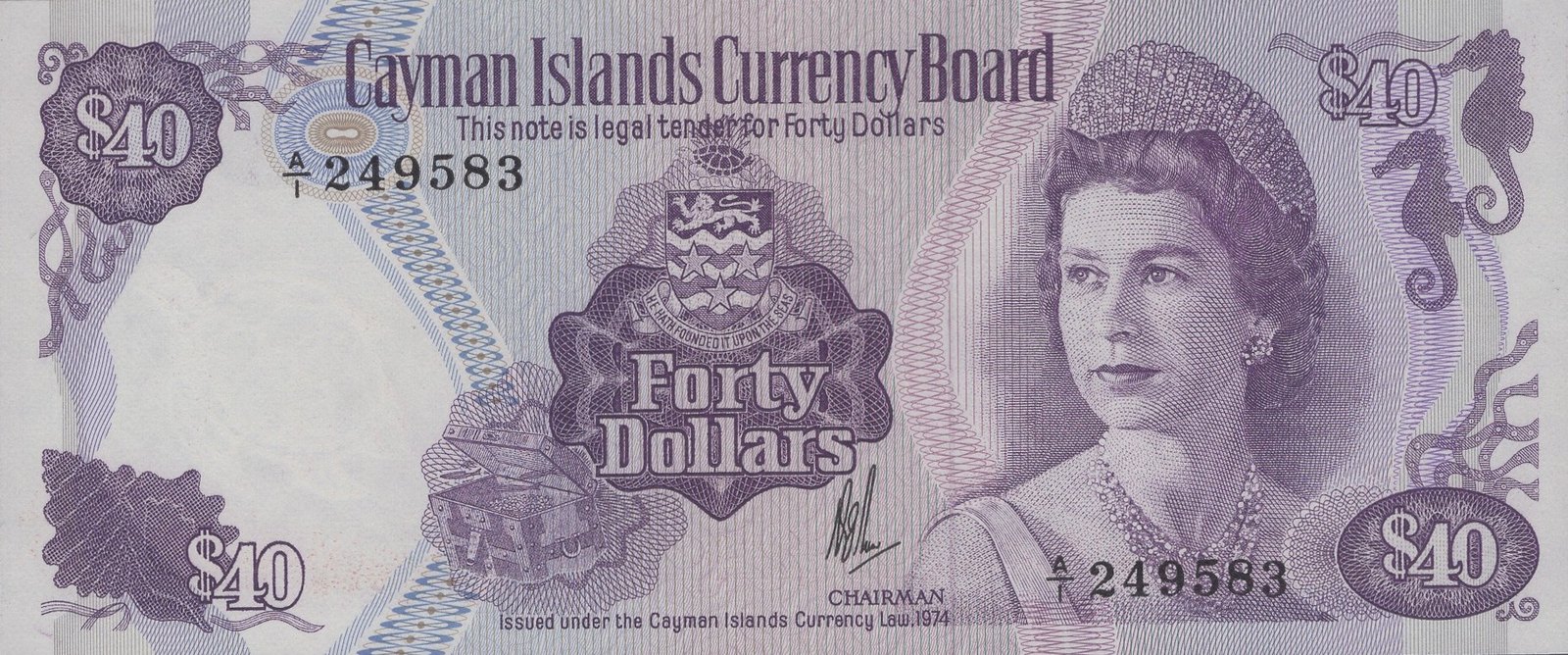
The year of the fifty dollars is given three ways. The catalogue dates the note 1986. Sources mention 1987, and a table in the Monetary Authority's report for 1998 gives 1987 as well. The Monetary Authority's page on the currency says the 50 dollars was issued in 1985. The Gazette cannot settle it: from the accounts of 31st December 1983 the Board gave its notes as one total. The same page of the Authority and the same table of 1998 agree on 1981 for the 40 and 100 dollars, and the Board's accounts of 31st December 1981 are the first found that list both.
The Currency Law was published in revised form in 1983, under an authority of 8th March 1983. As the Gazette prints it, the Board is the Financial Secretary and two other persons, and the Financial Secretary is Chairman by virtue of that office. It keeps the notes of the repealed law of 1971 as currency notes, and it lets the Governor, by proclamation, declare that notes shall cease to be legal tender. No such proclamation was found in the Gazette pages read, to 1996. A short amending law, Law 14 of 1985, assented to on 27th June 1985, made it an offence to deface a currency note.
Who signed for the Currency Board
Every Currency Board note has one signature, that of the Chairman, who was the Financial Secretary.
- Johnson signs the 1972 notes and the 1981 printings of the 1974 law: the 1 dollar with prefix A/3, the 5, 10, 25, 40 and 100 dollars.
- T. C. Jefferson signs the 1985 printings of the 1 dollar, the 50 dollars and the whole 1991 series. The Gazette of 8th February 1982 has Thomas Jefferson appointed to act as Financial Secretary from 1st April 1982, and the Gazette of 1st October 1984 calls Thomas C. Jefferson the Financial Secretary.
- McCarthy signs the 1996 series. The page of the 1996 one dollar says McCarthy became Financial Secretary on 1 April 1992. The Gazette of 28th June 1982 shows G. A. McCarthy ten years earlier, signing the Board's accounts as Auditor of the Cayman Islands Government.
The 1991 series
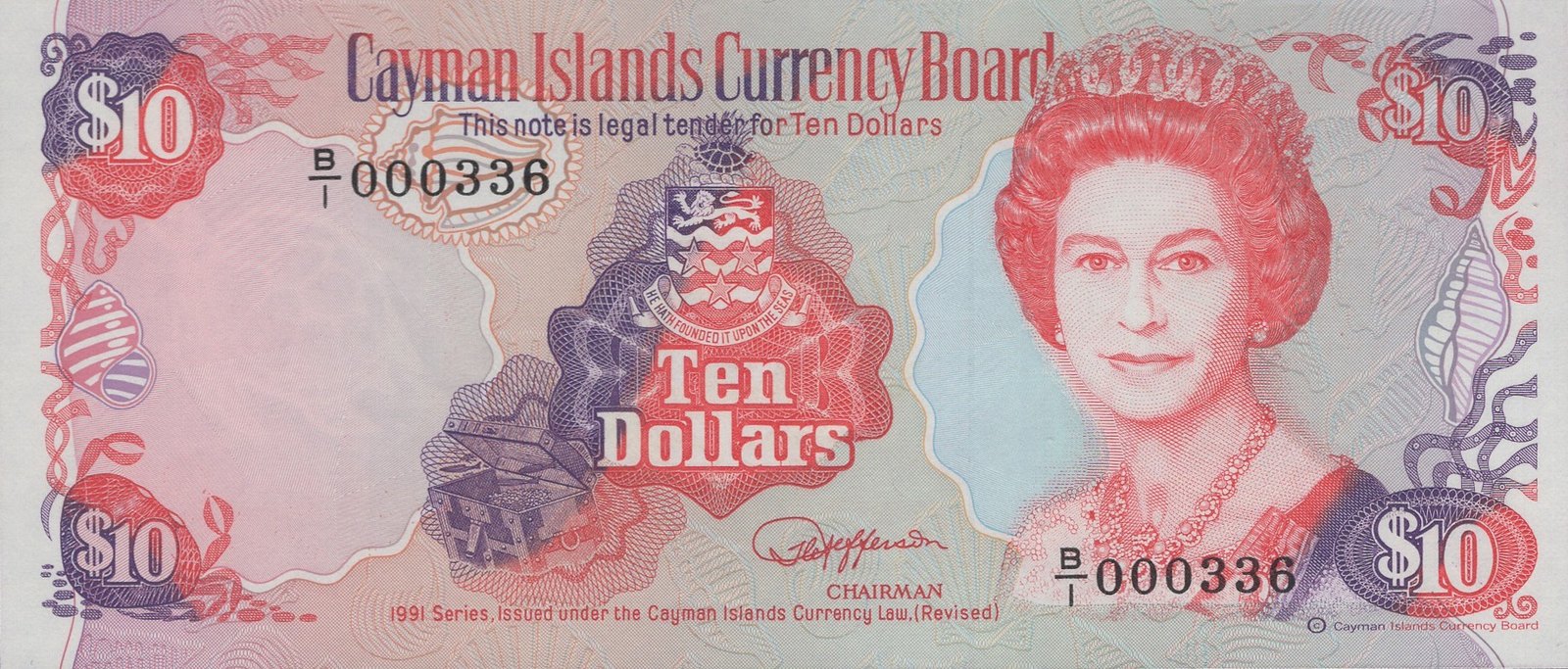
The 1991 series was the first change of design. It has four values: the 5 dollars, the 10 dollars, the 25 dollars and the 100 dollars. The 1991 series has no 1 or 50 dollars; sources mention that stocks of those were still adequate. It adds a second colour to each value, red on the 5, violet on the 10, orange on the 25 and brown on the 100, a new portrait of the Queen and a copyright symbol front and back. Sources mention that the portrait follows Peter Grugeon's 1977 Silver Jubilee photograph, engraved by De La Rue.
The series line at the foot of the front reads "1991 Series, Issued under the Cayman Islands Currency Law (Revised)". The prefix is B/1 and the signer is T. C. Jefferson. The ten dollars exists in two colour states of the back, which its page shows side by side.
The Board's accounts in the Gazette show a "Currency Issue Reserve" of 400,000 dollars for the first time on 31st December 1990, just before this series. The accounts do not say what the reserve was for.
The 1996 series
The 1996 series repeats the 1991 designs with the signature of McCarthy and adds a 1 dollar; sources mention two million one dollar notes, B/1 and B/2. The other values are the 5 dollars, the 10 dollars, the 25 dollars and the 100 dollars. On the 1996 printing the serial digits grow from 2 mm high on the first to 5 mm on the sixth, and the metallic thread reads CAYMAN ISLANDS repeatedly. On the ten dollars the red and purple inks also changed places.
Part of the 1996 ten dollars was printed on a trial paper under prefix X/1. That note, the specimen sets and the unadopted designs have an article of their own.
The Monetary Authority's report for 1997 puts the notes in circulation at the end of 1996 at 13.6 million dollars in hundreds, 6.4 million in twenty-fives, 2.8 million in tens, 1.7 million in fives and 2.9 million in ones. The figures of every year are in the article on circulation.
The Monetary Authority and the C series, 1998 to 2006
The Gazette Extraordinary of 18th September 1996 published the Bill to establish the Cayman Islands Monetary Authority and to transfer to it certain functions and assets of the Government and of the Currency Board. The text of the Bill was not in the pages read. The notes that followed cite the Monetary Authority Law, 1996.
The Authority's report for 1997 says it had ordered a new family of notes from De La Rue, which it called the "C" series. The designs are those of 1996 with the Authority's name in the heading. The notes carry no printed date: the series line reads "1998 Series, Issued under the Monetary Authority Law, 1996". The metallic thread is now windowed, and the initials CIMA sit above the turtle watermark.
The 1 dollar, the 5 dollars and the 10 dollars were put into circulation in August 1998. The 25 dollars, with a turtle embossed in gold foil, and the 100 dollars, with a hologram in the shape of a schooner, followed in July 1999 by the Authority's report for 1999. The Authority's web page on circulating banknotes says August 1999. The report for 1998 adds that leaflets on the new notes were issued and that De La Rue held a workshop for banks and police.
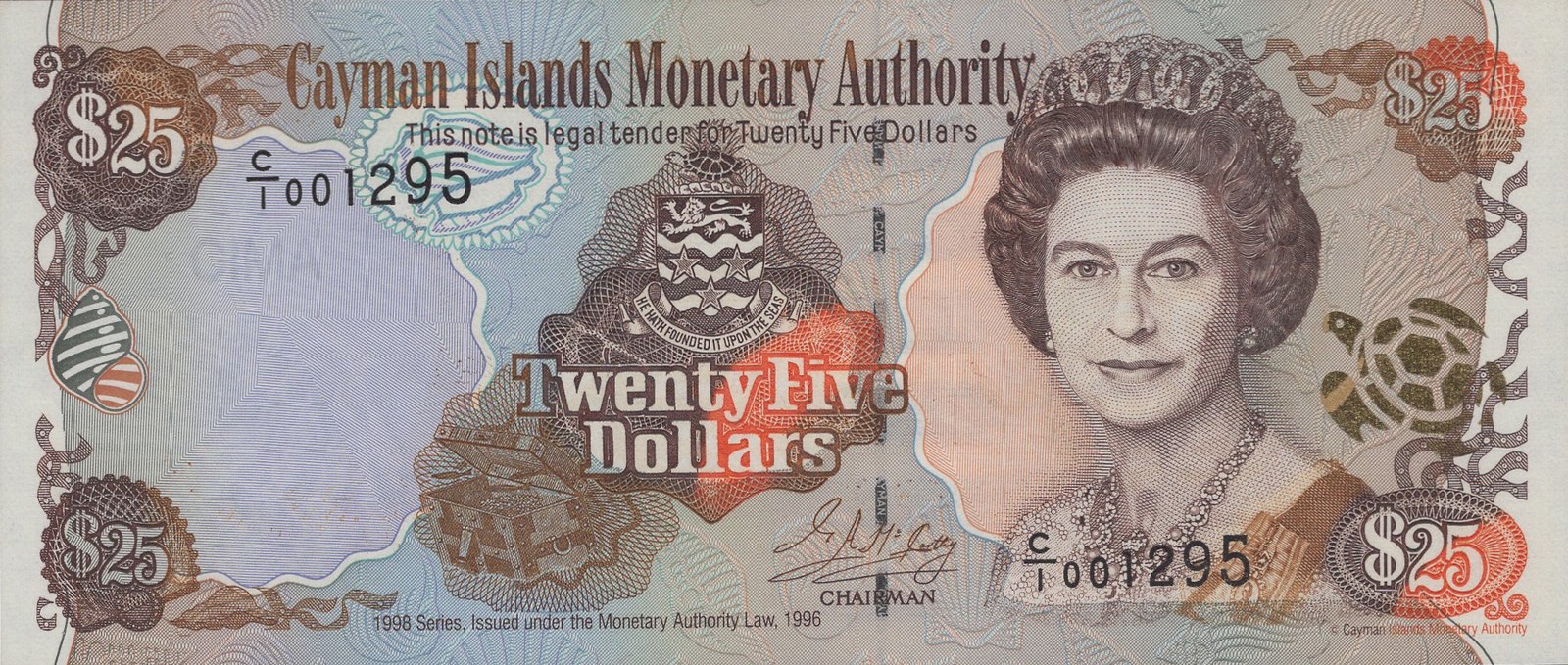
Later printings of the C series changed the series line and little else:
- 2001: the 1 dollar, the 5 dollars and the 10 dollars. The Authority's report for 2001 says these were reprinted to refill stocks and that the only change was the law line. The 50 dollars of 2001 was printed to bring that value up to the security features of the rest of the series, as a three-year supply first planned for 2000 and delayed to 2001. Its green front and blue back led people to mistake it for the 5 or the 1 dollar.
- 2003: the 25 dollars and a 50 dollars in changed colours, and the 1 dollar for the 500th anniversary of the discovery of the islands, with prefix Q/1.
- 2005 and 2006: the 1 dollar, the 5 dollars, the 10 dollars, the 25 dollars and the 100 dollars. This printing was ordered in the year to June 2005 and delivered in the year to June 2006. Watermarks were added in the four corners, meant to make the notes resist corner folds and to serve as a further security feature. The Monetary Authority's reports call these corner watermarks by their maker's name, Cornerstone. The report for the year to June 2006 adds that a reserve stock of notes was placed overseas from May 2006.
One signature becomes two
The notes of 1998 and 2001 carry one signature over CHAIRMAN, that of McCarthy. From 2003 there are two, over FINANCIAL SECRETARY and MANAGING DIRECTOR. The Authority's report for 2002 gives the background: under the 2002 Revision of the law the Financial Secretary was no longer to sit on the board of directors from January 2003. The Authority's web page on circulating banknotes puts it plainly: notes issued before 2003 bear the signature of the Chairman of the Board alone, and notes issued from 2003 to 2009 those of the Financial Secretary and the Managing Director.

Cindy Scotland, who signs as Managing Director, was appointed in June 2002, after Jennifer Dilbert had acted from January (Monetary Authority annual report for 2002). The same report says John Bourbon had resigned as Managing Director. On the 2003 notes Scotland signs with McCarthy. On the 2005 and 2006 notes Scotland signs with Jefferson: sources mention this Jefferson as Kenneth Jefferson, Financial Secretary from 1 November 2004, a different man from T. C. Jefferson of the 1985 to 1991 notes.
The D series, 2011 to 2024
The D series was the first full redesign since the currency began in 1972. The Monetary Authority's reports say the redesign was approved by Cabinet in its year 2006-07 and that the notes were designed and printed by De La Rue. The reports of 2009 and 2010 expected the series in 2010 and then in the year to June 2011.
It came out in stages: the 5 dollars and the 25 dollars in the week of 4th April 2011, the 1 dollar and the 50 dollars in July 2011 and the 10 dollars in September 2012. The 100 dollars was still not in circulation in mid-2014, and the reports for the years after say nothing of its release.
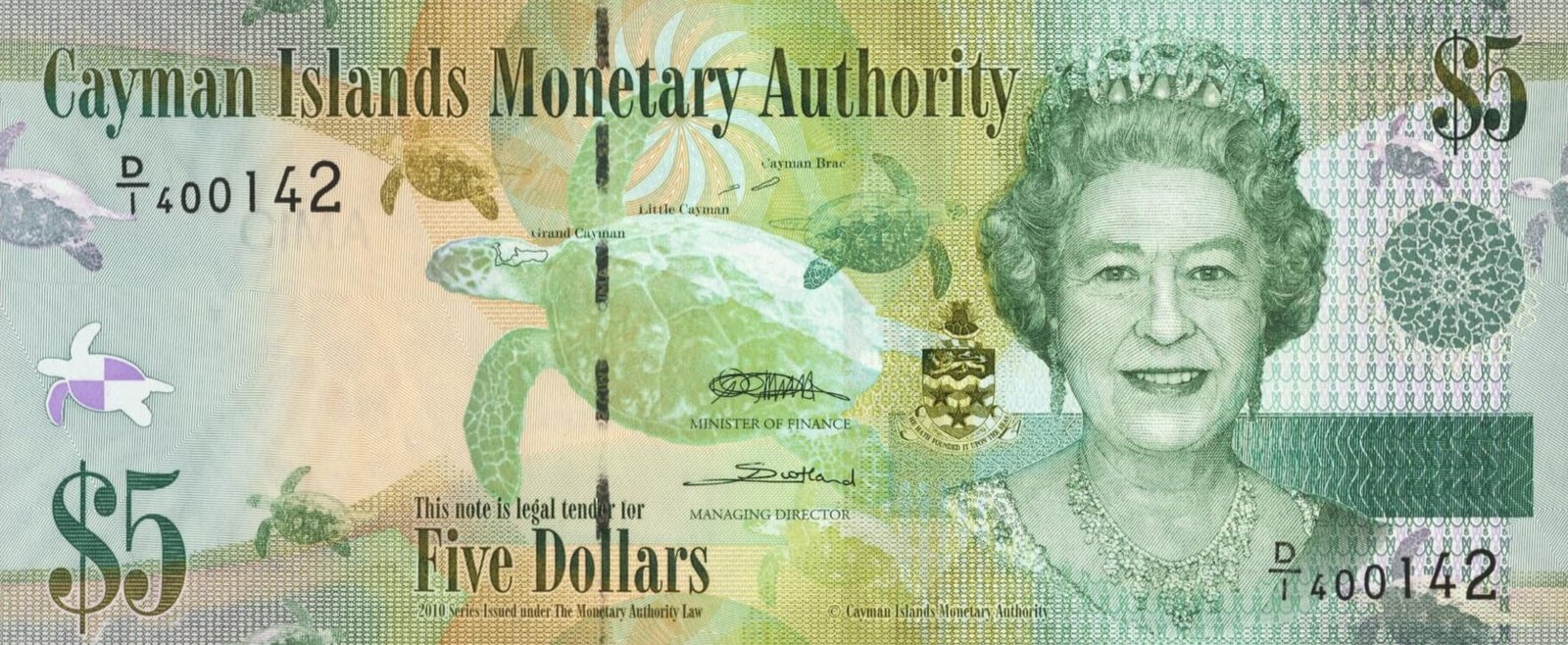
The Authority's notice of 30 March 2011 says that all notes issued before continue to be legal tender, that the colours of the C series were kept except on the 50 dollars, now mainly purple, and that every value now shows an outline of the three islands. It also explains the signatures: the Minister of Finance signs in place of the Financial Secretary, following the Constitution of 2009. The Minister's signature dates each printing: Bush on the notes of the 2010 series, Archer on 2014, McTaggart on 2018 and O'Connor-Connolly on 2024. The reports never name these later printings. The series year of the O'Connor-Connolly notes of 25, 50 and 100 dollars is not yet settled on the note pages.
The Monetary Authority's accounts put all its notes in circulation at 79.0 million dollars in June 2012, 114.4 million at the end of 2018 and 165.7 million at the end of 2025. Its reports for 2024 and 2025 say a new family of notes was being designed, and that work had begun on notes with the portrait of King Charles III.
Commemorative notes, 2003 to 2023
- 1 dollar, 2003. The 500th-anniversary one dollar carries the emblem CAYMAN ISLANDS 500, 1503-2003. The notes Q/1 000001 to Q/1 004000 were sold in a folder with a certificate and released on 10 February 2003; the notes for circulation were put out between July 2003 and June 2004.
- 1 dollar, 2018 series. The one dollar for the 60th anniversary of the first written constitution was printed by Crane Currency in December 2019. It is the only note of the islands for which the catalogue names a printer other than De La Rue. It was handed out at the National Heroes Day celebrations on 27 January 2020 and entered circulation the next day. The Authority's report for 2019 says Cabinet asked for the note, and that the paper was a more durable one the Authority was trying.
- 25 and 50 dollars, 2022 series. The 25 dollars and the 50 dollars for the 25th anniversary of the Monetary Authority have the designs of the regular notes with a hologram patch beside the portrait. The Authority's notice of 20 February 2023 says the 50 dollars had gone to the retail banks the week before and that the 25 dollars would follow. The annual report for 2022 speaks only of an anniversary coin.
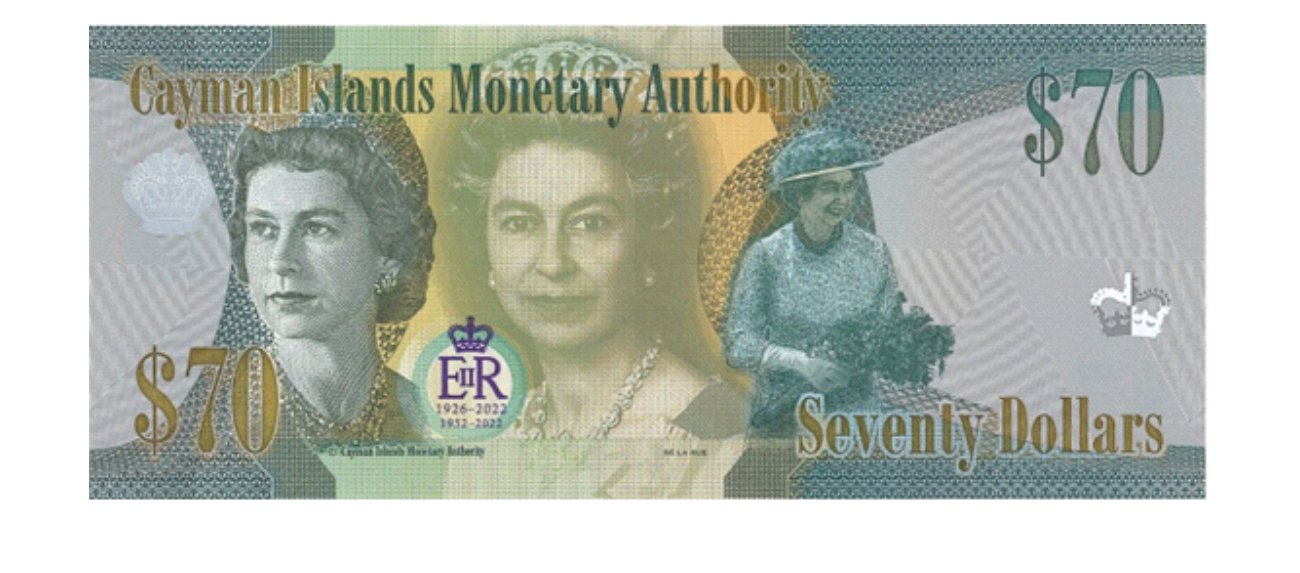
- 70 dollars, 2022 series. The 70 dollars was unveiled in October 2023, a year after the Queen's death, to mark the Platinum Jubilee. It carries three portraits of the Queen, one from the visit to the Cayman Islands in 1983. The annual report for 2023 says only 10,000 were produced by De La Rue. The Authority's notice of 12 October 2023 says the note would not enter general circulation and was sold at the Authority's currency office, at most ten to a buyer.
What the sources leave out
- No source read gives the day on which any Currency Board note after 1972 was first issued. The Gazette shows the 40 and 100 dollars only as figures in the accounts.
- No report or Gazette page read says that any note has been called in, the forty dollars included.
- The Monetary Authority's reports for 2003 and 2004 were not to hand, so the release of the 2003 notes rests on the note pages alone.
- The numbers printed are not given in the reports, apart from the 10,000 of the 70 dollars. The figures on the note pages come from other sources, and the pages say so.
Sources
- The note pages of the Cayman Islands in this catalogue, P-1 to P-W47.
- Cayman Gazette, 1975 to 1996: the lists of the Currency Board of 3rd February 1975 and 1st January 1978; the Board's half-yearly accounts from 30th June 1975; the acting appointments in the issue of 8th February 1982; the issue of 1st October 1984; the Currency Law (Revised) of 1983; Law 14 of 1985; the Gazette Extraordinary of 18th September 1996.
- Cayman Islands Monetary Authority, annual reports for 1997 to 2002 and for the years ended June 2005 to December 2025.
- Cayman Islands Monetary Authority, web pages "Currency" and "Circulating banknotes", and the notices of 30 March 2011, 20 February 2023 and 12 October 2023 (addresses above).


Member comments
Log in or register to post a comment.