For most of the years this catalogue covers, the place of honour on a note of a British territory belonged to the sovereign. From the 1950s that place came into question. As territories moved to self-government and independence, the printers were asked for, or offered on their own account, designs in which someone or something of the country stood where the Queen's portrait had been: a political leader, a figure from the country's history, an animal, a boat, a building, or nothing at all.
The design archive of this catalogue holds a good many of those designs. This article goes through them territory by territory and says of each what the archive's own record says became of it: issued, changed, or dropped. It names the people shown as the archive names them and adds nothing about them from outside. Where the record does not say who a portrait shows, or why a design was set aside, that is said. Dates printed on a design are written as "20th September 1958"; dates pencilled or inked on a piece are given as they are written, "15.3.68".
The designs that kept the King or the Queen and were never issued are the subject of two other articles; they come in here only where they belong to the same story.
Malaya and British Borneo: Tunku Abdul Rahman, a tiger and a sailing boat
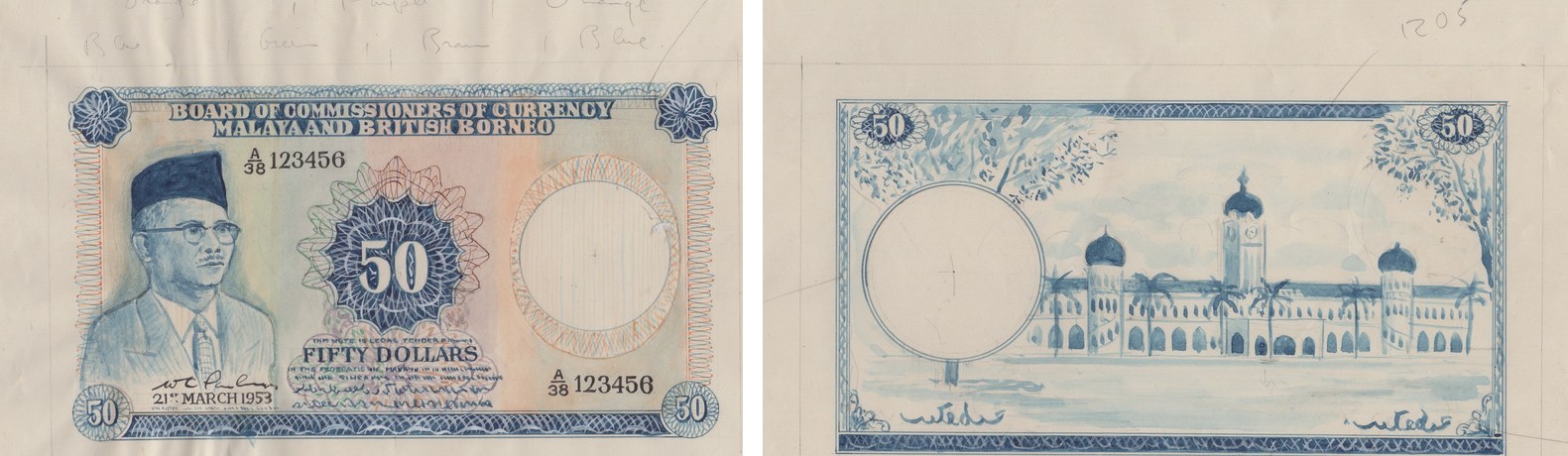
The notes of the Board of Commissioners of Currency, Malaya and British Borneo, dated 21st March 1953 carry Queen Elizabeth II at the right. The archive records a run of designs made to follow them.
The earliest by its date is a pair of paintings for a 50 dollars, in watercolour and ink on large paper. The front is dated 21st March 1953 and has Tunku Abdul Rahman, in a songkok and spectacles, at the left in place of the Queen, with the number A/38 123456 and Taylor's signature. The printer's colour scheme is pencilled along the top. The back shows the Sultan Abdul Samad Building in Kuala Lumpur among palms, with DEEP BLUE pencilled in the margin. The date is that of the notes then in use; the archive gives no date for the painting itself.
The same subject returns in 1958. A pair of drawn essays for a 50 dollars dated 20th September 1958 has Tunku Abdul Rahman at the centre of the front and the same building on the back. They come from the papers of a designer at Bradbury Wilkinson. Photographs of a 10 dollars of the same date show Tunku Abdul Rahman at the right, and on the back the Istana Negara, the royal palace in Kuala Lumpur; a second print of the front was once bound into an album.
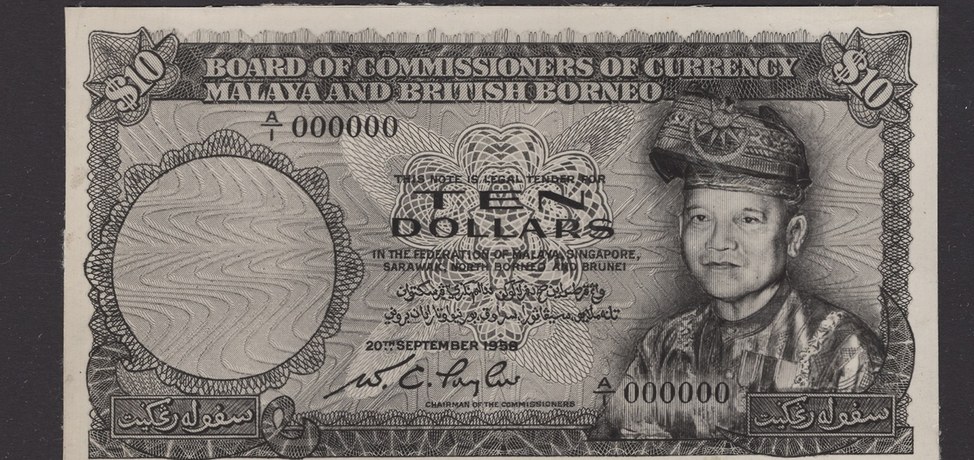
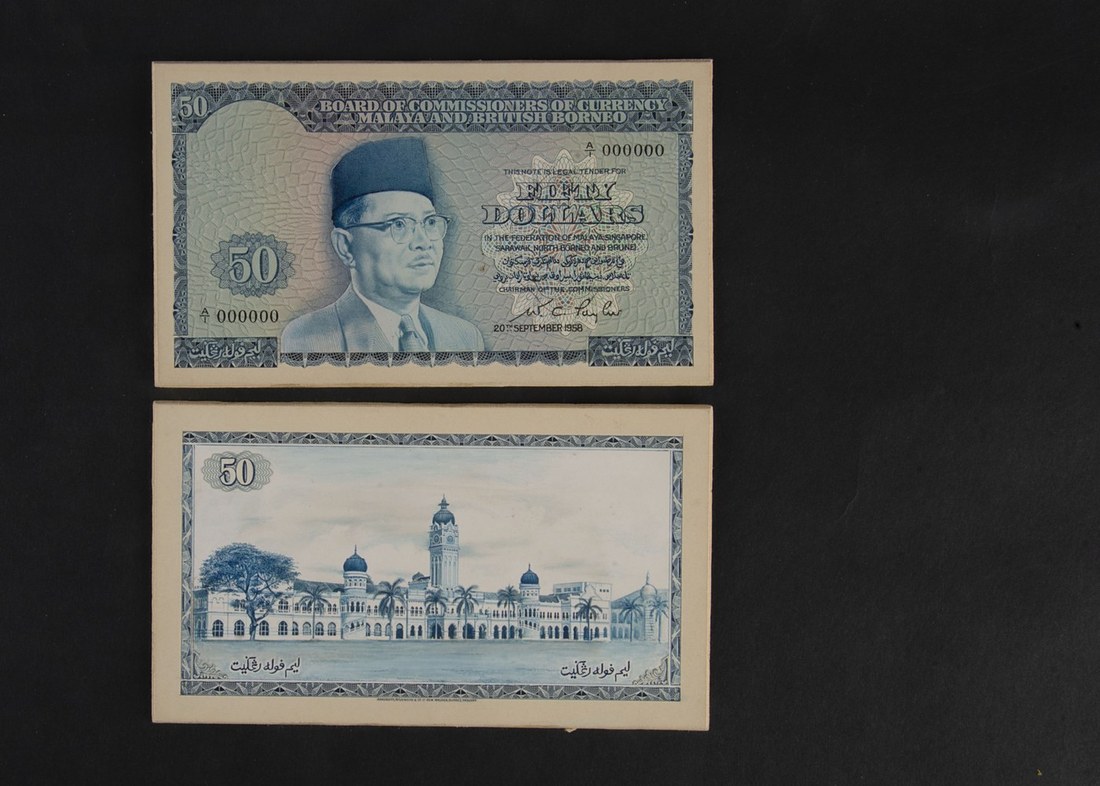
These were part of a larger scheme of 1958. In the photographs kept by Bradbury Wilkinson that are listed here, no value carries the Queen:
| Value | Date on the design | Front | Back |
|---|---|---|---|
| 1 dollar | 20th September 1958 | The crest of the Federation of Malaya | Two views of the independence ceremony in the stadium |
| 5 dollars | 20th September 1958 | A snarling tiger's head | A tractor, a papaya tree, long buildings and stacked logs |
| 10 dollars | 20th September 1958 | Tunku Abdul Rahman | The Istana Negara |
| 10 dollars | 21st March 1958 | No portrait: ornamental panels only | A tin dredger on a lake |
| 50 dollars | 20th September 1958 | A sambar stag | Three elephants |
| 100 dollars | 21st March 1958 | Four mouse deer | A sea eagle |
| 1,000 dollars | 20th September 1958 | Water buffalo and a gaur | An elephant and the arms of the five territories |
| 10,000 dollars | 20th September 1958 | A prowling tiger | The arms of the five territories |
A separate set of the same year, for a Board of Commissioners of Currency of Sarawak, Brunei and North Borneo, keeps the Queen.
What became of them: none was adopted. The archive's note is that the Board's actual issue of 1959 was the 1 dollar with a sailing boat. That 1 dollar of 1st March 1959 and the 10 dollars of 1st March 1961, with a farmer ploughing behind a water buffalo, were the Board's last two designs, and neither has a portrait of anyone. So the Queen did leave the Board's notes, but for a boat and a buffalo, not for a person.
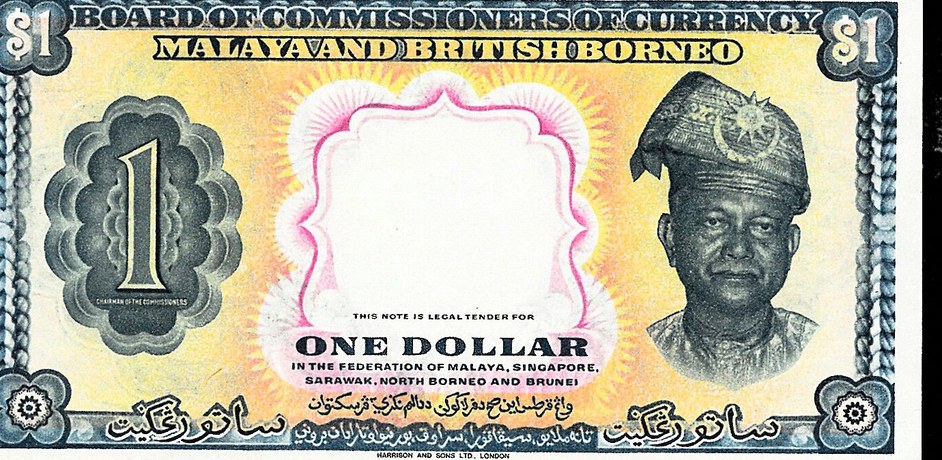
One more firm tried the portrait. Harrison and Sons of London, who printed stamps for the region and, in the archive's words, appear to have been seeking a banknote contract, made a 1 dollar in blue and yellow with Tunku Abdul Rahman at the right in place of the Queen, in the layout of the 1953 notes. Six examples are recorded, and a paste-up of the same design on board, with pencil notes on tone and colour. It was never adopted; the Board's notes were printed by Waterlow and De La Rue.
Jamaica: from "no portrait" to four portraits in eighteen months
Jamaica has the fullest record of the change, because the photographs made at each stage of the decimal notes were kept, dated and, at the last stage, lettered.
The Bank of Jamaica's notes in pounds, first put out in 1961, carry Queen Elizabeth II. The photographs for the dollar notes fall on three dates.
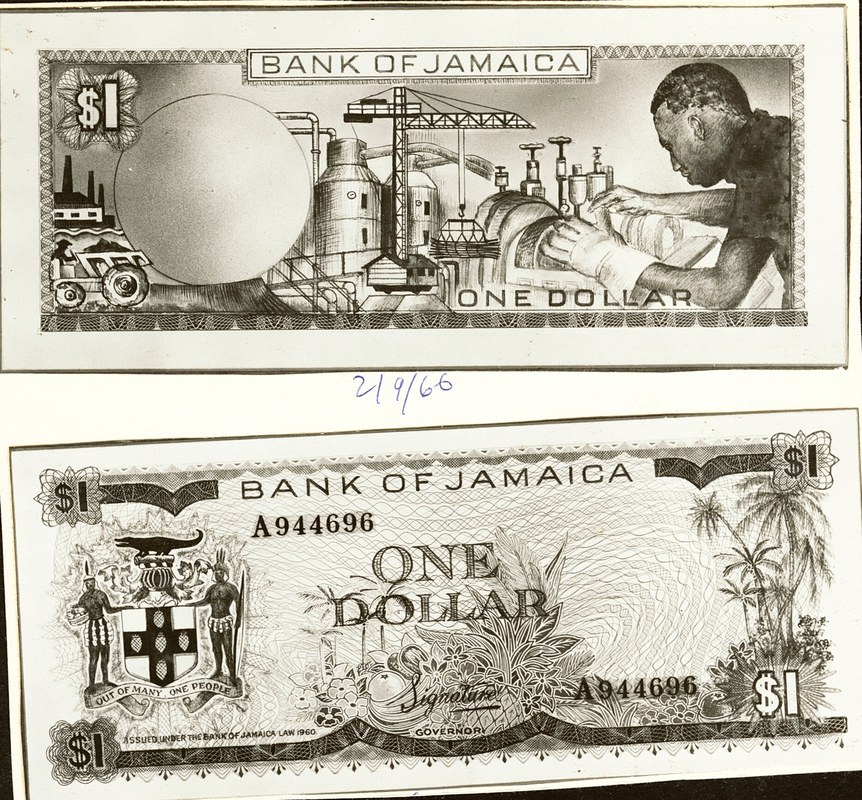
2/9/66. The earliest 1 dollar has no portrait at all: the arms at the left, ONE DOLLAR over fruit and flowers, palms at the right. Its back is a factory with a worker at a machine. The 5 dollars and the 10 dollars photographed with the same pencilled date both have the Queen (one of the two pencillings on the 5 dollars can also be read 2/4/66).
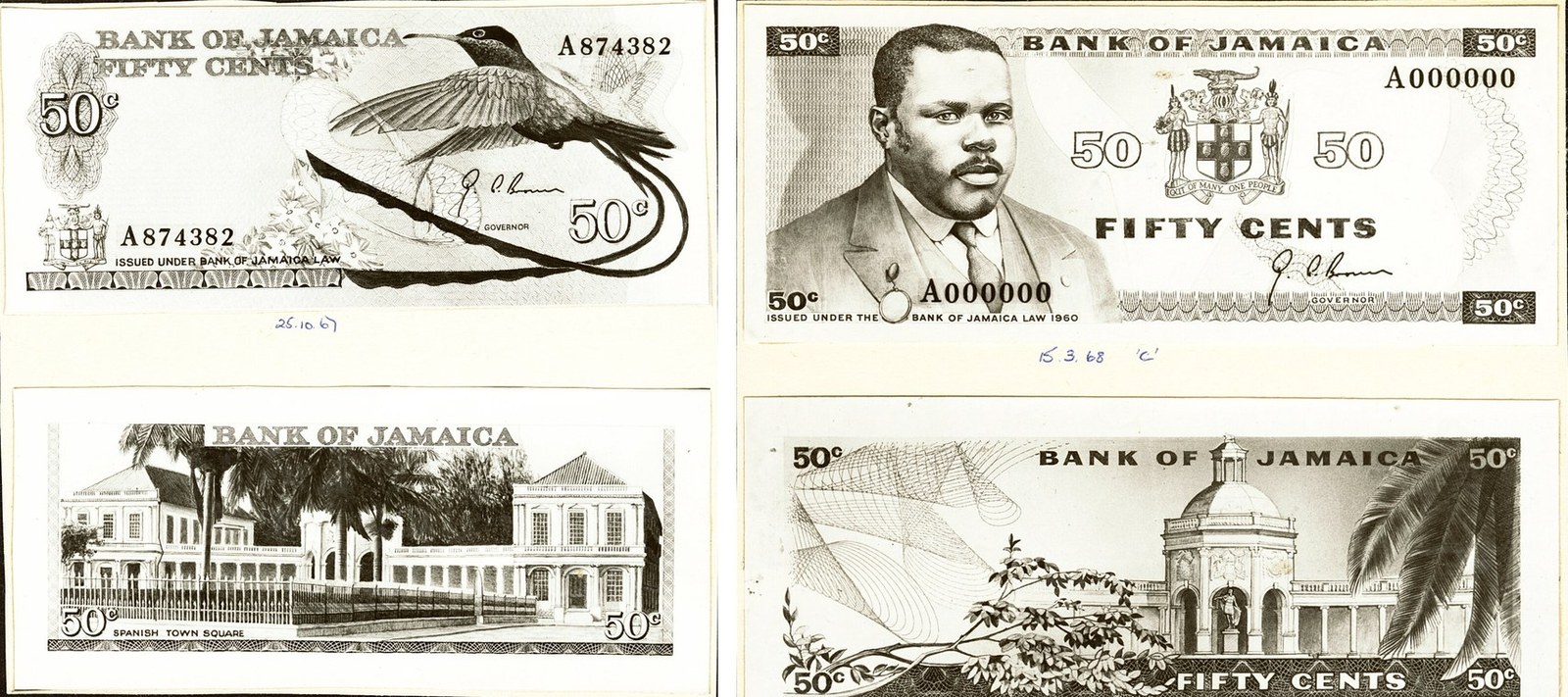
25.10.67. A year later the 2 dollars and the 10 dollars still have the Queen, in a tiara, at the right. The 50 cents has a streamertail hummingbird across the front and no portrait.
14.3.68 and 15.3.68. In March 1968 every value was photographed again with a Jamaican in the place of the Queen or of the blank, and where there was more than one version the photographs are pencilled A, B or C:
| Value | Portrait | A | B | C |
|---|---|---|---|---|
| 50 cents | Marcus Garvey | Garvey at left; the Rodney Memorial on the back | ||
| 1 dollar | Sir Alexander Bustamante | Portrait at left; the factory back of 1966 | Portrait at right; rafting on the Rio Grande | Portrait at left; a river scene |
| 2 dollars | Paul Bogle | Portrait at right; bauxite loading at Ocho Rios | Portrait at left; a sugar factory | |
| 5 dollars | Paul Bogle | Portrait at right; a woman carrying bananas, and a harbour | ||
| 10 dollars | George William Gordon | Portrait at left; a mining shovel | Portrait at right; Port Antonio harbour | Portrait at left; an alumina plant |
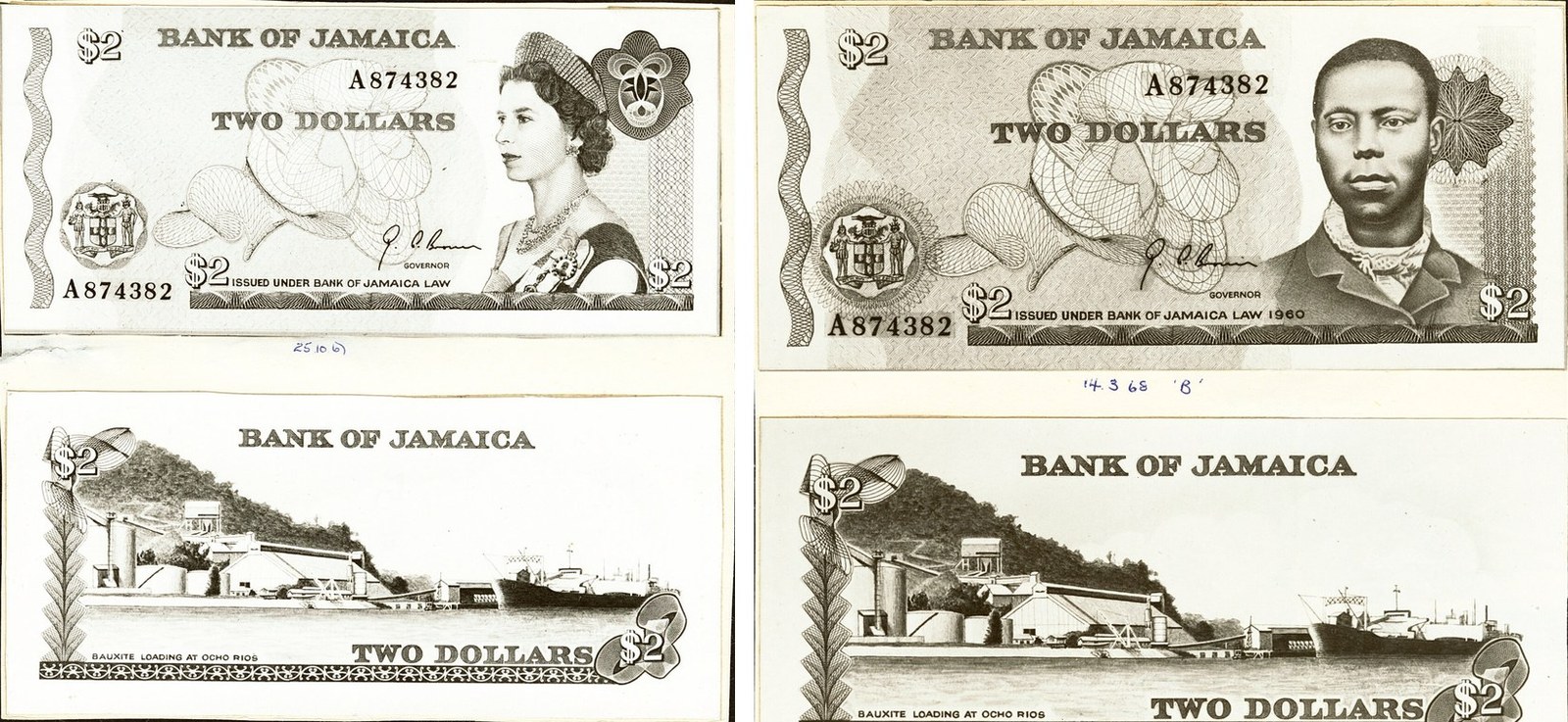
The photographs show how the change was made. Version B of the 2 dollars and of the 10 dollars is the layout of October 1967 with one head taken out and another put in: the frame, the arms, the number A874382 and the back are the same. Version A of the 1 dollar is the 1966 design with the portrait added. Version A of the 5 dollars is the 1966 design with Bogle in the Queen's round frame. Version C, on each value, is a fresh arrangement with the portrait at the left.
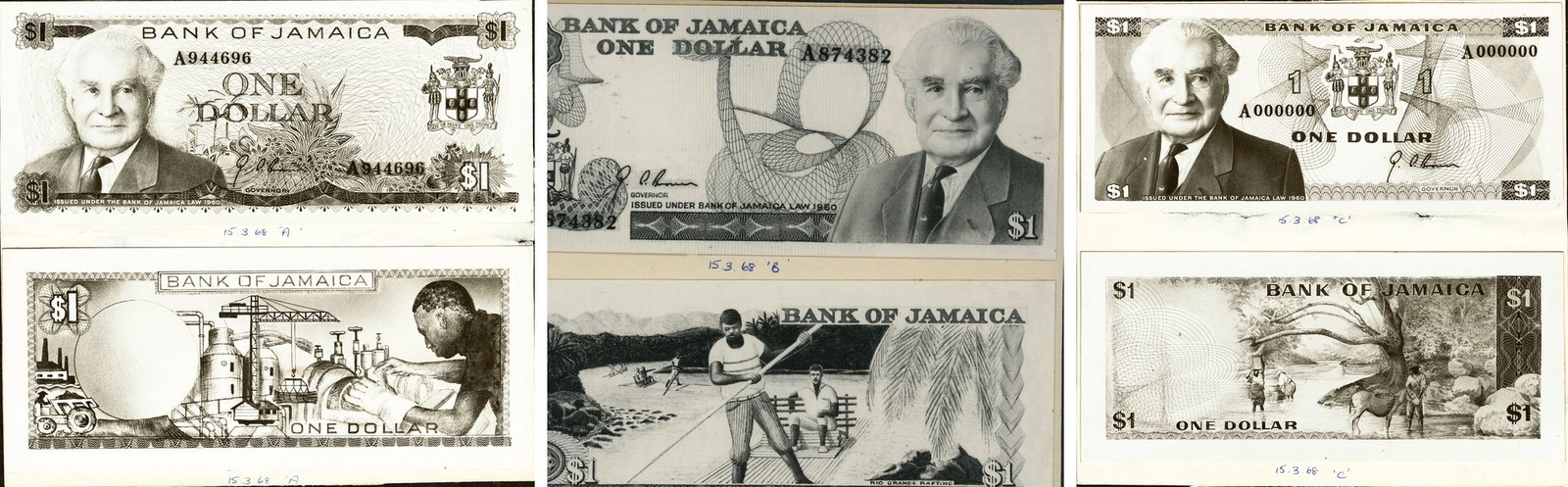
What became of them: the archive's notes on these photographs say that version C was the one that went forward. The 50 cents issued in 1970 has Garvey, not the hummingbird; the 1 dollar issued in 1970 has Bustamante at the left, as in C; the 2 dollars has Bogle at the left, as in C; the 10 dollars has Gordon at the left, as in C. The 5 dollars is the exception: the note issued in 1970 carries a different portrait from the Bogle of version A, and the archive does not record a later photograph of it. The notes of 1970 themselves lie outside the pages of this catalogue, which end for Jamaica with the notes in pounds.
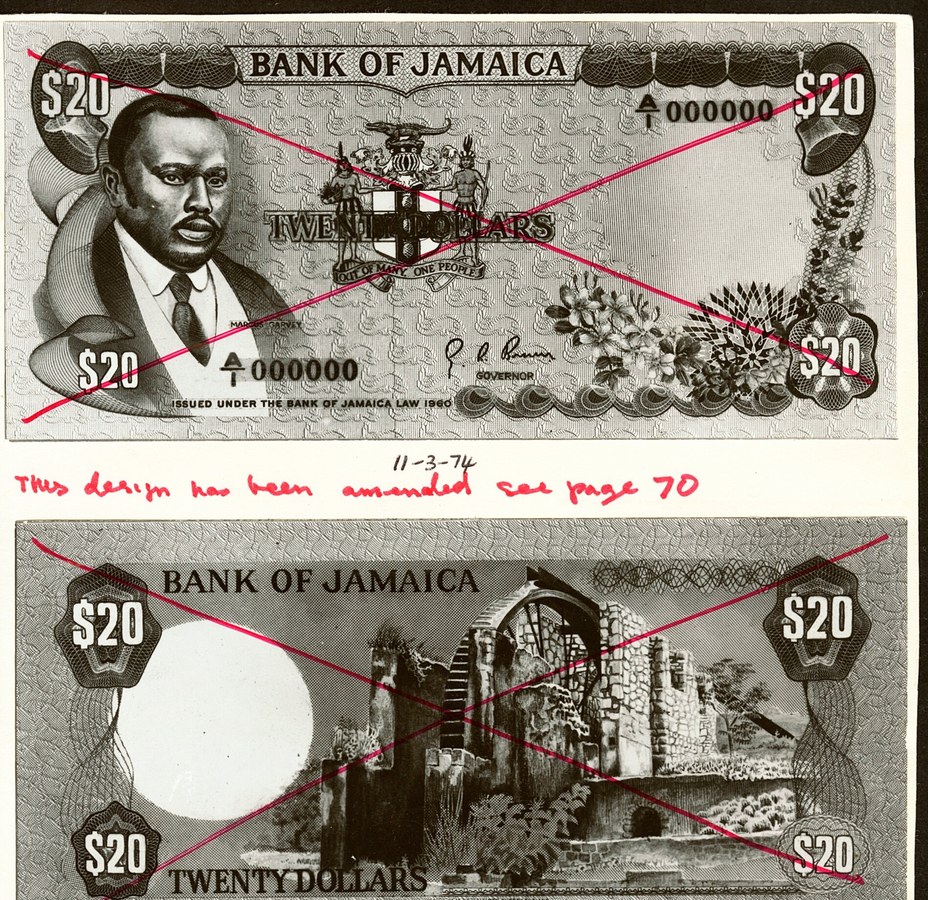
One later photograph shows that a design could still be sent back after the portraits were settled. A 20 dollars with Marcus Garvey, made by Bradbury Wilkinson, is crossed through in red on both sides, dated 11-3-74 and annotated "This design has been amended see page 70".
Trinidad and Tobago: A without, B with, and a man in dark glasses
Trinidad and Tobago became independent on 31 August 1962, and the Central Bank's first notes, issued in December 1964, carry the Queen at the centre. The archive's photographs show the bank being offered something else four years later.
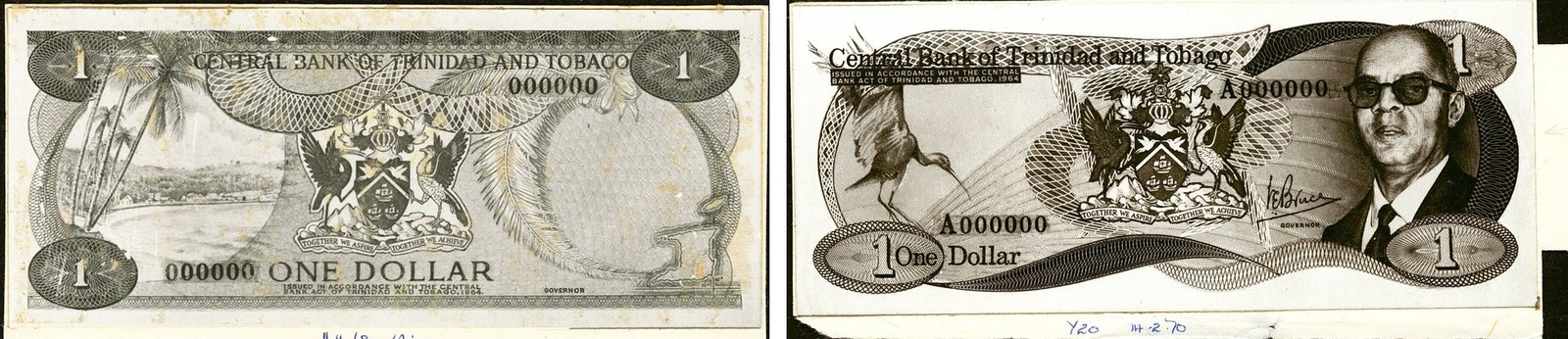
Two fronts for a 1 dollar are inked 11.4.68 and lettered. Proposal A has no portrait: a bay with palms at the left, the arms at the centre, and a map of the two islands at the right. Proposal B has the Queen at the right, the arms at the centre and a scarlet ibis at the left. A 5 dollars of the same date has no portrait either: two pelicans fly over a bay, and oil workers stand on a drilling-rig floor on the back.
Two photographs inked Y20 14.2.70 go further. A 20 dollars has the arms at the centre over a beach and no portrait. And a 1 dollar keeps the layout of proposal B, with the ibis and the arms, but a man in dark glasses takes the Queen's place at the right. A pencilled slip beside it reads "Different view of portrait submitted". The archive's record does not name the man, and this article does not guess.
What became of them: none was adopted. The notes of the 1964 design went on under three Governors, and the archive notes that the next 5 dollars was the design of the 1977 series, which lies outside this catalogue.
The Bahamas: a design for 1973
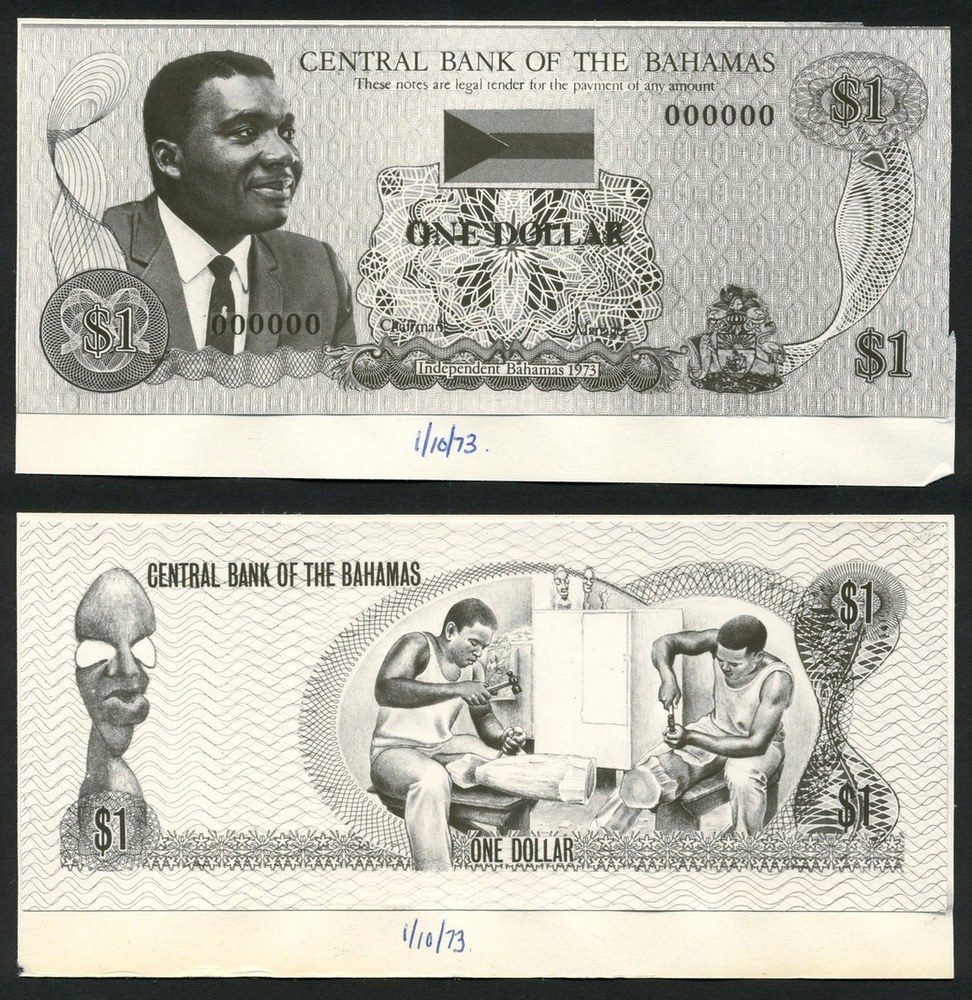
A pair of photographs dated 1/10/73 shows a 1 dollar for the Central Bank of The Bahamas with a portrait of Lynden Pindling at the left, the flag at the top centre and the words "Independent Bahamas 1973". The back has wood carvers at work. The archive describes it as a design made after independence in 1973.
What became of it: not adopted in this form. The Central Bank issued its first notes in 1974 and, as the archive puts it, carried over the artwork of the 1965 and 1968 series; the 1 dollar of 1974 has the Queen at the left.
Cyprus: Zeno in the Queen's frame
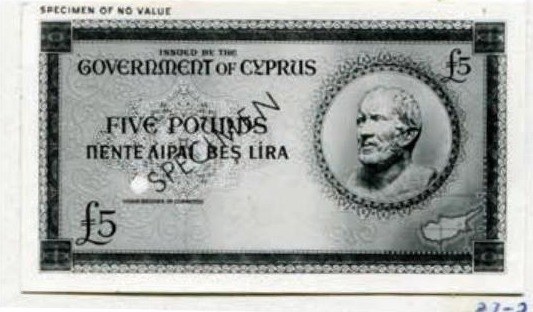
A photographic proof of a 5 pounds keeps the colonial layout whole, down to the title ISSUED BY THE GOVERNMENT OF CYPRUS, and changes one thing: a bust of Zeno stands at the right in place of the Queen. It is overprinted SPECIMEN OF NO VALUE and has one punch hole. Sources date the designs to February 1959.
What became of it: unadopted. A group of printer's photographs shows that the idea of a classical head lasted: designs for the Central Bank of Cyprus, several dated by hand 22.12.76, have classical heads, and a 10 pounds dated 1.12.1969 pairs one with a Byzantine church. The notes of the Central Bank lie outside this catalogue, whose Cyprus pages end with the Queen's notes of 1955 to 1960.
Belize: an osprey in the oval
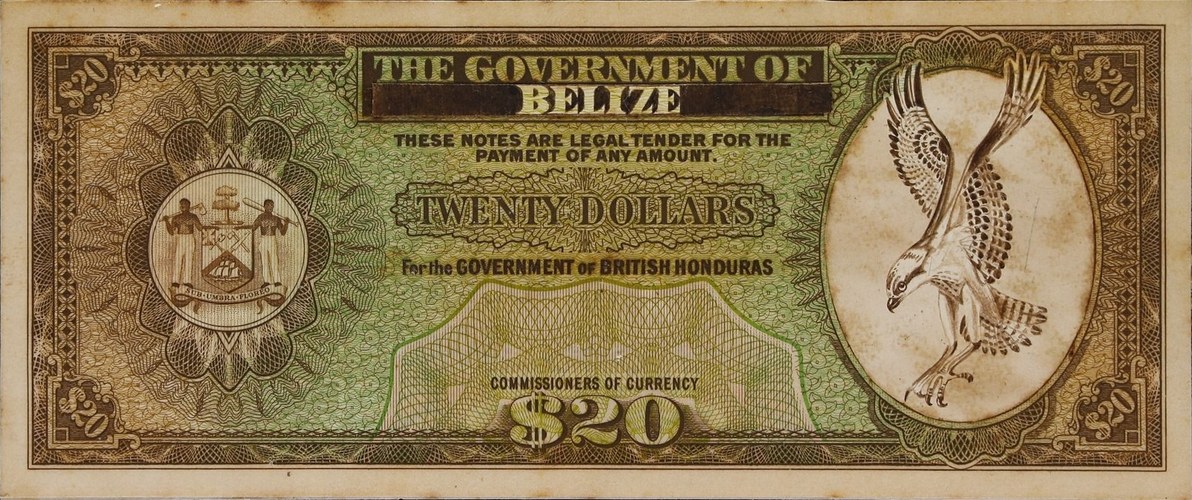
A front model for a 20 dollars is built on the frame of the note of 1974. THE GOVERNMENT OF BELIZE is pasted over the heading, while the text below still reads "For the GOVERNMENT of BRITISH HONDURAS". In the oval where the issued note has the Queen's portrait, an osprey is in flight. A drawn essay for a 20 dollars dated 1st June 1973 has a bird on a branch at the left in a Maya-style frame.
What became of them: neither was issued. The 20 dollars of 1974 to 1976 has the arms at the left and the Queen's portrait.
The East Caribbean: a bank that never opened
Photographs of 1969 record notes for a Central Bank of the East Caribbean, under a Central Bank Act of 1969. The 1 dollar and the 5 dollars have the Queen at the right. The 20 dollars does not: a modern bank building fills the centre and a coat of arms stands at the right.
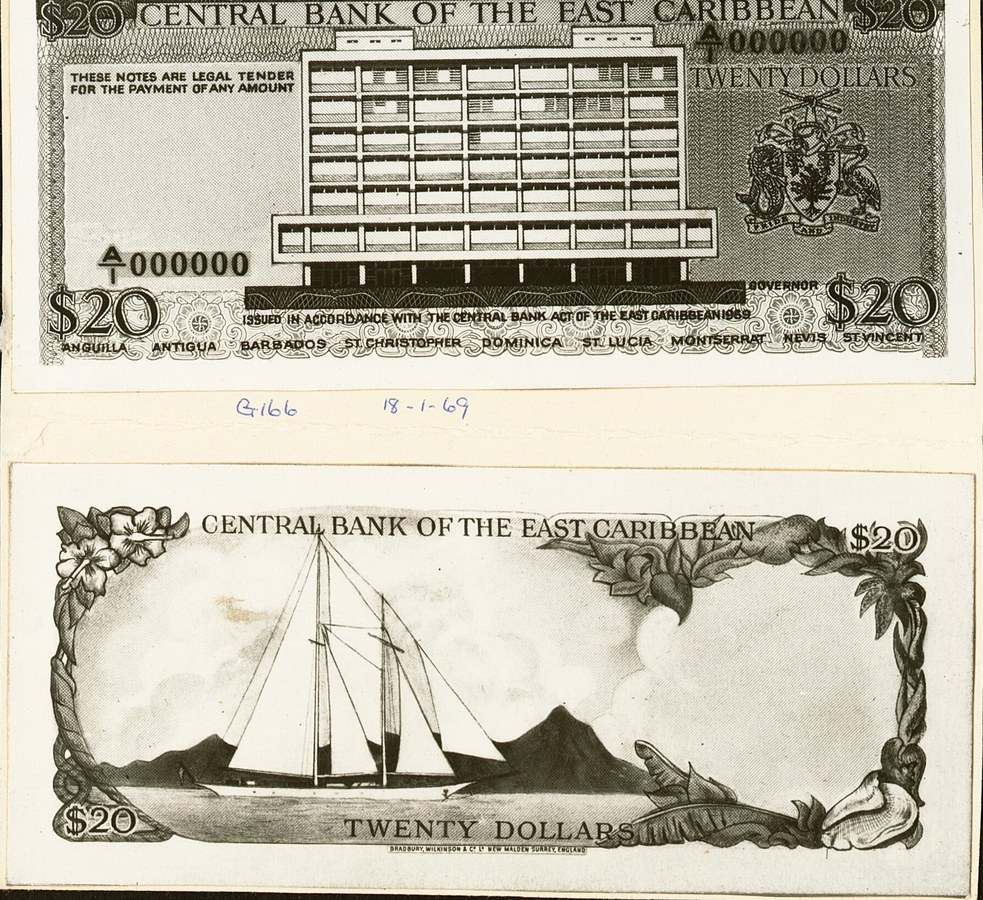
What became of them: the bank was never established, and the Currency Authority went on issuing its notes of 1965, which have the Queen.
East Africa: an empty oval
The East African Currency Board's notes of 1961 to 1963 have the Queen. Among the essays for the notes that followed, a 10 shillings shows a small sailing boat on Lake Victoria and, in the archive's words, a blank oval where a portrait would sit. The oval stayed empty. Photographs dated November 1962 show a lake steamer tried in the same place, and the notes of 1964 were issued with a dhow on the lake and no portrait. They were the Board's last notes.
Nigeria: "Sketch for an African Note"
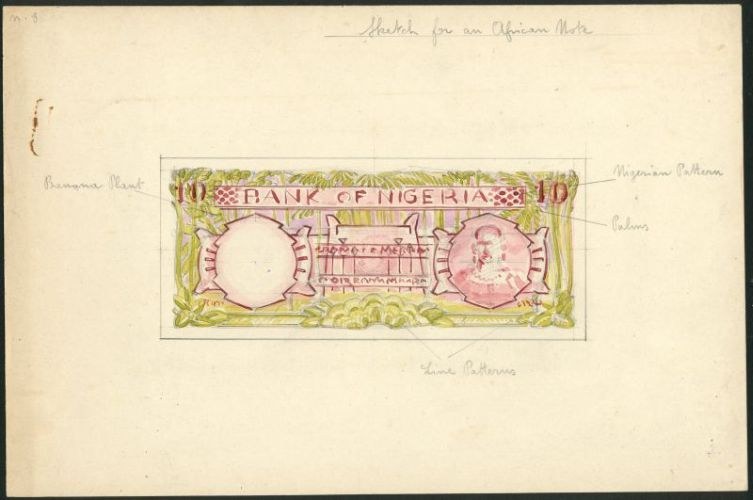
A painted essay of about 1960 on a large card is headed BANK OF NIGERIA and has 10 in the upper corners, with no unit and no date. It shows banana plants and palms, a building in a central panel, and at the right the head of an African man in an eight-sided frame. The card is pencilled "Sketch for an African Note", and its parts are labelled in the margins: Banana Plant, Nigerian Pattern, Palms, Line Patterns. The archive does not say whose head it is.
What became of it: nothing of the design was issued. The notes of the Central Bank of Nigeria dated 15th September 1958 share one view of the Niger River with palm trees on their fronts and have no portrait; Nigeria became independent on 1 October 1960.
Where the sovereign stayed
Not every new title brought a new face. The essays for a State of Malta, dated 16th June 1964, put a knight in armour or a statue of St Paul at the left and keep the Queen at the right; the series was never issued. The essays titled Central Bank of Fiji, of about 1974 and 1975, a name no Fiji note ever carried, keep the Queen. The designs for the Bank of Rhodesia dated 23rd February 1963, a bank that never issued a note, keep the Queen beside a lion. And the pencil essays for a Central Bank of Ceylon dated 1st February 1948 leave both ovals empty on the one that was photographed; when the Central Bank's first notes came out, dated 20th January 1951, the oval held King George VI.
The designs side by side
| Territory | Date on the piece | In place of the sovereign | What became of it |
|---|---|---|---|
| Malaya and British Borneo | 21st March 1953; 20th September 1958 | Tunku Abdul Rahman | Not adopted |
| Malaya and British Borneo | 1958 | Tiger, stag, mouse deer, buffalo, the Federation's crest | Not adopted; the notes of 1959 and 1961 have a boat and a buffalo |
| Malaya and British Borneo | About 1962 to 1966 | Tunku Abdul Rahman (Harrison and Sons) | Not adopted |
| Jamaica | 2/9/66 | No portrait (1 dollar) | Changed: Bustamante added in 1968 |
| Jamaica | 25.10.67 | A hummingbird (50 cents) | Changed: Garvey in 1968 |
| Jamaica | 14.3.68 and 15.3.68 | Bustamante, Garvey, Bogle, Gordon | Version C issued in 1970; the 5 dollars with a different portrait |
| Trinidad and Tobago | 11.4.68 | No portrait; pelicans | Not adopted |
| Trinidad and Tobago | 14.2.70 | A man in dark glasses, not named | Not adopted |
| Bahamas | 1/10/73 | Lynden Pindling | Not adopted in this form |
| Cyprus | February 1959 | Zeno | Not adopted |
| Belize | About 1973 | An osprey | Not issued |
| East Caribbean | 18-1-69 | A bank building (20 dollars) | The bank never opened |
| East Africa | About 1962 to 1964 | An empty oval, a steamer, a dhow | Issued in 1964 with the dhow |
| Nigeria | About 1960 | The head of a man, not named | Not issued |
Read together, the designs say something the issued notes do not. The portraits of Tunku Abdul Rahman, of Lynden Pindling and of the unnamed man on the Trinidad and Tobago dollar are not recorded on any issued note in this catalogue. The designs that went forward were Jamaica's four portraits, and the subjects without a face: a boat, a buffalo, a dhow.


Member comments
Log in or register to post a comment.