Gibraltar's first government notes are two series of five values, both dated 6th August 1914. This article brings together what the Pick pages say of them, what D. C. Devenish of the Gibraltar Museum added in the IBNS Journal of December 1969 from papers of the Treasurer and the Museum's own notes, what the Colonial Reports count, and what the auction houses state about survivors. Where the houses disagree with each other or with the pages, both statements are given.
The Bank Note Ordinance of 1914
The notes were issued under Ordinance 10 of 1914, so that sterling and gold need not be paid out. The Ordinance allowed up to 250,000 pounds in notes. The copy of the law in the Johns Hopkins currency board archive is headed Bank Note Ordinance, 1914, No. 10 of 1914, and is dated 5 August 1914. The annual report on Gibraltar for 1922 uses the same short title. Devenish gives the values the Ordinance named: 50 pounds, 5 pounds, 1 pound, 10 shillings and 2 shillings.
Devenish also draws on a letter that the Colonial Treasurer, A. C. Greenwood, wrote on 16th August 1914. Devenish writes that the Treasurer had to forbid the export of anything without a signed permit. In the letter, as Devenish quotes it, Greenwood is pressed by merchants, captains and others for food, and has to refuse.
Series A: text to the printers on 5th August
Sources mention that the text went to the printers on the afternoon of 5th August 1914, a proof was approved the next morning, and the first notes, signed by hand, were issued to the Anglo-Egyptian Bank on 6th August 1914. Devenish, whose source is a printed memorial card, gives the hours: the form of the note was handed to Beanland Malin and Company at two o'clock on Wednesday 5th August, a proof was put before a conference of the Governor, the Chamber of Commerce and the Exchange Committee, and by ten o'clock on Thursday 6th August notes of all values, signed in manuscript, had been issued to the bank.
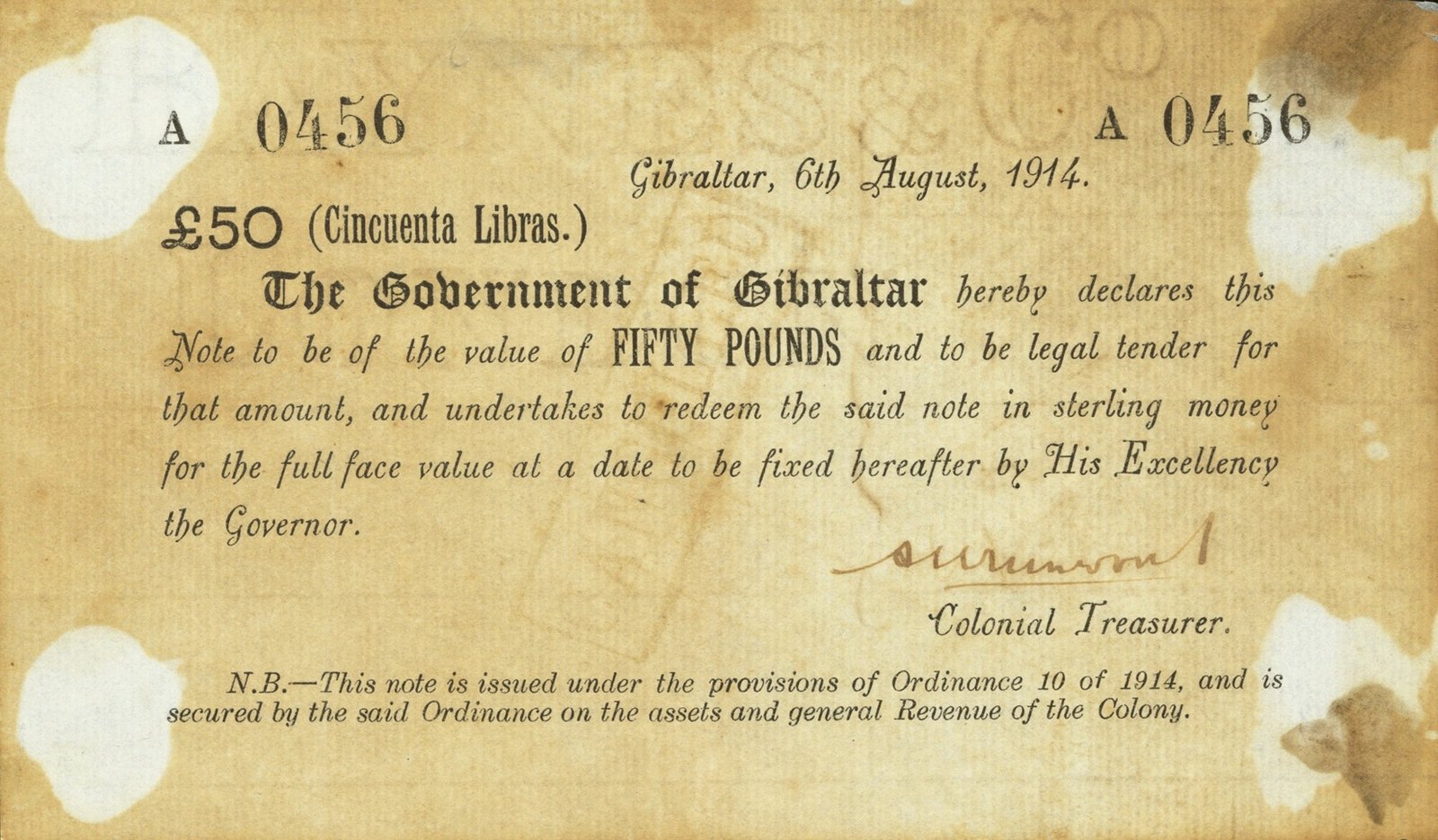
Series A was typeset on paper watermarked E. BAYNES & CO. LONDON, with the values in English and Spanish. The backs are blank and there is no security thread. The notes carry the embossed stamp of the Anglo-Egyptian Bank Limited. Devenish notes that the wording is the same on every value apart from the amount, that the paper was writing paper and the watermark belongs to the paper, and that Americans stationed on the Rock called the notes "Greenwoods".
| Value | Printed in | Paper | Size on the Pick page |
|---|---|---|---|
| 2 shillings | red | ivory | 170x105 mm |
| 10 shillings | blue | ivory | 165x115 mm |
| 1 pound | black | ivory | 170x105 mm |
| 5 pounds | black | azure | 165x105 mm |
| 50 pounds | black | azure | 175x105 mm |
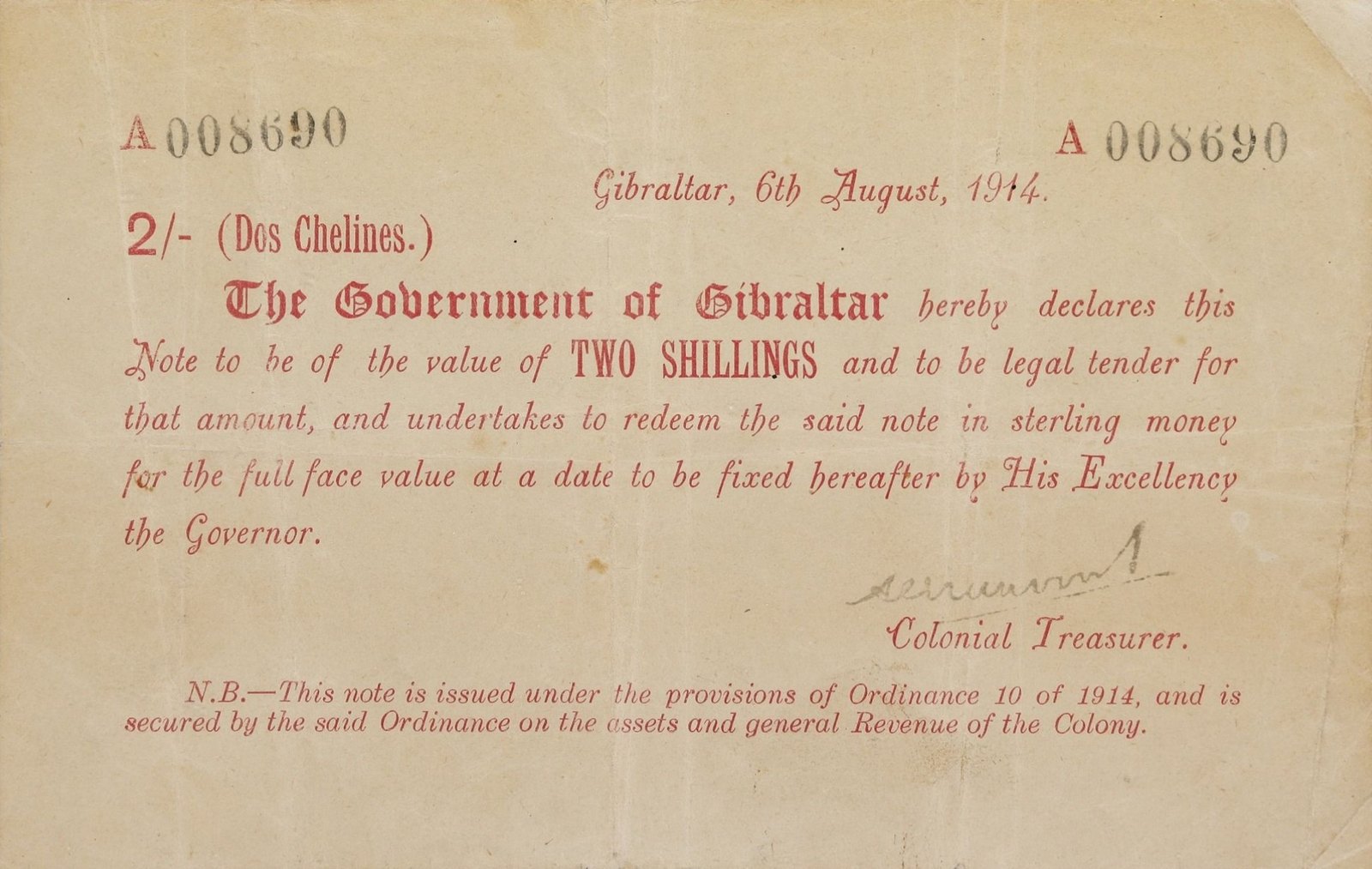
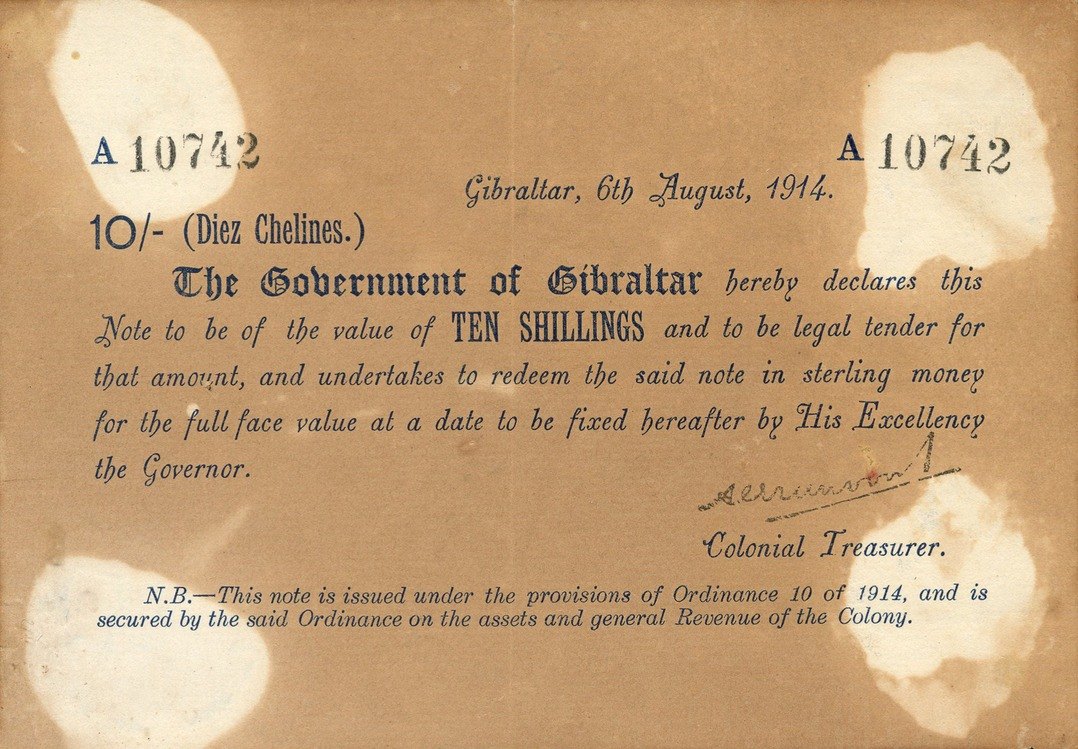
The Pick pages give the printer as Beanland, Malin and Company, Gibraltar. Two Heritage descriptions say otherwise: that of a 10 shillings (9 May 2023, lot 28234) says the first series was printed in England, and that of a 2 shillings (15 October 2026, lot 24480) calls Beanland, Malin an English firm. Devenish says of Series B, and not of Series A, that it was printed in England.
Signed by hand, then stamped
The Treasurer signed the first notes by hand. Sources mention that a stamp was used on later Series A notes, that 104,600 Series A notes worth 89,000 pounds were signed by hand or stamped, 60,000 pounds of them by 16th August 1914, and that four of the signature stamps are kept in the Gibraltar Museum. Greenwood's letter, as Devenish quotes it, speaks of working from six in the morning until late at night.
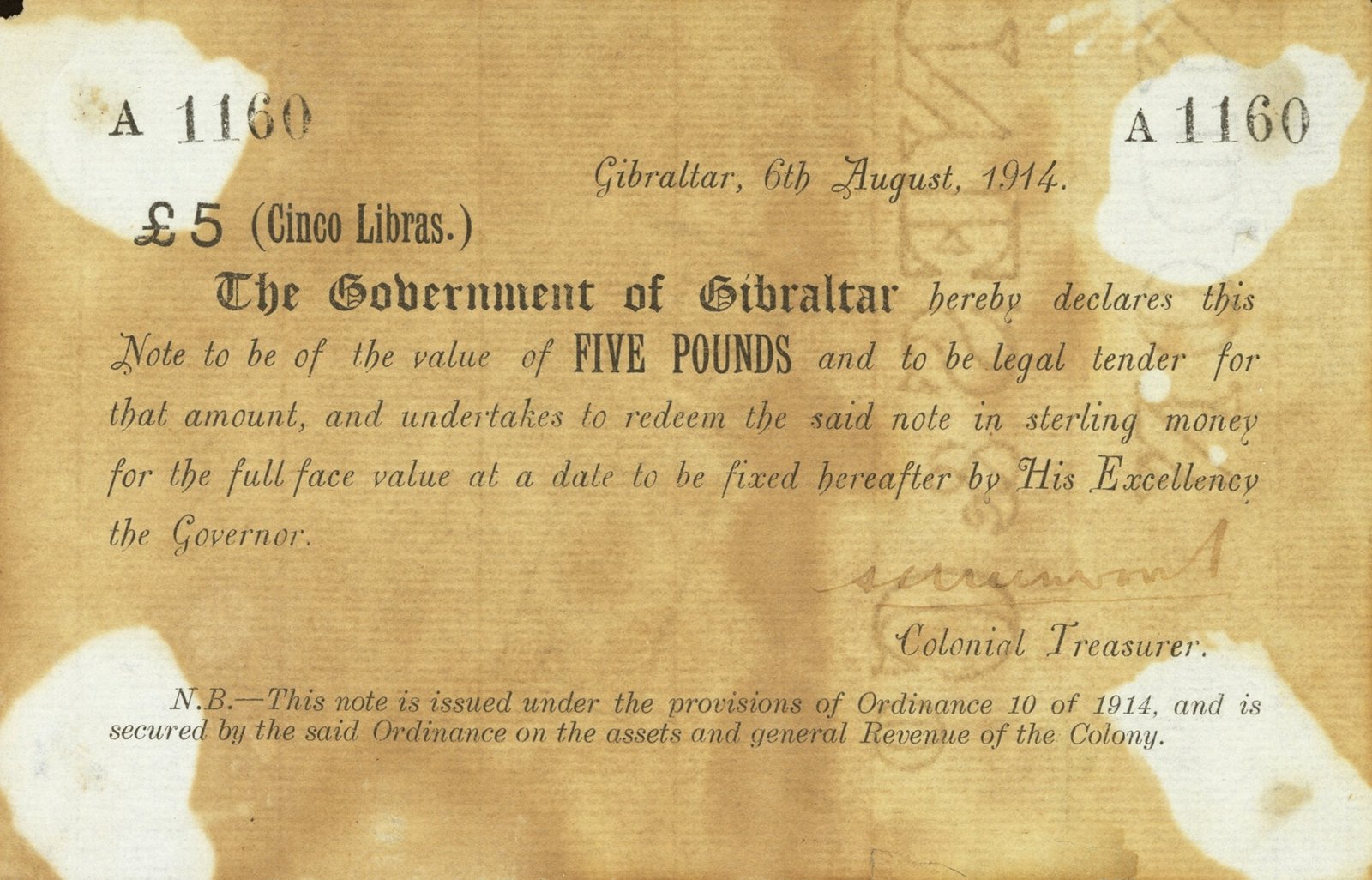
Not yet settled: no stamped Series A note is recorded in this catalogue. The houses do not agree on what they have seen. Spink's descriptions of the 2 shillings, 10 shillings and 1 pound of the Ibrahim Salem collection (17 April 2019, lots 487, 488 and 489) and of the 50 pounds (12 April 2016, lot 1077) all give a manuscript signature of the Colonial Treasurer Alfred Craven Greenwood. Heritage's description of a 10 shillings of the same collection (9 May 2023, lot 28234) says the signature is stamped, and its description of the 1 pound (lot 28235) says the signature appears to be signed by hand.
Series B: the engraved notes of October 1914
Series B was issued like Series A under Ordinance 10 of 1914 and bears the same date. Sources mention that it was put into circulation on 13th October 1914. It is smaller than Series A and was engraved by Thomas de la Rue, in English with the value repeated in Spanish, with the arms of Gibraltar (three castle towers, a key and the motto MONTIS INSIGNIA CALPE), a stamped signature and the embossed stamp of the Anglo-Egyptian Bank Limited. The backs are blank. Spink's descriptions name the printed signature as that of Greenwood (17 April 2019, lots 492 and 495).
| Value | Colours | Size on the Pick page |
|---|---|---|
| 2 shillings | green on pink | 125x63 mm |
| 10 shillings | purple on pink | 125x63 mm |
| 1 pound | blue on green | 130x85 mm |
| 5 pounds | brown on green | 130x85 mm |
| 50 pounds | pink on green | 130x85 mm |
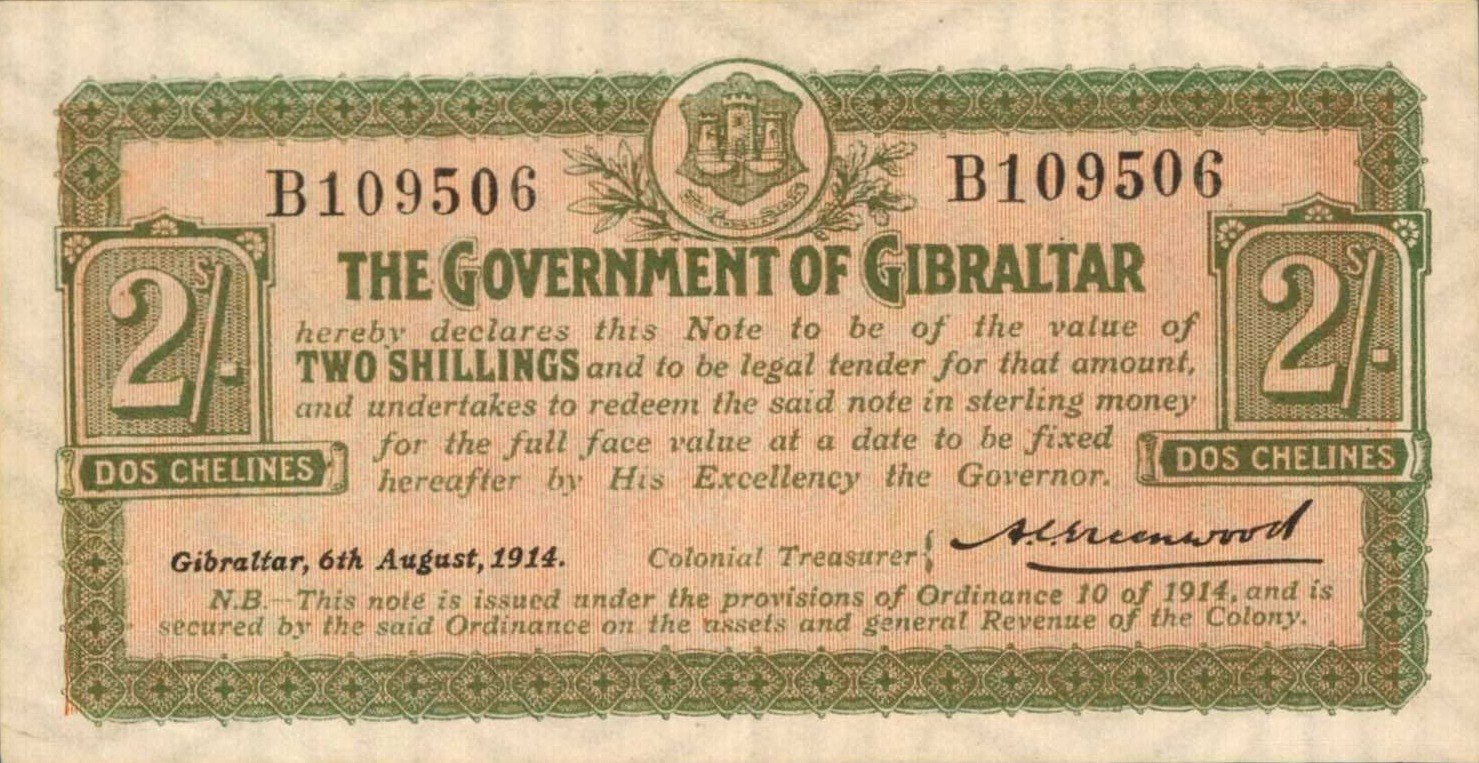
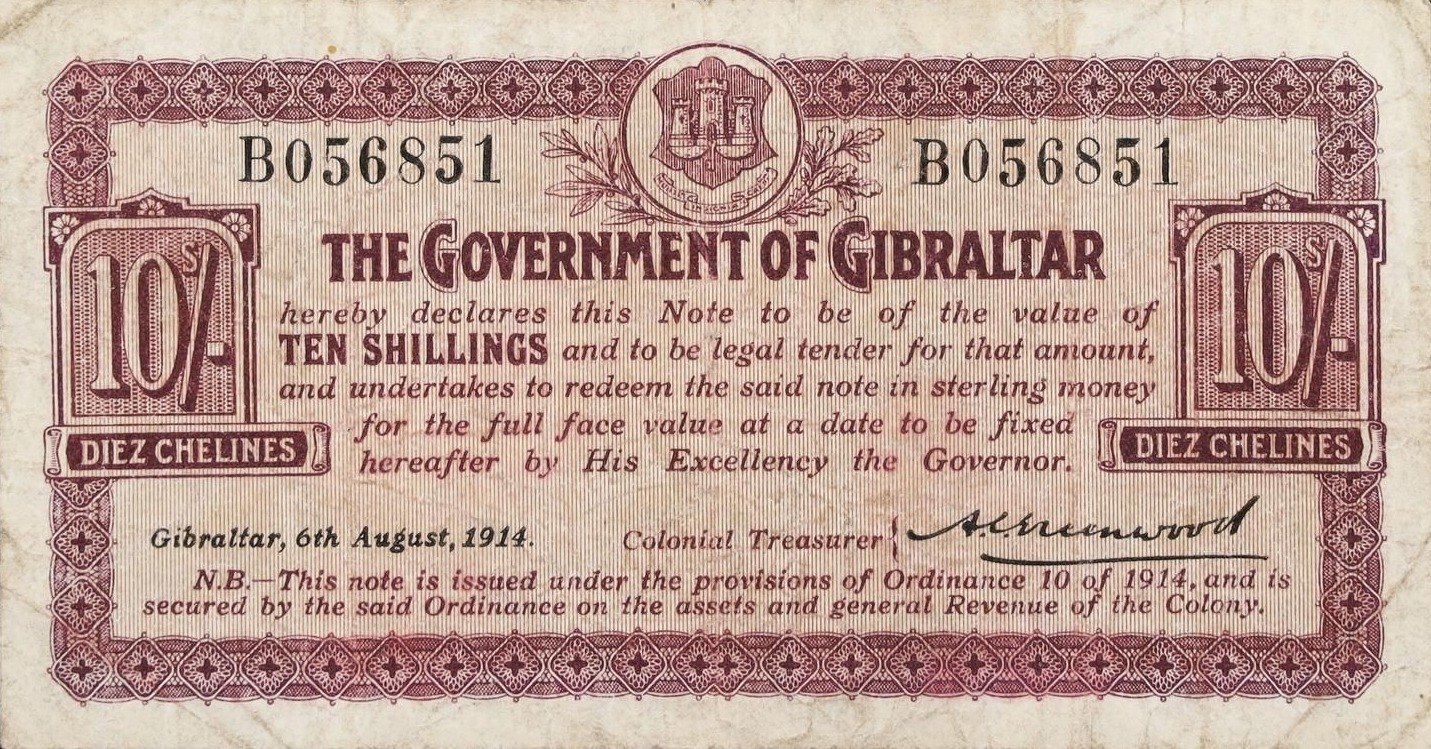
Devenish adds three points. The two small values have a different arrangement and design from the three higher ones. The paper has a watermark of a pattern of continuous arrows and no thread. And the Gibraltar Museum holds a 1 pound with an error in the numbering: one number reads B008037 and the other B098037.
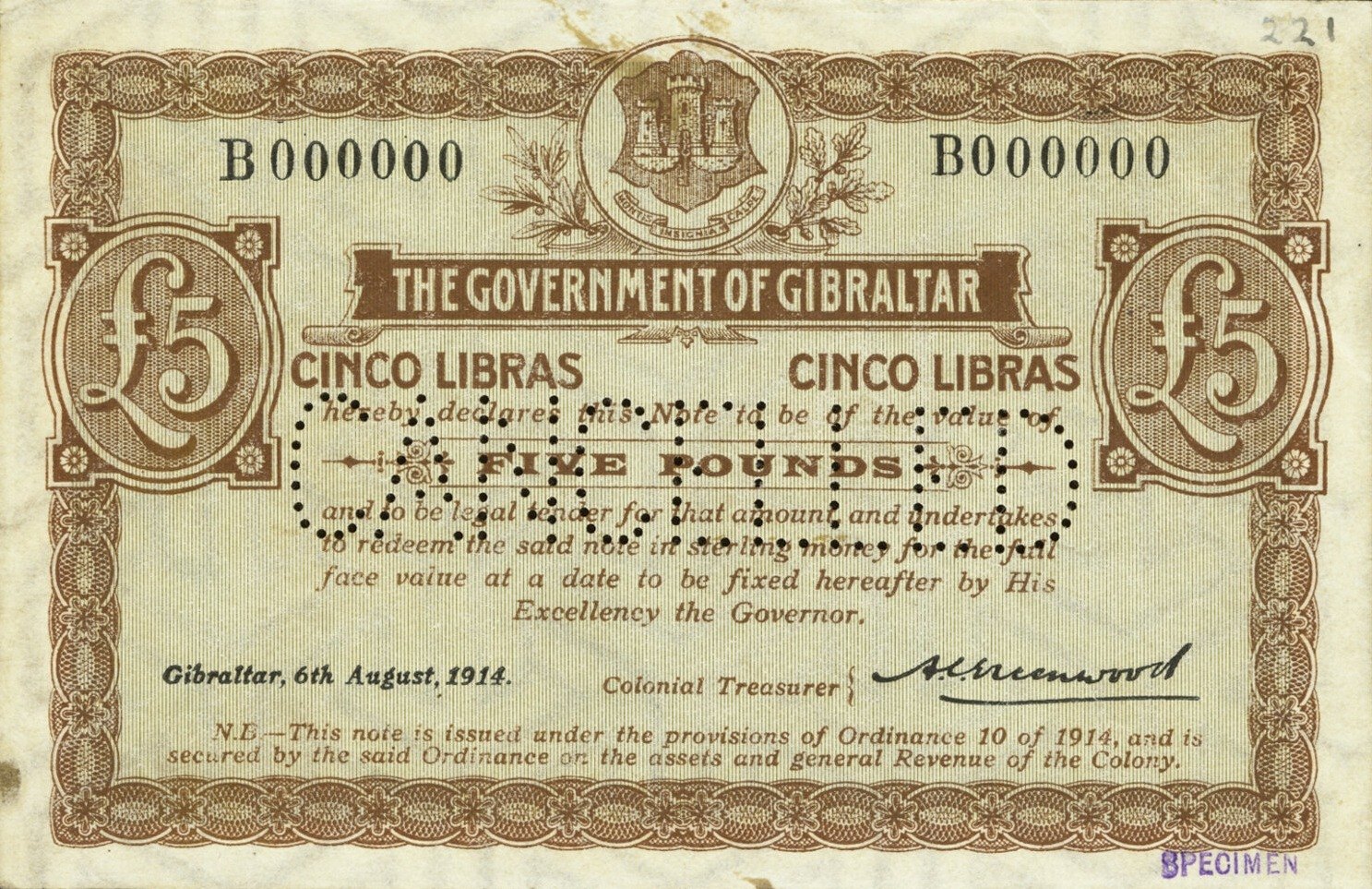
No source read here gives the number printed of any Series B value.
In circulation, and the two withdrawals
The annual report for 1922 gives 159,763 pounds of Government notes in circulation, in values of 50 pounds, 5 pounds, 1 pound, 10 shillings and 2 shillings.
Series A was demonetised on 1 January 1922. Devenish gives the instrument: a Proclamation of the Governor of 16th September 1921. Series B was demonetised on 1 January 1929, by a Proclamation of the Acting Governor of 25th August 1928 according to Devenish. The report for 1928, the last year before the demonetisation, says that of 130,000 pounds in circulation about 4,500 pounds were still old notes.

The reports for 1929 to 1934 still count old notes among the Government notes in circulation, that is, notes not yet handed in after the demonetisation: about 3,418 pounds in 1929, about 2,570 pounds in 1930, about 2,480 pounds in 1931, about 2,429 pounds in 1932 and 2,324 pounds 10 shillings in 1934. The reports do not say whether these old notes were of Series A or Series B.

Notes never handed in, as the houses state it
Several houses give counts of Series A notes that were not redeemed. The Pick pages do not carry these figures, and no house names the document more closely than a Treasury report of 1922.
- 2 shillings: Spink (17 April 2019, lot 487) says all notes apart from 346 had been redeemed by the Gibraltar Treasury as of 1st January 1922. Stack's Bowers (7 May 2026, lot 51313) repeats the figure of 346.
- 10 shillings: Spink (17 April 2019, lot 488) says all notes apart from 23 were redeemed. Heritage (9 May 2023, lot 28234) says the same, citing Treasury records and the year 1922.
- 1 pound: Spink (17 April 2019, lot 489) says all apart from 11 were redeemed. Heritage (9 May 2023, lot 28235) says 11 notes were outstanding according to a Gibraltar Treasury report dated 1922.
- 5 pounds: Heritage (9 May 2023, lot 28236) says two notes remained out after the type was demonetised in 1922.
- 50 pounds: Spink (12 April 2016, lot 1077, and 17 April 2019, lot 491) says no records survive for this denomination and that A 0456 may be the only issued note. Heritage (9 May 2023, lot 28237) describes that note as issued and cancelled, with the E. Baynes watermark still to be seen.
For Series B the houses give no Treasury figures, only what they have met. Spink's description of a 1 pound (26 September 2023, lot 103) says the house had traced three issued examples, two of them graded by PMG. Stack's Bowers (2 October 2025, lot 50185) counts four graded by PMG, and its description of a 10 shillings (17 January 2025, lot 20369) counts three of that value. For the 2 shillings, Stack's Bowers (15 January 2022, lot 20298) and Heritage (20 October 2022, lot 25188) each count eleven in the PMG report. Heritage's descriptions of the 5 pounds and 50 pounds specimens of the Ibrahim Salem collection (9 May 2023, lots 28238 and 28239) say each was the only one graded by PMG at the time. Such counts are true only for the day they were written.
What is not known
- Whether any Series A note with a stamped signature survives, and how many of the 104,600 were stamped.
- The number printed of each value, in either series.
- The Treasury report of 1922 from which the houses take the counts of notes not redeemed. It has not been read for this catalogue.
- Whether the old notes still counted in the reports of 1929 to 1934 were of Series A, Series B or both.
Sources
- The Pick pages of this catalogue for Gibraltar P-1 to P-10.
- D. C. Devenish (Gibraltar Museum), "Currency Notes of Gibraltar", IBNS Journal, volume 9, number 2, December 1969, pages 73 and 74, with its sources: a letter of A. C. Greenwood of 16th August 1914 and a printed memorial card.
- Bank Note Ordinance, 1914 (No. 10 of 1914), copy in the Johns Hopkins currency board archive.
- Colonial Reports, Annual: No. 1173 (Gibraltar 1922), No. 1437 (1928), No. 1488 (1929), No. 1584 (1931), No. 1629 (1932), and the reports for 1930 and 1934 as the Pick pages give them.
- House descriptions: Spink, 12 April 2016, lot 1077; Spink, 17 April 2019, lots 487, 488, 489, 491, 492 and 495; Stack's Bowers, 15 January 2022, lot 20298; Heritage, 20 October 2022, lot 25188; Heritage, 9 May 2023, lots 28234 to 28239; Spink, 26 September 2023, lot 103; Stack's Bowers, 17 January 2025, lot 20369; Stack's Bowers, 2 October 2025, lot 50185; Stack's Bowers, 7 May 2026, lot 51313; Heritage, 15 October 2026, lot 24480.


Member comments
Log in or register to post a comment.