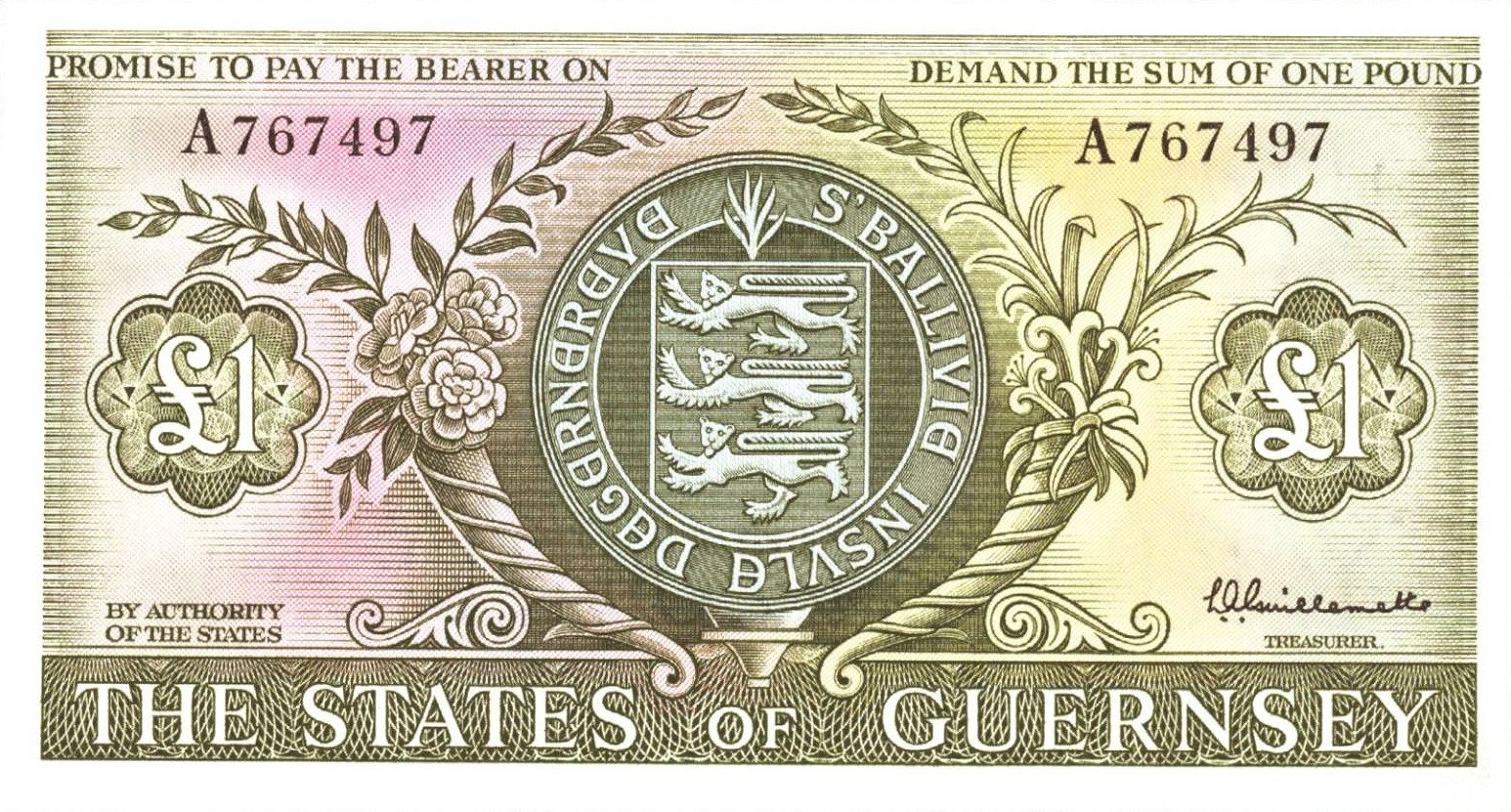
Four printers have made the notes of the States of Guernsey since 1895: Perkins Bacon, the Guernsey Press in the two wars, Bradbury Wilkinson and De La Rue. This article goes through them in turn, with the paper, the security threads and the system of serial prefixes each used. It is written from the catalogue pages, from Francis Thornton's articles in the journal of the International Bank Note Society, from press releases of the States and from house descriptions of single lots.
Perkins Bacon, 1895 to 1940
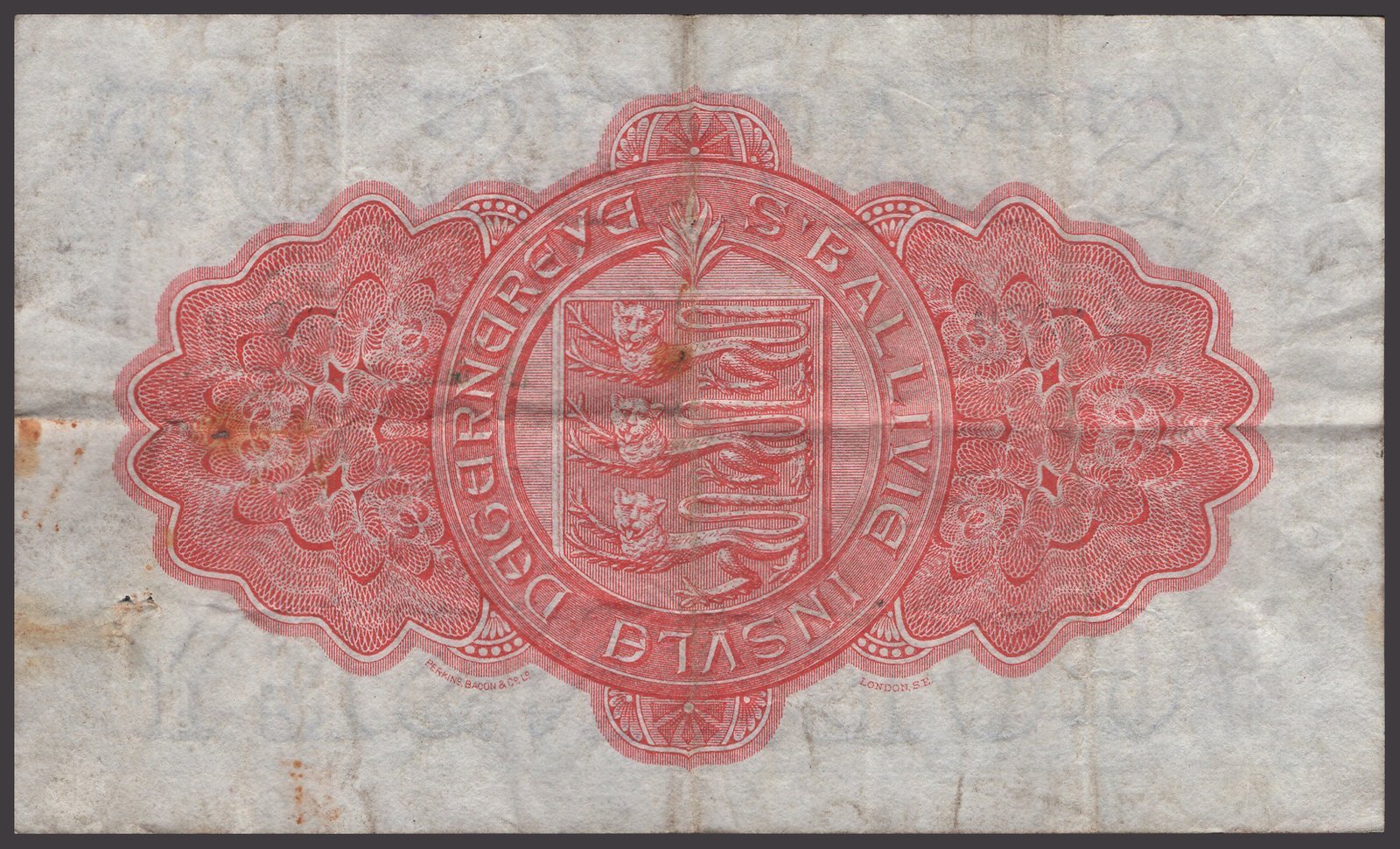
Perkins Bacon and Company printed every Guernsey note from the 1 pound of 1895 to the notes dated 9th March 1940, the local emergency notes of August 1914 excepted. That takes in the 1 pound of 1903 to 1918, the 5 shillings and 10 shillings of 1914 and the 1 pound with the BRITISH overprint, and the smaller notes of 1921 to 1940. The pages remark on the paper twice: the 5 shillings of 1914 and the 1 pound of 1921 to 1926 are on machine-cut paper.
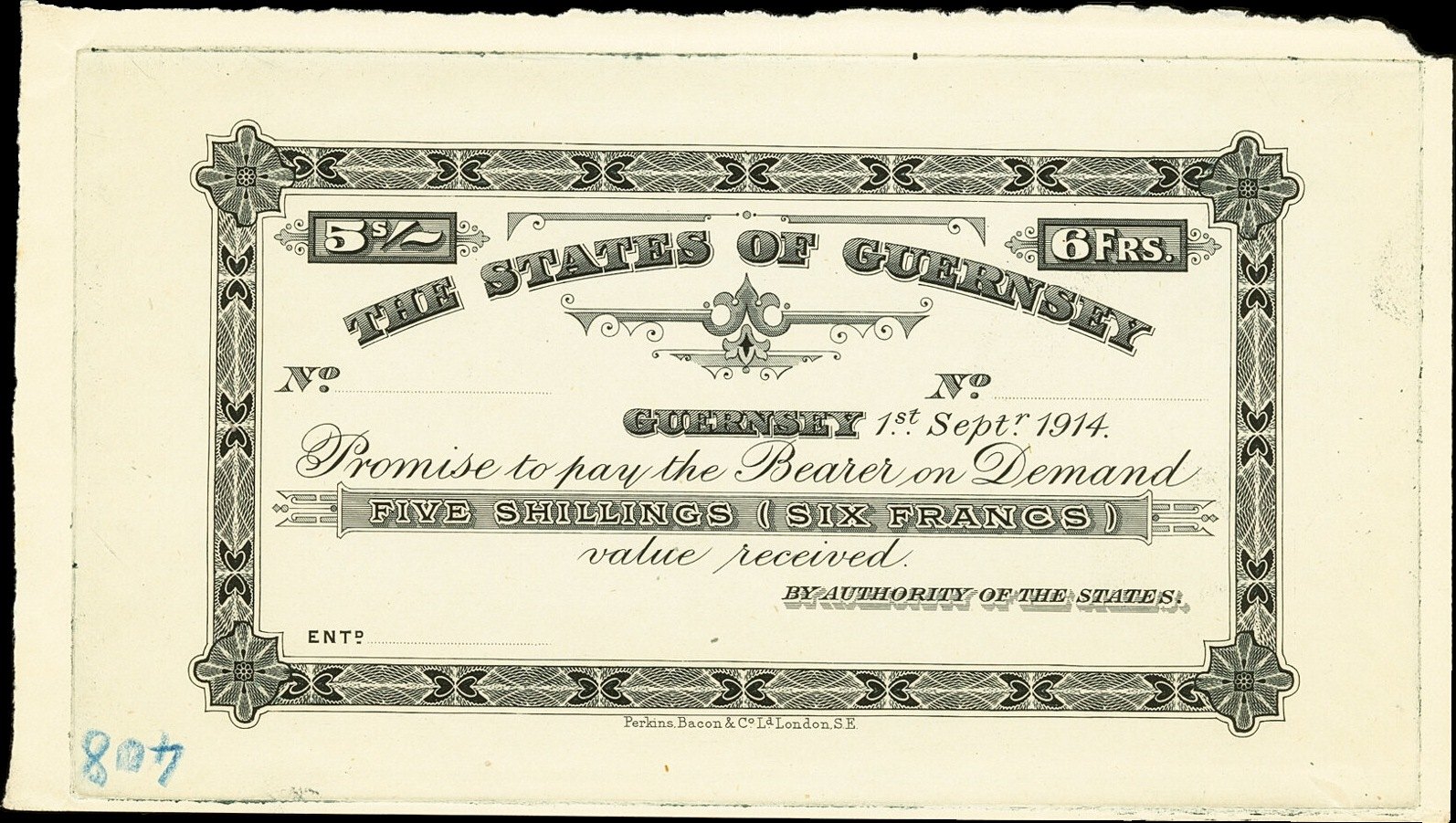
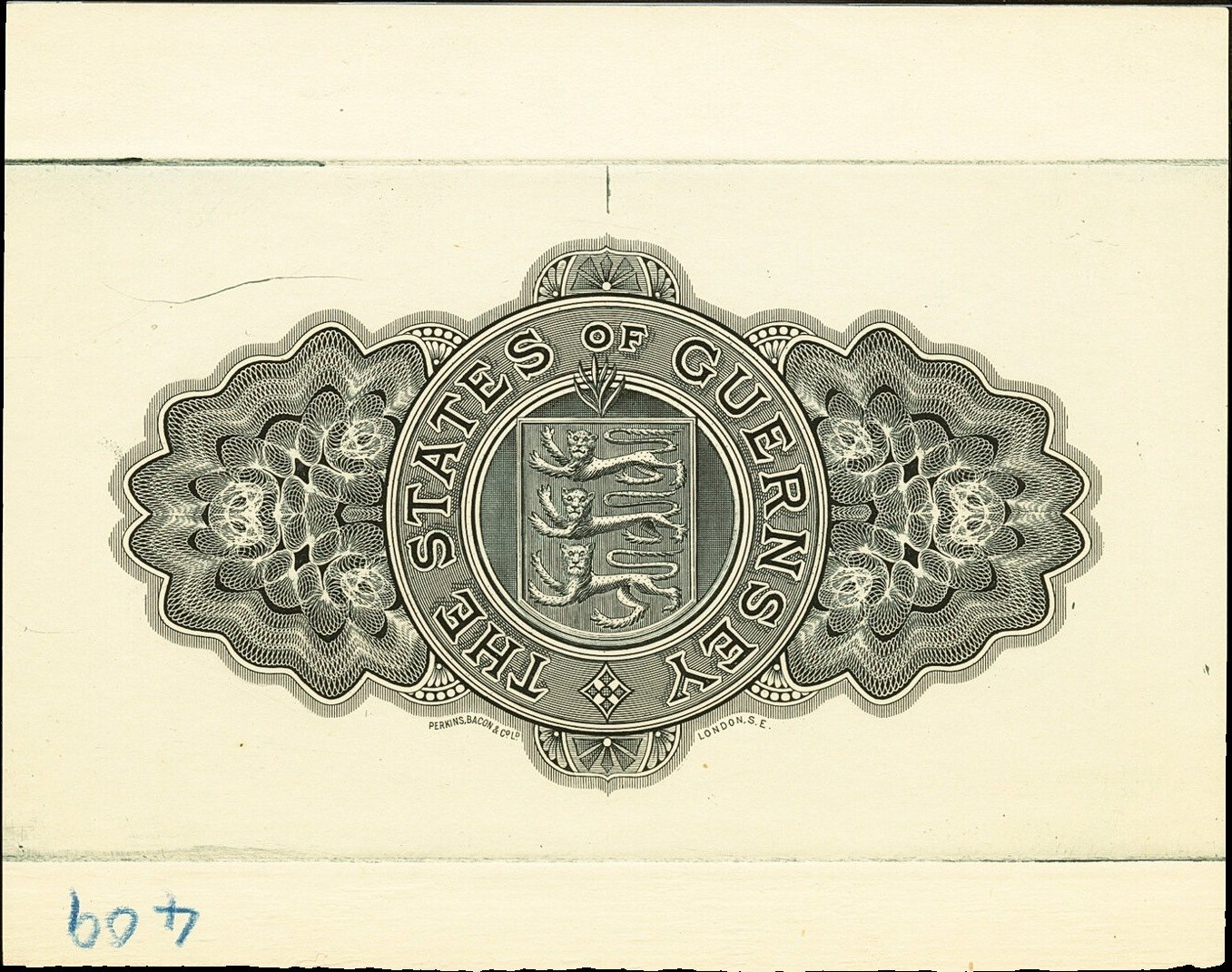
The prefixes of these years are two letters set one above the other. On the large 1 pound the pages record C/D on 3rd April 1914, C/G on 10th August 1914, C/N on 1st September 1916, C/W on 1st November 1917 and D/G on 15th October 1918, and the overprinted notes of 1921 run from D/R to E/A. The 5 shillings of 1914 is numbered from A/A 0001. The pages of the 1 pound of 1921 to 1926 and of the 1 pound of 1927 to 1932 note that no prefix has the letter I.
The dates printed on the small notes do not come one to a prefix. A date covers a block of prefixes, and some blocks have no recorded date at all. For that reason the catalogue gives a row to each date or undated block, on the 10 shillings of 1921 to 1931 as on the later notes: the page of the 10 shillings of 1934 to 1940 counts 27 dates and undated prefix blocks, and on the 1 pound of those years the letters run from a to ae. Grading companies do not follow this. Their holders give no letters at all for most of these notes, and on the 1 pound of 1934 to 1940 they call the last date 16b and every other date 16a.
Besides the dropped signature, the pages record one change of design in the 1930s. It is on the back: the legend around the seal is in English on the 10 shillings and 1 pound of 1933 and in Latin from 1934.
The Guernsey Press, 1914 and 1941 to 1945
The Guernsey Press printed for the States twice, both times in war. In August 1914 it printed the 5 shillings and, as its page gives the printer, the 10 shillings; for the 10 shillings sources also mention the words The Evening Press, Guernsey on the back, or a blank back. From 1941 to 1945 it printed the small-change notes of the occupation and the notes held for the liberation, which are described in Guernsey under occupation: the small-change notes of 1941 to 1943 and the liberation notes of 1945.
The occupation notes use three kinds of prefix. The 6 pence begins with a single letter and goes on to A/A after Z, and the shillings overprinted on the 1 shilling 3 pence have single letters, G to Z; the 2 shillings 6 pence and 5 shillings have two letters from the start; and the liberation notes have a letter over a figure, A/1 and onward, on the 1 pound, and a figure over a letter, 1/A to 1/H, on the 5 pounds. Stack's Bowers' description of lot 2104 in its sale of 30 July 2009, a shilling of 1942, says the note has no printer's imprint.
Perkins Bacon again, 1945 to 1966
The notes dated from 1st August 1945 came from Perkins Bacon once more. London Coins' description of lot 265 in its sale of 1 September 2019 reads the imprint on the back of a 1 pound of 1945 as Perkins Bacon Limited, London, in small script at lower centre, and its lot 831 of 3 June 2019 places the imprint of the 5 pounds in the lower margin of the front.
The prefix is now a figure over a letter and runs on through the dates: on the 1 pound from 1/A in 1945, with 5/Y the first prefix signed by Guillemette in 1950. The pages record three changes to paper and size:
- the 10 shillings was reduced from 140 x 81 to 138 x 78 mm with the date 1st May 1953;
- the 1 pound was reduced from 156 x 87 to 152 x 86 mm with the same date, and its paper changed from prefix 26/Q, part of the way through the notes dated 1st January 1961;
- the 5 pounds dated 1st December 1956 exists with a metal security thread, prefixes 1/J to 2/F, and with a plastic one, prefixes 2/J to 2/N.
Each value is also known as an unissued remainder without serial numbers and with the word CANCELLED perforated across it: the 10 shillings dated 1st March 1962, the 1 pound dated 1st January 1961 and the 5 pounds dated 1st December 1956.
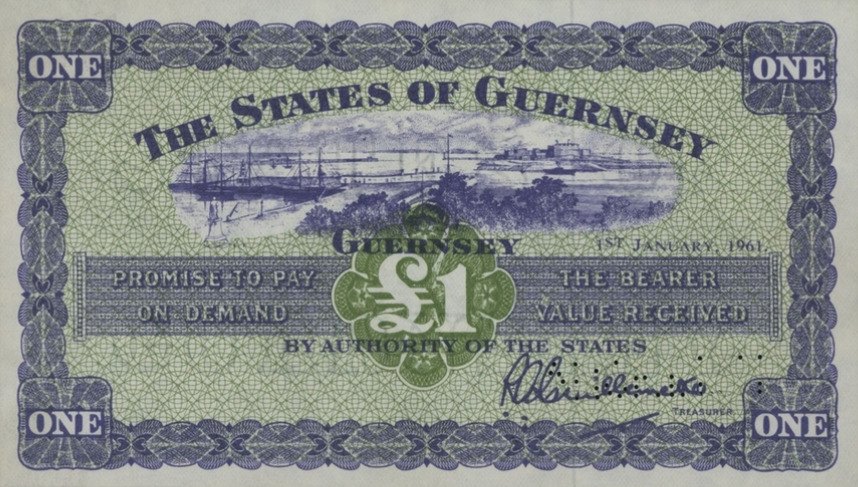
As with the notes before the war, the catalogues do not letter the dates alike. A grading-company holder prints three letters for each value, and other references give every date a letter of its own, 42a to 42q on the 10 shillings and 43a to 43u on the 1 pound. The catalogue rows keep the three letters and number the dates under each.
Heritage's description of lot 26450 in its sale of 4 September 2014, a 1 pound of 1st June 1963, says these were among the last notes Perkins Bacon printed before the firm stopped trading under that name. That is Heritage's statement; the pages say nothing on the end of the firm.
Bradbury Wilkinson, 1969 to 1975
The undated 1 pound and 5 pounds introduced on 27 March 1969 were printed by Bradbury Wilkinson. Thornton, in IBNS Journal 16:3 (1977, pages 138 and 140), says they were designed by Arnold Machin and printed on paper supplied by Portals, with the States of Guernsey watermark and a security thread to the right of centre, and that the 10 pounds of 1975 was designed by a member of Bradbury Wilkinson's staff.
The prefix became a single letter before a number of six figures. Two specimens from the printer's archive carry a range of numbers in place of a single number: one 1 pound specimen with Guillemette's signature carries the range B 600001 to C 100000 and a printer's approval date of 26 August 1970 in its top margin, so that batch was printed in 1970; one 5 pounds specimen with Hodder's signature carries the range A 400001 to A 600000.
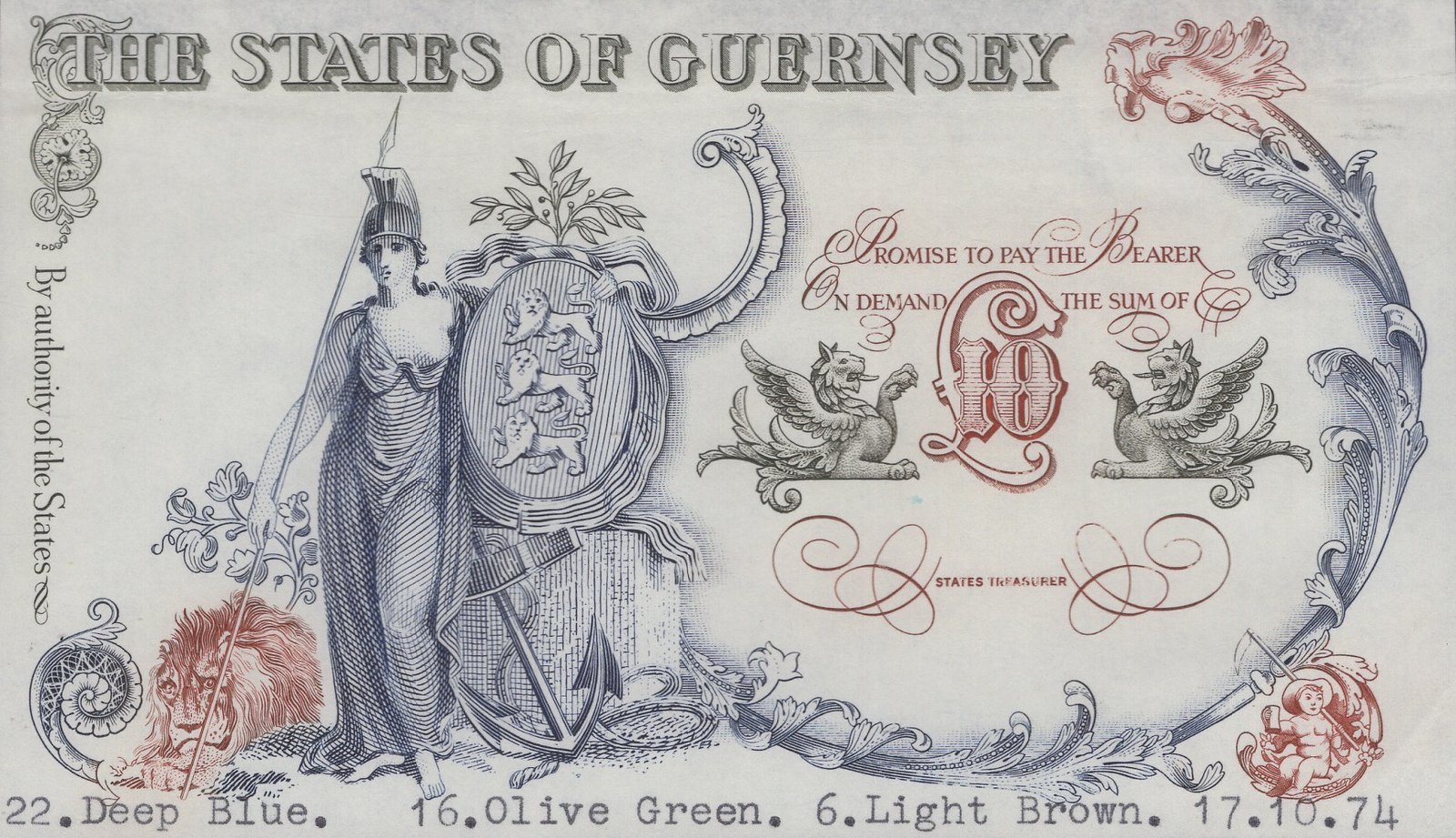
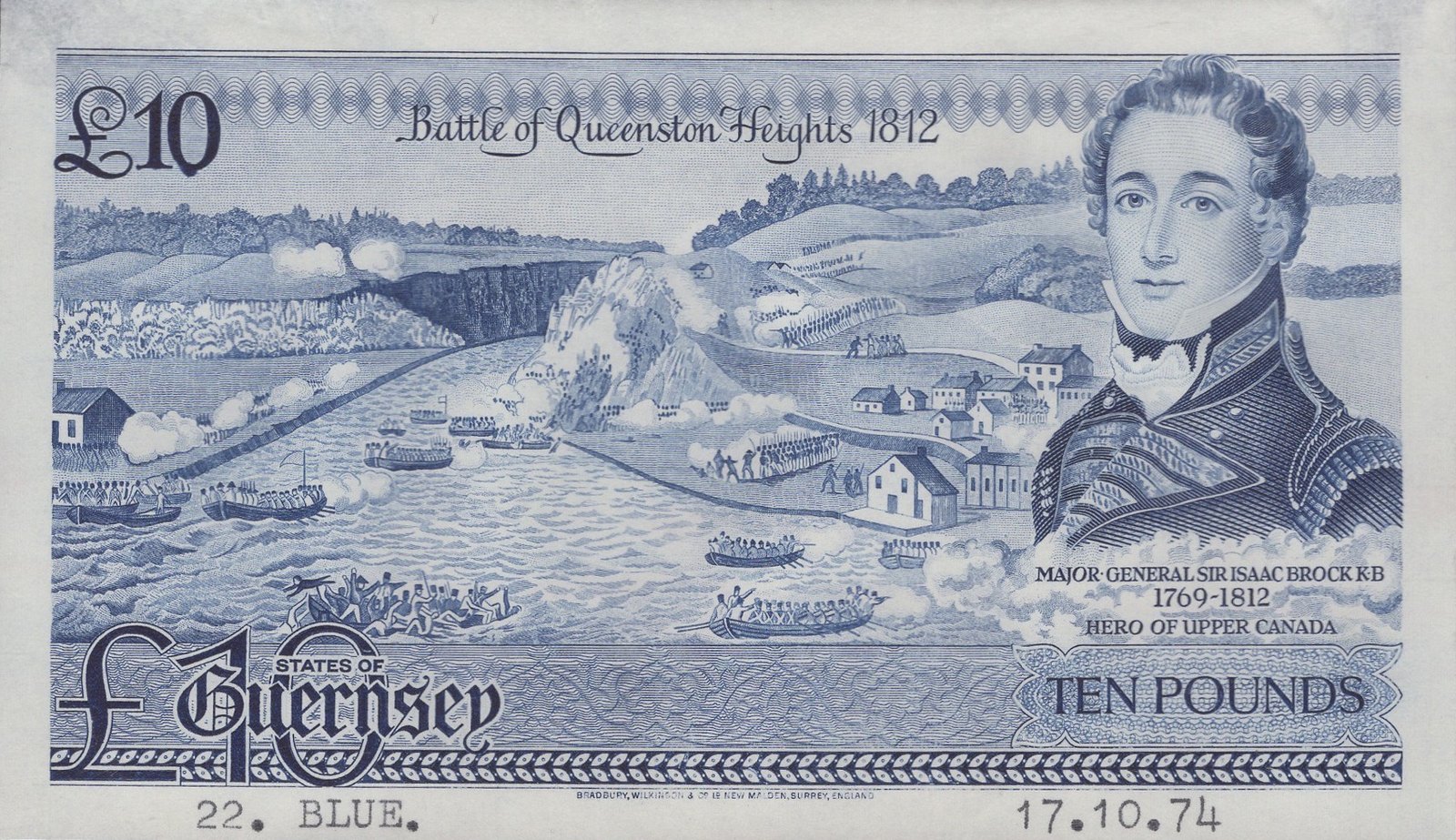
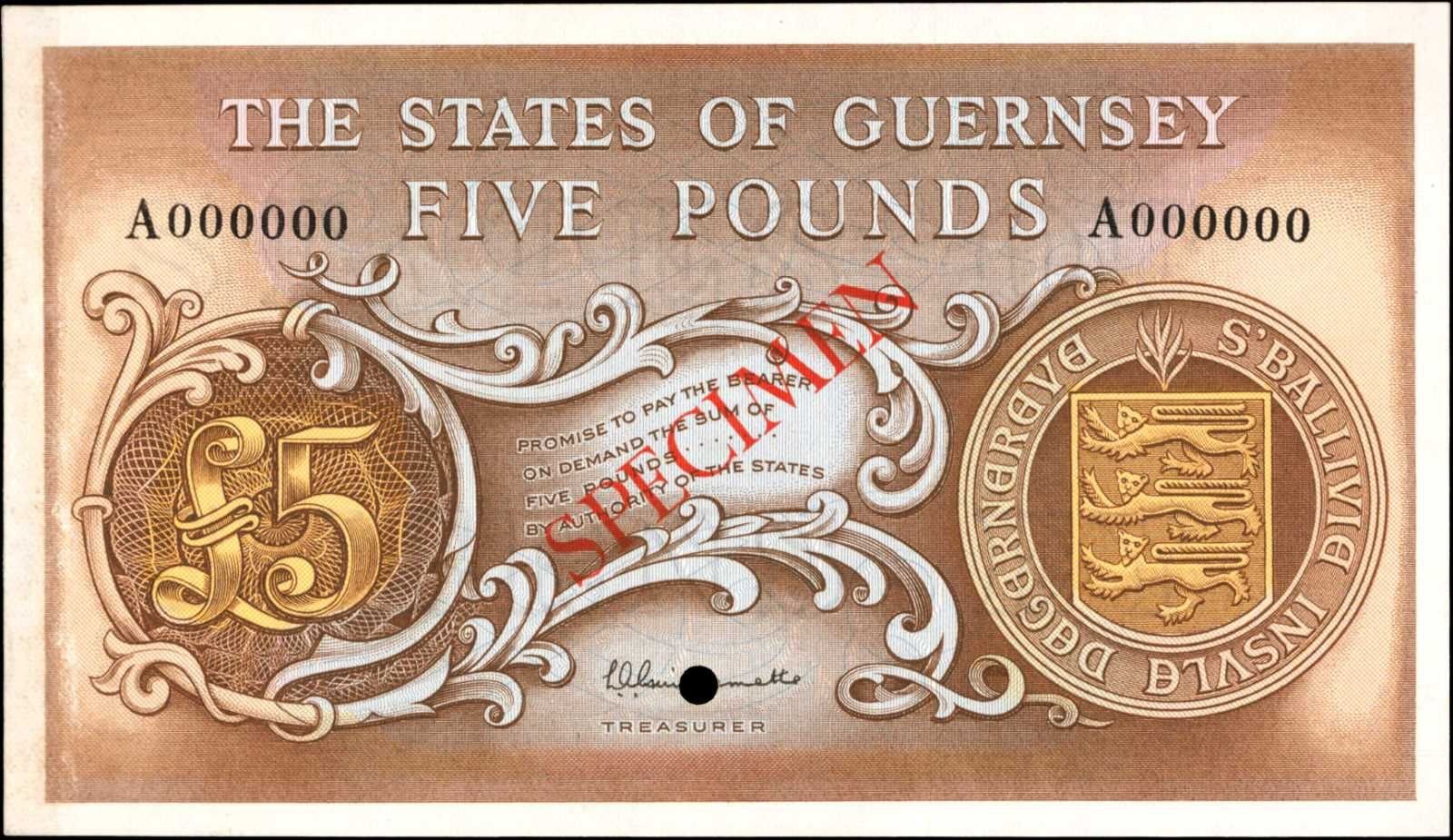
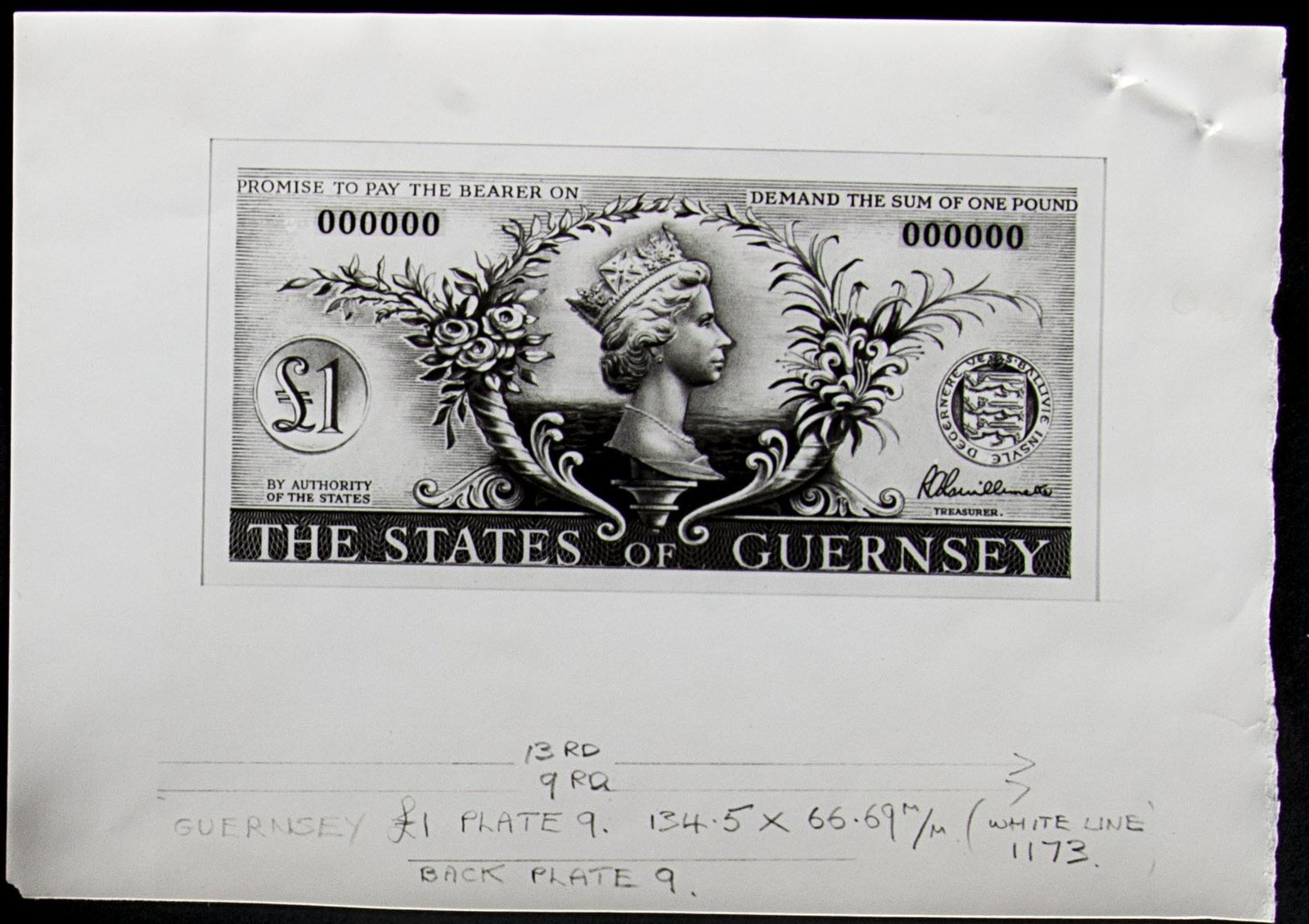
Three house descriptions show the printer at work. Noonans describes lot 812 in its sale of 8 July 2026 as a pair of colour die proofs of the 10 pounds, front and back, each with the typed date 17.10.74 and the printer's notes on colour. Stack's Bowers describes lot 30140 in its sale of 14 August 2018 as a colour trial of the 5 pounds in brown, where the issued note is purple. Special Auction Services describes lot 585 in its sale of 2 May 2024 as holding Bradbury Wilkinson photographs of the front and back of a Guernsey 1 pound, cut from larger sheets.
De La Rue, from 1980
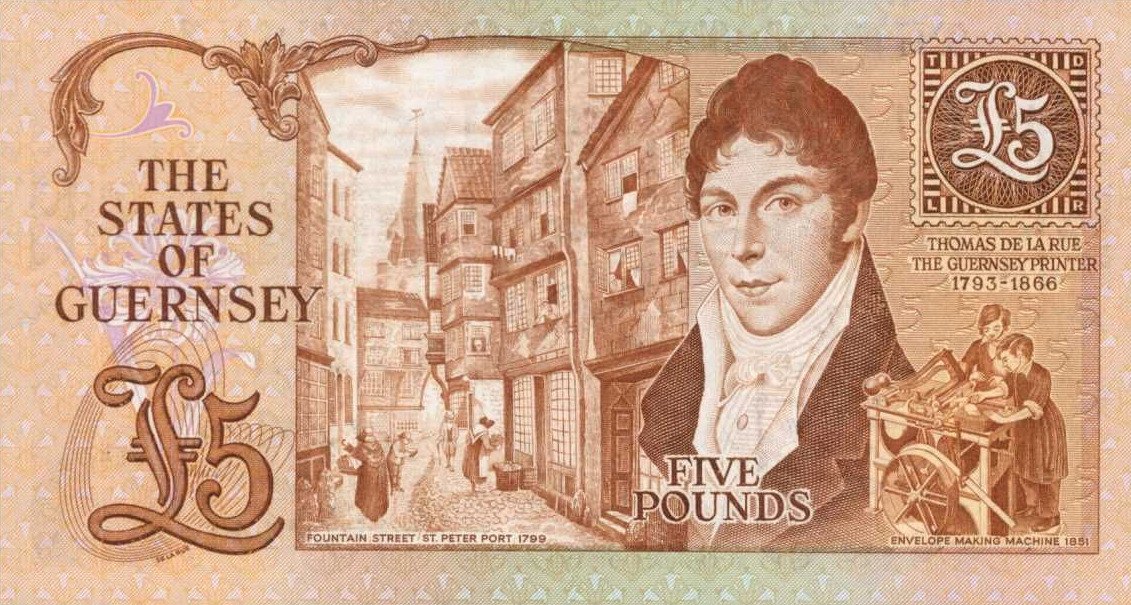
The four notes of 1980 were the first Guernsey notes printed by De La Rue; the pages say so, and so does the States' press release of 3 July 2013. The printer's name is on the back below the large value, and on the 20 pounds in the corner of the frame. The security thread is near the right edge of the front. Sources mention that the notes were designed at De La Rue by Ron Turrell. Thornton, writing from the States' press release in IBNS Journal 19:3 (1980, page 85), says the notes were made the same size as the United Kingdom notes of the same values.
The printer had an old tie to the island, and the notes show it. The 5 pounds of 1980 carries a portrait of Thomas de la Rue. The 1 pound of 2013 shows Thomas de la Rue (1793-1866) beside the journal Le Miroir Politique, with Fountain Street, St Peter Port, in 1799. The press release of 3 July 2013 says de la Rue was born in Guernsey on 24 March 1793, launched Le Miroir Politique in 1813 and moved to London in 1821.
From 1980 the replacement notes have a prefix of their own, Z, on each of the four values. Thornton's articles in IBNS Journal 21:4 (1982, page 114) and 29:4 (1990, page 18) describe them as a separate issue with the single prefix Z.
Telling the De La Rue printings apart
The same designs were printed many times over, and the pages use three marks of the printer to separate them.
Size. The notes of 1980 are the larger ones: 1 pound 135 x 67 mm, 5 pounds 146 x 78 mm, 10 pounds 151 x 85 mm and 20 pounds 160 x 90 mm. The notes of 1990 to 1992 measure 128 x 65 mm (1 pound), 135 x 70 mm (5 pounds), 142 x 75 mm (10 pounds) and 149 x 80 mm (20 pounds).
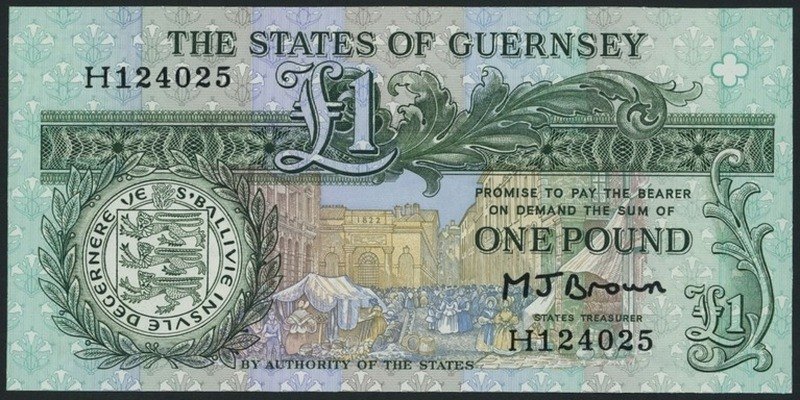
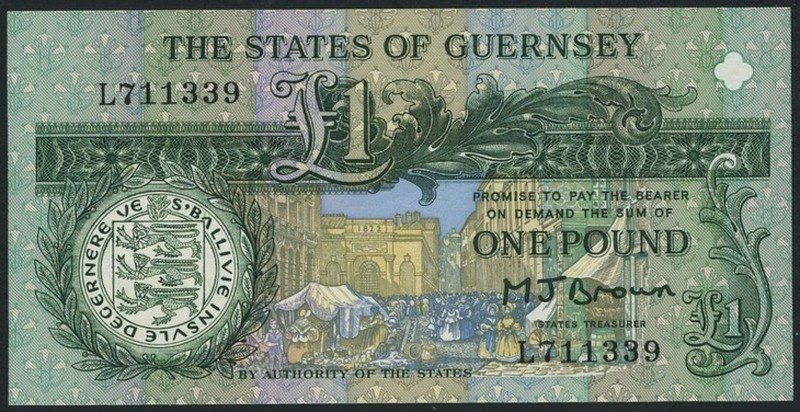
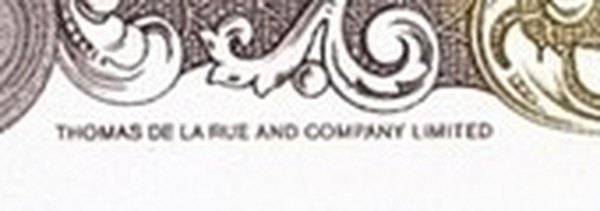
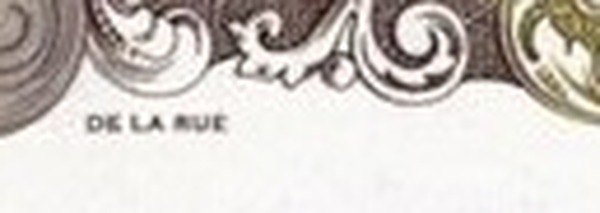
Imprint. On the notes with the Queen the printer's name runs up the right-hand edge of the front. It reads THOMAS DE LA RUE AND COMPANY LIMITED on the first 5 pounds, 10 pounds and 20 pounds, signed Trestain, and DE LA RUE on the later ones. The millennium 5 pounds is the exception the page points out: it is signed Trestain and yet reads DE LA RUE.
Thread. The first 5 pounds and 10 pounds with the Queen have a solid thread. On the 5 pounds a windowed thread begins at C 600001 and on the 10 pounds at D 900001, in both cases inside a prefix, so the number decides and not the letter. The 20 pounds of 4 June 2009 has a windowed thread, a foil patch and Cornerstone watermarks. The notes announced on 19 January 2023 changed the thread again: the pages describe a wide green windowed thread on the 10 pounds and a wide holographic stripe on the 20 pounds. The States' press release of that day names the features as a holographic thread on the 5 pounds, a colour-shifting thread on the 10 pounds and an 18 mm stripe on the 20 pounds.
Prefixes for an occasion
Four notes carry a prefix chosen for the occasion: M on the 5 pounds of 2000, QE/60 on the 20 pounds of 2012, TD/LR on the 1 pound of 2013 and TG/W on the 20 pounds of 2018. The press releases of 2013 and 2018 write the last two as TDLR and TGW, and the second explains its letters as The Great War.
On the small 1 pound the single letters have been followed by a double one: its page lists the prefixes of Haines as X, Y and AA.
Sources
- The Pick pages of this catalogue for Guernsey, P-1 to P-62 and the notes of 2018 and 2023.
- Francis Thornton, "Island of Guernsey: Undated Currency Issues", IBNS Journal 16:3 (1977), pages 138 to 141; "Island of Guernsey: Extended New Currency Note Issue", IBNS Journal 19:3 (1980), pages 85 to 86; and Thornton's two articles on the modern replacement notes of Jersey and Guernsey, IBNS Journal 21:4 (1982), page 114, and 29:4 (1990), page 18.
- States of Guernsey, press releases of 3 July 2013, 7 November 2018 and 19 January 2023 (gov.gg).
- London Coins, 3 June 2019, lot 831, and 1 September 2019, lot 265; Heritage Auctions, 4 September 2014, lot 26450; Stack's Bowers, 30 July 2009, lot 2104, and 14 August 2018, lot 30140; Noonans, 8 July 2026, lot 812; Special Auction Services, 2 May 2024, lot 585.


Member comments
Log in or register to post a comment.