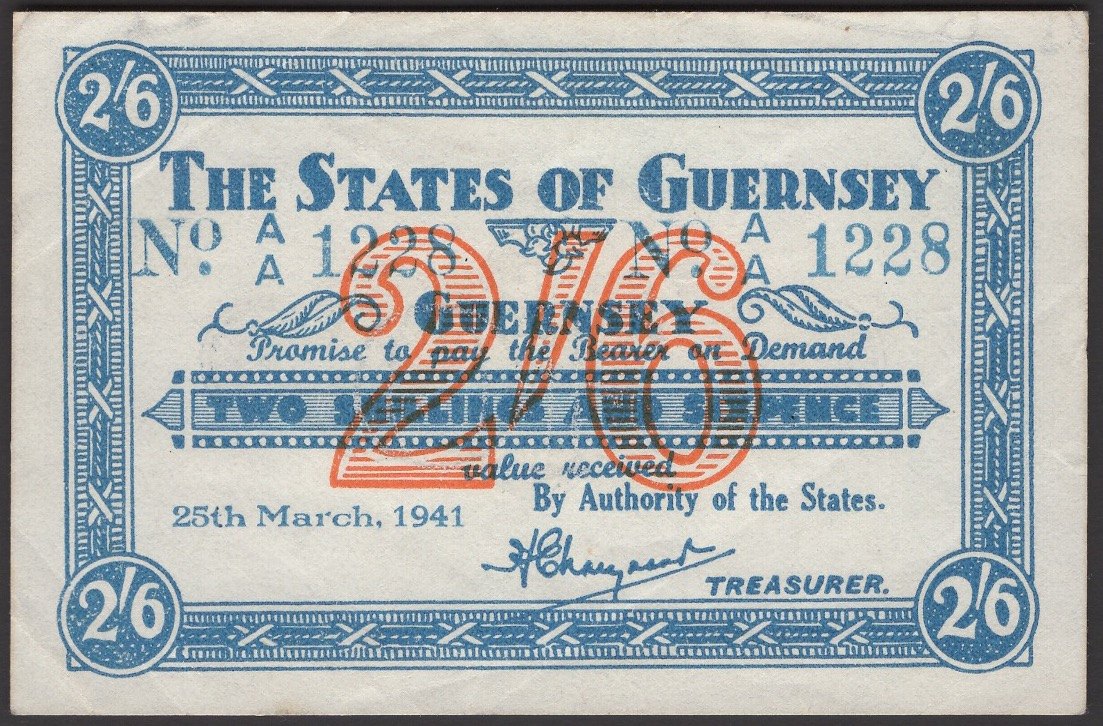
The Guernsey Press printed small notes for the States of Guernsey with six dates, from 25th March 1941 to 1st January 1943, and larger notes dated 1st January 1943 and 1st January 1945 for the liberation. This article sets the printings in order from the catalogue pages, and adds what two articles and a letter in the journal of the International Bank Note Society and the auction houses say. Where a house or a writer gives a figure that differs from the pages, both are given.
Why the notes were needed
Germany occupied Guernsey on 30 June 1940 without a fight, as the islands had been demilitarised. The page of the first 2 shillings 6 pence gives the steps that followed: from 2 July 1940 the pound was fixed at 5 marks, and on 7 August 1940 the German Reichskreditkassenscheine became legal tender. Sterling notes and coin then disappeared from circulation, and the shortage of small change led to the notes.
Richard Banyai, in IBNS Journal 10:1 (September 1970), gives a fuller run of rates for the Channel Islands: first 5 marks to the pound, changed to 8 marks by an Order of 8 July 1940, to 7 marks on 13 July 1940, to 9.60 marks on 2 September 1940 and to 9.36 marks on 28 September 1942, where it stayed. The end of that passage speaks of Jersey, so it is not certain that every step applied in Guernsey. Banyai also quotes Alan and Mary Wood, Islands in Danger, on how the occupation was paid for: shopkeepers paid their marks into the banks, the States bought the marks from the banks with loans and overdrafts, and income tax in Guernsey rose from 1 shilling 6 pence to 5 shillings. The Woods write that British notes and silver were hoarded or taken to France.
Steve Feller, in "Occupied Jersey and Guernsey" (IBNS Journal 45:1, 2006, page 36), writes that the local notes were made with German permission and that in Guernsey an equal amount of British notes was withdrawn by German order and stamped, so that the Germans could not use or exchange them. Feller names no source for this, and no note stamped in that way is recorded on the catalogue pages.
How the notes were made
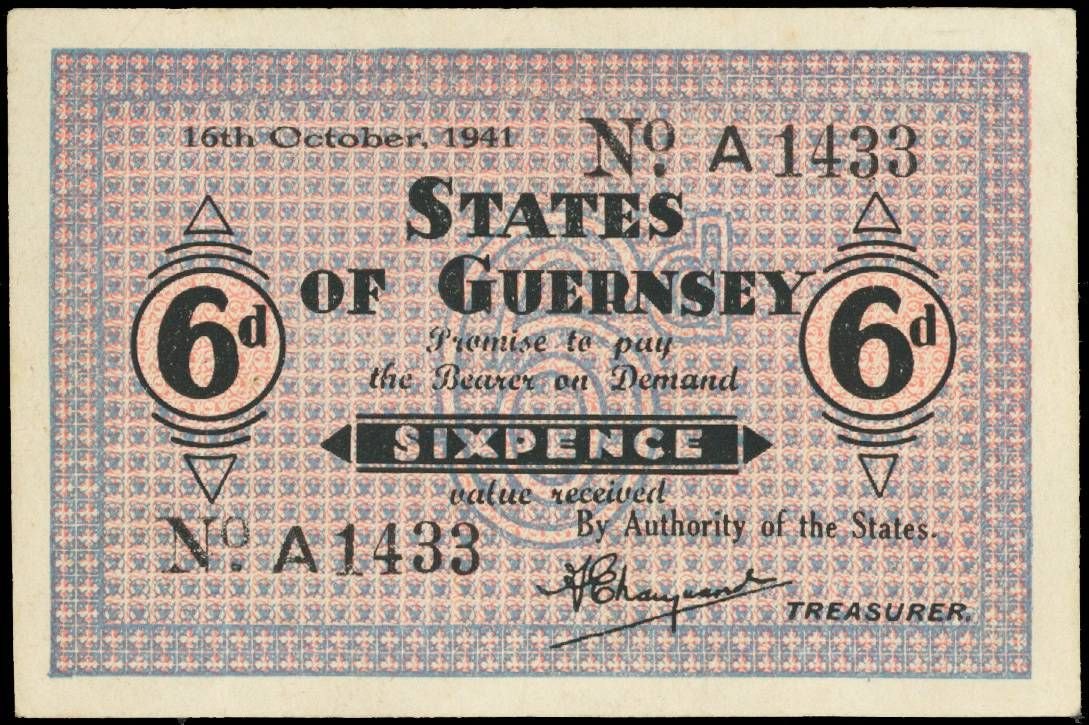
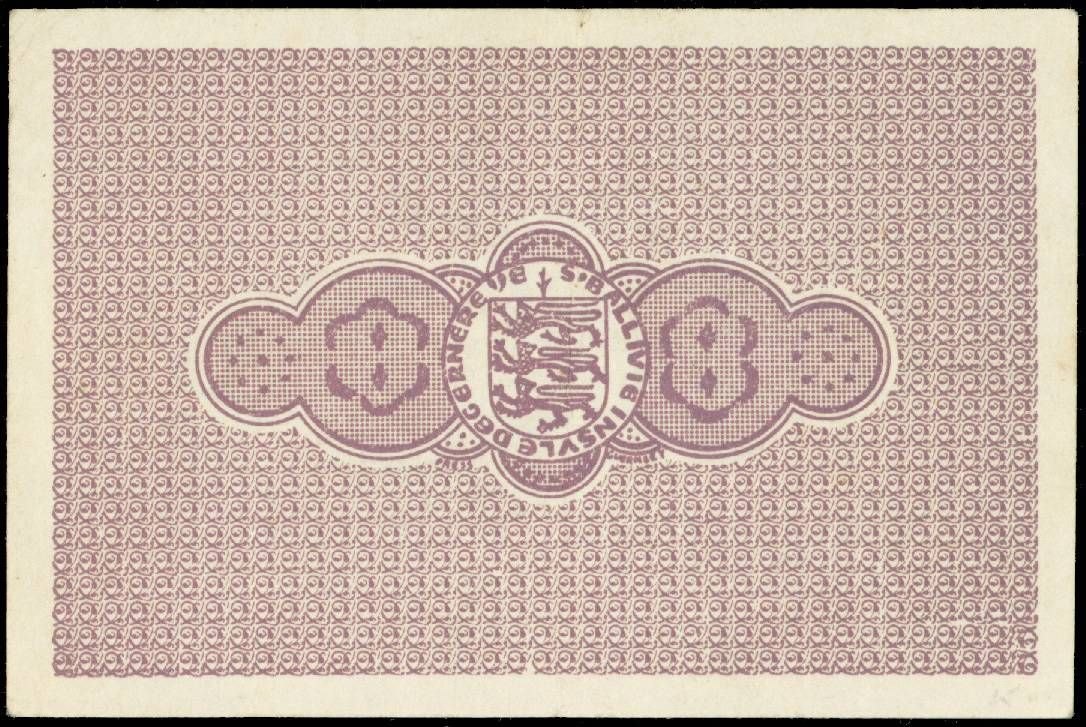
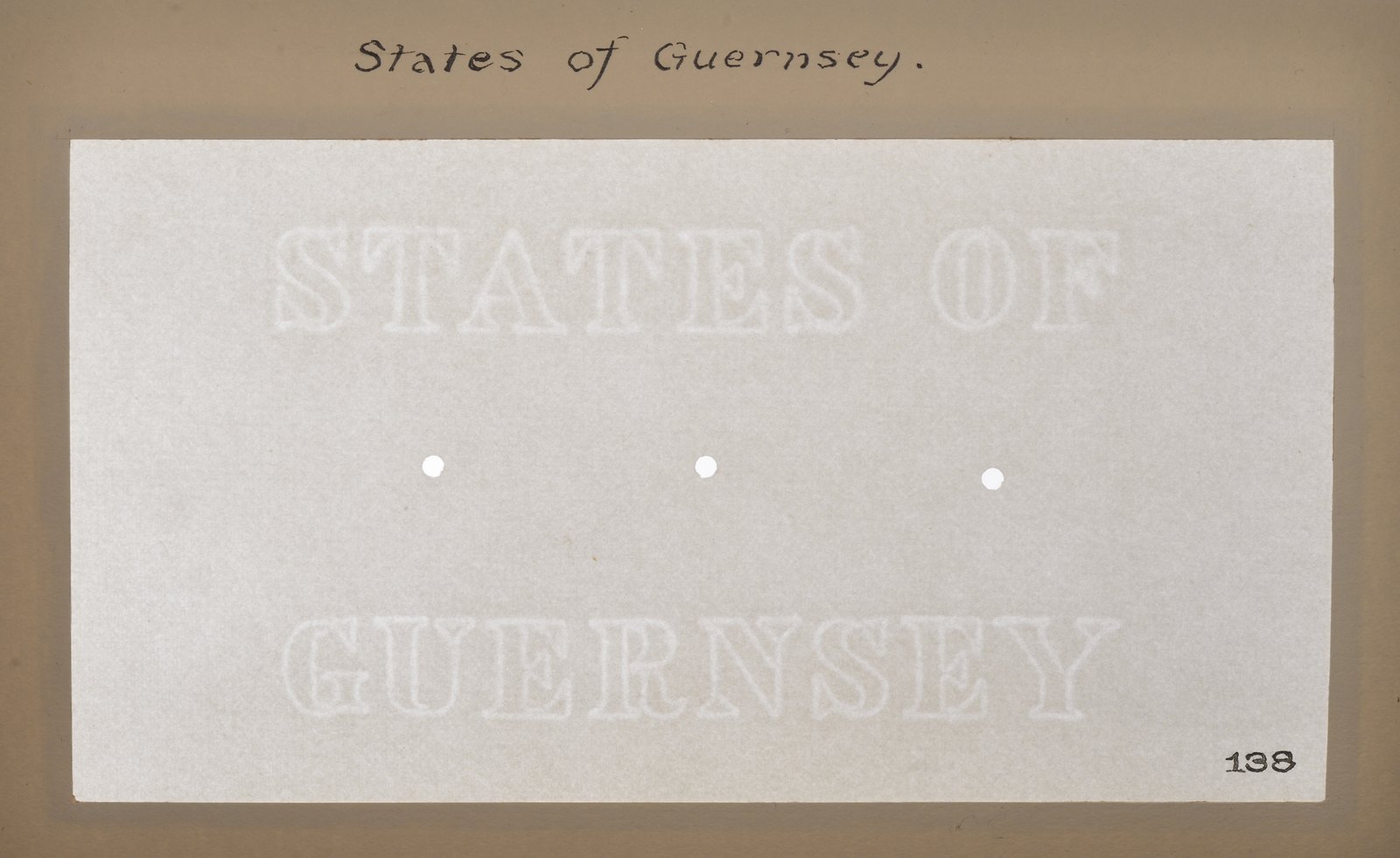
Every small-change note was designed by Edward William Vaudin and printed by the Guernsey Press four to a sheet. The white paper carries a large watermark STATES OF / GUERNSEY, so each small note shows only a part of it. Serial numbers have four digits beginning 0 to 3, so that a prefix holds at most 4,000 notes. A letter from Austin Sprake of Guernsey in IBNS Journal 12:3 (1973, page 175) says the same of every occupation note: the numbering machines never seemed to run higher than 3999.
Noonans' description of lot 829 in its sale of 14 March 2024, a sample of the watermarked paper, says the paper with this watermark was used for all notes from 1925 to the invasion of 1940 and again from 1945 to 1966. That is Noonans' statement; the pages name the watermark only on the occupation notes.
The printings in order
| Date on the notes | Values | Paper | Prefixes, as the pages give them |
|---|---|---|---|
| 25th March 1941 | 2 shillings 6 pence, 5 shillings | white, watermarked | 5 shillings ends at A/H 1999 |
| 17th May 1941 | 2 shillings 6 pence | white, watermarked | A/F to A/K |
| 16th October 1941 | 6 pence, 1 shilling 3 pence | not stated for the 6 pence; watermarked for the 1 shilling 3 pence | 6 pence A to K |
| 1st January 1942 | 6 pence, 2 shillings 6 pence, 5 shillings | blue for the 6 pence and the 2 shillings 6 pence | 6 pence L to Z, then A/A to A/E; 2 shillings 6 pence A/L to A/Z and B/A; 5 shillings from A/H 2000 |
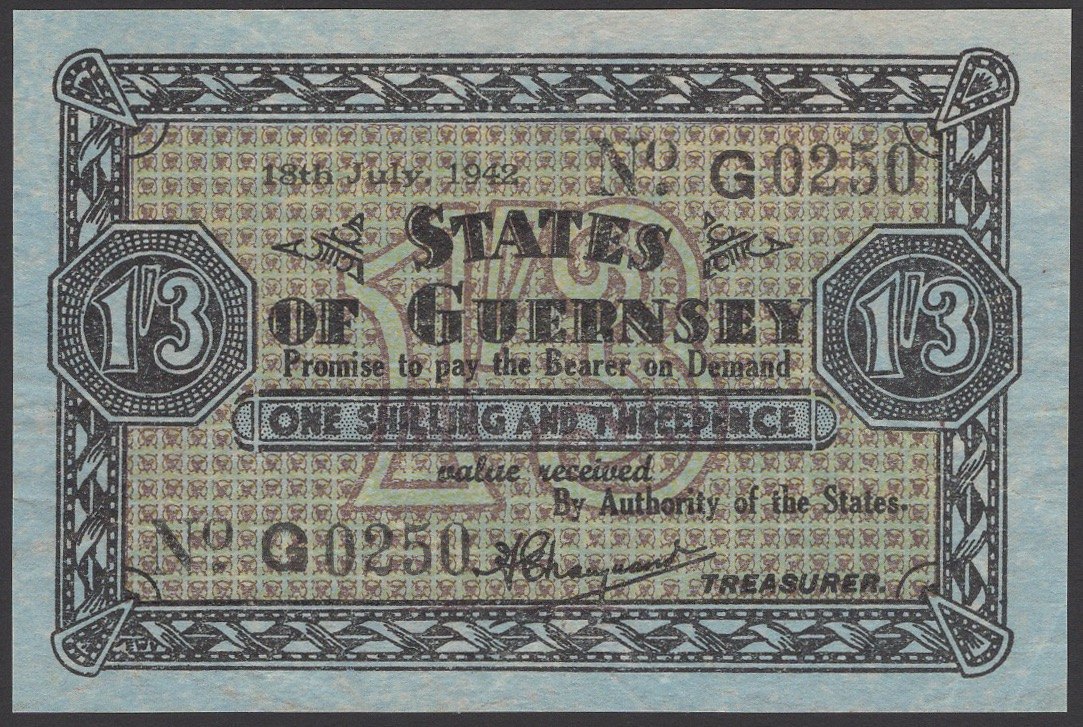
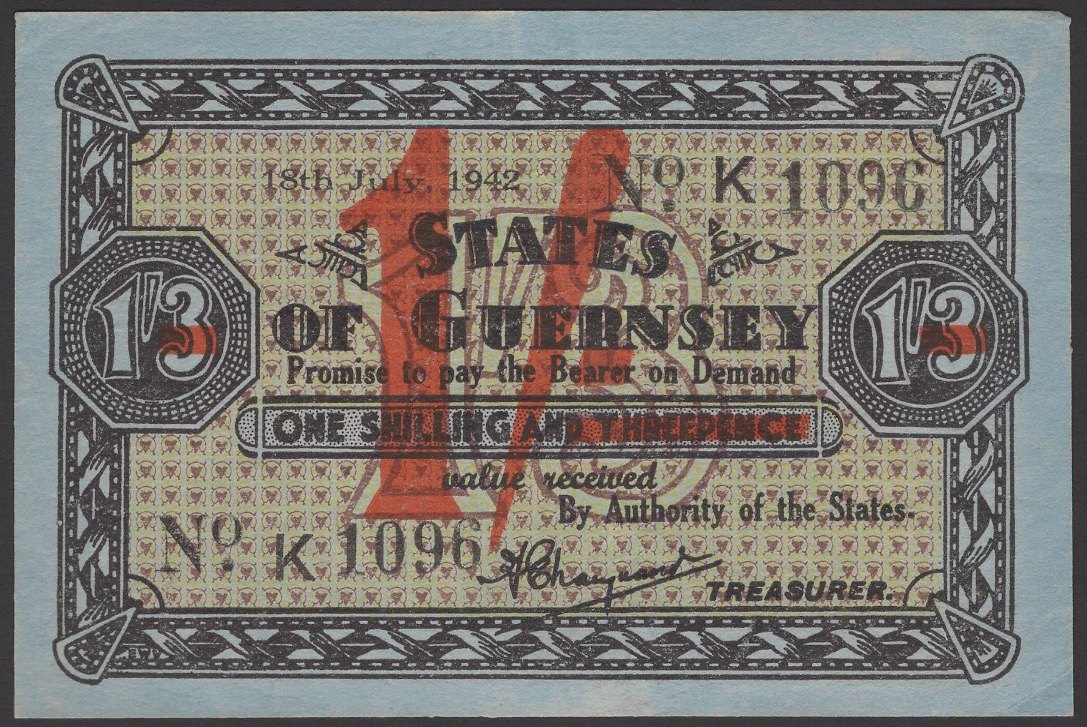
| 18th July 1942 | 1 shilling 3 pence, 1 shilling on 1 shilling 3 pence | blue | G to M |
| 1st January 1943 | 6 pence, 1 shilling on 1 shilling 3 pence, 2 shillings 6 pence, 5 shillings | white | 6 pence A/F to A/U; 1 shilling N to Z; 2 shillings 6 pence from B/B; 5 shillings from A/L |
The pages call the notes of 25th March 1941 the first printing. The second, of 17th May 1941, was £2,500 in notes of 2 shillings 6 pence. The third, of 16th October 1941, was £1,000 in notes of 6 pence and £1,500 in notes of 1 shilling 3 pence.
The notes dated 1st January 1942 are on blue French paper, because the white watermarked paper had run short. The page of the 5 shillings of that date names the watermarked paper, not the blue. With the date 1st January 1943 every value went back to white paper.
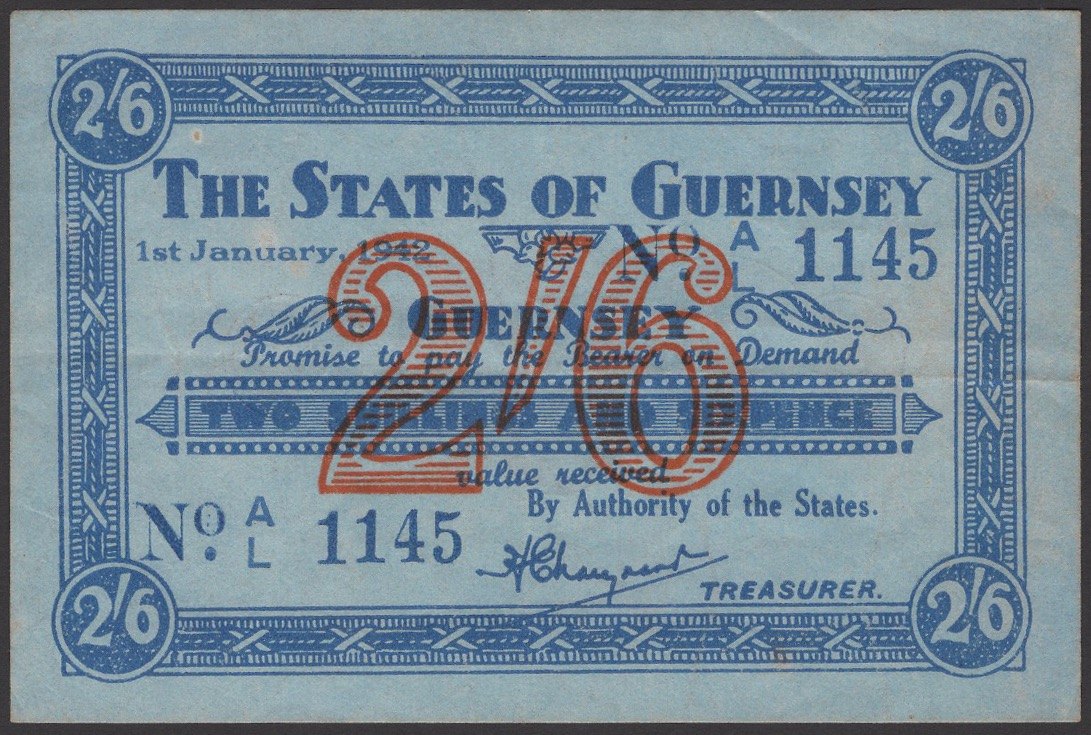
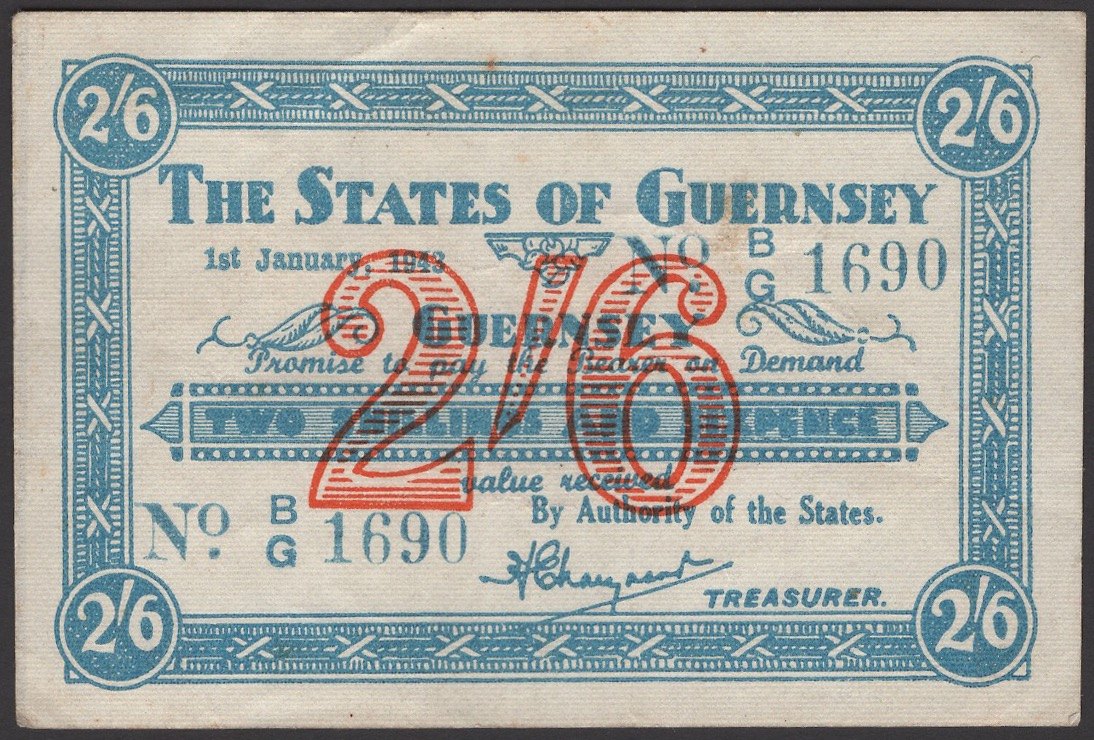
Within each value the prefixes run on from one date to the next. Two catalogue numbers have no note behind them. Sources mention a 5 shillings dated 17th May 1941 as P-21, but none has been recorded: the 5 shillings of March 1941 stops at A/H 1999 and the 5 shillings of 1942 carries on in the same prefix. And there is no P-25, because no 1 shilling 3 pence dated 1st January 1942 exists, with or without an overprint.
The 1 shilling 3 pence becomes a shilling
The 1 shilling 3 pence dated 18th July 1942 was overprinted 1/- in red and issued as a shilling, with the prefixes G to M. Only 500 notes of prefix G were left without the overprint; they are the 1 shilling 3 pence of 1942. The overprinted notes dated 1st January 1943 carry on from N to Z. No page says why the value was changed.
The sixpence marked as withdrawn
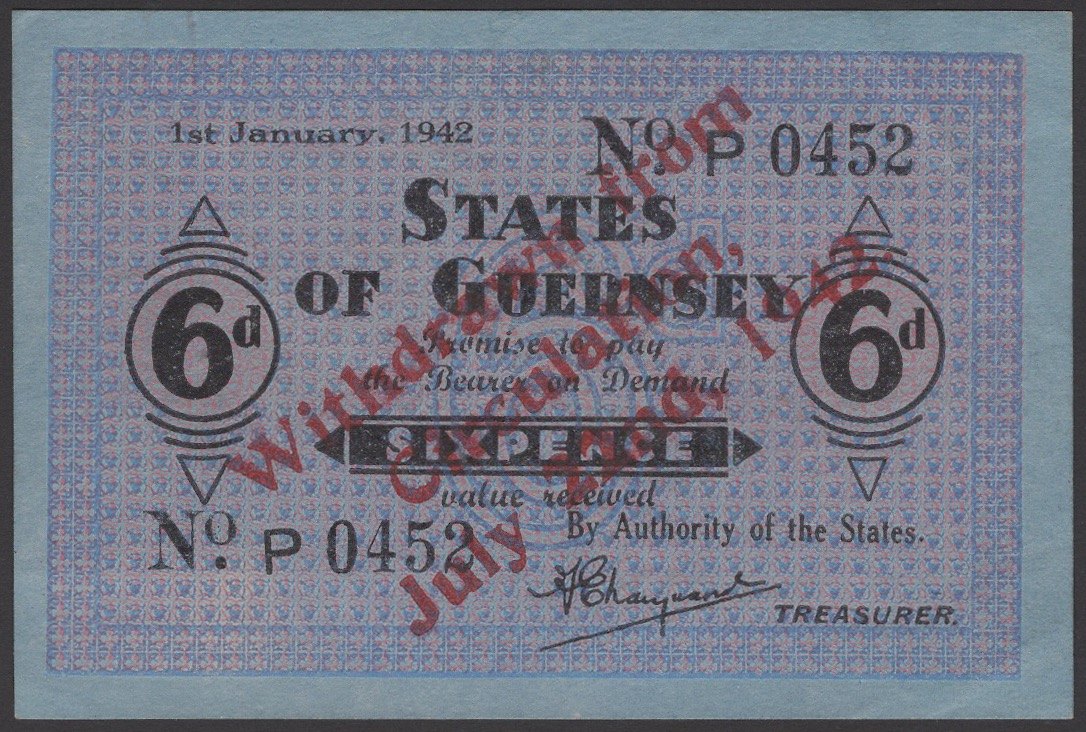
One row of the 6 pence of 1942 is the same blue note with a red overprint that reads "Withdrawn from Circulation, July 22nd, 1942". Noonans' description of lot 446 in its sale of 24 August 2022 says the overprint is on both sides, that several such notes are recorded with overprints of differing styles, and supposes they were kept as gifts or souvenirs. The pages give no account of the withdrawal.
How many were issued
The pages give one total for each value over all its dates, with the number still outstanding:
| Value | Dates | Issued | Outstanding |
|---|---|---|---|
| 6 pence | 1941 to 1943 | 180,000 | 26,000 |
| 1 shilling on 1 shilling 3 pence | 1942 and 1943 | 75,500 | 4,400 |
| 2 shillings 6 pence | 1941 to 1943 | 164,000 | 3,500 |
| 5 shillings | 1941 to 1943 | 72,000 | 1,200 |
No figure is given for the 1 shilling 3 pence of 1941. Heritage's description of lot 24214 in its sale of 17 October 2024 says about 200,000 or fewer were printed, without a source.
The houses do not always agree with the pages. Lyn Knight (2003, lot 745, and 9 June 2004, lot 649) gives the same totals as the pages for the 2 shillings 6 pence and the 6 pence. Heritage (17 October 2024, lot 24216) gives 160,000 for the 2 shillings 6 pence; the page of the 1942 note answers that the prefixes A/A to B/Q make 41 blocks of 4,000 notes, which fits 164,000. Heritage's description of lot 24219 in the same sale gives 64,000 printed for the shilling of 1943 and 175,000 for the 2 shillings 6 pence of 1943, and lot 24217 gives 75,000 for the overprinted shilling with prefixes G to M alone. None of these three figures is on the pages. Heritage (27 March 2025, lot 24268) has the same 72,000 and 1,200 for the 5 shillings as the pages.
The notes printed in secret
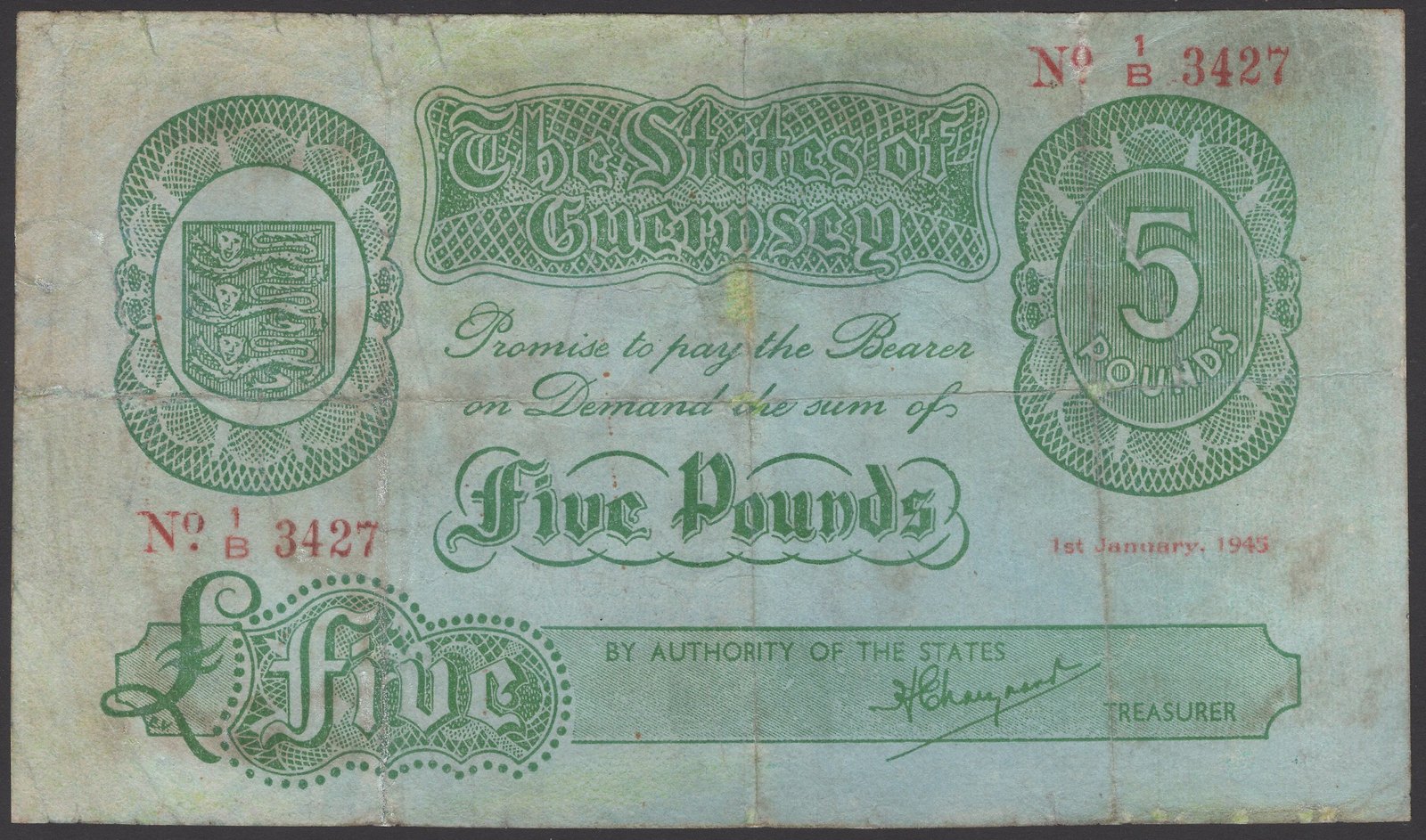
The 10 shillings and the 1 pound dated 1st January 1943 were printed in secret by the Guernsey Press during the occupation and issued at the liberation on 9 May 1945; the page of the 10 shillings adds that it was issued to redeem the small-change notes. A second 1 pound and a 5 pounds are dated 1st January 1945 and are on blue paper. The 1 pound of 1943 has the prefixes A/1 to Z/1 and A/2 to N/2, the 1 pound of 1945 carries on with O/2 to S/2, and the 5 pounds has 1/A to 1/H.
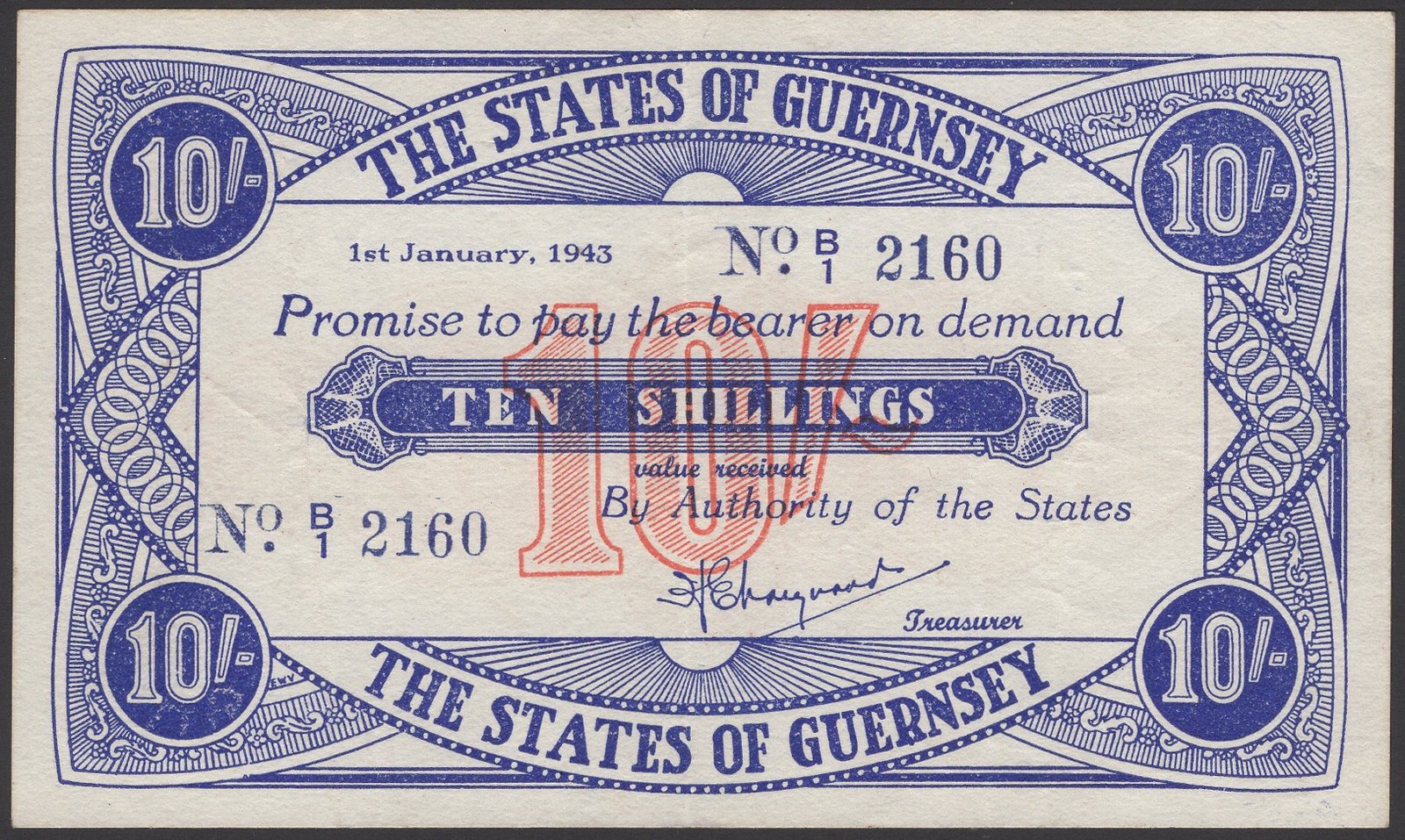
The pages give 88,000 notes of 10 shillings issued, 172,000 of 1 pound for both dates together and 30,000 of 5 pounds. Sprake's letter of 1973 quotes a booklet by R. Le Marchant, Paper Treasure of the Channel Islands, which divides the 1 pound: 160,000 notes dated 1.1.43, printed in 1943 with the 88,000 notes of 10 shillings, and a further 12,000 dated 1.1.45 with the 30,000 notes of 5 pounds. The letter does not accept the 12,000. It says that later research points to at least 19,995 notes of the 1 pound of 1945, because the five prefix letters O, P, Q, R and S had been recorded and no number above 3999 had been seen. The page of that note says only that the numbers recorded in each prefix stay below 4000. Heritage (27 March 2025, lot 24269) says island records show 88,000 notes of 10 shillings issued and 87,000 later withdrawn; the page gives 1,000 as still outstanding.
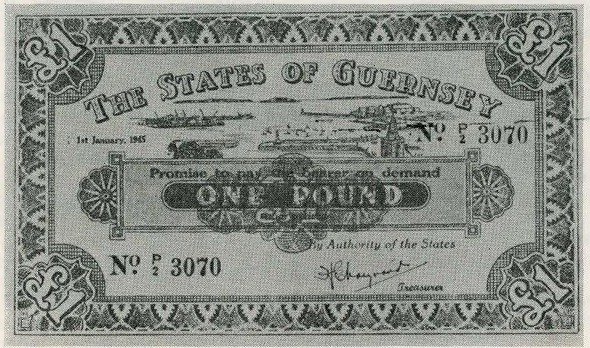
The letter also says that the local 1 pound notes stayed in use for about twelve months, while Bank of England notes and the new 1 pound dated 1st August 1945 took their place; the scanned text does not show whether these are still the booklet's words or Sprake's own. The letter adds that the blue paper came from France and has a decorative watermark.
The exchange of German money
At the liberation German notes could be exchanged at 2 shillings to the Reichsmark, up to 20 pounds a person, and £344,522 6s 6d was converted in all. Banyai quotes the proclamation of 8 May 1945 by Victor Gosselin Carey for the rate of 2 shillings.
Sources mention the 10 shillings and the 1 pound notes of the liberation with a diagonal red overprint WITHDRAWN FROM CIRCULATION. None is recorded in the catalogue.
Where to see them, and more to read
The Guernsey Museums' page on its stamps and coins says the museum's collection holds paper money issued during the occupation both by the States and by the German authorities. Feller, writing in 2006, describes a complete set of the Guernsey occupation notes on show at the Guernsey Museum.
The drawings and designs that survive from the wartime notes of the islands are the subject of Wartime and occupation: what the design archive keeps from 1914 to 1945. The other Guernsey issues are told in The notes of the States of Guernsey, 1895 to 2023.
Sources
- The Pick pages of this catalogue for Guernsey, P-18 to P-33B.
- Richard Banyai, "The German Military Occupation of the British Channel Islands (Jersey and Guernsey) and Occupation Monetary Policy, 1940-1941", IBNS Journal 10:1 (September 1970), pages 42 to 44, quoting Alan and Mary Wood, Islands in Danger.
- Austin Sprake, letter "Guernsey Occupation £1 Blue Paper", IBNS Journal 12:3 (1973), page 175, quoting R. Le Marchant, Paper Treasure of the Channel Islands.
- Steve Feller, "Occupied Jersey and Guernsey", IBNS Journal 45:1 (2006), pages 34 to 38.
- Guernsey Museums, "Stamps and coins" (museums.gov.gg).
- Heritage Auctions, 17 October 2024, lots 24214, 24216, 24217 and 24219; 27 March 2025, lots 24268 and 24269. Lyn Knight, 2003, lot 745, and 9 June 2004, lot 649, as the pages quote them. Noonans, 24 August 2022, lot 446, and 14 March 2024, lot 829.


Member comments
Log in or register to post a comment.