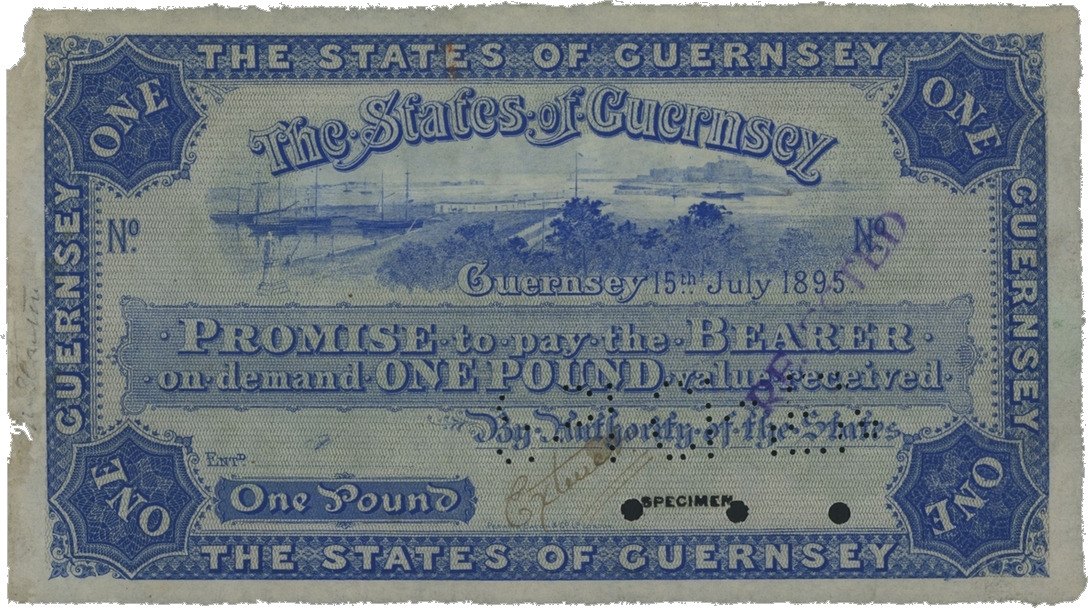
This article follows the notes of the States of Guernsey from the first note in this catalogue, the 1 pound of 1895, to the notes announced in 2023. It is written from the catalogue pages of each note, from the journals of the International Bank Note Society, from three press releases of the States and from what the auction houses have written about single lots. A house description is given as that house's statement.
Before 1895
The catalogue begins in 1895, but the States had issued notes long before. The States' press release of 3 July 2013 says that Guernsey 1 pound notes were first issued in 1816. Roger Outing, in "Beyond Rarity" (IBNS Journal, volume 41, number 1), gives an earlier start: a committee of the States, formed in 1815 to find the means of enlarging the Market House, issued 1 pound notes to a total of £3,000 with a redemption period of ten years, and Outing's table dates that issue 12th April 1815. Outing writes that the same was done on six further occasions up to 1829, that notes to a total value of £70,080 were created, that 48,183 notes were stated to be in circulation in 1829, and that no surviving example and no description of these notes is known. Outing takes the Guernsey figures from Norman Angell, The Story of Money (1930). The two starting years, 1815 and 1816, are left side by side here; the pages of this catalogue do not settle them.
The States themselves pointed back to these notes in 1980. Francis Thornton, writing in IBNS Journal 19:3 (1980) from the States' press release, says the front of the new 1 pound shows the Old Market Square about 1830, to recall that an earlier note issue paid for the building of the market.
1895 to 1918: the Greenback and the black and pink 1 pound
The 1 pound of 1895 was the first Guernsey note printed in colour, blue on the front and green on the back, which gave it the name Greenback. Its page says it answered attempts to counterfeit the black notes that came before. Perkins Bacon and Company printed it. Each note carried two handwritten signatures, and 40,000 notes were issued.
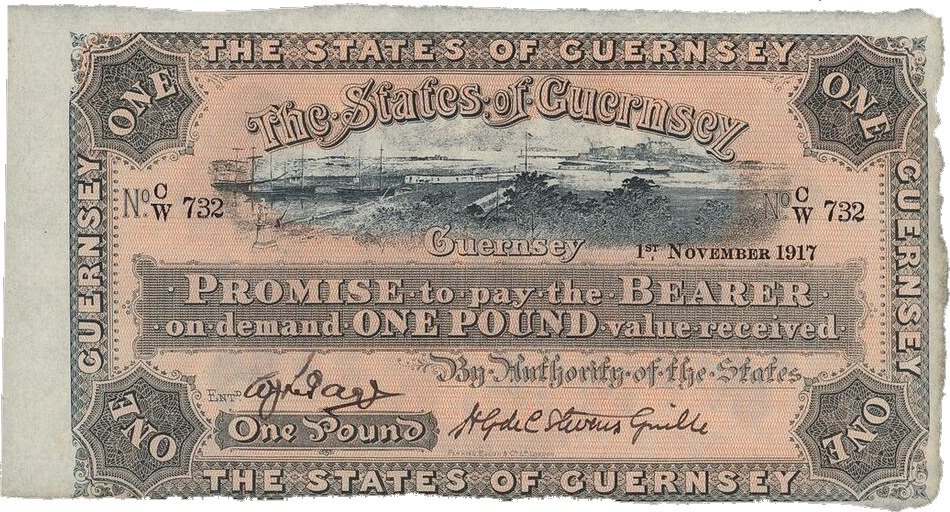
From 1903 the same design was printed in new colours, black and pink on the front and blue on the back. This is the 1 pound of 1903 to 1918, known with dates from 25th March 1903 to 15th October 1918. Noonans' description of lot 1100 in its sale of 15 October 2025 names what the picture on the front shows: ships at the Albert Pier, Joseph Durham's statue of Prince Albert, and Castle Cornet in the harbour of St. Peter Port.
August 1914: emergency notes, then notes from England
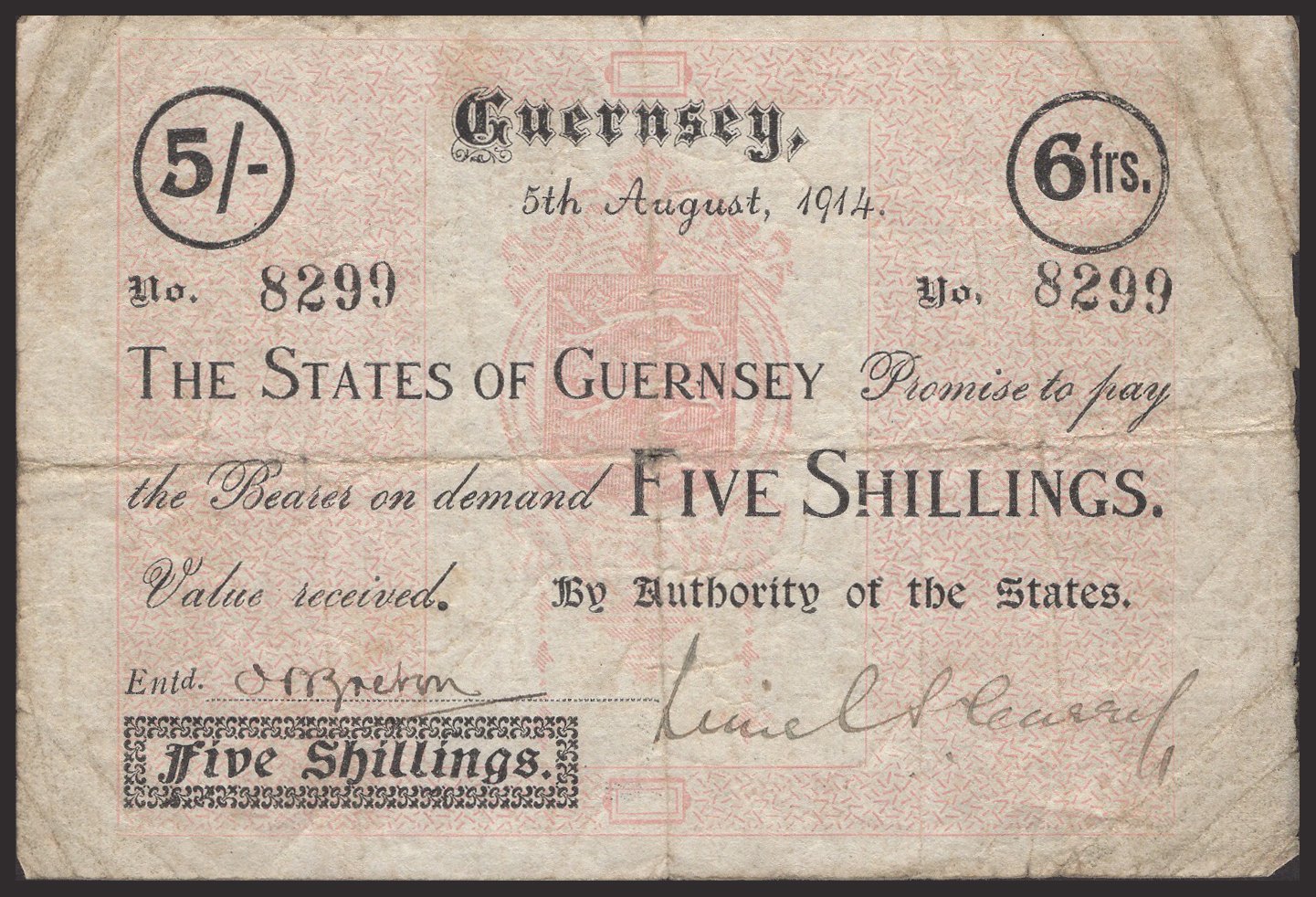
In the first days of the First World War the States had small notes printed in the island by the Guernsey Press. The 5 shillings is dated 5th August 1914 and the 10 shillings 7th August 1914. Both are valued in shillings and in francs, 6 francs and 12 francs. Heritage's description of lot 24265 in its sale of 27 March 2025 gives the reason: silver coin was being saved in Guernsey during the First World War. 17,000 of the 5 shillings were issued. Little is certain about the 10 shillings: no example has been photographed for the catalogue, and the figures its page quotes (8,000 notes issued) have no second source.
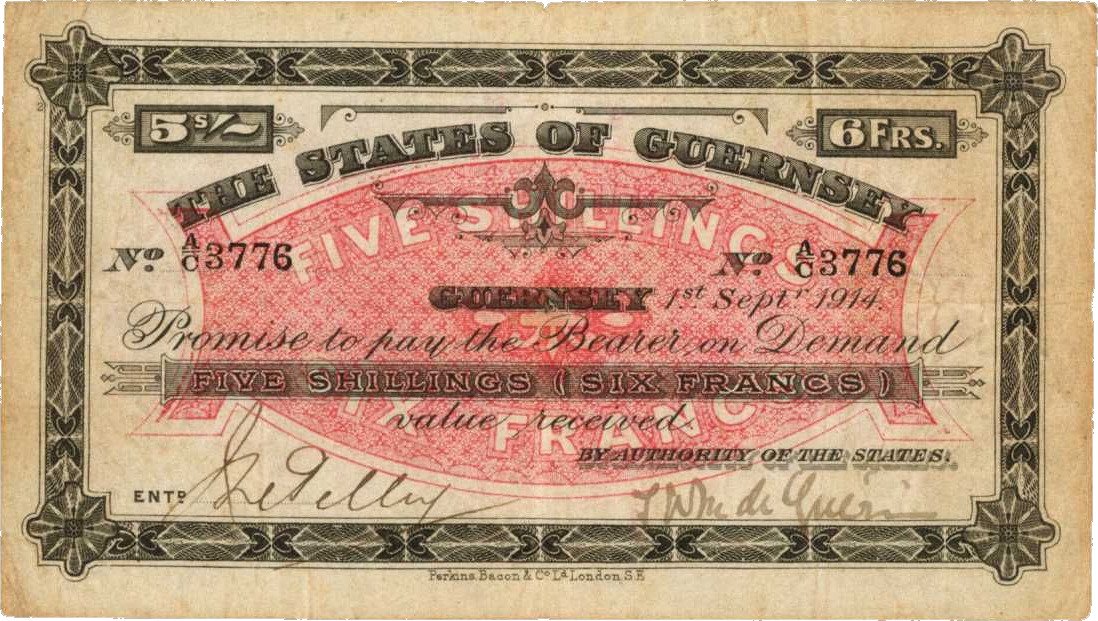
A resolution of 7 October 1914 ordered notes from England to replace the local ones. Perkins Bacon printed a 5 shillings and a 10 shillings, again valued in francs as well, and both carry the date 1st September 1914, earlier than the resolution. 17,000 of the 5 shillings were issued, numbered A/A 0001 to A/E 1000, and 11,500 of the 10 shillings, which also has the date 9th July 1919.
1921: a pound equal to sterling
After the French franc fell, Guernsey adopted a pound equal to sterling on 4 April 1921. The large 1 pound of the design of 1903, on notes dated 1st August 1919 and 1st January 1921, was given a diagonal red overprint BRITISH and introduced in April 1921. This is the overprinted 1 pound: 36,000 notes, numbered D/R 2001 to E/A 2000.
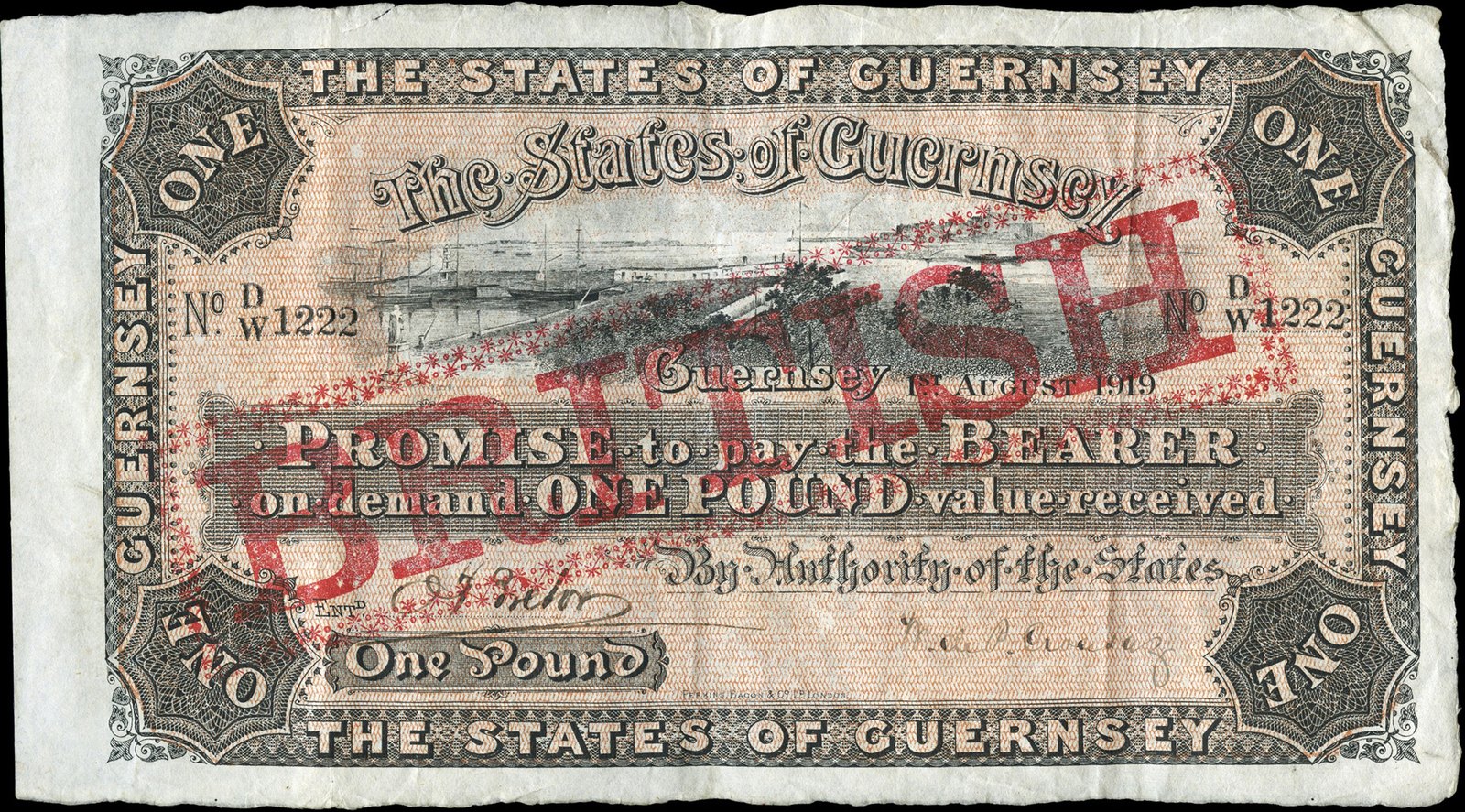
New, smaller notes followed with the date 1st March 1921: a 10 shillings that no longer gives a value in francs, with dates to 1931, and a 1 pound with a pink underprint, with dates to 1926. The 1 pound of 1927 to 1932 is without the pink underprint and has the value on a large red guilloche at lower centre. All these notes carry one handwritten signature at lower left and the Treasurer's printed signature at lower right. 148,000 of the 10 shillings were issued, 445,000 of the 1 pound of 1921 to 1926 and 77,000 of the 1 pound of 1927 to 1932.
1933 to 1940: one signature
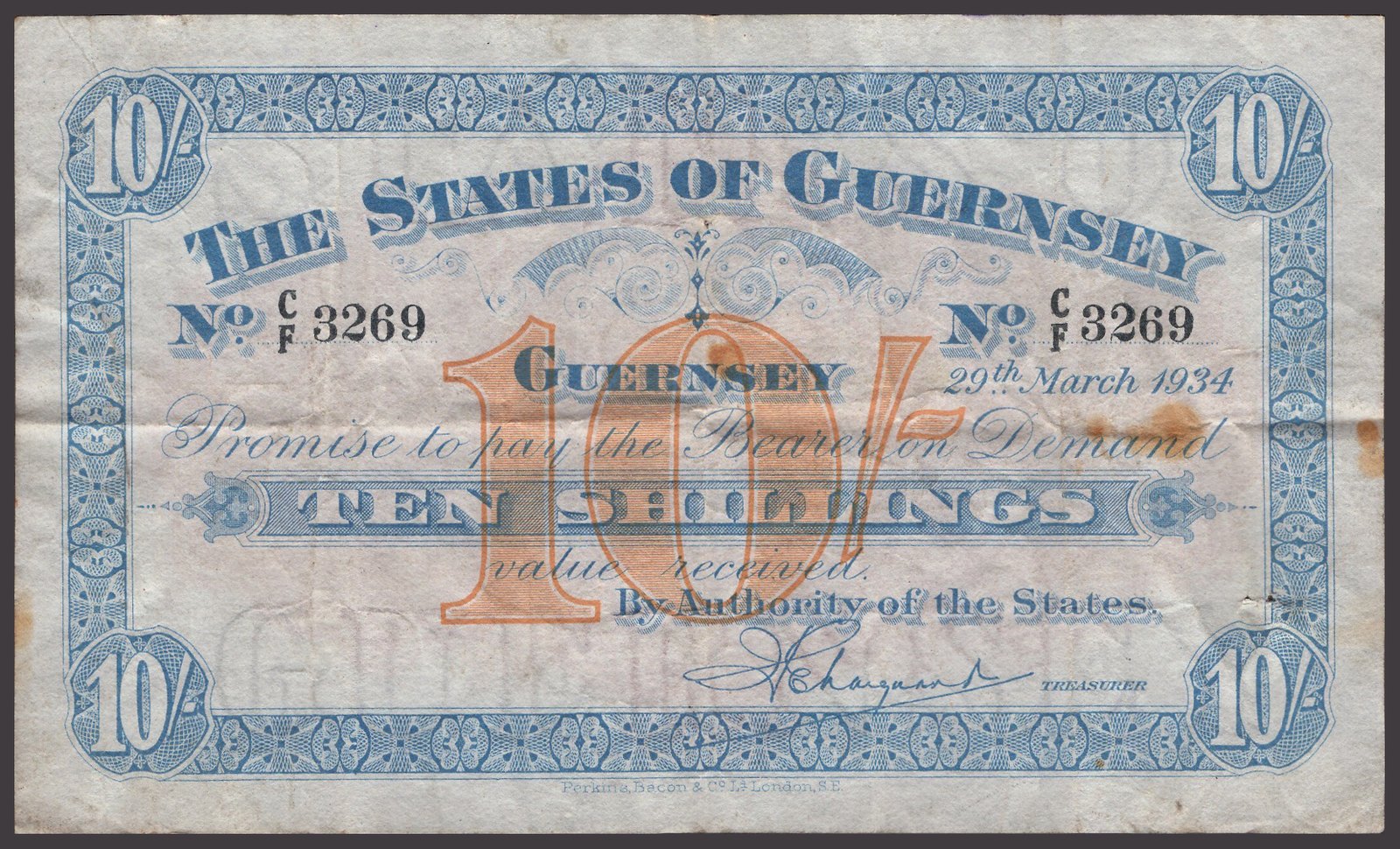
By a resolution of 12 December 1932 the handwritten signature was dropped, and the notes of 1933 carry only the printed signature of the Treasurer, Henry Edward Marquand. The 10 shillings and 1 pound of 1933 have the legend THE STATES OF GUERNSEY around the seal on the back. From 1934 the legend is in Latin, S'BALLIVIE INSVLE DEGERNEREVE, the Seal of the Bailiwick of the Islands of Guernsey: these are the 10 shillings and 1 pound of 1934 to 1940. The last date of both is 9th March 1940. The pages give the numbers issued for the two seal types together: 468,000 notes of 10 shillings and 820,000 of 1 pound.
1940 to 1945: occupation and liberation
Germany occupied Guernsey on 30 June 1940. Sterling notes and coin went out of circulation, and the States had small-change notes of 6 pence to 5 shillings printed by the Guernsey Press, the first dated 25th March 1941. Notes of 10 shillings and 1 pound dated 1st January 1943, printed in secret, were issued at the liberation on 9 May 1945, and a 1 pound and a 5 pounds are dated 1st January 1945. These issues have an article of their own: Guernsey under occupation: the small-change notes of 1941 to 1943 and the liberation notes of 1945.
Every note from the Greenback of 1895 to the 1 pound of 1940 has the same day of withdrawal on its page: 1 June 1945. For the local 10 shillings of 1914 the page gives that day only as something sources mention.
1945 to 1966: the last Perkins Bacon notes
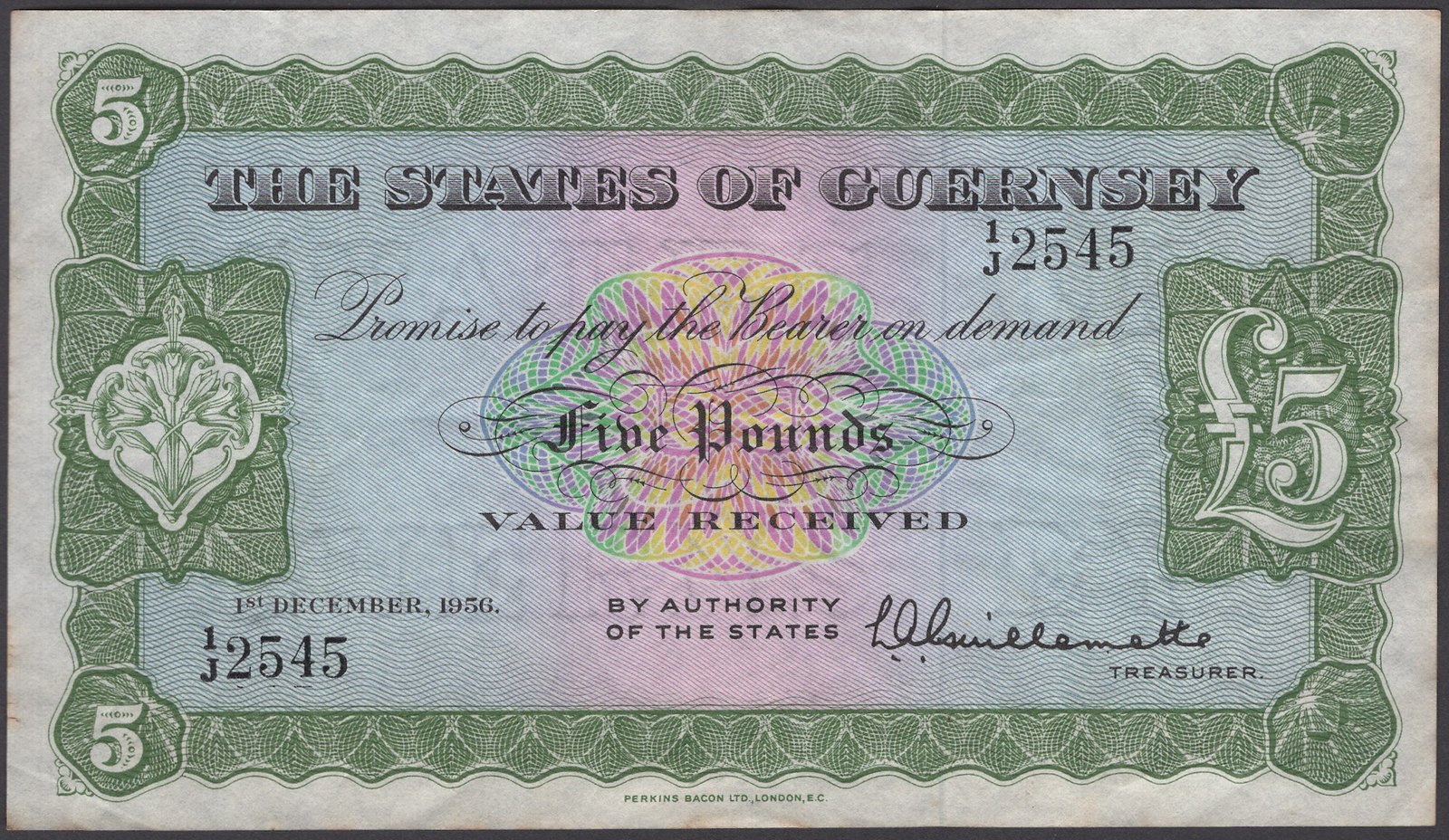
New notes printed by Perkins Bacon are dated from 1st August 1945: a 10 shillings and a 1 pound, and from 1st December 1956 a 5 pounds, which was introduced on 6 February 1957. Marquand signed the first dates and Guillemette the notes from 1950. Both smaller values were reduced a little in size with the date 1st May 1953. The last date of all three values is 1st July 1966. The pages give 2,328,000 notes of 10 shillings, 4,890,000 of 1 pound and 277,400 of 5 pounds as issued.
1969 to 1975: undated notes by Bradbury Wilkinson
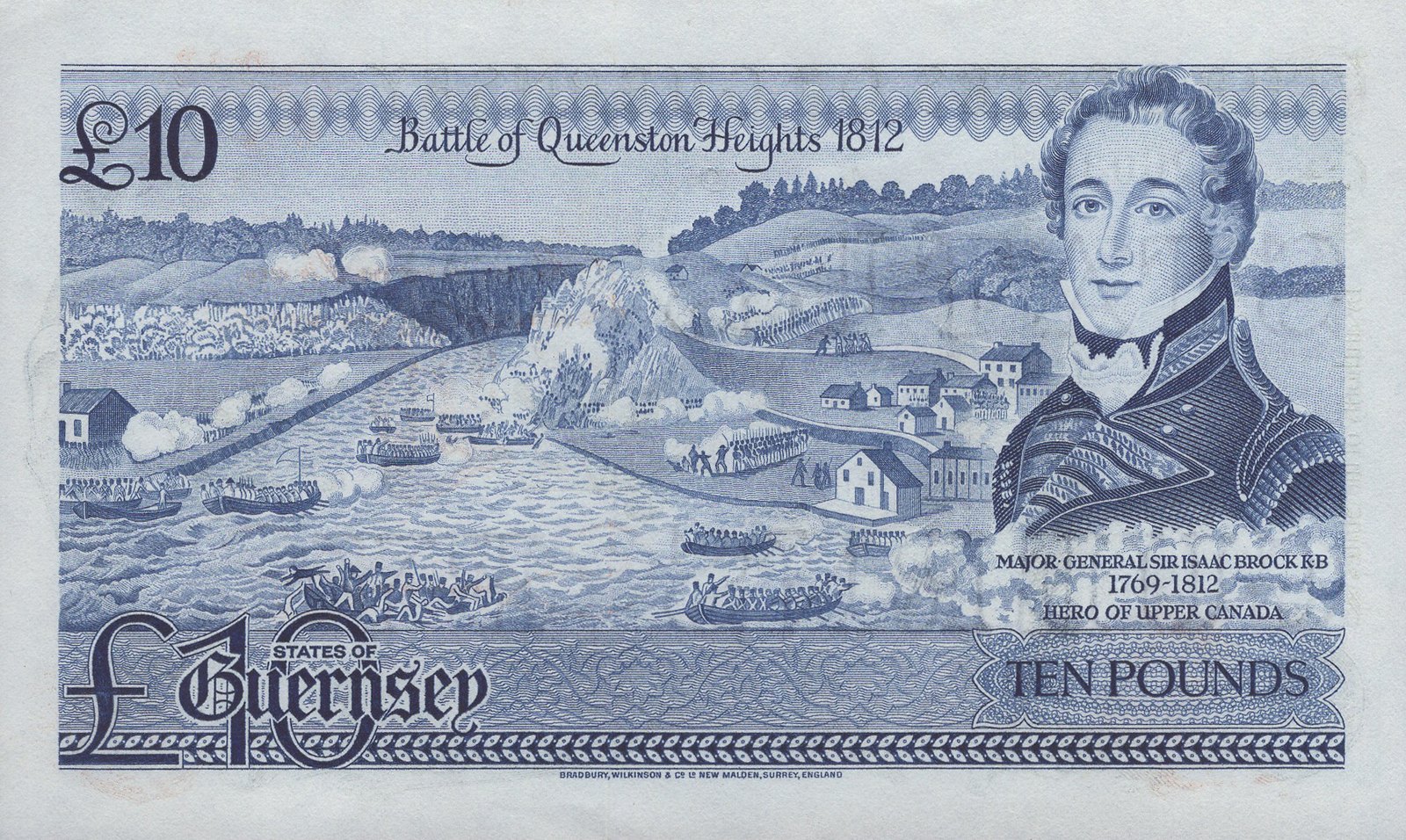
On 27 March 1969 a 1 pound and a 5 pounds printed by Bradbury Wilkinson were introduced. They carry no date. Francis Thornton, in IBNS Journal 16:3 (1977), points out that every States note before them, the occupation notes included, had been dated. The 1 pound page names the designer as A. Machin; Thornton writes Arnold Machin. Guernsey went over to decimal currency in 1971. A 10 pounds, the first of that value from the States according to Thornton, was introduced on 3 April 1975; it shows Sir Isaac Brock and the Battle of Queenston Heights. Guillemette, Hodder and Bull signed the 1 pound and the 5 pounds in turn, and Hodder the 10 pounds. 7,860,000 notes of 1 pound, 2,826,400 of 5 pounds and 571,400 of 10 pounds were issued.
1980 to 1992: De La Rue
The notes of 1980 were the first that De La Rue printed for Guernsey. There were four values, the 1 pound, 5 pounds, 10 pounds and, as a new value, the 20 pounds. The 1 pound page gives 20 March 1980 as the day of introduction and adds that the States' press release gives 24 March 1980; Thornton, who wrote from that press release in IBNS Journal 19:3, also has 24 March. Bull signed the first notes and Brown the later ones.
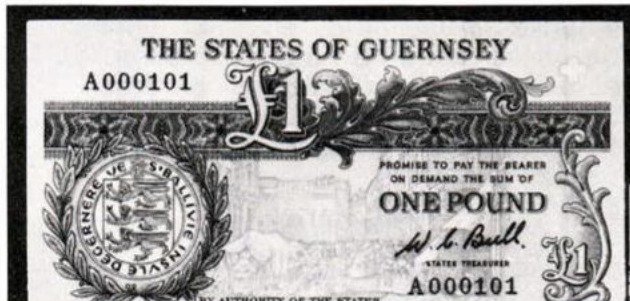
Between 1990 and 1992 the four values were reissued in a smaller size: the 5 pounds (the page says sources mention 7 June 1990), the 1 pound on 23 July 1991, the 20 pounds (the page says sources mention July 1991, on the same day as the 1 pound) and the 10 pounds. The small 1 pound has been signed by Brown, Trestain, Clark and, from 2016, Haines.
1994 to 2023: the notes with Queen Elizabeth II
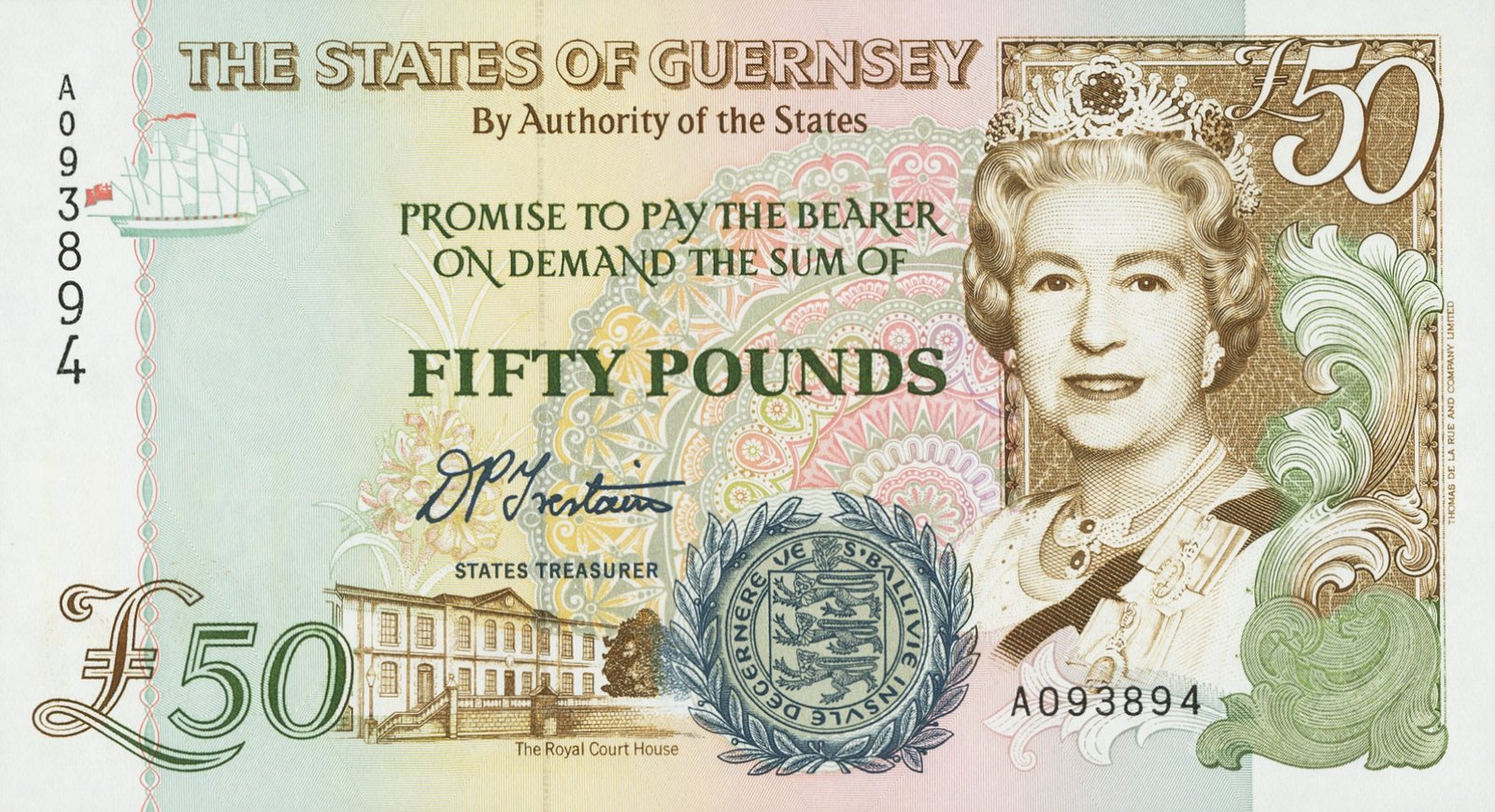
A 50 pounds, a new value, was introduced on 11 July 1994 with a portrait of Queen Elizabeth II. The 10 pounds followed on 7 March 1995, the 5 pounds on 26 March 1996 and the 20 pounds on 30 April 1996. The pages say sources mention that the portrait follows a photograph by Terry O'Neill taken in April 1992, engraved by Alan Dow of De La Rue. The 5, 10 and 20 pounds were later signed by Clark, and the 10 and 20 pounds by Haines as well. Windowed security threads took the place of solid ones, and a 20 pounds with a foil patch came on 4 June 2009.
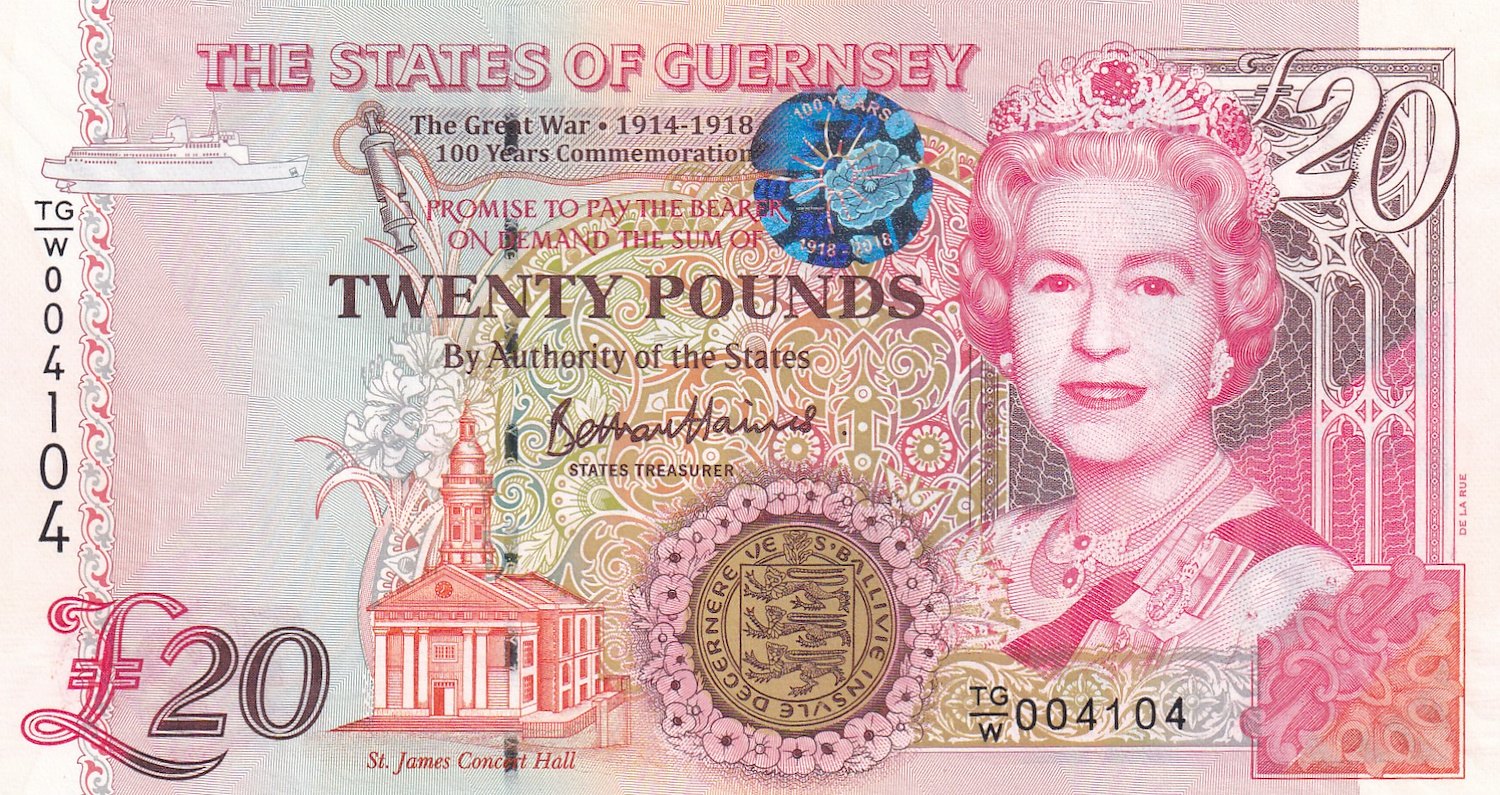
Four notes were made for an occasion. The States' press release of 7 November 2018 counts them:
- the 5 pounds of 2000 for the millennium, with the prefix M;
- the 20 pounds of 2012 for the Diamond Jubilee, 150,000 notes introduced on 1 June 2012;
- the 1 pound of 2013 for the 200th anniversary of Thomas de la Rue's first commercial venture, 300,000 notes from 4 July 2013;
- the 20 pounds of 2018 for the centenary of the end of the First World War, 500,000 notes introduced on 8 November 2018.
The same release says that there were then no plans for polymer notes, and that this stayed under review. The press release of 3 July 2013 puts Guernsey's notes and coin in circulation at just over £44.2 million, of which £33.5 million was in notes and £3.4 million in 1 pound notes.
On 19 January 2023 the States announced a 5 pounds, a 10 pounds and a 20 pounds with new security features, the designs otherwise unchanged. The press release of that day says the earlier notes stay legal tender and circulate beside the new ones, and gives the value of the States' currency in circulation as £51 million.
What the pages do not say
No page names the law or resolution under which the notes of 1895, 1903, 1945, 1969 or 1980 were issued; only the resolutions of 7 October 1914 and 12 December 1932 are named. The number of notes issued is not given for the 1 pound of 1903 to 1918, for the 1 shilling 3 pence of 1941 or for any note after 1975 apart from the three notes of 2012, 2013 and 2018. The figures that are given are set out in Guernsey notes issued and still outstanding, 1895 to 1975.
Sources
- The Pick pages of this catalogue for Guernsey, P-1 to P-62 and the notes of 2018 and 2023.
- Roger Outing, "Beyond Rarity", IBNS Journal, volume 41, number 1, pages 43 to 45, with Norman Angell, The Story of Money (London, 1930) as Outing's source for Guernsey.
- Francis Thornton, "Island of Guernsey: Undated Currency Issues", IBNS Journal 16:3 (1977), pages 138 to 141.
- Francis Thornton, "Island of Guernsey: Extended New Currency Note Issue", IBNS Journal 19:3 (1980), pages 85 to 86.
- States of Guernsey, press releases of 3 July 2013, 7 November 2018 and 19 January 2023 (gov.gg).
- Noonans, 15 October 2025, lot 1100; Heritage Auctions, 27 March 2025, lot 24265.


Member comments
Log in or register to post a comment.