A war changes a currency in ways a collector can still see: a note drawn by a local artist because nothing could come from London, a design approved in London for a country that was then in enemy hands, paper that went down with a ship, a value made by cutting an older note in three. This article goes through what the design archive of this catalogue keeps from the two world wars, and what the catalogue's pages say about the notes those pieces belong to.
Everything in it comes from the archive's own records of the pieces (what is drawn and written on them, and what was said when they were sold or catalogued by the museum that holds them) and from the notes on the catalogue's pages, which name their sources. Where a record does not say why something was done, no reason is guessed. Dates printed on a note or a design are written as "21st March 1944"; days of events as "20 April 1942".
Jersey, 1941 to 1942: an artist's five drawings
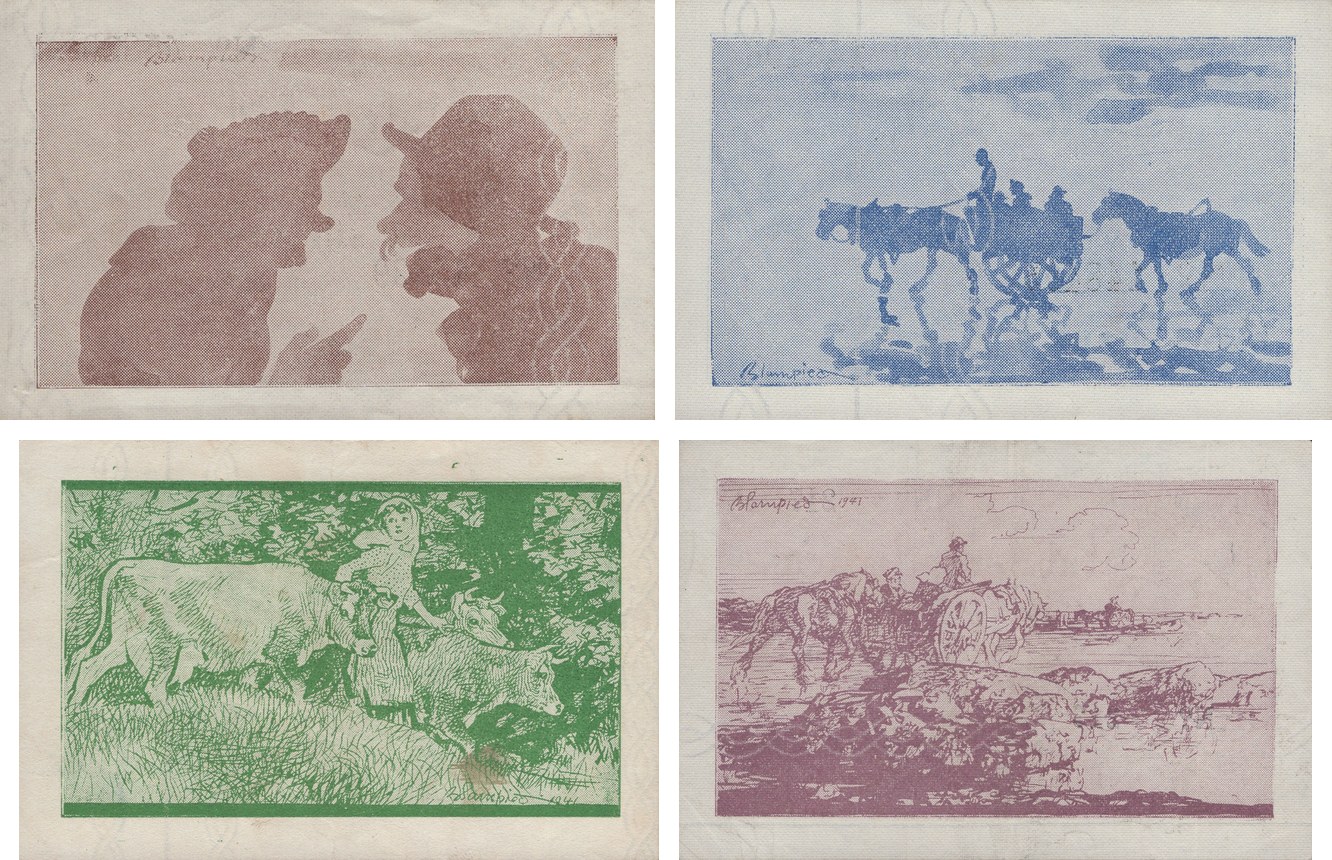
Jersey was occupied by Germany from 30 June 1940 to 9 May 1945. German occupation marks circulated beside sterling, coin ran short, and the island had to make its own small notes. The first was a 2 shillings authorised on 30 May 1941 and introduced the next day. On 6 December 1941 the law was changed to allow notes up to 1 pound, to a total of 100,000 pounds, and a series designed by Edmund Blampied was issued on 20 April 1942.
The original drawings for that series survive. The archive records all five, one for each value, in the art collection of Jersey Heritage (object numbers SJA/0000/01032/a to e): mixed media on card about 21 cm high, the face and the back of each note together. Each face is a line drawing in black ink with the inscription lettered by hand in a Gothic style, the Jersey crest at the top left and a patterned panel at the lower left. The backs are in a maroon wash:
| Value | The back on Blampied's drawing | The note as issued |
|---|---|---|
| 6 pence | the value, SIX PENCE, in decorative lettering | the same |
| 1 shilling | the silhouetted heads of a Jersey man and woman in conversation | the same scene, known as the Gossips |
| 2 shillings | a horse and cart in silhouette, with four figures and a horse led behind | the same scene: a cart on its way to gather vraic (seaweed) |
| 10 shillings | a swirling pattern | a milkmaid walking with three cows |
| 1 pound | the same swirling pattern | a man with horse and cart gathering vraic, with "Blampied 1941" in the plate |
The last two lines are the point of interest. By the museum's record the drawings for the two highest values have a pattern on the back, while the notes carry two scenes by Blampied, one of them dated 1941 in the plate. The record does not say when or how the scenes took the place of the pattern. No photograph of the drawings is published; the museum's record is text only, and the pictures here are of issued notes.
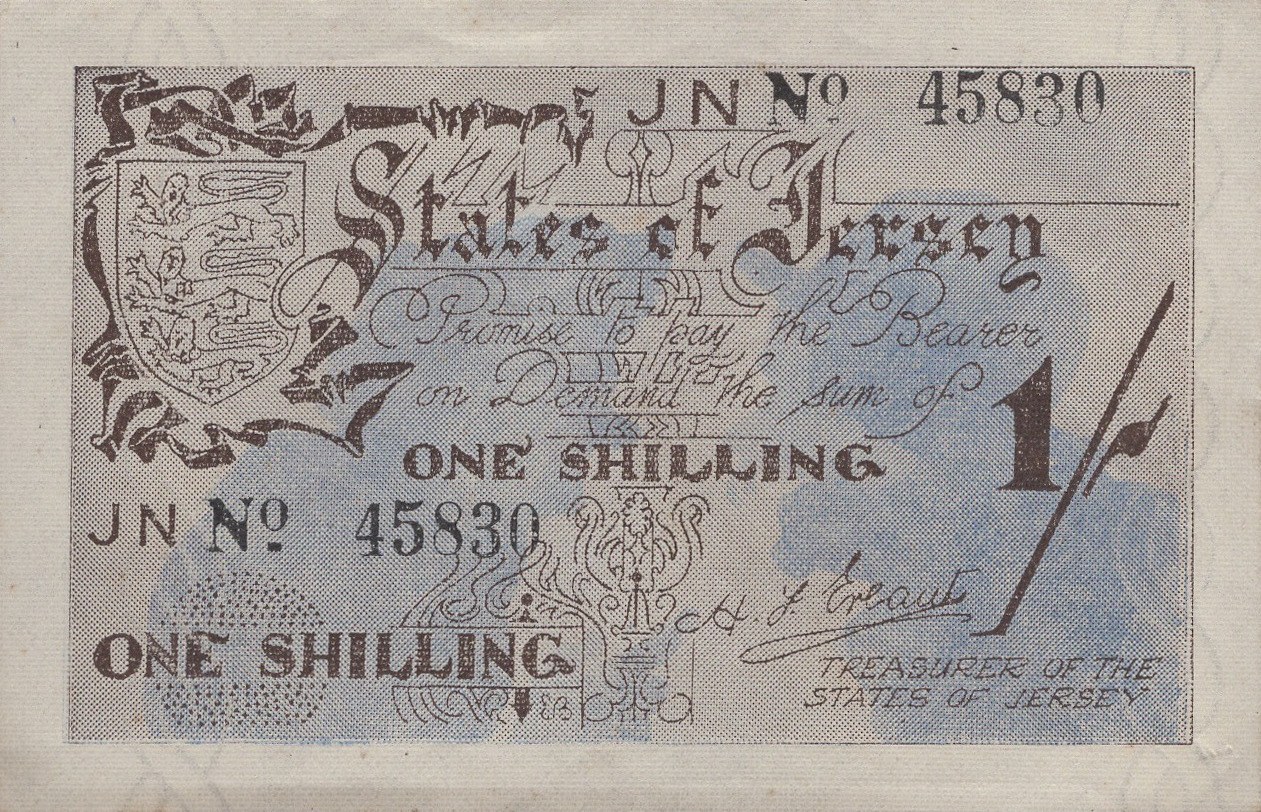
The catalogue's pages add how the designs were turned into notes. They were printed by Bigwoods of Saint Helier, and sources mention that the printing blocks were made by the Jersey Evening Post. The paper was poor, the notes soon looked worn, and they were nicknamed Dirty Berties after Herbert Ereaut, the Treasurer whose signature they carry. Some notes of the 1 shilling, 2 shillings and 1 pound were also signed by Blampied by hand. Sources mention a rumour, denied by Blampied, that the space between the two faces of the Gossips outlines the coast of Brittany. All the notes were withdrawn on 27 November 1946.
Guernsey, occupied on the same day, has no drawing in the archive, but its pages name the designer: the small-change notes of 1941 to 1943 were designed by Edward William Vaudin and printed by the Guernsey Press four to a sheet (2 shillings 6 pence of 1941). A 10 shillings and a 1 pound dated 1st January 1943 were printed in secret by the same press and issued at the liberation on 9 May 1945.
Malaya: designs made in London while the country was occupied
Malaya's wartime notes are best taken in order. The archive has pieces from three of the five steps.
Small change made locally, 1940. Once the war began silver coin was hoarded, its metal being worth more than its face value. The 10 cents of 15th August 1940 and the 25 cents of 1st September 1940 were designed and printed by the Survey Department of the Federated Malay States.
The notes of 1940 and 1941. The 1 and 5 dollars dated 1940 were withheld because part of the stock was feared to be in enemy hands; an earlier article here follows the one 5 dollars recorded without the cancelling overprint. The cent notes dated 1st July 1941 were issued that year, before the invasion. The dollar notes of the same date were printed before the occupation and released in September 1945.
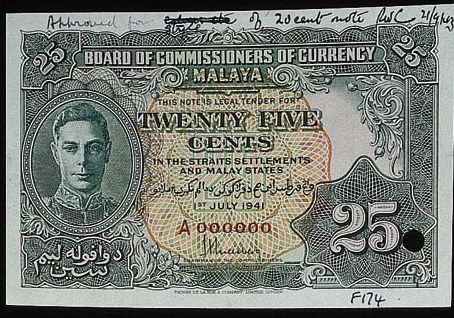
A design still at work in 1943. Singapore fell on 15 February 1942. A De La Rue 25 cents dated 1st July 1941, a value that was not issued with that date, has a pencil line across its top margin: "Approved for … of 20 cent note, RWC 21/9/43". The archive's record draws the conclusion that the design was still in use in London in September 1943, under the Japanese occupation, as the approved model for the 20 cents.
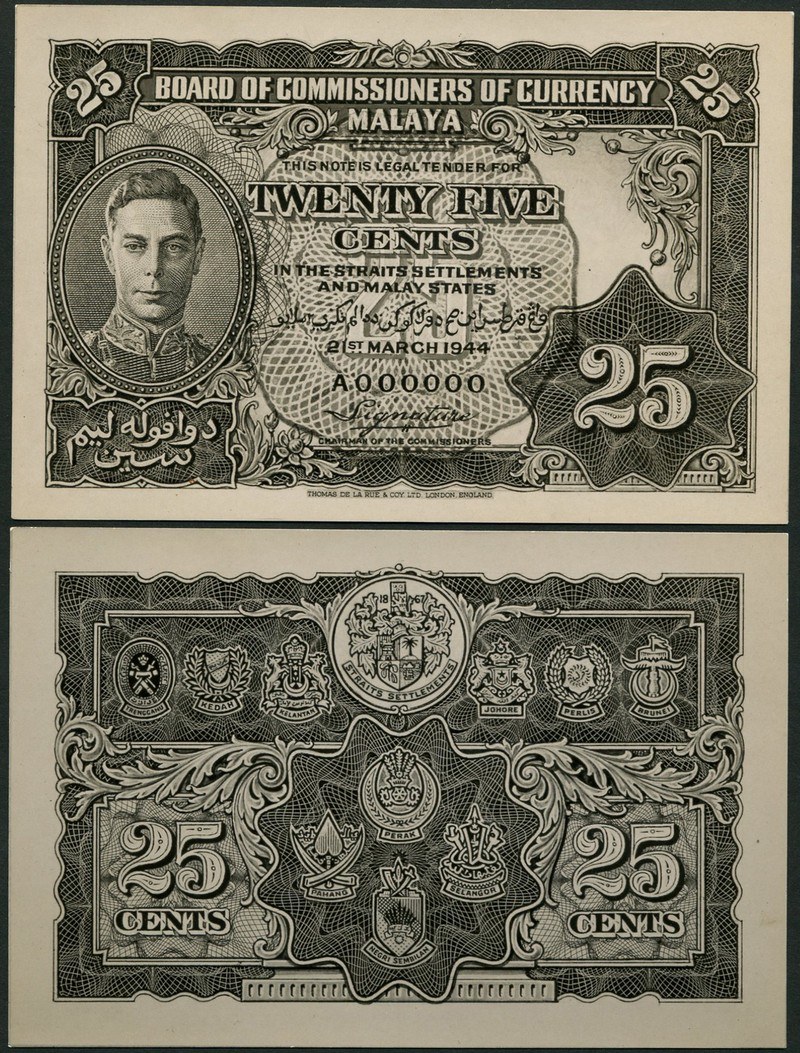
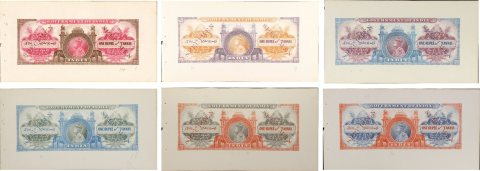
A series dated 21st March 1944. The same months produced a full set of small notes with a date in the future. The archive holds De La Rue models on board for a 1 cent, a 5 cents, a 10 cents and a 50 cents, and photographs of a 25 cents, all dated 21st March 1944, each with George VI in an oval at the left and the word Signature where a name would go.
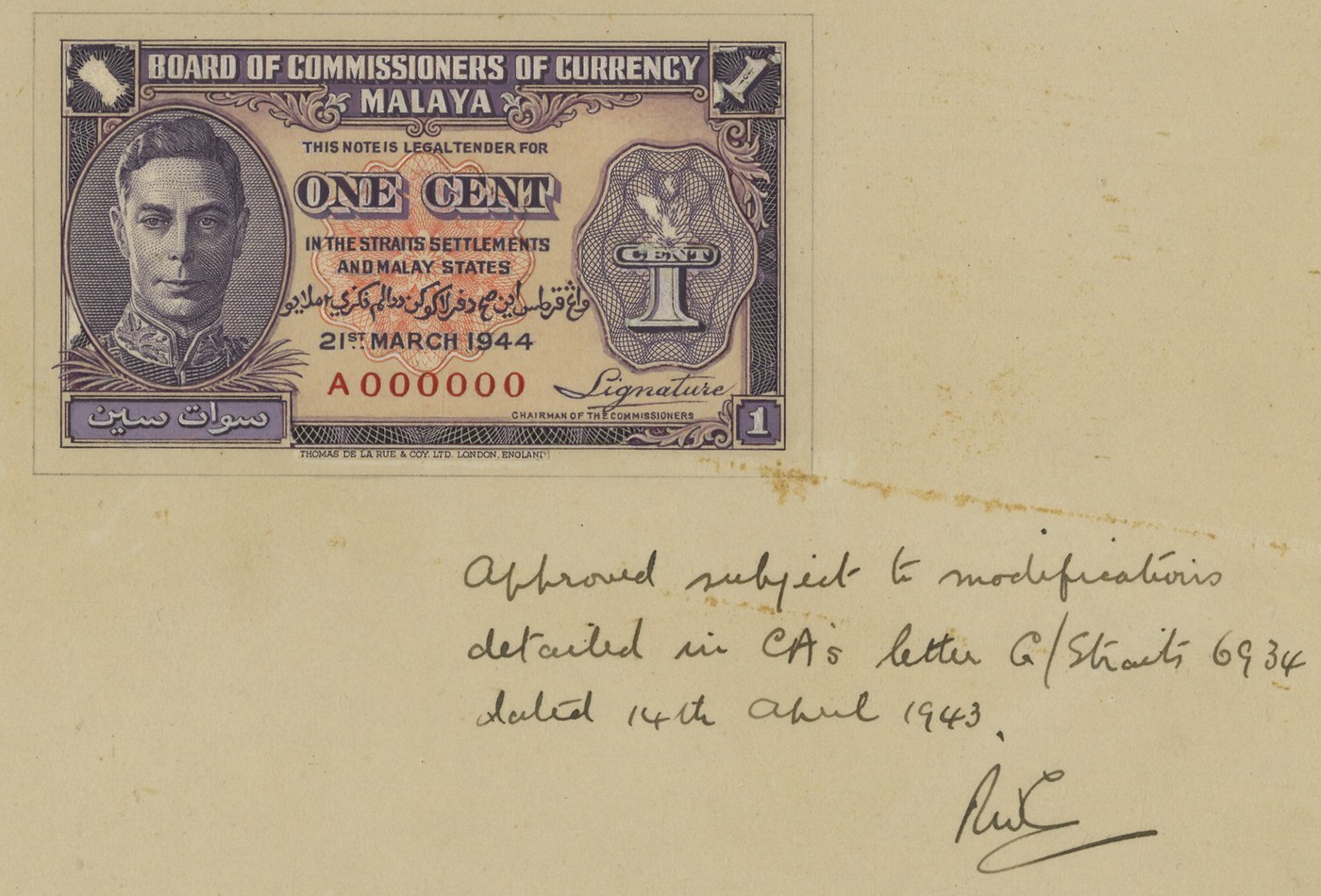
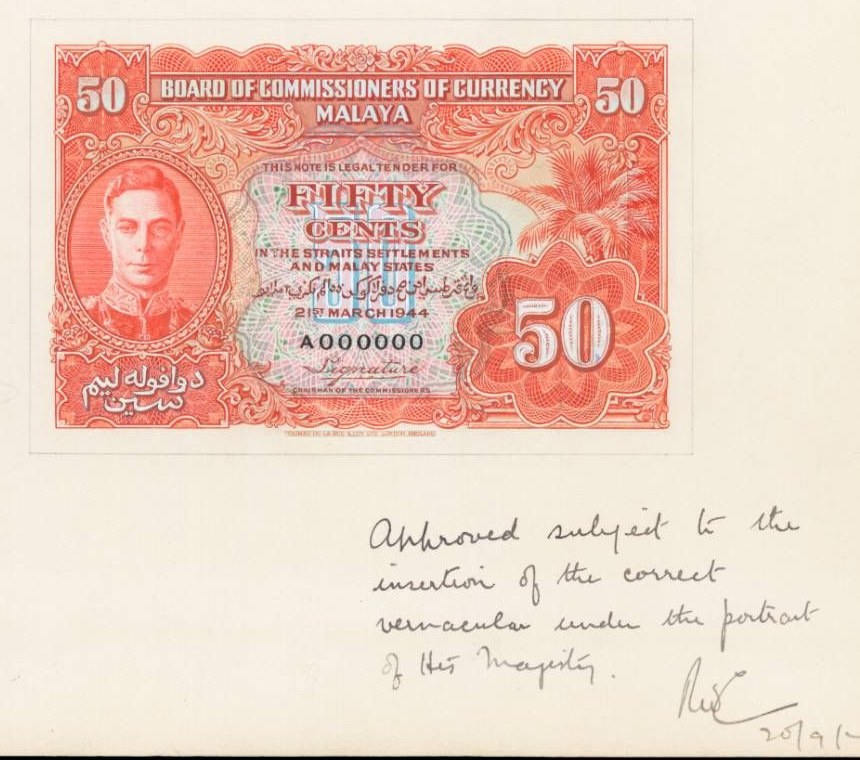
The notes written on them date the work. The 1, 5 and 10 cents are marked as approved subject to the modifications detailed in the Crown Agents' letter G/Straits 6934 of 14th April 1943, and initialled (the auction house that sold the 1 cent read the date of the letter as 14 October 1943). The 50 cents still carries the wording for 25 cents in the Jawi panel under the portrait, with "Arabic for 25 cents" pencilled beside it, and is approved "subject to the insertion of the correct vernacular under the portrait of His Majesty", initialled and dated 20/9/43. So the set was being settled in London in 1943, for a country the Board could not reach, with a date some months ahead printed on it. No note dated 1944 was issued, and the records do not say what the date was chosen for.
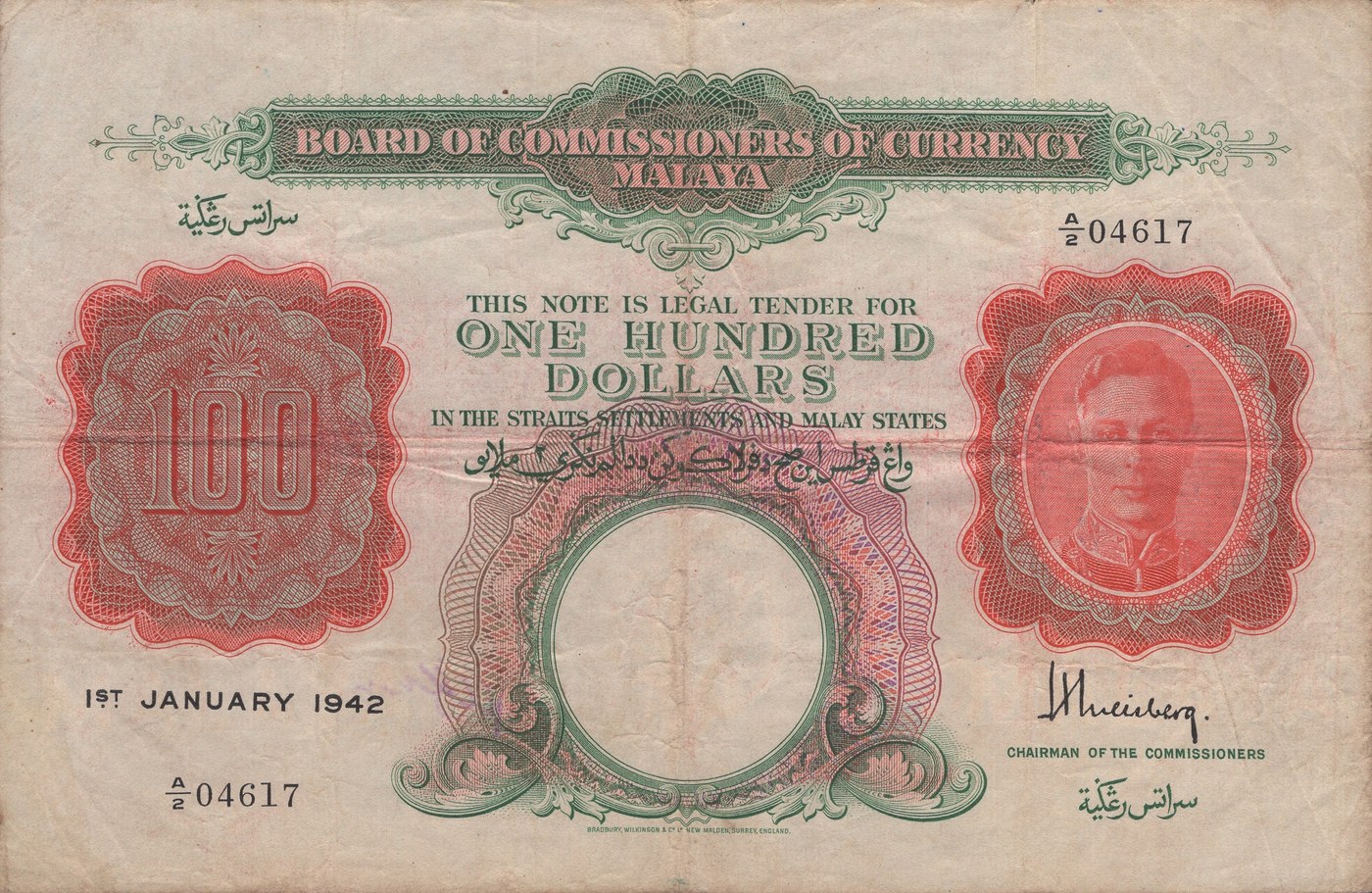
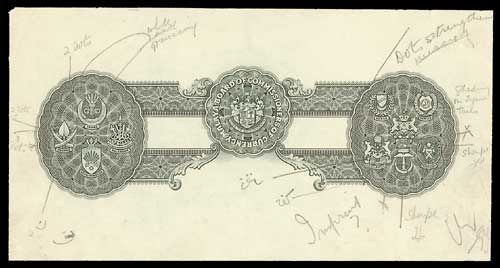
The large notes dated 1942. The 50 and 100 dollars carry the date 1st January 1942, some six weeks before Singapore fell, and were printed by Bradbury Wilkinson; the 1,000 dollars belongs with them. The catalogue's pages show from the printers' own specimens that the 100 and 1,000 dollars were ordered after the war: the range specimens of the 100 dollars are marked 19.5.47 and 7.4.49, and those of the 1,000 dollars 8.2.46 and 27.8.47. From the making of these notes the archive has a die proof of the arms panel of the back, covered in the engraver's pencilled corrections, and the British Library holds the firm's paste-up of the 10,000 dollars, dated 1st January 1941.
Burma and India
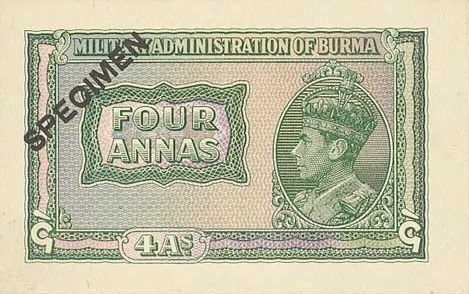
Burma was given notes for its return. The 4 annas and 8 annas with George VI were prepared in booklets, with perforated left edges, for use once the Japanese were driven out. Shaw's book The Coins and Banknotes of Burma (1980) says they were planned in 1943, that proofs went to London in May of that year for the King's approval, given in June, and that the notes were then held in reserve against a shortage of coin and not issued. What was issued after the reoccupation in 1945 was Indian notes overprinted MILITARY ADMINISTRATION OF BURMA, LEGAL TENDER IN BURMA ONLY.
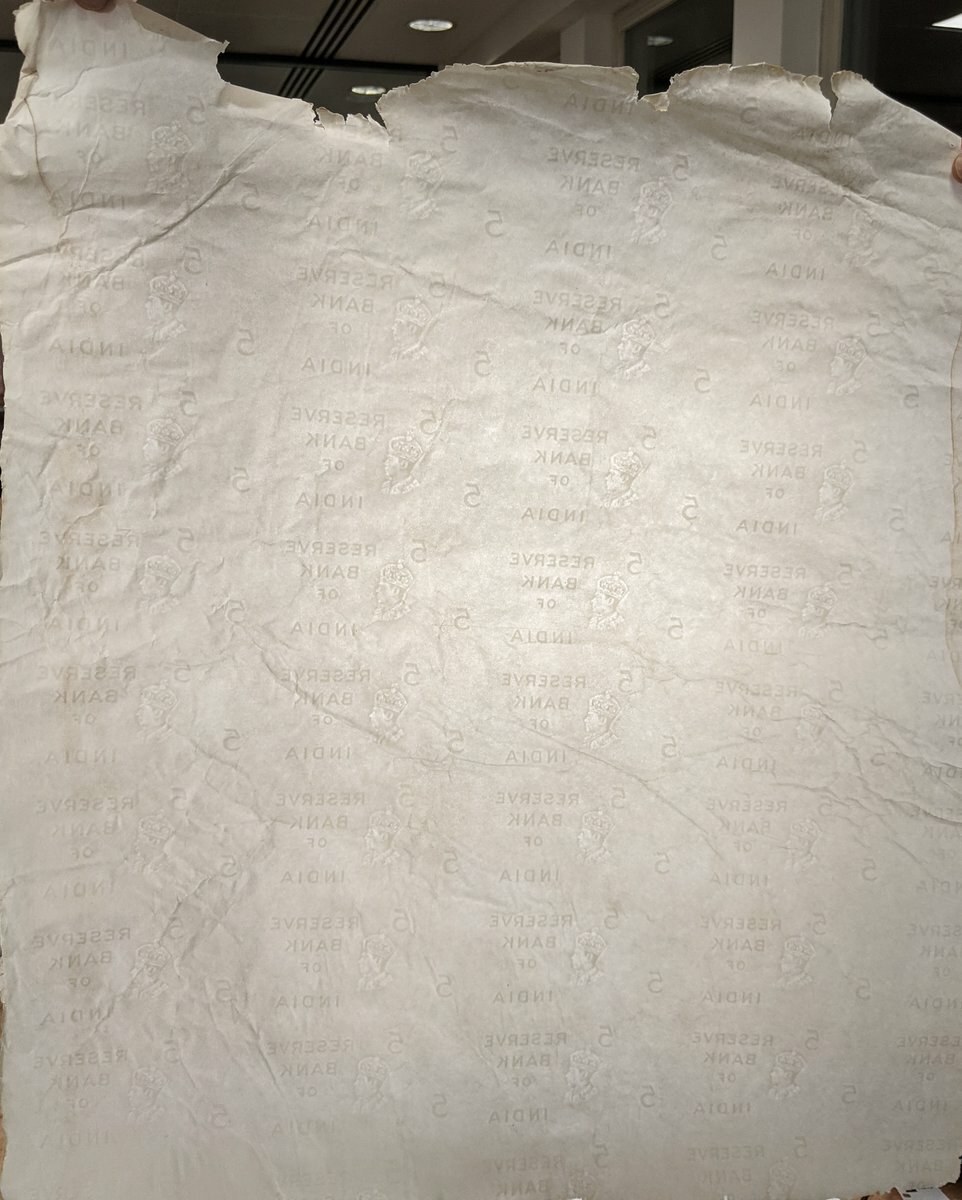
India's archive pieces from the war are not designs but paper. Portals made the watermarked paper for the Reserve Bank's notes, and some of it did not arrive. Two complete sheets, one of 50 pieces for the 5 rupees and one of 40 for the 10 rupees, were salvaged from the S.S. Breda, which sank in December 1940 on its way to India. Twenty-two sheets for the 5 rupees, creased and stained by the water, and two boxes of some 4,100 cut pieces for the 5 and 10 rupees are recorded as recovered from the sea in the same way; the sale records of those two do not name the ship.
The same thing had happened in the first war. The catalogue's pages record Indian notes lost with the SS Camberwell, mined in 1917, and the SS Shirala, sunk on 2 July 1918, some of which were recovered unsigned, and Ceylon notes lost when the SS Mongolia struck a mine on 23 June 1917.
India also printed for others. While De La Rue could not supply Nairobi, the East African notes dated 1st August 1942 were printed by the India Security Press (5 shillings); two auction houses say the plates were sent out from England for the purpose.
Small change: designs made in a hurry
East Africa's 1 shilling
East African troops took Italian Somaliland and occupied Eritrea and Ethiopia, they were paid in East African money, and silver ran short. A 1 shilling note was printed to stand in for the coin, and by the Board's report 4,094,000 of the notes were issued to the Occupied Territories Administration in the year to 30 June 1943. The archive has a photograph of an essay for it, dated Nairobi, 1st July 1942, with the prefix B/4. On the essay the lion on the back faces left; on the note, which is dated 1st January 1943, it faces right.
A second piece shows the note on the press. A sheet of cheap brownish paper used by De La Rue to set up a printing has the front of the Jamaica 10 shillings of George VI on one side and at least four overlapping impressions of the East African 1 shilling on the other, some upside down. The commentary sold with it calls it printer's waste and notes that the two notes were evidently on De La Rue's presses at the same time.
Fiji's penny
Fiji was never occupied, but many Commonwealth and American troops were stationed there from 1941 to 1943 and coin ran short. The 1 penny note of 1st July 1942 began as two rough pencil sheets, A and B, each with the front above the back, drawn by Robertson for the engraver of the Commonwealth Bank of Australia. Design A has a coin at the right, B the coat of arms; Robertson preferred A, and the note as printed has the holed penny at the right of the front. A matching 6 pence was drawn in the same way and never printed: sources mention that Australian sixpences had been obtained by then. Sources place both sheets in the archives of the Reserve Bank of Fiji.
Seychelles: a new King on an old layout
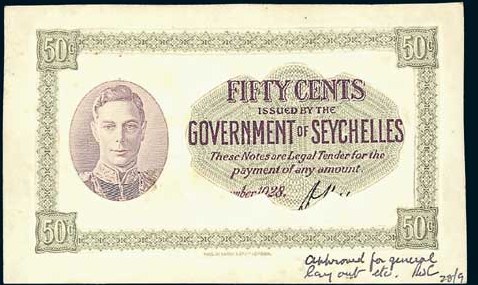
The Seychelles pieces show how a wartime note could be put together from what the printer had. A composite design for a 50 cents has a portrait of George VI in uniform set on an earlier layout: the date line still reads "…mber 1928", with a signature partly covered. It is annotated "Approved for general lay out etc. RWC 28/9", and the 50 cents of 1943 keeps the arrangement. The same three letters, RWC, are on the Malaya 25 cents above, and the catalogue's Seychelles pages record them on the specimens approved in 1942 and 1943 as well.
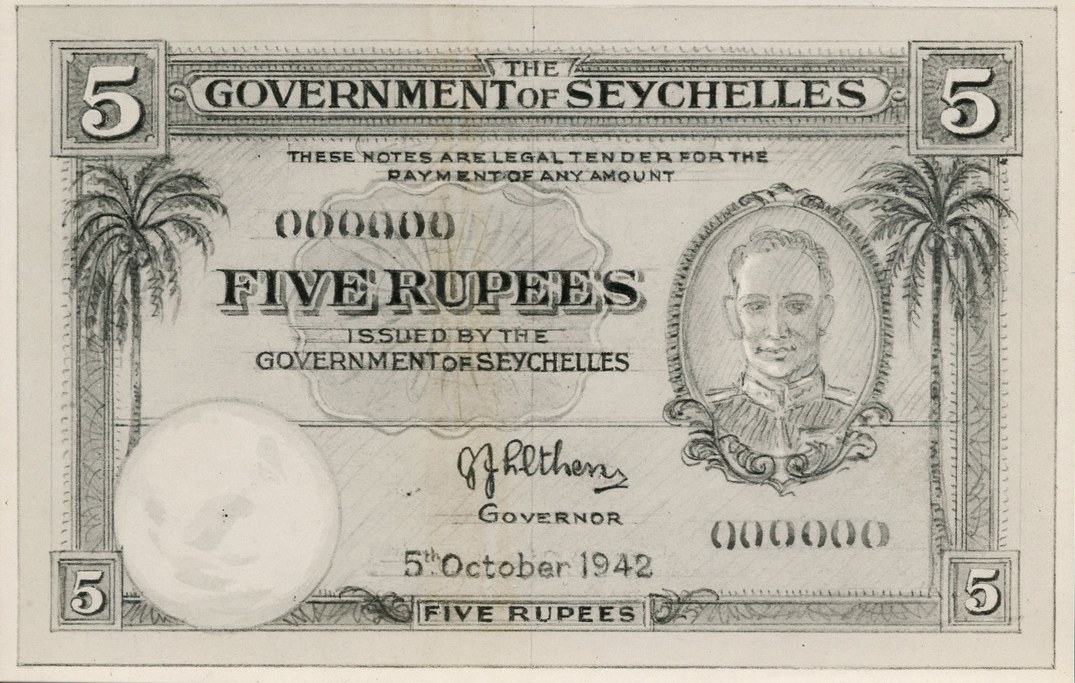
A fuller design was drawn and passed over. Photographs of a 5 rupees dated 5th October 1942 show the King in an ornate oval between palm trees, with the arms on the back; a hand-lettered stage of the same design reads 1944, which the auction house took to be struck out in favour of 1942. The 5 rupees that was issued is printed on one side only and dated 7th April 1942, and its approval copy is pencilled 9 June 1942. An emergency 5 rupees dated 20th June 1942 was also printed locally, on hand-cut paper with an embossed seal.
Malta
Malta prepared early. In June 1938 the Colonial Office warned that a war would make new supplies of notes hard to send, and about 750,000 pounds in notes was ordered from Bradbury Wilkinson to be held ready on the island. The firm's archive photographs of the 2 shillings 6 pence, 5 shillings, 10 shillings and 1 pound are carded 5-10-38 and show the designs with a dummy date, "00, NOVEMBER, 1900", dummy numbers and the word Signature. The notes came from London unsigned, and the Treasurer's signature was printed on in Malta, at the Government Printing Office and, once the bombing grew heavy, at printing shops round the island and even a brewery.
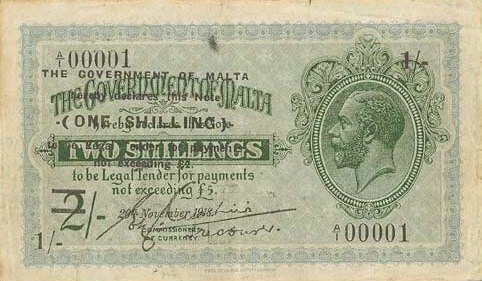
During the siege the 1 shilling coin ran short. New notes could not come in time, so the 2 shillings of 1918, prepared in the first war, never released and still in store, was overprinted ONE SHILLING under a Government Notice of 17 November 1942. Bradbury Wilkinson's photograph of the proper 1 shilling is carded 2-7-42, and the notes reached Malta from April 1943. A second card, dated 12.9.42, shows the 1 shilling, 2 shillings and 2 shillings 6 pence with the George Cross added to the designs, and another shows the higher values in the same style with a back that has the George Cross in a guilloche.
Cyprus and Palestine
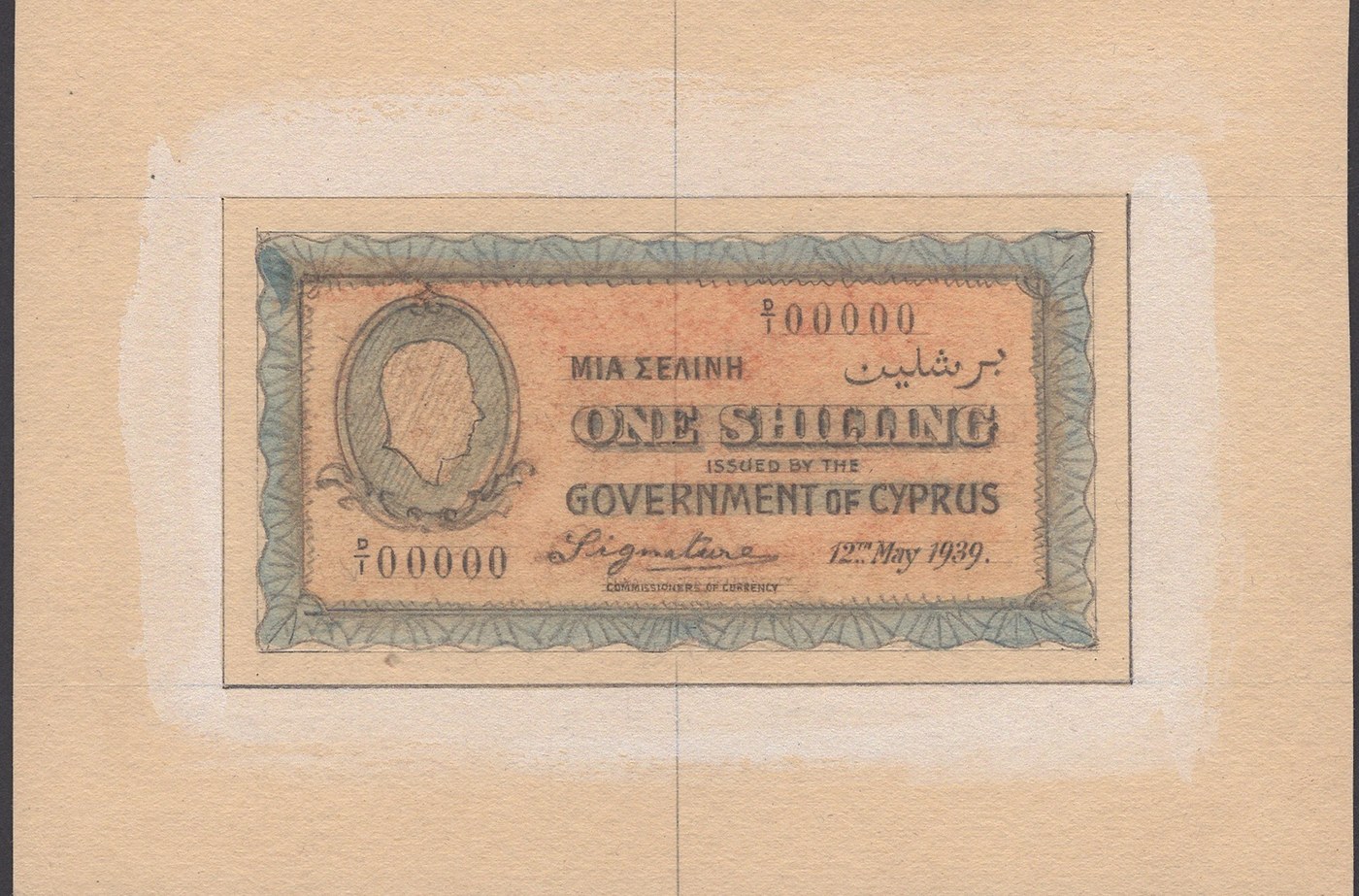
In Cyprus the 1, 2 and 5 shillings were prepared in 1938 against the shortage a war would bring, and were made legal tender six days after war was declared (1 shilling). Two hand-made De La Rue essays belong to those years, a 5 shillings dated 12th May 1938 and a 1 shilling dated 12th May 1939 with the portrait oval at the left and only the outline of a head drawn in it; neither layout was adopted. Later in the war the island's printers made a 3 piastres by overprinting the 1 shilling and then by cutting it in two. For six months of 1942 the Palestine 1 pound and 5 pounds were legal tender in the island as well, which is the subject of Palestine pounds in Cyprus, 1942.
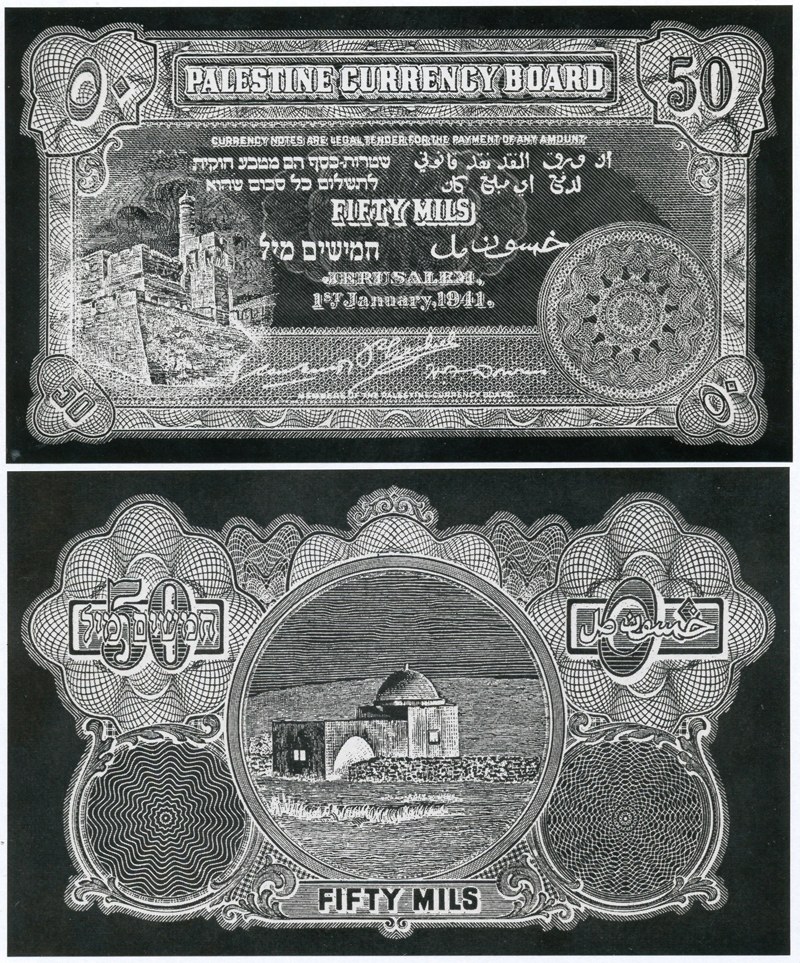
For Palestine the archive holds the printer's negatives of a 50 mils and a 100 mils dated 1st January 1941, with the Citadel of Jerusalem on the front and Rachel's Tomb on the back. They were not adopted, and the record does not say why they were drawn. The catalogue does record a later preparation: a 50 mils, a 100 mils and a 1 pound in a small format, dated 26th March 1943 and never issued. Sources mention the Board's report of 20 September 1945, which says that no value of note or coin ran short in Palestine during the war.
Notes made from other notes
Where no design could be made or sent, the catalogue's pages record what was used instead:
| Where and when | What was done |
|---|---|
| Malta, November 1942 | the unissued 2 shillings of 1918 overprinted ONE SHILLING |
| Mauritius, March 1942 | a 1 rupee printed locally on the backs of old 10 rupees notes cut up, so that the back shows part of another note |
| Ceylon, 1942 | 25 and 50 cents printed by the Government Press on the security paper of the tea and rubber export coupons |
| Cyprus, 1943 | the 1 shilling overprinted THREE PIASTRES, then cut in two and the smaller piece overprinted |
| Fiji, 1942 | 1 and 5 pounds of the Reserve Bank of New Zealand's first issue overprinted in Wellington for use in Fiji |
| Burma, 1945 | Indian notes overprinted for the Military Administration |
The first war: Gibraltar, 1914
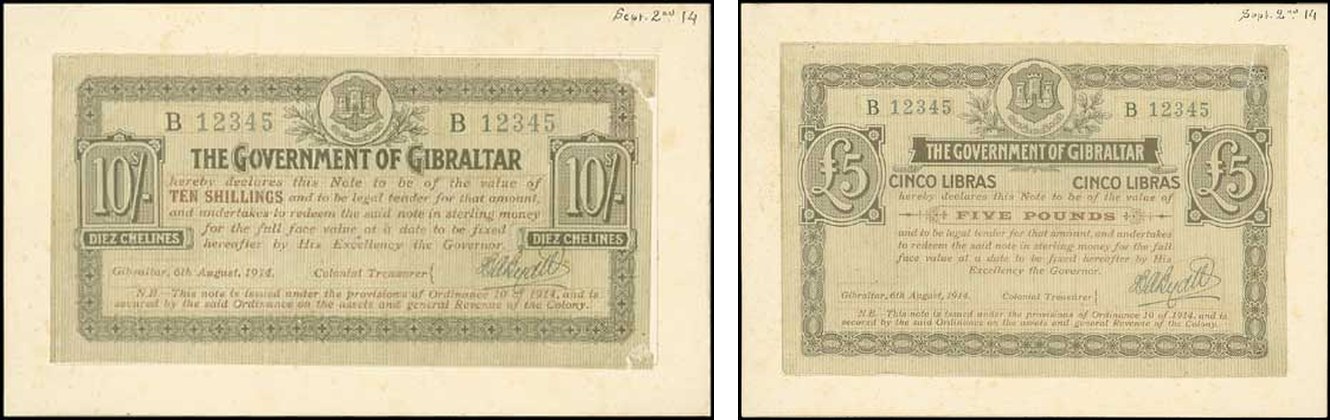
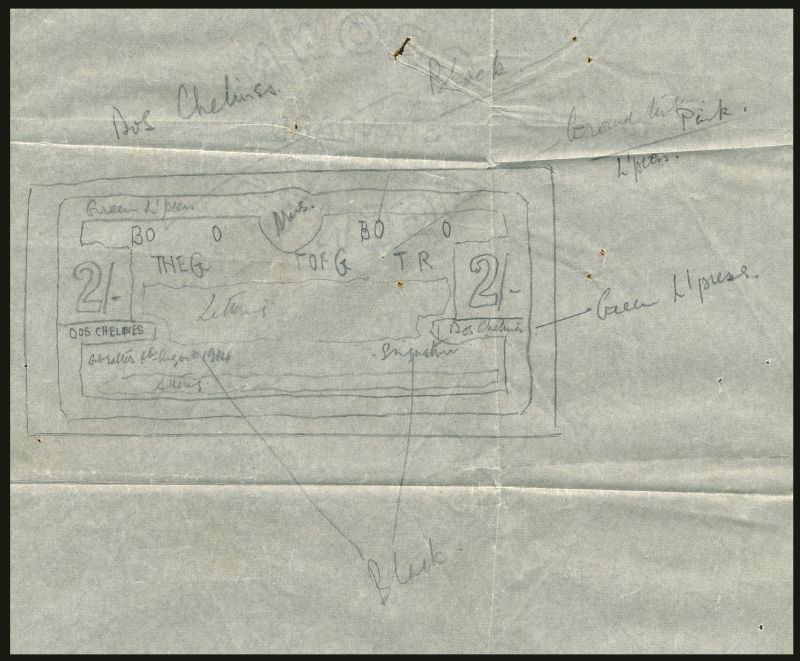
The oldest wartime designs in the archive are Gibraltar's. The catalogue lists an emergency issue dated 6th August 1914, in two series, A and B, under Ordinance 10 of 1914. For series B the archive has hand-drawn and hand-lettered designs on board for the 10 shillings and the 5 pounds, each with the specimen number B 12345 and each dated Sept. 2nd 14 in ink at the top right, nearly four weeks after the date the notes carry. They are signed for Byatt as Colonial Treasurer; the issued notes are signed by Greenwood. With them goes a rough pencil layout for the 2 shillings on thin paper watermarked Crown Agents, the design blocked out and the colours and processes written round it: green letterpress, black, brown lithography, a pink underprint.
One more piece may belong to the first war. A stage proof in brown, with the figure 10 in circles between the words ZANZIBAR GOVERNMENT, matches no issued note. The auction house that sold it suggested it was prepared for a small-change 10 cents during the First World War. The value is nowhere spelled out on the piece, and that suggestion is all there is.
The occupier's side: Tripolitania, 1943
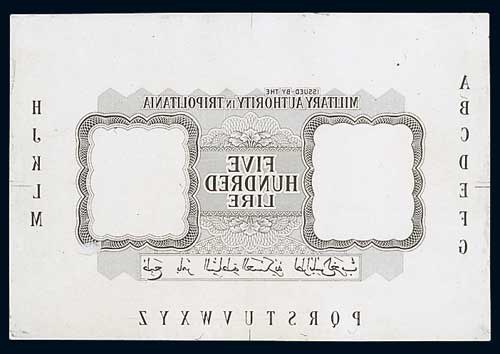
British forces issued occupation notes of their own. The lire notes of the Military Authority in Tripolitania were introduced on 15 September 1943, at 480 lire to the pound, and were printed at the Bank of England Printing Works. The archive has their stage proofs: four pulls in black of the face of the 500 lire, one of them a mirror image of the whole design with the registration letters A to M down the sides and P to Z along the foot, and a group of underprints in grey, among them a design with a blank oval and two star rosettes that was not used on any note of the series.
A series the war stopped
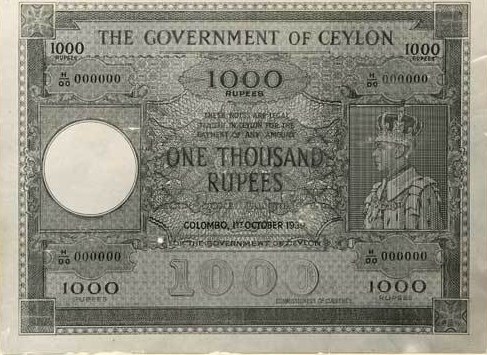
Last, a design that was dropped because a war began. De La Rue photographed a complete new series for the Government of Ceylon, the 1, 2, 5, 10, 50, 100, 500 and 1,000 rupees, each dated Colombo, 1st October 1939, with a crowned George VI at the right: sixteen photographs, the pair of the 1,000 rupees pencilled 14-5-38. The archive's record says it was not adopted, overtaken by the outbreak of war. Ceylon went on with the notes it had, and the war reached those too: sources mention that the 1 rupee notes of 2nd October 1939 numbered R/44 50001 to R/46 50000 were lost, damaged or destroyed through enemy action and were declared invalid.
What to look for
- A date on a design is not the date of the work. The Malaya models dated 21st March 1944 were approved in 1943; the 100 dollars dated 1st January 1942 was ordered in 1947 and 1949; Gibraltar's designs for notes dated 6th August 1914 are dated 2 September.
- The notes written on a piece are the evidence. An approval, a set of initials and a day and month place a design more surely than its printed date.
- A local hand shows. Blampied's lettering in Jersey, Robertson's pencil sheets in Fiji and the Survey Department's notes in Malaya exist because the usual printers could not be reached in time.

Member comments
Log in or register to post a comment.