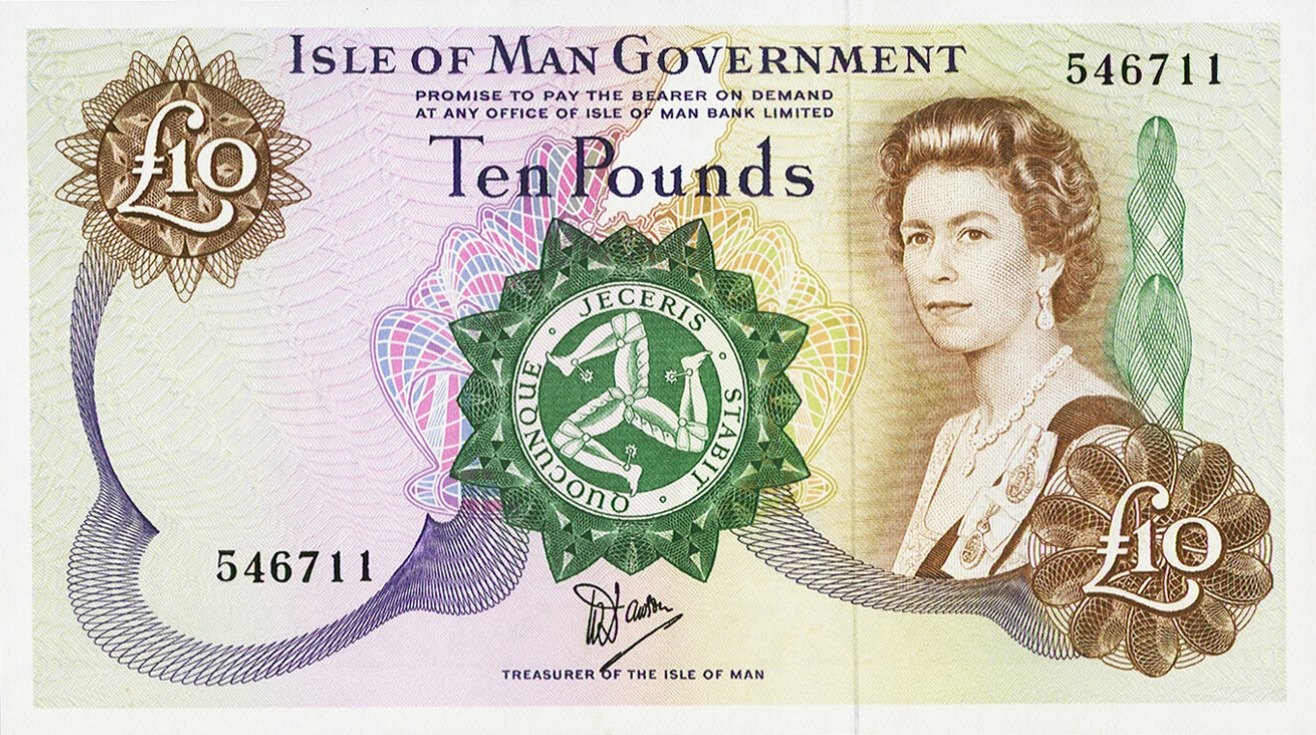
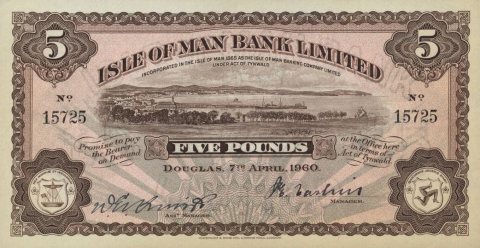
The Isle of Man Government has issued its own notes since 1961. Apart from the year in the Millennium overprint of 1979 they carry no date, so a note is placed by its signature, the signer's title, its serial prefix and number and, on the later notes, the wording of the promise and the printer's imprint. This article brings together what the Pick pages say on those points, with what the auction houses and Bank Note Reporter add. The banks' notes that came before are in The notes of the Manx banks, 1882 to 1961, and the whole story in order of time is in The paper money of the Isle of Man, 1882 to 2019.
The signers and their titles
The pages and the auction houses name eight signers, under three titles.
| Signer | Title on the note | Notes |
|---|---|---|
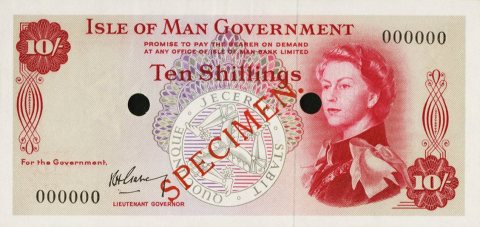
| Garvey | not given on the pages | the first printings of the 10 shillings, 1 pound and 5 pounds of 1961 |
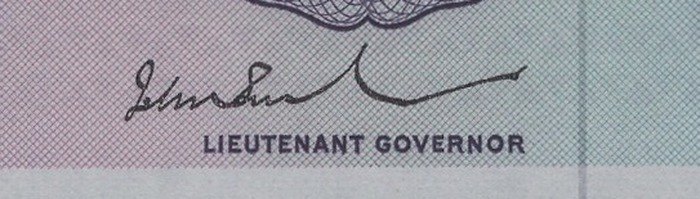
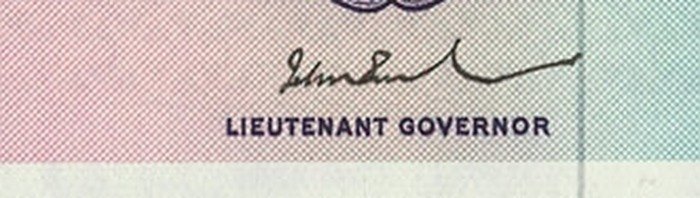
| Stallard | Lieutenant Governor | the later printings of the 10 shillings and the 5 pounds of 1961; the 50 new pence of 1969; the first printings of the 50 new pence, 1 pound, 5 pounds and 10 pounds of 1972 |
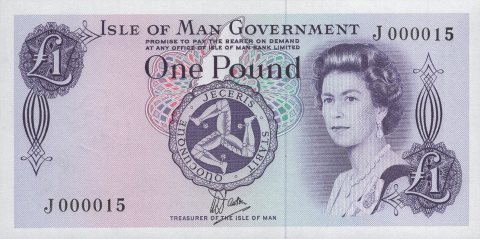
| Paul | Lieutenant Governor | the later printings of the 50 new pence and the 1 pound of 1972 |
| Dawson | Treasurer of the Isle of Man | the 20 pounds of 1979 (P-32 and P-37); the 50 new pence of 1979; the 1 pound, 5 pounds and 10 pounds of 1980; the plastic 1 pound and the 50 pounds of 1983 |
| Dawson | Chief Financial Officer | the first printings of the 1 pound, 5 pounds and 20 pounds of 1990 and 1991 |
| Cashen | Chief Financial Officer | the 1 pound P-40b, the 5 pounds P-41b, the 10 pounds P-42 and P-44a, the 20 pounds P-43b and P-45 |
| Shimmin | Chief Financial Officer | the 1 pound P-40c, the 10 pounds P-44b and P-46, the 20 pounds P-47 |
| Couch | Chief Financial Officer | the 5 pounds of 2015 |
| Lowe | Chief Financial Officer | the 10 pounds of 2019 |
The pages give surnames only, except for Malcolm Couch. The houses supply more for three signers: London Coins (3 June 2019, lot 948) names Sir Ronald Herbert Garvey, Heritage (24 April 2020, lot 26132) names the Lieutenant Governor Sir Peter Hyla Gawne Stallard, and Stack's Bowers (4 May 2023, lot 50503) gives the signer of the Millennium 20 pounds as W. Dawson. Not every cell of the table rests on the pages. The page of the 5 pounds of 1961 names Garvey and Stallard, but the pages of the 10 shillings and the 1 pound of 1961 name no signer: London Coins (lot 948) describes a Garvey specimen set of all three values, and Stack's Bowers (24 June 2020, lot 70492) calls Stallard the second signature of the 10 shillings. No source read for this article names the signer of the later printing of the 1 pound of 1961, P-25b. Stallard on the 5 pounds and the 10 pounds of 1972 comes from Heritage (24 April 2020, lot 26132, and 10 November 2023, lot 24379), and the pages do not name the signer of the later printings of those two notes. Dawson on the 5 pounds of 1980 comes from Spink (3 October 2011, lot 436); on the 10 pounds of 1980 and on the 20 pounds P-37 the pages give the Treasurer's title without the name. The pages state the title LIEUTENANT GOVERNOR for the notes of 1972, not for those of 1961. The pages do not say who signed the 20 pounds of 2013, P-49, and they do not give the dates on which any signer took or left office.
Paul's two signatures
Paul's signature comes in two widths. On the 50 new pence it is 26 mm wide on P-28b, where it starts well to the left of the title LIEUTENANT GOVERNOR, and 20 mm wide on P-28c, where it starts above the title. On the 1 pound it is 26 mm wide on P-29b and P-29c and 20 mm wide on P-29d. Sources mention the 20 mm signature from 1976 on the 50 new pence. On that note the serial number is a guide only: sources put the change at B 370000, but the narrow signature is also mentioned on numbers a little below it, so the signature decides. Spink's description of lot 1783 in its sale of 15 July 2014 gives the wide signature as 28 mm, where the page of P-29 measures 26 mm.
Bradbury Wilkinson, 1961 to 1991
The pages name Bradbury Wilkinson and Company as the printer of every note from P-24 to P-39, among them the 10 pounds printing given as of June 1991. London Coins (3 June 2019, lot 948) gives the printer of the first notes as Bradbury Wilkinson & Co., New Malden, Surrey.
The first notes were designed by the Manx artist John H. Nicholson, with the Three Legs of Man, a small outline map of the island on the 1 pound and the 5 pounds, and Pietro Annigoni's 1956 portrait of Queen Elizabeth II. Sources mention 3 July 1961 as the day they went into circulation. Sources mention that the smaller notes of 1972 carry a portrait of the Queen by Anthony Buckley, from a photograph of about 1966, and the pages say the same of the later notes up to the 20 pounds of 1991. The 50 pounds of 1983 is the exception: sources mention its portrait as by Peter Grugeon.
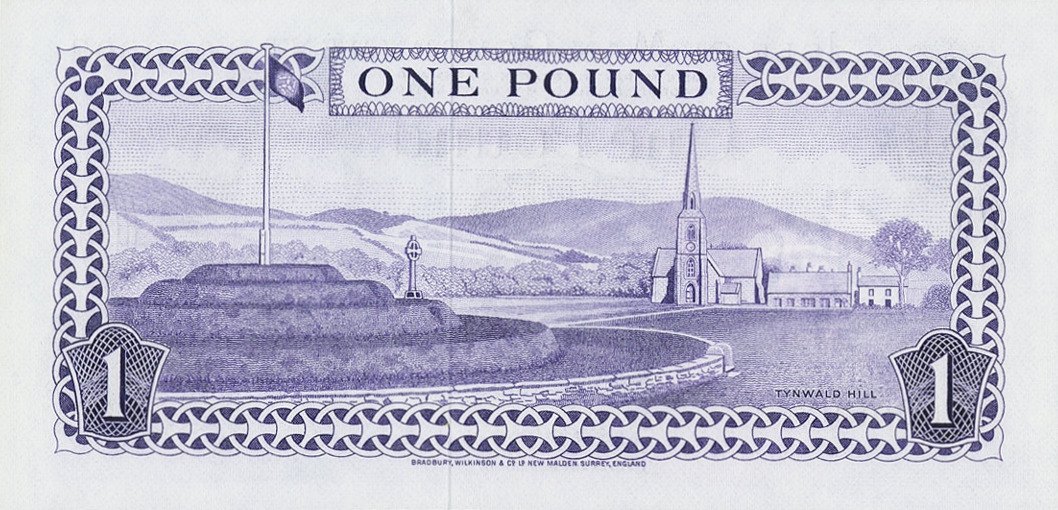
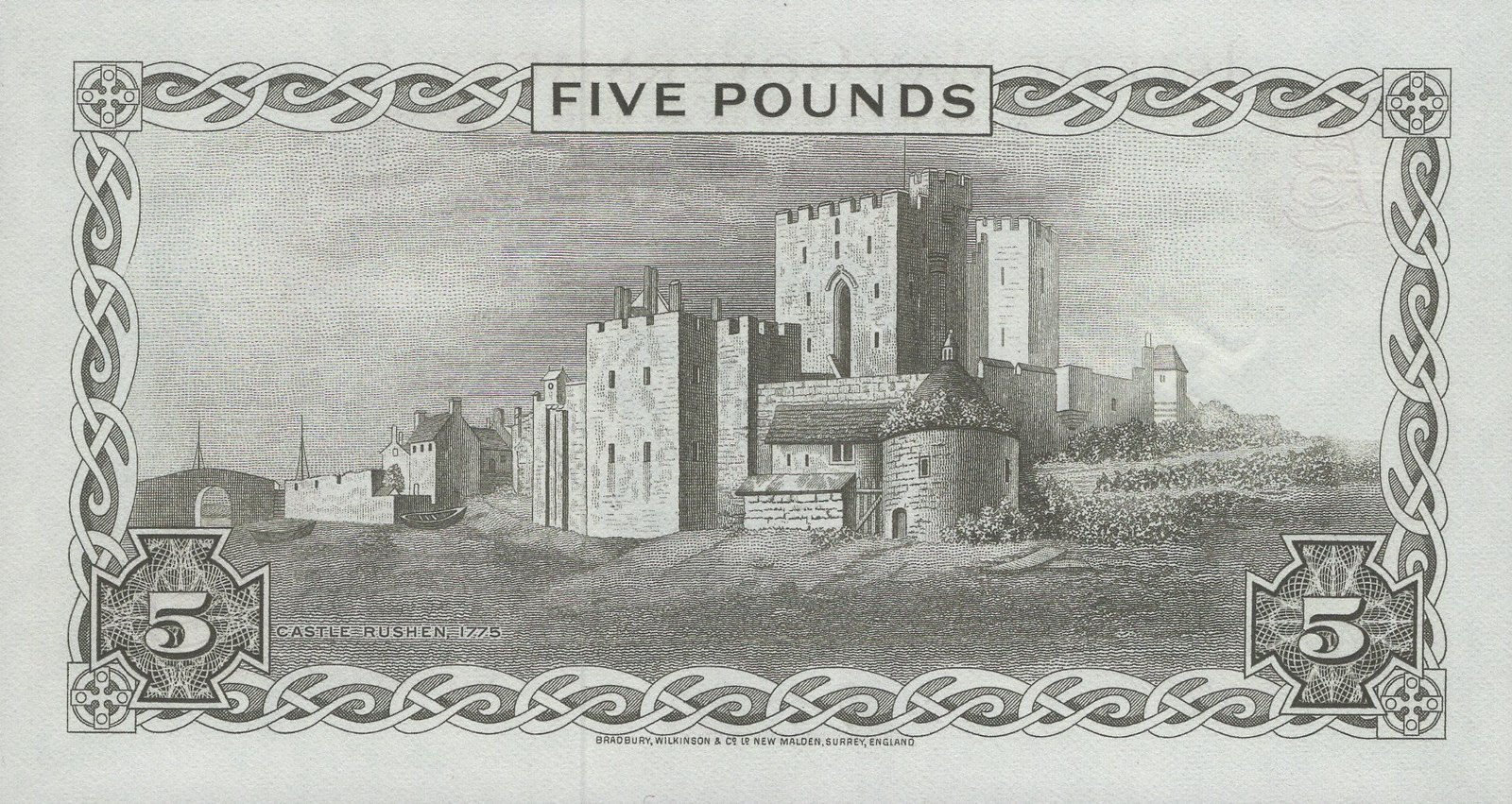
The houses describe the same subjects on the backs of the smaller notes. Spink (15 July 2014, lot 1783) describes the back of the 1 pound of 1972 as St John's Church on Tynwald Hill, and Heritage (24 April 2020, lot 26132) describes Castle Rushen on the back of the 5 pounds of 1972. Spink (3 October 2011, lot 436) describes a sailing ship on the back of the 50 new pence of 1979.
Numbers that run on from one signer to the next
The serial numbers run on from one signer to the next. The pages give these points of change:
| Note | Where the numbers change hands |
|---|---|
| 5 pounds of 1961 | no prefix; Garvey to 250000, Stallard from 250001 |
| 1 pound of 1961 | P-25b runs to C 745000 |
| 50 new pence of 1969 and 1972 | the note of 1969 has no prefix; the small note starts with prefix A; Stallard ends at A 800000 and Paul starts at A 800001; P-28c ends at C 200000 and Dawson's P-33a starts at C 200001 |
| 1 pound of 1972 | Stallard from C 850001 to D 970000; Paul's P-29b from D 970001 to D 1000000; P-29c is prefix E; P-29d is prefixes F to H and ends at H 440000; Dawson's P-34a starts at H 440001 |
| 10 pounds of 1972 | P-31b ends at 360000; Dawson's P-36a has no prefix and runs from 360001 to 1000000; P-36b is prefix A; P-36c is prefix B |
| 5 pounds of 1980 | P-35a is prefix B, from B 600001, and prefix C; P-35b is prefix D with serifs, D 000001 to D 100000; a prefix D note numbered above that is P-35A |
| 20 pounds of 1979 | 000001 to 005000 with the Millennium overprint are P-32; P-37a runs from 005001 to 150000 |
| 1 pound, plastic | prefixes M and N in full and P to P 500000; the paper 1 pound P-34 resumes at P 500001 |
| 1 pound of 1990 | Dawson from R 500001 to prefix T; Cashen prefixes U to Y; Shimmin prefix AA |
| 5 pounds of 1990 | Dawson prefixes E and F; Cashen prefixes F to M; Couch prefix M |
| 10 pounds of 1991 | P-42a prefixes C to G, to G 500000; P-44a from G 500001 through prefix M; P-44b prefixes N and P; P-46a prefixes Q to T; the note of 2019 prefix T |
| 20 pounds of 1991 | P-43b ends at D 450000; P-45a runs from D 450001 to G 450000; P-47 begins at G 450001; prefix J is shared by P-47 and P-49 |
Heritage's descriptions add two print figures. Its lot 24378 of 10 November 2023 says that only 250,000 of the 5 pounds of 1961 with the first signature were printed, which agrees with the change at 250000. Its lots 24379 of 10 November 2023 and 24695 of 20 June 2024 say that only 50,000 of the 10 pounds signed Stallard were printed.
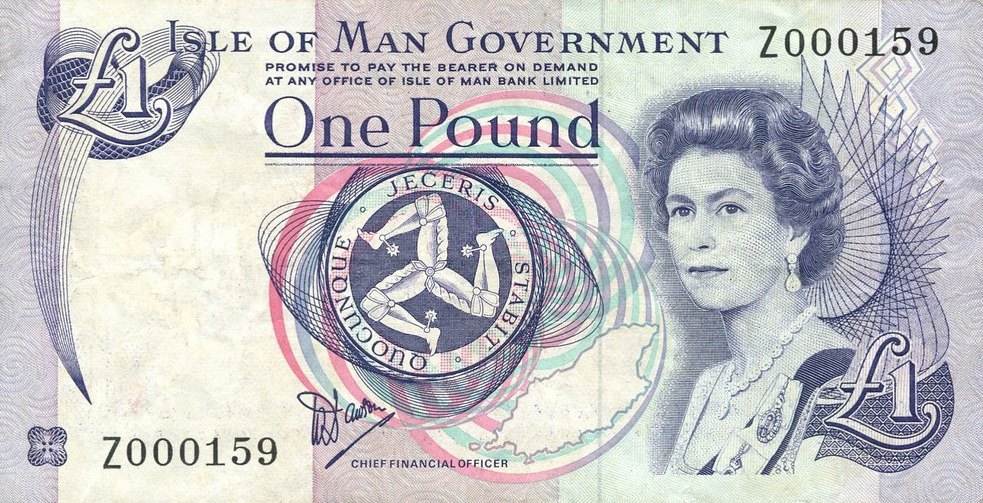
Where a prefix is shared, the pages say which mark decides. The 1 pound prefix P is on the purple paper note, which carries its number twice, and on the green plastic note, which carries it once. The 1 pound prefix R is on Dawson's notes as Treasurer and, from R 500001, as Chief Financial Officer. On the 5 pounds, prefix F is shared by Dawson and Cashen and prefix M by Cashen and Couch, so the signature places the note. On the 10 pounds, prefix T is shared by Shimmin and Lowe.
Several of these points rest on sources the pages do not name, and some are open. For the 5 pounds of 1990, sources mention F 100000 as the last Dawson note and F 100001 as the first Cashen note; the number at which prefix M passes from Cashen to Couch is not settled. For the 20 pounds of 1991, sources mention 250001 as the first number of the Dawson note and 450000 as the change from Dawson to Cashen. Sources mention prefix C on the 50 new pence from October 1979 and prefix J on the 20 pounds from January 2011.
The 1 pound of the 1974 holiday season
P-29b is the short run of the 1 pound with Paul's wide signature at the end of prefix D. Spink (15 July 2014, lot 1783), citing Quarmby, says these notes were issued over about three weeks in the 1974 holiday season and passed into circulation unnoticed, and believes only 20 are known in top grade. The note Spink sold was the 23rd of the run and has a slanting D in its upper serial number.
The Millennium 20 pounds of 1979
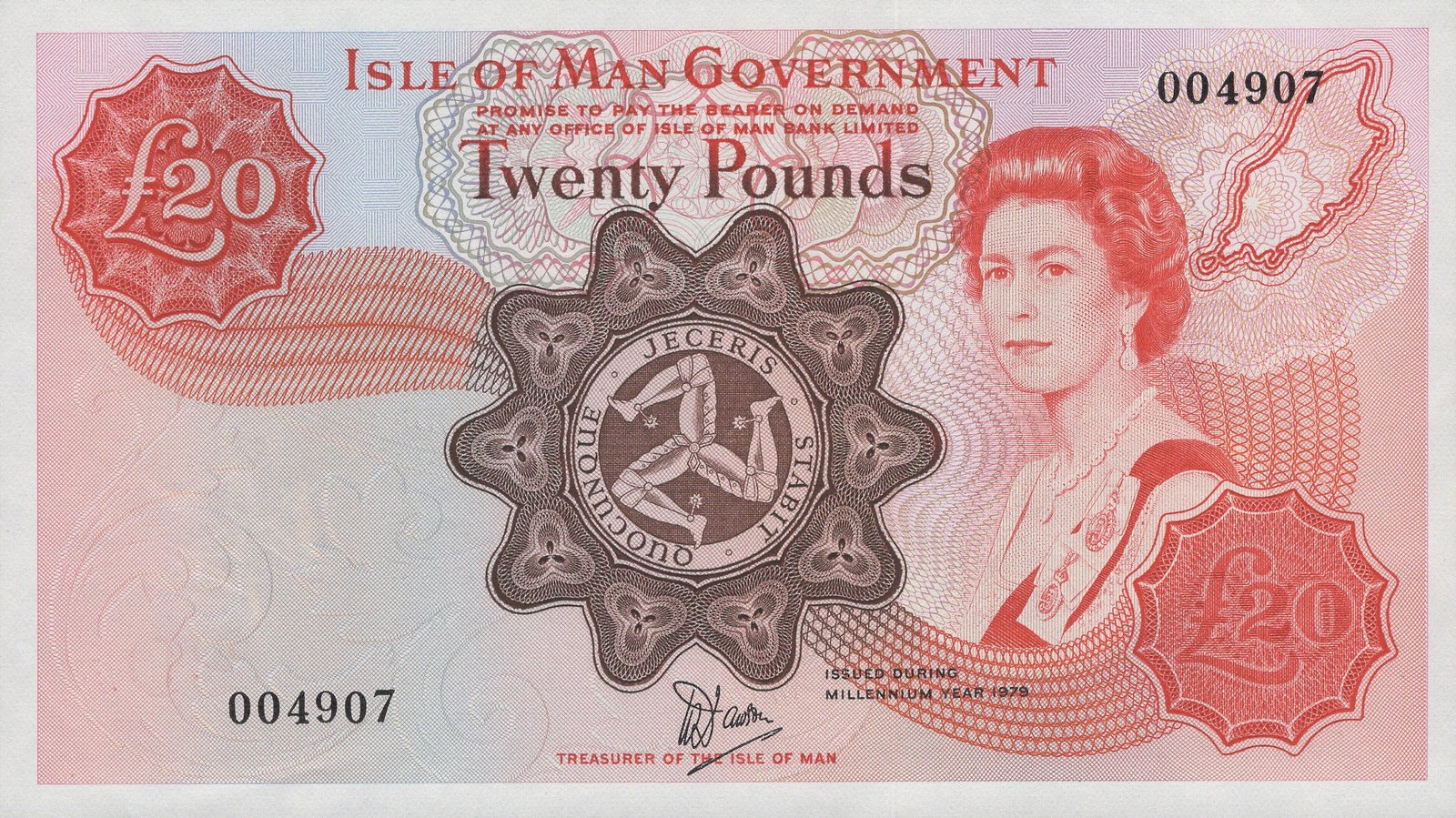
The 20 pounds was introduced on 19 December 1979 as a commemorative for the Millennium of Tynwald. The first 5,000 notes carry the overprint ISSUED DURING / MILLENNIUM YEAR 1979 beside the signature. A note numbered inside that run but without the overprint is listed as the error P-32x. A note with two black SPECIMEN overprints is listed as P-32s, and whether it is a specimen is not settled: the specimens of P-37 carry red overprints, and the lot it comes from does not call it a specimen. Stack's Bowers (4 May 2023, lot 50503) gives the watermark as the triskele arms.
The plastic 1 pound of 1983
The green 1 pound P-38 was printed on Bradvek. Heritage (8 September 2016, lot 26417) explains Bradvek as Bradbury Wilkinson's trade name for banknotes on Tyvek, which the American Bank Note Company was marketing too. Sources mention the material as Tyvek 919. It could not take a security thread or a watermark, and the plastic was not tried on other values.
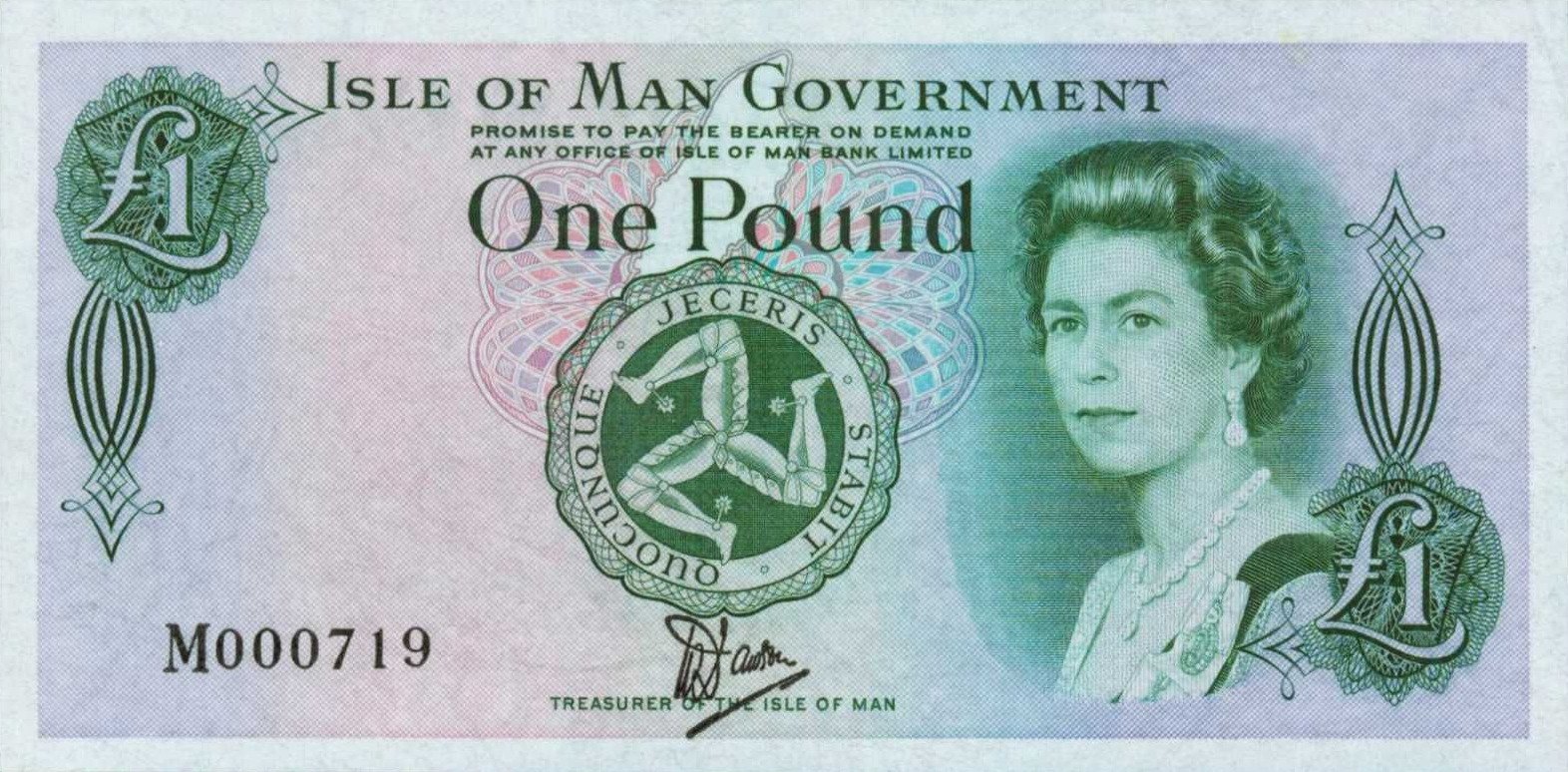
Bank Note Reporter of January 1984 reports that the note was introduced on 23rd November 1983. Sources mention 2,500,000 notes printed on the plastic, and that it was dropped because the notes soon looked worn and lasted no longer than paper ones. Trevor Wilkin, writing in Bank Note Reporter in October 2001, gives 1988 as the year the note ceased, and understood that the licence for the material was withdrawn after Thomas De La Rue bought Bradbury Wilkinson from the American Bank Note Company. The page gives 31 October 2013 as the day the note was withdrawn.
The paper 1 pound of the same design, P-34, is purple. Its prefix P numbers resume where those of the plastic note end.
De La Rue: the promise and the imprint, 1990 to 2019
From 1990 the pages name De La Rue as the printer. The 10 pounds of 1991 to 2019 share one design, as do the 20 pounds of 1991 to 2013, and the Pick numbers are told apart in two places: the promise under ISLE OF MAN GOVERNMENT on the front, and the imprint at the foot of the back.
| Note | The promise ends | The imprint reads |
|---|---|---|
| 10 pounds P-42; 20 pounds P-43 | ISLE OF MAN BANK LIMITED | THOMAS DE LA RUE AND COMPANY LIMITED |
| 10 pounds P-44; 20 pounds P-45 | ISLE OF MAN BANK | THOMAS DE LA RUE AND COMPANY LIMITED |
| 10 pounds P-46; 20 pounds P-47 | ISLE OF MAN BANK | DE LA RUE |
| 10 pounds of 2019; 20 pounds P-49 | ISLE OF MAN BANK LIMITED | DE LA RUE |


On P-49 the restored wording is set as PROMISE TO PAY THE BEARER ON DEMAND AT ANY / OFFICE OF ISLE OF MAN BANK LIMITED. NatWest Group's history page for Isle of Man Bank Ltd says that the bank "was subsequently appointed to manage the note issue of the Isle of Man government" after the banks' own licences were revoked in 1961.

The 1 pound and the 5 pounds changed less. The promise on the 1 pound ends ISLE OF MAN BANK LIMITED under all three signers, and its imprint reads THOMAS DE LA RUE AND COMPANY LIMITED on the Dawson and the Shimmin notes alike. The 5 pounds has the long imprint on P-41 and DE LA RUE on the printing of 2015. London Coins (7 March 2021, lot 124) describes the back of the 10 pounds as Peel Castle about 1830.
The dates of these notes are less firm than the numbers. Sources mention both 1987 and 1990 for Dawson's 5 pounds, and 1991 or 1990 for Dawson's 20 pounds. Sources give 2002 or 1998 for P-44a, December 2006 or 2002 for P-44b, April 2011 or 2007 for P-46 and 2002 or 2000 for P-45. They give December 2007 for P-47, December 2013 for P-49, November 2009 for the Shimmin 1 pound and September 2015 for the Couch 5 pounds. Sources list the Shimmin 20 pounds twice, as P-45b and as P-47; it is kept on P-47 here.
Replacement notes
Sources mention no replacement notes before the reduced-size notes of 1990. From then the replacements carry prefix Z on every value. They are divided between the Pick numbers in the same way as the ordinary notes: by signature on the 1 pound and the 5 pounds, and by the wording of the promise on the 10 pounds and the 20 pounds.
The 10 pounds printing of June 1991
P-36c, prefix B, is given as a printing of 10,000 notes of the old Bradbury Wilkinson 10 pounds made in June 1991, with a life in issue of about two weeks. No note of it has been seen at auction, so its range, date and print run rest on the literature alone. Sources mention three notes logged by collectors. Sources mention P-36 as introduced in 1980 and give its three printings as one note.
Sources
- The Pick pages of the Isle of Man in this catalogue, P-24 to P-49 and the 10 pounds of 2019.
- Bank Note Reporter, January 1984 and October 2001 (Trevor Wilkin), as the page of P-38 reports them.
- Heritage Auctions: 8 September 2016, lot 26417; 24 April 2020, lot 26132; 10 November 2023, lots 24378 and 24379; 20 June 2024, lot 24695.
- London Coins: 3 June 2019, lot 948; 7 March 2021, lot 124.
- Spink: 3 October 2011, lot 436; 15 July 2014, lot 1783.
- Stack's Bowers: 24 June 2020, lot 70492; 4 May 2023, lot 50503.
- NatWest Group heritage hub, the page "Isle of Man Bank Ltd".
Member comments
Log in or register to post a comment.