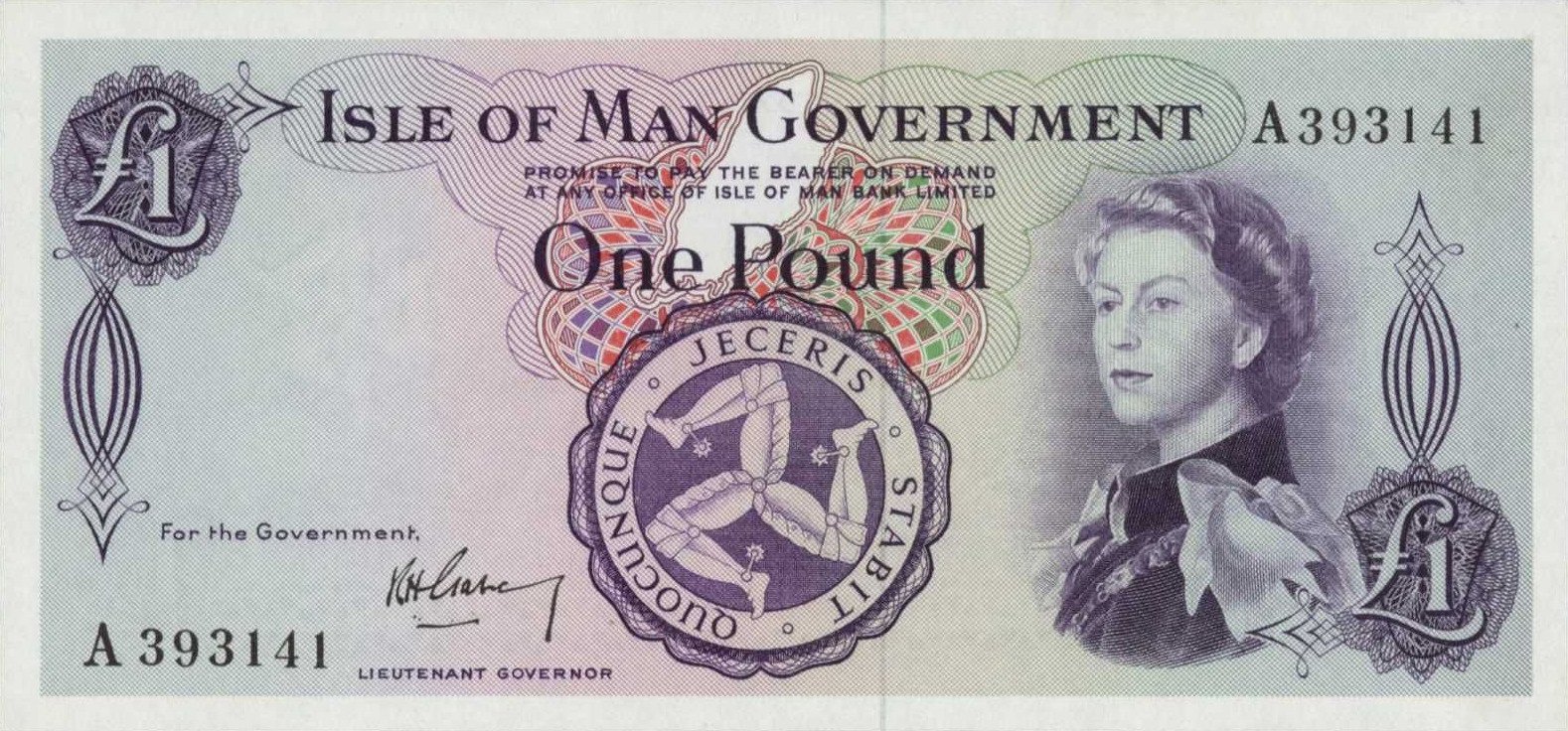
This article sets out the notes of the Isle of Man in the catalogue as one story, from the Manx Bank's 1 pound of 1882 to the Government's 10 pounds of 2019. It is written from the Pick pages, from what the auction houses wrote about the lots they sold, and from the history pages of NatWest Group, of which Isle of Man Bank is part. Two companion articles go into the detail: the banks' notes of 1882 to 1961 and the Government's notes of 1961 to 2019. A third covers the colour trials, specimens and proofs.
The banks and their licences, 1882 to 1961
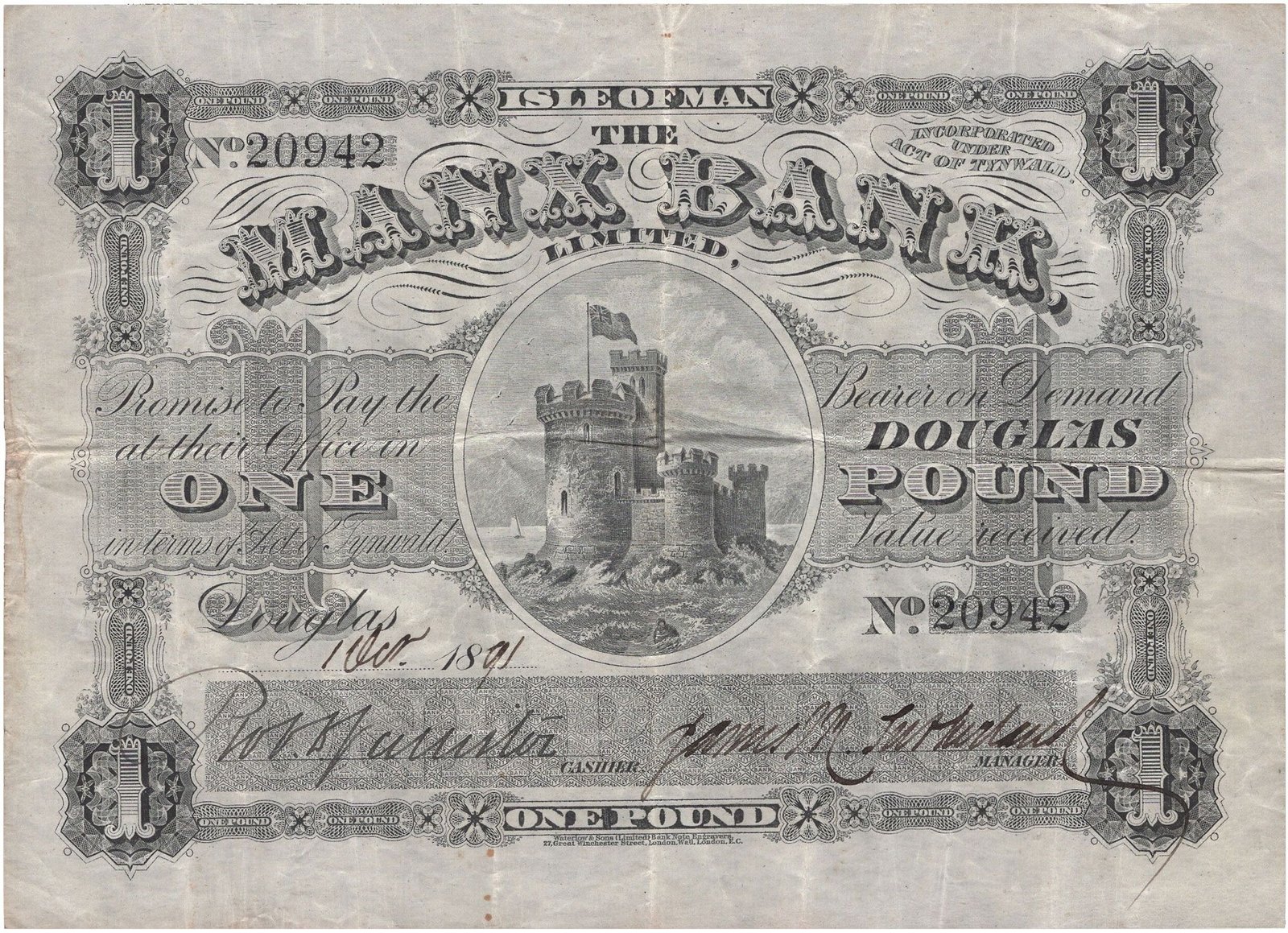
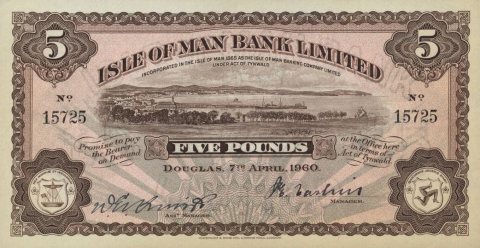
Before the Isle of Man Government Notes Act of 1961, several commercial banks issued their own notes on the island, each under a licence granted by Tynwald. Every note promises payment at the bank's office in Douglas in terms of Act of Tynwald. Stack's Bowers, describing lot 50324 of its sale of 8 May 2025, says that the island's first banknote issues date from the late 1700s, and that the Pick catalogue arranged the banks alphabetically. The catalogue here begins later, with the notes listed in the Pick catalogue.
In order of time the pages are these:
- Manx Bank Limited: the 1 pound of 1882 to 1900, dated and signed by hand.
- Isle of Man Banking Company Limited: the 1 pound of 1899 and the 1 pound of 1914 to 1926. As Isle of Man Bank Limited the same house issued the 1 pound of 1926 to 1933, the 5 pounds of 1927, the 1 pound of 1934 to 1960 and the 5 pounds of 1936 to 1960.
- Parr's Bank Limited: the 1 pound of 1906. Westminster Bank Limited followed with the 1 pound of 1927, the 1 pound of 1929 to 1955 and the 1 pound of 1955 to 1961.
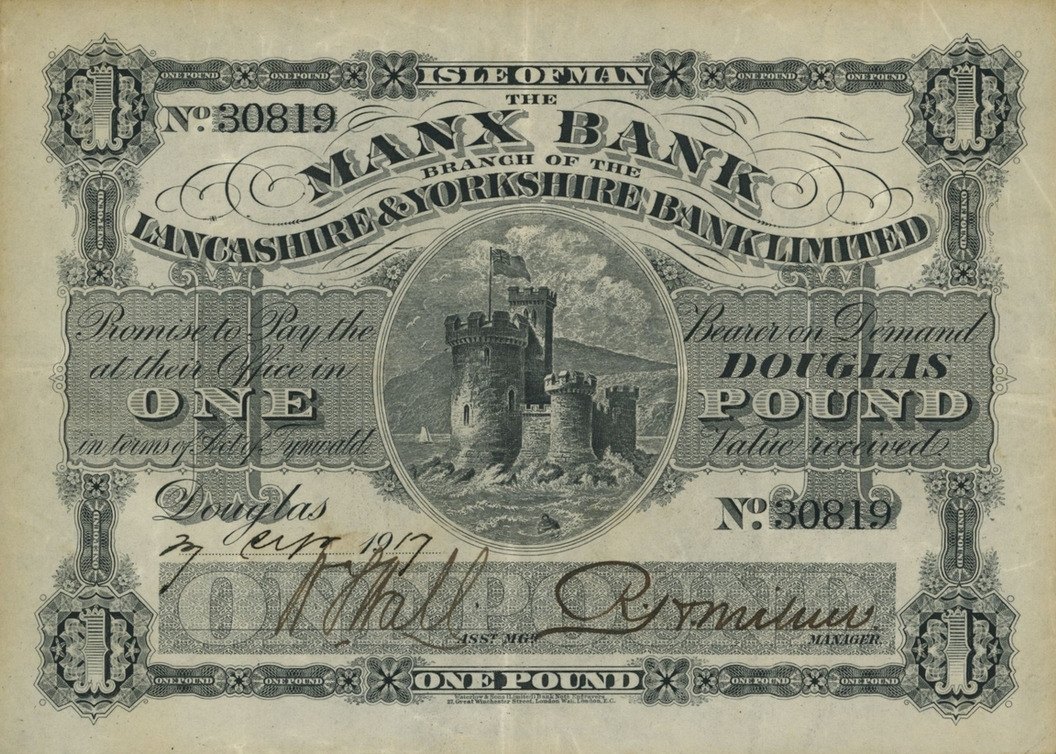
- Lancashire and Yorkshire Bank Limited: the large 1 pound of 1906 to 1917, which reads THE MANX BANK, BRANCH OF THE LANCASHIRE & YORKSHIRE BANK LIMITED, and the smaller 1 pound of 1921 to 1927. Martins Bank Limited followed with the 1 pound of 1929 to 1938 and the 1 pound of 1946 to 1957.
- Lloyds Bank Limited: the large 1 pound of 1919 to 1921, the 1 pound of 1932 to 1954 and the 1 pound of 1955 to 1961.
- Barclays Bank Limited: the 1 pound of 1924 to 1960.
All of these are 1 pound notes except the two 5 pounds of Isle of Man Bank.
How the banks followed one another
NatWest Group's history page for Isle of Man Bank Ltd says that the bank was founded in 1865 as Isle of Man Banking Co, after the island's legislature had passed a law allowing companies with limited liability, and that "the company issued its own banknotes from the outset". The same page gives 1926 as the year the name was changed to Isle of Man Bank Ltd. The notes agree with that year: the last Isle of Man Banking Company date on the page of P-3A is 1st March 1926, and the earliest Isle of Man Bank date on the page of P-4 is 1st May 1926. The earliest note of this house with a page here is of 1899. The page of P-2 records that sources also mention P-2 as a 5 pounds of 1865 to 1915, without a picture.
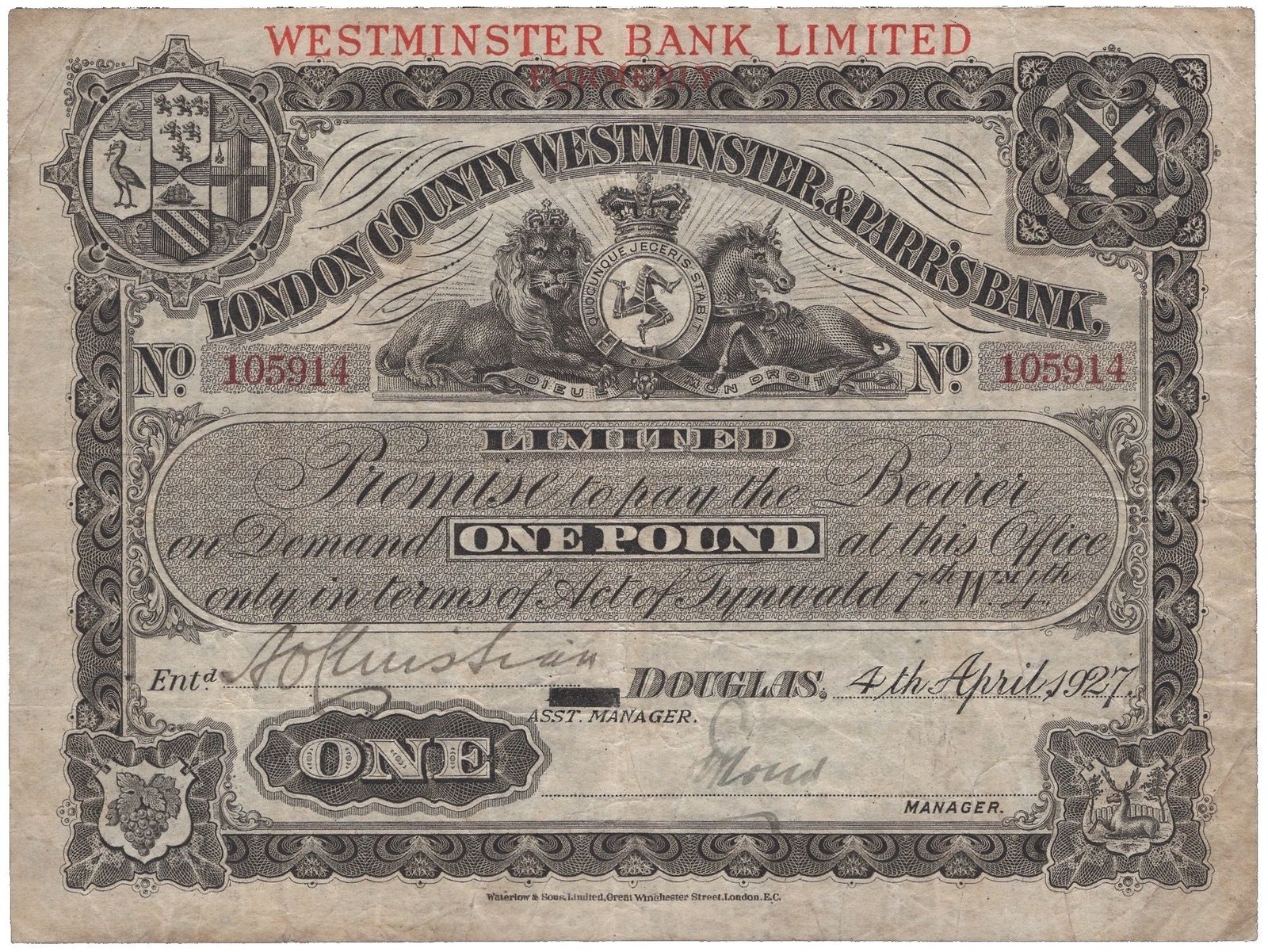
NatWest Group's page for Dumbell's Banking Co Ltd says that this Douglas bank suspended payment in 1900 and that Parr's Bank acquired its premises and goodwill. Its page for Parr's Bank Ltd gives that name from 1896 and says that in 1918 the bank amalgamated with London County & Westminster Bank Ltd to form London County Westminster & Parr's Bank Ltd. Its page for Westminster Bank Ltd says the name was shortened to Westminster Bank Ltd in 1923. The 1 pound of 1927 shows the change on the paper: it is a London County Westminster & Parr's Bank note with WESTMINSTER BANK LIMITED and FORMERLY overprinted in red above the old name.
Spink's descriptions of lots 465 to 467 in its sale of 25 September 2025 say that the Lancashire & Yorkshire Bank came to the island by acquiring the Mercantile Bank and was incorporated into Martins Bank Limited in 1928. Stack's Bowers (8 May 2025, lot 50324) says that Barclays Bank came to the island in 1922 by acquiring Manx banks and made its first issue of notes in 1924. These are the houses' statements. The Pick pages give no dates for the mergers.
The Act of 1961
The Isle of Man Government Notes Act of 1961 revoked the banks' licences from 31 July 1961 and gave the Isle of Man Government the sole right to issue notes. The last dates on the banks' pages fall shortly before it: 14th March 1961 for Lloyds, 10th March 1961 for Westminster, 24th October 1960 for the Isle of Man Bank 1 pound and 30th March 1960 for Barclays. The last Martins Bank date is 1st February 1957.
NatWest Group's page says that National Provincial Bank acquired Isle of Man Bank in 1961, that the licences of all the commercial banks on the island were revoked in the same year, and that Isle of Man Bank was then appointed to manage the note issue of the Isle of Man Government. The Government's notes name the bank: the promise on the 20 pounds of 2013 reads PROMISE TO PAY THE BEARER ON DEMAND AT ANY OFFICE OF ISLE OF MAN BANK LIMITED.
The first Government notes, 1961 to 1969
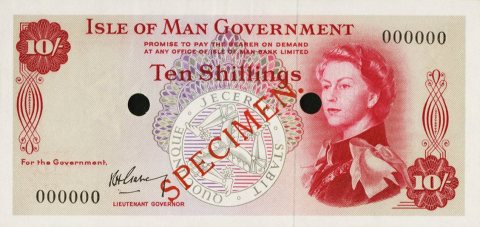
Sources mention 3 July 1961 as the day the first Government notes went into circulation. There were three values, the 10 shillings, the 1 pound and the 5 pounds, all printed by Bradbury Wilkinson and Company. They were designed by the Manx artist John H. Nicholson. The front has the Three Legs of Man and Pietro Annigoni's 1956 portrait of Queen Elizabeth II. The backs show a Viking ship in full sail on the 10 shillings, Tynwald Hill on the 1 pound and Castle Rushen, after a print of 1775, on the 5 pounds, each within a Celtic interlace border of its own. The paper has a security thread and a triskelion watermark.
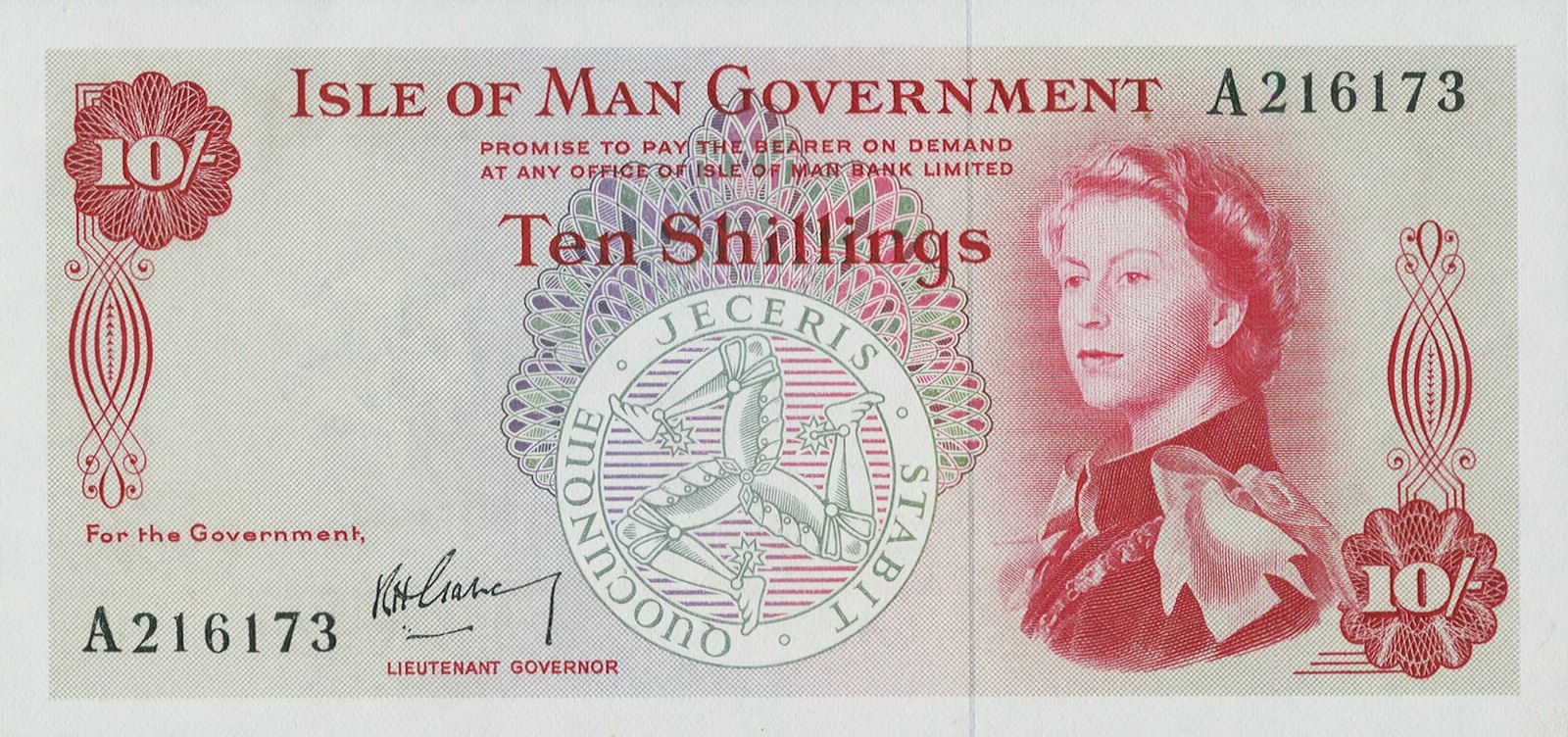
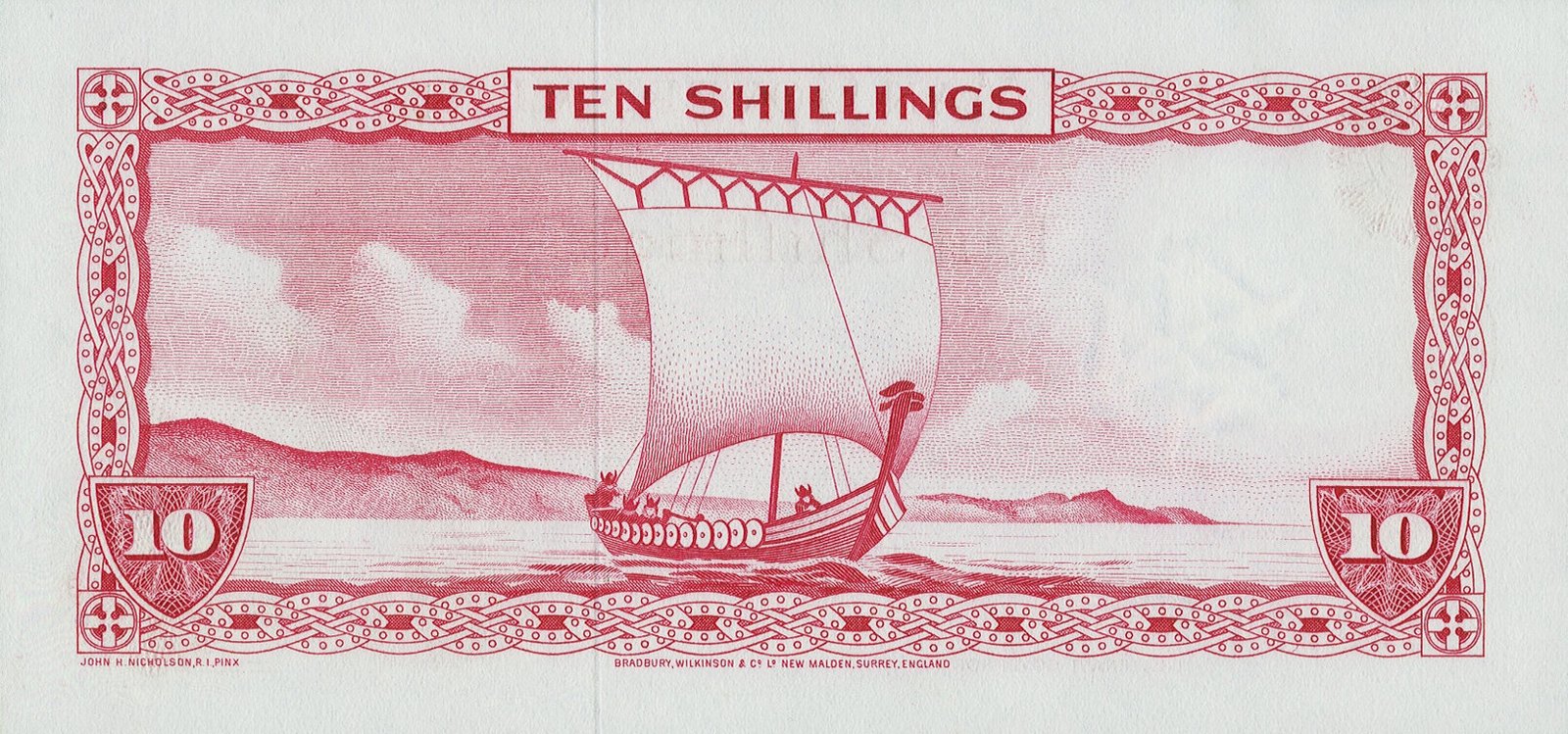
A proof of the 10 shillings, P-24p, carries the printed stamp 17-3-61 AS SUBMITTED in its top margin and is marked APPROVED LETTER 23.3.61 in ink.
In 1969, ahead of decimalisation, a 50 new pence replaced the 10 shillings, in the same size.
The smaller notes of 1972 and after
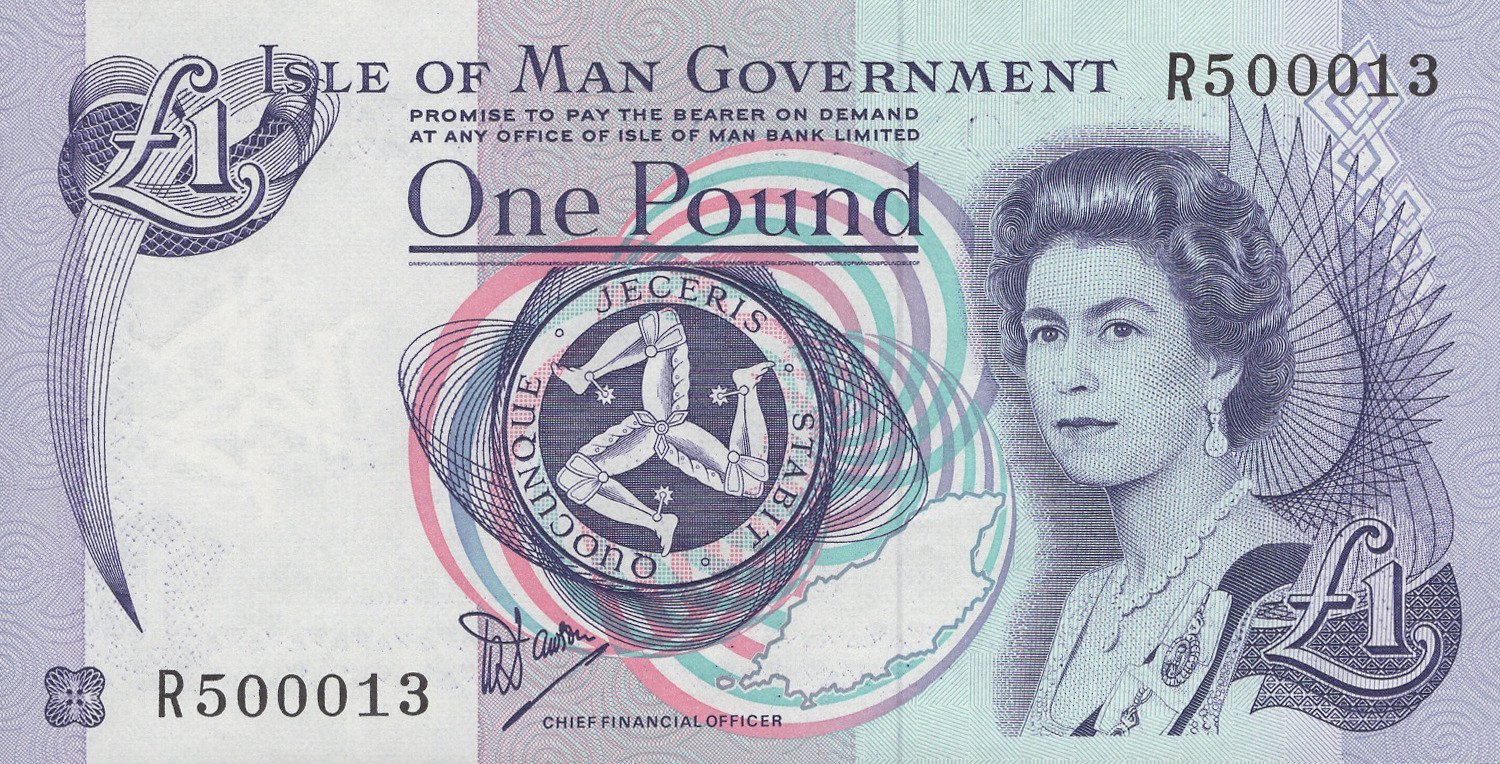
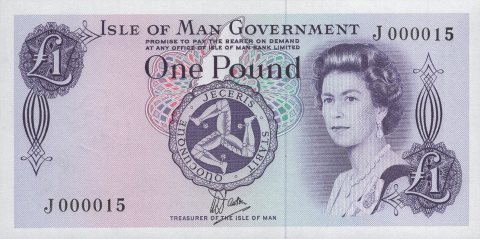
The notes of 1972 are smaller. Sources mention that they carry a portrait of the Queen by Anthony Buckley, from a photograph of about 1966, in place of the Annigoni portrait. The values were the 50 new pence, the 1 pound, the 5 pounds and a 10 pounds, the earliest 10 pounds with a page here.
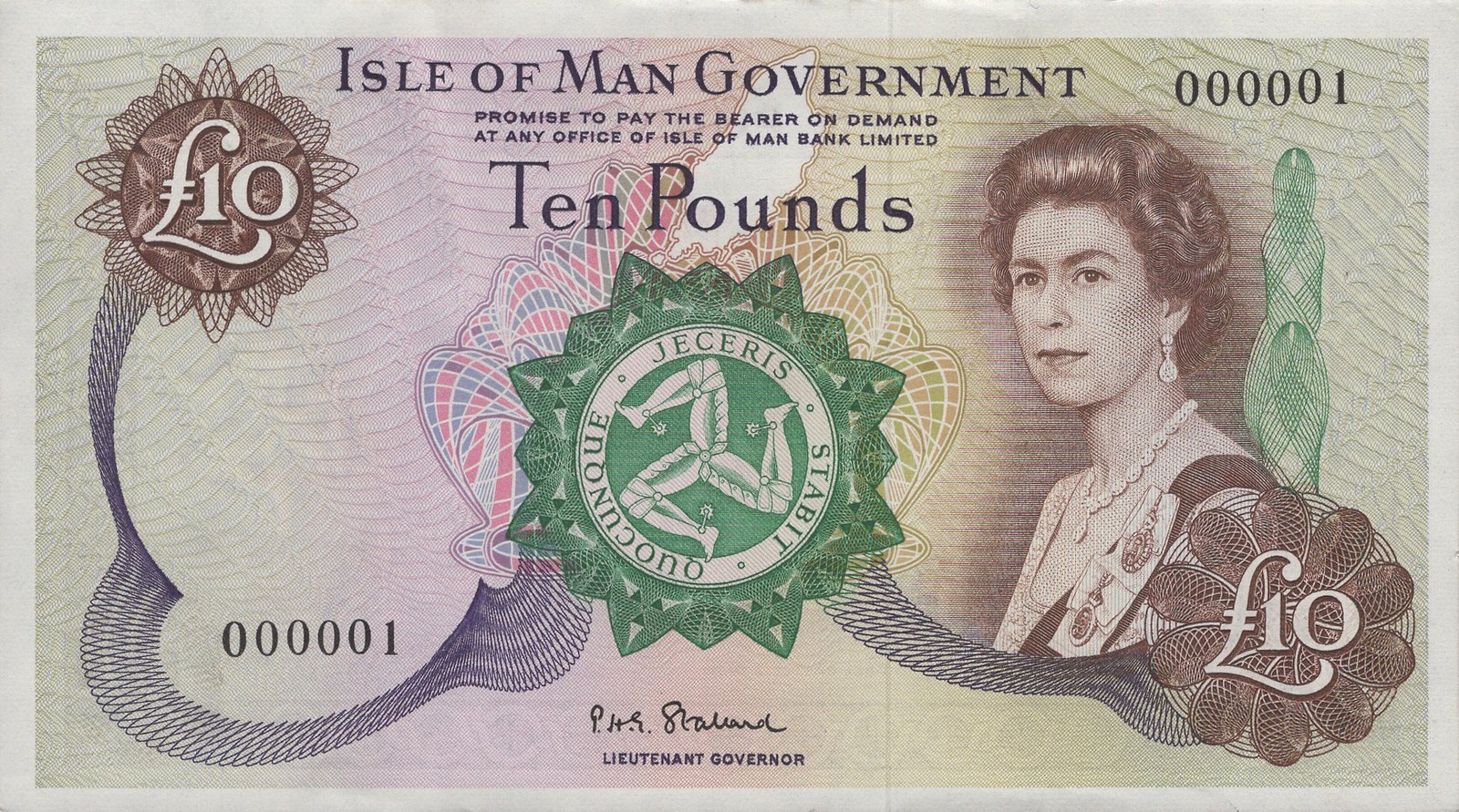
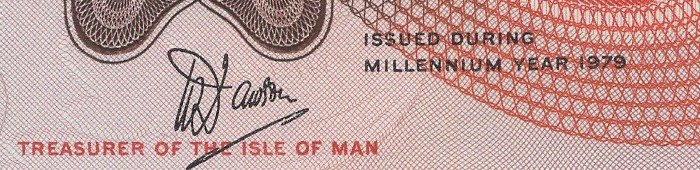
At the end of the 1970s the signature changed. The notes of 1972 are signed by the Lieutenant Governor, with the title LIEUTENANT GOVERNOR. The 50 new pence of 1979, the 1 pound of 1980 and the 10 pounds of 1980 to 1991 keep the designs of 1972 and are signed by the Treasurer, with the title TREASURER OF THE ISLE OF MAN. The page of the 5 pounds of 1980 names no signer; Spink (3 October 2011, lot 436) describes that note with the same signature, Dawson.
Three notes of these years stand apart:
- The 20 pounds of 1979. The value was introduced on 19 December 1979 for the Millennium of Tynwald. The first 5,000 notes carry the overprint ISSUED DURING MILLENNIUM YEAR 1979 and are P-32; the rest are P-37.
- The 50 pounds of 1983. P-39 was introduced on 27 April 1983. Sources mention the portrait of the Queen on this note as by Peter Grugeon.
- The plastic 1 pound of 1983. P-38, printed on Bradvek, was introduced on 23rd November 1983 according to Bank Note Reporter of January 1984.
A plainer printing of the 5 pounds, P-35A, is dated 1987 on its page.
The De La Rue notes, 1990 to 2019
From 1990 the pages name De La Rue as the printer. Trevor Wilkin, writing in Bank Note Reporter in October 2001, understood that Thomas De La Rue had bought the printer Bradbury Wilkinson from the American Bank Note Company. The notes are smaller again, and the signer's title is CHIEF FINANCIAL OFFICER.
The values are the 1 pound of 1990 to 2009, the 5 pounds (P-41 of 1990 to 1991 and P-48 of 2015), the 10 pounds (P-42, P-44, P-46 and the note of 2019, which has no Pick number) and the 20 pounds (P-43, P-45, P-47 and P-49). Each value kept one design through all those years. What changed was the signature, the wording of the promise and the printer's imprint, and those three things separate the Pick numbers.
Withdrawal
The pages give 31 October 2013 as the day of withdrawal for five notes: the 10 shillings (P-24), the three 50 new pence (P-27, P-28 and P-33) and the plastic 1 pound (P-38). For the plastic note Trevor Wilkin, in Bank Note Reporter of October 2001, gives 1988 as the year the note ceased. The pages give no day of withdrawal for any other note, and none for the banks' notes.
What the sources here do not give
The pages hold no circulation figures for the Government's notes and few printing figures. They do not give the wording of the Act of 1961 beyond the two points above, nor the Acts of Tynwald under which the banks were licensed. They do not give the dates on which the signers took or left office. The auction houses cite Isle of Man Paper Money by Pam West and Alan Kelly, and Spink's descriptions also cite Quarmby. Neither book was read for this article.
Sources
- The Pick pages of the Isle of Man in this catalogue, P-1 to P-49 and the 10 pounds of 2019.
- Bank Note Reporter, January 1984 (the day the plastic 1 pound was introduced) and October 2001 (Trevor Wilkin on the end of the plastic note), as the page of P-38 reports them.
- Stack's Bowers, 8 May 2025, lot 50324 (Barclays Bank on the island; the first Manx notes; the order of the Pick catalogue).
- Spink, 3 October 2011, lot 436 (the signer of the 5 pounds of 1980); 25 September 2025, lots 465, 466 and 467 (the Lancashire & Yorkshire Bank and Martins Bank).
- NatWest Group heritage hub, the pages "Isle of Man Bank Ltd", "Dumbell's Banking Co Ltd", "Parr's Bank Ltd" and "Westminster Bank Ltd".
Member comments
Log in or register to post a comment.