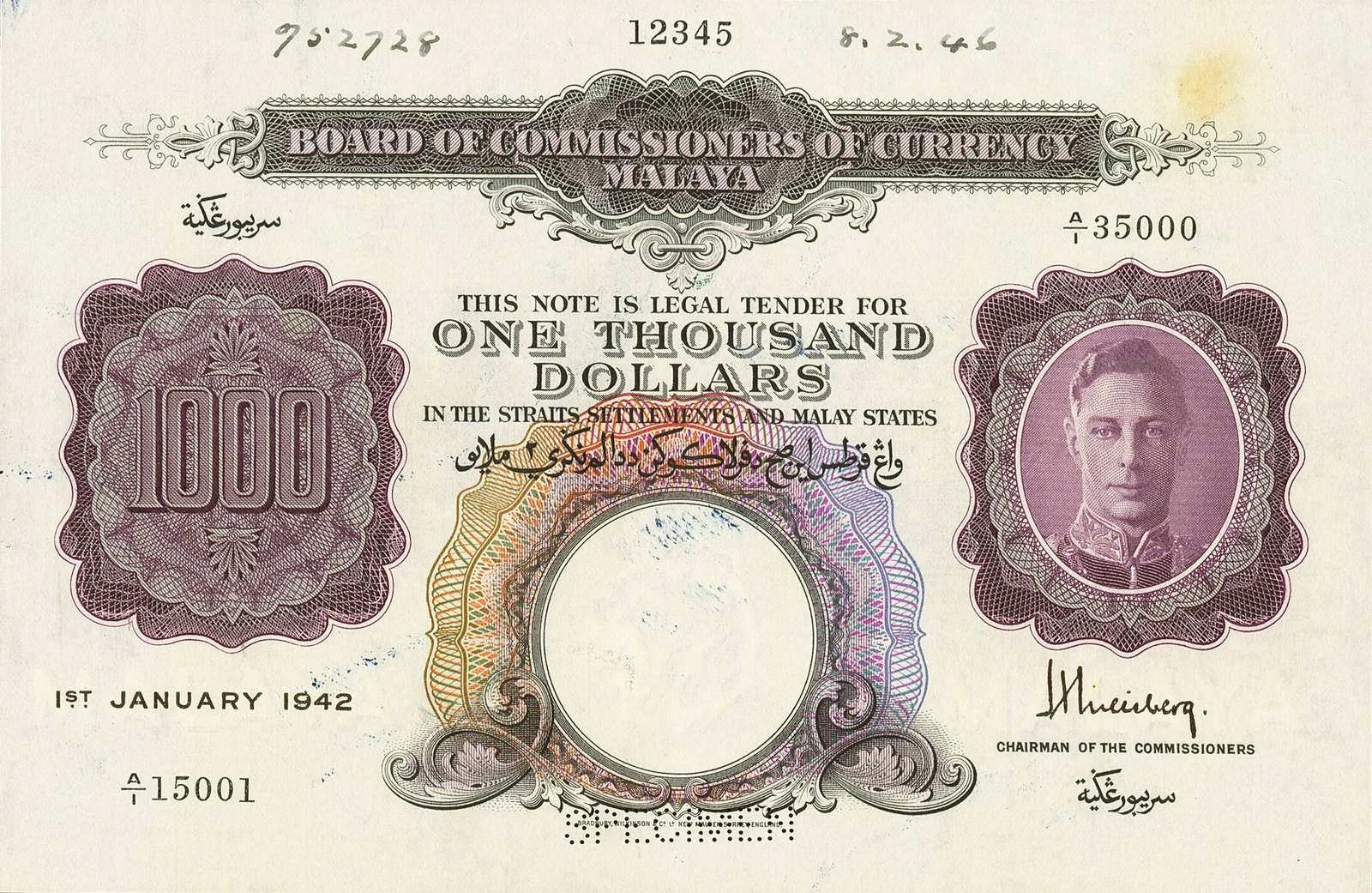
The two highest notes of the Board of Commissioners of Currency, Malaya, are the 1,000 dollars dated 1st January 1942 and the undated 10,000 dollars, both printed by Bradbury Wilkinson. Their specimens and colour trial specimens are set out in Specimens, colour trial specimens and proofs of Malaya, 1939 to 1949. This article gathers what the official sources say of the two values as money: whether they were legal tender, how many were counted in circulation and how many were destroyed. It then sets the statements of the auction houses and of collectors' papers beside those figures. The sources are the Singapore annual reports for 1952 to 1959, Tables 19 and 20 of Money in British East Asia (1957), the order dates on the printers' specimens, and Bank Note Reporter.
What the Pick pages say
The page of the 1,000 dollars says the note is a high value dated 1st January 1942, and that the printers' range specimens carry order dates from after the war. The page of the 10,000 dollars says the note was never publicly issued, that it was used only for settlements between banks, and that it carries no date. Neither page gives a number printed or a number issued. The 10,000 dollars page also has a row for an issued note, P-17a, beside its specimen rows.
The old high values and the new after the war
Two groups of high notes have to be kept apart. The first is the 1,000 and 10,000 dollars of the Straits Settlements, the 1,000 dollars and 10,000 dollars of 1919 to 1933. Money in British East Asia (p. 24) says that immediately after the war the notes from before the invasion were declared legal tender again, except those of less than one dollar and those of one thousand and ten thousand dollars, and that the right of possession of the larger notes had to be established.
Kerry Rodgers, writing in Bank Note Reporter of March 2006 (printed page 79), quoted the proclamation of the British Military Administration on these notes. As the text of the newspaper has it, holders of Straits Settlements currency notes of one thousand and ten thousand dollars were to deposit them, within one month from the day the proclamation came into force in their area, at the office of the District Civil Affairs Officer, with a written statement of where the notes had come from and what had been given for them. If the Chief Civil Affairs Officer, or a person authorised for the purpose, found the possession lawful after investigation, the notes would be exchanged for legal tender of the same nominal value. The passage was read in the newspaper's text only. Rodgers gives no number or date for the proclamation, and no copy of it is in the records.
Table 20 of Money in British East Asia (p. 154) shows that one note of 1,000 dollars from before the occupation was handed in and destroyed in 1954. The table does not say whose note it was.
The second group is the Board's own high values. The sources define the notes from before the invasion in two ways: Money in British East Asia (p. 27, read in the text) as notes bearing dates before 1st July 1941, and the Singapore annual report for 1948 (text only) as notes originally issued before 15th February 1942. The Board's 1,000 dollars is dated 1st January 1942; the 10,000 dollars carries no date.
Legal tender every year from 1952 to 1959
The Colony of Singapore annual reports for 1952 to 1959 list each year the currency in circulation as legal tender. Every one of them includes the notes of the Board of Commissioners of Currency, Malaya, bearing dates not earlier than 1st July 1941, in denominations of one, five, ten, fifty, one hundred, one thousand and ten thousand dollars, for the payment of any amount (pp. 75 and 76 of the report for 1952). The undated 10,000 dollars is named in a list that otherwise goes by the date on the note. The reports were read in the text only. None of them gives a day on which the Board's 1,000 or 10,000 dollars ceased to be legal tender.
The same reports list the Queen's notes of the new Board, dated 21st March 1953, value by value as they appear. The Queen's 10,000 dollars is first named in the report for 1956, and the Queen's 1,000 dollars only in the report for 1958. The report for 1954 names the Queen's 1, 50 and 100 dollars and no other. The State of Brunei annual report for 1955 adds that the currency of the former Board of Commissioners of Currency, Malaya, was still legal tender there.
The count at the end of 1954
Table 19 of Money in British East Asia (p. 153), taken from the Commissioners' report for 1954 and read on the page image, counts the notes issued after the liberation that were in circulation on 31st December 1954. Table 20 (p. 154) counts the notes destroyed during 1954.
| Value | In circulation, 31st December 1954: pieces | Value, $ | Share of all notes by value, % | Destroyed in 1954, issued after the liberation: pieces | Destroyed in 1954, from before the occupation: pieces |
|---|---|---|---|---|---|
| 1,000 dollars | 31,890 | 31,890,000.00 | 4.09 | 12,938 | 1 |
| 10,000 dollars | 1,325 | 13,250,000.00 | 1.70 | 759 | none |
The tables do not say which Board's notes these were. The Singapore report for 1954 (text only) does not list the Queen's 1,000 or 10,000 dollars as in circulation during that year.
What the figures do say is that notes of these two values were in circulation in the Commissioners' accounts, and were destroyed in thousands and hundreds in a single year. They do not say how many were printed, how many were ever paid out, or how many were in the hands of banks and how many elsewhere.
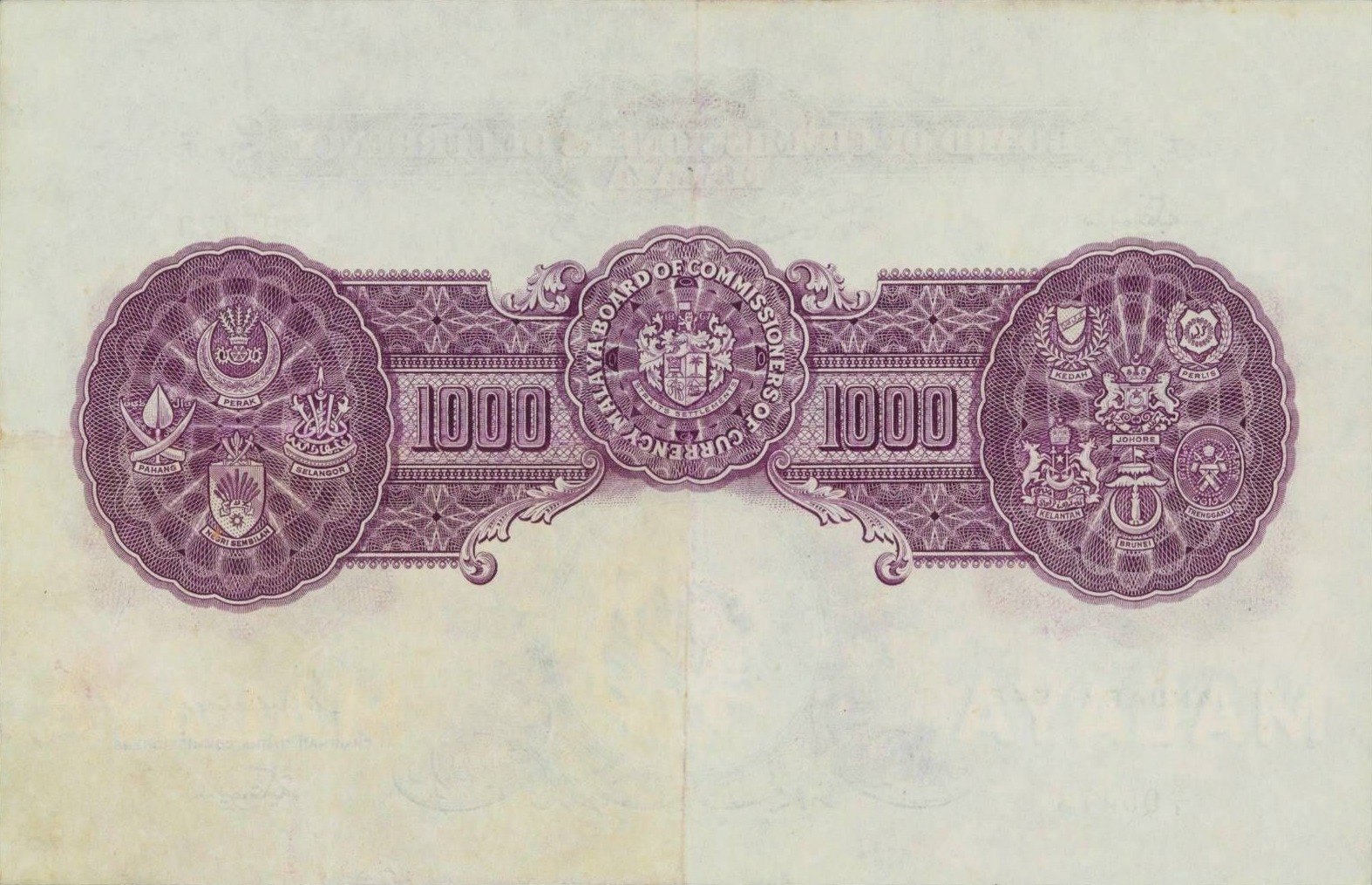
The order dates on the specimens
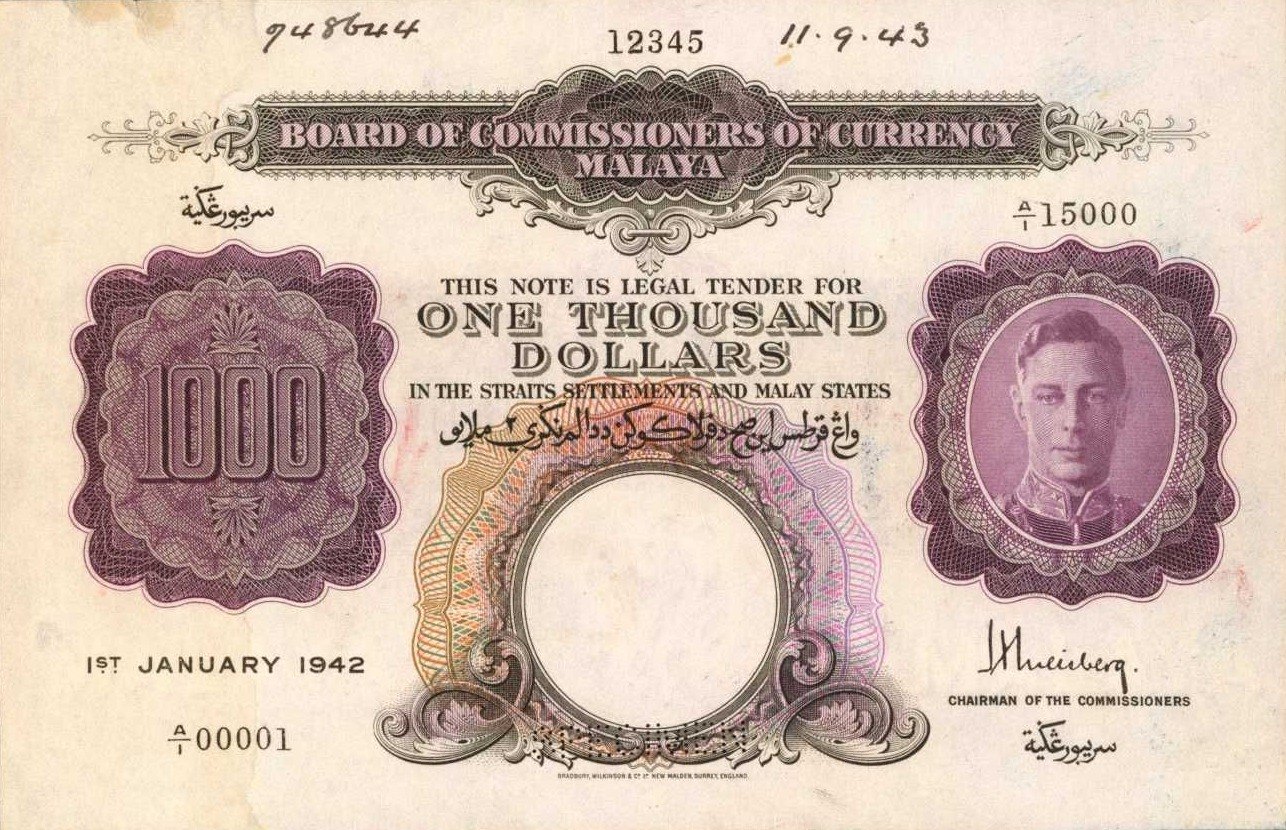
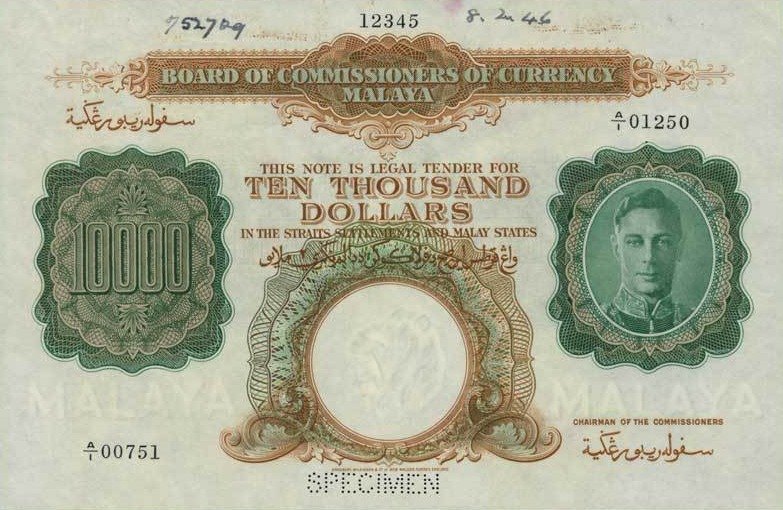
The printers' archive specimens of both values carry ranges of numbers, and some have a date written in the margin, which the Pick pages take for the date of the order. The specimens of the 1,000 dollars, with order dates of 11.9.43 (seen in the photograph of Stack's Bowers' lot 60103 of 4th April 2018), 8.2.46 and 27.8.47, are set out in Specimens, colour trial specimens and proofs of Malaya. One more date belongs with them. Bank Note Reporter of July 2009 (p. 12) pictures the 10,000 dollars specimen of Spink's sale of 4th July 2009 (lot 56), with the range A/1 01751 to A/1 02750; its text says the piece shows no printed date but has "27.8.47" handwritten at top right, and the photograph also shows an ink number at top left. The catalogue's record of that sale notes that Spink's own lot text misprints the range and the margin date. Heritage's description of 7th December 2025 (lot 22407) gives the same range and no margin date, but Heritage's photograph of the piece shows 27.8.47 at top right and, at top left, a handwritten number that reads as the one in Bank Note Reporter's picture. The two photographs point to one and the same piece.
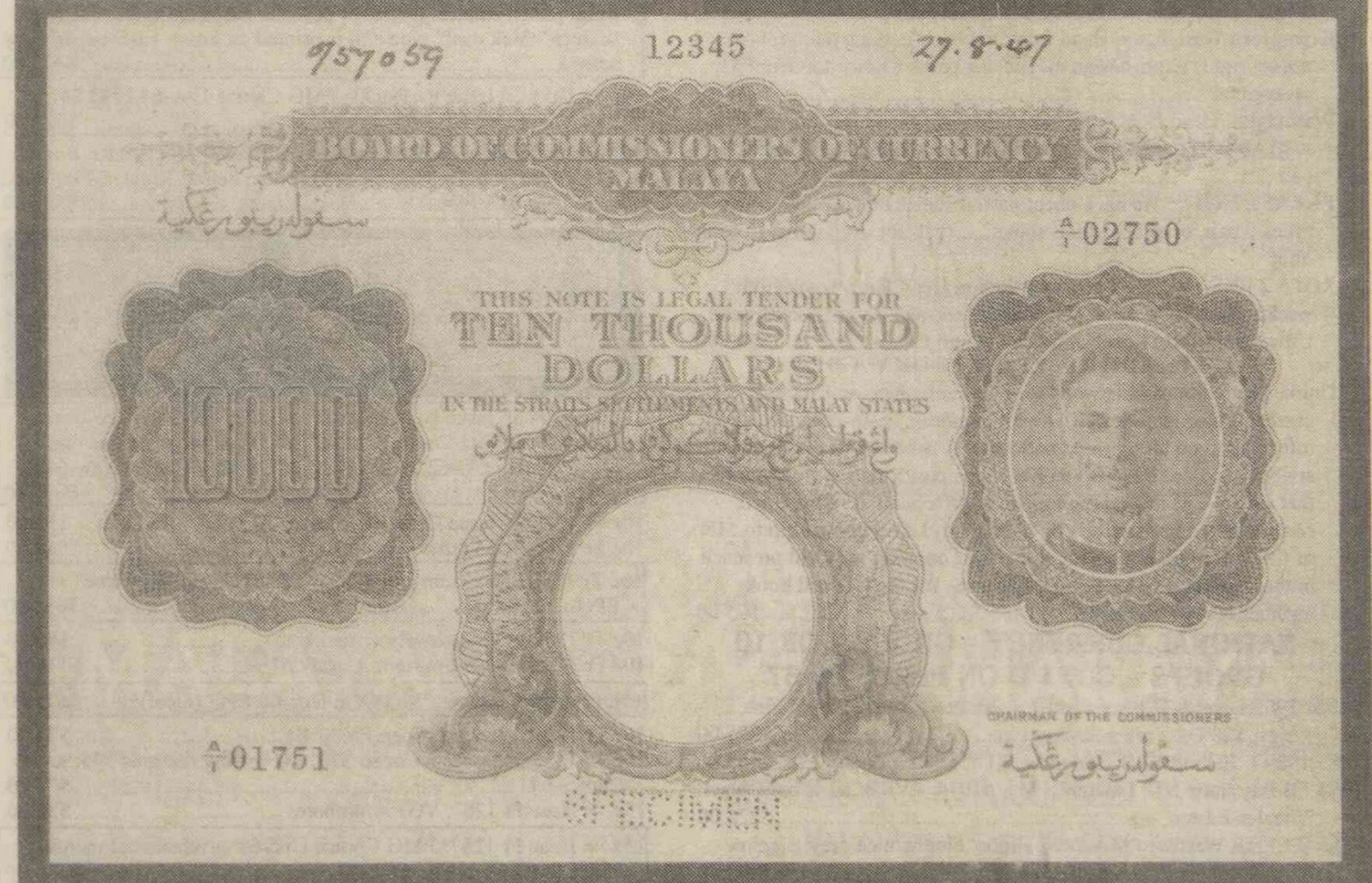
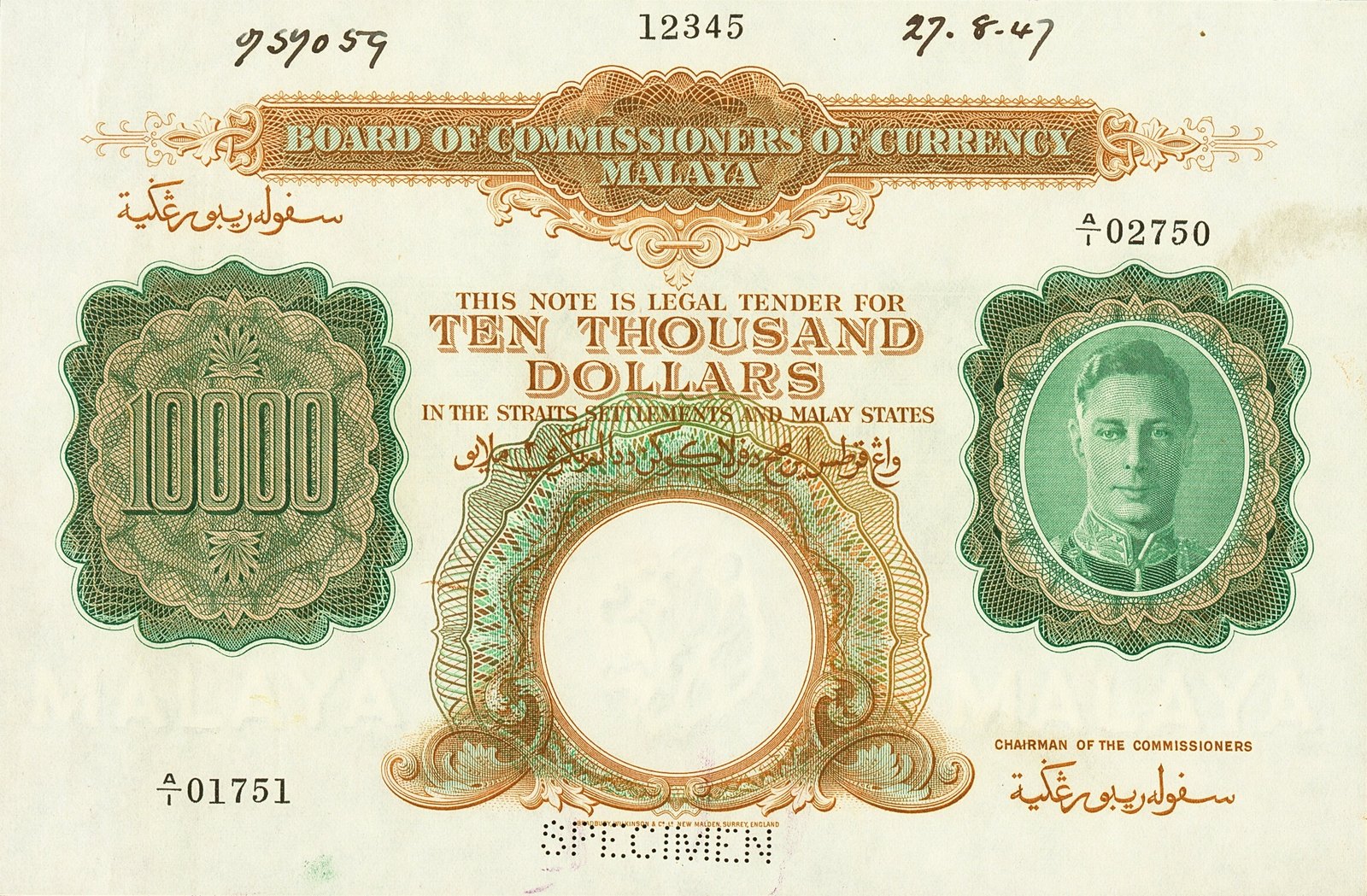
The dates on these specimens are of 1943, 1946 and 1947. The specimens do not say when any note was paid out.
What houses and collectors wrote
The statements below are given as each house or writer made them.
| Statement | Who, where | What the official sources set beside it |
|---|---|---|
| An issued 1,000 dollars with prefix A/1 was the first of the design the house had handled in any form | Stack's Bowers, 19 August 2013, lot 52596 | Table 19 counts 31,890 notes of 1,000 dollars issued after the liberation in circulation at the end of 1954 |
| Perhaps as few as 35,000 notes of 1,000 dollars were issued | Heritage, 7 December 2025, lot 22405 | No official source read gives a number issued. The specimen of 27.8.47 carries a range ending at A/1 50000 |
| The 10,000 dollars was produced in 1952 for transactions between banks; the writer would like to see one, or a photograph of one | Fred Schwan, Bank Note Reporter, October 1983, p. 17 | The Singapore report for 1952 already lists the Board's 10,000 dollars as legal tender; a specimen carries the date 27.8.47 |
| The Board's 1,000 and 10,000 dollars were printed just before the Pacific war and issued in 1945; the 10,000 dollars circulated to a limited extent only, if at all | Kerry Rodgers, Bank Note Reporter, March 2006, p. 79 | The specimens of the 1,000 dollars carry order dates of 1943, 1946 and 1947. No report read gives a day of issue |
| The 10,000 dollars was listed in the Standard Catalog of World Paper Money as "reported not confirmed", and at Spink's Singapore sale of 1st July 2006 it was available as a specimen only | Bank Note Reporter, August 2006 | Table 19 counts 1,325 notes of 10,000 dollars in circulation at the end of 1954. Spink's own record of that sale gives the piece (lot 846) as a colour trial |
| No issued 10,000 dollars has turned up; the fall of Singapore limited or stopped the issue of this design | Heritage, 6 December 2017, lot 28293 | The Singapore reports list the note as legal tender from 1952 to 1959 |
| The 10,000 dollars was most likely not available to the public, so it is reasonable to assume no issued note was saved | Heritage, 7 December 2025, lot 22407 | Table 20 counts 759 notes of 10,000 dollars destroyed in 1954 |
| The grading service's census lists the 10,000 dollars only as five specimens, seven colour trial specimens and three progressive proofs | Bank Note Reporter, November 2024, p. 68 | A census of graded pieces, not of pieces that exist |
The two statements stand side by side and neither settles the other. The Pick page of the 10,000 dollars says the note was never publicly issued and was used only for settlements between banks. Tables 19 and 20 of Money in British East Asia count 1,325 notes of 10,000 dollars in circulation at the end of 1954 and 759 destroyed during that year, and do not say who held them. The statements that no issued note has turned up are about notes surviving today, which the tables of 1954 cannot answer. The dates of 1945 and 1952 that the two writers give rest on no document they name, and the official sources give no day of issue for either value.
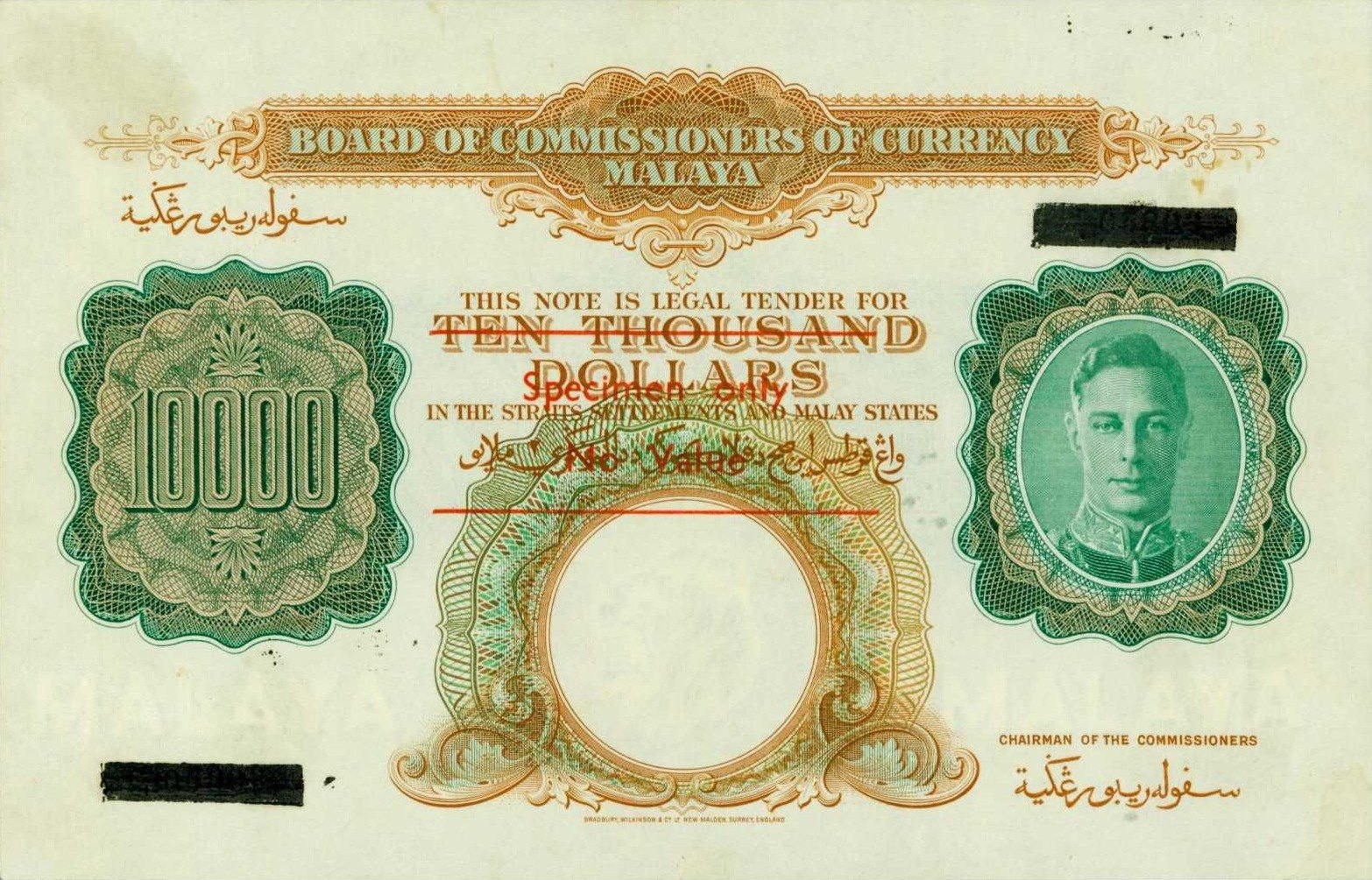
Stack's Bowers' description of 24 August 2015 (lot 50190) adds one piece that touches the question: a 10,000 dollars sold as a specimen, with a regular serial number blacked out and with some handling. It is described in the article on the printers' pieces, named above.
What would settle it
- The Commissioners' annual reports for 1946 to 1953, which Money in British East Asia quotes but which are not in the records, for a count of these two values by year.
- The Gazette text of the proclamation of the British Military Administration on the Straits Settlements 1,000 and 10,000 dollars, with its number and date.
- Bradbury Wilkinson's order books, for the number printed of each value and the dates of delivery.
- A note of either value with a regular number and no specimen marks, photographed, which would show what a paid-out note looked like.
Sources
- The Pick pages of the 1,000 and 10,000 dollars (P-16, P-17) and of the Straits Settlements 1,000 and 10,000 dollars (P-14, P-15).
- Money in British East Asia (1957): pp. 24 and 27; Table 19, p. 153; Table 20, p. 154 (the tables read on the page images).
- Colony of Singapore annual reports for 1948 and 1952 to 1959, Currency (1952: pp. 75 and 76), read in the text only.
- State of Brunei annual report for 1955, read in the text only.
- Bank Note Reporter: October 1983, p. 17 (Fred Schwan, "Military Vignettes: Japanese invasions cut short circulation of paper"); March 2006, p. 79 (Kerry Rodgers); August 2006; July 2009, p. 12; November 2024, p. 68.
- Stack's Bowers: 19 August 2013, lot 52596; 24 August 2015, lot 50190.
- Heritage Auctions: 6 December 2017, lot 28293; 7 December 2025, lots 22405 and 22407.
- Spink: 4 July 2009, lot 56; 1 July 2006, lot 846.
Member comments
Log in or register to post a comment.