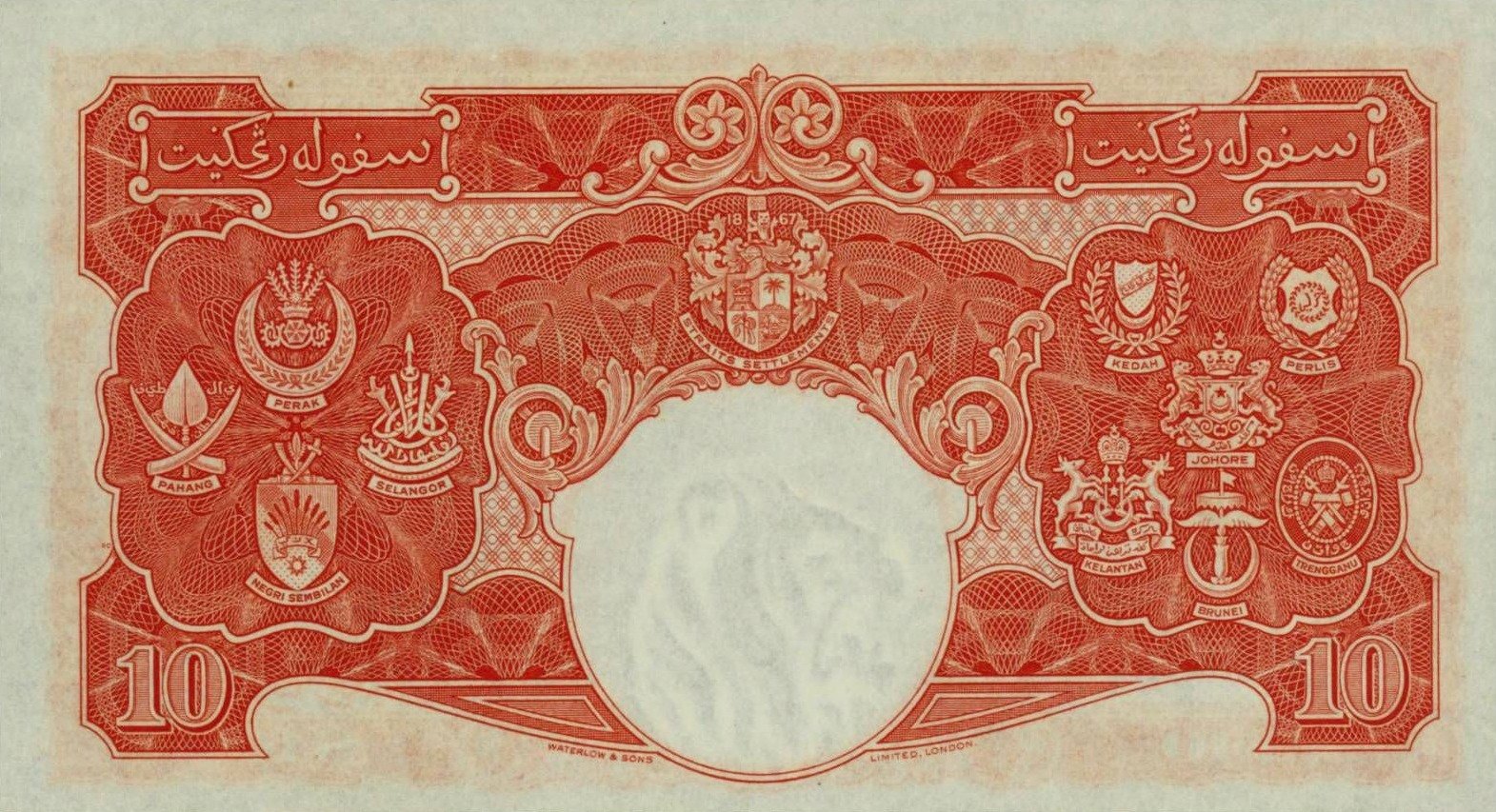
This article sets out the official figures for the currency notes in circulation in Malaya from September 1945 to the end of 1954. The main source is Money in British East Asia (1957), whose Table 4 reprints the Commissioners' statement of the note circulation and whose Tables 19 and 20 give the only count by value found for these years. Beside it stand the Singapore annual reports for 1947 to 1951, the Malayan Union report for 1946, the Brunei, Sarawak and North Borneo reports, and the Bank of England Quarterly Bulletin of 1962. What happened to the notes from before the invasion, and the three figures for the day Singapore fell, are told in Malaya's notes after the invasion, 1942 to 1959 and in The Straits Settlements notes after the fall of Singapore. The years from 1952 on are told for the new Board in The notes of the Board of Commissioners of Currency, Malaya and British Borneo, 1953 to 1969.
The sources and how they were read
The tables of Money in British East Asia were read on the page images of the book, its running text in the text layer. The Singapore, Brunei and Sarawak reports and the Malayan Union report for 1946 are held only as machine-read text, so every figure from them was read in the text only and may be a digit out; each is marked so below. The passage of the North Borneo report for 1947 was read on the page image.
None of these sources splits the circulation between the notes of the Board of Commissioners of Currency, Malaya, and the notes of the older issuer. After 1952 none splits it between the old Board's notes and the Queen's notes of the new Board, whose notes are a separate country here: Malaya and British Borneo.
From the liberation to 1st April 1946
Money in British East Asia (p. 23) says the total note circulation showed a small increase during the war, to 235,603,368.70 dollars on 3rd September 1945. On the same page the book says the Crown Agents redeemed notes for evacuees and issued Malayan notes to the War Office at 2s. 4d. Then came what the book calls the sudden post-war expansion of the currency: the total nominal circulation was 421,924,085.48 dollars on 1st April 1946. On that day the Board was formed again under the Currency (Transitional Amendment) Ordinance, 1946, which the book numbers No. 4 of Singapore and No. 5 of the Malayan Union. Both figures were read on the page image.
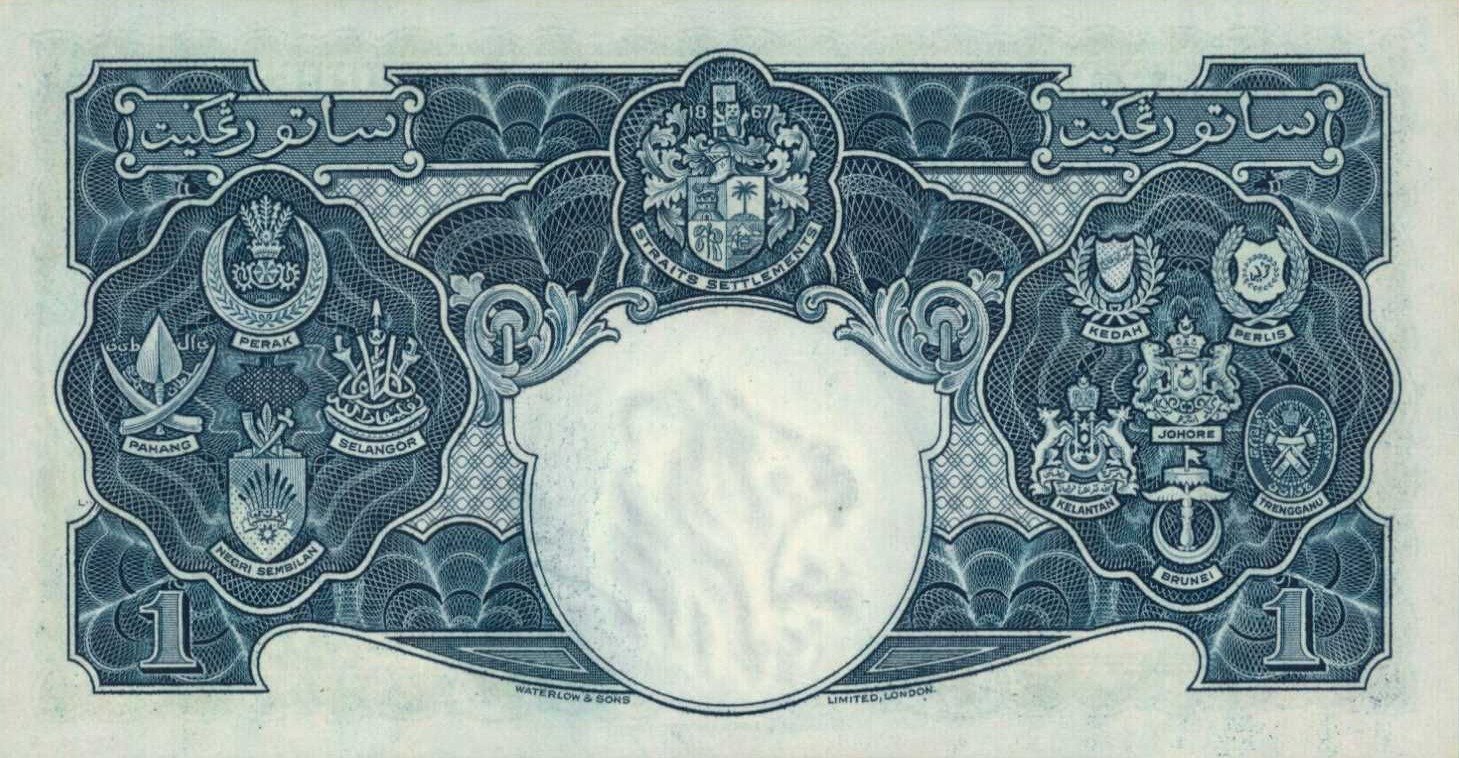
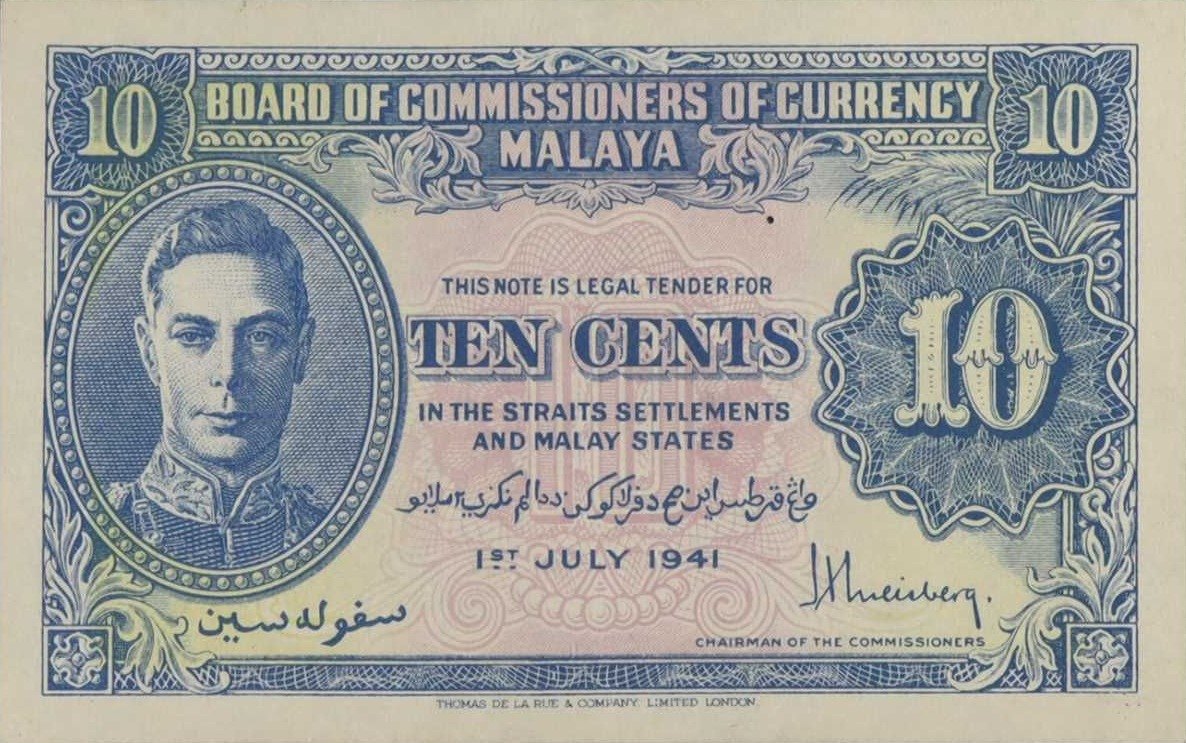
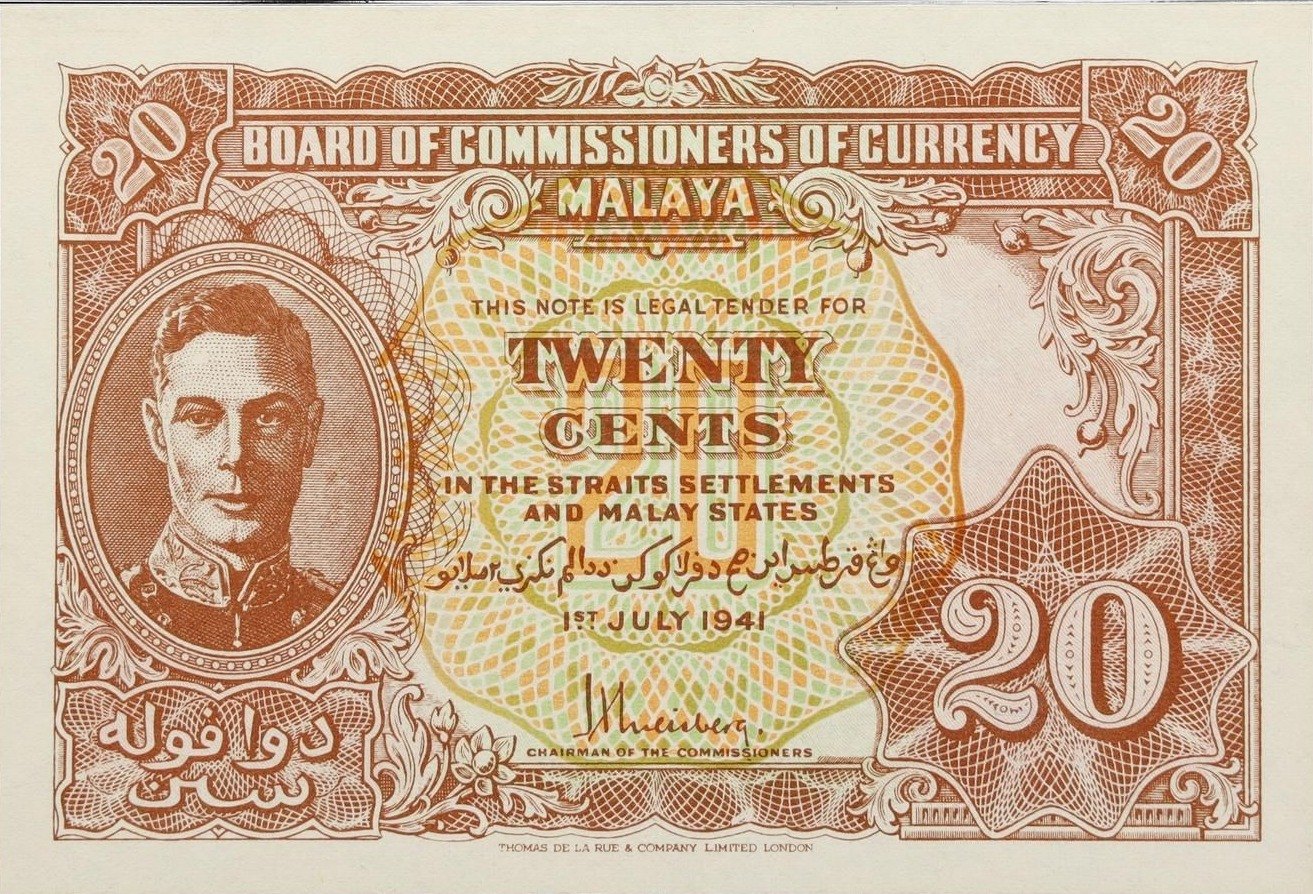
The Pick pages say the 1 dollar, 5 dollars and 10 dollars dated 1st July 1941 were released in September 1945, and that the cent notes of the same date were issued in 1941, before the Japanese invasion. The Singapore annual report for 1952 (p. 76, read in the text only) says that all the Board's notes then legal tender, the cent notes among them, were issued into circulation after the liberation in September 1945. Neither source settles the other. Of the high values dated 1st January 1942 the Pick pages say that the printers' range specimens carry order dates from after the war.
The Malayan Union annual report for 1946 (p. 21) gives the notes issued since the liberation as 230,925,548.79 dollars by the end of 1946, and the notes from before the invasion destroyed or awaiting destruction by the Currency Commissioners as 65,118,301.80 dollars. The balance and total printed beside these lines do not add up in the machine-read text, so they are left out.
The end of each year, 1946 to 1951
Table 4 of Money in British East Asia (p. 140), headed "Currency Circulation: Malayan Currency Area, 1946-54, Statement of Notes in Circulation", gives the notes in thousands of dollars under three headings, gross, net and active, with the active figure as a share of the gross. A note under the table says that the figures up to and including 30th June 1948 include the issues from before the invasion, and the figures from 30th September 1948 onwards leave them out, because those issues ceased to be legal tender with effect from 31st August 1948. The record holds the year-end lines of the table for 1946 to 1949 and every line from March 1950. It does not hold the book's definitions of net and active.
The Singapore annual reports give the note circulation at 31st December in all the territories that used the currency, and the notes and coin together.
| At 31st December | Gross, $'000 (Table 4) | Net, $'000 (Table 4) | Active, $'000 (Table 4) | Active as % of gross (Table 4) | Notes in circulation, $ (Singapore report, text only) | Notes and coin, $ (Singapore report, text only) |
|---|---|---|---|---|---|---|
| 1946 | 405,885 | 404,480 | 316,178 | 78 | no Singapore report read | no Singapore report read |
| 1947 | 412,104 | 410,327 | 292,619 | 71 | 412,103,846.92 | 440,871,673.06 |
| 1948 | 400,939 | 398,130 | 301,799 | 75 | 400,938,886.12 | 429,619,239.56 |
| 1949 | 402,944 | 400,444 | 310,914 | 77 | 402,943,632.60 | 433,917,920.96 |
| 1950 | 633,487 | 630,689 | 515,165 | 81 | 633,487,211.08 | 669,767,536.58 |
| 1951 | 764,109 | 761,294 | 654,472 | 86 | 764,109,203 | 808,712,504 |
The two sources agree to the thousand in every year they share. The Singapore report for 1947 (text only) gives the coin as 28,767,826.14 dollars and divides the notes into 94,131,786.86 dollars from before the invasion and 317,972,060.06 dollars issued since the liberation, the division the Malayan Union report for 1947 also gives; in the machine-read text of the Singapore report the second figure reads 319,972,060.06, and the reader of that report took 317,972,060.06 from the printed total. The Singapore report for 1948 (text only) says its figure for that year leaves out the notes from before the invasion.
A third source gives other round figures. The Bank of England Quarterly Bulletin of 1962, in the article "Currency and banking developments in certain Commonwealth countries" (read on the page image), gives a table of the currency circulation of the Malayan Currency Board, in millions of dollars at the end of financial years: 144 in 1939, 435 in 1946, 681 in 1950, 812 in 1952 and 987 in 1957. It does not give the day, and its heading is currency, not notes alone. For 1946 there are therefore three figures, each as printed: 421,924,085.48 dollars on 1st April 1946 (Money in British East Asia, p. 23), 405,885 thousand gross at 31st December 1946 (Table 4) and 435 million for 1946 (the Bank of England). No source read explains the difference.
Money in British East Asia quotes the Commissioners' report for 1950 on what the figures show: since 1946 the gross circulation had remained almost stationary at around 400 million dollars, and by the close of 1950 it had increased by 235.85 million dollars, 54 per cent over the figure at the close of 1949. That passage was read in the text only, and the record does not give its page.
Where the notes were at the end of 1947
Money in British East Asia (p. 44, read in the text) breaks down the gross circulation of 412,000,000 dollars at 31st December 1947. About 20 million dollars were circulating outside the territories, about 110 million were held as cash in the vaults of the banks, and about 19 million were in British Borneo. That, the book says, left a balance of 263,000,000 dollars in the hands of the public of the Federation of Malaya and Singapore.
A circulation total is therefore not a count of notes in the hands of the public. The book does not say how its four figures were reached.
Malayan notes in Borneo and Brunei, 1945 to 1955
The 19 million dollars in British Borneo had come with the British Military Administration. Money in British East Asia (p. 25) says the British military authorities issued Malayan currency notes in the Bornean territories they administered, and that steps were later taken in Sarawak to withdraw the Sarawak notes. The North Borneo annual report for 1947 (read on the page image) says the Administration introduced Malayan currency throughout the three Borneo territories on liberation, and that about 7 million dollars of it was in circulation in the colony.
The Singapore annual report for 1947 (p. 48, read in the text only) prints a table of the Malayan currency put into Borneo. Its line for the British Military Administration (British Borneo) gives 11,200,000 dollars in notes, and its total for notes is 18,547,945 dollars. The lines for North Borneo and Sarawak are scrambled in the machine-read text and their figures do not add up to their own totals, so they are not given here.
The later reports follow the change (all read in the text only):
- The report for 1949 (p. 48) says the Borneo territories bought 2,574,750 dollars of Malayan currency during the year while gradually replacing their locally issued currencies.
- The report for 1950 (p. 51) says the circulation was expanded by 1,450,650 dollars as a result of the withdrawal by the Government of Sarawak of its own currency for replacement by Malayan currency.
- The Sarawak annual report for 1953 says that since 1945 only Malayan currency had been issued in Sarawak.
Money in British East Asia (pp. 31 to 36, read in the text) shows the other side of the change in Sarawak's own notes, which are not in this catalogue: 9,312,387.50 dollars at their peak between December 1941 and January 1946, 8,198,382.40 dollars at the end of 1946 and 961,444.60 dollars on 31st December 1951.
In Brunei the Malayan notes were the only legal tender. The Brunei reports were read in the text only. The Brunei annual report for 1946 (pp. 50 and 51) says Malayan currency was the only legal tender and that currency notes were issued in denominations from 10 cents upwards. The report for 1953 says notes were issued from 50 cents upwards; the reader of that report noted that this may be loose wording. The report for 1955 says that only currency issued by the Board of Commissioners of Currency, Malaya and British Borneo, was legal tender in Brunei, and adds that this of course included the currency of the former Board of Commissioners of Currency, Malaya.
Quarter by quarter, 1950 to 1954
From March 1950 Table 4 gives a line for every quarter. For 1953 and 1954 it also gives a gross figure for the end of every month; those monthly lines are left out of the table below except where the text needs them.
| Date | Gross, $'000 | Net, $'000 | Active, $'000 | Active as % of gross |
|---|---|---|---|---|
| 31st March 1950 | 402,651 | 399,945 | 337,402 | 84 |
| 30th June 1950 | 418,401 | 416,349 | 521,521 (as printed) | 86 |
| 30th September 1950 | 495,924 | 493,630 | 419,032 | 84 |
| 31st December 1950 | 633,487 | 630,689 | 515,165 | 81 |
| 31st March 1951 | 701,571 | 698,465 | 599,441 | 85 |
| 30th June 1951 | 728,238 | 725,342 | 623,565 | 84 |
| 30th September 1951 | 739,519 | 737,009 | 638,781 | 86 |
| 31st December 1951 | 764,109 | 761,294 | 654,472 | 86 |
| 31st March 1952 | 788,766 | 786,012 | 635,011 | 81 |
| 30th June 1952 | 788,422 | 785,556 | 618,268 | 78 |
| 30th September 1952 | 787,672 | 784,342 | 617,095 | 78 |
| 31st December 1952 | 786,797 | 783,640 | 630,190 | 80 |
| 31st March 1953 | 786,512 | 782,874 | 622,134 | 79 |
| 30th June 1953 | 758,271 | 753,978 | 612,672 | 81 |
| 30th September 1953 | 740,102 | 736,248 | 619,614 | 84 |
| 31st December 1953 | 740,924 | 738,105 | 622,458 | 84 |
| 31st March 1954 | 740,713 | 735,641 | 621,297 | 84 |
| 30th June 1954 | 740,377 | 735,379 | 621,573 | 84 |
| 30th September 1954 | 739,376 | 735,868 | 648,541 | 88 |
| 31st December 1954 | 778,959 | 775,366 | 683,056 | 88 |
The active figure for 30th June 1950 is printed as 521,521, which is more than the gross figure of 418,401 for the same day; the percentage printed beside it is 86. Both are given here as printed. The page image would show whether the book or the reading is at fault.
Two movements stand out. The gross figure went from 402,651 thousand dollars at 31st March 1950 to 633,487 thousand at the end of that year. And between 31st May and 31st July 1953 it fell from 787,560 thousand to 739,098 thousand, then stayed near 740 million for more than a year before rising to 778,959 thousand at the end of 1954. The record holds no explanation of the fall of 1953 from the book or from the reports.
The notes in circulation at the end of 1954, value by value
Table 19 of Money in British East Asia (p. 153) is headed "Post-Liberation Currency Notes in Circulation as at 31st December 1954, by Denominations". It is taken from the Commissioners' report for 1954 and is the only count by value of the Malayan notes that the filed records hold.
| Value | Number of pieces | Value, $ | Share of the total value, % |
|---|---|---|---|
| 1 cent | 21,223,036 | 212,230.36 | .03 |
| 5 cents | 17,698,738 | 884,936.90 | .11 |
| 10 cents | 20,372,300 | 2,037,230.00 | .26 |
| 20 cents | 2,938,576 | 587,715.20 | .08 |
| 50 cents | 5,441,673 | 2,720,836.50 | .35 |
| 1 dollar | 38,775,271½ | 38,775,271.50 | 4.98 |
| 5 dollars | 13,618,646 | 68,093,230.00 | 8.74 |
| 10 dollars | 46,637,252 | 466,372,520.00 | 59.87 |
| 50 dollars | 1,602,213½ | 80,110,675.00 | 10.29 |
| 100 dollars | 740,239¾ | 74,023,975.00 | 9.50 |
| 1,000 dollars | 31,890 | 31,890,000.00 | 4.09 |
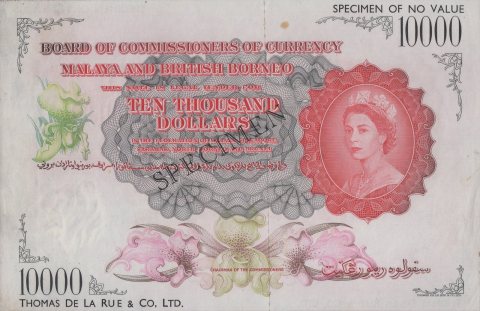
| 10,000 dollars | 1,325 | 13,250,000.00 | 1.70 |
| Total | 169,081,160¾ | 778,958,620.46 | 100.00 |
A fraction, the table says, marks a mutilated note for which full value was not given. The total agrees with the gross figure of Table 4 for the same day.
What the table shows and what it does not:
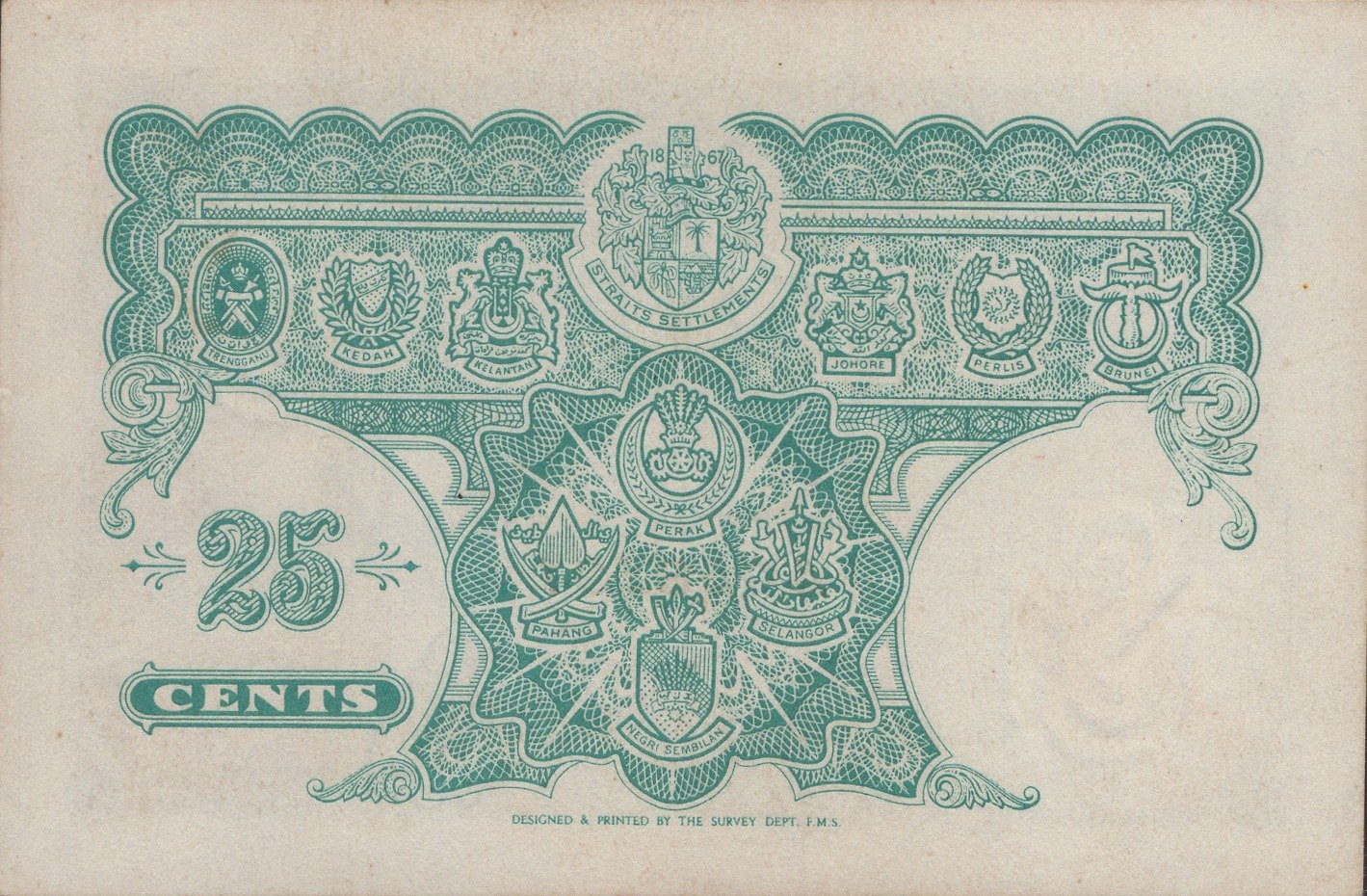
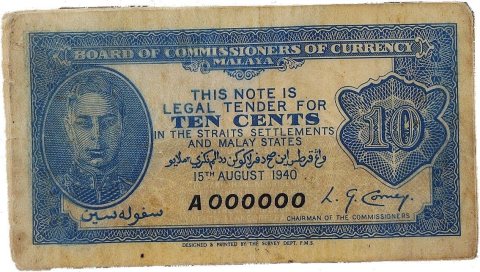
- The five cent values are those of the notes dated 1st July 1941, the only cent notes of the Board that the Pick pages give as current after the war: the 1 cent, 5 cents, 10 cents, 20 cents and 50 cents. The table counts them among the notes issued after the liberation; the Pick pages say the cent notes were issued in 1941, before the invasion. More than 21 million notes of 1 cent were still counted as in circulation at the end of 1954, although the Commissioners had issued no notes below 50 cents since the cupro-nickel coins came out in November 1948 (Singapore annual report for 1948, text only).
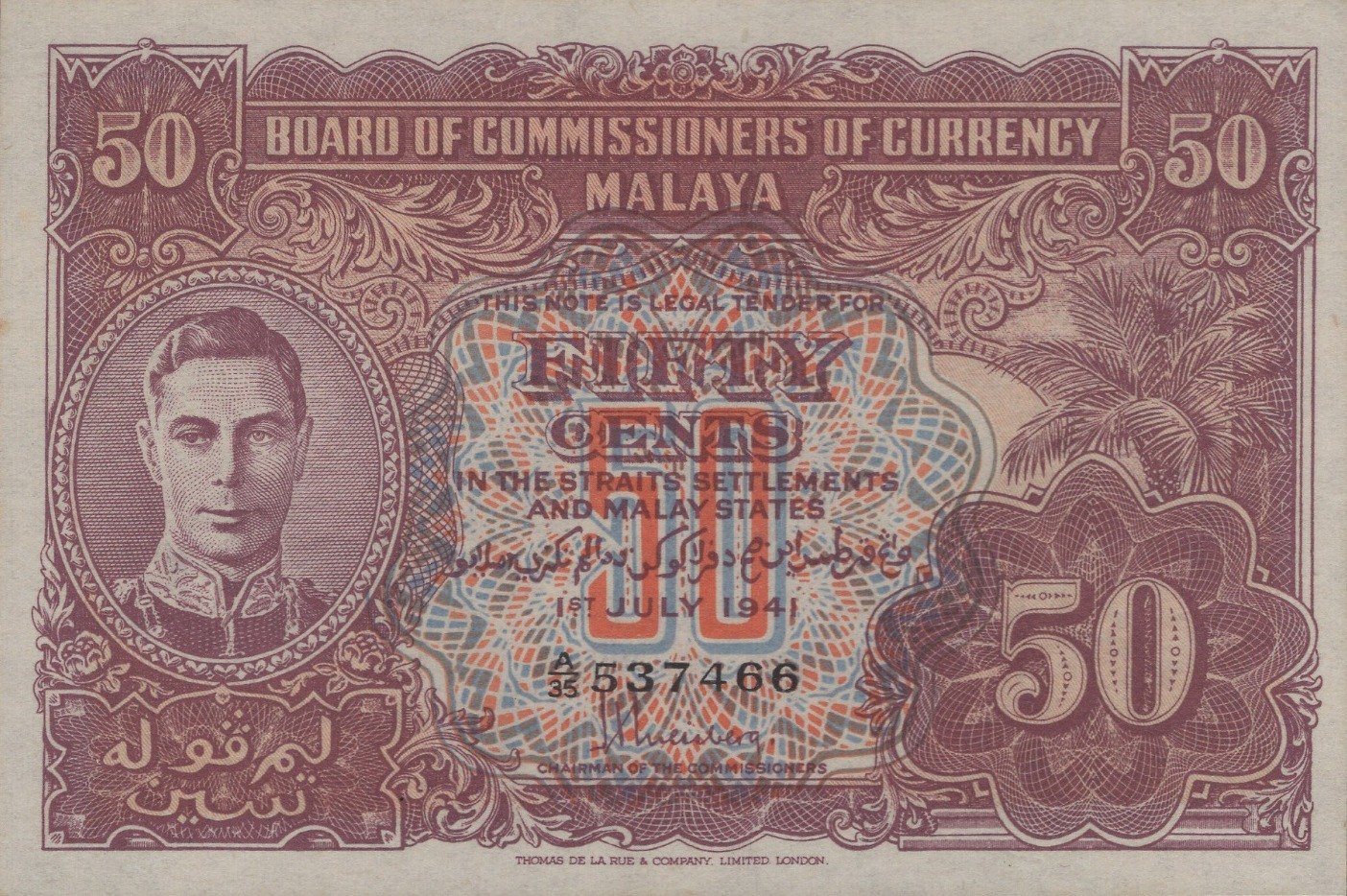
- There is no line for 25 cents. The only 25 cents of the Board, the 25 cents of 1st September 1940, was not put out again after the war.
- The dollar values mix two Boards. The Singapore annual report for 1954 (text only) lists the Queen's notes dated 21st March 1953 in circulation as legal tender during that year in the values of 1, 50 and 100 dollars only. The 1, 50 and 100 dollar lines of the table may therefore hold notes of both Boards; the table does not divide them.
- The 10 dollars carries 59.87 per cent of the value in the table, more than any other note.
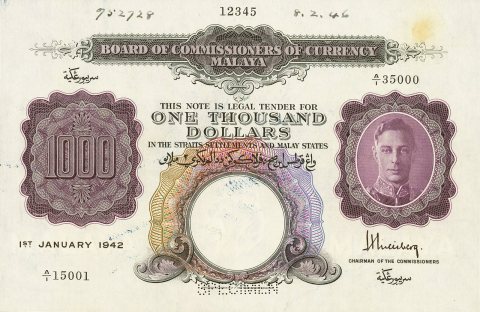
The 1,000 and 10,000 dollar lines are discussed in The 1,000 and 10,000 dollars of Malaya in the official figures, 1945 to 1959.
The notes destroyed in 1954
Table 20 of the same book (p. 154), "Notes Withdrawn from Circulation and Destroyed during 1954", divides the notes destroyed in that year between notes issued after the liberation and notes from before the occupation.
| Value | After the liberation: pieces | After the liberation: value, $ | Before the occupation: pieces | Before the occupation: value, $ |
|---|---|---|---|---|
| 1 cent | 35,266 | 352.66 | none | none |
| 5 cents | 1,579,921 | 78,996.05 | none | none |
| 10 cents | 7,873,375 | 787,337.50 | 3,539½ | 353.95 |
| 20 cents | 664,164 | 132,832.80 | none | none |
| 25 cents | none | none | 4,910 | 1,227.50 |
| 50 cents | 7,642,815½ | 3,821,407.75 | none | none |
| 1 dollar | 14,153,639½ | 14,153,639.50 | 9,524½ | 9,524.50 |
| 5 dollars | 4,936,771 | 24,683,855.00 | 2,384 | 11,920.00 |
| 10 dollars | 8,483,621½ | 84,836,215.00 | 5,551 | 55,510.00 |
| 50 dollars | 109,688 | 5,484,400.00 | 46 | 2,300.00 |
| 100 dollars | 30,537½ | 3,053,750.00 | 46 | 4,600.00 |
| 1,000 dollars | 12,938 | 12,938,000.00 | 1 | 1,000.00 |
| 10,000 dollars | 759 | 7,590,000.00 | none | none |
| Total | 45,523,496 | 157,560,786.26 | 26,002 | 86,435.95 |
Here a fraction marks a mutilated note for which only half value was allowed. The table is printed sideways in the book; the half on the 3,539½ notes of 10 cents was read from the value beside it. Where the table has dots, this article writes "none".
Three things come out of the table. The small notes of 1941 were still being taken in and destroyed in 1954: 7,873,375 notes of 10 cents and 7,642,815½ of 50 cents that year. Only 35,266 notes of 1 cent were destroyed, against the 21,223,036 that Table 19 counts as still out at the end of the year. And notes from before the occupation were still coming in: 26,002 pieces in 1954, among them 4,910 notes of 25 cents. Both the Board, with its 25 cents of 1940, and the Government of the Straits Settlements, with its 25 cents, issued a note of that value; the table does not say which issuer any old note came from.
What the figures do not give
- No count by value for any year before 1954, and none after it, has been found in the records. The Singapore reports for 1947 to 1959 give totals only.
- No source divides the dollar notes between the Board of Commissioners of Currency, Malaya, and the Board of Commissioners of Currency, Malaya and British Borneo.
- The record does not hold the book's definitions of gross, net and active, or its quarterly lines before 1950.
- Nothing read explains the fall of the gross circulation in June and July 1953, or the difference between the three figures for 1946.
- A scan of the Singapore, Brunei, Sarawak and North Borneo reports would settle any digit in doubt.
Sources
- Money in British East Asia (1957): p. 23 (3rd September 1945 and 1st April 1946, read on the page image); p. 25; pp. 31 to 36 (Sarawak notes, text only); p. 44 (the circulation at the end of 1947, text only); the passage quoting the Commissioners' report for 1950 (text only, page not recorded); Table 4, p. 140; Table 19, p. 153; Table 20, p. 154 (all three read on the page images).
- Annual Report on the Malayan Union for 1946, p. 21 (text only).
- Colony of Singapore annual reports for 1947 (pp. 47 and 48), 1948, 1949 (p. 48), 1950 (p. 51), 1951, 1952 (p. 76) and 1954 (all text only).
- North Borneo annual report for 1947, p. 16 of the file (read on the page image).
- State of Brunei annual reports for 1946 (pp. 50 and 51), 1953 and 1955 (text only).
- Sarawak annual report for 1953 (text only).
- "Currency and banking developments in certain Commonwealth countries", Bank of England Quarterly Bulletin, 1962 (read on the page image).
- The Pick pages of Malaya in this catalogue (P-3, P-6 to P-13).
Member comments
Log in or register to post a comment.