This article follows the notes of the Board of Commissioners of Currency, Malaya and British Borneo, from the law that set the Board up to the day its notes ceased to be legal tender. It is put together from the Pick pages of this catalogue, from the annual reports of the Federation of Malaya, Singapore, Sarawak, North Borneo and Brunei, from the book Money in British East Asia (1957), from the Bank of England Quarterly Bulletin of 1962, and from what the auction houses wrote about single notes. A house's statement is given as that house's statement. The notes of the earlier Board, which carry the name Malaya alone, are told in Malaya's notes after the invasion, 1942 to 1959.
The Board and its law
The Board was set up under the Currency Ordinance 1951 (Singapore No. 42 of 1951, assented to on 1st November 1951). The Ordinance carried out an agreement between the Federation of Malaya, Singapore, Sarawak, North Borneo and Brunei. The Federation of Malaya annual reports for 1953 to 1956 say that the Board took over on 1st January 1952, with the Financial Secretary of Singapore as its Chairman. The same reports say that the Federation's member was its Financial Secretary, and from the report for 1956 its Minister of Finance. They do not agree on the year of the agreement: three of the four reports say 1950, and one speaks of the 1951 Currency Agreement.
Money in British East Asia (1957) names the Board as it stood in December 1954: T. M. Hart, acting Financial Secretary, as Chairman, with A. N. Goode, E. M. Himsworth, F. C. Benham and G. A. P. Sutherland as members and J. M. H. Hill as Secretary. The Economic Survey of the Colonial Territories of 1955 gives the shares in which the Board's surplus was divided: Malaya 61.16 per cent, Singapore 27.28, Sarawak 4.89, North Borneo 4.42 and Brunei 2.25. The Singapore annual report for 1959 says that from 1959 the Chairman was the Minister for Finance of Singapore.
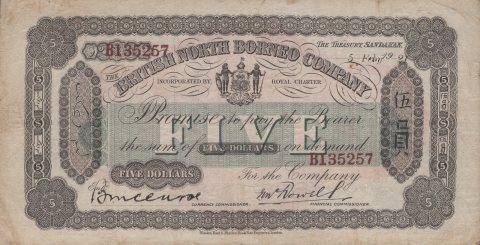
In the Borneo territories the Board's currency took the place of the older local notes. The Sarawak annual report for 1954 (p. 27) says that from 1st January 1953 only the notes and coins of the Board were legal tender in Sarawak. The North Borneo annual reports for 1953 to 1955 say that the notes of the British North Borneo Company ceased to be legal tender as from 1st September 1953, and could still be changed at face value for Malayan currency at banks and treasuries.
The Queen's notes dated 21st March 1953
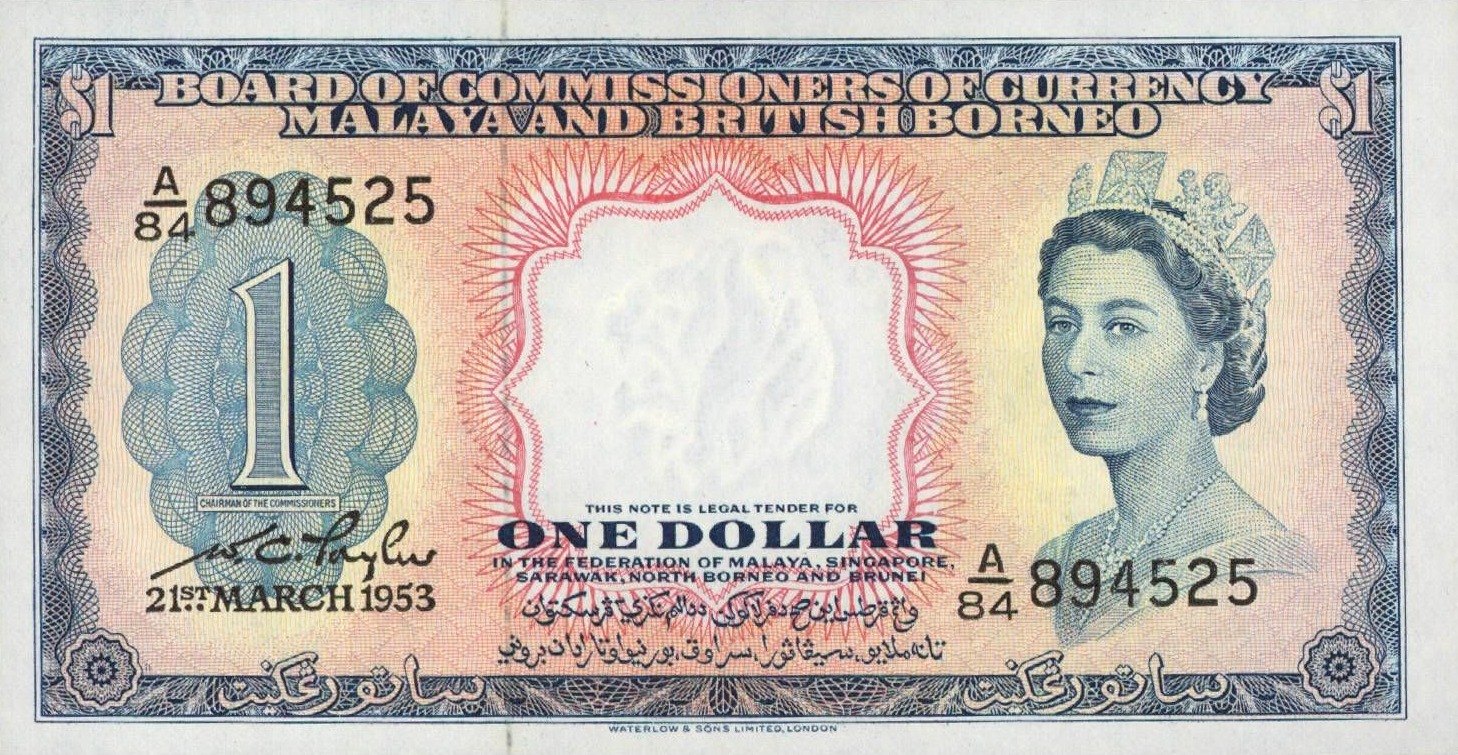
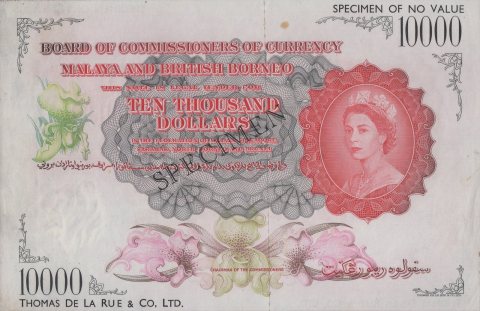
The first issue has seven values, all dated 21st March 1953 and all with the portrait of Queen Elizabeth II: the 1 dollar, the 5 dollars, the 10 dollars, the 50 dollars, the 100 dollars, the 1,000 dollars and the 10,000 dollars.
Three printers shared the work. The Pick pages give Waterlow and Sons for the 1, 5 and 10 dollars, Bradbury Wilkinson and Company for the 50 and 100 dollars, and Thomas de la Rue and Company for the 1,000 and 10,000 dollars. Sources mention that the portrait follows a 1952 photograph by Dorothy Wilding, in an engraving prepared by Waterlow and Sons.
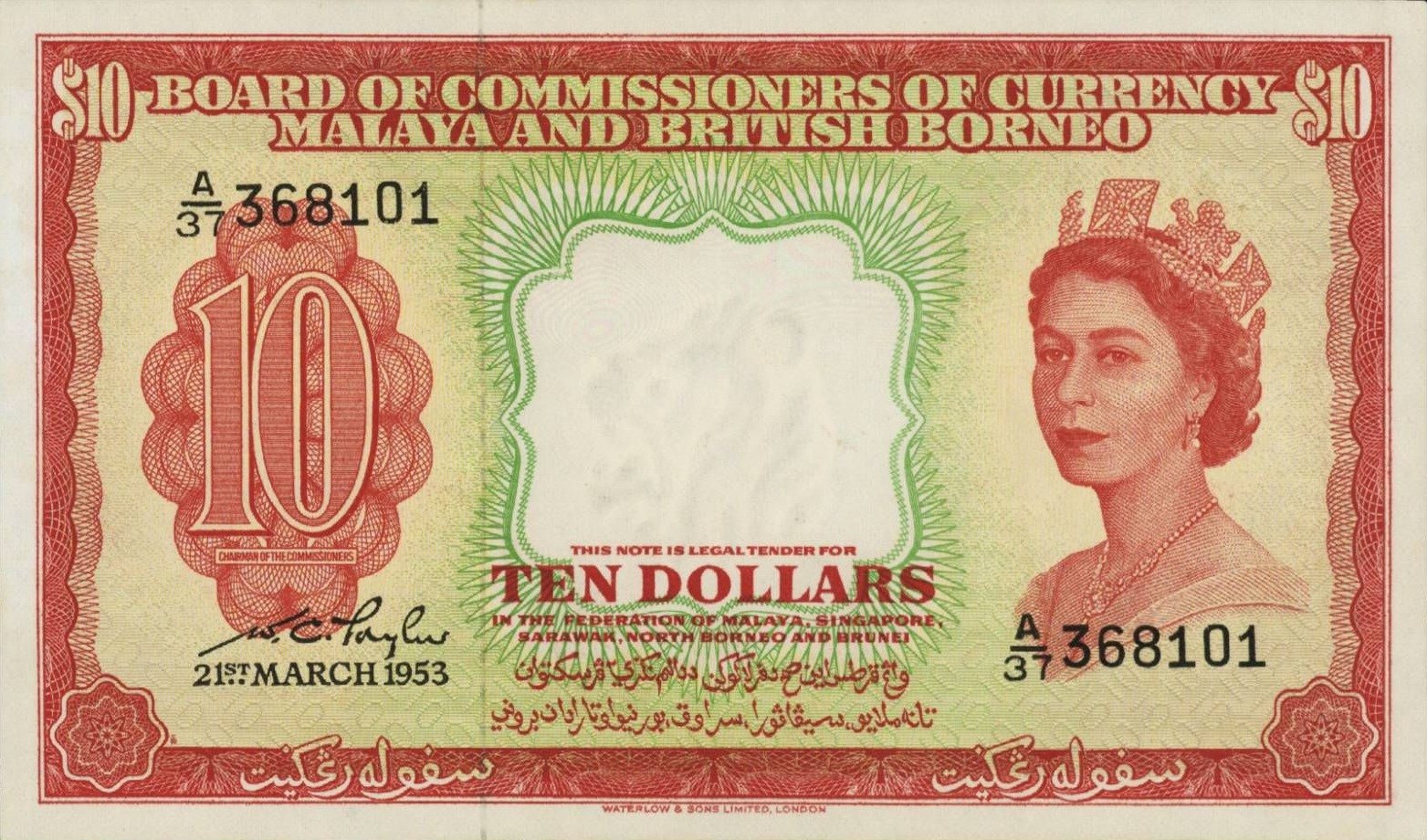
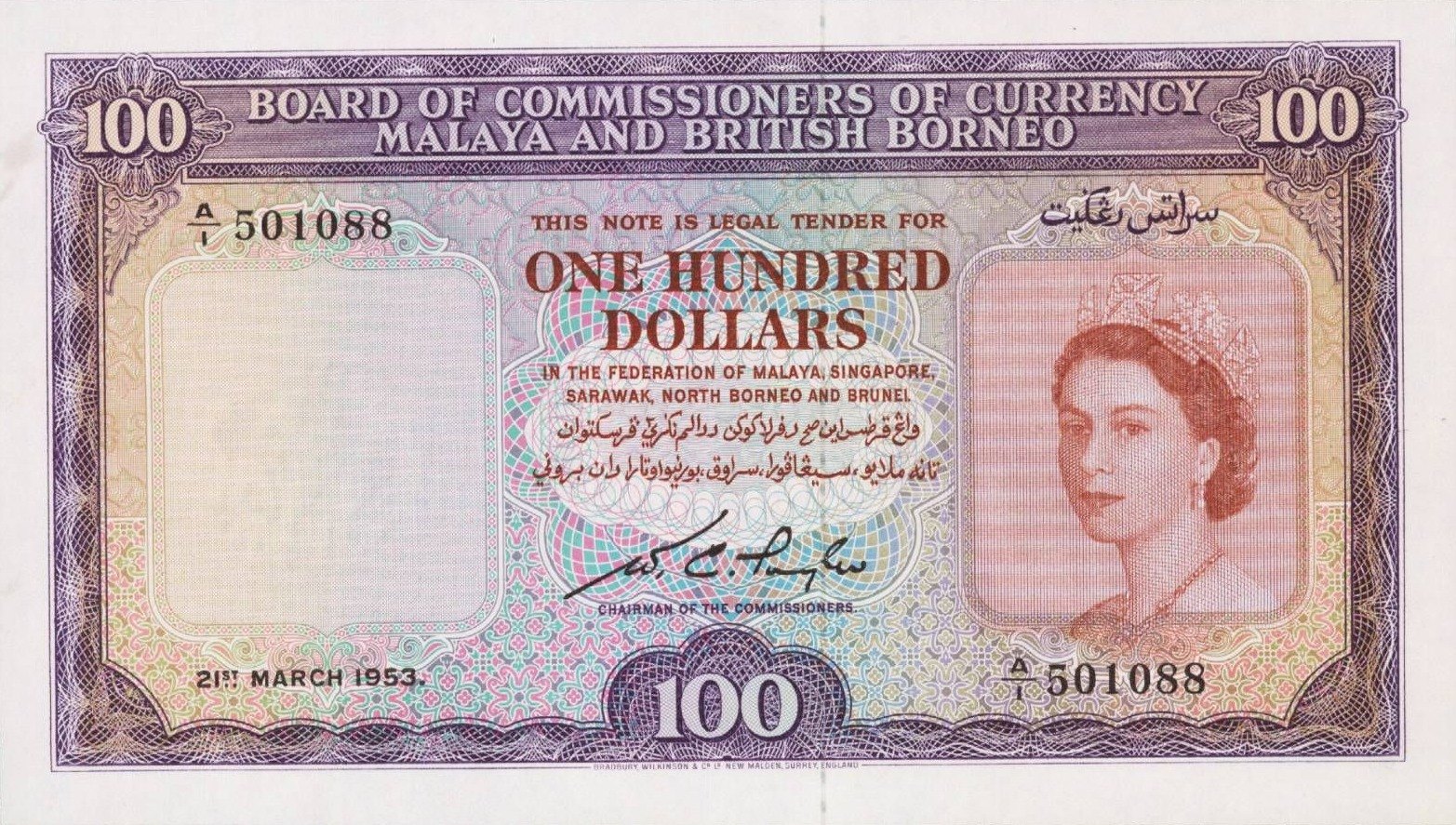
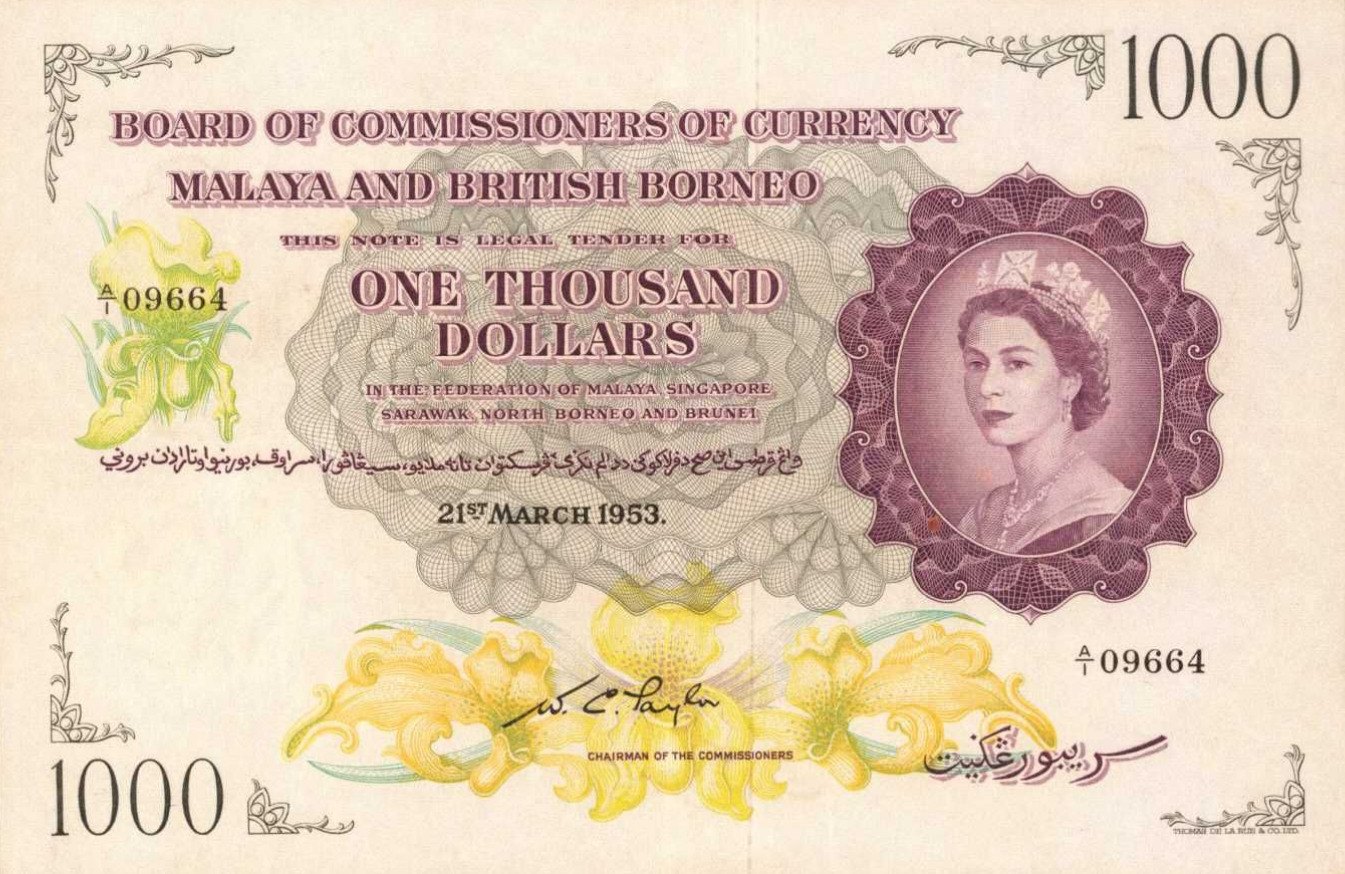
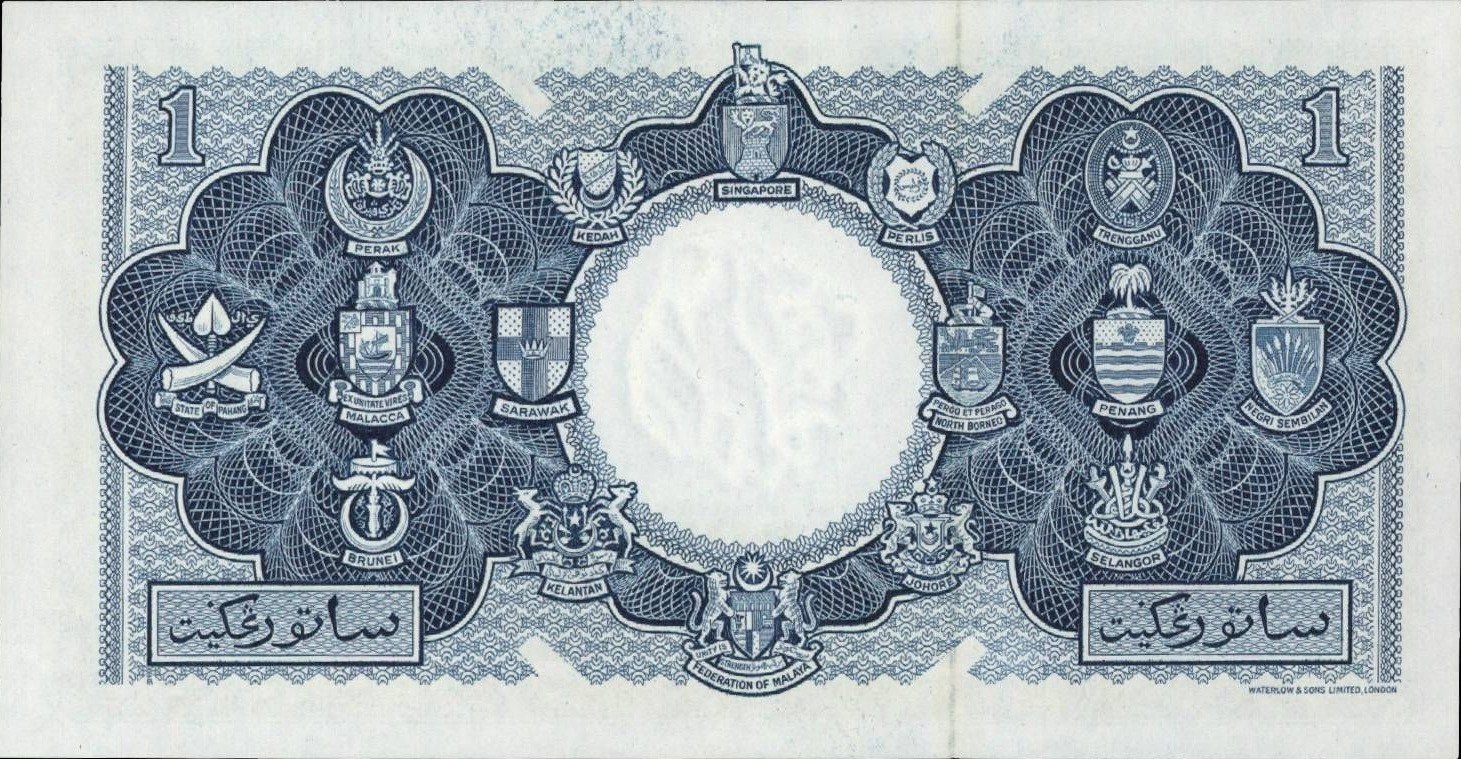
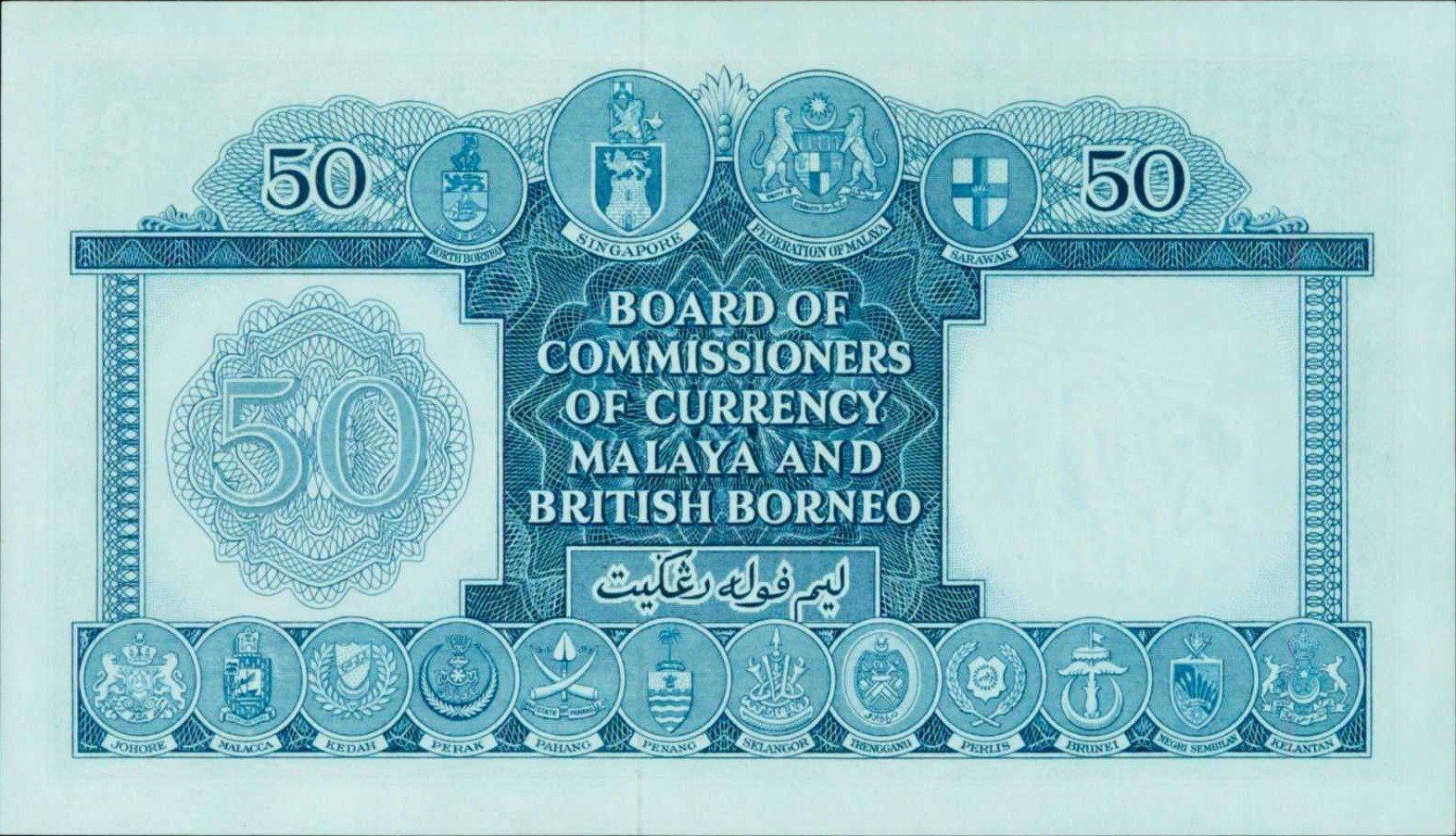
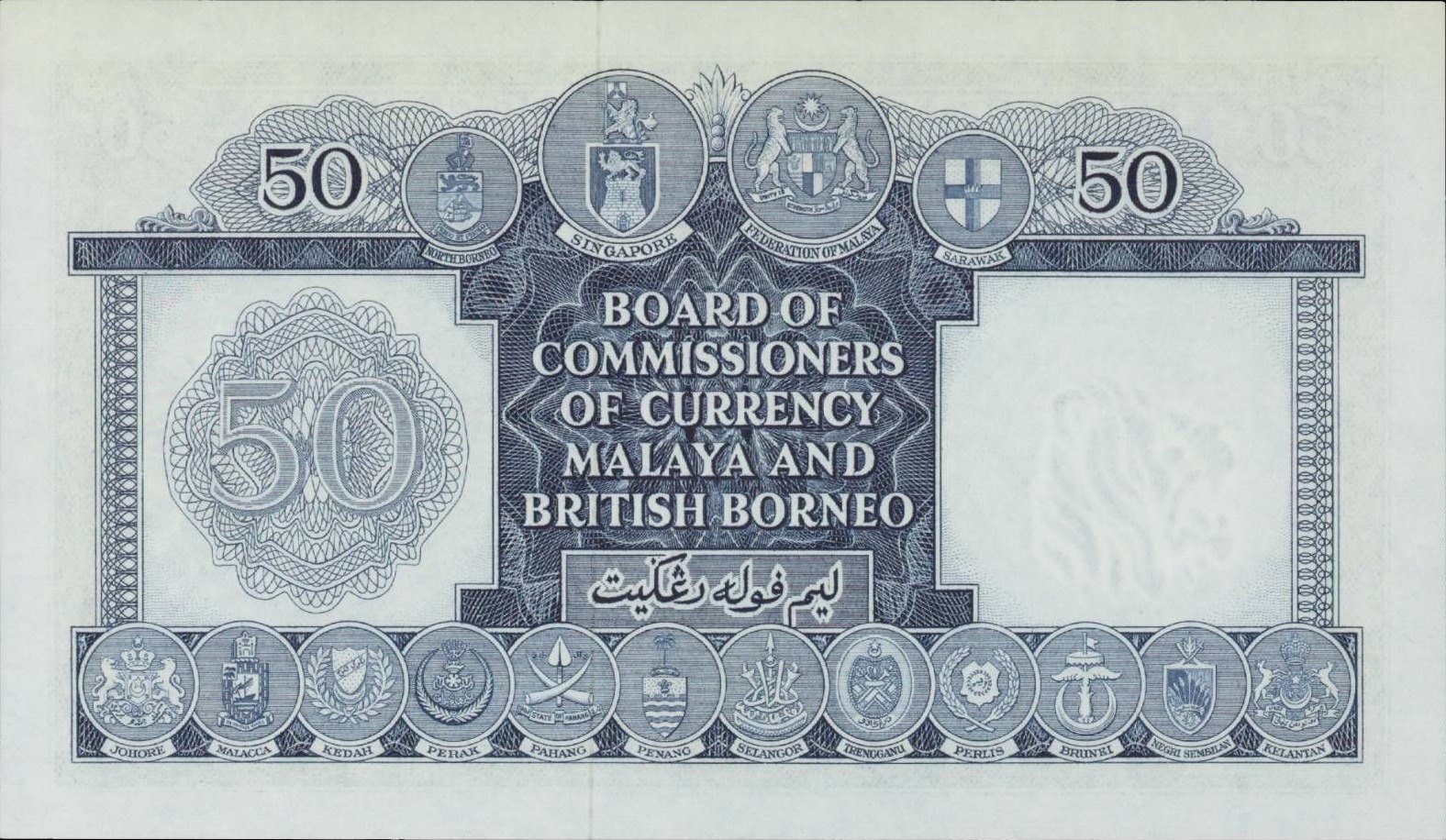
The houses describe the back. Spink's description of lot 330 in its sale of 8 October 2024 says each note shows the arms of Brunei, North Borneo, Sarawak and Singapore and of the eleven states of the Federation of Malaya: Johore, Kedah, Kelantan, Malacca, Negri Sembilan, Pahang, Penang, Perak, Perlis, Selangor and Trengganu. Stack's Bowers, in its sales of 19 August 2013 (lot 52607) and 4 April 2018 (lot 60107), speaks of the arms of the 16 states on the 10,000 dollars. The houses also name the watermark: a tiger's head on the 5 dollars (Stack's Bowers, 3 April 2017, lot 70509) and a lion's head on the 100 dollars (Stack's Bowers, 4 October 2022, lot 41214). The Pick pages do not describe the back or the watermark of this issue.
The 50 dollars has two issued varieties, told apart by the serial prefix and the colour of the back. P-4a, serial prefixes A/1 to A/9, has a blue-grey back. P-4b, from serial prefix A/10 on, has a blue back.
The pages do not name the signer of the notes of 1953. Noonans' description of lot 154 in its sale of 23 March 2024, two photographs of a design that was not used, speaks of a Taylor signature on that design.
When the notes of 1953 came out
No source read gives a first day of issue for any value. The Singapore annual reports list each year the notes that were in circulation as legal tender during the year, and the Queen's notes dated 21st March 1953 come into that list value by value:
| Singapore report for | Values of the Queen's notes listed |
|---|---|
| 1953 | none (only the notes of Malaya dated 1941) |
| 1954 | 1, 50 and 100 dollars |
| 1955 | 1, 10, 50 and 100 dollars |
| 1956 and 1957 | 1, 10, 50, 100 and 10,000 dollars |
| 1958 and 1959 | 1, 5, 10, 50, 100, 1,000 and 10,000 dollars |
Money in British East Asia (1957) says on p. 26, and again on p. 43, that the new notes were first issued in 1954. Spink's description of lot 330 in its sale of 8 October 2024 says the notes were released a few months before the coronation of 2nd June 1953. The Singapore report for 1953 and the book of 1957 do not bear that out.
The Federation of Malaya reports for 1953 to 1956 say nothing about the new notes, and nothing about the older notes being called in.
The two highest values
The Pick page of the 10,000 dollars says the note was intended for interbank transactions and was never publicly issued. The Singapore reports for 1956 to 1959 none the less list it among the notes in circulation as legal tender. Heritage Auctions (11 December 2021, lot 26472; 7 December 2025, lot 22417) says the 10,000 dollars was used only between banks to settle accounts, and that the 1,000 dollars was the highest value the public could obtain. Stack's Bowers (5 October 2023, lot 22144) says no issued 10,000 dollars is known.
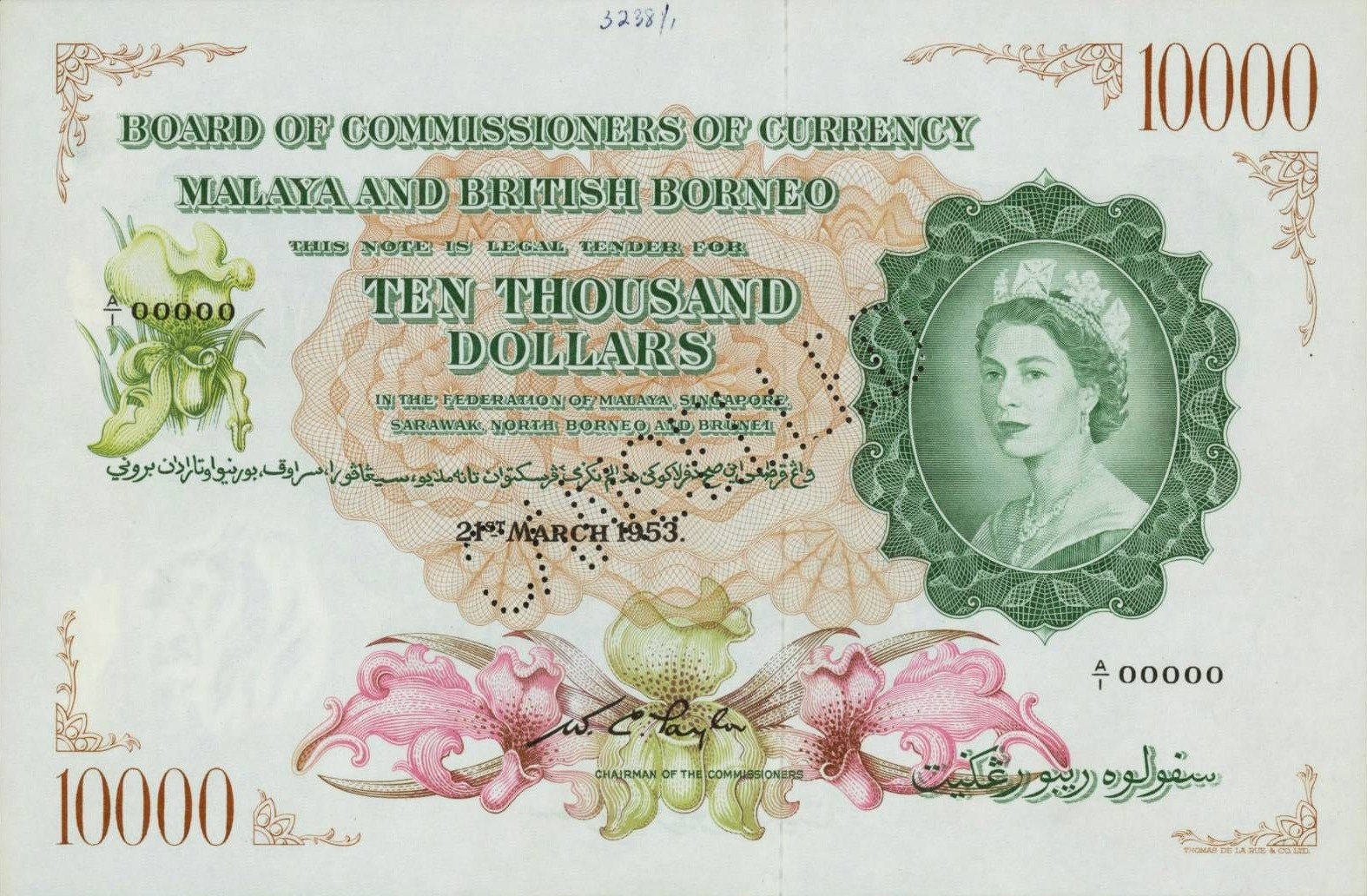
Of the 1,000 dollars, Heritage Auctions (8 December 2023, lot 22285) says that only notes with the prefix A/1 are known, and Stack's Bowers (5 October 2023, lot 22143) says the same of the issued notes. Heritage's description of lot 28299 in its sale of 6 December 2017 says that note had been in the Frank Goon Collection, which the house calls the basis of the book Banknotes of British Malaya. The house gives the earlier owners as Frank Goon and Dr Chan Chin Cheung, and calls the piece a plate note. Heritage (7 December 2025, lot 22417) gives the rate at which the dollar was tied to sterling as 2 shillings and 4 pence.
Notes in circulation, 1952 to 1966
The reports give totals only. None read gives the notes in circulation by value. The Pick pages give no number printed.
The Singapore annual reports give the notes in circulation at 31st December in all the territories that used the currency. The Federation of Malaya reports for 1953 to 1956 give the same figures in millions (740.9 million at the end of 1953, 942.8 million at the end of 1956).
| At 31st December | Notes in circulation, dollars |
|---|---|
| 1952 | 786,797,439 |
| 1953 | 740,923,669 |
| 1954 | 778,958,620 |
| 1955 | 915,420,660 |
| 1956 | 942,840,095 |
| 1957 | 943,100,508 |
| 1958 | 948,530,912 |
| 1959 | 1,077,726,238 |
The reports do not split these totals between the Queen's notes and the notes of the earlier Board, which the Singapore reports list as legal tender up to the report for 1959.
The State of Brunei annual reports give the Board's notes and coin in circulation in Brunei at the end of each year, as estimates: 43,313,193 dollars for 1954 and 39,490,000 for 1955, then about 52,500,000 (1956), 61,800,000 (1957), 68,957,000 (1958), 75,637,000 (1959), 83,340,000 (1960), 100,193,000 (1963), 107,852,600 (1964), 117,636,496 (1965) and 133,201,915.84 (1966). The reports for 1961 and 1962 give no figure. The Sarawak annual reports give the Malayan currency in circulation in Sarawak as 28,560,956 dollars at the end of 1953, 30,310,956 in 1954, 39,980,956 in 1955, 49,210,956 in 1956, 45,410,956 in 1957 and 44,930,956 in 1958.
The 1 dollar dated 1st March 1959
The 1 dollar dated 1st March 1959 shows a sailing boat and is signed by Henry Lee Hau Shik. It was printed by two firms to one design: by Waterlow and Sons, P-8, and by Thomas de la Rue, P-8A. The two Pick pages say how to tell them apart by the imprint at the foot of the front and by the prefix, and that is left on those pages.
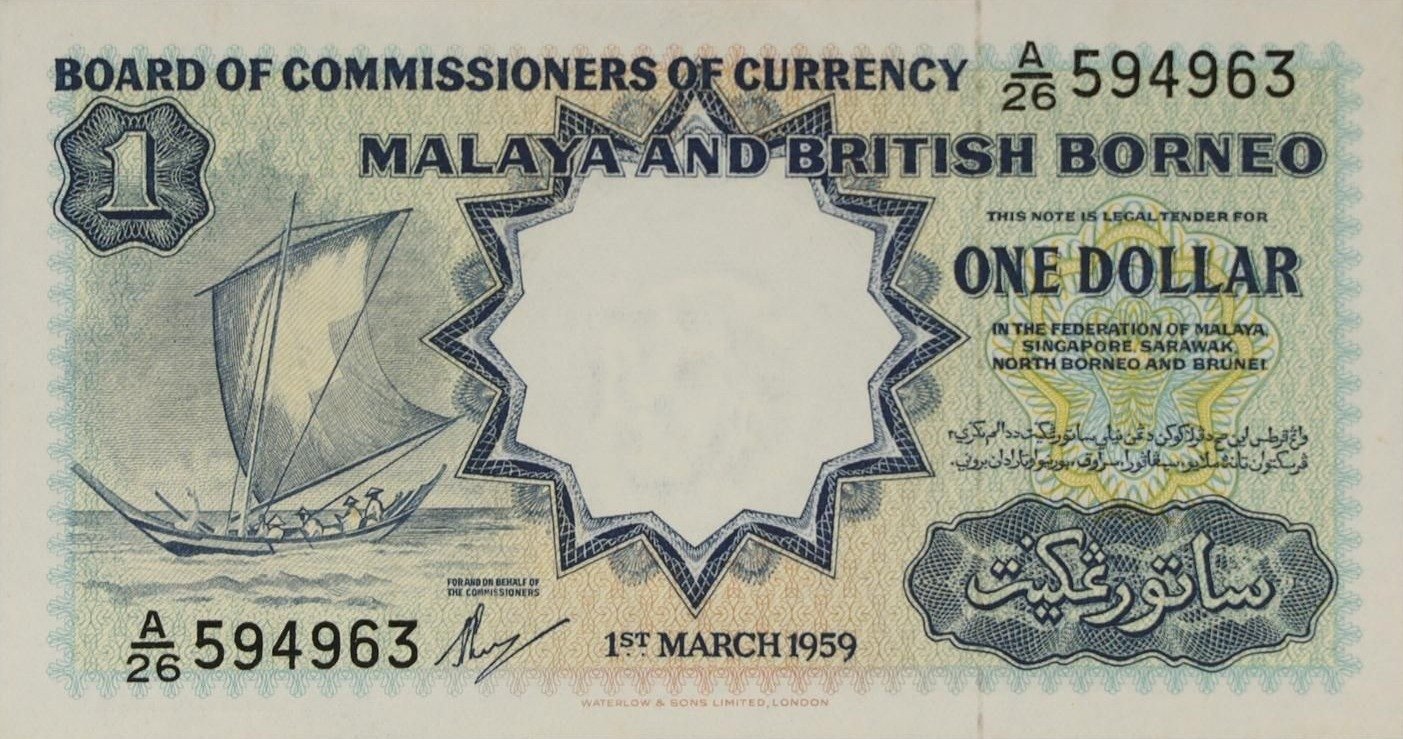
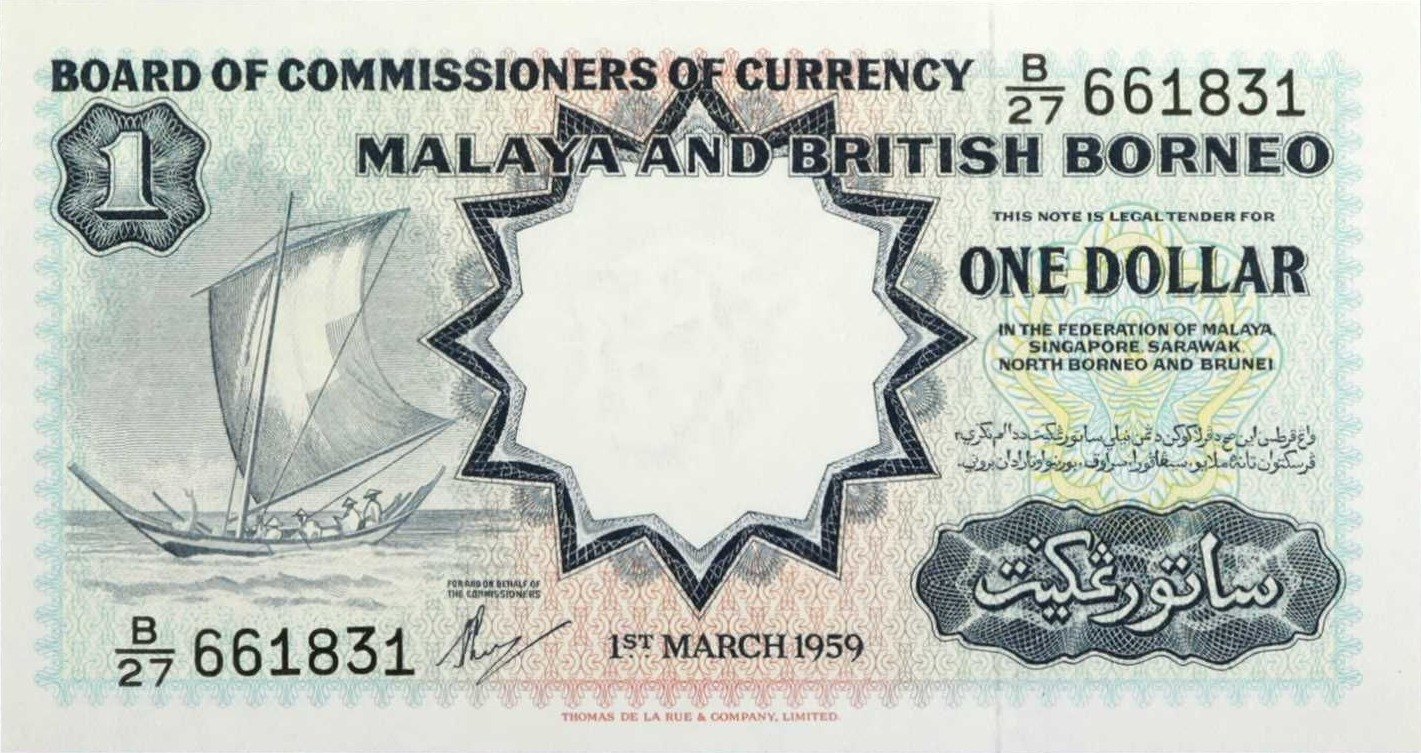
Spink's description of lot 1495 in its sale of 12 April 2016, a De La Rue specimen numbered A/71 000000, calls A/71 the prefix at which the work passed from Waterlow to De La Rue. The Pick pages are more exact: De La Rue printed most of the run A/71 to A/99, and Waterlow also printed A/71 and A/88. Spink's descriptions (12 April 2016, lot 1495; 28 April 2021, lot 237) add that the back shows five coats of arms at the top with fishermen and a fishing boat in the centre, and that the text is in English and in Jawi script.
The Singapore annual report for 1959 (p. 71) lists only the notes of 1941 and of 1953 as legal tender in circulation and does not name the 1 dollar of 1959. No report read gives its day of issue.
The 10 dollars dated 1st March 1961
The 10 dollars dated 1st March 1961 is the last issue of the Board before the split into the currencies of Malaysia, Singapore and Brunei. It was printed by Thomas de la Rue and is signed by Tan Siew Sin. The houses describe the scene on two printers' pieces for this value: Spink (19 January 2018, lot 882) names a peasant ploughing with a buffalo on the colour trial specimen dated 1st March 1959, and Noonans (25 March 2023, lot 150) a farmer and water buffalo on a die proof.
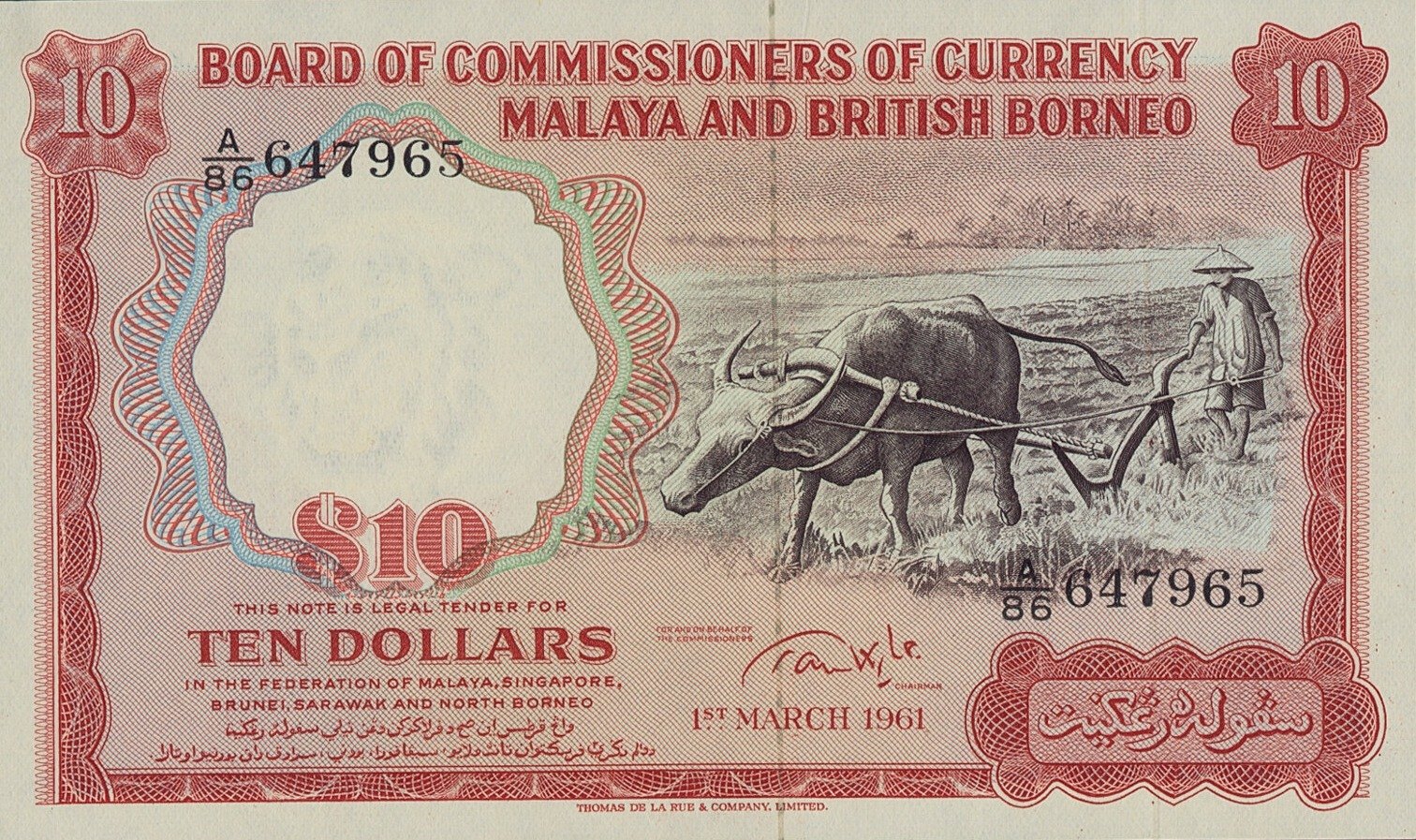
There are two issued printings, told apart by the height of the serial prefix: 4.5 mm on P-9a and 6.0 mm on P-9b. The prefix ranges of the two are on the Pick page. A colour trial specimen dated 1st March 1959, of a design that was not adopted, is told in Specimens, colour trial specimens, proofs and unadopted designs of Malaya and British Borneo, 1952 to 1961.
No report read gives the day of issue of the 10 dollars of 1961.
The Board after independence, and its end
After Malayan independence the Federation kept the Board's notes under a new agreement of 1960 between the five territories. The Central Bank of Malaya, founded in 1958, had not issued a note of its own by 1962 (Bank of England Quarterly Bulletin, 1962).
The State of Brunei annual report for 1967 (pp. 35 to 37) says that the Malaysian Government gave notice in December 1964 to end the Malaya, British Borneo Currency Agreement, 1960, and that as a result the Board ceased to issue currency to the banks and the public on Saturday, 10th June 1967. The Brunei Currency Board began to issue its own notes on 12th June 1967, and Brunei coins on 22nd August 1967. The same report says that the Board's currency stayed legal tender in Brunei beside the new notes, and that after the devaluation of sterling in November 1967 the old Malayan dollar was exchanged at 85.71 Brunei cents.
The Brunei annual report for 1969 (p. 36) says that the currency issued by the Board ceased to be legal tender in Brunei with effect from 16th January 1969. The reports for 1970 to 1972 repeat the sentence.
The Brunei reports give no dates for Malaysia or Singapore. Bank Negara Malaysia's own page on its past series says that the Board went on issuing currency until 12 June 1967, and that the old notes stayed in circulation beside the new Malaysian notes until 16 January 1969, when they were demonetised. The two sources do not give the same day for the end of issue: Saturday, 10th June 1967 in the Brunei report, 12 June 1967 on the Bank's page. The Monetary Authority of Singapore's page on the history of currency in Singapore says only that Singapore, Malaysia and Brunei began to issue their own currencies from 1967. Stack's Bowers (13 December 2024, lot 30343) says the notes ceased to be legal tender on 16th January 1969, without naming a territory.
What the sources leave out
- The first day of issue of every value of 1953, of the 1 dollar of 1959 and of the 10 dollars of 1961.
- The notes in circulation by value.
- The name of the signer of the notes of 1953, and the office under which Henry Lee Hau Shik and Tan Siew Sin signed: the Pick pages give neither.
- The day the Board's notes ceased to be legal tender in Singapore.
Sources
- The Pick pages of Malaya and British Borneo in this catalogue.
- Currency Ordinance 1951 (Singapore No. 42 of 1951), as cited on the Pick pages.
- Federation of Malaya annual reports for 1953 to 1956.
- Colony of Singapore annual reports for 1952 to 1959.
- Sarawak annual reports for 1953 to 1958.
- North Borneo annual reports for 1953 to 1955.
- State of Brunei annual reports for 1954 to 1967 and for 1969 to 1972.
- An Economic Survey of the Colonial Territories, 1955, volume V.
- Money in British East Asia (1957), pp. 26 and 43, and its list of the Board's members in December 1954.
- Bank of England Quarterly Bulletin, 1962.
- Bank Negara Malaysia, "Past series", bnm.gov.my.
- Monetary Authority of Singapore, "History of currency in Singapore", mas.gov.sg.
- Spink: 12 April 2016, lot 1495; 19 January 2018, lot 882; 28 April 2021, lot 237; 8 October 2024, lot 330.
- Stack's Bowers: 19 August 2013, lot 52607; 3 April 2017, lot 70509; 4 April 2018, lot 60107; 4 October 2022, lot 41214; 5 October 2023, lots 22143 and 22144; 13 December 2024, lot 30343.
- Heritage Auctions: 6 December 2017, lot 28299; 11 December 2021, lot 26472; 8 December 2023, lot 22285; 7 December 2025, lot 22417.
- Noonans: 25 March 2023, lot 150; 23 March 2024, lot 154.
Member comments
Log in or register to post a comment.