The catalogue's pages for Malta are the notes of the Government and of the Central Bank. This article is about the other paper money that passed on the island: the notes of the Banco di Malta, the Anglo-Maltese Bank and the Anglo-Egyptian Banking Company; the British Treasury notes of 1915 and the Bank of England notes that followed them; and the British Armed Forces vouchers of 1956. It rests on Robert Chalmers's A History of Currency in the British Colonies (1893), John E. Sandrock's paper "Bank Notes of the Government of Malta" (2011), the Malta Government Gazette as read in the Digital Archive on Currency Boards at Johns Hopkins University, the IBNS Journal, Bank Note Reporter and the old sale catalogues. None of these notes has a page in this catalogue. Chalmers and Sandrock were read on the printed page. The IBNS Journal and Bank Note Reporter passages, the old sale catalogues and An Economic Survey of the Colonial Territories, 1951 were read in the text layer of their scans only, and their figures are given as that text reads. The Government's own notes are told in The notes of the Government of Malta and the Central Bank of Malta, 1914 to 1969.
Two Maltese banks, 1809 to 1891
Sandrock writes that the first bank on the island, the Anglo-Maltese Bank, opened in 1809 and was soon followed by the Banco di Malta. Chalmers, on page 324, writes in 1893 of three banks in Malta, two of them established in 1809 and 1810. In Sandrock's account the two banks kept their capital in scudi, for Maltese and Italian traders, and issued notes in scudi. The notes had no standing with the Government and were privately financed.
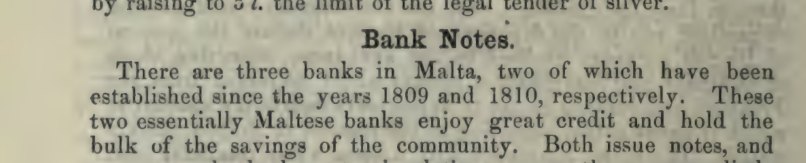
Sandrock gives the turn to sterling twice, in two ways. The text says that a proclamation of 1825 made British silver legal tender, that Government accounts were kept in scudi until that year, and that the two banks did not convert to sterling until 1851, when they dropped the scudi notes and issued notes in lire sterline. A caption on page 3 says instead that in 1825 the British government decreed that all future issues of the commercial banks would be in lire sterling. Sandrock adds that between 1873 and 1875 the notes were overprinted "Payable in Sicilian Dollars", because so much Sicilian coin was then circulating. Sandrock also writes that a separate currency for Malta was first proposed in 1824 and given up when the Treasury decided to supply its colonies with British silver.
Sandrock's Table 1 (page 5) and the captions give these issues. The table is copied as it stands; the last column gives what the captions add, and the one place where a caption differs from the table.
| Bank | Notes | Years in the table | Values in the table | What the captions add |
|---|---|---|---|---|
| Banco di Malta | scudi | 1812 to ? | 10, 20, 25, 50, 100 and 500 scudi | first issue engraved in black on white paper; the main vignette St Paul's escutcheon, a snake round a sword in palm and olive branches |
| Banco di Malta | scudi | 1851 to 1891 | 5, 10, 20, 30, 40, 50, 100, 200, 250 scudi | |
| Banco di Malta | lire sterline | 1851 to 1891 | £5, £10, £20, £50, £100 | St Paul at upper left; black on white, dated at Valletta, Italian text; watermark "Banco di Malta" and the value in words |
| Banco Anglo Maltese | scudi | 18-- | 10, 20, 30, 40, 50, 100, 150, 200, 250, 300, 400, 500 and 1000 scudi | |
| Banco Anglo Maltese | lire sterline | 1888 to 1891 | £1, £5, £10, £20, £30, £50 | the caption gives 1, 5, 10, 20, 30 and 100 lire sterline, St George and the dragon at upper left |
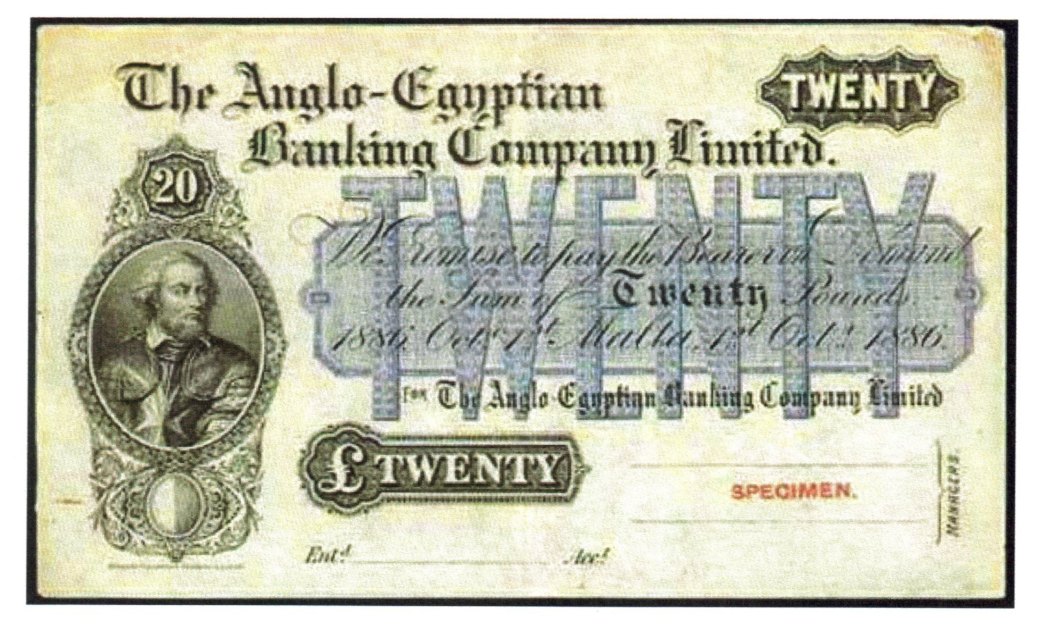
| Anglo-Egyptian Banking Company | Maltese pounds | 1886 to 1891 | 10 shillings, £1, £5, £10, £20 | printed by Bradbury Wilkinson; a likeness of Grandmaster La Vallette, as Sandrock spells it, with the arms of Malta |
The table's years for the Anglo Maltese sterling notes, 1888 to 1891, do not agree with Sandrock's own text, which has both banks in sterling from 1851.
The Anglo-Egyptian Banking Company, 1886
Richard Kelly, in "Blue Books and Bank Histories" (IBNS Journal, volume 16, number 4, 1978, pages 224 and 225), found the Malta issue in The DCO Story, a history of Barclays Bank (Dominion, Colonial and Overseas). In Kelly's report the Malta branch asked the board's approval for a note issue in April 1886, and 3,700 notes with a face value of £8,500 were printed by Bradbury Wilkinson, in £20, £10, £5, £1 and 10 shillings, all dated 1 October 1886. Kelly writes that the bank was reconstructed the next year and took back its first name, the Anglo-Egyptian Bank, and that in 1926 it joined two other banks to form Barclays DCO.
The other sources give the bank's dates differently. Sandrock writes that the bank was formed in London in 1886. Ahmed Elseroui, in "The Establishment and Objectives of Banks in Egypt from 1850 to 1950, Part I" (IBNS Journal, volume 34, number 4, 1995, page 32), has the Anglo-Egyptian Bank Limited created in London in 1864, renamed the Anglo-Egyptian Banking Company Limited in 1867, back to its first name in 1887, and amalgamated with others in 1925. William Barrett, in Bank Note Reporter of October 2007 (page 70), also gives 1925 for the merger into Barclays DCO.
Barrett's column described lot 954 in Spink's London sale of 8 October 2007: a specimen set of the 10 shillings, £1, £5 and £10, Bradbury Wilkinson master specimens whose numbers show the lowest and highest notes printed. On Barrett's reading, 1,000 of the 10 shillings were printed and only 200 of the £10. Barrett writes that the set was first offered at Christie's sale of Bradbury Wilkinson material in October 1985, and that to the author's knowledge the bank is represented by two specimen sets, this one and a second without the master numbers, and one issued and cancelled set kept in the bank's archives. These counts are Barrett's, and the passage was read in the text layer of the scan only. No £20 is named in the set.
Chalmers wrote in 1893 that the note issue of the Malta branch of the Anglo-Egyptian Bank, which used to average about £8,000, had been discontinued.
What Chalmers found in 1892
Chalmers's table on page 324 counts the money of Malta and Gozo about 1892. The figures were read on the page image.
| Item | £ | Sub-total, £ |
|---|---|---|
| English gold | 305,000 | |
| English silver | 120,000 | |
| English bronze | 5,000 | 430,000 |
| Foreign gold (Napoleons) | 50,000 | |
| Foreign silver (five franc pieces) | 10,000 | 60,000 |
| Coin total | 490,000 | |
| Bank notes, local | 26,000 | |
| Bank notes, English and foreign | 5,000 | 31,600 |
| Total | 521,000 |
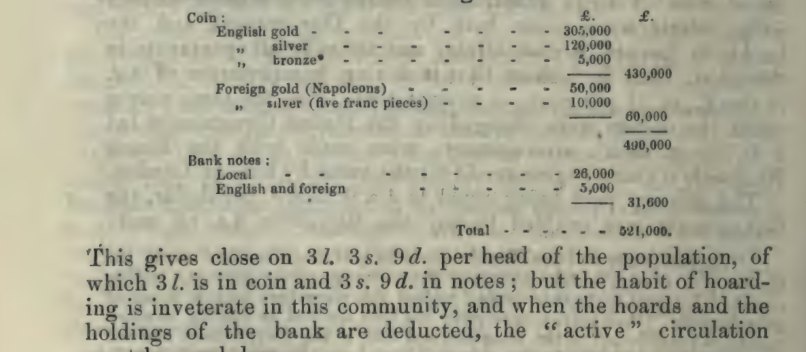
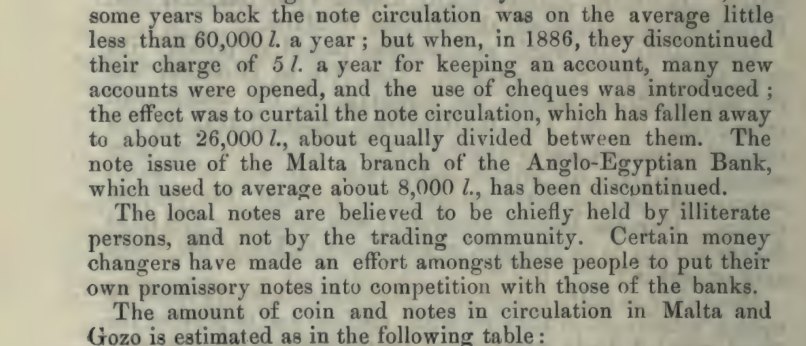
The sub-total is printed as 31,600. The two lines above it and the grand total of 521,000 fit 31,000, so the printed figure looks like a slip in the book. Chalmers writes that the note circulation of the two banks had once averaged a little less than £60,000 a year and had fallen to about £26,000, about equally divided between them. Chalmers ties the fall to 1886, when the banks discontinued their charge of £5 a year for keeping an account. Chalmers also notes that certain money changers had tried to put their own promissory notes into competition with those of the banks.
The end of the bank notes: an open question
Sandrock writes that a British ordinance of 1891 withdrew the banks' right to issue notes, that the Anglo-Egyptian notes were withdrawn in 1891, that the notes of all three banks nevertheless stayed in circulation for many years, and that the National Bank of Malta, until its dissolution in 1974, kept a provision on its books for redeeming them. Chalmers, writing in 1893, still speaks of the two Maltese banks as issuing notes. Sandrock gives no number or date for the ordinance, and none of the records read here names it. The annual reports on Malta for 1909-10 (No. 642) and 1911-12 (No. 731) have no chapter on currency or banks and say nothing of paper money; they name only the Government Savings Bank. What the ordinance was, and when the last bank note left circulation, are not settled by any source read here.
The banks' notes in the sale rooms
The old sale catalogues show the remainders of both Maltese banks.
- NASCA's sale of the Stanley Gibbons Collection, Part II, 7 December 1981: lot 1491 was a Banco di Malta £10, £20 and £100, described as uncirculated remainders with binding holes at left, watermarked with the value and the bank's name in a scalloped border. Lots 1492 and 1493 were each three more of the same. The house thought them early notes in Italian, probably of 1810 to 1840. Lot 1494 was a Banco Anglo-Maltese £50 on paper watermarked with a Grecian wave pattern round the edges, also a remainder. Bank Note Reporter of December 1981 named both groups in its preview of the sale.
- NASCA's sale of the Stanley Gibbons Collection, Part III, 22 March 1982: lot 3429 was a Banco di Malta set of seven remainders with binding holes, of £5, £10, £20, £50 and £100. The text layer of the scan is poor here; it says that one piece is on paper watermarked for a £500 note.
- Herbert I. Melnick's sale of the Stanley Gibbons Collection, Part V, 20 December 1982: lot 2829, a Banco di Malta £10, £20 and £100, with the same description as lot 1491 of 1981. Whether they were the same three notes the catalogue does not say.
- R. M. Smythe, 2 December 2003, lot 2002: a Banco Anglo Maltese £50 of the 1880s, a remainder with the date left as 18--, which the house called identical to the picture in the Pick catalogue (P-S116).
- Coincraft's advertisements in the IBNS Journal showed a Banco Anglo Maltese 50 lire sterline in volume 60, numbers 2 and 3 (2021), an unissued 50 lire sterline with the date line blank in volume 61, number 4 (2022), and an unissued Banco di Malta 100 lire in volume 64, number 1 (2025).
The NASCA catalogue's dating of the sterling remainders to 1810 to 1840 does not sit with Sandrock, who has the Banco di Malta's sterling notes from 1851. The pages read here do not settle which is right. Every piece named is a remainder or an unissued note.
Joseph C. Sammut's article on the bank and currency notes of Malta, printed in the Bank of Valletta's Annual Report and Financial Statements for 1987, ran to 38 pages and pictured forty notes in colour, as Bank Note Reporter of April 1988 (page 28) reported. Sandrock lists the 1987 report in the bibliography. The article itself has not been read for this catalogue.
British Treasury notes, 1915
Ordinance No. V of 1915, passed on 9th June and assented to on 10th June 1915, let the Governor make the British Treasury notes of 1 pound and 10 shillings legal tender in Malta, and Proclamation No. X of 16th June 1915 did so for any amount from 17th June 1915.
A letter from the Public Record Office, London, printed in the IBNS Journal (volume 10, number 4, 1971, page 202), cites the Treasury file T 1/11863: 1 pound and 10 shillings notes were issued for the military and naval expeditionary forces in the Mediterranean in May and June 1915, and supplies were sent to Malta and Alexandria. In the letter's words the notes sent to Malta "do not seem to have been overprinted".
Bank of England notes, 1932 to 1949
An Economic Survey of the Colonial Empire (1932), Colonial No. 95 of 1934 (page 236), says that Malta had no local issue of currency notes and that about £650,000 of Bank of England notes was in circulation at the end of 1932. An Economic Survey of the Colonial Territories, 1951 (volume VI, page 27) says that the Government notes of the war were legal tender beside Bank of England notes and United Kingdom coin.
Proclamation No. III of 7th January 1929 was revoked by Proclamation No. IV of 12th April 1949 under the Currency Notes Ordinance of 1949, first from 21st July 1949 and then, by Proclamation No. VI of 12th July 1949, from September. The pages read in the Gazette do not say what the proclamation of 1929 did. The Economic Survey of 1951 has the 1 pound and 10 shillings Bank of England notes cease to be legal tender in Malta after 20th September 1949; the Treasurer's report in the Gazette Supplement of 1951 has them cease from 21st September 1949.
The forces' vouchers, 1956
Fred Schwan, in Bank Note Reporter of August 1984, printed passages from the War Office volume Pay Duties, volume 4 (1952 to 1959), on the British Armed Forces Special Vouchers of the 3rd series issued for the Suez operation of 1956. Paragraph 55, "Troops embarking from Malta, Cyprus", says that the Command Paymasters at these stations had been given a supply of the vouchers and that local currency was exchanged before the troops sailed. In Bank Note Reporter of May 1991 Schwan wrote that the Ministry of Defence's stock of old vouchers had come back not only from Germany and Japan but also from Malta and Singapore, which in Schwan's words seems to confirm that they were used there. Neither column says how many vouchers passed through Malta.
Sources
- Robert Chalmers, A History of Currency in the British Colonies, 1893, page 324.
- John E. Sandrock, "Bank Notes of the Government of Malta", The Currency Collector website, 2011, pages 2 to 5 with Table 1 (page 5), and the bibliography (page 20); read on the pages of the PDF.
- Richard Kelly, "Blue Books and Bank Histories", IBNS Journal, volume 16, number 4, 1978, pages 224 to 225, reporting The DCO Story.
- Ahmed Elseroui, "The Establishment and Objectives of Banks in Egypt from 1850 to 1950, Part I", IBNS Journal, volume 34, number 4, 1995, page 32.
- William Barrett, "Spink plans 1,336-lot auction in London Oct. 8", Bank Note Reporter, October 2007, pages 69 to 70.
- Letter from the Public Record Office, IBNS Journal, volume 10, number 4, 1971, page 202.
- Coincraft advertisements, IBNS Journal, volume 60, numbers 2 and 3 (2021), volume 61, number 4 (2022), volume 64, number 1 (2025).
- Bank Note Reporter, December 1981 (preview of the NASCA sale) and April 1988, page 28 (Joseph C. Sammut's article in the Bank of Valletta's annual report for 1987).
- Fred Schwan, Bank Note Reporter, August 1984 and May 1991.
- Malta Government Gazette, 1915 and 1949, and the Treasurer's report of 1951: Ordinance No. V of 1915; Proclamation No. X of 16th June 1915; Proclamations No. IV and No. VI of 1949. Read in the Digital Archive on Currency Boards, Johns Hopkins University.
- An Economic Survey of the Colonial Empire (1932), Colonial No. 95, 1934, page 236; An Economic Survey of the Colonial Territories, 1951, volume VI, page 27.
- Colonial Reports, annual, Malta, Nos. 642 (1909-10) and 731 (1911-12).
- NASCA, 7 December 1981, lots 1491 to 1494, and 22 March 1982, lot 3429; Herbert I. Melnick, 20 December 1982, lot 2829; R. M. Smythe, 2 December 2003, lot 2002; Spink, 8 October 2007, lot 954.


Member comments
Log in or register to post a comment.