This article sets out the notes of Malta from 1914 to 1969 as one story: who issued them, under which law, when each issue came out and who signed. It draws on the Malta Government Gazette, the Central Bank of Malta's annual report for 1968, John E. Sandrock's paper "Bank Notes of the Government of Malta" and the Pick pages of this catalogue. The wartime notes have an article of their own, Malta's wartime notes, 1938 to 1946.
Before the Government notes
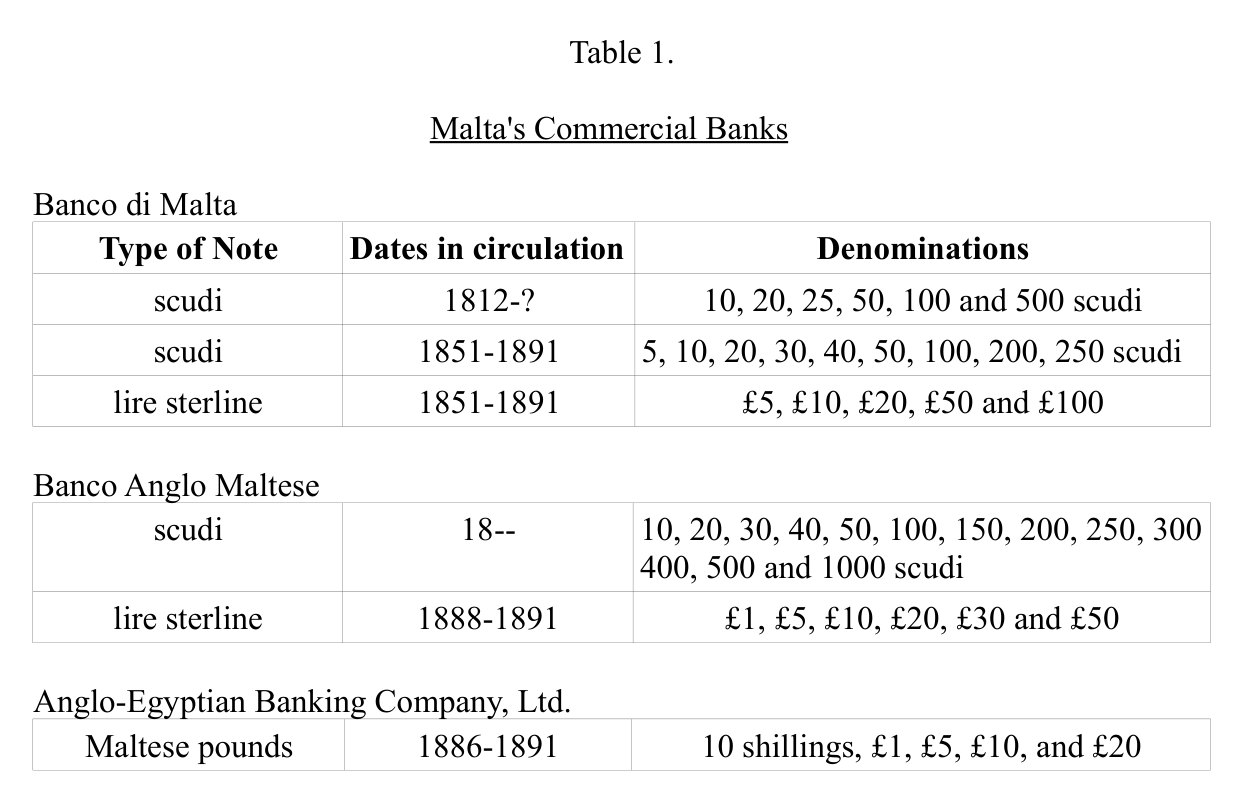
Sandrock describes three private banks that issued notes in Malta. The Anglo-Maltese Bank opened in 1809 and the Banco di Malta followed. Both issued notes in scudi and turned to sterling in 1851. The Anglo-Egyptian Banking Company issued notes dated 1 October 1886: Sandrock gives an order of 3,700 notes worth £8,500 from Bradbury Wilkinson, and Richard Kelly, reporting the bank history "The DCO Story" in the IBNS Journal (volume 16, number 4, page 224), gives the values as 10 shillings, 1, 5, 10 and 20 pounds. Sandrock writes that an ordinance of 1891 ended the banks' right to issue. Robert Chalmers, in A History of Currency in the British Colonies (1893, page 324), put the notes of the two Maltese banks at about £26,000 in 1892. This catalogue has no pages for the private banks.
The emergency notes of 1914
The first Government notes were printed on the island in August 1914 under Ordinance No. VIII of 1914, passed on 12th August 1914 after a run on the banks. There were seven series in five values, from 5 shillings to 10 pounds. The Treasurer's report for 1914 to 1915, signed Tom. Vella, says that never more than 100,000 pounds was out at one time, that 39,000 pounds was in circulation on 31st March 1915 and that 1,533 pounds was outstanding at the date of the report. The 1 pound ceased to be legal tender on 7th May 1915 and the other values on 30th September 1915. From 17th June 1915 British Treasury notes of 1 pound and 10 shillings were legal tender in Malta, under Ordinance No. V of 1915 and Proclamation No. X of 16th June 1915.
The series and their dates are set out in What the currency boards published: Gazettes, laws and reports, 1847-1969.
The 2 and 5 shillings of 1918
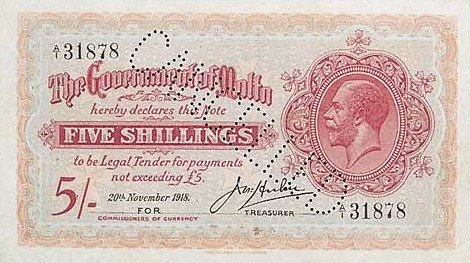
Sandrock writes that in September 1918, with silver coin being hoarded, the Treasury in London agreed to send Malta a supply of small notes: £10,000 in 2 shillings and £20,000 in 5 shillings, printed by De La Rue, to be put out through the banks, the post office and the dockyards. The Pick pages give these as 100,000 and 80,000 notes. The shortage passed and the notes were not released. Both values are dated 20th November 1918.
The 2 shillings stayed in store on the island and almost the entire stock was overprinted ONE SHILLING in 1942. The 5 shillings was never used. Three statements about its signature do not agree, and none is settled here. The Pick page says its specimens carry the printed signature of Joseph Huber, Treasurer of Malta from 16 August 1916 according to the Malta Blue Books of 1918-19 and 1919-20. Spink's description of lot 84 in its sale of 2 October 2019 reads the signature on a note perforated CANCELLED as Pace and says that the Treasurer's title and signature were added. Sandrock says the surviving notes of 1918 have no signature.
The Central Bank of Malta's annual report for 1968 (page 4) says that the first Maltese notes were issued shortly after the end of the First World War and were soon replaced by British currency. The other sources do not bear that out: the Gazette shows the notes of 1914 issued during the war, and the Pick pages and Sandrock have the notes of 1918 as not issued.
An Economic Survey of the Colonial Empire (1932), Colonial No. 95 of 1934 (page 236), says that Malta had no local issue of currency notes and that £650,000 of Bank of England notes was estimated to be in circulation at the end of 1932.
The wartime issue, 1940 to 1946
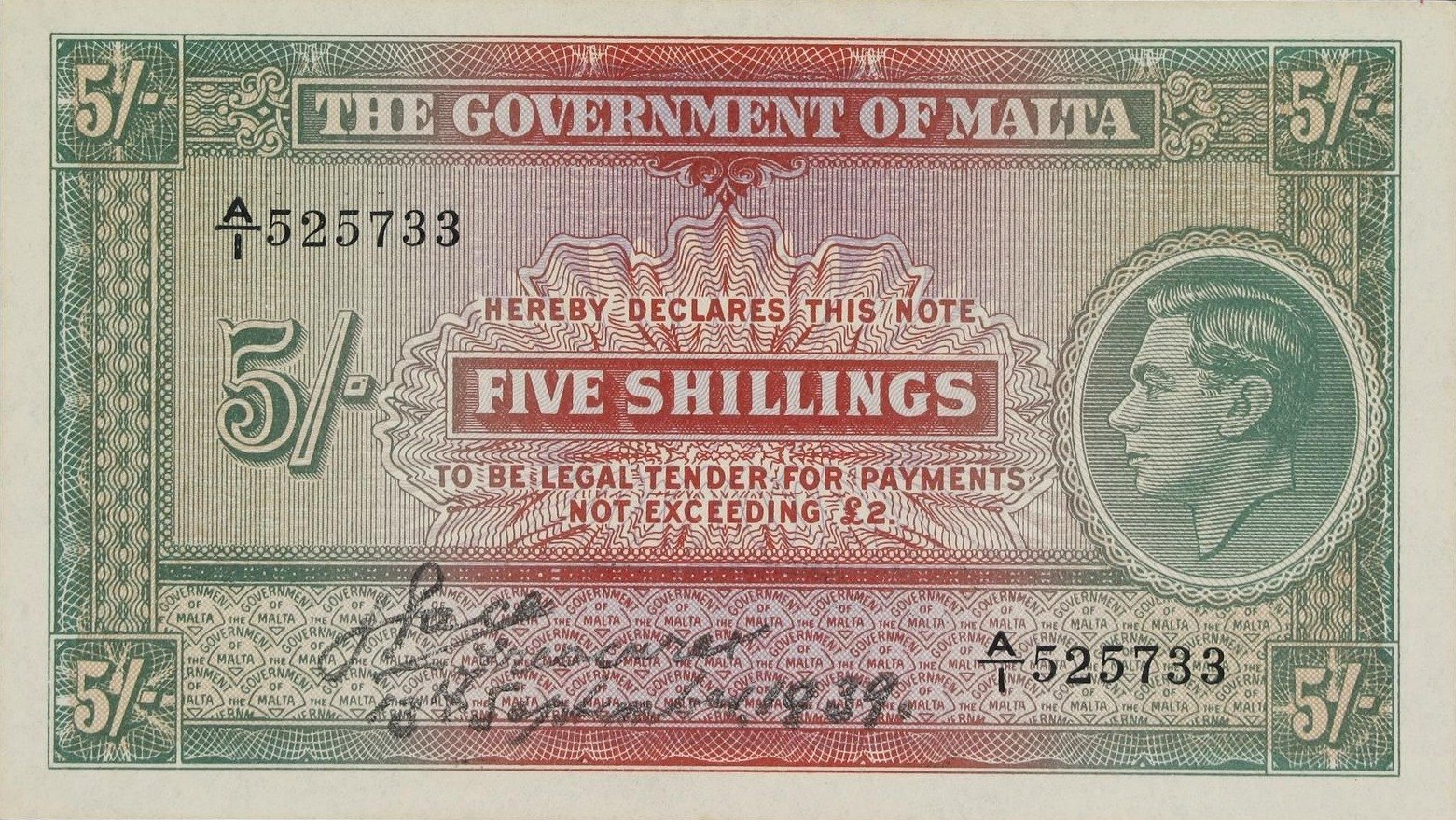
The Paper Currency Ordinance, No. XLVIII of 1939, was assented to on 13th September 1939. The notes had been ordered from Bradbury Wilkinson after a warning of June 1938 and came to Malta unsigned. The dated notes of 2 shillings 6 pence, 5 shillings, 10 shillings and 1 pound were authorised series by series from January 1940. Undated notes followed from 1942: the 2 shillings, the 2 shillings 6 pence, the 10 shillings and the 1 pound. The 1 shilling on 2 shillings was authorised on 17th November 1942 and the new 1 shilling on 13th April 1943. All are signed by the Treasurer, J. Pace, or by Edgar Cuschieri, who acted as Treasurer from 30th March 1942.
The ordinance allowed 500,000 pounds without a further resolution of the Council. Government Notice No. 630 of December 1946 authorised 1 pound notes of Series A/18 up to 300,000 pounds over the 10,919,000 pounds already authorised. The Treasurer's report in the Gazette Supplement of 1947 gives the notes in circulation as 11,316,889 pounds on 31st March 1945 and 11,912,758 pounds on 31st March 1946.
The Currency Notes Ordinance of 1949
Sandrock writes that the wartime notes had proved convenient and that it was decided to keep a paper currency, no longer as a temporary measure. The Currency Notes Ordinance, No. I of 1949, was enacted on 21st January 1949. Proclamation No. II of 8th March 1949 brought it into operation on 11th April 1949. It placed the issue under a Board of Commissioners of Currency: the Legal Secretary and the Treasurer, with others the Governor might appoint. Notes under 10 shillings stayed legal tender only up to 40 shillings, and the values and designs needed the approval of the Secretary of State.
The regulations made under it, Government Notice No. 226 of 1949, had the plates made by a firm chosen by the Crown Agents and kept by the Crown Agents. Notes withdrawn were to be cancelled by stamping, perforating or cutting, then burnt, and recorded by the prefix of each series. Lily Zhu's working paper on the Malta board, in the Johns Hopkins Digital Archive on Currency Boards (page 12), says that Government Notice No. 780 of 9th December 1949 amended the regulations on a point about serial numbers; the notice itself has not been read.
The ordinance also ended the Bank of England notes in Malta. Proclamation No. IV of 12th April 1949 fixed 21st July 1949 and Proclamation No. VI of 12th July 1949 moved the day to September. An Economic Survey of the Colonial Territories, 1951, says the 1 pound and 10 shilling Bank of England notes ceased to be legal tender after 20th September 1949, and the Treasurer's report in the Gazette Supplement of 1951 has them cease from 21st September 1949.
George VI and Elizabeth II, 1951 and 1954
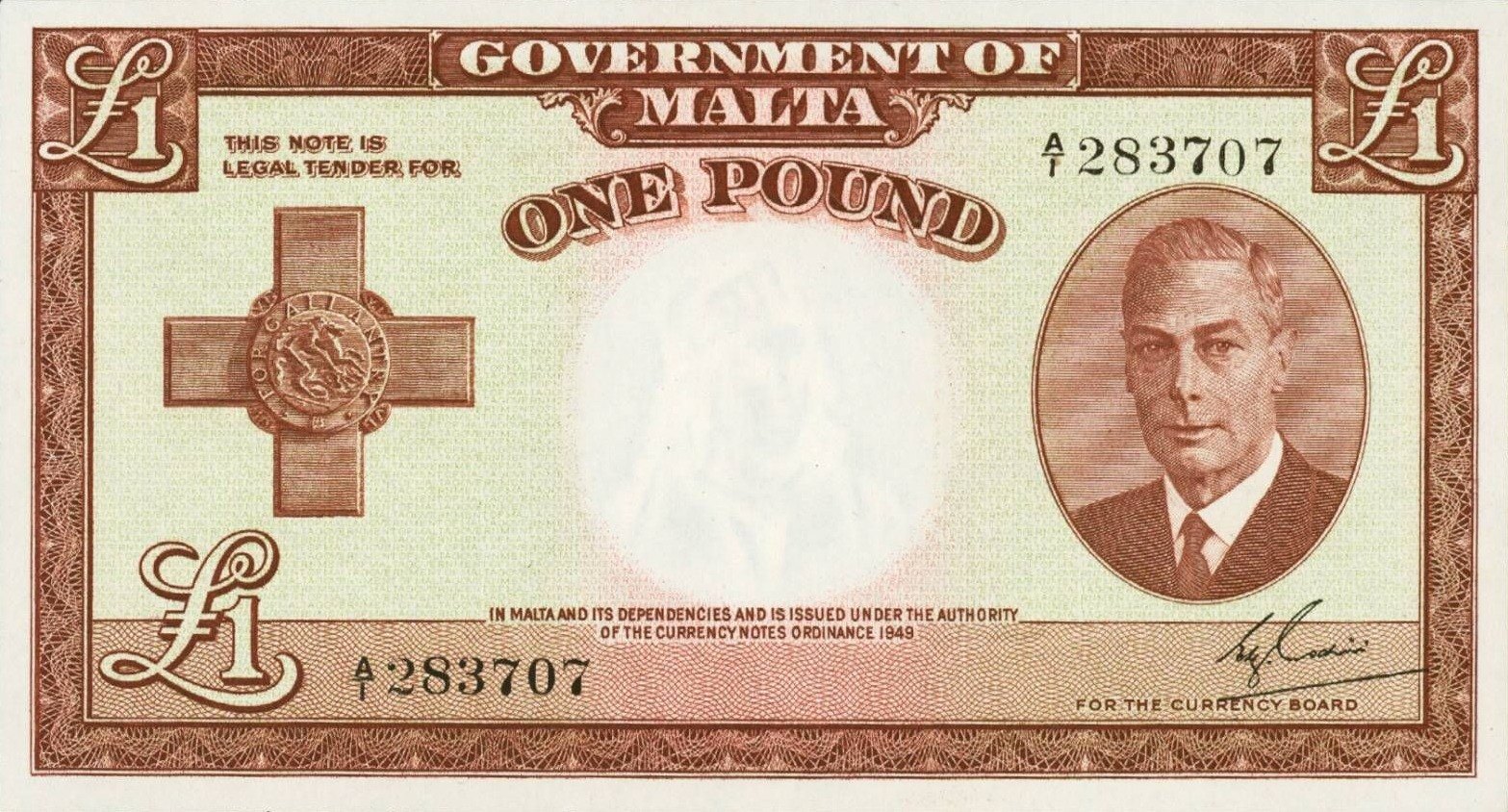
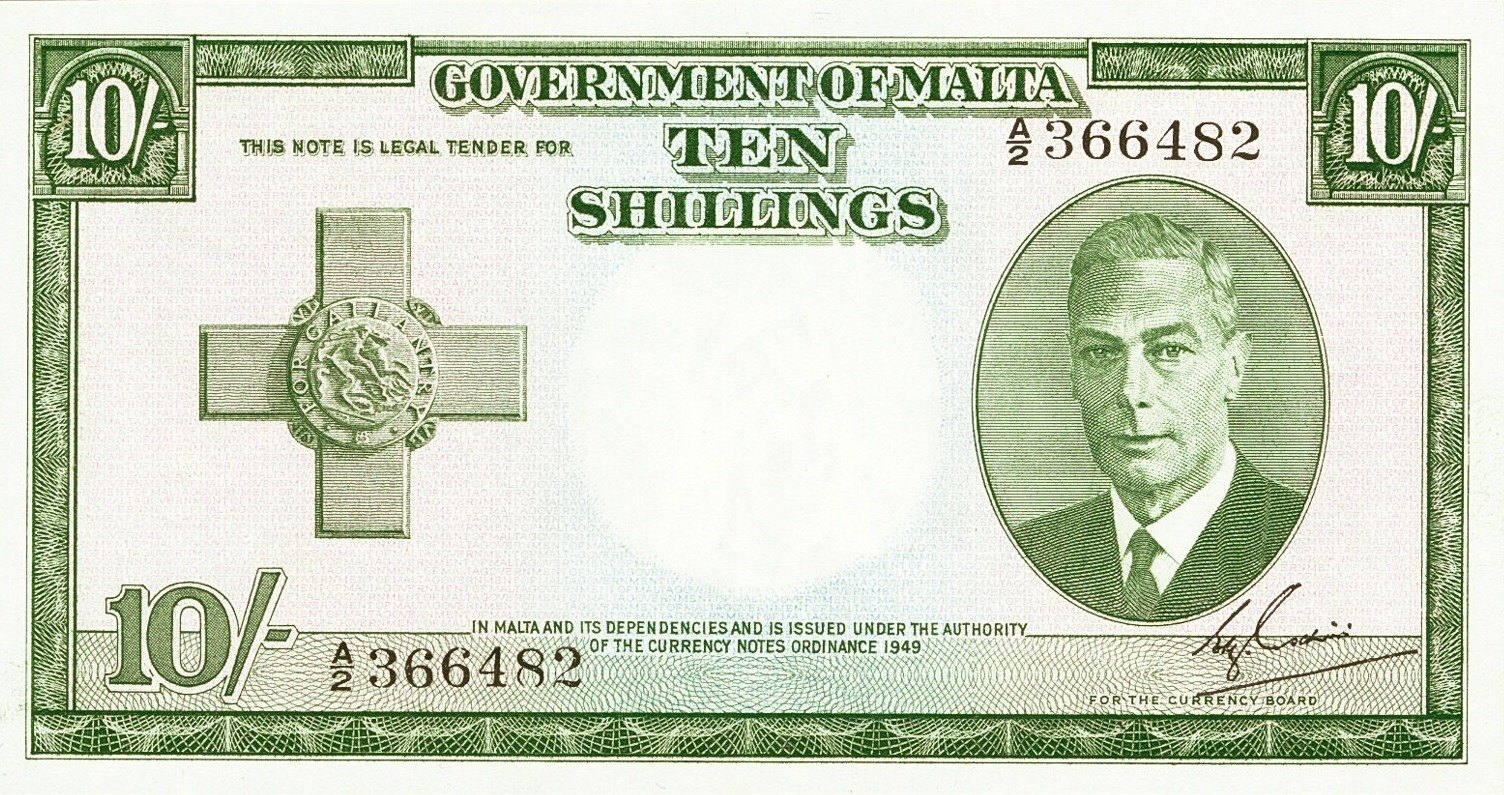
The first notes of the Currency Board, a 10 shillings and a 1 pound printed by De La Rue, were put into circulation on 8th May 1951. The date is given by the Central Bank of Malta's annual report for 1968 and by Government Notice No. 164 of 20th April 1954. Spink's description of lot 1118 in its sale of 15 April 2014 places the portrait of King George VI at right and the George Cross at left. Sandrock describes the back as a shield among ornamental leaves. Both values are signed Cuschieri, For the Currency Board. Gene Hessler's article on the engraver in the IBNS Journal (volume 44, number 1, page 23) names Stanley Doubtfire of De La Rue as the engraver of the King's portrait on the 1 pound.
Government Notice No. 164, signed by the Commissioners Trafford Smith, A. M. I. Austin and Edg. Cuschieri, announced a new issue from Monday 26th April 1954: the same design with the portrait of Queen Elizabeth II, the George VI notes to stay legal tender beside it. Sandrock writes that the notes marked the Queen's visit to Malta and dates the visit 24 April 1954. Hessler's article also names Doubtfire as the engraver of the Queen's portrait on both values. Heritage's description of lot 26152 in its sale of 24 April 2020 calls it Dorothy Wilding's portrait in the version prepared by De La Rue.
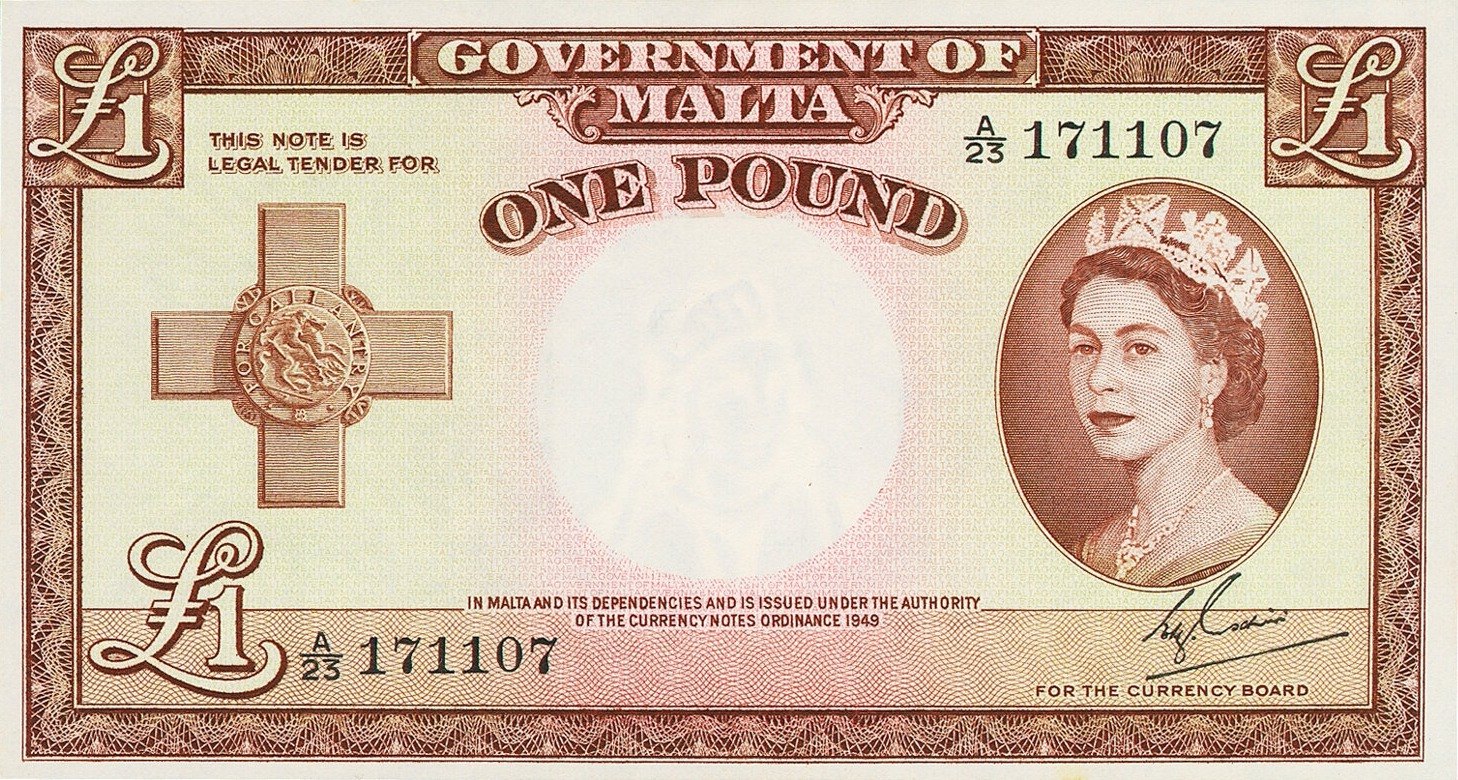
The 10 shillings and 1 pound of 1954 carry on the prefix series of 1951. The 1 pound was signed first by Cuschieri and then by D. A. Shepherd, whose name Sandrock spells Shepard. Sources mention a 10 shillings signed by Shepherd; no example has been seen. The Commissioners' statements in the Gazette help to date the change: Denis Synge Stephens and E. Cuschieri sign in December 1957, Stephens and R. Soler in August 1958, and D. A. Shepherd, R. Soler and L. Vella in March 1961. The Gazette does not say which Commissioner signed the notes.
The 5 pounds of 1961 and the notes of 1963
Lily Zhu's working paper (page 12) says that the Currency Notes (Amendment) Ordinance, No. 15 of 1960, enacted on 8th August 1960, put the Financial Secretary and the Accountant General on the Board in place of the Legal Secretary and the Treasurer.
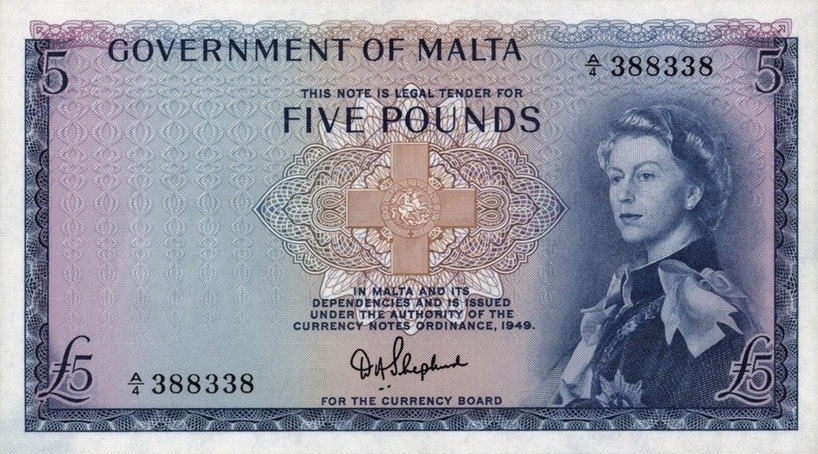
Malta's first 5 pounds was issued on 2 June 1961. Sandrock puts it down to the growth of the currency in circulation with more employment, industry and tourism. The note was printed by Bradbury Wilkinson, with a portrait of the Queen adapted from Pietro Annigoni's painting. Sandrock describes the Queen at right in robes of state and a view of the Grand Harbour at Valletta on the back. The first printing is signed Shepherd and the printing of 1963 is signed R. Soler, the Accountant General.
A 10 shillings and a 1 pound with similar fronts followed in July 1963. Sandrock describes a harbour on the island of Gozo on the back of the 10 shillings and an aerial view of the industrial complex at Marsa on the 1 pound. The 1 pound is signed Soler.
The Central Bank of Malta, 1968 and 1969
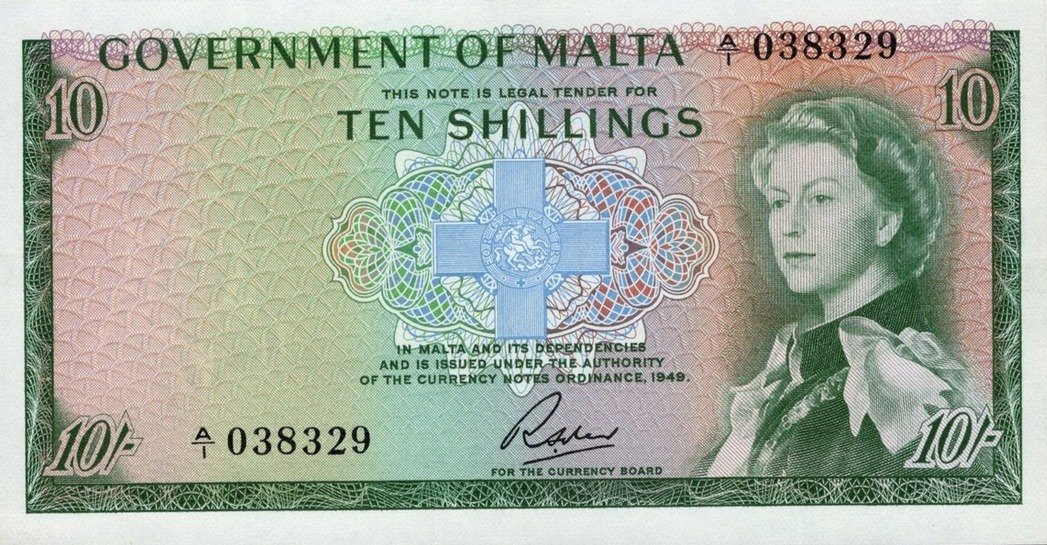
The first notes of the Central Bank of Malta were issued under the Central Bank of Malta Act 1967. The Bank's annual report for 1968 (page 5) says that early in the summer of 1968 its first notes, the 10 shillings and the 5 pounds, were placed in circulation, and that no Central Bank 1 pound had yet been issued because ample stock of the Government note remained. The Note Security Fund was handed to the Bank on 7th June 1968. The 1 pound is listed here as of 1969.
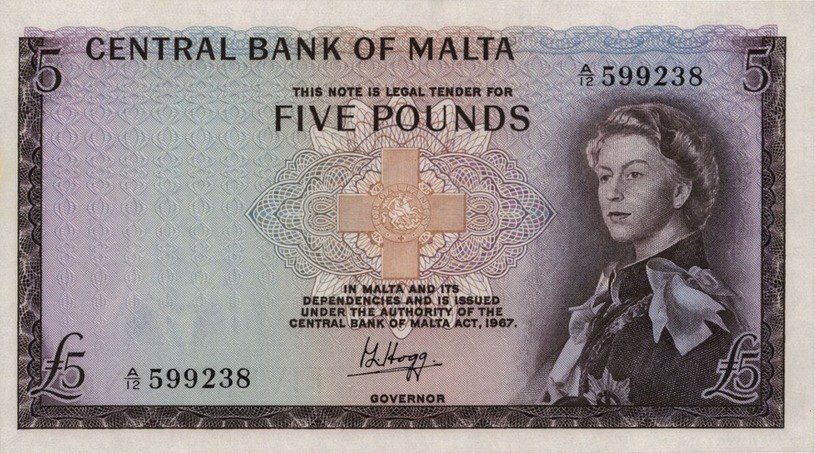
Spink's description of lot 633 in its sale of 13 March 2024 gives the signer of all three as Philip L. Hogg and the colours as red for the 10 shillings, olive green for the 1 pound and purple and brown for the 5 pounds. Spink names the backs as Mgarr harbour on Gozo, the industrial estate at Marsa and the Grand Harbour, and calls the designs similar to those of the issue before. The Pick pages give Bradbury Wilkinson as the printer.
Notes in circulation
The figures below are those the sources give. No source read here gives a full run of years or the number of notes printed of each value.
| Date | Notes in circulation | Source |
|---|---|---|
| 31st March 1915 | 39,000 pounds | Treasurer's report, 1914 to 1915 |
| 31st March 1945 | 11,316,889 pounds | Treasurer's report, Gazette Supplement of 1947 |
| 31st March 1946 | 11,912,758 pounds | Treasurer's report, Gazette Supplement of 1947 |
| 31st March 1952 | 16,157,882 pounds | An Economic Survey of the Colonial Territories, 1951, volume VI, page 27 |
| 7th June 1968 | 35,386,000 pounds | Commissioners of Currency, Gazette of 23rd July 1968 |
The Economic Survey sets its figure against a Note Security Fund of 15,507,808 pounds. The statement of 7th June 1968, the day of the handover to the Central Bank, gives the values one by one:
| Value | In circulation at 7th June 1968 |
|---|---|
| 5 pounds | 20,749,500 pounds |
| 1 pound | 14,055,800 pounds |
| 10 shillings | 514,900 pounds |
| 5 shillings | 9,130 pounds |
| 2 shillings 6 pence | 17,150 pounds |
| 2 shillings | 16,050 pounds |
| 1 shilling | 23,470 pounds |
The Gazettes of 1949 to 1968 hold half-yearly statements by value, which have not been tabulated here. The day on which the Government notes ceased to be legal tender is not given in any source read for this article, and the Pick pages show no date of withdrawal.
Sources
- Malta Government Gazette, 1914 to 1915 and 1940 to 1968: Ordinance No. VIII of 1914; the Treasurer's report for 1914 to 1915; Ordinance No. V of 1915 and Proclamation No. X of 16th June 1915; Ordinance No. XLVIII of 1939; Ordinance No. I of 1949 and Proclamations No. II, IV and VI of 1949; Government Notices No. 226 and No. 780 of 1949; Government Notice No. 164 of 20th April 1954; the Commissioners of Currency's statements of 1957, 1958, 1961 and 1968; the Treasurer's report in the Supplement of 1947. Read in the Digital Archive on Currency Boards, Johns Hopkins University.
- Central Bank of Malta, Annual Report 1968, pages 4 and 5.
- Lily Zhu, working paper on the Malta currency board, Johns Hopkins Digital Archive on Currency Boards, page 12.
- John E. Sandrock, "Bank Notes of the Government of Malta", The Currency Collector website, 2011; printed in the IBNS Journal, volume 51, number 2, 2012.
- An Economic Survey of the Colonial Territories, 1951, volume VI, page 27.
- Robert Chalmers, A History of Currency in the British Colonies, 1893, page 324.
- An Economic Survey of the Colonial Empire (1932), Colonial No. 95, 1934, page 236.
- Malta Blue Books, 1918-19 and 1919-20, Civil Establishment, Treasury, published online by the National Statistics Office of Malta.
- Richard Kelly, "Blue Books and Bank Histories", IBNS Journal, volume 16, number 4, 1978, pages 224 to 225, reporting "The DCO Story"; Gene Hessler, "Stanley Doubtfire, British Engraver", IBNS Journal, volume 44, number 1, page 23.
- Heritage Auctions, 24 April 2020, lot 26152; Spink, 15 April 2014, lot 1118; 2 October 2019, lot 84; 13 March 2024, lot 633.


Member comments
Log in or register to post a comment.