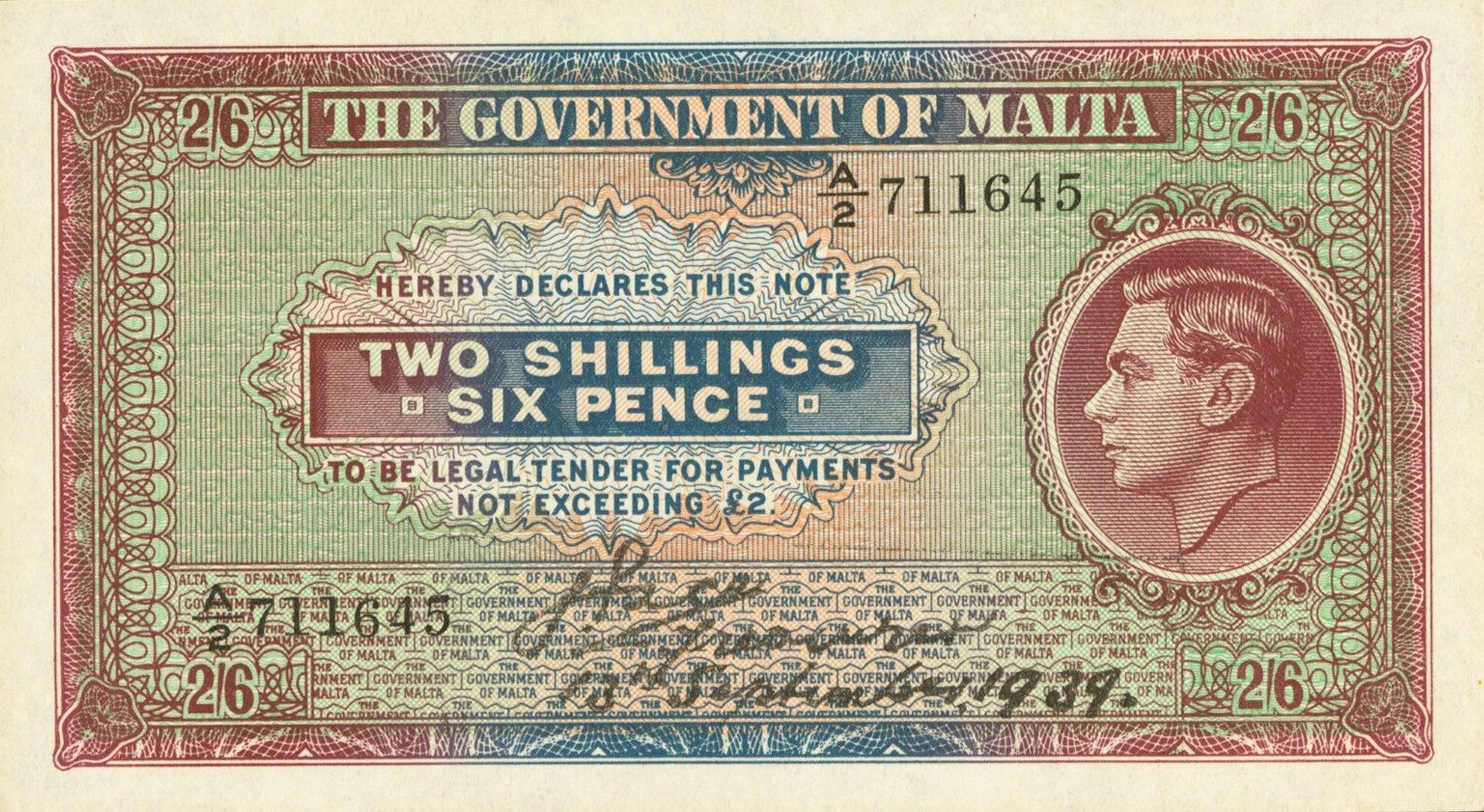
This article follows the notes that the Government of Malta issued between 1940 and 1946: the dated notes of 13th September 1939, the undated notes that followed them, and the 1 shilling overprinted on a note of 1918. It rests on the Malta Government Gazette, on John E. Sandrock's paper "Bank Notes of the Government of Malta", on Fred Schwan's column in Bank Note Reporter of April 1984 and on the Pick pages of this catalogue.
The order of 1938
Sandrock writes that as early as June 1938 the Secretary of State for the Colonies warned that a war with Germany would make it hard to send new supplies of notes to the colonies. In Sandrock's account it was suggested that notes of 2 shillings, 2 shillings 6 pence, 5 shillings, 10 shillings and 1 pound be printed and held ready in Malta, and that £750,000 would be adequate. The Pick pages put it as about £750,000 ordered. Sandrock adds that there was no suitable printing works on the island and that the work went to the lowest bidder, Bradbury Wilkinson.
A working paper by Lily Zhu in the Johns Hopkins Digital Archive on Currency Boards, citing Sammut (2001, page 165), gives part of the order by number: 240,000 notes of 2 shillings 6 pence, 300,000 of 10 shillings and 500,000 of 1 pound. No figure for the 2 shillings or the 5 shillings has been found.
The printer's own photographs of the designs, carded in October 1938, are described in Wartime and occupation: what the design archive keeps from 1914 to 1945.
The Paper Currency Ordinance of 13th September 1939
The notes were issued under the Paper Currency Ordinance, No. XLVIII of 1939, which provided for a temporary Government paper currency. The Council of Government passed it on 12th September 1939 and the Governor, Charles Bonham-Carter, assented on 13th September 1939, the date printed on the first notes. The ordinance allowed notes of 2 shillings and upwards, up to 500,000 pounds without a further resolution of the Council. Notes under 10 shillings were legal tender only up to 40 shillings. Forging the notes was punished as the forging of gold coin. Government Notice No. 583 of 21st November 1939 announced that the ordinance had not been disallowed in London.
Four values carry the date and the signature of J. Pace, with Treasurer and the date in script under the signature: the 2 shillings 6 pence, the 5 shillings, the 10 shillings and the 1 pound.
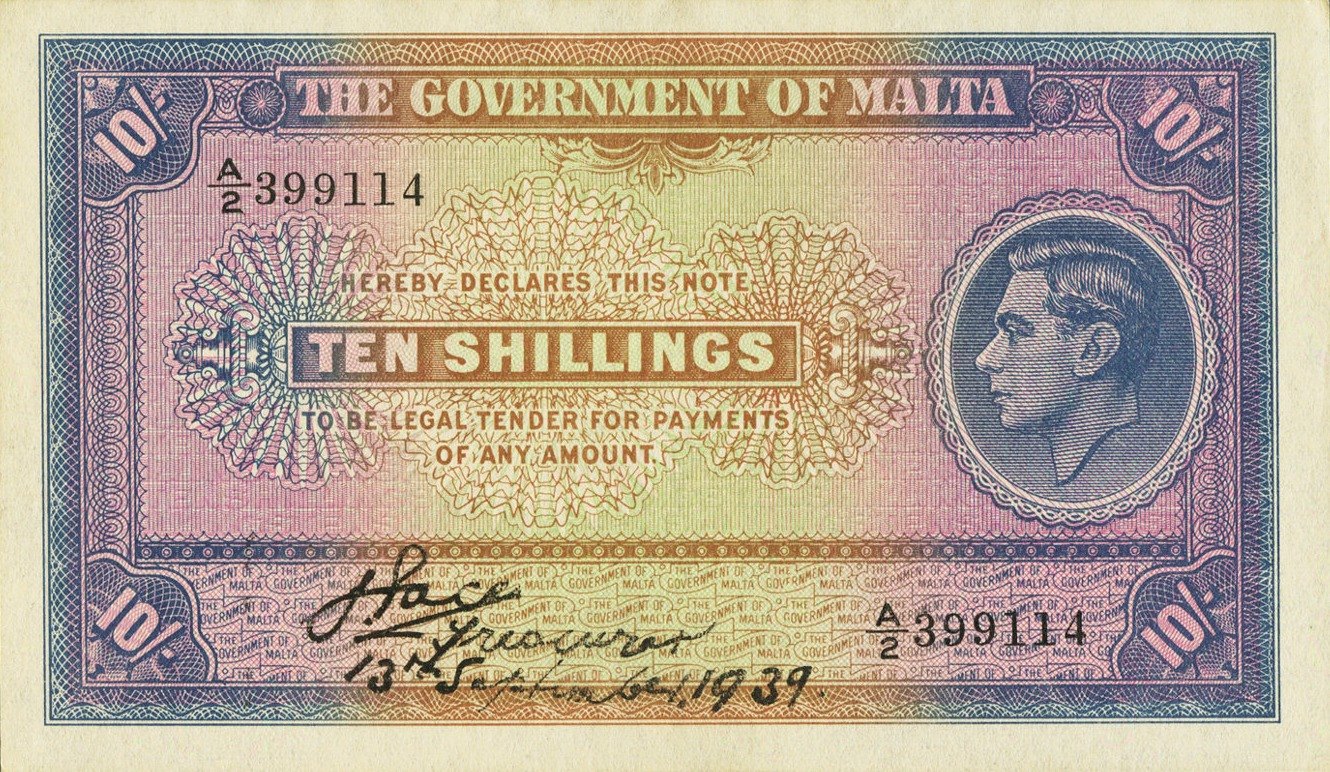
When each value came out
The Gazette of 1939 is not among the volumes read for this catalogue, so no notice of September 1939 has been seen. The notices that have been read begin in January 1940. Each one authorised a series up to a stated sum. The notes were convertible into Bank of England notes at the Treasury. The 2 shillings 6 pence and the 5 shillings were legal tender up to 2 pounds, the 10 shillings and the 1 pound for any amount.
| Notice | Value and series | Sum authorised |
|---|---|---|
| No. 13 of 12th January 1940 | 2 shillings 6 pence, A/1 | up to 60,000 pounds |
| No. 215 of 18th May 1940 | 1 pound, A/1 | up to 300,000 pounds |
| No. 239 of 30th May 1940 | 5 shillings, A/1 | up to 40,000 pounds |
| No. 256 of 4th June 1940 | 10 shillings, A/1 | up to 100,000 pounds |
| No. 318 of 24th June 1940 | 1 pound | a further 300,000 pounds |
| No. 353 of 13th July 1940 | 1 pound | a further 200,000 pounds |
| No. 137 of 1st April 1941 | 1 pound, A/2 | 300,000 pounds |
| No. 324 of 4th July 1941 | 2 shillings 6 pence A/2, 10 shillings A/2, 1 pound A/3 | not noted |
| No. 468 of 17th October 1941 | 5 shillings, A/2 | 30,000 pounds over the 140,000 already authorised |
| No. 563 of 10th December 1941 | 1 pound, A/4 | not noted |
| No. 146 of 26th March 1942 | 2 shillings, A/1 | up to 50,000 pounds |
| No. 477 of 12th September 1942 | 2 shillings, A/1 and A/2 | not noted |
| No. 615 of 17th November 1942 | 1 shilling overprinted on 2 shillings, A/1 | up to 5,000 pounds |
| No. 184 of 13th April 1943 | 1 shilling, A/1 (New); 2 shillings, A/2 and A/3 | 1 shilling: up to 20,000 pounds |
| Notice of 20th July 1943 | 10 shillings, A/3; 2 shillings 6 pence, A/2 and A/3 | 10 shillings: up to 100,000 pounds |
| No. 630, December 1946 | 1 pound, A/18 | up to 300,000 pounds over the 10,919,000 already authorised |
For the 1 pound the notices also name A/5 in March 1942, A/6 to A/10 in August 1942, A/12 by 1943 to 1944, and A/13 and A/14 in 1944 to 1945. The 2 shillings 6 pence A/2 and A/3 are first named on 2nd February 1943, and the new 1 shilling A/2 on 2nd October 1943. The line for the 10 shillings in the notice of 20th July 1943 was read from a poor print and has not been checked again.
The days of first issue come from another source. Fred Schwan, in Bank Note Reporter of April 1984 (page 38), gives them, drawing on Emmanuel Said's Malta Coin, Banknote and Medal Catalogue of 1982: the 2 shillings 6 pence on 1st January 1940, the 1 pound on 20th May 1940, the 5 shillings on 31st May 1940, the 10 shillings on 5th June 1940, the 2 shillings on 31st March 1942, the overprinted 1 shilling on 19th November 1942 and the new 1 shilling on 13th April 1943. Each falls on the day of its notice or within days after it, except the first: 1st January 1940 is eleven days before the notice of 12th January. Said's catalogue itself has not been seen.
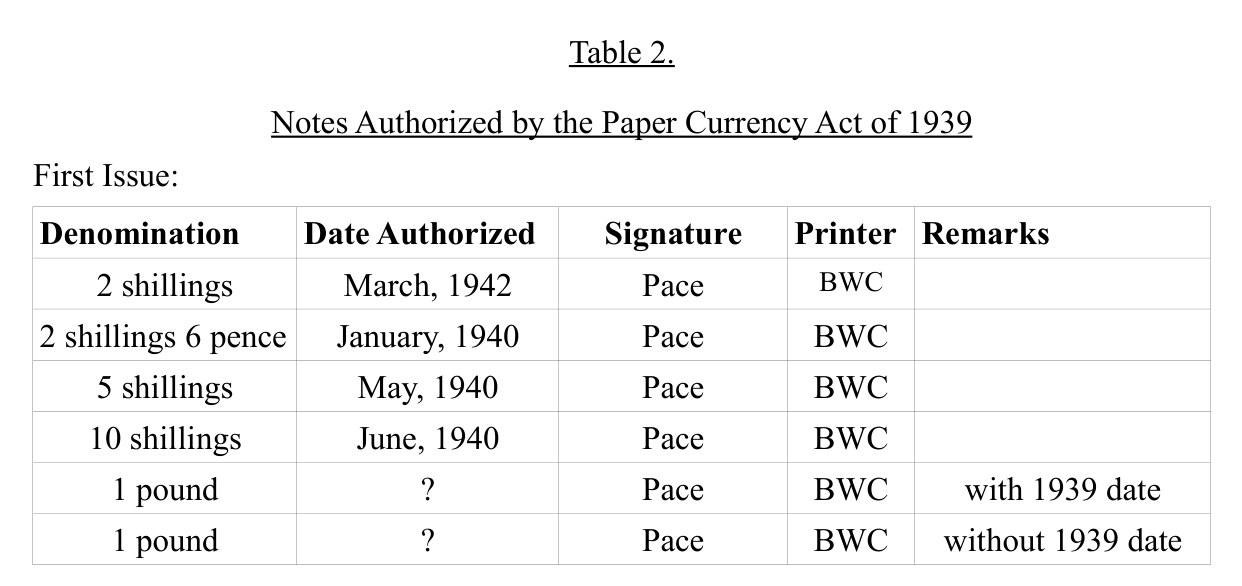
Sandrock tells it differently. In that account the 2 shillings 6 pence was released first, when less than a week's supply of half-crowns and florins was left and postage stamps were being taken for bus fares, and the 1 pound entered circulation two days later. The Gazette notices for the two values are four months apart. Sandrock's own table gives January 1940 for the 2 shillings 6 pence, May 1940 for the 5 shillings, June 1940 for the 10 shillings and March 1942 for the 2 shillings, and leaves the 1 pound open.
Signed on the island, shipped through the siege
Sandrock writes that the notes left London without a signature. The Treasurer's signature was printed on in Malta, on hand-fed machines at the Government Printing Office. Once the bombing grew heavy the work was spread over printing shops round the island, and a brewery was used too.
Sandrock writes that the Admiralty and the Air Ministry carried the notes. Warships, submarines, flying boats, merchant ships and aircraft were all used, and not every shipment arrived. In Sandrock's example, when HMS Breconshire was sunk off Malta, only 12,000 of the 84,000 1 pound notes on board were recovered. Sandrock gives no date for the loss and does not say whether the notes were dated or undated.
Pace, Cuschieri and the undated notes
Government Notice No. 150, in the Gazette of 31st March 1942, granted leave to J. Pace, Treasurer and Director of Contracts, and appointed Edgar Cuschieri, Senior Assistant Treasurer, to act in that office from 30th March 1942. Later notices are signed by Cuschieri as Acting Treasurer (27th November 1943) and as Treasurer (from 1944). A note signed Cuschieri is therefore of 1942 or later. This catalogue listed the undated notes signed Cuschieri as of 1940 until that notice was read, and Spink (15 July 2014, lot 859) dated an undated 2 shillings 6 pence about 1940.
The undated notes are uniface, printed by Bradbury Wilkinson without imprint. They are the 2 shillings, first signed Pace and then Cuschieri, the 2 shillings 6 pence and the 10 shillings signed Cuschieri, and the 1 pound, signed Pace and then Cuschieri. There is no undated 5 shillings. Each undated value carries on the prefix series of the dated note, so one prefix can be found on both.
Why the date was dropped is not known. Sandrock says so of the two 1 pound notes signed Pace. P. Michael Rhodes, in a letter in the IBNS Journal (volume 51, number 3, page 9), wrote that every Pace note seen was dated 13th September 1939 except the 2 shillings and one form of the 1 pound, and asked whether anyone had seen an undated 2 shillings 6 pence, 5 shillings or 10 shillings with that signature. None is recorded here.
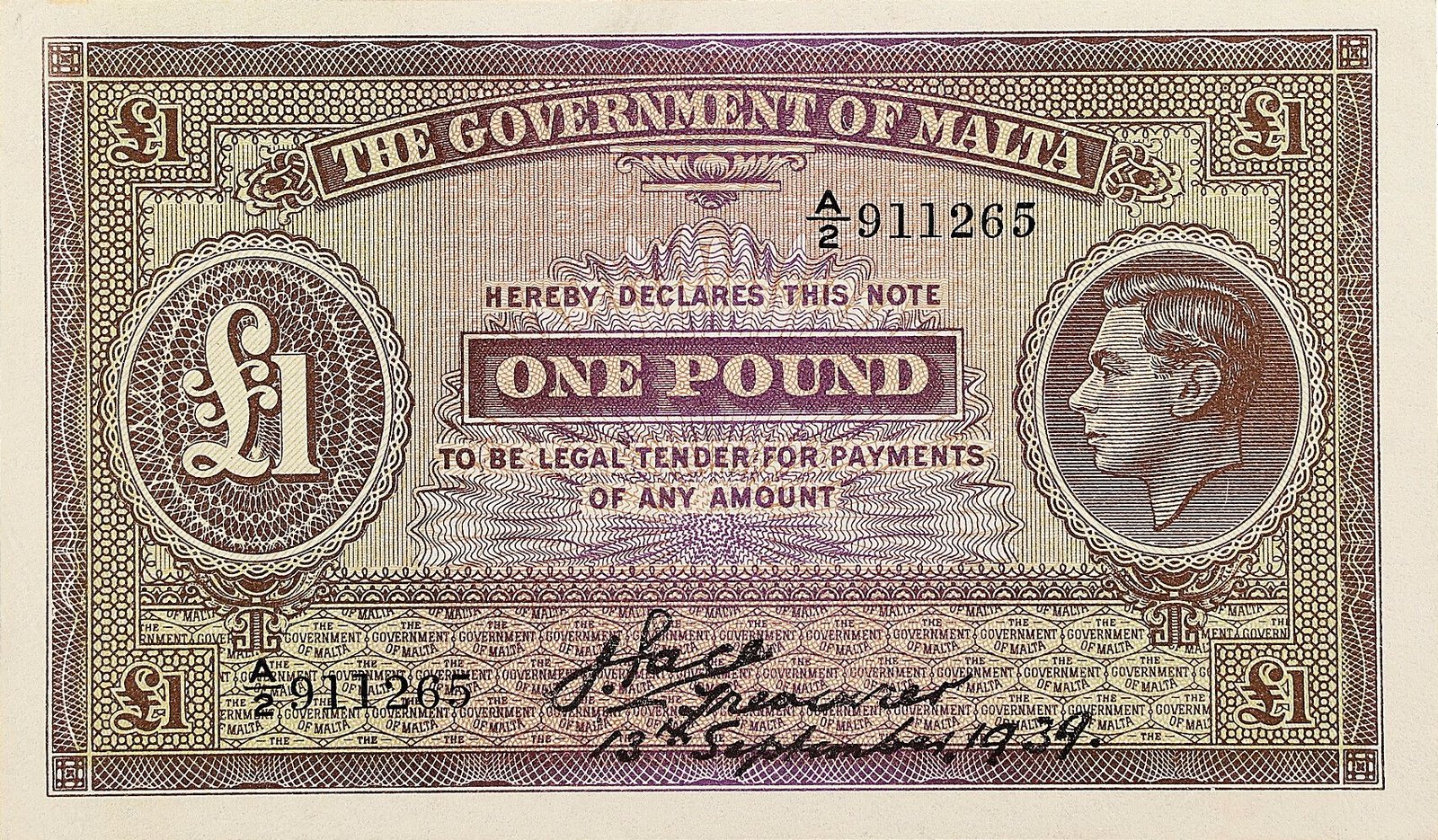
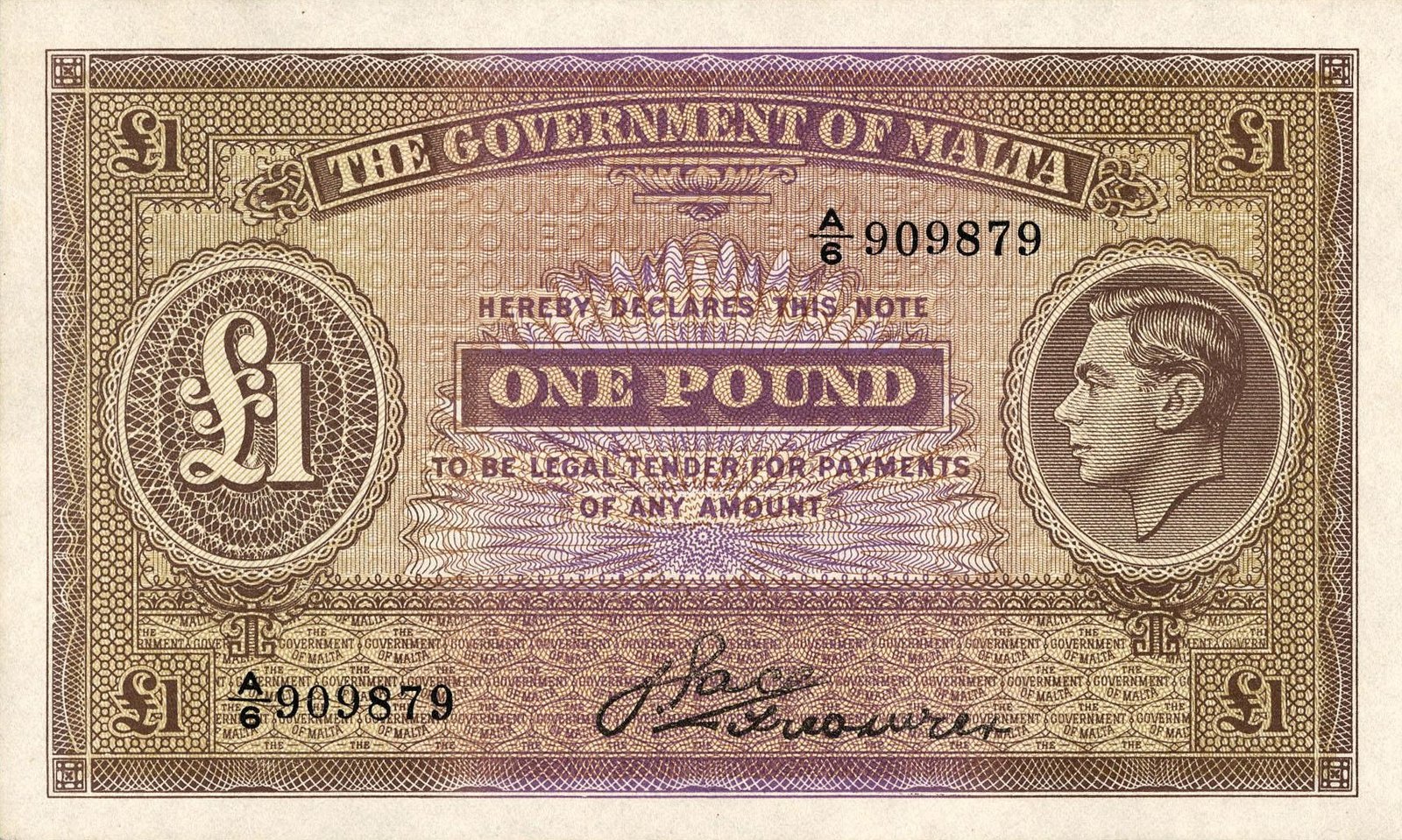
One printing of the 1 pound crossed the change. Noonans (26 February 2025, lot 359) describes a printer's archival specimen whose range of numbers runs from prefix A/4 into prefix A/5, with the order date 22.8.41 in its top margin, and says that the run covers both the note with the date and the later note without it. The range itself is on the page of the undated 1 pound.
The 2 shillings and the paper with a map of Malaya
The 2 shillings was in the order of 1938 but was the last of the five values to come out, under the notice of 26th March 1942, days before Pace went on leave. The Cuschieri notes exist on two papers: one without watermark and a heavier one with a watermark that shows a map of Malaya.
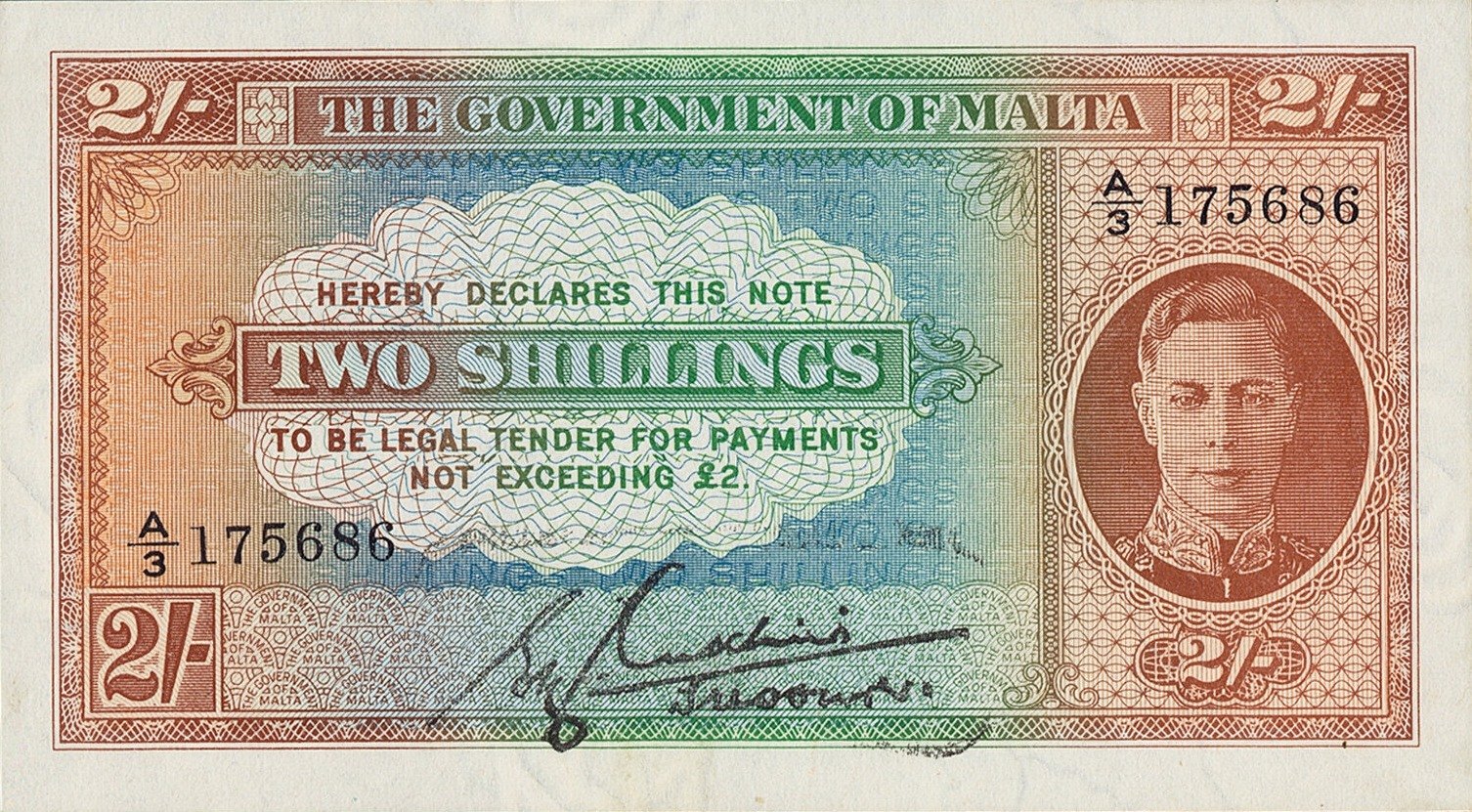
Schwan, in the same column of April 1984, describes the 2 shillings A/3 089910 as the only note seen on paper watermarked "SDM" with an outline of the Malayan peninsula, and calls it the paper of the Survey Department of the Federated Malay States. The Pick page records another account, without a named source: that the paper was stock Bradbury Wilkinson had laid in for a Malaya contract which then went to Waterlow. Neither account has been confirmed from a document.
The 1 shilling of November 1942
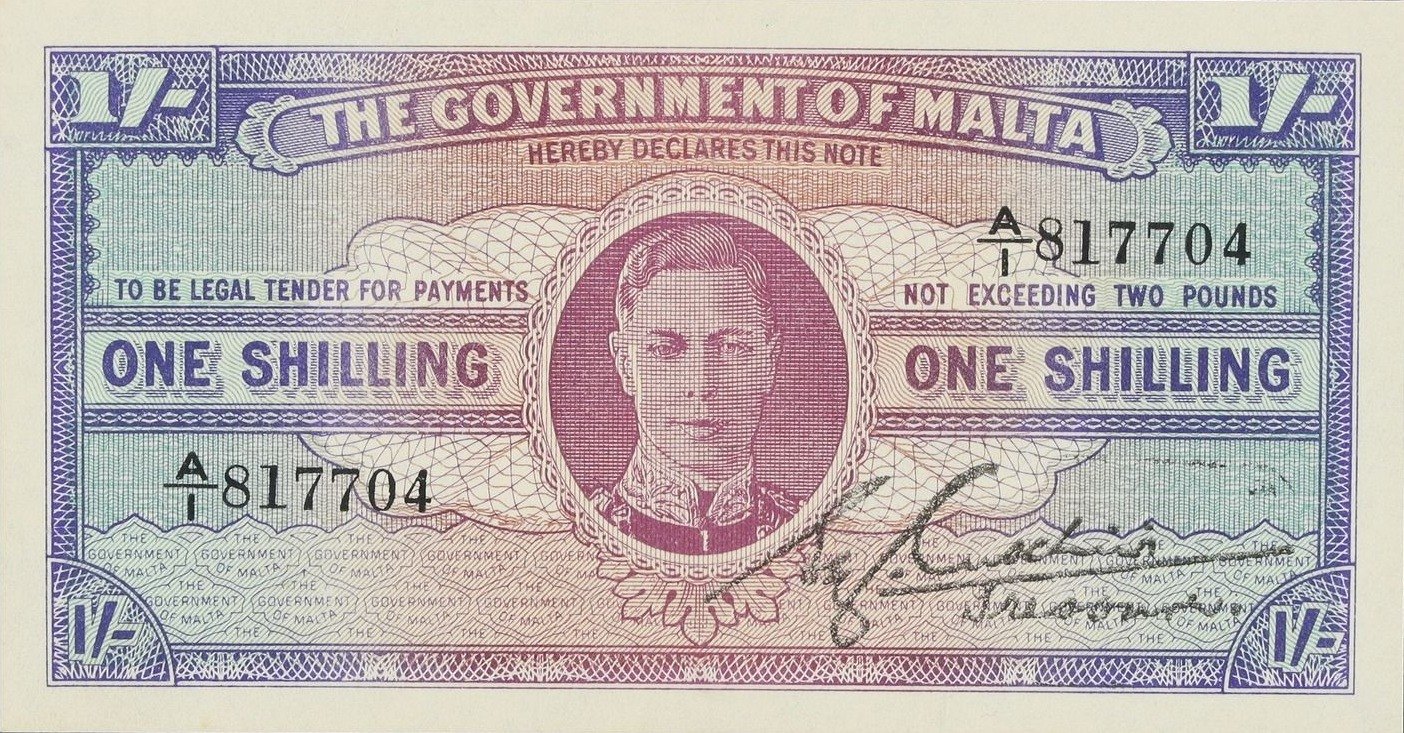
No 1 shilling was in the order, and the ordinance of 1939 allowed nothing below 2 shillings. When 1 shilling coins ran short during the siege, the Paper Currency (Amendment) Ordinance, No. XV of 1942, put "one shilling" in place of "two shillings". The Council passed it on 22nd September 1942 and Governor Gort assented on 25th September 1942.
New notes could not come from London in time. The 2 shillings notes of 20th November 1918, printed by De La Rue and never released, were still in store on the island, and they were overprinted ONE SHILLING. Government Notice No. 615 of 17th November 1942 authorised these notes, "originally printed as 2s/- notes and now overprinted as 1s/- notes", up to 5,000 pounds, which the Pick page gives as the value of the whole 1918 printing of 100,000 notes. They were legal tender for payments up to 2 pounds. The page for the 1 shilling on 2 shillings sets out the black and the red overprint and the two papers.
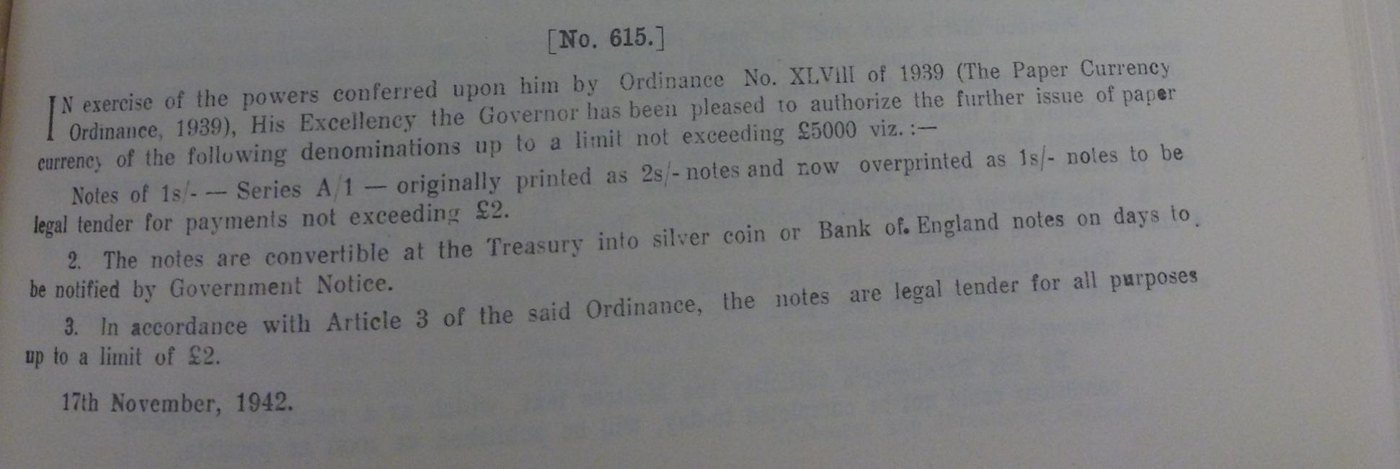
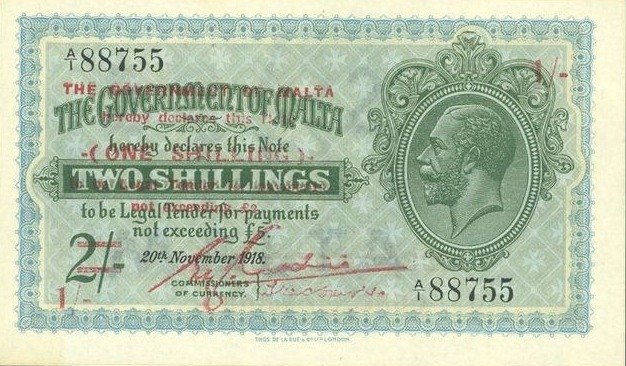
Sandrock pictures two notes: the unoverprinted 2 shillings A/1 00003 and the overprinted A/1 00018. Sandrock writes that at least 85,000 of the overprinted notes were issued, without naming a source for the figure, and guesses from the two numbers that no more than seventeen notes were left in their first form. Neither figure is from the Gazette. The Pick page records the lowest numbers known and which of them carry the overprint.
The 1 shilling printed by Bradbury Wilkinson was authorised on 13th April 1943 as Series A/1 (New), up to 20,000 pounds besides the 5,000 pounds of the overprint. The overprinted notes were withdrawn once the new notes arrived from London, from April 1943.
After the siege
From 1945 the notices authorise new notes to replace worn notes of the same value withdrawn from circulation. Government Notice No. 283 of 19th June 1945 covered 300,000 pounds, of which 150,000 pounds was 1 pound notes of Series A/13 and A/14. The Treasurer's report printed in the Gazette Supplement of 1947 counts 1,191,159 worn notes withdrawn in 1945 to 1946.
The small notes were still out when the Central Bank of Malta took over. The Commissioners of Currency's statement as at 7th June 1968, in the Gazette of 23rd July 1968, still shows 9,130 pounds in 5 shillings notes, 17,150 pounds in 2 shillings 6 pence, 16,050 pounds in 2 shillings and 23,470 pounds in 1 shilling notes in circulation, and the Central Bank of Malta's annual report for 1968 says these values were still legal tender. When they ceased to be so is not stated in any source read here.
What the grading counts say
A grading company's count covers only the notes sent to it, on the day the count was taken. Stack's Bowers (2 October 2025, lot 50283) wrote that PMG had graded 17 examples of the dated 5 shillings, two of them uncirculated. Heritage (20 October 2022, lot 25390) wrote that PMG had graded three specimens of the 2 shillings.
Sources
- Malta Government Gazette, 1940 to 1946 and 1968: the Government Notices named above; Ordinance No. XLVIII of 1939; Ordinance No. XV of 1942; the Treasurer's report in the Supplement of 1947; the Commissioners of Currency's statement as at 7th June 1968. Read in the Digital Archive on Currency Boards, Johns Hopkins University.
- John E. Sandrock, "Bank Notes of the Government of Malta", The Currency Collector website, 2011; printed in the IBNS Journal, volume 51, number 2, 2012.
- Fred Schwan, "War emergency notes examined: Malta", Bank Note Reporter, April 1984, page 38, quoting Emmanuel Said, Malta Coin, Banknote and Medal Catalogue, 1982.
- Lily Zhu, working paper on the Malta currency board, Johns Hopkins Digital Archive on Currency Boards, citing Sammut (2001), page 165.
- P. Michael Rhodes, letter, IBNS Journal, volume 51, number 3, 2012, page 9.
- Central Bank of Malta, Annual Report 1968.
- Noonans, 26 February 2025, lot 359; Spink, 15 July 2014, lot 859; Stack's Bowers, 2 October 2025, lot 50283; Heritage Auctions, 20 October 2022, lot 25390.


Member comments
Log in or register to post a comment.