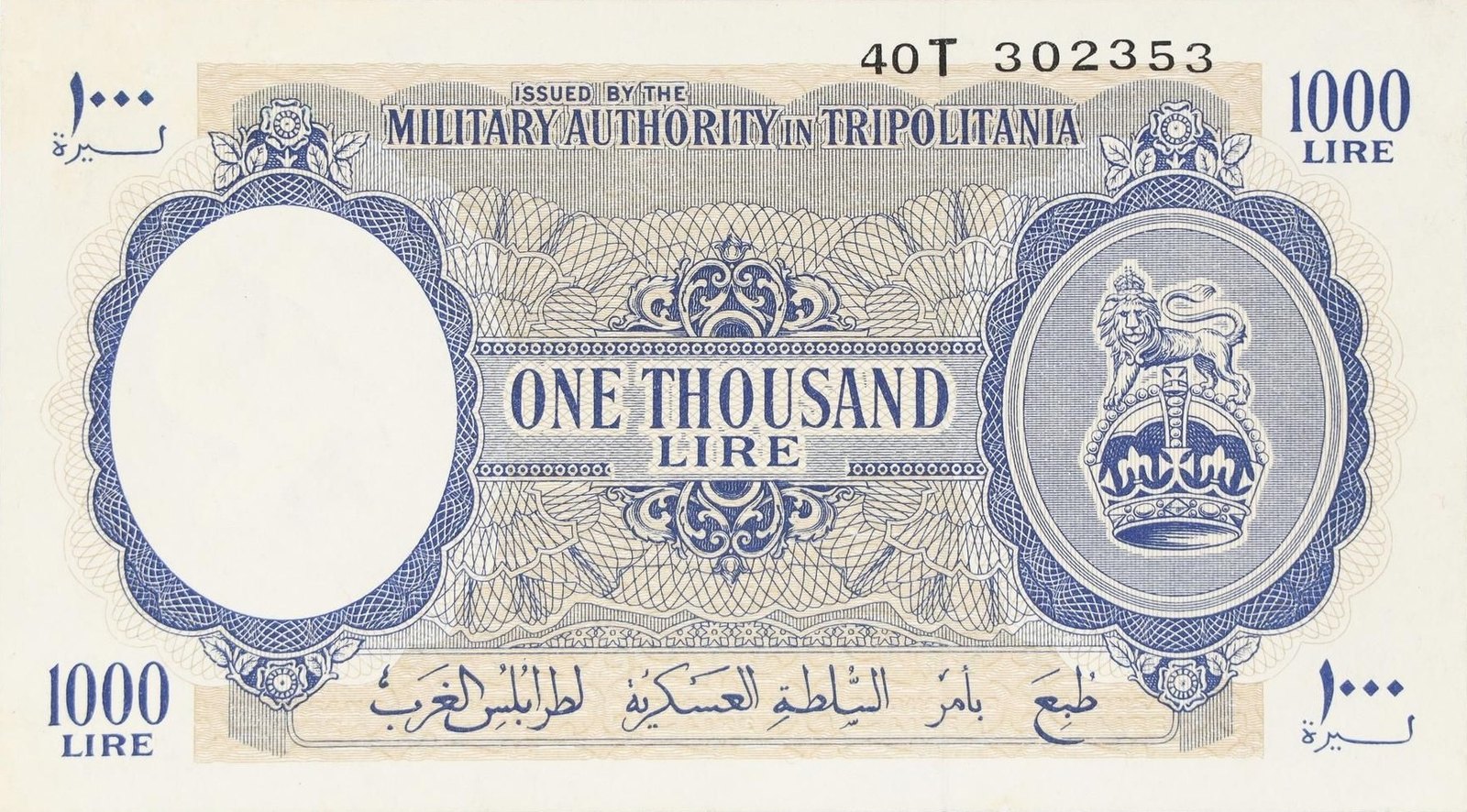
The Military Authority in Tripolitania issued one series of notes, eight values from 1 lira to 1,000 lire, which circulated in British-occupied Tripolitania from 15 September 1943 until 1952. This article sets out what the catalogue's pages, two official reports quoted in the International Bank Note Society Journal, a United States War Department manual of 1944 and the published American diplomatic papers of 1943 say about how the notes came, how they were used and how they went. Where the sources give different dates, both are given.
Tripolitania before the lira notes
Peter Symes, writing on the Libyan Currency Commission in the International Bank Note Society Journal (volume 43, no. 4, 2004), says the British army occupied Tripolitania and Cyrenaica after driving out the Axis forces in the winter of 1942 to 1943, and that from the end of the Second World War the three Libyan provinces were kept under separate administrations, with separate currencies circulating in each.
For Tripolitania, Symes quotes the report of G. A. Blowers and A. N. McLeod, "Currency Unification in Libya", printed in the Staff Papers of the International Monetary Fund, volume II, 1951-52. The two had been nominated by the United Nations to look into Libya's economy before the country received a currency of its own. Their report says that the Italian metropolitan lira circulated in Libya before the war; that at the beginning of the British occupation early in 1943 the British Military Administration pound was introduced; and that the Italian lira was allowed to go on circulating at a rate fixed at 480 to the pound sterling.
Neil Shafer, reviewing T. F. A. van Elmpt's book British Military Authority Occupation Currency 1942-1956 in Bank Note Reporter of December 2003, gives the sterling side of this in a picture caption: the British Military Authority notes with the series letters A to F were used only in Tripolitania, were issued in January 1943, and were all withdrawn on 15 September of the same year.
The published American diplomatic papers show the question being argued in Washington that spring. In a letter of 24 April 1943 printed in Foreign Relations of the United States, 1943, volume I (document 875), the Acting Secretary of the Treasury, Bell, told the Secretary of State that Sir Frederick Phillips of the British Treasury had reported that the British Government was agreeable to the suggestion that British Military Authority pound notes should not be used in Tripolitania. The Secretary of State's reply of 28 April 1943 (document 876) welcomed this. These letters and the report of Blowers and McLeod do not fit together easily: the report says the sterling notes were introduced early in 1943, and Shafer's caption has them in use until September. None of the sources read here settles whether, and for how long, the sterling notes were used in Tripolitania.
15 September 1943: the new notes
The report of Blowers and McLeod, as Symes quotes it, says the Military Authority lira was introduced beginning on 15 September 1943, was first issued in exchange for the Italian lira one for one, and was worth an English halfpenny, 480 to the pound sterling. The catalogue's pages give the same day and the same rate. A footnote to document 876 in Foreign Relations of the United States reports a letter of 20 September 1943 from A. T. K. Grant of the British Treasury, which said that in Tripolitania and Cyrenaica metropolitan lire, except for the smallest denominations, were being replaced by lire issued by the military authority of Tripolitania, and that this was expected to have started as from 15 September 1943.
United States War Department Technical Manual 14-511, Foreign Exchange Guide, published in March 1944 for finance officers, has a section on Tripolitania. Fred Schwan, who reviewed the manual in two parts in Bank Note Reporter in May and June 1994, quotes it in the June issue: before 15 September 1943 British Military Authority and Italian lire paper currency circulated in Tripolitania, and on that date a new paper currency, the Military Authority lire, was introduced.
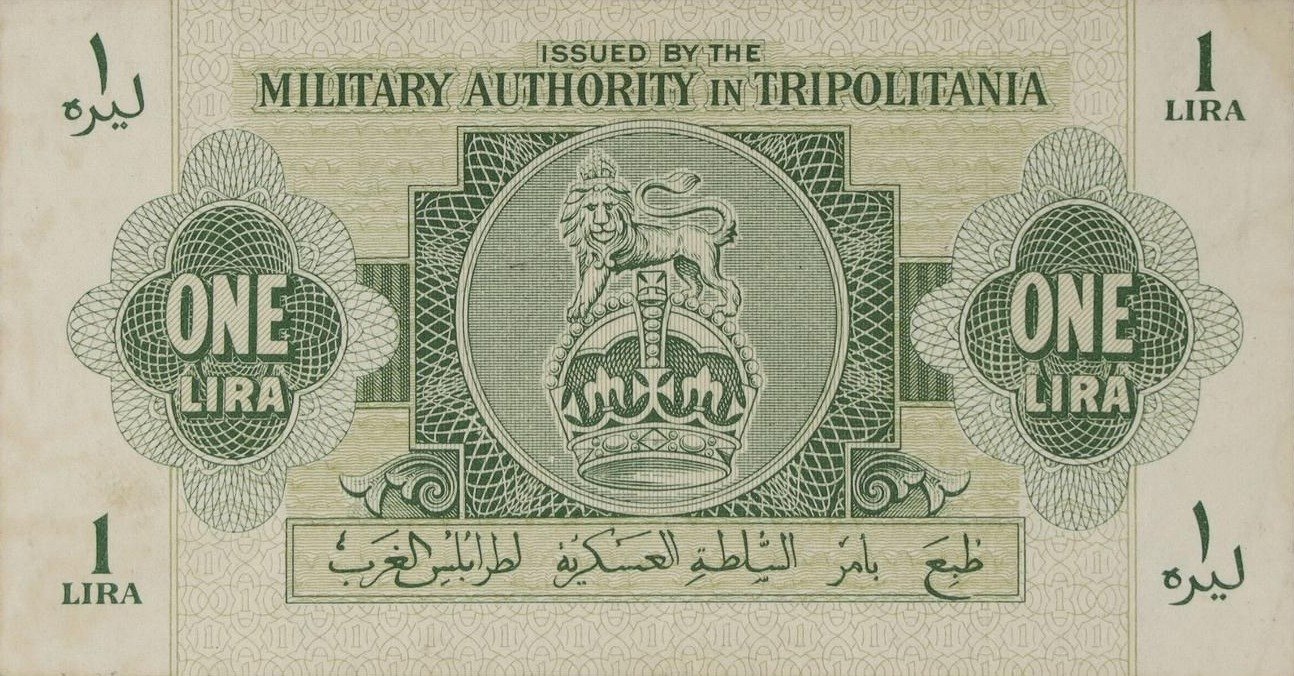
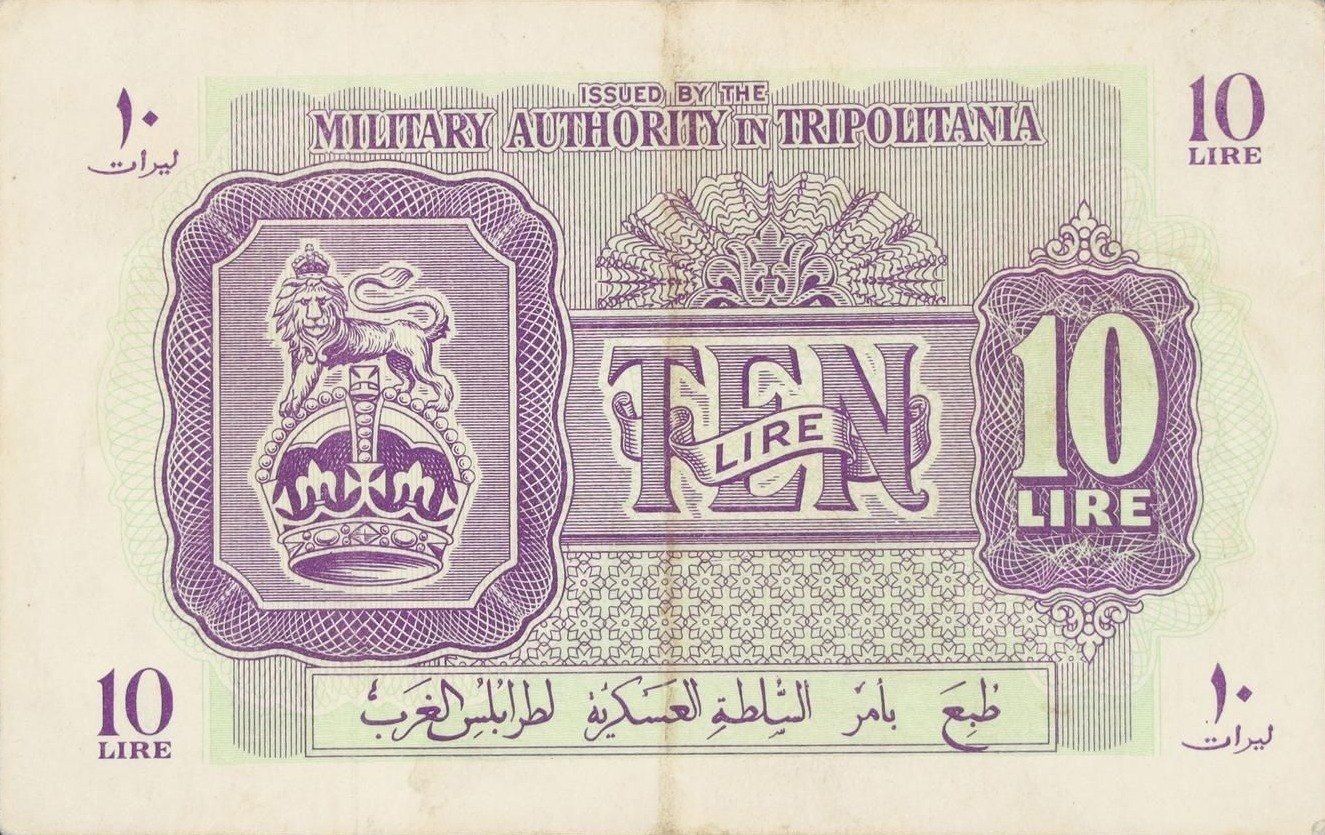
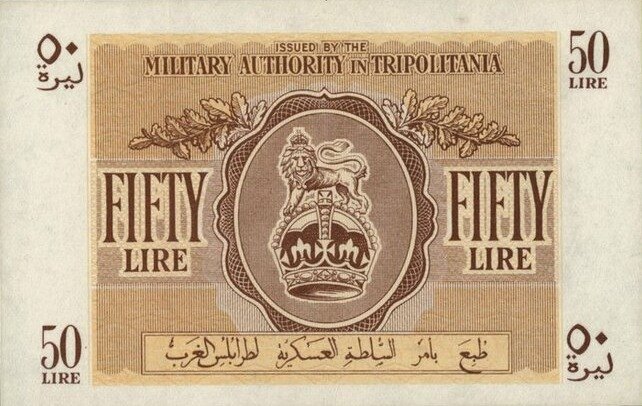
There were eight values:
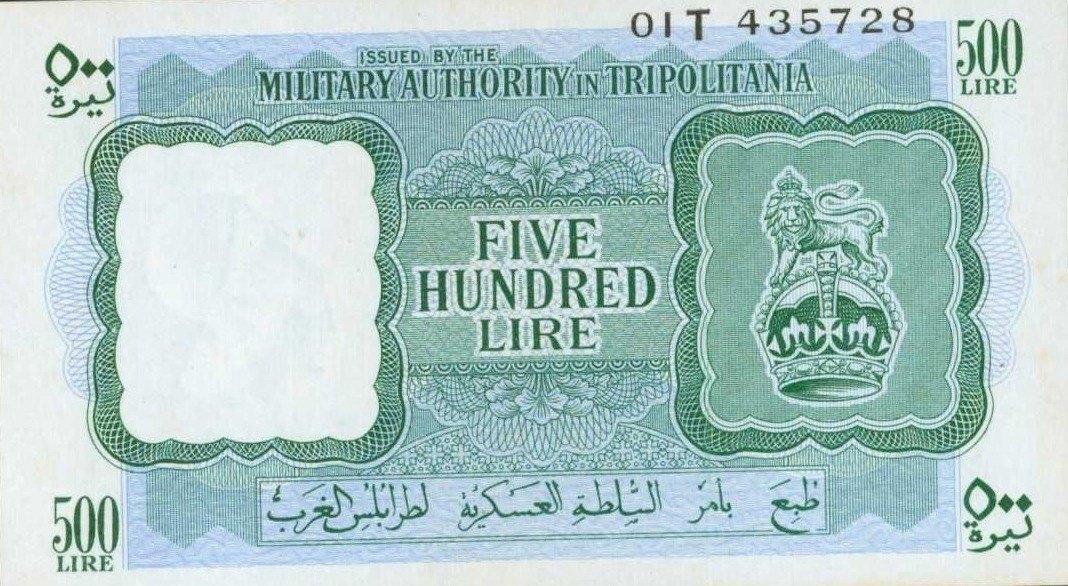
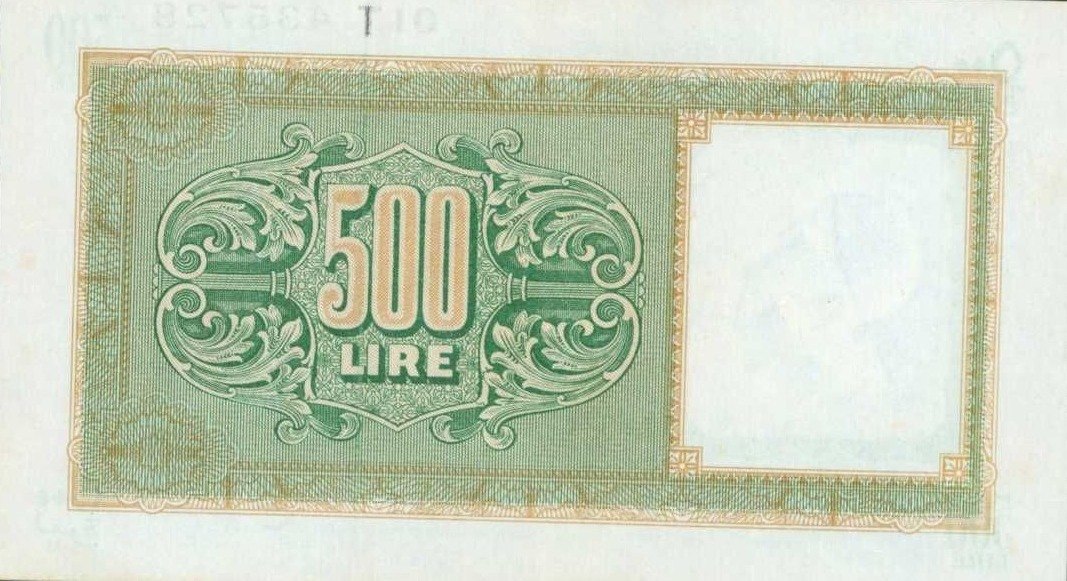
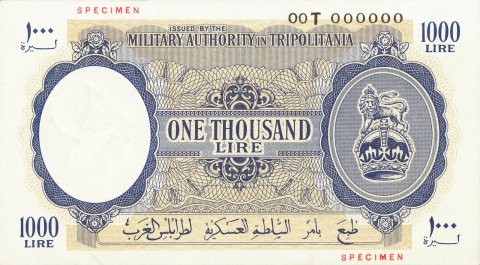
The catalogue's pages give the printer as the Bank of England Printing Works and note a solid security thread. The issued notes carry no signature and no date. Spink's description of lot 1018 in its sale of 30 September 2004 gives every value a lion on a crown at right, with the value at the centre and in each corner. The catalogue records four sizes: 112 by 58 mm for the 1, 2 and 5 lire, 115 by 75 mm for the 10, 50 and 100 lire, 140 by 77 mm for the 500 lire and 150 by 85 mm for the 1,000 lire. No source read for this article gives the number of notes printed of any value.
The exchange of the old money: two dates
The sources give two different days for the end of the money the lira notes replaced.
The report of Blowers and McLeod says the British Military Administration pound and the metropolitan lira were retired and ceased to be legal tender in the territory on 30 November 1943.
Technical Manual 14-511, as Schwan quotes it in Bank Note Reporter of June 1994, cites a British proclamation. Under it, British Military Authority notes and Italian lire notes of more than 5 lire had to be exchanged for Military Authority notes by 10 December 1943, and after that day only the legal tender currency was to circulate. The export or import of Military Authority currency was forbidden in Tripolitania. Schwan remarks that these dates had not been available to collectors before.
Neither date is settled here. Neither source prints the proclamation itself, and its number and date were not found.
Both sources agree on the small change. The manual says Italian lire notes and coin of 5 lire and under remained legal tender beside the Military Authority notes. Blowers and McLeod say the denominations of five lire or less were allowed to stay in circulation to meet the need for small change, and were accepted at face value as equal to Military Authority lire.
The 1, 2 and 5 lire and the manual of 1944
Schwan noticed that the manual of March 1944 neither lists nor pictures the 1, 2 and 5 lire, though it pictures the higher values. Schwan suggested that these three values may not have been issued at first, and offered this as a guess, not as a finding. Symes, after quoting the report of Blowers and McLeod, lists all eight values without saying when each came out. The question is open.
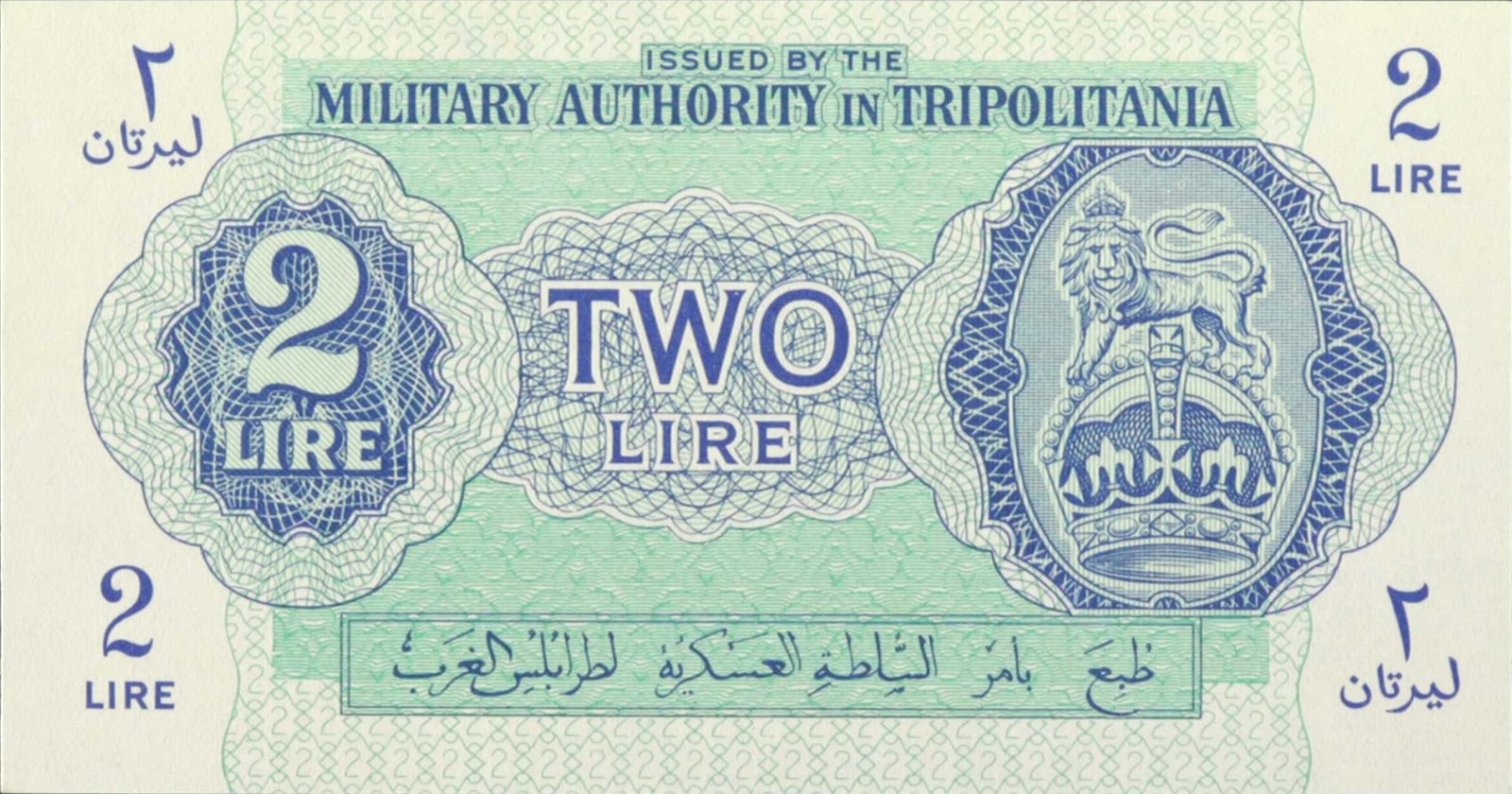
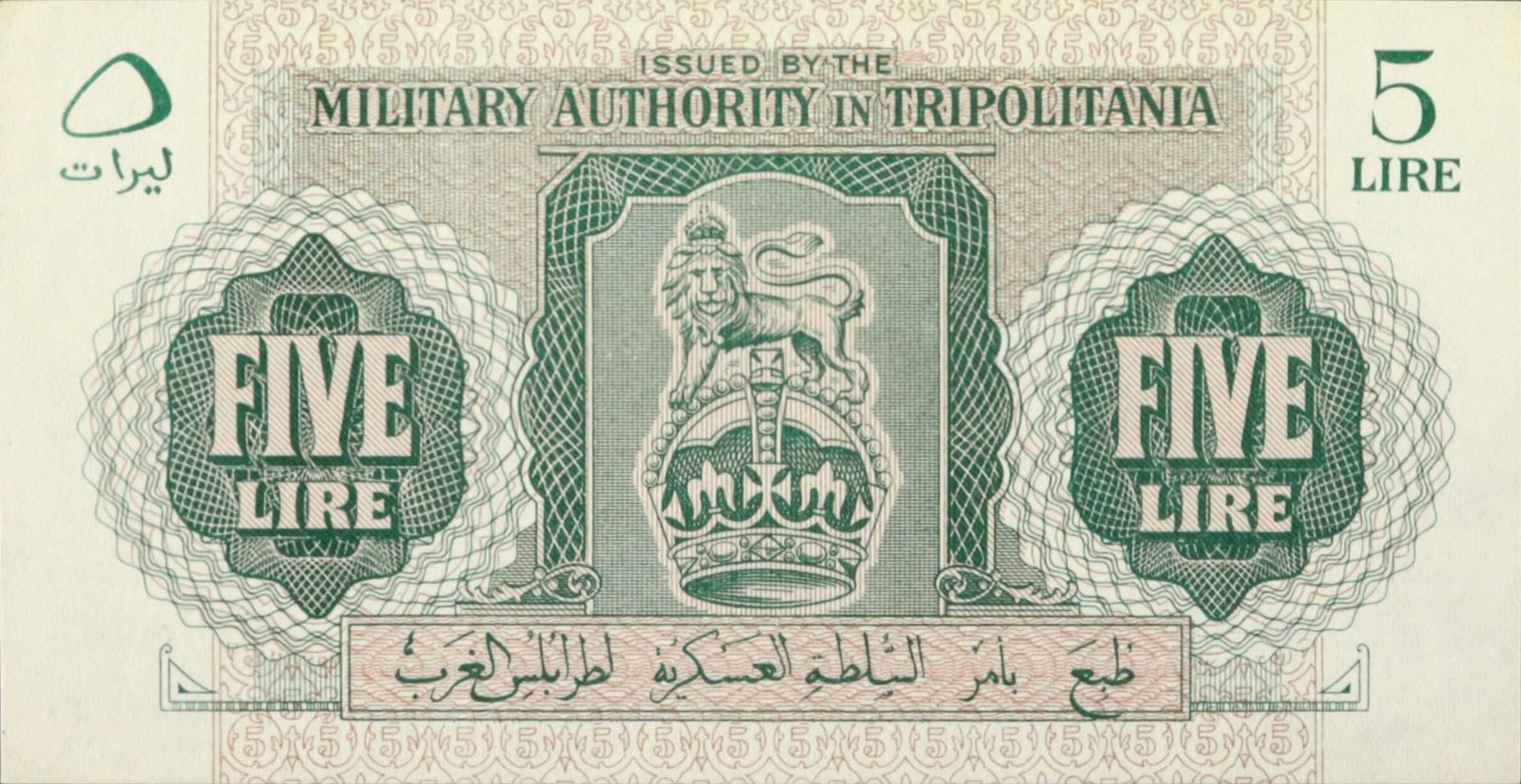
In an earlier article in Bank Note Reporter, in June 1982, Schwan wrote that less was known of the Tripolitania notes than of the British Military Authority notes they replaced, that it was believed the lira issue replaced the sterling notes because of some difficulty with them, and that there was no confirmation of this.
Numbering
The catalogue's pages record that the 1 to 100 lire were printed without serial numbers. One note of these values cannot be told from another except by its condition.
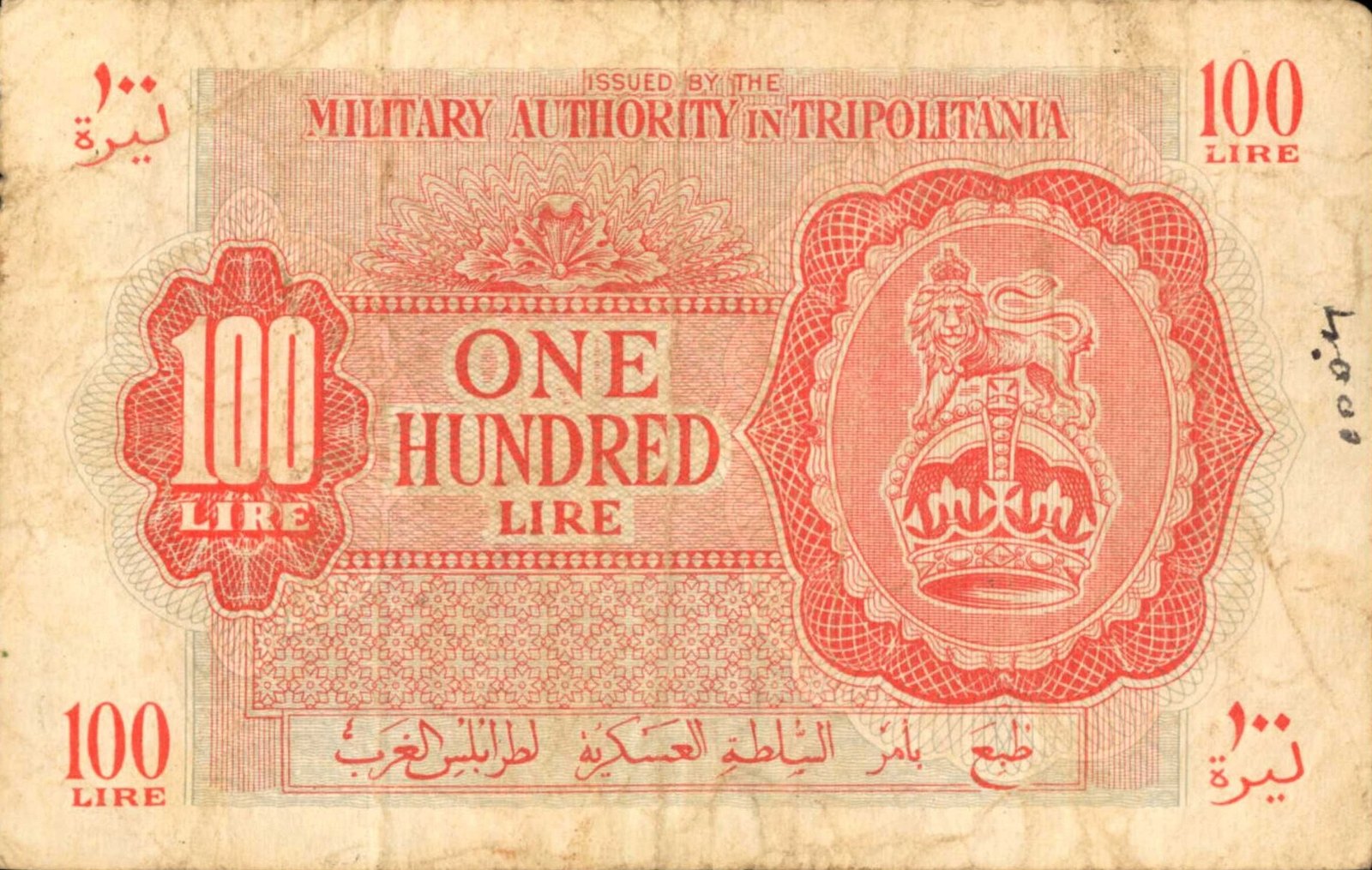
Only the two highest values are numbered. The number is printed in black at upper right: a two-digit block number, the letter T and six digits. The catalogue lists the 500 lire with the blocks 01T to 03T and the 1,000 lire with the blocks 40T and 41T. Shafer's review of van Elmpt's book says the book labels the lira notes Series T of the British Military Authority issues, and that only the 500 and 1,000 lire carry the letter. The 500 lire has a blank panel at left for the watermark, which a grading-company holder calls a Britannia head; the 1,000 lire has a blank oval.
What the writers and the houses say of the high values
Schwan wrote in Bank Note Reporter of June 1982 that the Tripolitania notes are met with less often than the British Military Authority notes, that the 500 and 1,000 lire are much harder to find than the rest, and that the 2 lire, for a reason not known, turns up less often than the 1, 5 and 10 lire.
The auction houses say much the same of the two high values, each from its own experience. Heritage Auctions, describing lot 28451 in its sale of 4 January 2018, said the 1,000 lire offered was only the third example the house had handled and that it had offered none since September 2015. Stack's Bowers, describing lot 20547 in its sale of 2 October 2024, called its 1,000 lire the highest graded in the PMG population report at that time. In its description of lot 1241 on 12 January 2017 Stack's Bowers held that the 500 lire is the harder of the two to find. These are the houses' statements, and none of them gives a count of the notes known.
A contemporary counterfeit of the 100 lire exists and has its own row in the catalogue. How to tell it from a genuine note is set out in The specimens, stage proofs and counterfeit of the Tripolitania lira notes.
1952: exchanged for Libyan pounds
Symes gives the steps by which the lira notes were replaced. On 21 November 1949 the United Nations resolved that Libya should become independent before 1 January 1952. The Libyan Currency Law, Law No. 4, was enacted on 24 October 1951 and set up the Libyan Currency Commission. Libya became independent on 24 December 1951, and the Commission held its first meeting in London on 12 February 1952.
The First Report of the Libyan Currency Commission and the Libyan Currency Law of 1951 were not read for this article: they are given here as the catalogue's filed record of the currency board papers cites them. That record cites the First Report for Currency Notices 14 and 15 of 11th March 1952: the law came into force on 24th March 1952, the old currency was redeemed from 24th March to 24th June 1952, and it was not legal tender from 24th June 1952. It cites articles 12 and 13 of the Libyan Currency Law of 1951 for the rate of 480 Military Authority lire to one Libyan pound, and notes that the Libyan pound was at par with the pound sterling. Symes gives the same rate, and says the new currency was placed into circulation on 24 March 1952.
Symes adds that the exchange was first planned to last three months in all three provinces. It did so only in Tripolitania. In Cyrenaica, where Egyptian pounds circulated, it ended on 25 April 1952, and in the Fezzan, where Algerian francs circulated, on 12 April 1952.
After the exchange, Symes writes, 1,216,247,049 British Military Authority lire, equal to 2,533,848 Libyan pounds, were handed over to the British Government. This is the only figure found for the quantity of the lira notes, and it is a figure for what was redeemed in 1952, not for what was printed.
Sources
- The catalogue's pages for the eight notes of the Military Authority in Tripolitania.
- Peter Symes, "The Libyan Currency Commission", International Bank Note Society Journal, volume 43, no. 4 (2004), pp. 44 to 51.
- G. A. Blowers and A. N. McLeod, "Currency Unification in Libya", Staff Papers of the International Monetary Fund, volume II, 1951-52, as quoted by Symes.
- First Report of the Libyan Currency Commission: Currency Notices 14 and 15 of 11th March 1952, as cited in the catalogue's filed record of the currency board papers (the report itself was not read).
- The Libyan Currency Law, 1951 (Law No. 4), articles 12 and 13, as cited in the same record (the law itself was not read).
- United States War Department, Technical Manual 14-511, Foreign Exchange Guide, March 1944, as quoted by Fred Schwan, "War guide could prompt some re-evaluations", part two, Bank Note Reporter, June 1994.
- Fred Schwan, article on British military issues, Bank Note Reporter, June 1982, p. 24.
- Neil Shafer, review of T. F. A. van Elmpt, British Military Authority Occupation Currency 1942-1956, Bank Note Reporter, December 2003, pp. 86 to 87.
- Foreign Relations of the United States, Diplomatic Papers, 1943, General, Volume I, document 875: the Acting Secretary of the Treasury (Bell) to the Secretary of State, 24 April 1943.
- The same volume, document 876: the Secretary of State to Bell, 28 April 1943, with footnote 1.
- Spink, 30 September 2004, lot 1018; Heritage Auctions, 4 January 2018, lot 28451; Stack's Bowers, 12 January 2017, lot 1241; Stack's Bowers, 2 October 2024, lot 20547.
Member comments
Log in or register to post a comment.