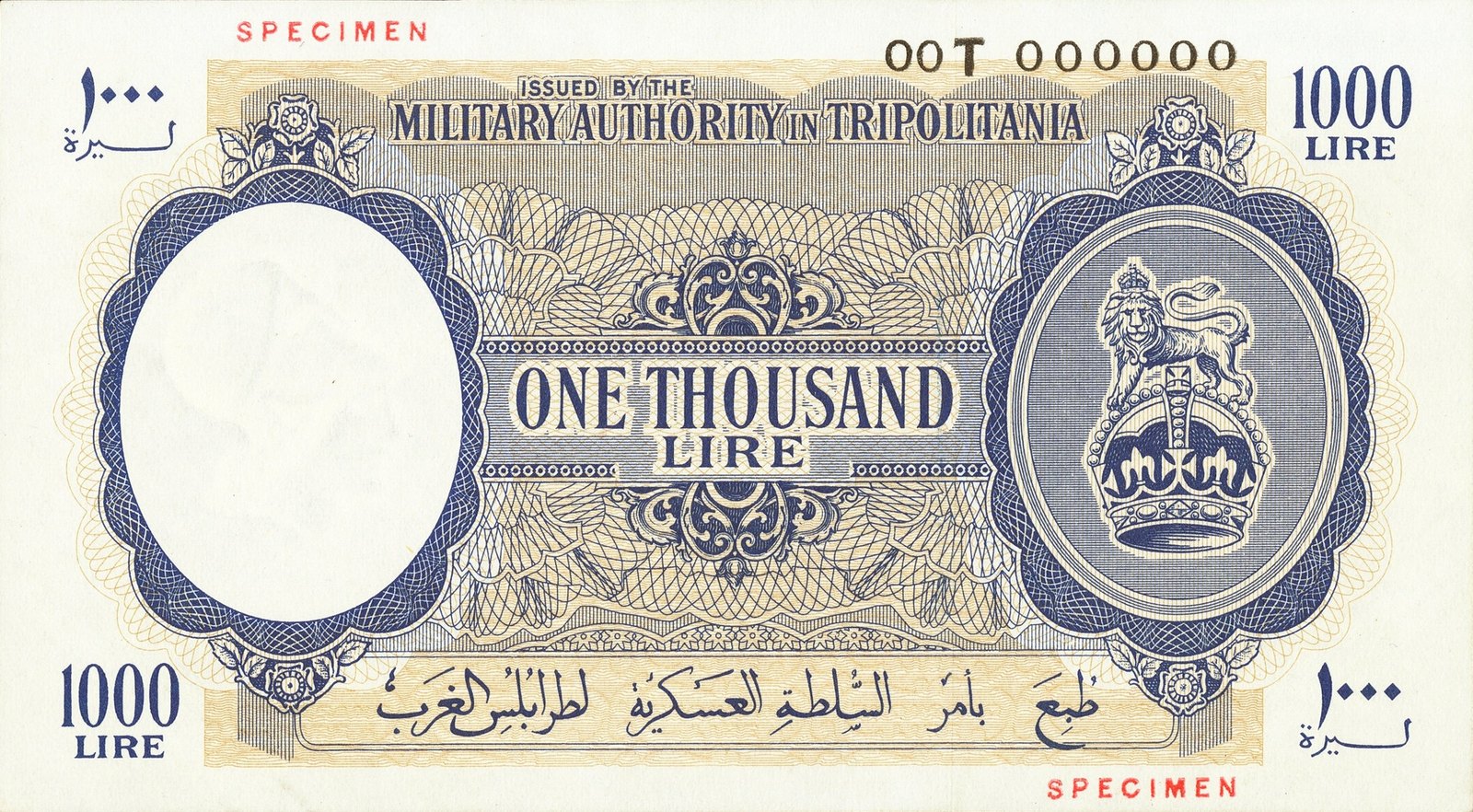
The eight lira notes of the Military Authority in Tripolitania are known as specimens in three different forms, as stage proofs, and, for one value, as a counterfeit made at the time. This article brings together what the catalogue's pages record of them and what the auction houses wrote when the pieces were sold. The story of the issue itself is told in The lira notes of the Military Authority in Tripolitania, 1943 to 1952.
Three forms of specimen
The catalogue's pages record three forms.
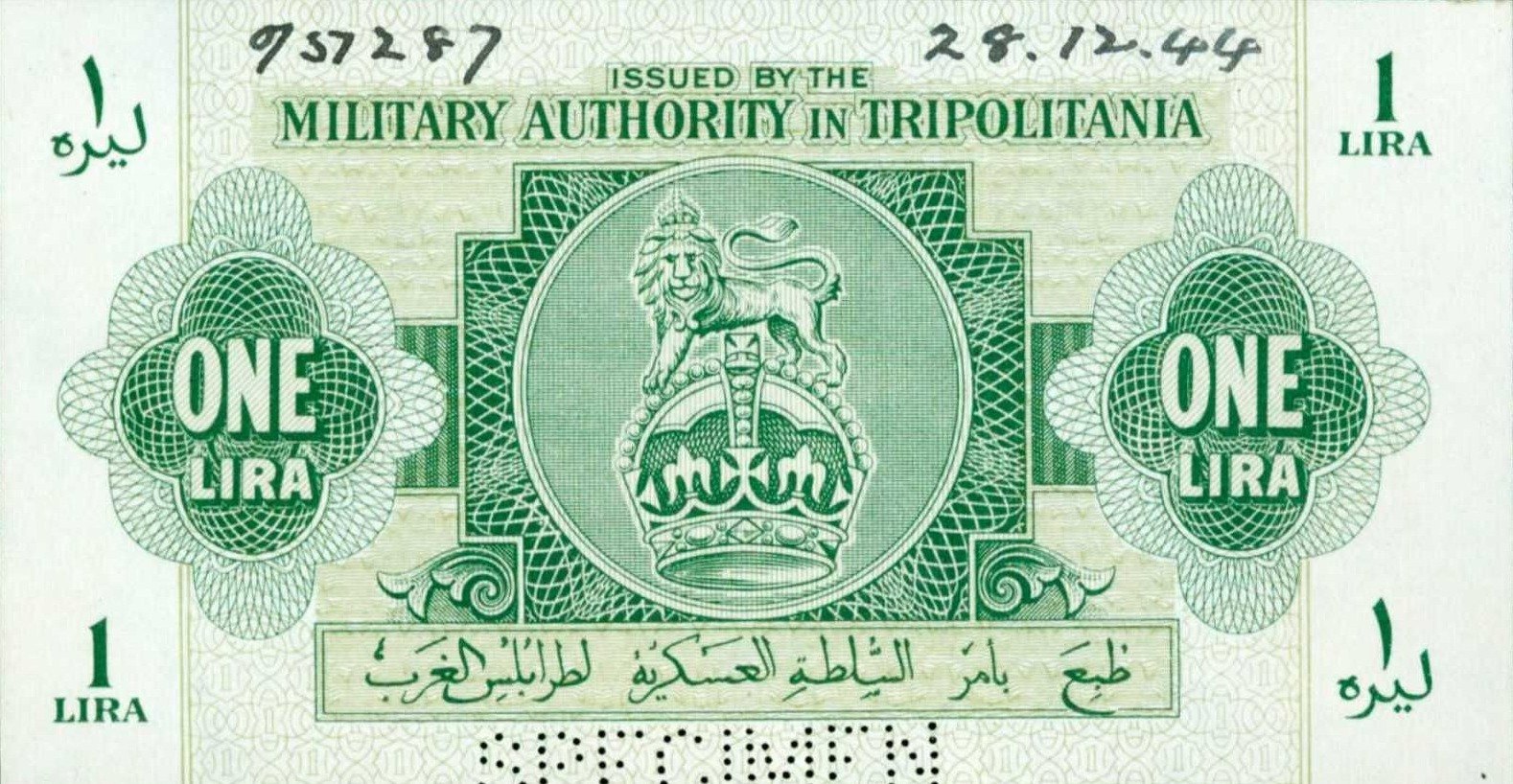
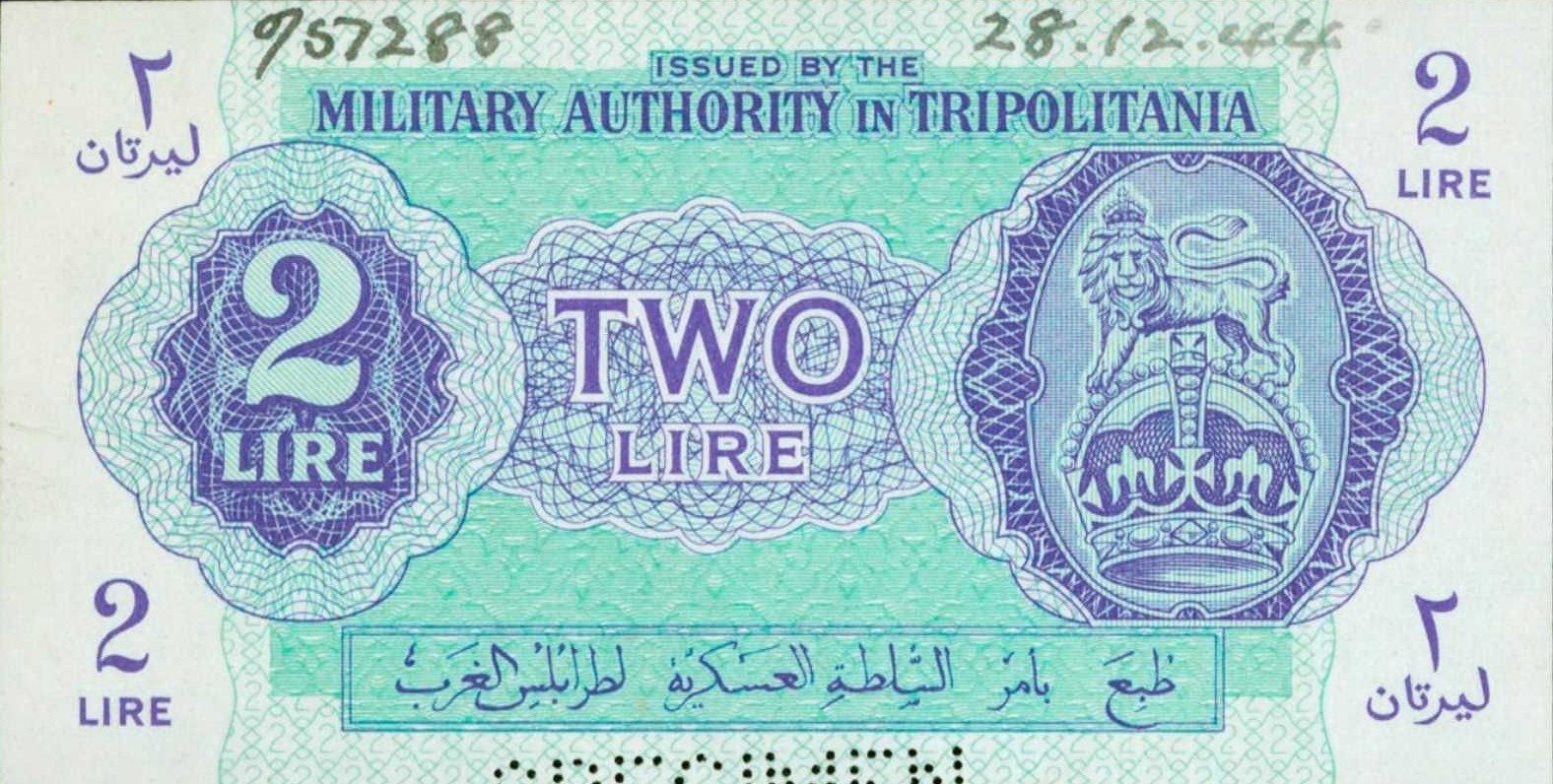
Perforated. The word SPECIMEN is punched horizontally through the note: at the foot on the 1 lira and 2 lire, at the top and at the foot on the 10 lire, 50 lire, 100 lire, 500 lire and 1,000 lire. The perforated 1 and 2 lire carry the printer's ink annotations 957287 and 957288 and the date 28.12.44 in the top margin.
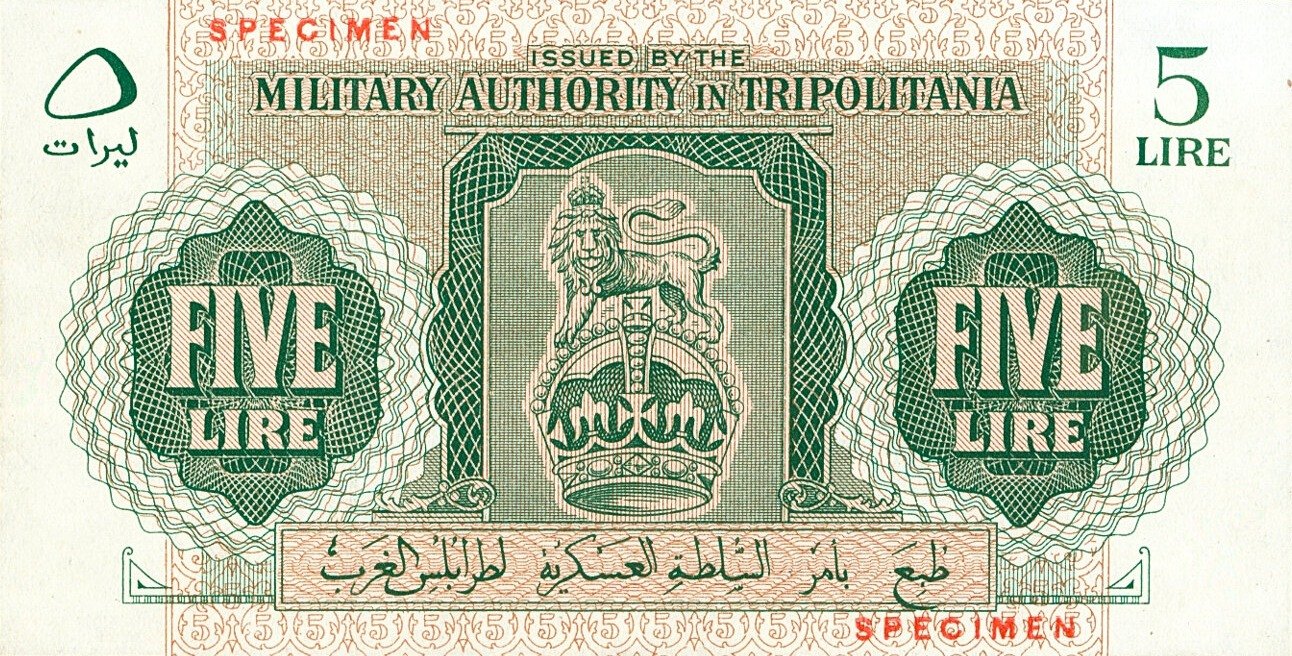
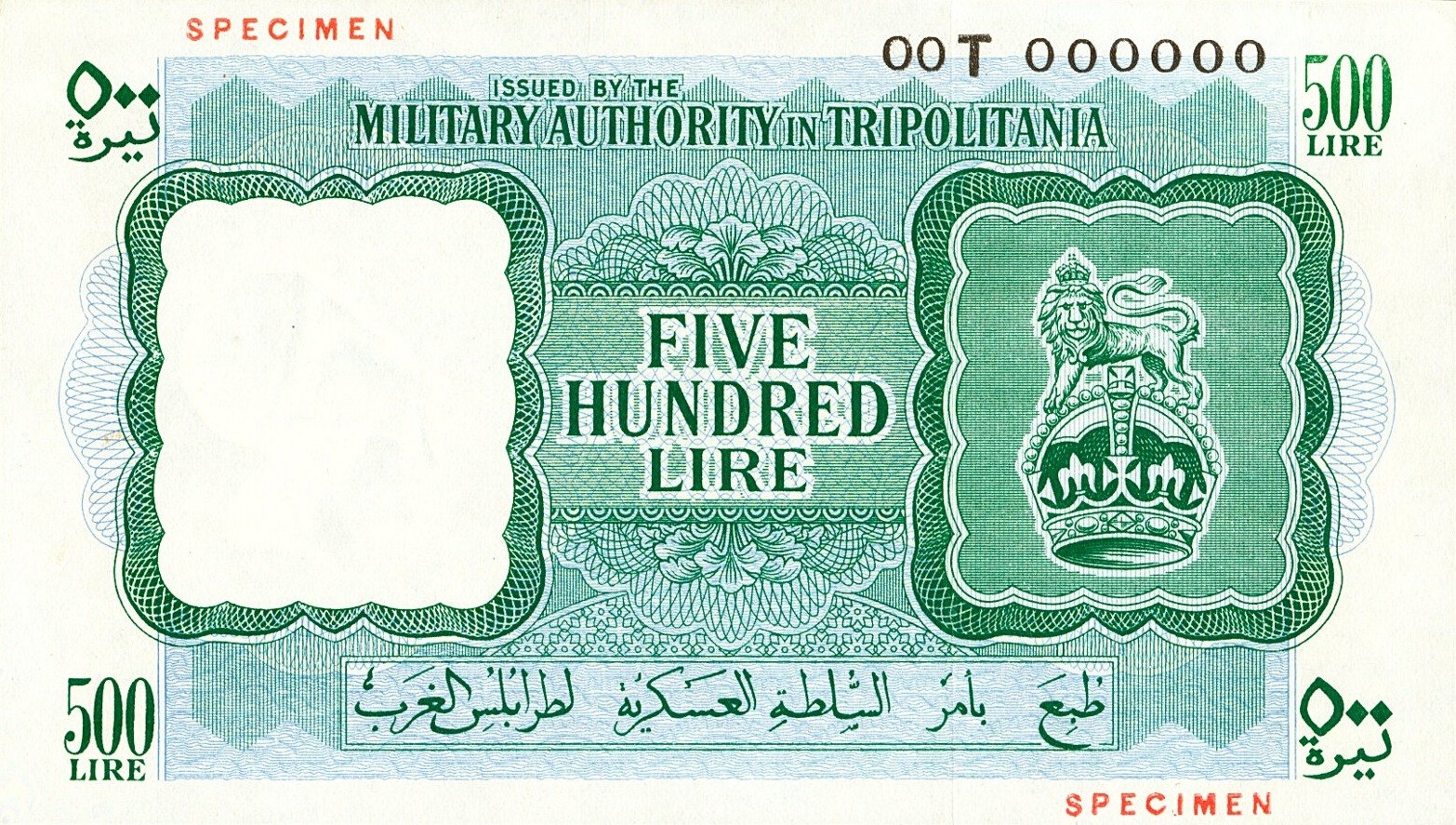
Overprinted. Small red SPECIMEN overprints stand at upper left and lower right, and the note is not perforated. This is the form of the 5 to 1,000 lire in the full specimen sets of those six values.
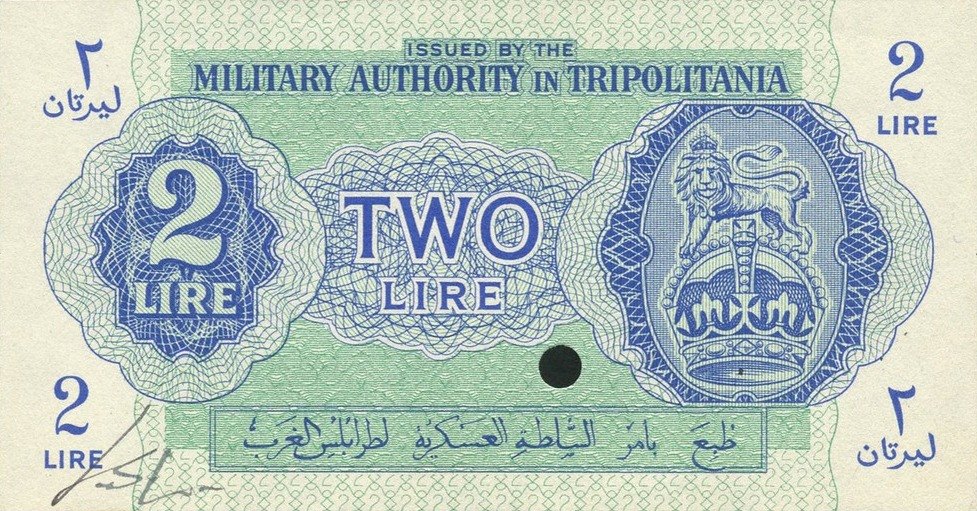
Cancelled, without the word SPECIMEN. The 1 and 2 lire also exist with a single cancellation hole and an ink signature at lower left, and no SPECIMEN marking at all.
The table sets out which value is recorded in which form.
| Value | Perforated | Red overprints | Hole and ink signature |
|---|---|---|---|
| 1 lira | yes, at the foot | not recorded | yes |
| 2 lire | yes, at the foot | not recorded | yes |
| 5 lire | not recorded | yes | not recorded |
| 10 lire | yes, top and foot | yes | not recorded |
| 50 lire | yes, top and foot | yes | not recorded |
| 100 lire | yes, top and foot | yes | not recorded |
| 500 lire | yes, top and foot | yes | not recorded |
| 1,000 lire | yes, top and foot | yes | not recorded |
The 5 lire stands apart. Its specimen has so far been seen only with the red overprints, even in sets whose other notes are perforated.
The 500 and 1,000 lire are the only values with a serial number, and their specimens of both forms carry the number 00T 000000. The specimens of the six lower values have no number, as the issued notes have none.
The sets
Most of what is known of the specimens comes from a small number of sets sold as single lots.
Spink, 30 September 2004, lot 1018, was a set of all eight values. Spink's description says every note was perforated SPECIMEN except the 5 lire, that the 1 and 2 lire had a printer's ink annotation in the top margin with the date 28.12.44, and that the last two notes were numbered with zeros. Spink dated the series 1942 in this description. The catalogue and the reports of the time date the issue to 1943.
Spink, 27 April 2006, lot 1041, was a set of the six values from 5 to 1,000 lire. Spink's description says each had a small red specimen overprint at top left and lower right and a small ink numeral at the top of the back, and that the 500 and 1,000 lire were numbered 00T 000000.
Noble Numismatics, 2 April 2009, lot 3723, was again the six values from 5 to 1,000 lire. Noble's description says the first note, the 5 lire, was overprinted in red and the other five were punctured. It adds that the 5 lire had "47.W.43" written neatly in pencil on the back at top left. Noble does not say what the pencil mark means, and no other source read here explains it.
The filed record of NASCA's sale of the Stanley Gibbons collection, part II, in December 1981 shows that lot 2055 was also a set of specimens of the 5 to 1,000 lire. The record does not say which form they took.
Heritage Auctions, 24 October 2024, sold specimens with the red overprints from the Ibrahim Salem Collection one by one: the 10 lire (lot 24037), the 50 lire (lot 24038), the 500 lire (lot 24040) and the 1,000 lire (lot 24041). Heritage's descriptions refer the reader to pages 22 to 29 of a work the house cites as "IS Libya". Of the 1,000 lire Heritage said that, when the lot was catalogued, it was the only specimen of that value that PMG had graded.
Single perforated specimens have also been sold. Stack's Bowers, 12 August 2016, offered the 1 lira (lot 30322) and the 2 lire (lot 30323) in the same sale, each described as having specimen annotations and perforations. A perforated 1,000 lire in a grading-company holder at 66 was sold by Spink on 15 April 2014 (lot 1040) and again by Noonans in 2021.
Stage proofs and the dates of 1944
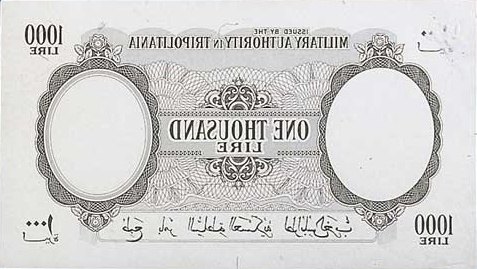
The catalogue's Design Archive holds stage proofs of four values: grey uniface proofs of the face underprint of the 2 lire, the 5 lire and the 1,000 lire, and black-and-white proofs of the face of the 500 lire and the 1,000 lire printed in mirror image, those of the 500 lire with registration letters.
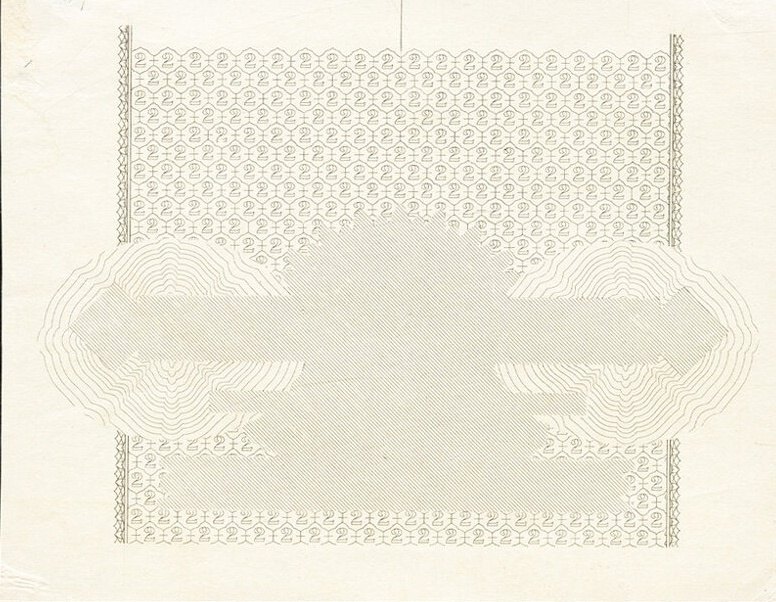
The grey proofs were sold together by Heritage Auctions on 26 April 2018 as lot 28314: five pieces, two of the 2 lire, one of the 5 lire, one of the 1,000 lire and one without a value. Heritage's description says each shows only the underprint, in grey ink on thin paper, that the pieces had once been mounted, and that the back of the 1,000 lire is pencilled "Proposal No. 45 9/6/44 1000".
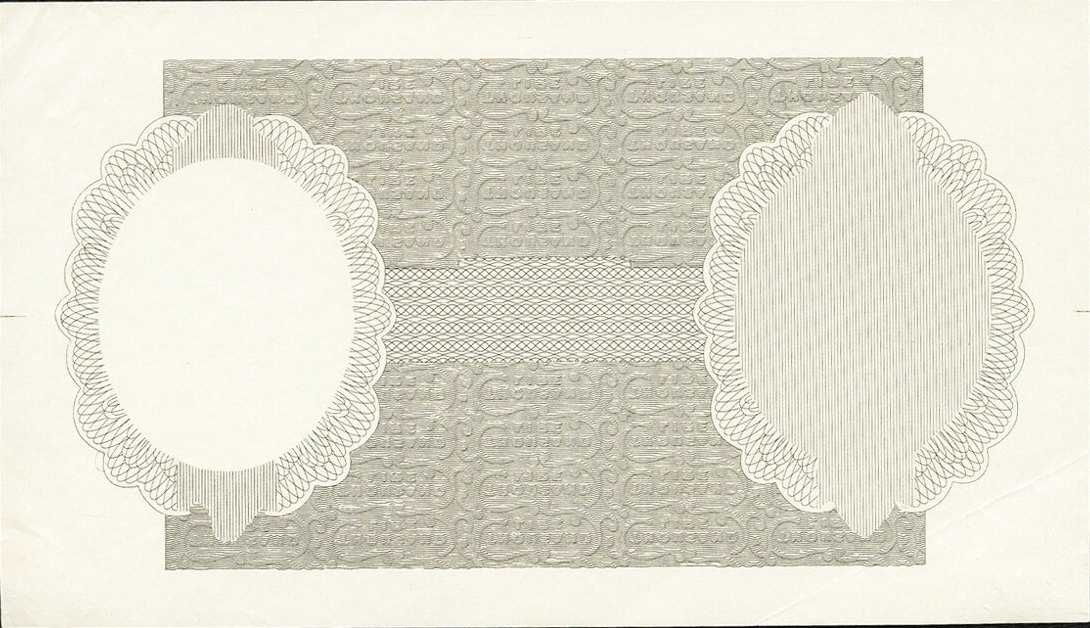
Two dates of 1944 therefore stand on this material: 9/6/44 on a stage proof of the 1,000 lire and 28.12.44 on the perforated specimens of the 1 and 2 lire. Both are later than 15 September 1943, the day the notes were introduced. No source read for this article says why.
The watermark panel
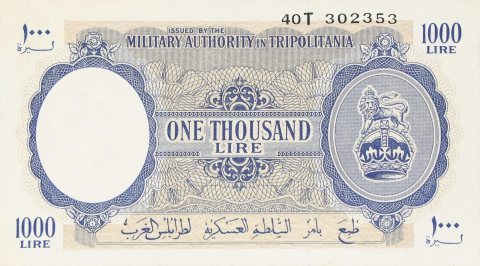
The 500 lire has a blank panel at left and the 1,000 lire a blank oval at left. Both are windows for the watermark. A grading-company holder of a 500 lire calls the watermark a Britannia head. The catalogue's pages note a solid security thread on every value.
The counterfeit 100 lire
A counterfeit of the 100 lire made while the notes were in use is listed in the catalogue as P-M6x. The issued 100 lire has no serial number and no signature, so there is no number to check: only the engraving separates the two. The catalogue's page for the 100 lire names three places to look.
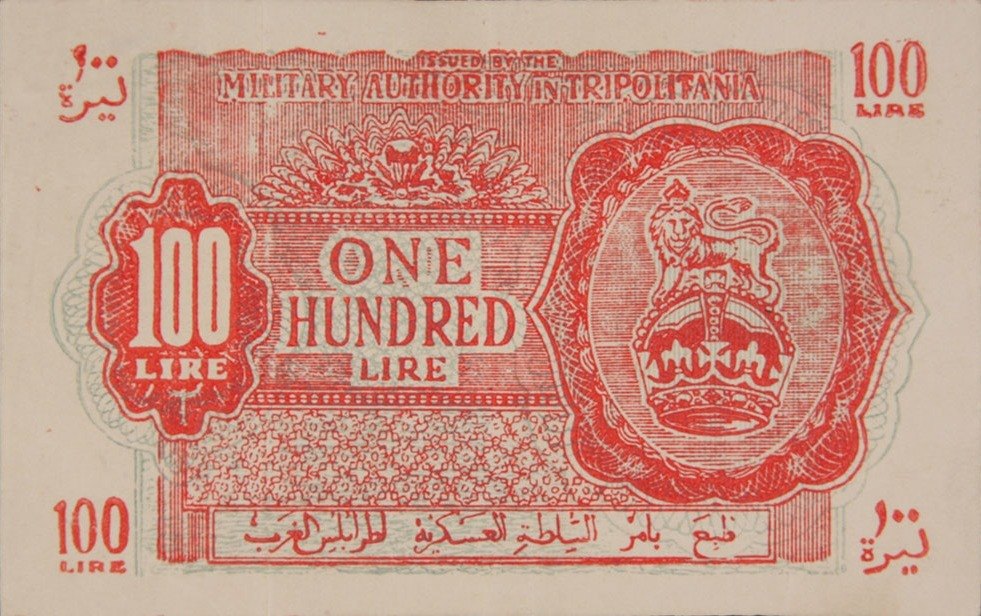
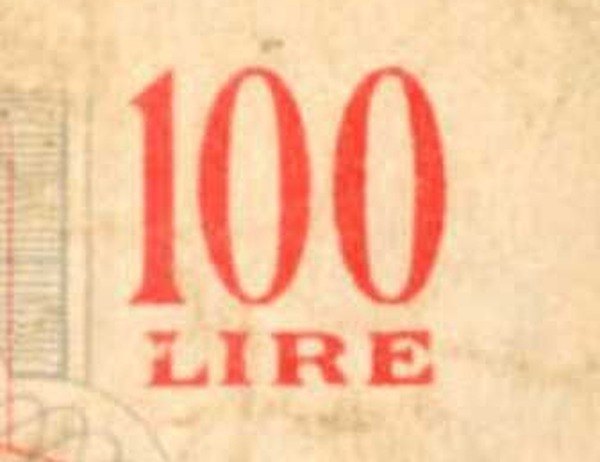
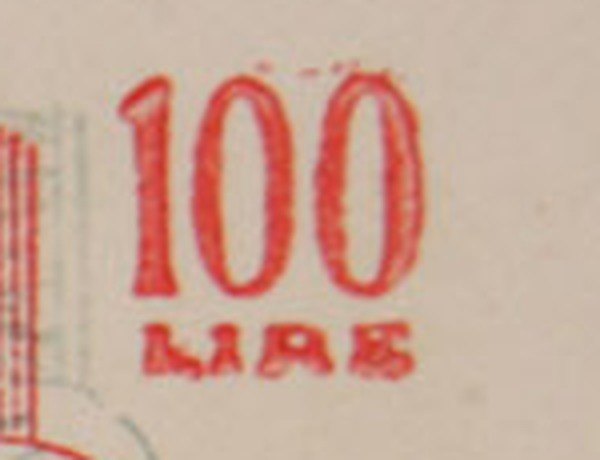
- The corner value at upper right. On a genuine note the word LIRE is in small serifed capitals. On the counterfeit it is in heavy filled block letters.
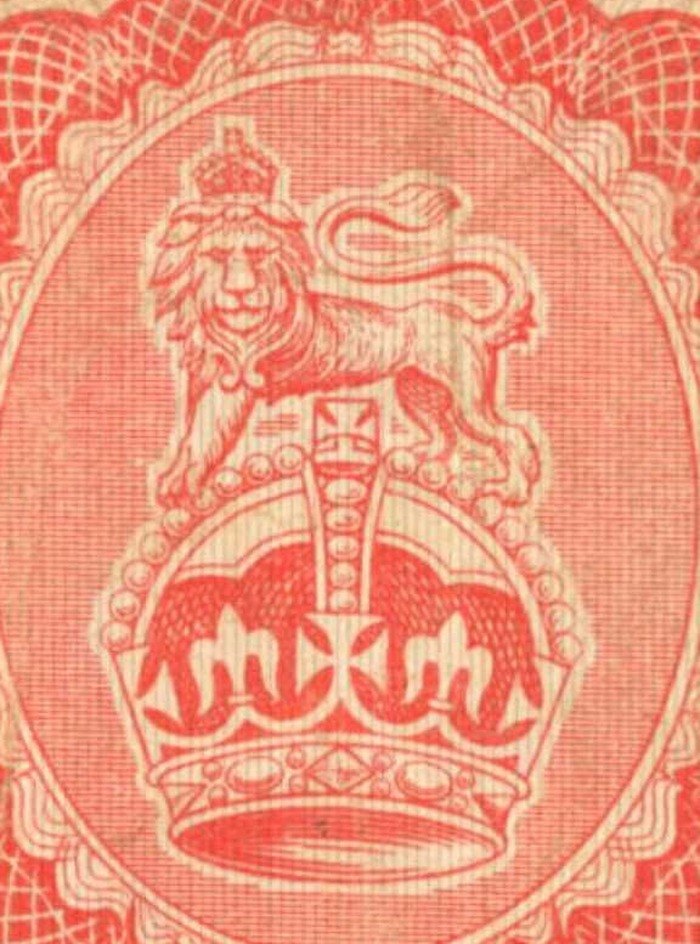
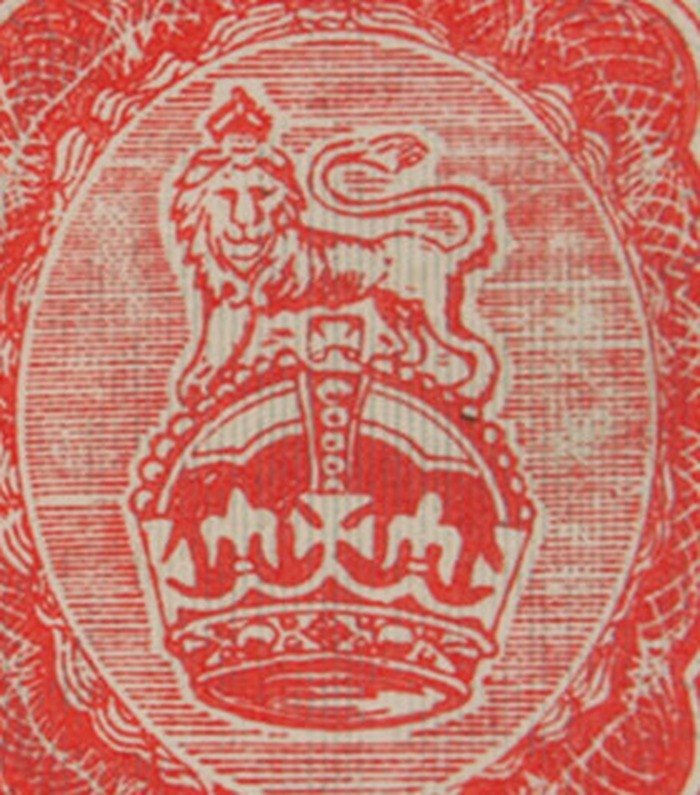
- The oval at right. The genuine lion has a mane of fine curls and a crown with distinct pearls, on a ruled guilloche ground. The counterfeit's mane is a few scribbles, the arches of its crown are solid red, and its oval is a field of coarse lines.
- The lattice beneath ONE HUNDRED LIRE. On a genuine note it is a regular grid of eight-pointed stars. On the counterfeit it is a blotchy tangle.
The page shows pictures of these details. Nothing has been found on who made the counterfeit, where, or how many were passed.
Sources
- The catalogue's pages for the eight notes of the Military Authority in Tripolitania, and its Design Archive.
- Spink, 30 September 2004, lot 1018; Spink, 27 April 2006, lot 1041; Spink, 15 April 2014, lot 1040.
- Noble Numismatics, sale 90, 2 April 2009, lot 3723.
- NASCA, the Stanley Gibbons collection, part II, December 1981, lot 2055.
- Stack's Bowers, 12 August 2016, lots 30322 and 30323.
- Heritage Auctions, 26 April 2018, lot 28314; Heritage Auctions, 24 October 2024, lots 24037, 24038, 24040 and 24041.
- Noonans, 2021 (the perforated 1,000 lire specimen sold by Spink in 2014).
Member comments
Log in or register to post a comment.