For every note that reached a bank counter, the printers drew several that did not. A design could lose the contract to another firm, be dropped for a better layout, be overtaken by a war, or simply outlive the King whose portrait it carried. The design archive of this catalogue records what is left of them: hand-painted essays, printer's models and the photographs the printers kept of each proposal.
This article goes through the designs with King George V and King George VI that were never issued, territory by territory. Everything in it is taken from the pieces themselves, as they are recorded in the archive: what is printed and pencilled on them, and what was said of them when they were sold. Where that record gives a reason for a design being set aside, the reason is given here; where it gives none, none is guessed. Dates printed on a design are written as "1st January 1936"; days of events as "1 January 1968".
A firm that did not get the order
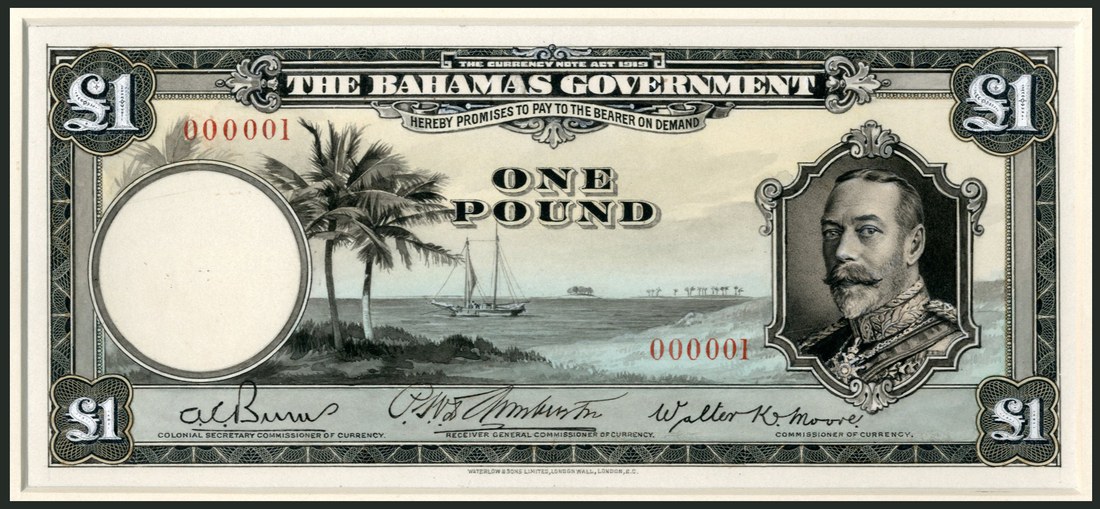
The plainest case is a 1 pound for the Bahamas Government, made by hand and mounted on a board that carries the embossed specimen seal of Waterlow & Sons. George V is at the right, a shoreline with palms and a schooner at anchor fills the centre, and the number 000001 is printed in red. The Currency Note Act 1919 is named along the top, so the design was offered while the first Government issue was being settled. Someone has written "Not accepted" in pencil in the upper margin. The 1 pound that was issued came from the American Bank Note Company instead, in a form with three vignettes (P-4).
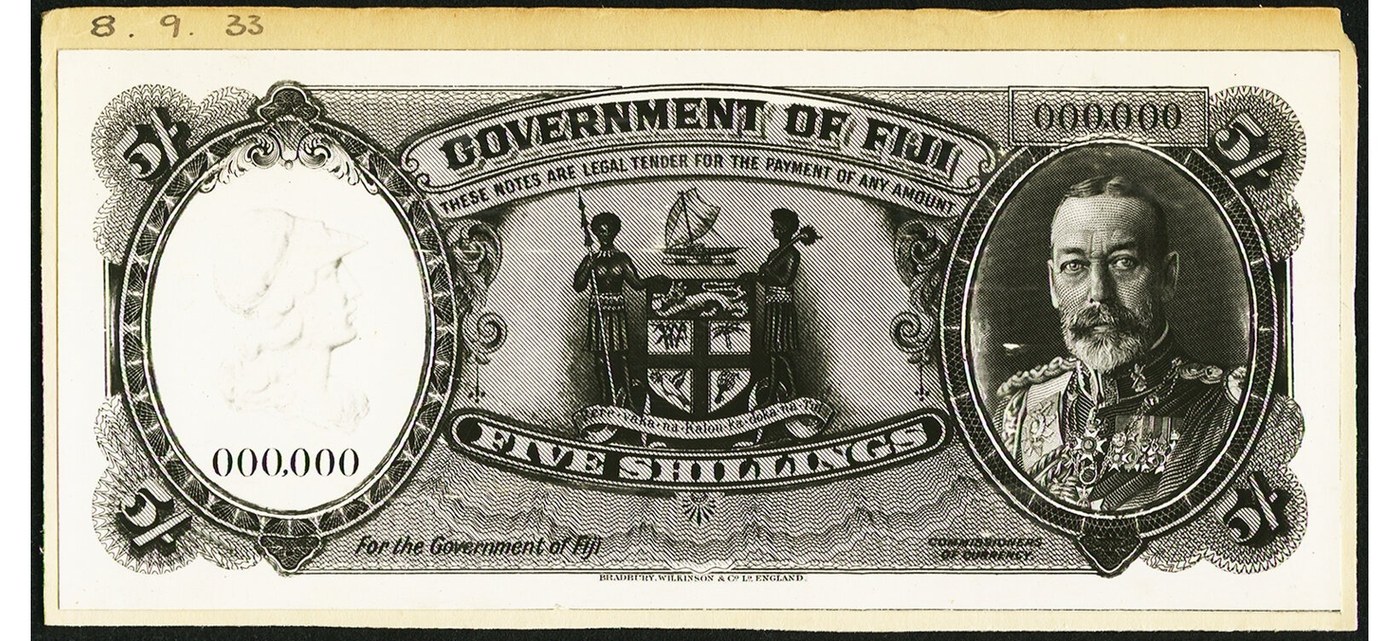
Fiji shows the same thing from both sides. For the notes of 1934 Thomas De La Rue prepared a 1 pound dated 1st January 1934 with the King at right and the serial number B/1 00000. The contract went to Bradbury Wilkinson, whose 1 pound came out with the same date and the same first prefix in a quite different frame (P-33). But Bradbury Wilkinson's own first idea was not issued either. A photograph of its 5 shillings, dated 8.9.33 in pencil, has the arms of the colony drawn large in the middle of the note. On the note as issued the arms were made smaller and moved to the top.
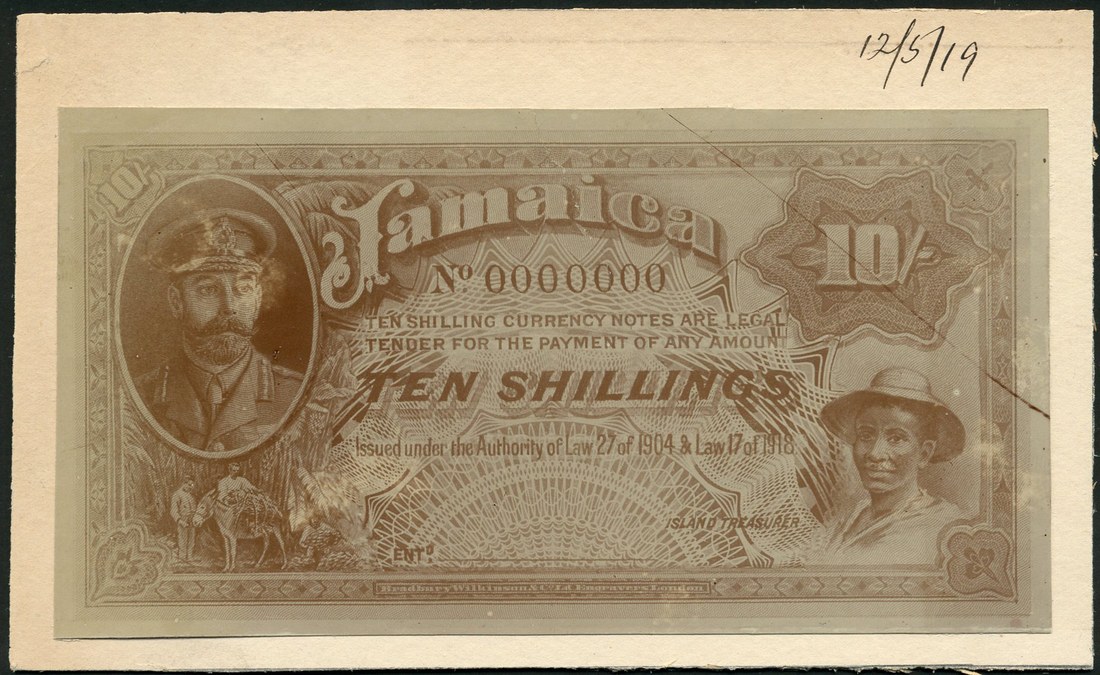
Jamaica has the longest run of refusals. Bradbury Wilkinson photographed a 5 shillings and a 10 shillings in 1919, the second dated 12th May 1919, with George V in military uniform and cap at the left and scenes of ox carts, cane cutting and banana carriers. About 1928 the same firm tried again, with the arms and the King set at an angle in the top corners and Roaring River Falls in the centre. In the early 1930s, by the dating of the auction house that sold it, De La Rue painted a 5 shillings and a 10 shillings with a waterfall between sugar cane and bananas when it bid for the new Government notes. That contract went to Waterlow.
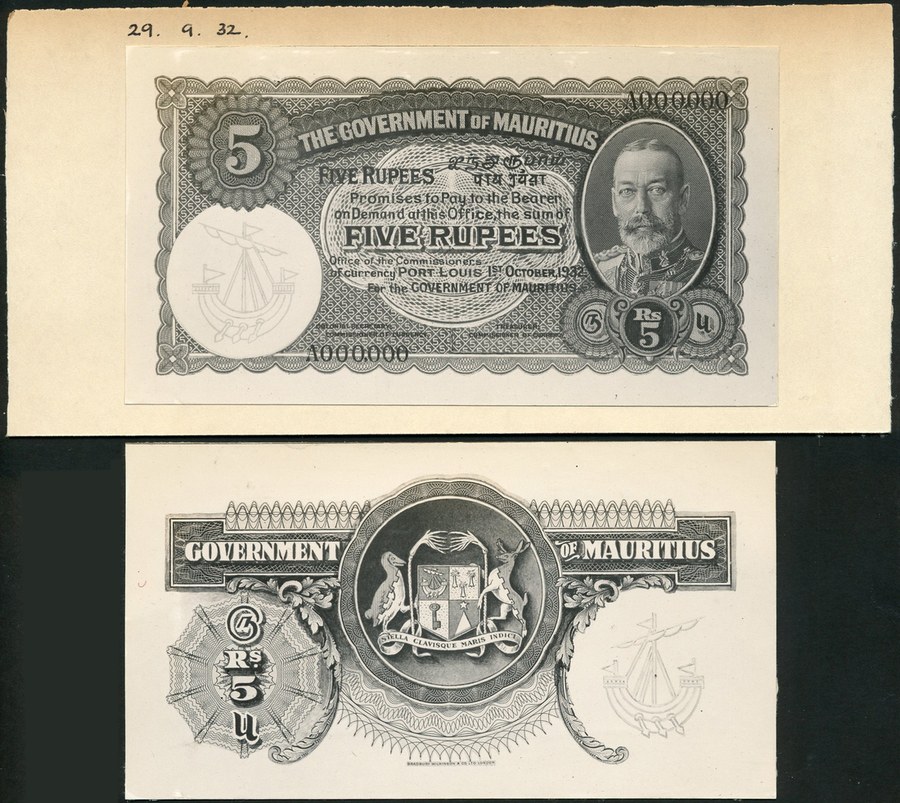
For Mauritius, Bradbury Wilkinson's photographs of a 5 rupees, a 10 rupees and a 20 rupees are all dated 1st October 1932, and all three cards are marked 29. 9. 32. in ink. The King is in uniform at the right, and a sailing ship is drawn in the circle where the watermark would fall. The design is quite unlike the Waterlow notes that Mauritius issued, and no 20 rupees was issued for Mauritius under George V at all, so the third card records a value as well as a design that was not taken up.
Several tries for one note
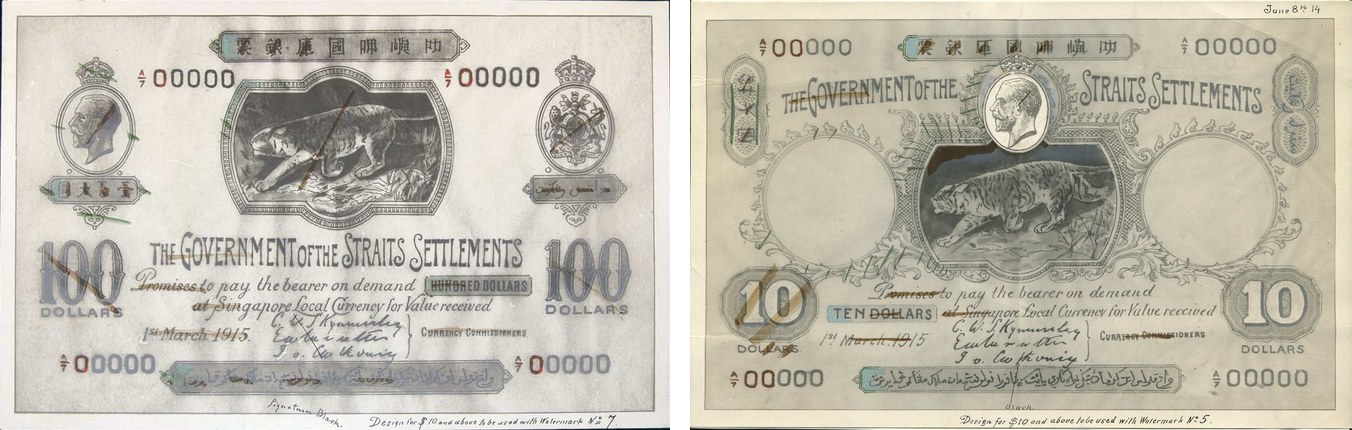
Some designs were not rejected so much as worked through. For the Straits Settlements the archive holds a group of photographs coloured by hand, most of them dated June 8th 14 at the top, for notes dated 1915: a 100 dollars of 1st March 1915 in three versions, a 10 dollars in two, and 1 and 5 dollars dated September 1915. Nearly all have George V in a crowned oval and a tiger, with three signatures copied from the issue of 1900, and most carry the printer's notes on colour and on the watermark it was meant for, such as "Design for $10 and above to be used with Watermark No 7". One of the three 100 dollars is the closest to the note adopted in 1916 (P-5); the others went no further.
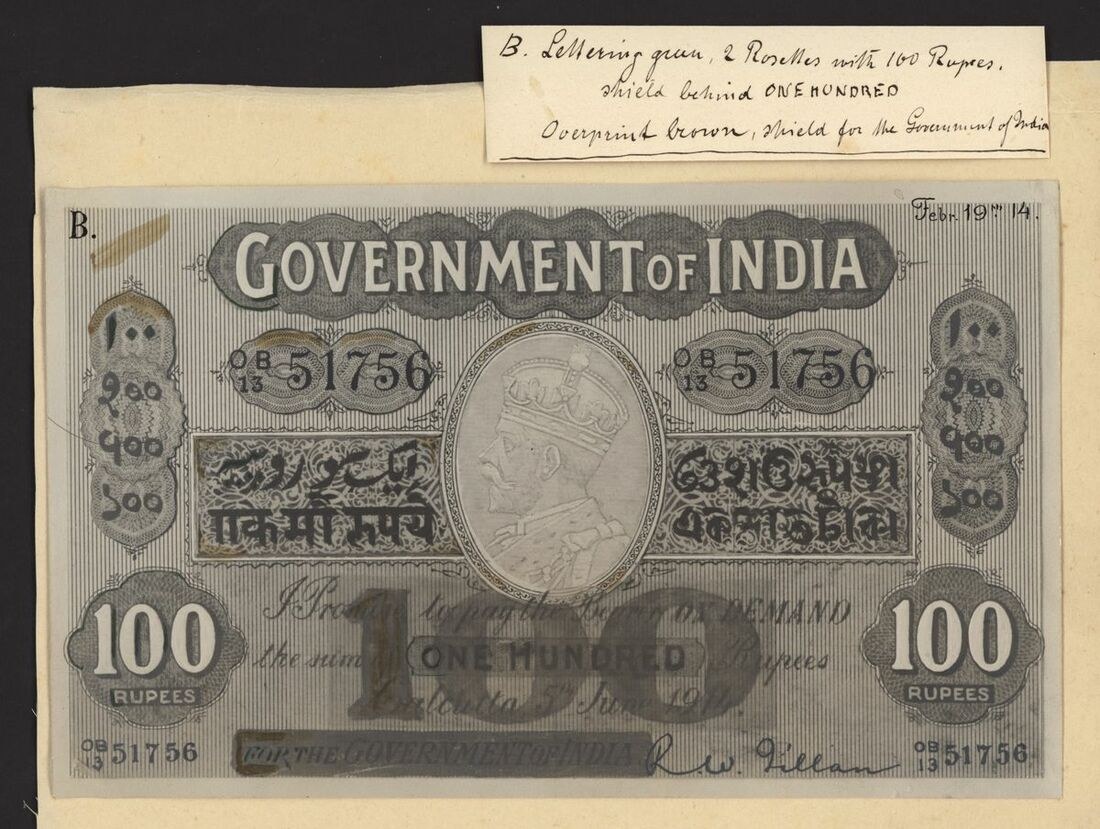
British India has the same kind of record for the first notes to carry the King. Four photographic proofs of a 100 rupees, lettered A to D, place a portrait of George V in the centre of a 100 rupees; each is built on a Calcutta note dated 5th June 1914 with the number OB/13 51756, and a slip on version B gives the colours: "Lettering green ... Overprint brown". A 5 rupees with an elephant and a domed building was not adopted, and a 5 rupees trial of the 1917 series is catalogued as a note of its own, known only as colour trials (P-3); the year of that trial is not settled. The archive also holds more than twenty printer's essays, in as many colour schemes, for a 1 rupee 8 annas with the King between two elephants. No note of that value was issued.
The King died first
Two territories were shown a George V note and never issued one.
For Barbados there are photographs of a 2 dollars with George V at the right and the Neptune vignette in the centre. The card is pencilled 21.3.35 and the design is dated 1st January 1936. The King died twenty days after that date. No note with George V was issued for Barbados, and the 2 dollars that was issued carries George VI (P-3).
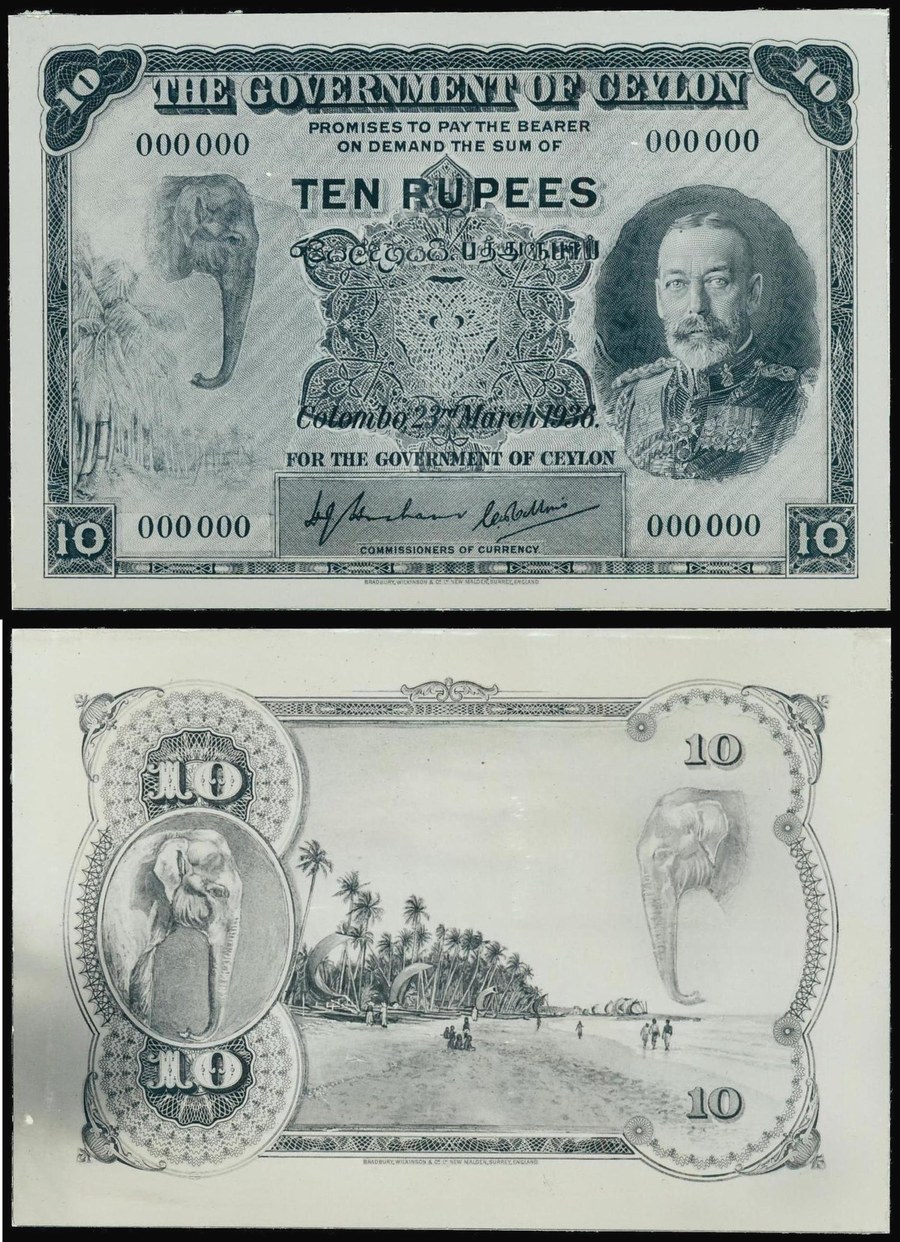
For Ceylon the dates run past the reign. A 10 rupees with George V at right, an elephant watermark and, on the back, a beach with outrigger boats is dated Colombo, 23rd March 1936, two months after the King's death. A 1 rupee with the same portrait and the Bradbury Wilkinson imprint is dated 30th July 1937, more than a year after it. The archive's entry adds that no Ceylon note ever carried the portrait of George V.
George VI: side face or full face
The new reign brought a new round of proposals, and a choice between two kinds of portrait.
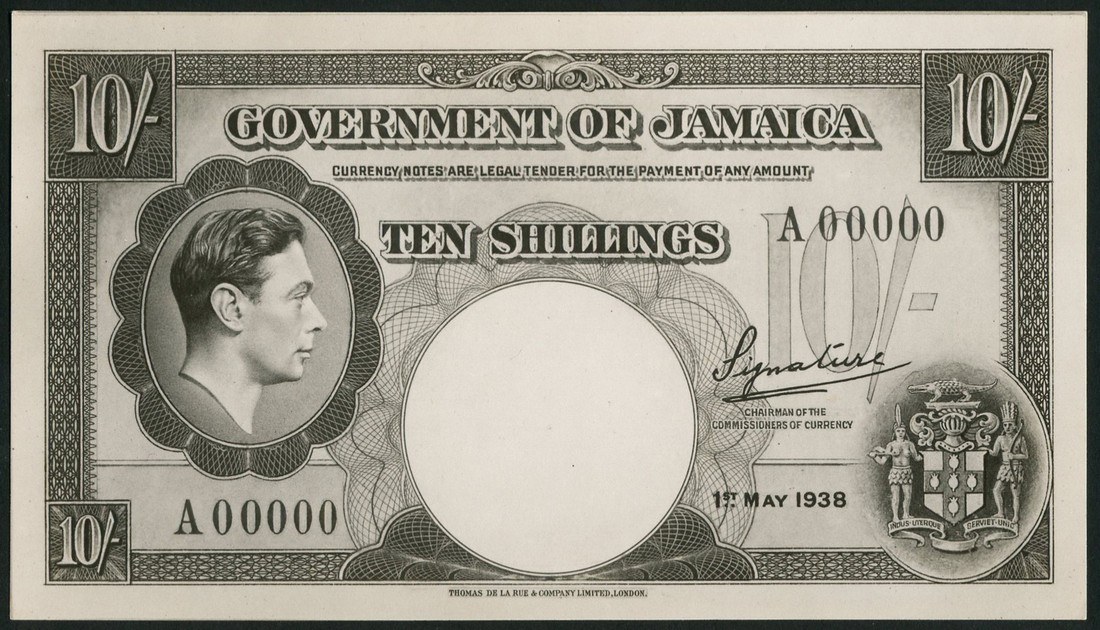
For Jamaica, Bradbury Wilkinson photographed a 5 shillings and a 10 shillings dated 15th January 1938 with the King in uniform at the right. The notes issued with George VI, dated from 2nd January 1939, were printed by De La Rue to a different design. De La Rue's own first proposal, dated 1st May 1938, showed the King in profile. The issued notes kept its arrangement but used a portrait facing the viewer.
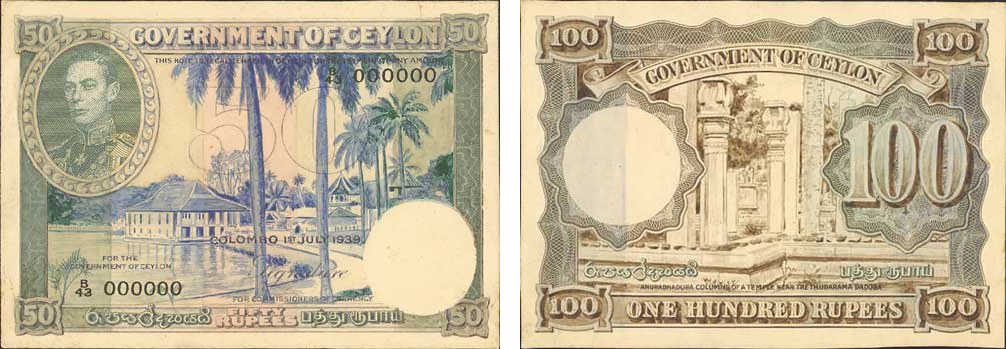
For Ceylon, De La Rue photographed a whole series dated 1st July 1938, from 2 rupees upward, with a profile of George VI at the upper left; it was not adopted. Two painted designs dated 1st July 1939 followed, a 50 rupees with buildings beside the lake at Kandy and a 100 rupees that the auction house described as showing a Buddhist monastery.
Elsewhere the change was smaller. A hand-drawn 5 shillings for Cyprus, dated 12 May 1938, has the King in an oval at the left; the issued note carries the portrait in the centre.
Overtaken by the war
Sixteen photographs record a full Government of Ceylon series dated 1st October 1939, from 1 rupee to 1,000 rupees, with a crowned George VI at the right. The entry says shortly why it stopped: "overtaken by the outbreak of war". Two notes printed for Ceylon by the India Security Press in those years, a 10 rupees dated 1st July 1938 and a 1,000 rupees, are catalogued as notes without a Pick number; neither is recorded as an issued note.
Some war designs went all the way to the press and still were not issued:
- Malaya, 1 and 5 dollars dated 1st January 1940 (P-4 and P-5). They were withheld because part of the stock was feared to be in enemy hands. Sources mention one shipment lost with a merchant ship and another on the SS Automedon, captured in November 1940, though no official account confirms either.
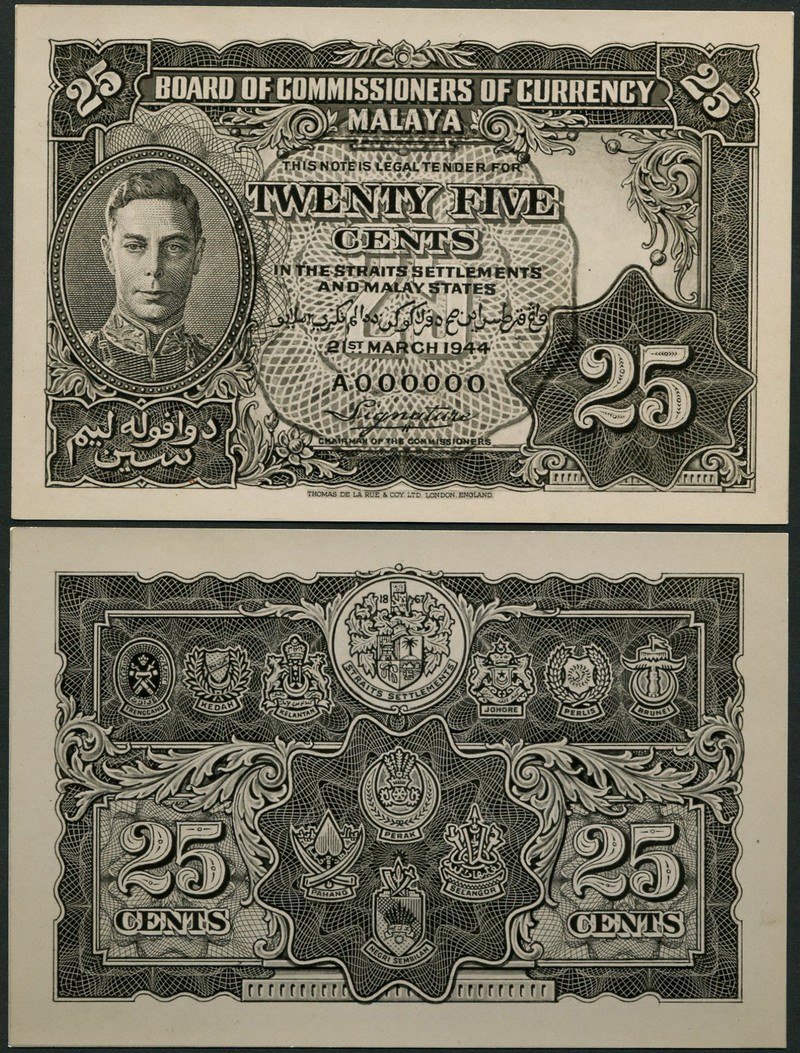
- Malaya, 25 cents dated 21st March 1944. De La Rue's photographs of the front and back show George VI in an oval at the left. No 25 cents was issued in that series.
- Burma, 4 annas and 8 annas of 1943 (P-23 and P-24), with the King in profile. Fred Schwan, writing in Bank Note Reporter in August 1982 from Robinson and Shaw's book on the coins and banknotes of Burma, says that proofs went to London in May 1943 for the King's approval, and that the notes were then kept in reserve against a shortage of coin and never issued.
- Bermuda, 10 shillings and 1 pound dated 1st April 1943 (P-13A and P-13B). Bradbury Wilkinson made them with the signature of a new Colonial Treasurer, Robert Alsop Kelly. Kelly took up the post, but the notes with the Kelly signature were never issued, and why is not known.
A new name on the way
The last George VI designs belong to issuers that were changing their names.
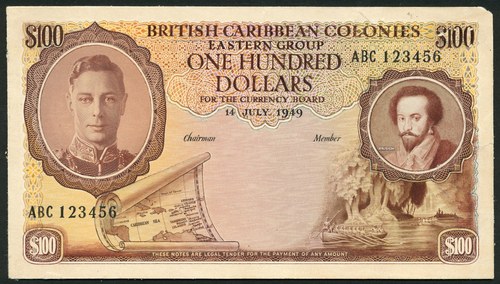
In the eastern Caribbean a single board was being planned for several colonies, and the designs made for it carry names the board never took. A 1 dollar drawn in watercolour, dated 14 July 1948, is headed BRITISH CARIBBEAN COLONIES, EASTERN DIVISION. A year later a 1 dollar and a 100 dollars dated 14 July 1949 read BRITISH CARIBBEAN COLONIES, EASTERN GROUP. All of them put George VI at the left in naval uniform and a second portrait at the right over a sea scene: Sir Walter Raleigh on the 100 dollars, and on the 1 dollar an admiral whom one auction house named as Nelson and another as Rodney. The notes that were issued read THE BRITISH CARIBBEAN TERRITORIES, EASTERN GROUP, and have the King alone, in an oval at the right.
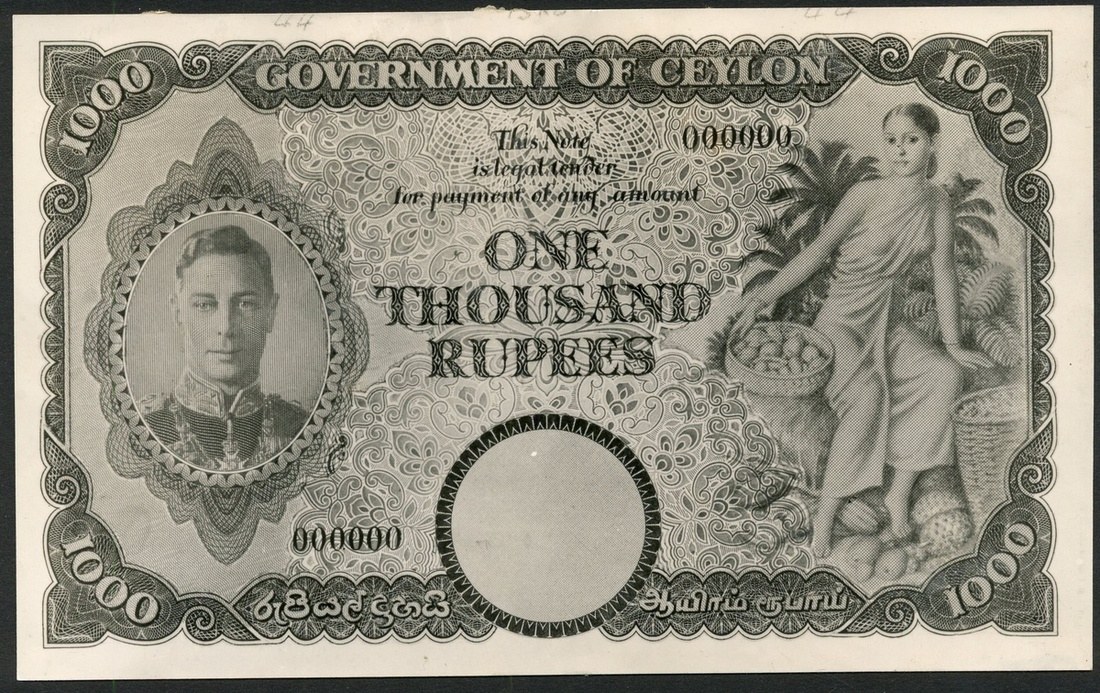
Ceylon went on being offered designs with the King to the end of the reign: a 5 rupees dated 1st November 1948 and an undated 1,000 rupees of about the same time; a series lettered for a RESERVE BANK OF CEYLON, dated 1st January 1950, a name the central bank never took; and a series for the Central Bank of Ceylon dated 1st June 1951. The Central Bank's first notes, dated 20th January 1951 with George VI, were issued only as 1 and 10 rupees. A 2, 5, 50 and 100 rupees were prepared and sent to the Bank as proofs but never issued; the values issued in 1952 carry Queen Elizabeth II.
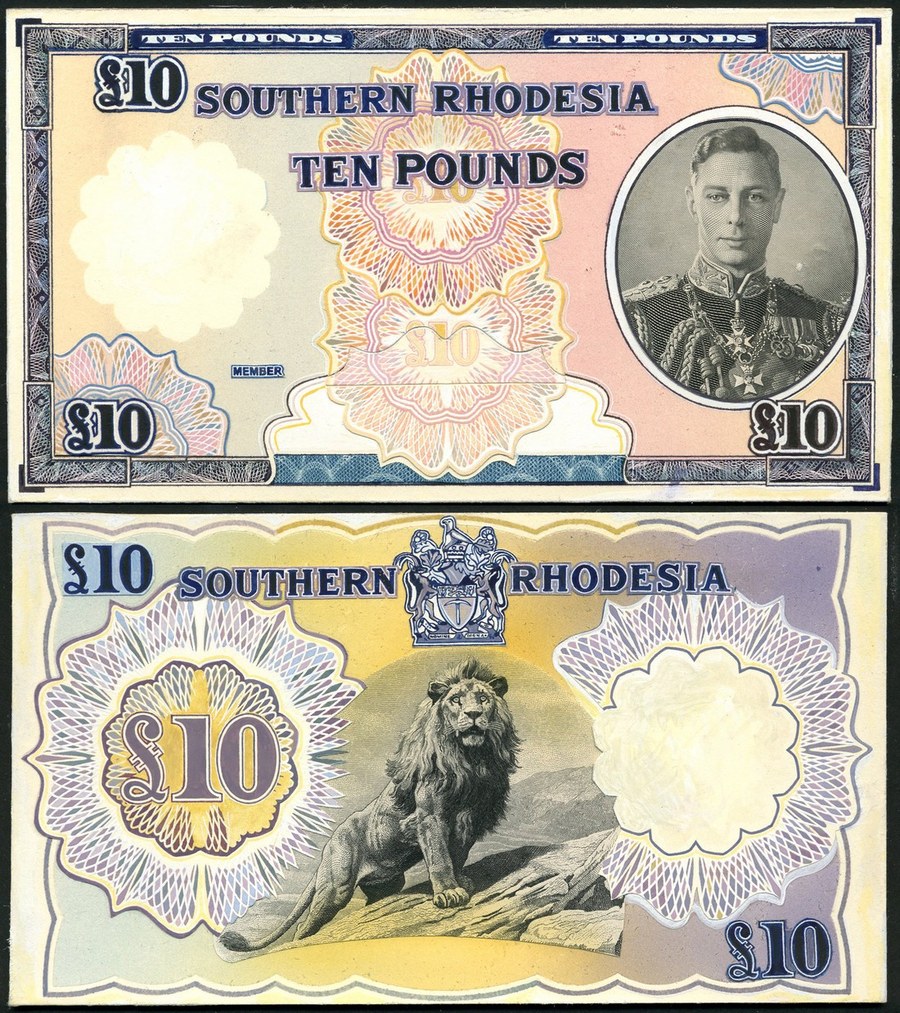
Two designs have no story beyond their own faces. A 10 pounds for Southern Rhodesia with George VI in naval uniform has no date and no number, and the single word MEMBER where a signature would go; the auction house put it at about 1940 to 1950. The 10 pounds catalogued here for Southern Rhodesia carries the Queen. And for Malaya and British Borneo, Bradbury Wilkinson's photographs of a 10 dollars dated 1st July 1952 still show George VI: the King had died before the date the design carries.
The reasons, side by side
| Territory | Design | Date on it | What the record says |
|---|---|---|---|
| Bahamas | 1 pound, Waterlow | about 1919 | marked "Not accepted"; the order went to another printer |
| Jamaica | 5 and 10 shillings, Bradbury Wilkinson | 1919 and about 1928 | not adopted |
| Jamaica | 5 and 10 shillings, De La Rue | early 1930s | the contract went to Waterlow |
| Mauritius | 5, 10 and 20 rupees, Bradbury Wilkinson | 1st October 1932 | never issued; no 20 rupees under George V |
| Fiji | 1 pound, De La Rue | 1st January 1934 | the contract went to Bradbury Wilkinson |
| Barbados | 2 dollars | 1st January 1936 | the King died twenty days after the date |
| Ceylon | 10 rupees and 1 rupee | 23rd March 1936, 30th July 1937 | dated after the King's death |
| Jamaica | 10 shillings, De La Rue | 1st May 1938 | profile portrait; a facing portrait was issued |
| Ceylon | 1 to 1,000 rupees | 1st October 1939 | overtaken by the outbreak of war |
| Malaya | 1 and 5 dollars | 1st January 1940 | withheld; stock feared in enemy hands |
| Bermuda | 10 shillings and 1 pound | 1st April 1943 | never issued; the reason is not known |
| British Caribbean | 1 and 100 dollars | 14 July 1948 and 1949 | a name and a layout that were not adopted |
| Ceylon | 2, 5, 50 and 100 rupees | 1951 | proofs only; the Queen's notes followed in 1952 |
Each piece named here has its own page in the archive of its territory, with every photograph on record.


Member comments
Log in or register to post a comment.