This article follows the notes that the Southern Rhodesia Currency Board, and from 1954 the Central Africa Currency Board, issued for Southern Rhodesia, Northern Rhodesia and Nyasaland. It is drawn from the Pick pages of this catalogue, which rest on the Government Gazettes, the annual reports of the two northern territories, the Colonial Office List and the notes and specimens themselves. Where an auction house is quoted, the statement is that house's own.
The Board and its first issue, 1939 to 1940
The Southern Rhodesia Currency Board was constituted, and its members appointed by the Governor, on 3 January 1939 under the Coinage and Currency Act 1938. Every note cites that Act.
The first order was placed with Bradbury Wilkinson in March 1939, for issue on 1 January 1940. The outbreak of war delayed the introduction to 1 March 1940. From that day the commercial banks ceased to issue their own notes.
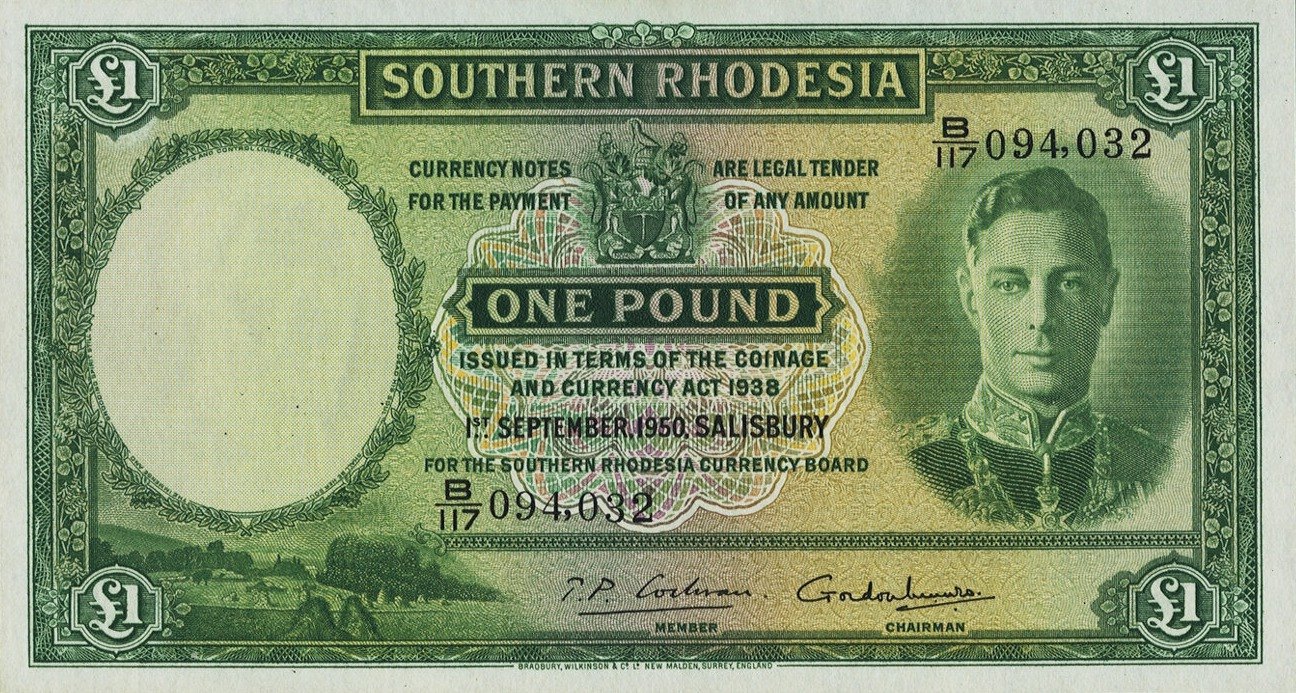
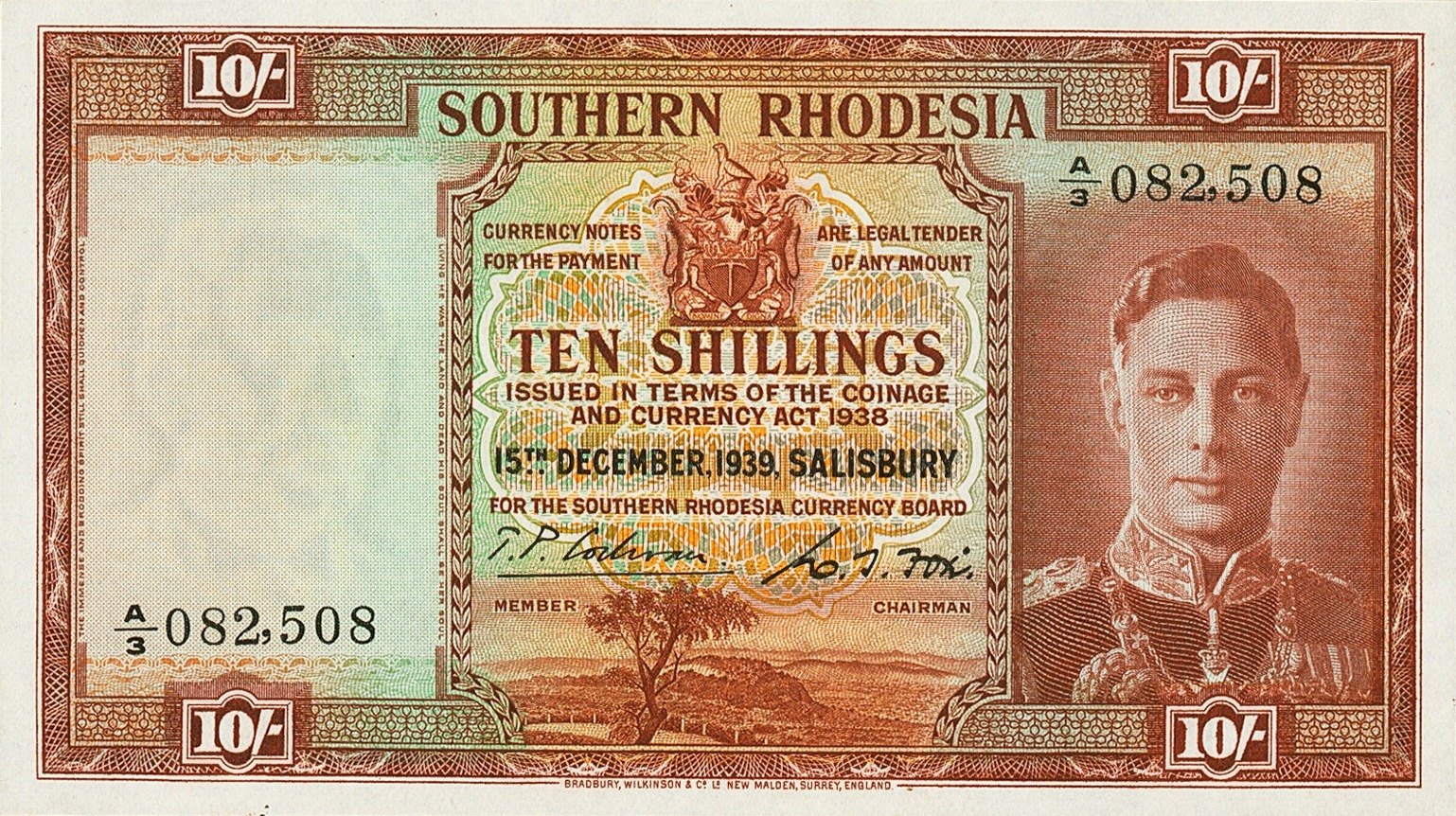
Three values made up the first issue, all with the portrait of King George VI:
- the 10 shillings of 1939 to 1951. Sources mention a scene of the Eastern Districts on the front and the Devil's Cataract at Victoria Falls on the back;
- the 1 pound of 1939 to 1951. Sources mention a farm scene in the Melsetter area on the front and the Conical Tower at Zimbabwe Ruins on the back;
- the 5 pounds of 1939 to 1952. Sources mention a view of the Wankie Colliery on the front and the Main Falls at Victoria Falls on the back.
Sources mention the same watermark on all three: the head of Cecil Rhodes with lines of a Kipling verse around it. The back of each has the head of a sable antelope in a round panel at the left. The earliest date printed on the notes is 15th December 1939.
Legal tender in three territories
The Board's notes became legal tender in Nyasaland on 8 June 1940 and in Northern Rhodesia on 1 November 1940. Neither name appears on them: the heading is SOUTHERN RHODESIA throughout.
Until then the paper money of both northern territories had been the notes that the Standard Bank of South Africa and Barclays Bank issued at Salisbury. Those had been made legal tender there from 12th October 1931, by Northern Rhodesia Ordinance No. 23 of 1931 and Nyasaland Proclamation No. 11 of 1931.
The bank notes went out at different times in the two territories. In Nyasaland all notes other than those of the Southern Rhodesia Currency Board ceased to be legal tender from 1st March 1942, according to An Economic Survey of the Colonial Territories, 1951. In Northern Rhodesia the bank notes, not issued since 1940, ceased to be legal tender only on 1st January 1954, according to the territory's annual reports for 1953 and 1954.
The annual reports of the two northern territories give the scale of the Board's money there:
| Territory | Date | Amount | What was counted |
|---|---|---|---|
| Northern Rhodesia | 1946 | 1,342,506 pounds | the Board's notes in circulation, an estimate |
| Northern Rhodesia | end of 1953 | 3,865,000 pounds | the Board's notes in circulation |
| Nyasaland | end of 1947 | 1,710,882 pounds | the Board's notes and coin on issue |
| Nyasaland | end of 1953 | 2,054,000 pounds | the Board's notes and coin on issue |
The pages hold no figure for Southern Rhodesia itself, and none for the Board's whole issue.
Wartime changes, 1942 to 1945
The 5 shillings
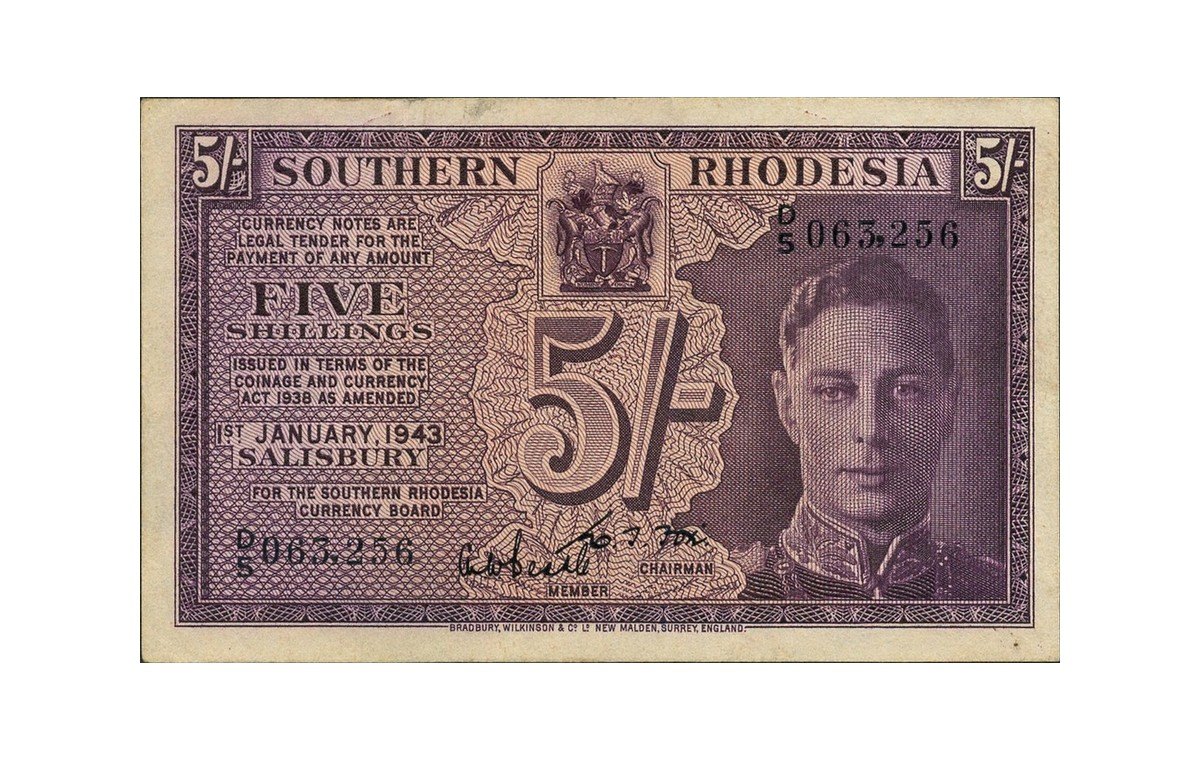
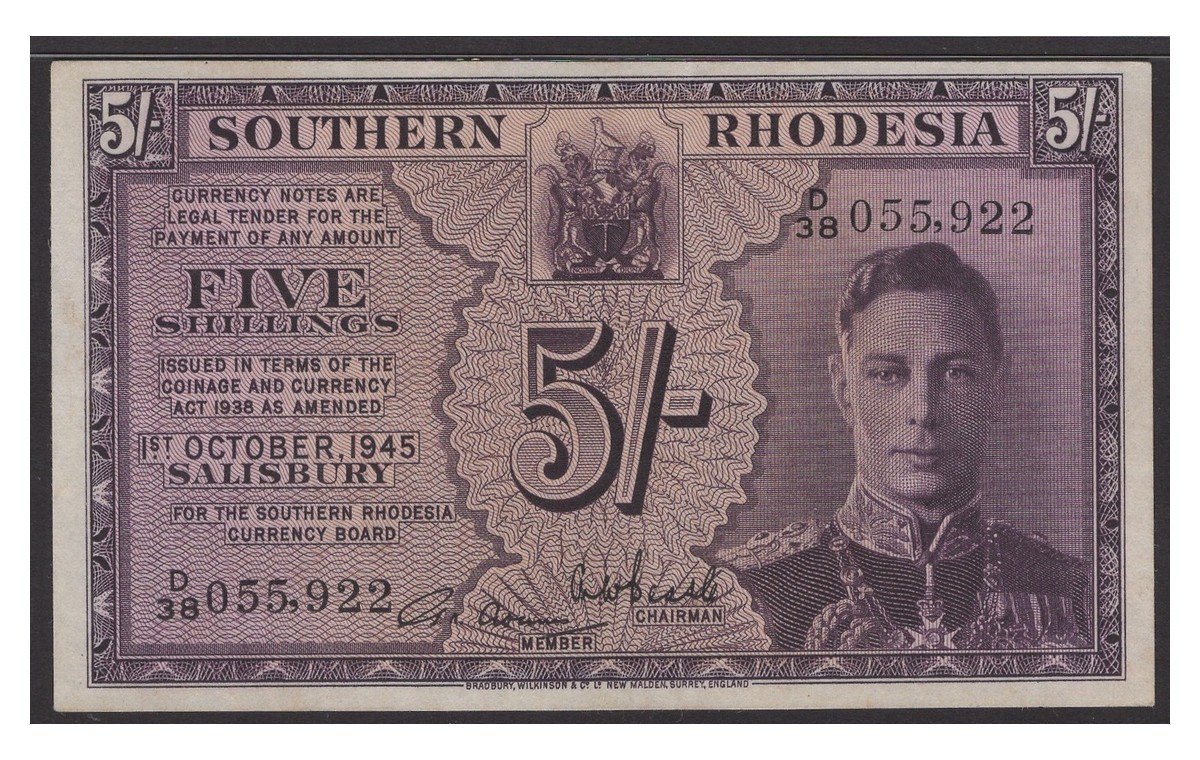
To save silver coin during the war, the Coinage and Currency Amendment Act of December 1942 let the Board issue other values. A 5 shillings note dated 1st January 1943 followed. A notice of 7th December 1943 in the Nyasaland Government Gazette, signed by G. H. Adams as Nyasaland's representative on the Board, announced the new 5 shilling notes "for the purpose of circulation in Southern Rhodesia, Northern Rhodesia and Nyasaland after 31st December, 1943".
The first note measures 92x57 mm. It was judged too small to handle, and from 1st February 1945 the note was enlarged to 114x68 mm. Neither size has a watermark.
Sources mention that the Board stopped issuing the 5 shillings in 1948, and that the notes already out stayed legal tender and were left to die out of use. The Nyasaland annual reports show the end from the other side. The report for 1951 says the 5 shilling notes were then "in process of being withdrawn from circulation". The report for 1952 says that new issues were no longer made. From 1953 the reports no longer list the value among the Board's notes.
The 5 pounds redesigned
The 5 pounds has two designs. The first is dated 15th December 1939 and 1st July 1942. From 1st March 1944 a revised design has a large white 5 pound figure at the centre of the front. Sources mention that the figure was added so the 5 pounds could be told more easily from the 1 pound.
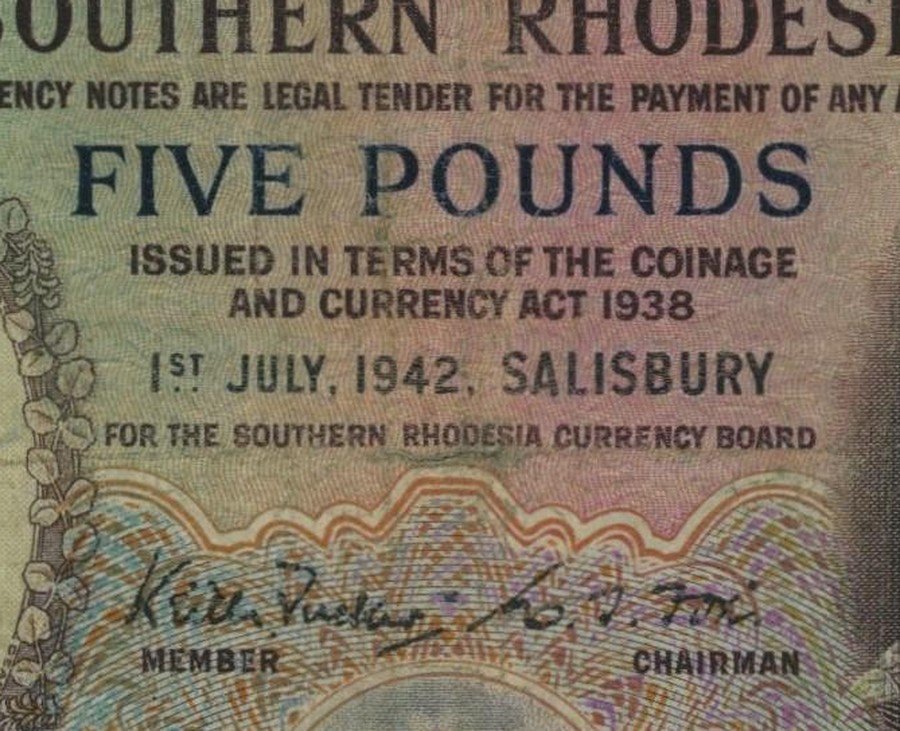
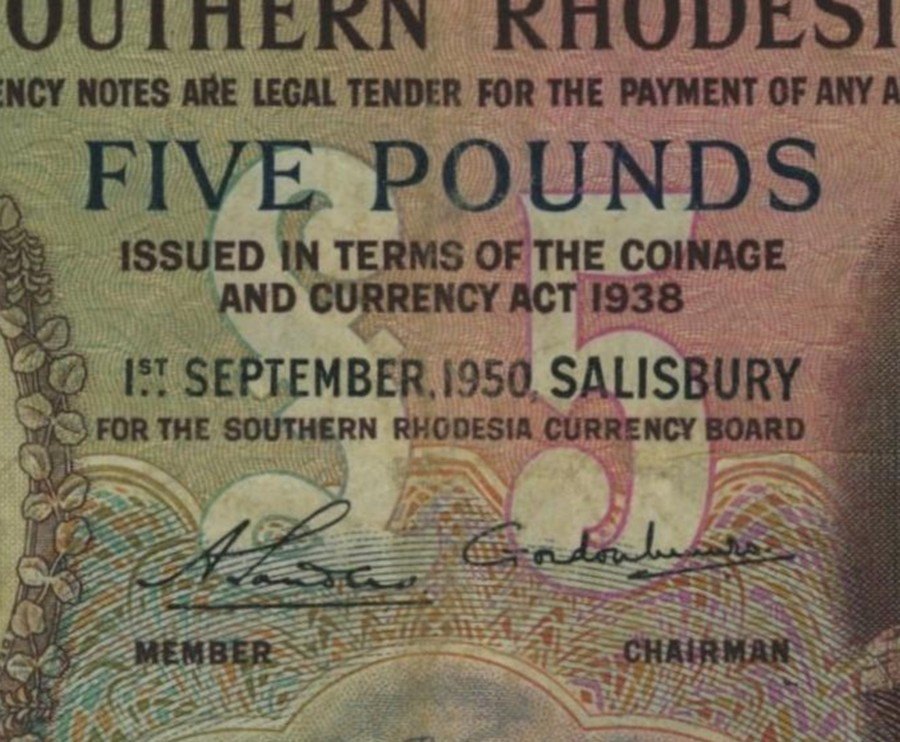
Heritage's description of lot 28547 in its sale of 23 April 2020 says that only the first 300,000 notes of 5 pounds were printed without the white figure, and that the figure begins with prefix C/4. The Pick page does not put the change at a prefix: it records that the prefixes C/1 to C/5 are shared between dates and signature pairs, so that the date and the number decide. Heritage's description of lot 24493 in its sale of 26 March 2026 calls C/3 a prefix split between the notes dated 1939 and those dated 1942.
The Chairman and the Members
Every note is signed by the Chairman of the Board and by one Member. The Members signed in rotation, so one printed date can carry five or more signature pairs, and on the Pick pages each pair has its own row.
The Chairmen, as the notes and the pages show them:
- Fox signs as Chairman on the notes of 1939 to 1944.
- Beadle signed as a Member under Fox in 1942, 1943 and 1944, and as Chairman from 1945 to 1948.
- Strachan signed as a Member under Beadle in 1947 and 1948, as Chairman on the notes of 10th January 1950, and as a Member again afterwards.
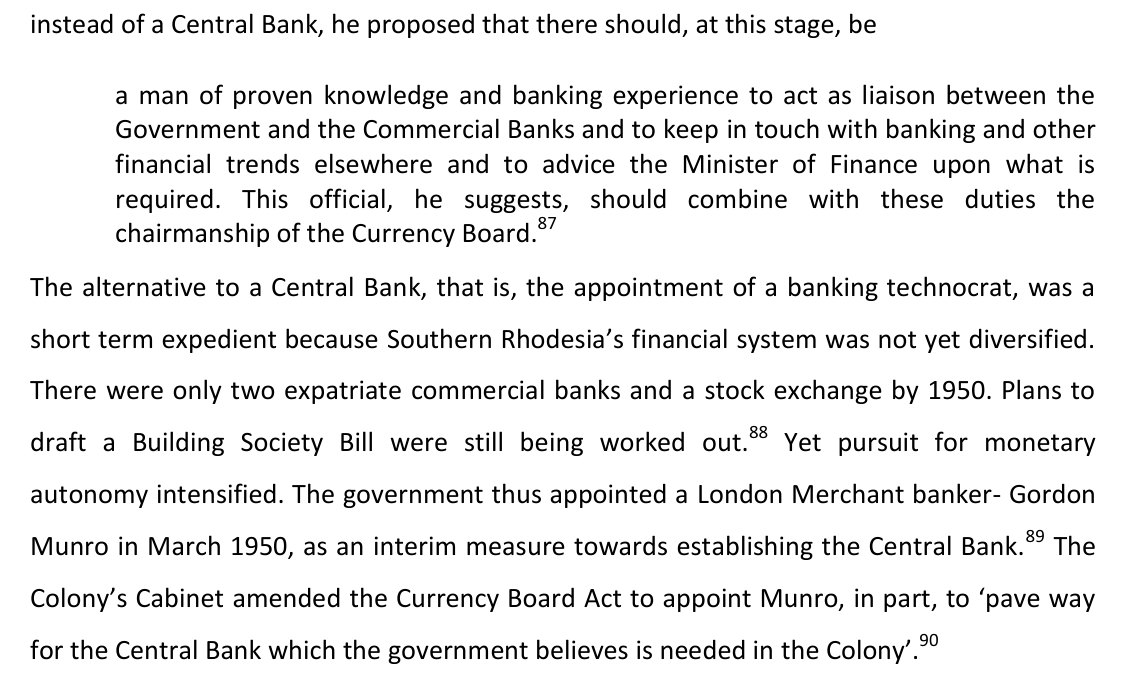
- Gordon Munro signs as Chairman on notes of 1950, 1951 and 1952. Munro, a London merchant banker, was appointed in March 1950 to advise the Government on finance and to chair the Board, as a step towards a central bank (R. A. Sowelem, Towards Financial Independence in a Developing Economy, 1967, p. 35, as cited by Tinashe Nyamunda in the thesis Financing Rebellion, University of the Free State, 2015, p. 40). A Bank of England note of 3rd December 1965 gives Munro's years as Chairman as 1950 to 1952 (Nyamunda, p. 106).
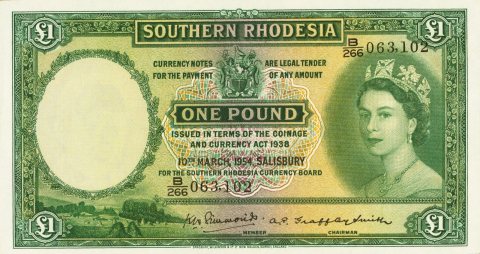
- A. P. Grafftey-Smith followed Munro as Chairman and went on to be the first Governor of the Bank of Rhodesia and Nyasaland (Sowelem, p. 36, as cited by Nyamunda, p. 48). The pages name Grafftey-Smith on the printer's submission piece of the 10 pounds, printed with the date 15th January 1953, and on notes of 10th March 1954 and 10th September 1955.
Among the Members, three were officers of Nyasaland: G. H. Adams, its representative on the Board in December 1943 (Nyasaland Government Gazette, 7th December 1943); C. W. F. Footman, Financial Secretary of Nyasaland from 1947; and K. W. Simmonds, Financial Secretary from 1951 (Colonial Office List for 1955). A fourth came in 1955: Norman-Walker, Development Secretary of Nyasaland from 1954 (Colonial Office List for 1955).
Sources mention that Cochran was away on military service from 1942 to 1949, so no note signed by Cochran is dated between 1939 and 1950.
Queen Elizabeth II, 1952 to 1954
The notes of the new reign are like the King George VI issue, with the portrait of Queen Elizabeth II in place of the King. The first are dated 1st December 1952: the 10 shillings of 1952 to 1953 and the 1 pound of 1952 to 1954. The 5 pounds of 1953 to 1954 begins on 3rd January 1953.
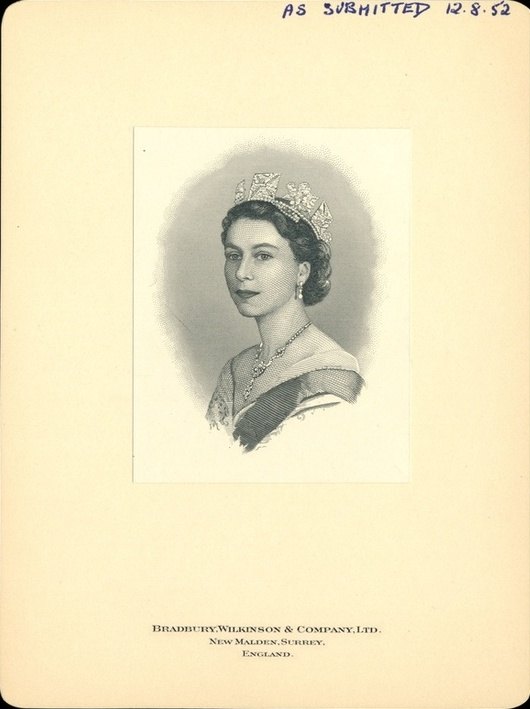
Sources mention that the portrait follows a 1952 photograph by Dorothy Wilding, engraved by Bradbury Wilkinson. Spink's description of lot 320 in its sale of 2 October 2019 concerns two proofs of that engraved portrait: one marked as submitted on 12 August 1952, the other with a signed approval of 29 August 1952.
The 10 pounds
The 10 pounds of 1953 to 1954 had no King George VI forerunner. It has its own design, with a tree and a lion on the front and elephants on the back, and is dated 15th April 1953 and 10th March 1954. Sources mention that the banks had asked for a note above 5 pounds.
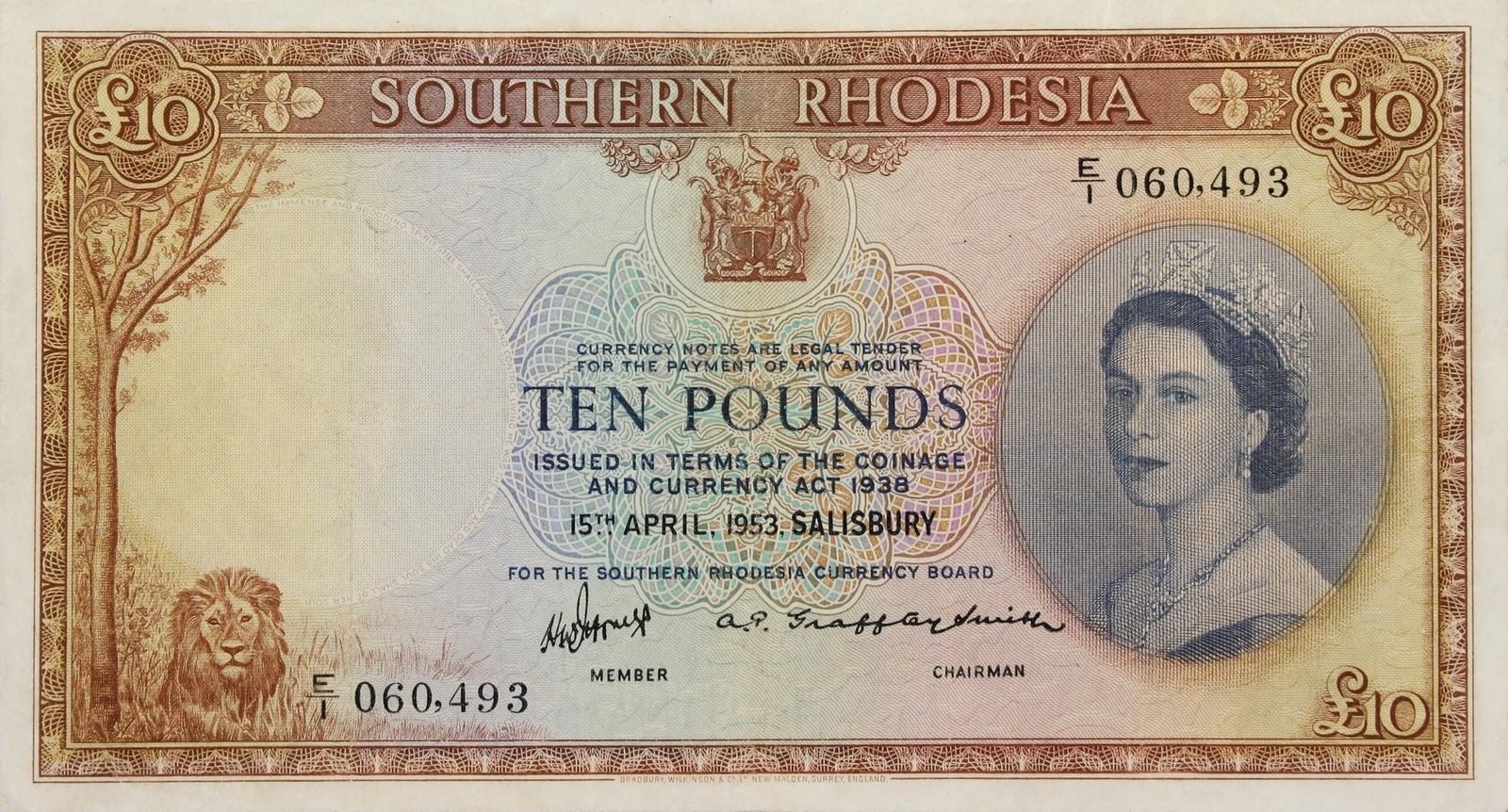
The printer's submission piece survives among the specimens. It is marked AS SUBMITTED, FEBY 11TH 1953, and was approved by letter of 27 February 1953 and by cable of 24 March 1953. Three prefixes are recorded, E/1 and E/2 on the first date and E/3 on the second, each one printing of 100,000 notes. Heritage's description of lot 22404 in its sale of 8 December 2023 puts it more loosely: "only a few hundred thousand notes" were printed.
How many 10 pounds survive, as each house puts it
The houses do not agree, and their statements have changed with time.
- Heritage, 8 December 2023, lot 22404: eight pieces dated 1953 were then graded in the PMG Population Report, and the note is harder to find than the 10 pounds of the Bank of Rhodesia and Nyasaland that followed.
- Heritage, 8 December 2023, lot 22407: the note of 10th March 1954 offered there was then the only issued note of that date in the PMG Population Report.
- Stack's Bowers, 2 October 2025, lot 50401, and 17 January 2026, lot 31452: for many years only a handful of issued notes were known; in the last few years a quantity came to light from two different sources in England, and most of those have since been sold.
- Spink, 6 May 2026, lot 368: fewer than ten notes of the second date, 10th March 1954, are known.
- Stack's Bowers, 6 September 2026, lot 31336: since the group from England appeared, the 10 pounds of the Bank of Rhodesia and Nyasaland is believed to be the one that survives in smaller numbers. This is the opposite of what Heritage said in 2023.
None of the houses gives a count of the group found in England.
The Central Africa Currency Board, 1954 to 1955
After the Federation of Rhodesia and Nyasaland was formed, the Federal Coinage and Currency Act 1954 renamed the Southern Rhodesia Currency Board the Central Africa Currency Board, with effect from 12th March 1954 (Northern Rhodesia annual report for 1954). The Act enlarged the Board to a Chairman and eight Members, among them one named by each of the Governments of Southern Rhodesia, Northern Rhodesia and Nyasaland.
The notes changed very little. Those of 10th September 1955, the 10 shillings, the 1 pound and the 5 pounds, are like the issue before, but the line under the date reads FOR THE CENTRAL AFRICA CURRENCY BOARD. The heading SOUTHERN RHODESIA, the Chairman and the run of prefixes all continue unchanged. Among the Members, Simmonds and Strachan no longer sign, and Greenfield, Nicholson and Norman-Walker sign for the first time.
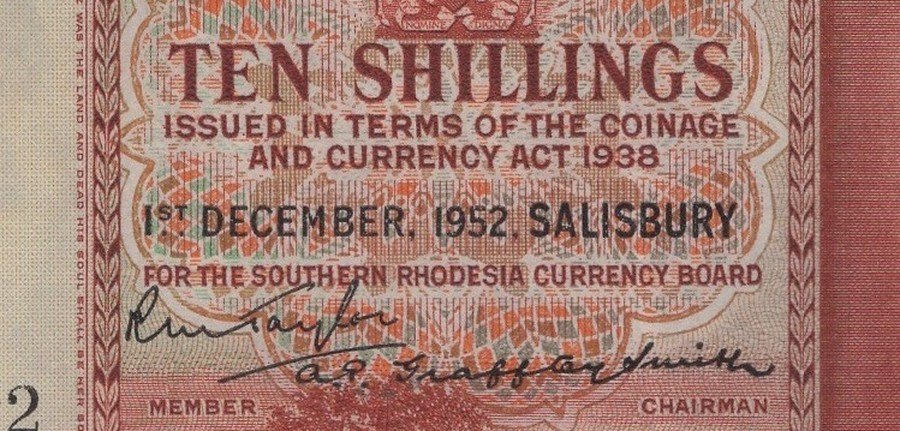
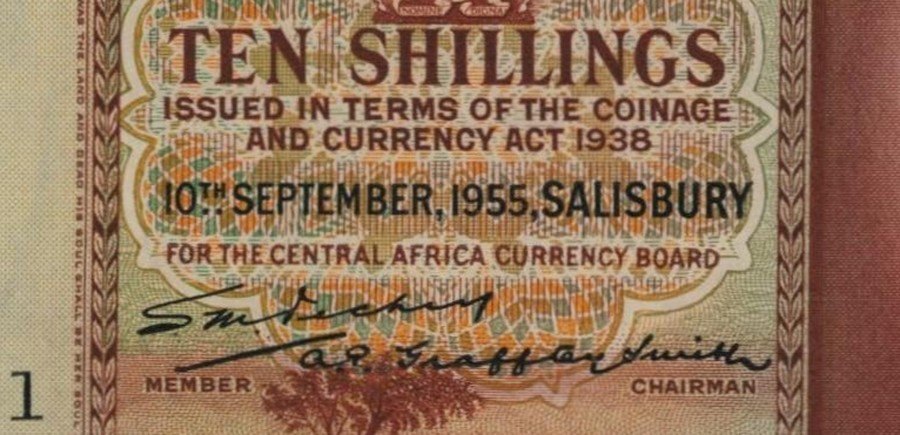
The new name reached the printer's paperwork before it reached the notes. Specimens of the 1 pound and the 5 pounds dated 10th March 1954, which name the Southern Rhodesia Currency Board under the date, carry approvals of 26 November 1954 and 12 November 1954 given for the Central Africa Currency Board.
These notes were followed by those of the Bank of Rhodesia and Nyasaland, dated from 1956 and first issued on 23rd April 1957. That bank is the subject of The Bank of Rhodesia and Nyasaland and its notes, 1956 to 1965.
Prefixes, range specimens and the London agent
The numbering is the same from 1939 to 1955. The upper letter of the prefix stands for the denomination and the lower number advances through the printings, 100,000 notes to a prefix. The prefixes on the Pick pages are:
| Value | Letter | Prefixes on the pages |
|---|---|---|
| 5 shillings | D | D/1 to D/52 |
| 10 shillings | A | A/1 to A/201 |
| 1 pound | B | B/1 to B/333 |
| 5 pounds | C | C/1 to C/40 |
| 10 pounds | E | E/1 to E/3 |
The pages give no total of the notes printed of any value. Heritage's description of lot 28618 in its sale of 18 September 2020 reckons one for the 5 pounds: it says that prefixes C/1 to C/40 were used across all dates from 1939 to 1955, and so that four million notes were issued. That figure is the house's own. The pages add that some prefixes are shared by two printings, where the printed date decides.
For each printing the printer made a range specimen, a specimen printed with the first and last number of the block. On the Pick pages these fix which prefixes belong to which date and signature pair. How many were made is not agreed: Noonans' description of lot 571 in its sale of 26 February 2025 says two range specimens were printed for each printing, while Noonans' description of lot 872 in its sale of 26 February 2020 says only one. The range specimens of 1955 carry the printer's order number and a date written in the top margin.
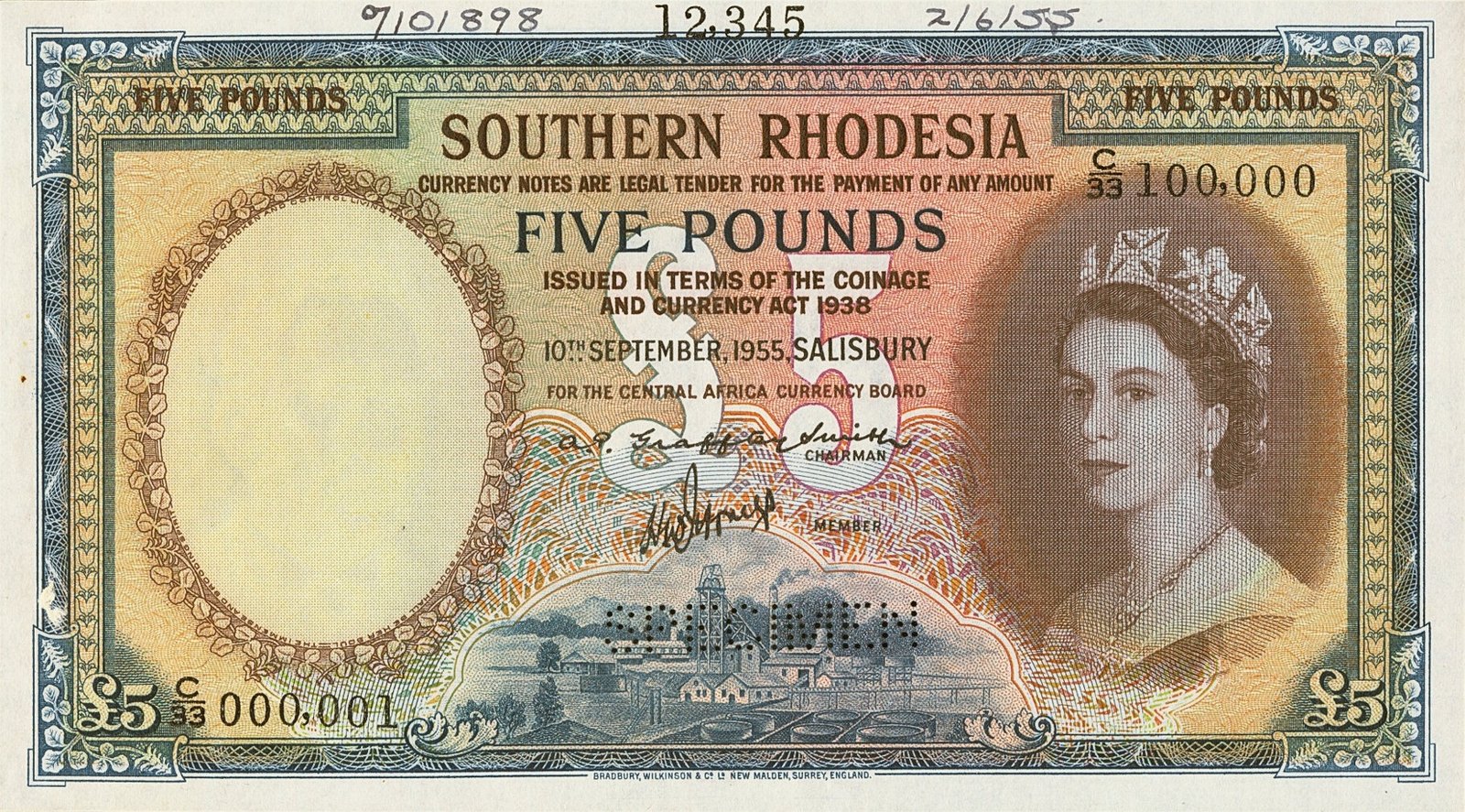
The Board's agent in London was The Standard Bank of South Africa, and specimens approved by the agent carry the date of approval. The dates recorded on the pages run from 2 February 1944 to 5 January 1956, and each is listed on the page of its note. Spink's description of lot 1036 in its sale of 9 December 2014 reads the last of them, on a 10 shillings of 1955, as an approval given on behalf of the Central Africa Currency Board and signed by the agent's General Manager.
Withdrawal
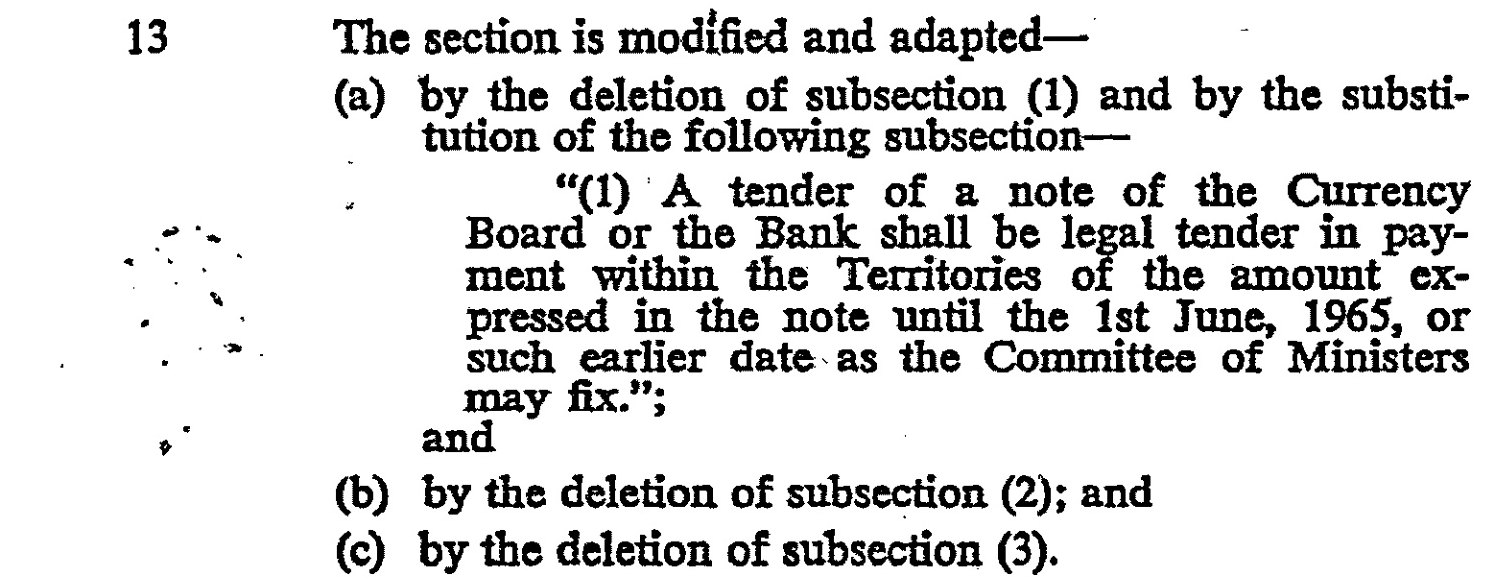
The Currency Board's notes were not called in when the Bank of Rhodesia and Nyasaland began to issue. They stayed legal tender beside the Bank's notes until 1st June 1965 (Southern Rhodesia Government Notice No. 956 of 1963). The Treasury's statement in the Gazette of 4th June 1965, Rhodesia Notice No. 812 of 1965, says the currency of the Federation was demonetized on that day.
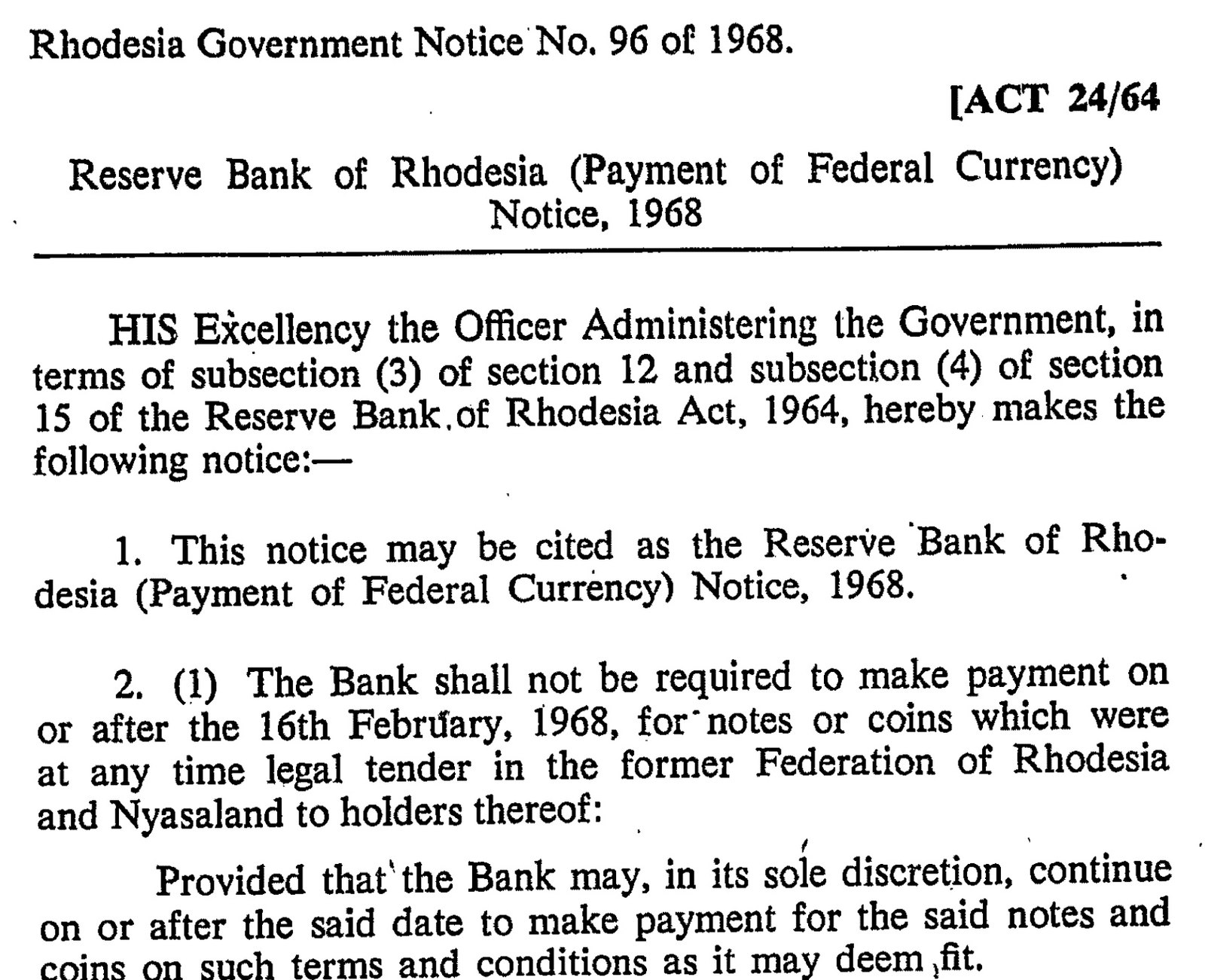
From 16th February 1968 the Reserve Bank of Rhodesia was no longer bound to pay for notes that had been legal tender in the Federation (Rhodesia Government Notice No. 96 of 1968).
Sources
- Coinage and Currency Act 1938 and the Coinage and Currency Amendment Act of December 1942 (Southern Rhodesia), as cited on the notes and the Pick pages.
- Northern Rhodesia Ordinance No. 23 of 1931; Nyasaland Proclamation No. 11 of 1931.
- Nyasaland Government Gazette, notice of 7th December 1943.
- Annual reports on Northern Rhodesia for 1946, 1953 and 1954; annual reports on Nyasaland for 1947, 1951, 1952 and 1953.
- An Economic Survey of the Colonial Territories, 1951.
- Colonial Office List for 1955.
- Federal Coinage and Currency Act 1954.
- Southern Rhodesia Government Notice No. 956 of 1963; Rhodesia Notice No. 812 of 1965 (Gazette of 4th June 1965); Rhodesia Government Notice No. 96 of 1968.
- R. A. Sowelem, Towards Financial Independence in a Developing Economy, 1967, pp. 35 and 36, as cited by Tinashe Nyamunda, Financing Rebellion, thesis, University of the Free State, 2015, pp. 40, 48 and 106.
- The notes, range specimens and approval pieces listed on the Pick pages.
- House descriptions: Spink, 9 December 2014, lot 1036; Spink, 2 October 2019, lot 320; Noonans, 26 February 2020, lot 872; Heritage, 23 April 2020, lot 28547; Heritage, 18 September 2020, lot 28618; Heritage, 8 December 2023, lots 22404 and 22407; Noonans, 26 February 2025, lot 571; Stack's Bowers, 2 October 2025, lot 50401; Stack's Bowers, 17 January 2026, lot 31452; Heritage, 26 March 2026, lot 24493; Spink, 6 May 2026, lot 368; Stack's Bowers, 6 September 2026, lot 31336.
Member comments
Log in or register to post a comment.