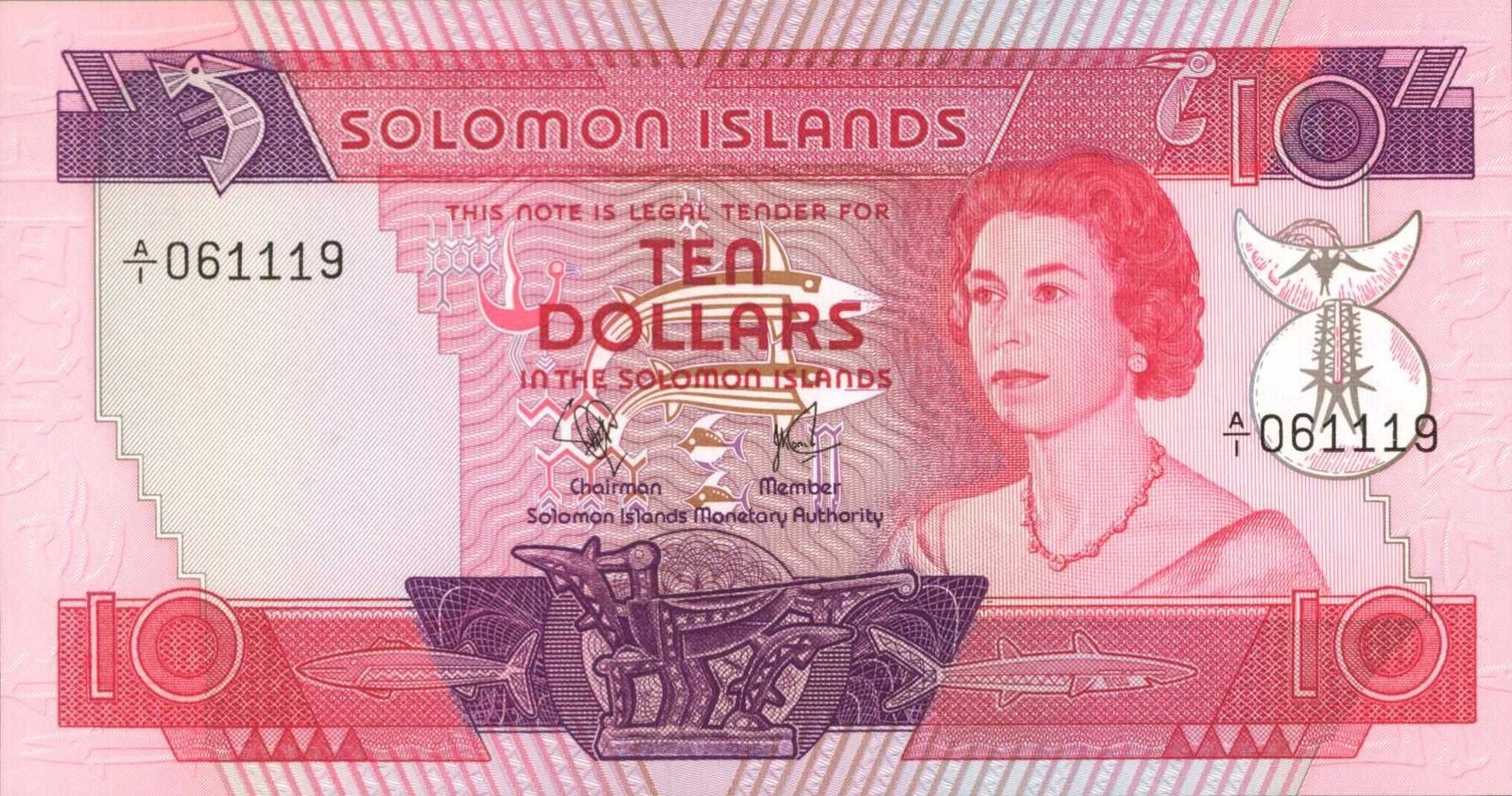
Between 1977 and 1986 the Solomon Islands issued six notes with the portrait of Queen Elizabeth II: the Monetary Authority's 2 dollars, 5 dollars, 10 dollars and 20 dollars, and the Central Bank's 10 dollars and 20 dollars of 1984. This article follows them from the planning of 1975 to the series that replaced them in 1986. It rests on the annual reports of the Monetary Authority and the Central Bank for 1976 to 1989 (the report for 1986 was not available), on three articles in the IBNS Journal and on the descriptions of the auction houses. The earlier notes of the Protectorate have an article of their own.
The Monetary Authority and its law
A memorandum of 23 April 1975 on currency arrangements led to the Solomon Islands dollar. The Solomons became self-governing on 2 January 1976 and independent on 7 July 1978, so the first notes came out between the two dates.
The Monetary Authority's annual report for 1976 says the Authority was established by the Solomon Islands Monetary Authority Ordinance 1976, which was brought into effect on 21st June 1976 with the exception of the clauses on currency: those had no purpose until the new money was about to be issued. The first Board took office on the same day: J. G. Palfrey as Chairman, with J. Korinihona, G. Siama, S. Yee and A. V. Hughes, the Permanent Secretary of the Ministry of Finance.
The same report says the Council of Ministers had approved the note designs in December 1975 and that final proofs of each value had been received and approved. Notes of 2, 5 and 10 dollars were planned first and a 20 dollars later, all with the Queen's portrait, scenes of the Solomon Islands and what the report calls custom designs.
The designs and the printer
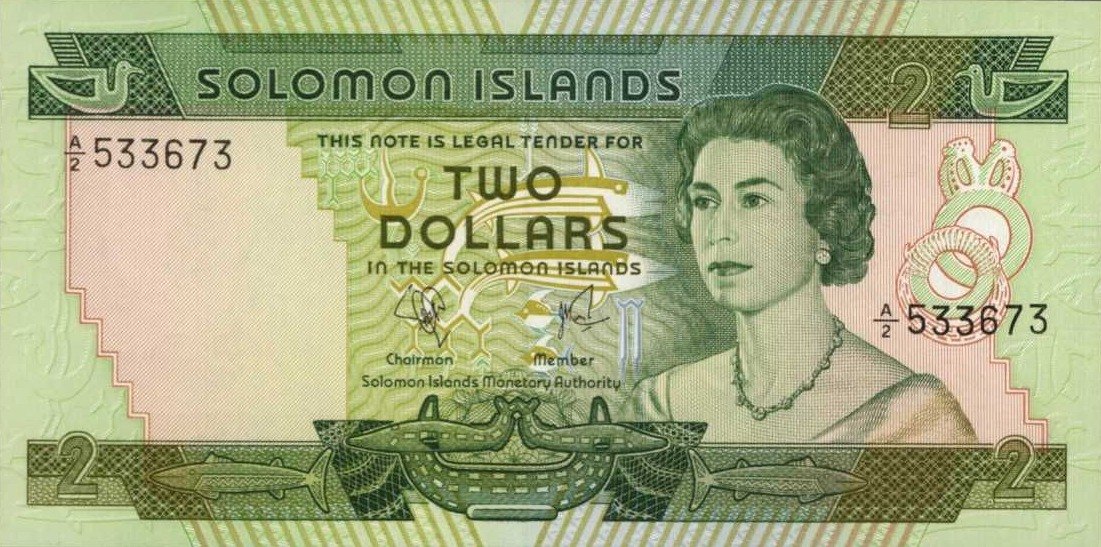
The notes are undated and were printed by De La Rue without imprint, with a watermark of a falcon in flight. They grow with the value: the catalogue gives 140 x 70 mm for the 2 dollars, 145 x 75 mm for the 5 dollars, 150 x 80 mm for the 10 dollars and 155 x 85 mm for the 20 dollars.
Mark D. Tomasko's article "The Work of John White" in the IBNS Journal, volume 57 number 3 (2018), says John White of De La Rue was given the job of designing the notes in 1975, drew the 2, 5 and 10 dollars then and the 20 dollars in 1977. Peter Symes's "The Portraits of Queen Elizabeth II" in the IBNS Journal, volume 44 number 2 (2005), says the portrait follows an official photograph taken by Anthony Buckley around 1962. Symes notes that the same photograph was engraved for notes of Canada, and that the engraving De La Rue prepared for the Solomon Islands differs slightly from the Canadian one, with finer lines in the shading of the face.
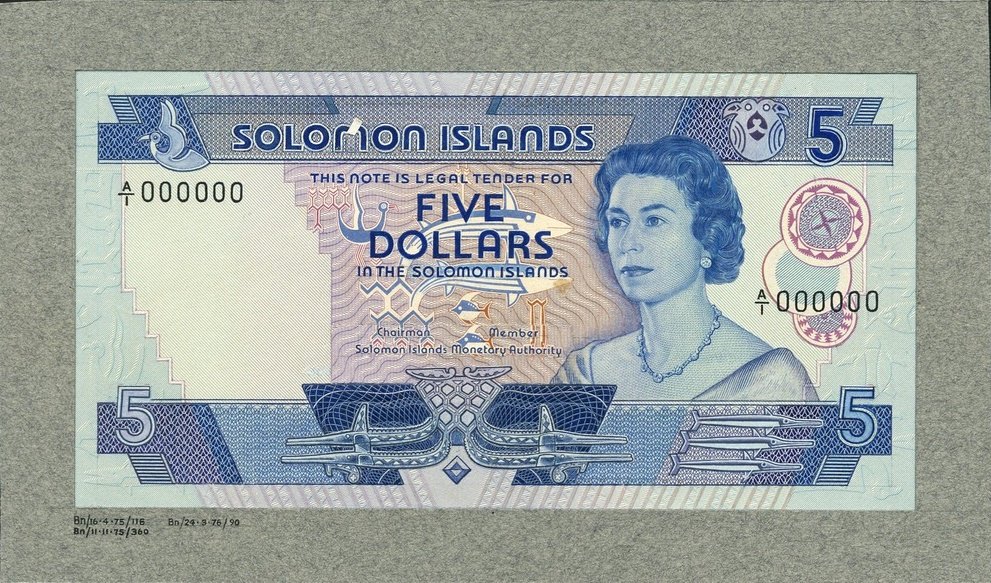
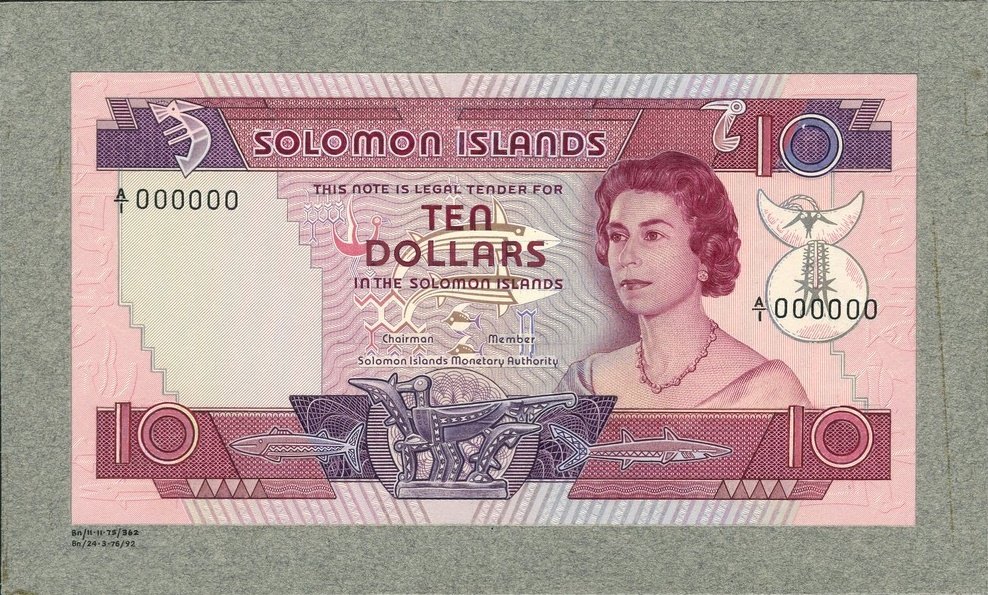
Two lots in Spink's sale of 30 September 2014 show an earlier stage. Lot 1618 was a pair of composite essays on card for the face and back of the 5 dollars, and lot 1619 a pair for the 10 dollars, both described as ND (1975) and numbered A/1 000000. Spink called each pair unique.
The changeover, 24th October 1977 to 30th September 1978
The Solomon Islands dollar was introduced on 24 October 1977 at par with the Australian dollar it replaced. The Authority's report for 1977 says the introduction had been delayed by almost a year because of difficulties in producing the notes and coin. Australian currency stayed legal tender beside the new money during a transitional period. Its end, first set for 30th June 1977, was moved to 30th June 1978 and then extended by three months. The report for 1978 says Solomon Islands currency became sole legal tender when the transitional period ended on 30th September 1978.
The report for 1977 adds that the withdrawn Australian currency was checked by the Authority's staff and sent back to Australia, and that the Australian money came in faster than expected. Its table shows 1,013,000 dollars of the new notes in circulation on 31st October 1977, one week after the issue. The report for 1978 says that by the end of September 1978 a total of 3.6 million dollars in Solomon Islands currency had been issued.
Parity with the Australian dollar did not last. The report for 1979 records a revaluation of 5 per cent in May 1979 and a peg to a basket of currencies from the end of October 1979.
The Chairmen and the signatures
The Monetary Authority's notes are signed by the Chairman and a Member. The Member is J. Korinihona on every note: the reports show Korinihona on the Board throughout. The Chairman's signature changes, and the annual reports give the terms:
| Chairman | Term | Signs |
|---|---|---|
| Palfrey | 21st June 1976 to 20th June 1978 | 2, 5 and 10 dollars |
| Longmuir | 21st June 1978 to 30th May 1980 | 5 and 10 dollars |
| Coney | 1st June 1980 to 31st October 1981 | 20 dollars |
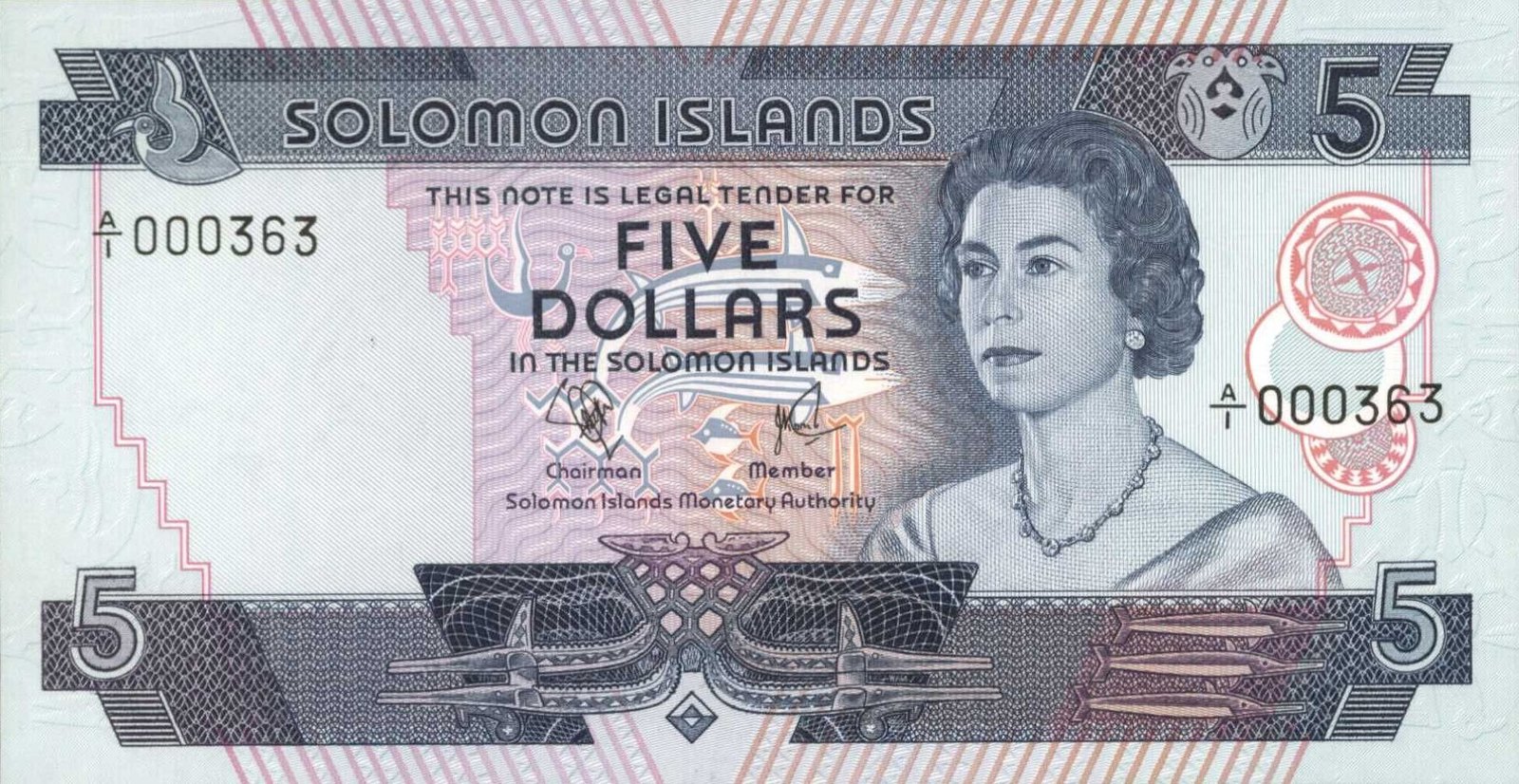
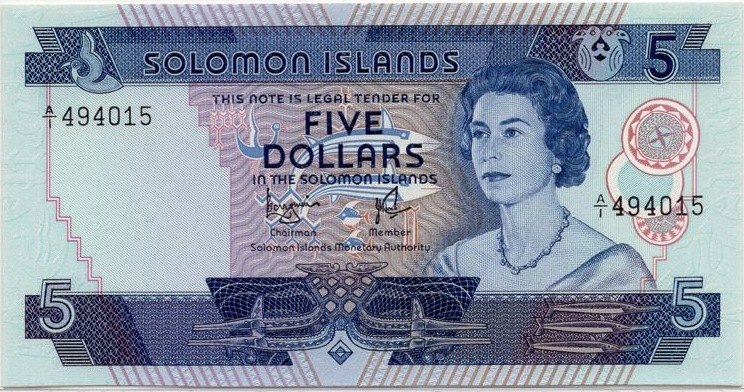
The 2 dollars is signed by Palfrey and Korinihona only. The 5 and 10 dollars are signed by Palfrey and then Longmuir, with Korinihona. The 20 dollars is signed by Coney and Korinihona.
The report for 1978 says Palfrey had been seconded from the Bank of England. The report for 1981 says Coney had been seconded from the Reserve Bank of New Zealand and left in December 1981, and that A. V. Hughes became Chairman on 1st November 1981.
The reports print the names LONGMUIR and CONEY wherever the two Chairmen are named or sign. M. A. Munoz's article "Signature Varieties of the Dollar System Bank Notes of the Solomon Islands" in the IBNS Journal, volume 30 number 1 (1991), spells them Longmuire and Corney. This catalogue follows the reports. Munoz supplies the first names: John, Barry, Philip and Jezriel, in the order Palfrey, Longmuir, Coney and Korinihona.
Both Chairmen of the 5 and 10 dollars signed under one prefix, A/1, with Z/1 for replacement notes, so only the signature tells the two apart. The Pick pages give the numbers recorded for each.
The 20 dollars of 24th October 1980
The report for 1979 says the 20 dollars was not yet out and that the Authority hoped to have it in circulation by the end of 1980. The report for 1980 says the Authority issued it on 24th October 1980 after almost two years of preparation, completing the range of notes first planned. The same report records that the extensions to the Authority's building were formally opened on the same day.
The 20 dollars first appears in the circulation table at the end of October 1980. The Authority counted 38,100 of them in circulation at the end of 1980 and 122,800 at the end of 1981. The report for 1981 says the 20 dollars then made up 38 per cent of the notes by value and had taken the place of a part of the 10 dollar notes, and that the fast rise in its share foreshadowed the need for a note of higher value.
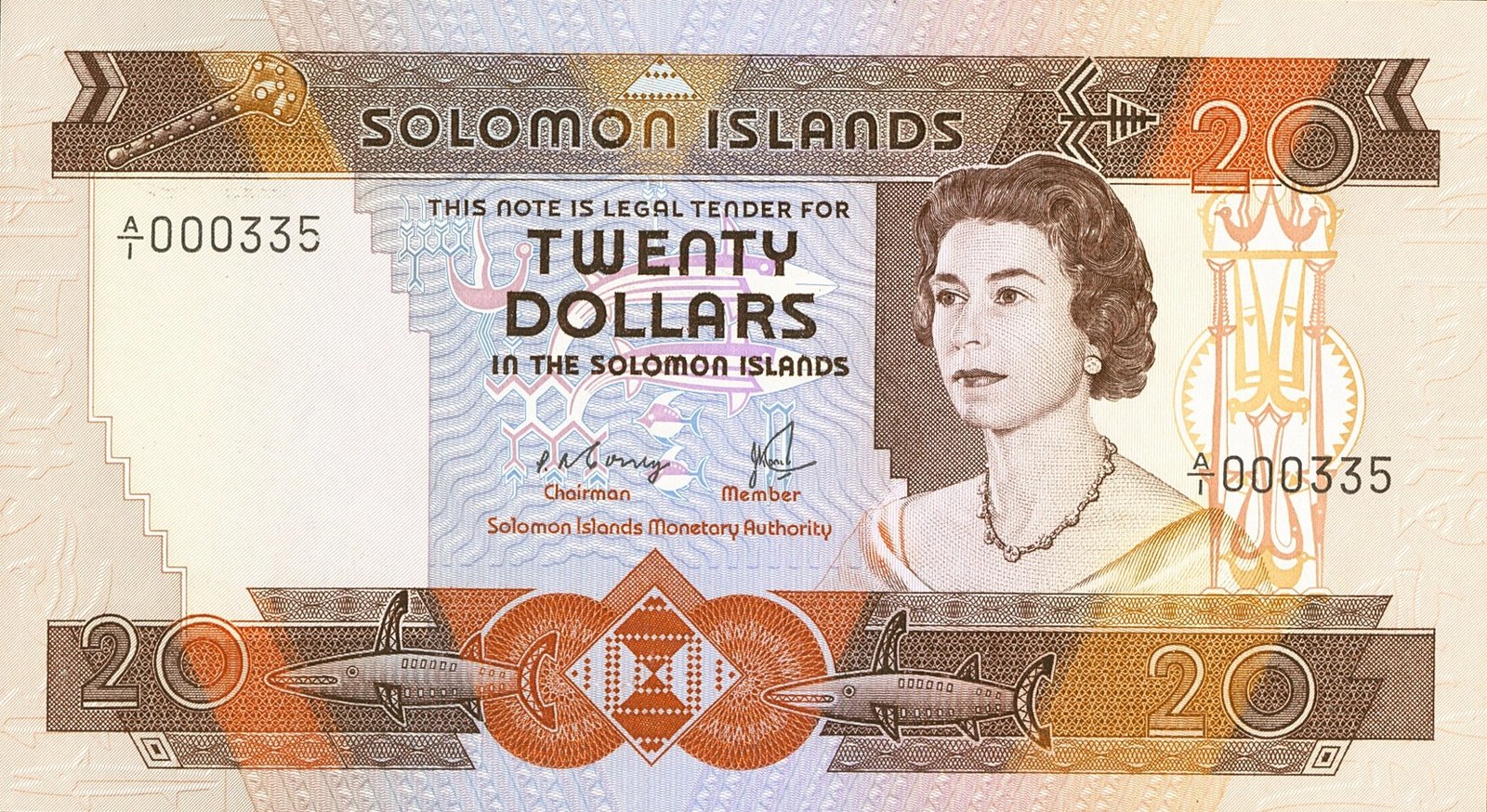
Munoz's article of 1991 dates the 20 dollars to 1981, and Spink (28 April 2015, lot 383), Stack's Bowers (14 December 2024, lot 31663) and Heritage (30 March 2025, lot 95389) catalogue it as 1981. The Authority's own report gives the day in 1980.
Notes in circulation, 1977 to 1982
The Authority's reports print the value of notes in circulation by denomination at the end of each month. The year-end figures, in Solomon Islands dollars:
| End of | Total | 20 dollars | 10 dollars | 5 dollars | 2 dollars |
|---|---|---|---|---|---|
| 1977 | 1,939,500 | 1,185,000 | 427,500 | 327,000 | |
| 1978 | 3,665,549 | 2,336,790 | 694,185 | 634,574 | |
| 1979 | 4,753,204 | 3,420,830 | 658,690 | 673,684 | |
| 1980 | 5,317,800 | 762,000 | 3,350,640 | 565,550 | 639,610 |
| 1981 | 6,546,030 | 2,456,000 | 2,778,170 | 608,050 | 703,810 |
| 1982 | 7,548,200 | 3,320,000 | 2,872,740 | 652,050 | 728,910 |
The line for 1982 is given as the Central Bank's report for 1982 prints it. The four values in it do not add up to the printed total.
The reports for 1981 and 1982 also count the notes by number at the end of the year:
| End of | 20 dollars | 10 dollars | 5 dollars | 2 dollars | Total |
|---|---|---|---|---|---|
| 1980 | 38,100 | 335,064 | 113,110 | 319,805 | 806,079 |
| 1981 | 122,800 | 277,817 | 121,610 | 351,905 | 874,132 |
| 1982 | 177,000 | 293,774 | 123,410 | 384,985 | 979,169 |
The count for 1982 does not agree with the value table of the same report. Neither report explains the difference.
For 1983 the Central Bank's report gives only a total: 9,493 thousand dollars of notes at 31st December 1983.
Worn notes destroyed, 1980 to 1982
The report for 1980 says the heavy use of the 2 dollars was shortening the life of each note. The reports for 1981 and 1982 count the notes destroyed:
| Year | 20 dollars | 10 dollars | 5 dollars | 2 dollars | Total |
|---|---|---|---|---|---|
| 1980 | none | 127,000 | 135,000 | 368,200 | 630,200 |
| 1981 | none | 53,000 | 42,000 | 132,000 | 227,000 |
| 1982 | 2,000 | 350,500 | 268,500 | 806,700 | 1,427,700 |
All of these were Monetary Authority notes. The tables do not say which signatures were destroyed.
The accounts show what the Authority, and then the Bank, spent on currency issue: 8,000 dollars in 1980 and 107,000 dollars in 1981, then nothing in 1982 or 1983, and 137,000 dollars in 1984, the year of the Central Bank's notes. The reports do not say what the money bought, and none of the reports read gives the number of notes printed.
The collector set of 1979, specimens and replacements
Franklin Mint sold a three-note collector set of 3 July 1979 with a Maltese cross prefix. Its 2 dollars is signed by Palfrey, its 5 and 10 dollars by Longmuir. Heritage's description of lot 86247 in its sale of 30 September 2018 says the set was sold in association with De La Rue and that the three notes carry matching serial numbers. The Authority's reports for 1977 to 1980 speak of coin sets and royalties on numismatic issues and do not mention the note set.
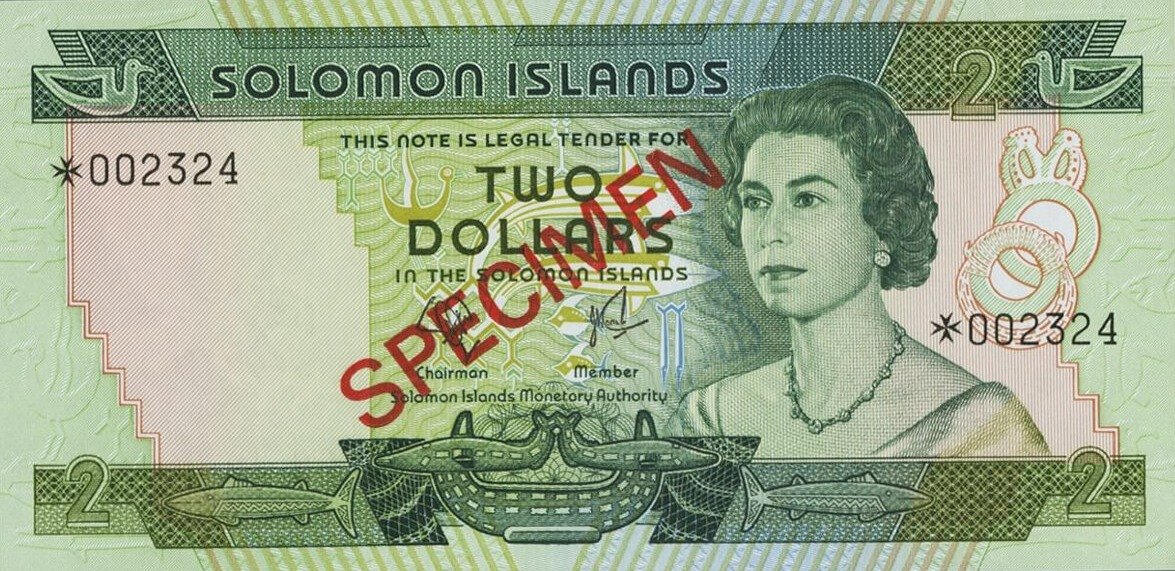
Spink's description of lot 2361 in its sale of 4 October 2018 shows how De La Rue marked its own specimens of the 10 dollars: numbered A/1 000000, overprinted SPECIMEN in red on both sides, the signatures cancelled with a stamp, and a numbered specimen stamp in the lower margin.
The replacement notes of the 5, 10 and 20 dollars carry the prefix Z/1.
The Central Bank and the notes of 1984
The Central Bank's report for 1982 says an amending law passed at the end of 1982 turned the Monetary Authority into the Central Bank of Solomon Islands and its Act of 1976 into the Central Bank of Solomon Islands Act. The report for 1983 says the Bank was formally established on 24th January 1983 and took over the Authority's assets and liabilities, among them its notes in circulation.
A. V. Hughes, on the Monetary Authority's Board from 1976 and its Chairman from 1st November 1981, signed the Central Bank's annual reports as Governor from 1983 to 1989.
The Bank's notes of 1984 are a 10 dollars and a 20 dollars only. They repeat the designs of 1977 to 1980 and are signed by Hughes and Panjuboe, so the line under the signatures decides. The Monetary Authority notes read Chairman and Member over Solomon Islands Monetary Authority, with IN THE SOLOMON ISLANDS under the denomination. The Central Bank notes read Governor and Director over Central Bank of Solomon Islands, with IN SOLOMON ISLANDS. Munoz's article names the two signers as Anthony Hughes, Governor, and Philip Panjuboe, Director.
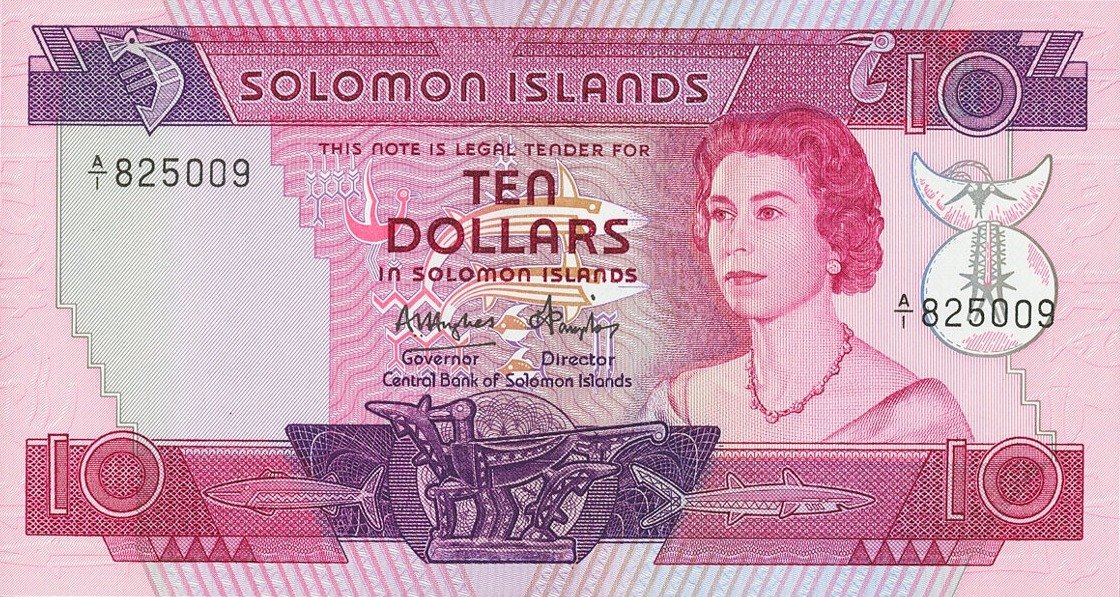
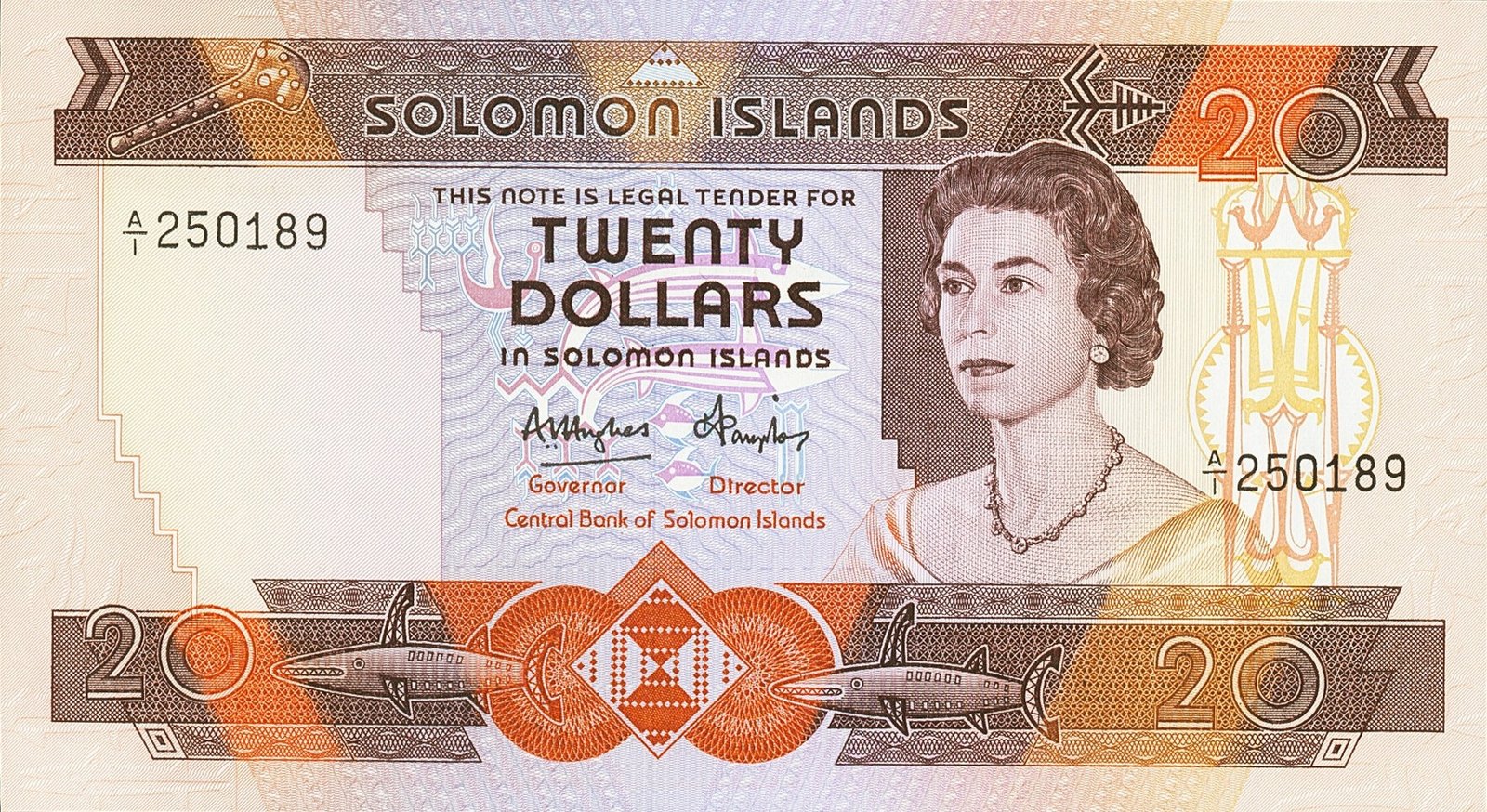
The numbering carries on from the Monetary Authority notes. The 10 dollars is numbered in A/1 and A/2, and the lowest recorded follows closely on the highest Monetary Authority 10 dollars recorded. The 20 dollars starts at A/1 250001, above the highest Monetary Authority 20 dollars recorded. Heritage's description of lot 95389 in its sale of 30 March 2025 gives the same first number for the Central Bank's 20 dollars.
From 1984 the Bank's reports give the notes in circulation in thousands of dollars. The figures do not divide the Monetary Authority's notes from the Central Bank's, nor, from 1986, the old series from the new:
| End of | Total | 50 dollars | 20 dollars | 10 dollars | 5 dollars | 2 dollars |
|---|---|---|---|---|---|---|
| 1984 | 12,400 | 6,409 | 4,173 | 879 | 939 | |
| 1985 | 13,305 | 7,490 | 4,057 | 816 | 942 | |
| 1986 | 13,922 | 780 | 7,014 | 4,232 | 914 | 982 |
| 1987 | 16,816 | 2,457 | 7,072 | 5,099 | 1,068 | 1,120 |
| 1988 | 20,837 | 4,833 | 7,783 | 5,920 | 1,087 | 1,214 |
| 1989 | 22,521 | 6,734 | 7,151 | 6,183 | 1,172 | 1,282 |
The series of 1986
A 50 dollars was in view early. The Central Bank's report for 1982 records first steps towards a 50 dollar note for 1985, and the report for 1984 says work had begun on a 50 dollars and on a possible new series for 1986. The report for 1985 records that a new series was designed and ordered that year for the second half of 1986, slightly smaller, with the national coat of arms in place of the Queen's portrait and a 50 dollars for the first time. The 50 dollars first appears in the Bank's circulation figures at the end of October 1986.
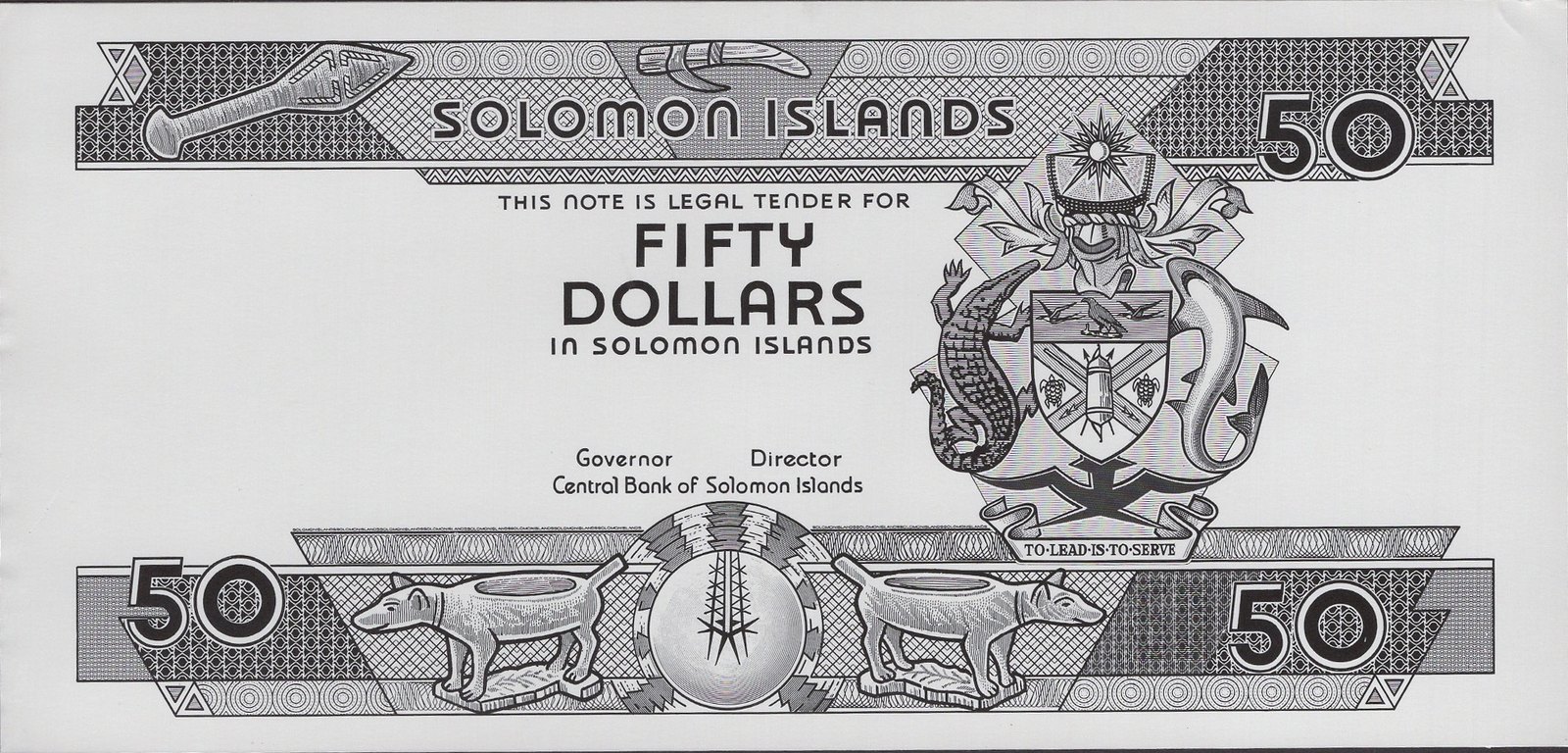
Spink's lot 1517 in its sale of 27 September 2011 held specimens of the 1986 series of 2, 5, 10, 20 and 50 dollars, all numbered B/1 000000, with the arms at right. The 1986 series has no page in this catalogue.
What the sources leave open
- The annual report for 1986 was not among those read, so the day the new series came out is not known here.
- No report names Panjuboe. The Board list in the report for 1985 does not include the name, and the reports for 1982 to 1984 have no Board list.
- No report gives a number of notes printed for any value.
- The reports never name the printer and give no day of issue for the Central Bank's notes of 1984.
- Munoz's article gives independence as June 7, 1978 and says Australian currency was withdrawn in 1979. The Pick pages give 7 July 1978, and the Authority's report for 1978 gives 30th September 1978 as the end of Australian currency as legal tender.
Sources
- Solomon Islands Monetary Authority, annual reports for 1976, 1977, 1978, 1979, 1980 and 1981.
- Central Bank of Solomon Islands, annual reports for 1982, 1983, 1984, 1985, 1987, 1988 and 1989.
- M. A. Munoz, "Signature Varieties of the Dollar System Bank Notes of the Solomon Islands", IBNS Journal, volume 30 number 1 (1991).
- Peter Symes, "The Portraits of Queen Elizabeth II", IBNS Journal, volume 44 number 2 (2005).
- Mark D. Tomasko, "The Work of John White", IBNS Journal, volume 57 number 3 (2018).
- Spink: 27 September 2011, lot 1517; 30 September 2014, lots 1618 and 1619; 28 April 2015, lot 383; 4 October 2018, lot 2361.
- Stack's Bowers, 14 December 2024, lot 31663.
- Heritage Auctions: 30 September 2018, lot 86247; 30 March 2025, lot 95389.

Member comments
Log in or register to post a comment.