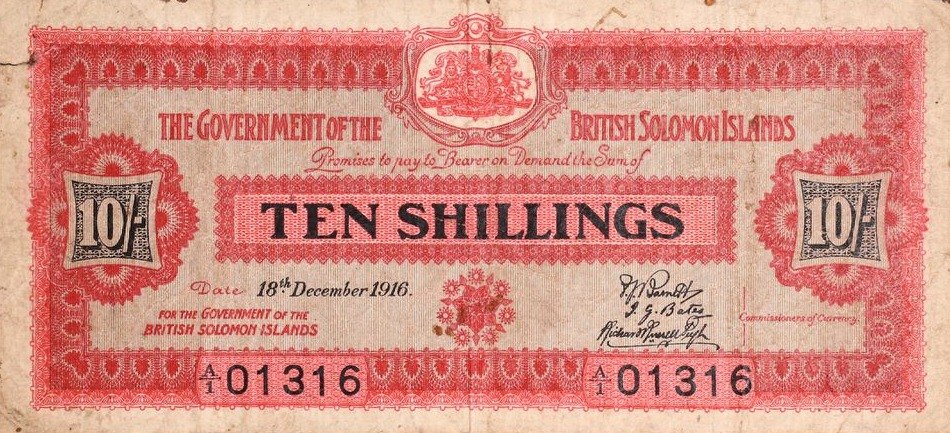
The Government of the British Solomon Islands Protectorate issued notes of 5 shillings, 10 shillings, 1 pound and 5 pounds from July 1917 until September 1937. This article tells their story in order of time. Most of it comes from John Pettit's article "Banknotes of British Solomon Islands" in the IBNS Journal, volume 15 number 4 (1976), which was written from the records of the Western Pacific Archives in Suva. The Colonial Office annual reports and the descriptions of the auction houses add the rest. Each is named where it is used.
Before the Government notes
Before the Regulation of 1916, Australian notes and the private issue of Burns, Philp and Company served the Protectorate. Pettit quotes the Pacific Islands Monthly of November 1934, which says that the paper currency until Mr. Barnett's term as acting Resident Commissioner was either Australian banknotes or, more commonly, Burns Philp notes.
Dr. W. J. Mira's article on the Burns Philp Pacific Islands Note Issue Register No. 1, in the IBNS Journal, volume 23 number 1 (1984), describes that private issue from the company's own register: notes of 1 pound and 5 pounds issued in Sydney between 1909 and 1914 and shipped to the company's trading posts and plantations in the Solomon and Gilbert Islands. Mira writes that the one thing missing from the register is an example of each value, or at least of each note's format. According to the register all the 5 pound notes were destroyed on 7 December 1916, the last entry is dated 15 December 1924, and 67 of the 1 pound notes then remained unaccounted for.
The Currency Regulation of 1916
The British Solomon Islands Currency Regulation of 1916 was King's Regulation No. 10 of 1916, passed by the Western Pacific High Commission on 14 September 1916. Pettit sets out what it did:
- It created a Board of Commissioners of Currency at Tulagi with not less than three Commissioners: the Resident Commissioner, the Treasurer and the Chief Magistrate of the Protectorate, or anyone the High Commissioner chose to appoint.
- It empowered the Commissioners to issue notes of five shillings, ten shillings, one pound and five pounds, or any other value the High Commissioner determined. Worn or damaged notes were to be destroyed and replaced with a new note of the same value.
- It set up a Note Guarantee Fund from the money paid in for the notes. At least half of the Fund was to be held in gold at Tulagi (the coin portion) and the rest in bank deposits and securities (the investment portion).
- It put a monthly tax on any private notes still in circulation after the Regulation came into effect. Mira gives the rate as one half of one per cent a month.
A person who took notes from the Commissioners had to pay at least half of the amount in gold. The Regulation also forbade the use of the notes "for payment of wages of native labourers", so at first the notes were not meant for the islanders.
Burns, Philp and Company wrote from Sydney to the High Commissioner in Fiji, and it was decided not to enforce the sections on private notes until two months after the Government notes had been received (Pettit; Mira says the same).
The first shipment, July 1917
The first shipment was 9,000 pounds in notes. Pettit gives its make-up: 2,000 notes of 5 shillings, 2,000 of 10 shillings, 5,000 of 1 pound and 500 of 5 pounds. The Crown Agents handled the order and Thomas de la Rue printed the notes in London. Every note was dated 18th December 1916 and carried the printed signatures of the three Commissioners of Currency: F. J. Barnett (acting Resident Commissioner), I. G. Bates (Chief Magistrate) and Richard N. Russell Pugh (acting Treasurer).
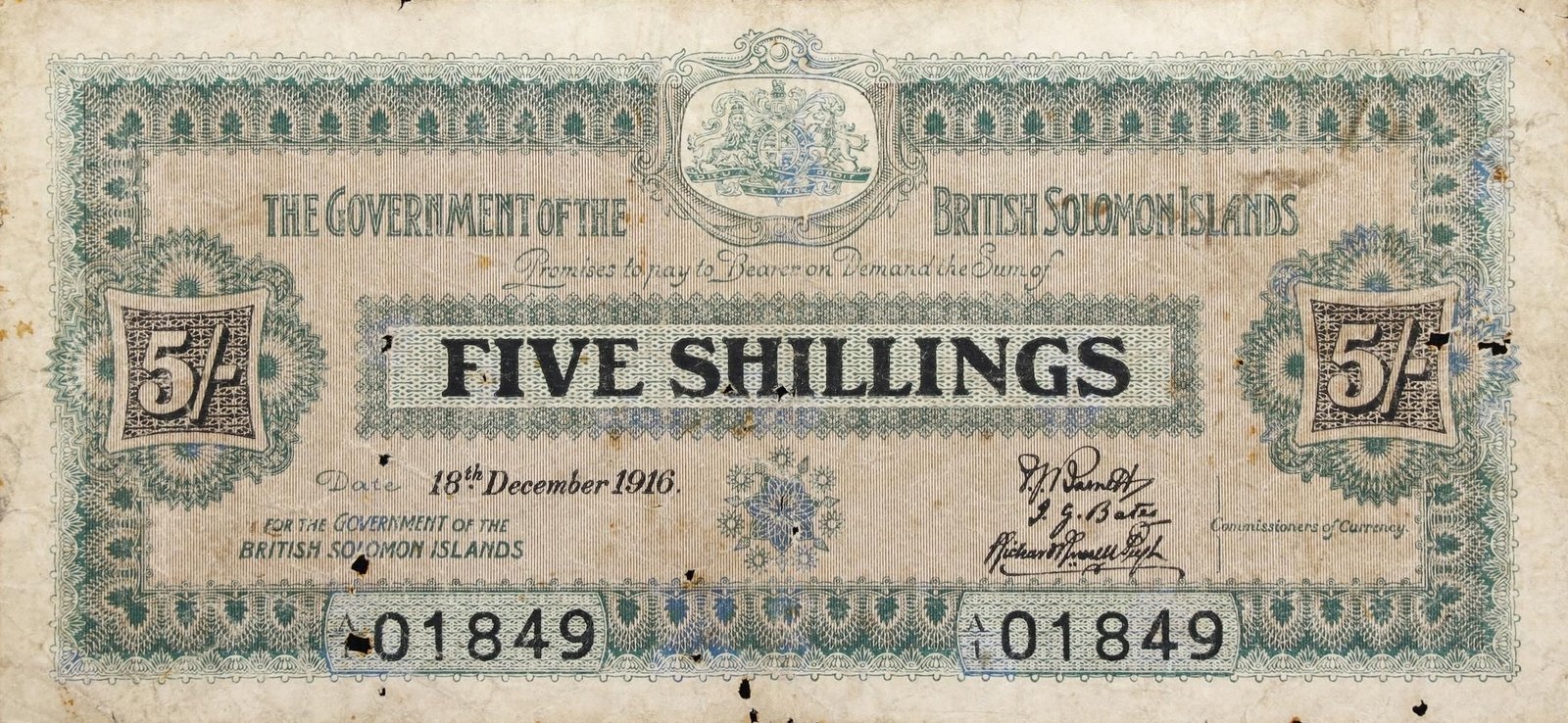
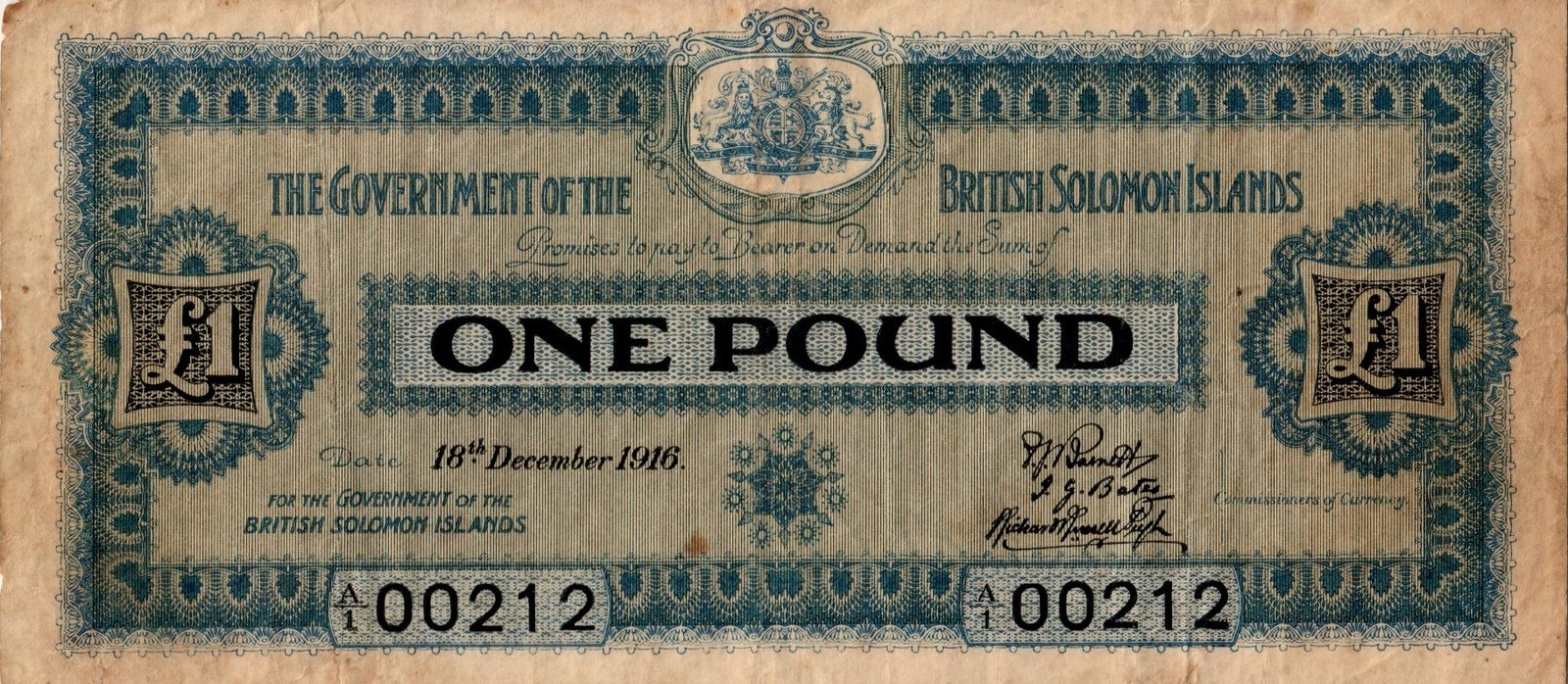
Pettit writes that the shipment arrived in Tulagi on 9 July 1917, was delivered to the Currency Office there on 14 July and was put into circulation two days later, on 16 July. Mira's article says the notes did not reach Tulagi until 14 July 1917 and were placed in circulation on the sixteenth. The two agree on the day of issue.
No parity was laid down for the notes. Pettit's reading is that they were meant to stand at par with the Australian pound and the pound sterling, which were equal until 1932.
The notes themselves
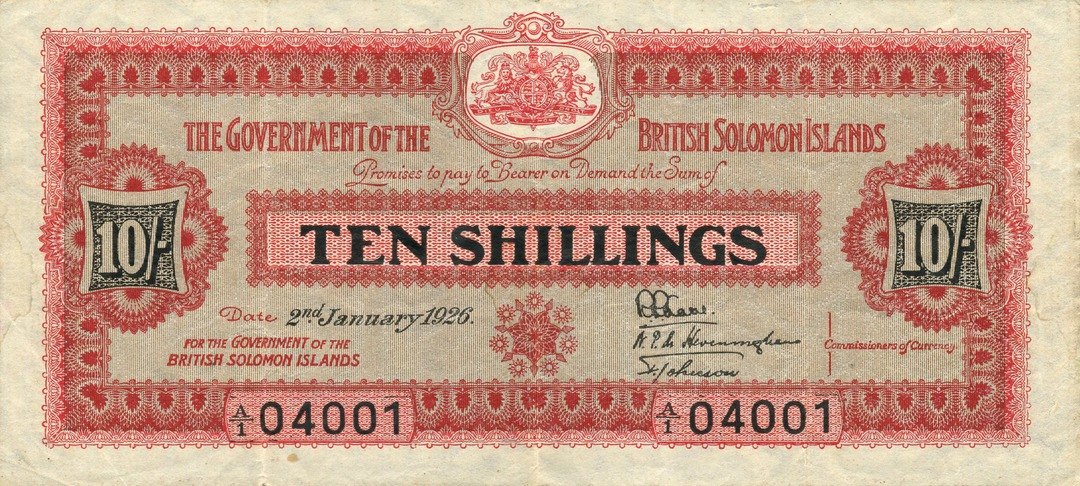
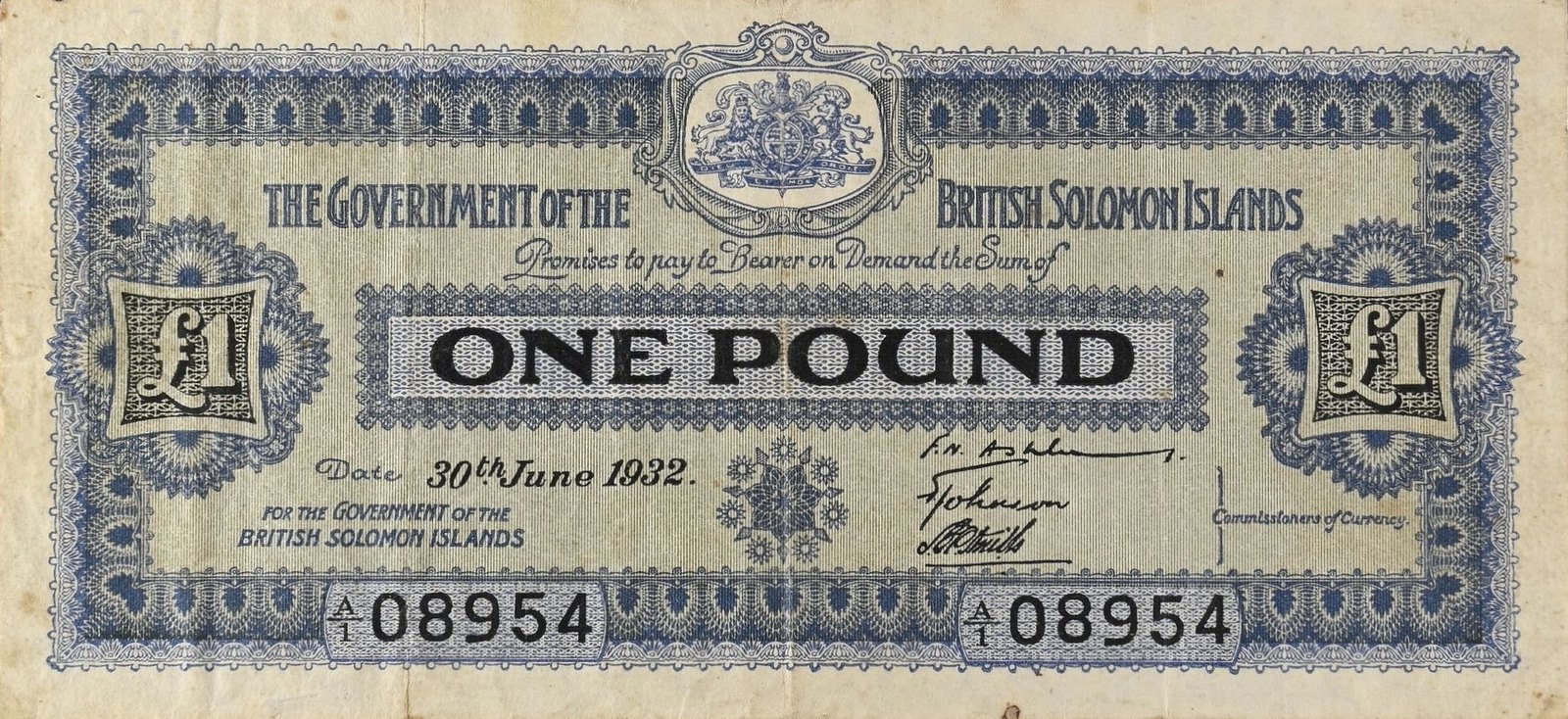
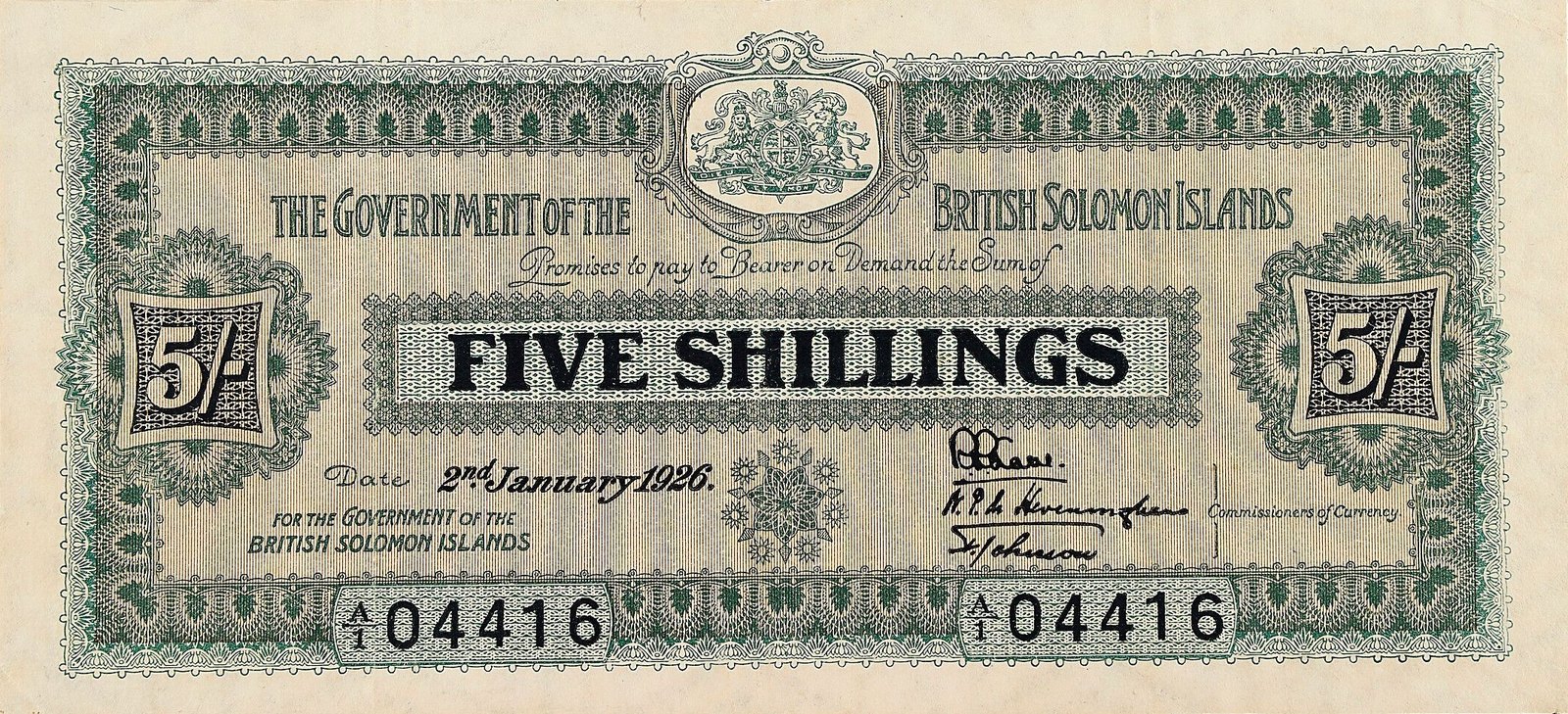
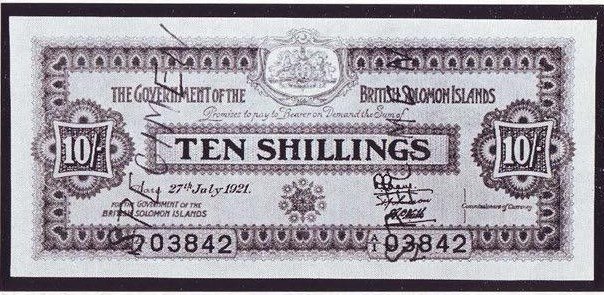
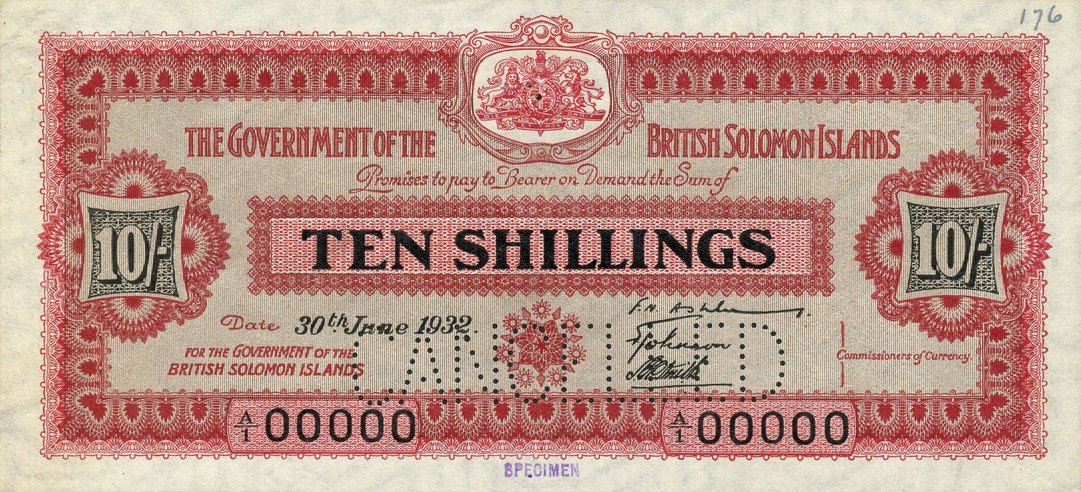
All four values have the same design: Pettit calls the face identical on all notes apart from the value, the date and the signatures, and the back blank. Spink's description of lot 100 in its sale of 29 September 2015 gives the arms at top centre and the value in a tablet at the centre and at left and right. Pettit gives 187 x 86 mm for every value and a watermark of arrows, with no imprint. The 5 shillings is black and green, the 10 shillings black and red and the 1 pound black and blue. Pettit gives the colours of the 5 pounds as unknown, probably black and brown. The designer is not known either: Pettit supposes the printers.
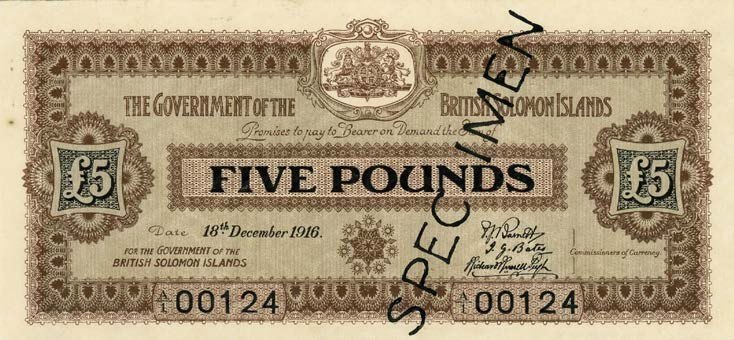
Each value is numbered in a single run under the prefix A/1, and each later printing carries on where the last one stopped. The printed date and the serial number therefore place a note together.
Circulation, gold and the figure of 4,637 pounds
The new notes circulated beside Australian notes and coin and British coin. Pettit records that 3,130 pounds had been issued by the end of 1918, of which 2,765 pounds was in notes of 10 shillings and 1 pound, the equals of the half sovereign and the sovereign.
Because new notes could only be had against at least half their value in gold, and the Protectorate's report for 1917-18 said that little gold was in circulation, the issue slowed. In 1921, Pettit writes, 78 pounds 5 shillings of new notes were issued and 52 pounds 15 shillings destroyed. At 31st December 1921 the notes in circulation stood at 4,637 pounds, backed by 2,369 pounds of gold at Tulagi, a fixed deposit of 2,000 pounds at the Bank of New Zealand and 268 pounds at the Commonwealth Bank. According to Pettit that figure was held for the rest of the issue: new notes went out only to replace damaged notes returned for destruction.
The Colonial Office annual reports bear this out. The reports for 1928 and 1929 still list local notes of 5 shillings, 10 shillings, 1 pound and 5 pounds as issued, and the report for 1929 adds that Australian currency was also in circulation. The annual reports for 1933 to 1936 give the value of the notes issued as 4,637 pounds, the same figure each year. The reports do not say whether that is the total ever issued or the amount still out.

Wages and the amendment of 1919
Pettit quotes the Protectorate's report for 1917-18 on why the notes were kept from the labourers: shell and feather money was still largely used in the remoter islands. King's Regulation No. 4 of 1919 amended the Regulation of 1916 and made the notes legal tender for all purposes, for everyone, so that labourers could be paid in them. Pettit calls it a temporary measure, possibly meant to ease the shortage of gold, that stayed in force until 1937. The Handbook of the Protectorate for 1923, as Pettit quotes it, says the use of paper notes was by then understood by the islanders, who did not like them because they were easily destroyed.
The printings, 1916 to 1934
New printings of the 5 shillings, 10 shillings and 1 pound were needed because the first printings were small and notes did not last in the climate. All were ordered through the Crown Agents from Thomas de la Rue and differ from the 1916 notes only in date and signatures. No second printing of the 5 pounds is listed.
Pettit's table of issues, taken from the records in the Western Pacific Archives and from notes seen, is given here as it was read from the machine-read text of the journal. The page image was not at hand, and what the machine text leaves unclear is marked. The numbers printed, the ranges of numbers and the numbers issued are Pettit's published figures, not this catalogue's. A date in brackets is the time of printing: Pettit had not yet seen a note of that printing. The machine text has lost the order of the column of signers, so the signers of each printing are given as the table, the captions of the journal's plates and the auction houses' descriptions together give them.
| Value | Date on the note | Printed (Pettit) | Numbers (Pettit) | Issued (Pettit) | Signers |
|---|---|---|---|---|---|
| 5 shillings | 18th December 1916 | 2,000 | A/1 00001 to 02000 | 2,000 | Barnett, Bates, Pugh |
| 10 shillings | 18th December 1916 | 2,000 | A/1 00001 to 02000 | 2,000 | Barnett, Bates, Pugh |
| 1 pound | 18th December 1916 | 5,000 | A/1 00001 to 05000 | 5,000 | Barnett, Bates, Pugh |
| 5 pounds | 18th December 1916 | 500 | A/1 00001 to 00500 | 124 (unclear in the scan) | Barnett, Bates, Pugh |
| 5 shillings | 27th July 1921 | 2,000 | A/1 02001 to 04000 | 2,000 | Kane, Johnson, Knibbs |
| 10 shillings | 27th July 1921 | 2,000 | A/1 02001 to 04000 | 2,000 | Kane, Johnson, Knibbs |
| 5 shillings | 2nd January 1926 | 2,000 | A/1 04001 to 06000 | 1,546 | Kane, de Heveningham, Johnson |
| 10 shillings | 2nd January 1926 | 2,000 | A/1 04001 to 06000 | 2,000 | Kane, de Heveningham, Johnson |
| 1 pound | 2nd January 1926 | 2,000 | A/1 05001 to 07000 | 2,000 | Kane, de Heveningham, Johnson |
| 10 shillings | (1930-31) | 1,000 | A/1 0600? to 07000 | 847 | not known |
| 1 pound | (1930-31) | 1,000 | A/1 0700? to 08000 | 1,000 | not known |
| 10 shillings | 30th June 1932 | 1,000 | A/1 0700? to 08000 | none | Ashley, Johnson, Knibbs |
| 1 pound | 30th June 1932 | 1,000 | A/1 0800? to 09000 | 1,000 | Ashley, Johnson, Knibbs |
| 1 pound | (1933-34) | 1,000 | A/1 0900? to 10000 | 68 | not known |
Where the number issued is lower than the number printed, Pettit's note says the balance was destroyed by fire before the four members of the Board of Survey on 20th July 1937.
Two things in the table are unclear in the scan. The number of 5 pound notes issued stands in the machine text as "1 24", with a gap, so 124 is a likely reading and no more. In the last five lines the final figure of the first number of each range was not read by the machine and is shown here as a question mark; the last number of each range is clear.
The table and the catalogue do not agree at every point. Pettit's table gives none of the 10 shillings of 30th June 1932 as issued, the whole printing being among the notes burnt on 20th July 1937. The page of the 10 shillings has a row for an issued note of that date. Both are given here, and neither is settled.
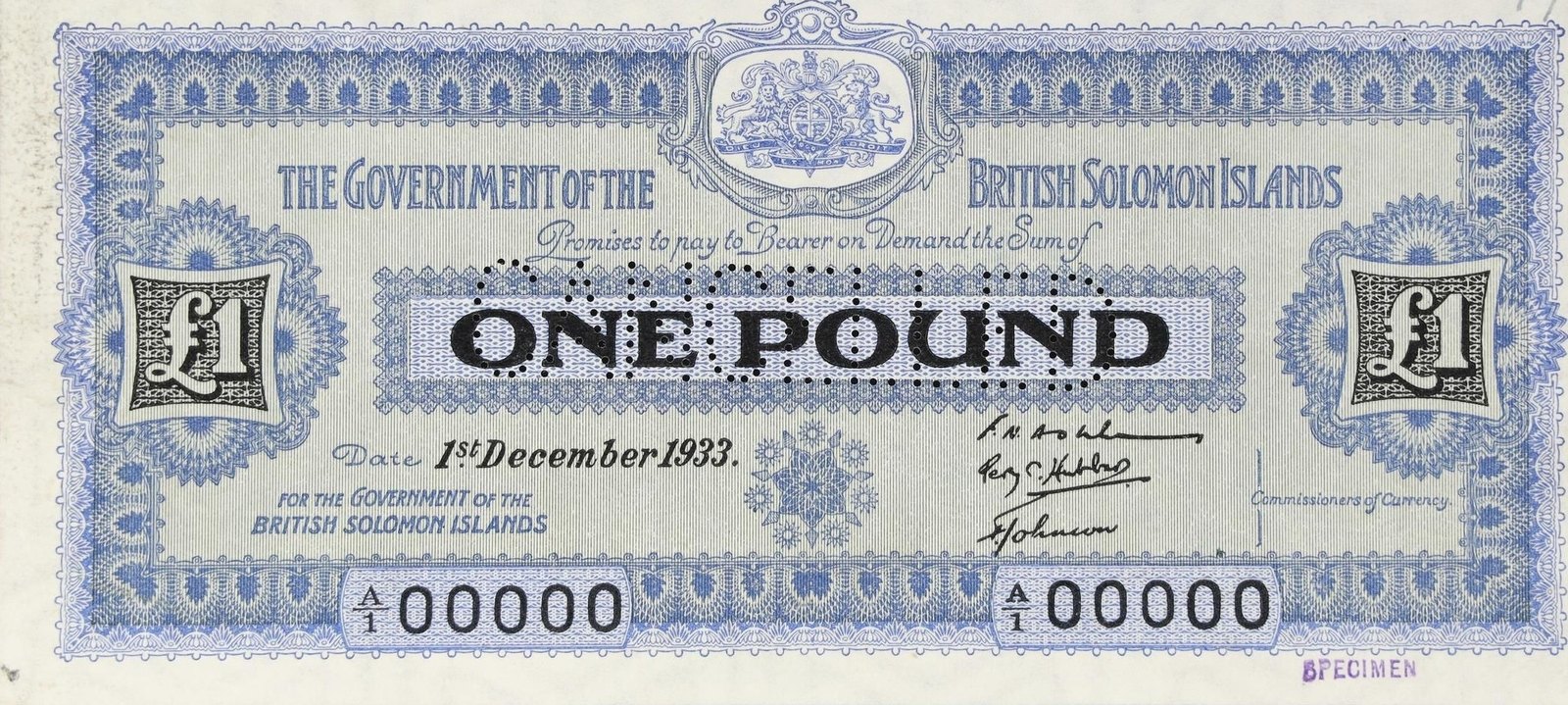
The houses' descriptions fit the table. Spink's description of lot 432 in its sale of 5 July 2016 names Kane, de Heveningham and Johnson on a 10 shillings of 2 January 1926 and calls its number the first of the 1926 issue. Noonans, 27 August 2025, lot 286, names Ashley, Johnson and Knibbs on a 1 pound of 30 June 1932. Stack's Bowers, 18 January 2025, lot 21245, a specimen of the 1 pound dated 1st December 1933, supplies the date that Pettit had not seen: the house says 1,000 notes of that date were printed and 68 reported issued, the same figures as Pettit's last line.
For the 5 shillings, Stack's Bowers (8 May 2025, lot 50560) and Heritage (24 April 2020, lot 26181) give 2,000 notes printed of each of the three dates, 6,000 in all, of which 5,546 were issued, only 1,546 of the 1926 date.
Specimens
Pettit records two specimen sets of the 5 shillings, 10 shillings, 1 pound and 5 pounds issued to the Resident Commissioner, R. R. Kane, in 1926. A similar set was sent in 1932 to the editor of the review "Contrefacons et Falsifications", published in Vienna, a review on forgeries.
The specimens the houses have sold are of another kind: numbered A/1 00000, perforated CANCELLED, with a small purple SPECIMEN handstamp. Spink sold a 10 shillings of 30 June 1932 so marked on 29 September 2015 (lot 100) and a 5 shillings of 2 January 1926 on 28 September 2016 (lot 1792).
The withdrawal of 1937
Pettit gives the background: the Australian pound had fallen against sterling in the depression, and both against gold, which made further issues difficult. A Currency Committee sat in July 1932 and found no sufficient reason, from the point of view of the currency, to keep a separate note issue in the Protectorate. Nothing was done until King's Regulation No. 2 of 25 March 1937, passed by the Western Pacific High Commission. As Pettit sets it out, the Regulation:
- withdrew the notes up to and including 24 September 1937, after which they ceased to be legal tender, though they could still be exchanged at the Treasury;
- ordered the destruction of the unissued notes and of all notes withdrawn;
- made Australian notes the sole legal tender notes from 25 September 1937 (Pettit adds that most business was already done in Australian currency);
- made British and Australian coin the sole legal tender coin;
- passed any balance left in the Note Guarantee Fund after 24 September 1937 to the revenue of the Protectorate;
- repealed all the earlier currency note Regulations on 25 September 1937.
The Colonial Office annual reports for 1937 and 1938 say the same of the date: the notes ceased to be legal tender after 24 September 1937.
The Board of Survey supervised the destruction. Unissued notes were burnt on 20 July 1937 and issued notes from 12 August 1937. According to D. C. Horton, a member of the Board of Survey in 1937, as Pettit reports it, the notes were taken from a vault in the Currency Office at Tulagi to the wharf and burnt there.
By 25 September 1937, 3,494 pounds of the 4,637 pounds in circulation had come in. The 1,143 pounds' worth that was never accounted for was transferred to the Protectorate's revenue on that day, and the Board of Commissioners of Currency was abolished.
What survives, as each source puts it
Pettit wrote in 1976 that the fate of the outstanding 1,143 pounds is not clear, because most of the Protectorate's Treasury records were destroyed in the Second World War, and that very few of the notes were in collectors' hands.
The auction houses give counts from the grading service PMG at the time of each sale. These are the houses' statements:
- 5 shillings: Stack's Bowers, 11 January 2019, lot 30352, says PMG had certified four. Heritage, 24 April 2020, lot 26181, and Stack's Bowers, 4 May 2023, lot 50728, say five.
- 10 shillings: Stack's Bowers, 12 January 2018, lot 30428, says PMG had graded two.
- 1 pound: Stack's Bowers, 4 August 2017, lot 30390, says of a note of the 1926 date that PMG had graded two for the catalogue number, and that it was the first the house had seen or handled.
Heritage says in the same description of 2020 that it had not offered the type before. Stack's Bowers says of lot 50560 in 2025 that it had not offered the first date of the 5 shillings until then.
What is not known
- The exact dates on the notes of the (1930-31) printings, and who signed them. Pettit's table leaves both open.
- The colours of the 5 pounds. Pettit gives them as unknown, probably black and brown.
- The offices of the later signers. Pettit names the offices of the three signers of 1916 and calls Kane the Resident Commissioner in 1926, no more.
- What became of the 1,143 pounds' worth of notes that never came in.
- The Colonial Office volumes read for this catalogue hold nothing on the printings, the signers or the burning beyond what is told here.
Sources
- John Pettit, "Banknotes of British Solomon Islands", IBNS Journal, volume 15 number 4 (1976), with its table of issues.
- Dr. W. J. Mira, article on the Burns Philp Pacific Islands Note Issue Register No. 1, IBNS Journal, volume 23 number 1 (1984).
- Colonial Reports, Annual: British Solomon Islands Protectorate, reports for 1928, 1929, 1933, 1934, 1935, 1936, 1937 and 1938.
- Stack's Bowers: 4 August 2017, lot 30390; 12 January 2018, lot 30428; 11 January 2019, lot 30352; 4 May 2023, lot 50728; 18 January 2025, lot 21245; 8 May 2025, lot 50560.
- Heritage Auctions, 24 April 2020, lot 26181.
- Spink: 29 September 2015, lot 100; 5 July 2016, lot 432; 28 September 2016, lot 1792.
- Noonans, 27 August 2025, lot 286.

Member comments
Log in or register to post a comment.