A colour trial is a finished note printed in colours other than the issued ones, so that the issuer could choose. From 1939 to 1964 Bradbury Wilkinson printed every note of Southern Rhodesia, of the Federation and of Rhodesia, and colour trials are recorded in this catalogue for four of those issues: fifteen notes, and a pair of plate proofs from 1939.
This article puts each trial beside the note as it was issued, and gathers what the notes themselves and their sales tell us.
The four issues
| Issue | First date on the notes | Values with a trial | How the trial is marked |
|---|---|---|---|
| Southern Rhodesia Currency Board, King George VI | 15th December 1939 | 5 and 10 shillings, 1 and 5 pounds | no serial number, red SPECIMEN, two or three punch holes |
| Southern Rhodesia Currency Board, Queen Elizabeth II | 1st December 1952 | 10 shillings, 1, 5 and 10 pounds | all-zero serial number, red SPECIMEN, two or three punch holes, a number on the back |
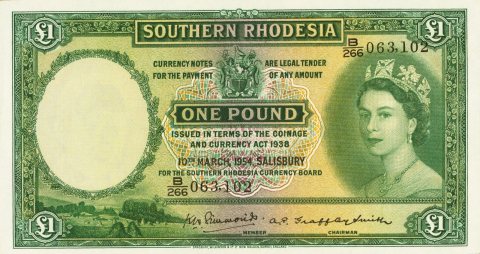
| Bank of Rhodesia and Nyasaland | 3rd April 1956 | 10 shillings, 1, 5 and 10 pounds | all-zero serial number, red SPECIMEN, one punch hole, a number on the back |
| Reserve Bank of Rhodesia | 3rd September 1964 | 10 shillings, 1 and 5 pounds | printed date and signature, all-zero serial number, red SPECIMEN, one punch hole, a number on the back |
No colour trial is recorded here for the Central Africa Currency Board notes of 1955, or for the notes printed in Rhodesia from 1966.
King George VI, 1939 to 1945
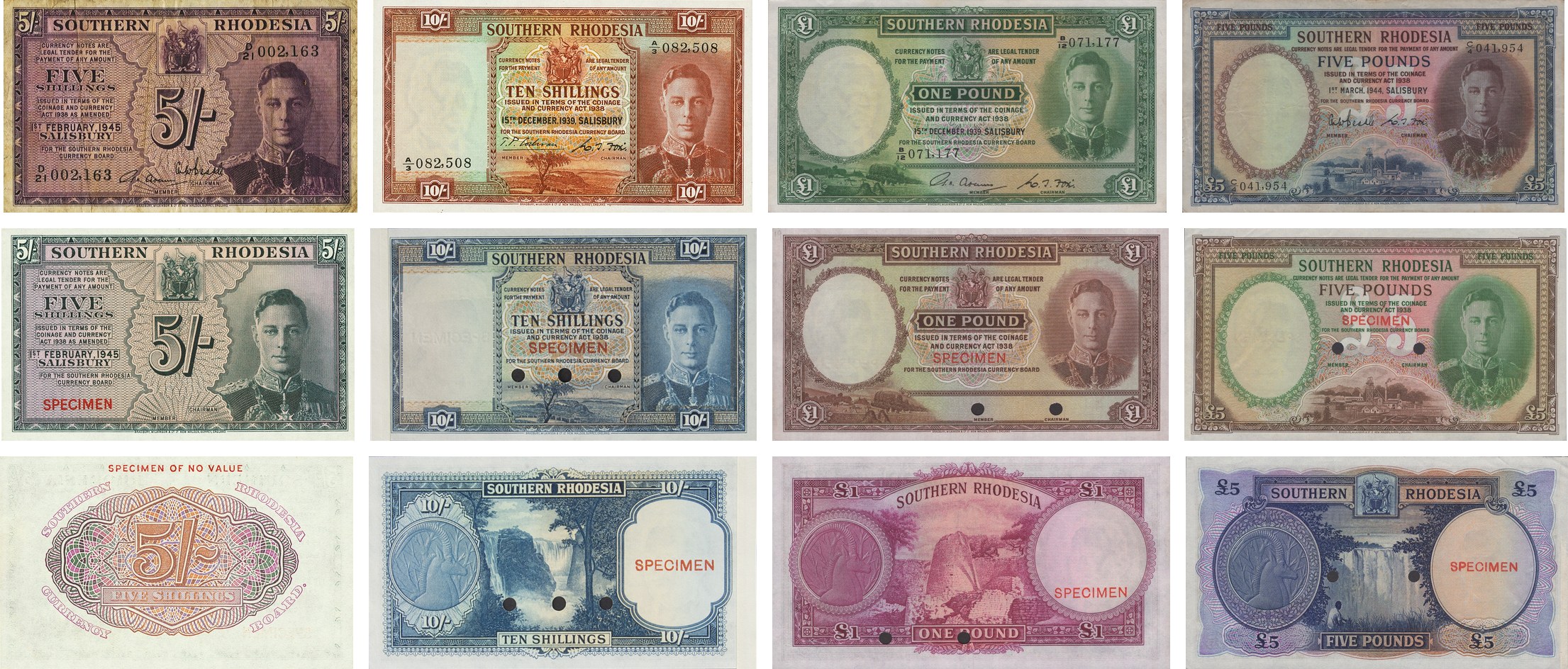
- 5 shillings, P-8cts. Issued in purple, tried in dark green. It is the only one of the four with a printed date, 1st February 1945, the first date of the second 5 shillings type. SPECIMEN is at the lower left, the back reads SPECIMEN OF NO VALUE, and there are no punch holes. It is the trial seen most often: 28 sale records from 2000 to 2025.
- 10 shillings, P-9cts. Issued in reddish brown, tried in blue, front and back. One piece has two punch holes and another has three. All three sale records are from the Derek Friday Collection, sold by Special Auction Services in 2024 and 2025.
- 1 pound, P-10cts. Issued in green, tried in brown with a magenta back.
- 5 pounds, P-11cts. The issued note has a blue frame and the King in brown. The trial turns this round: a brown frame and the King in green. It shows the large white figure of 5 pounds in the centre, the revised design that this catalogue records on notes from 1st March 1944. Noonans (1 October 2018, lot 1015) dates the trial 1942. Nothing recorded here settles which is right.
The plate proofs of 14 July 1939
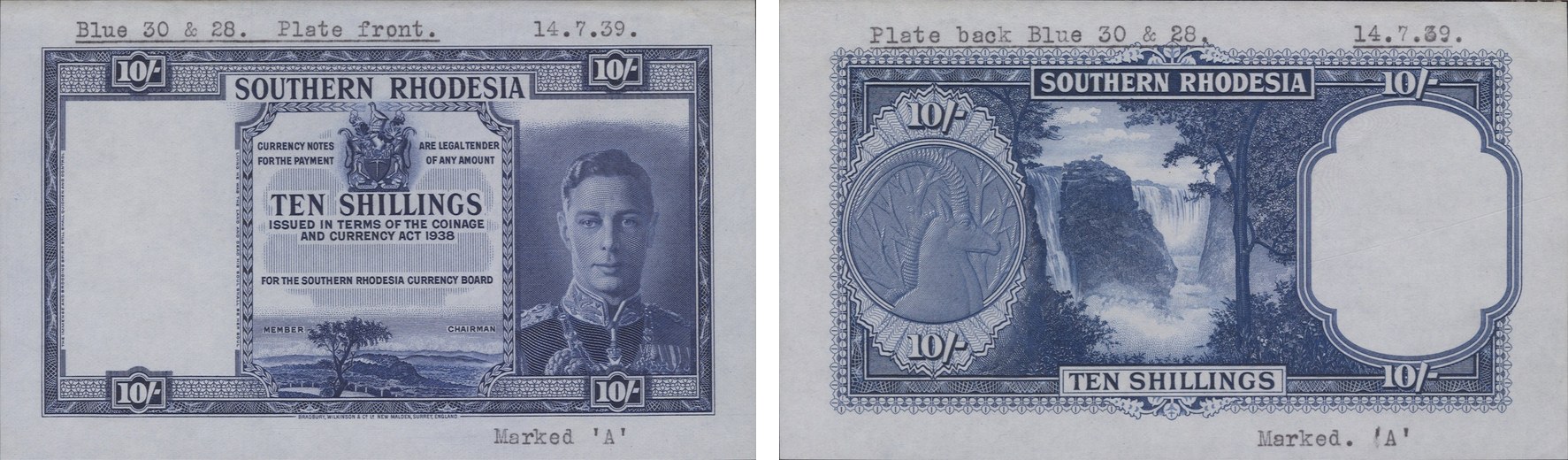
The oldest pieces are two proofs of the 10 shillings, one of the front and one of the back, each printed on one side in a single dark blue (P-9ctp). Heritage sold them together on 7 September 2012 as lot 15817.
Typed in the margins are Blue 30 & 28, Plate front or Plate back, the date 14.7.39 and Marked 'A'. The Board had placed its first order with Bradbury Wilkinson in March 1939, and the first date printed on the notes is 15th December 1939. So these proofs come four months after the order and five months before the notes. Their blue is close to the blue of the 10 shillings colour trial. What 30, 28 and A stood for at the printer is not recorded.
Queen Elizabeth II, 1952 to 1953
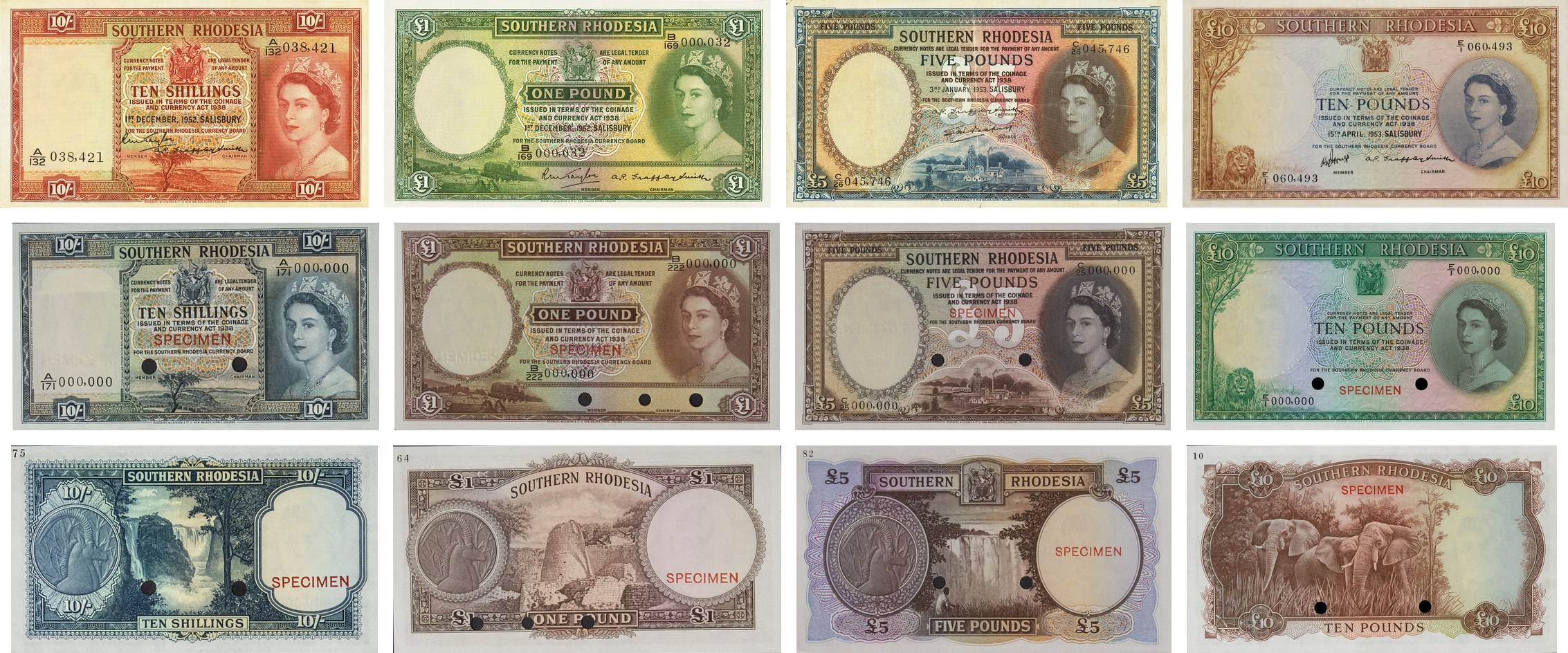
From this issue on, a trial has a real prefix and an all-zero serial number, and a small number printed at the top left of the back. That number tells one piece from another.
- 10 shillings, P-12cts. Issued in orange-red, tried in slate blue. Prefix A/171.
- 1 pound, P-13cts. Issued in green, tried in brown, as the King's 1 pound had been. Prefix B/222. It has three punch holes where the others have two.
- 5 pounds, P-14cts. Issued with a blue frame, tried in brown. Prefix C/25. The earliest sale on record of any Rhodesia colour trial is of this note: NASCA, 28 May 1980, lot 1989, from the George Thomas Collection.
- 10 pounds, P-15cts. The issued note has a brown front, and the catalogue gives its back as grey-green. The trial has a green front and a brown back, so the two colours change places. Prefix E/1. Its numbers are low, 7 to 23, where the other three values run from 59 to 86.
The Federation, 1956
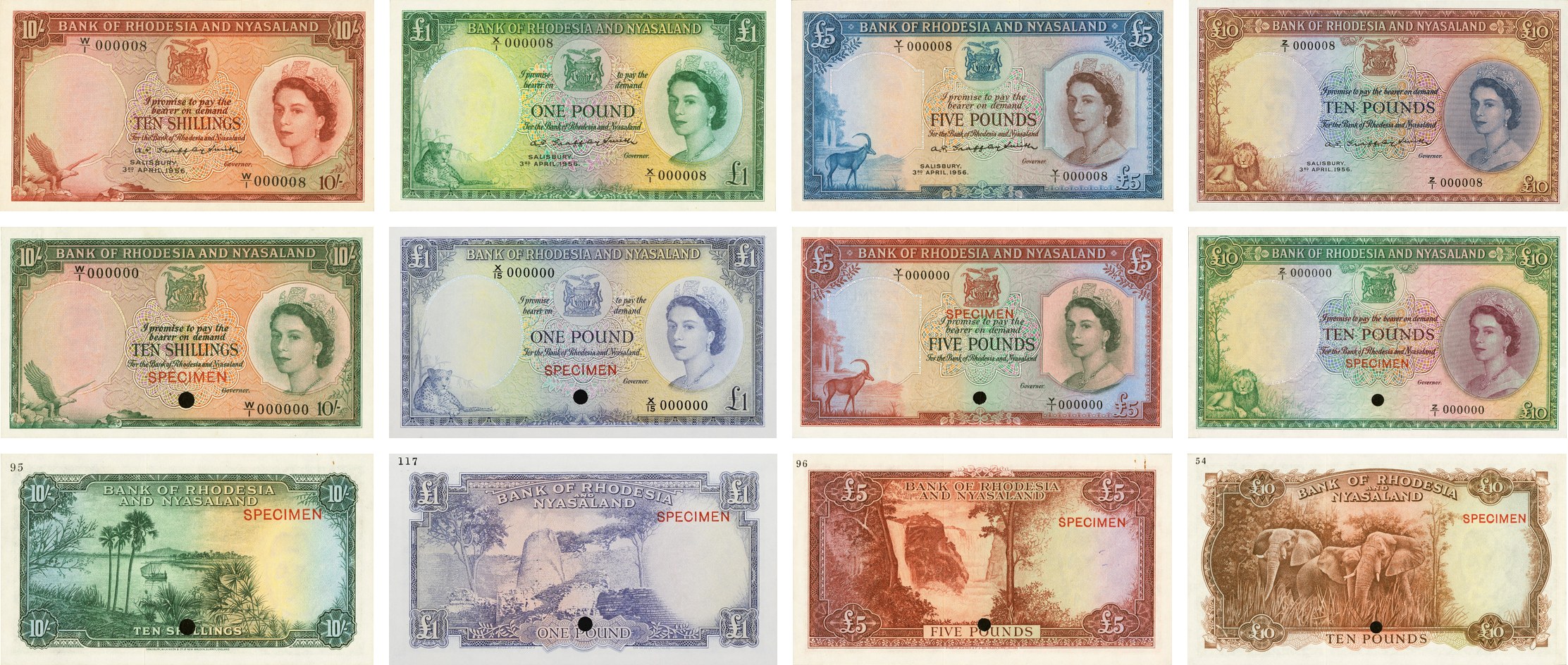
- 10 shillings, P-20cts. Issued in reddish brown, tried in green. Prefix W/1.
- 1 pound, P-21cts. Issued in green, tried in blue-violet. Its prefix is X/15, where the other three trials have the first prefix of their value (W/1, Y/1, Z/1). No source explains why.
- 5 pounds, P-22cts. Issued in blue with the Queen in brown, tried in red-brown with the Queen in dark green. Prefix Y/1. SPECIMEN sits above the promise to pay; on the other three it is below the bank's name.
- 10 pounds, P-23cts. The issued note has a brown front, and the catalogue gives its back as dark green. The trial has a green front and a brown back: the same exchange as on the 10 pounds of 1953. Prefix Z/1.
The pencil date. The four trials that Spink sold on 29 September 2010 (lots 1377, 1396, 1422 and 1439) each have 9/9/57 in pencil on the back. Christie's sold a set of the four on 3 May 2001 (lot 643) as the "ND (1957) series", while Spink's sale of 6 October 2000 dated the 10 shillings about 1956. The first notes are dated 3rd April 1956, so 9 September 1957 is seventeen months later. What was being decided then is not recorded.
The Reserve Bank of Rhodesia, 1964
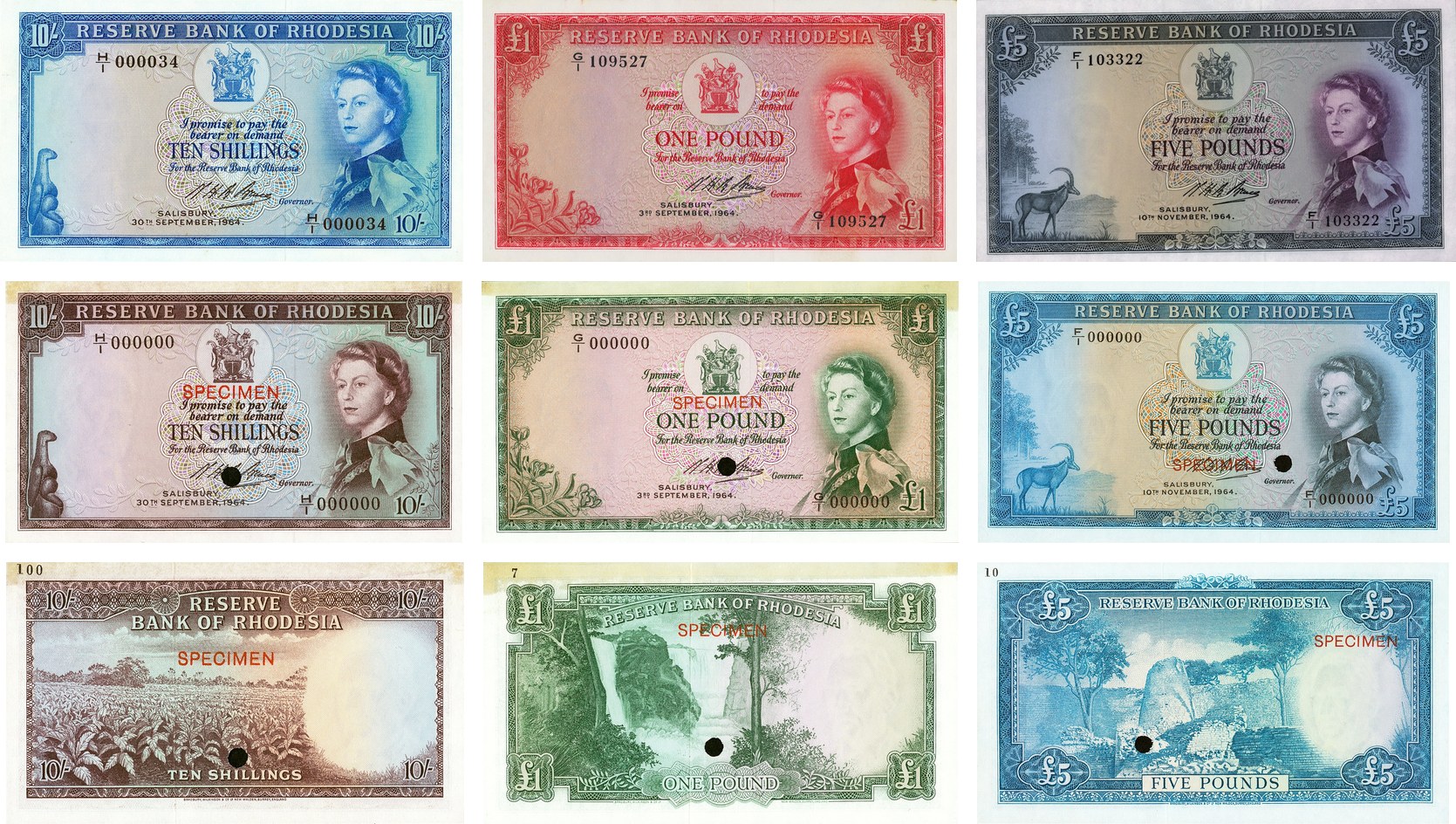
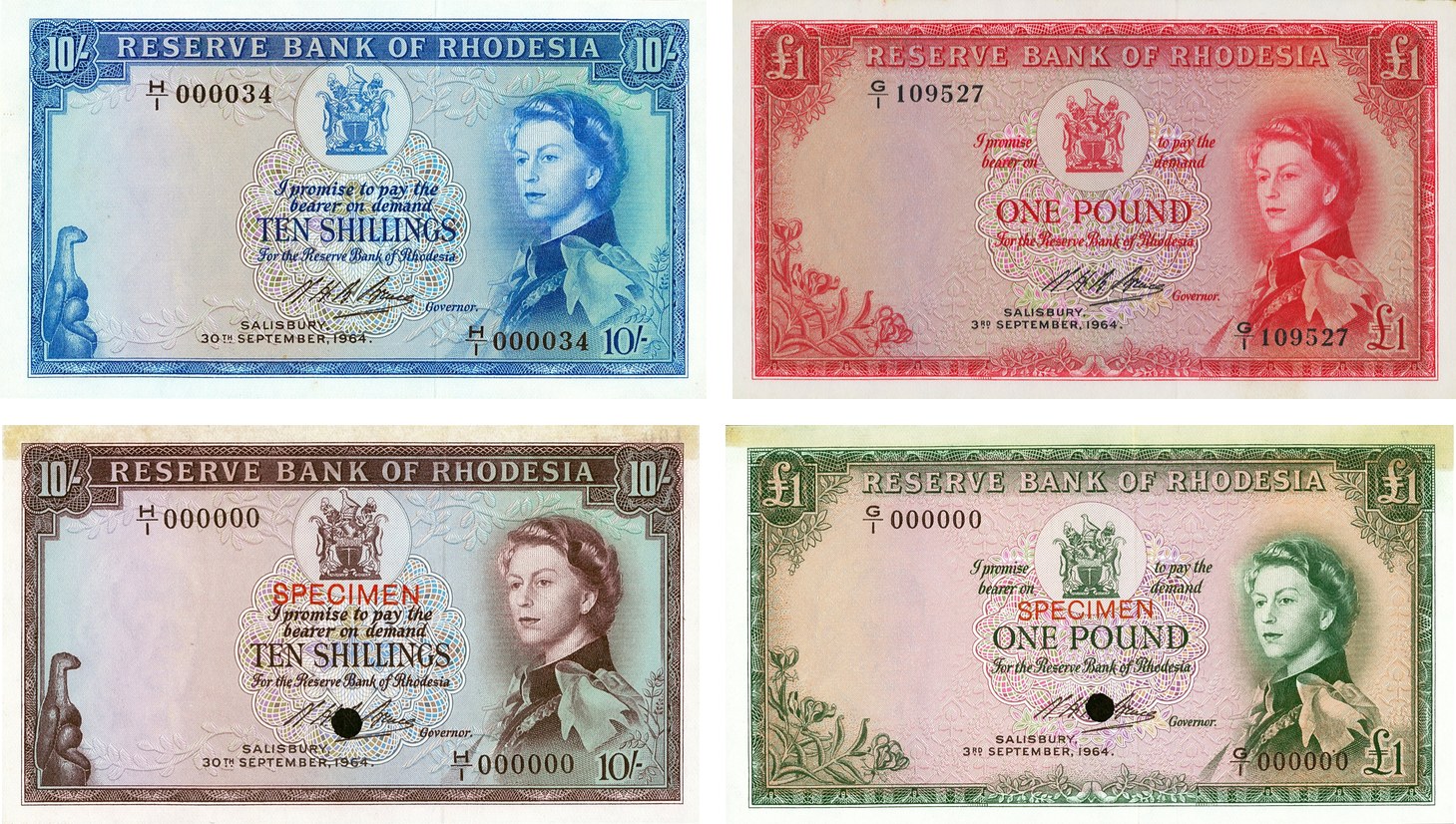
These three differ from all the earlier trials: they carry the printed date and the signature of the Governor, N. H. B. Bruce. They are the finished note in another colour.
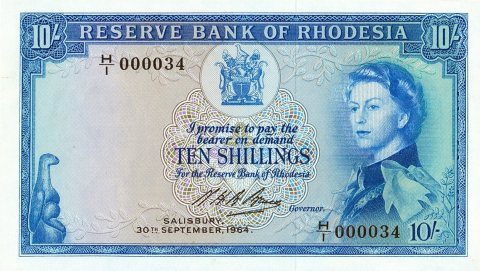
- 10 shillings, P-24cts. Dated 30th September 1964. Issued in blue, tried in dark brown. Prefix H/1.
- 1 pound, P-25cts. Dated 3rd September 1964. Issued in red, tried in green. Prefix G/1.
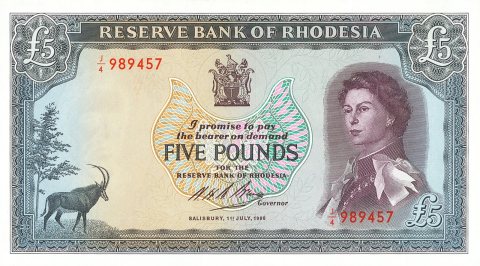
- 5 pounds, P-26cts. Dated 10th November 1964. This is the quietest change of the fifteen. The issued note is slate blue with the Queen in purple, and the catalogue gives its back as green. The trial is a brighter blue with the Queen in grey, and its back is blue. Prefix F/1.
"From B.W. 10/28/64". The 5 pounds trial in Christie's sale of 3 May 2001 (lot 642) had this in pencil in the top margin. Read as 28 October 1964, it is thirteen days before the date printed on the note.
Number 1. The 10 shillings numbered 1 and the 1 pound numbered 2 have been sold side by side three times: by Mavin International on 19 November 2011, by Heritage on 28 April 2017 and by Spink on 30 September 2026.
A run of seven. Numbers 57 to 63 of the 1 pound are all recorded. Spink sold 60 to 63 as two lots of two on 24 April 2012.
How many are there
The number on the back makes it possible to count different pieces from 1952 on. The highest number seen is also the least that can have been made. The George VI trials have no number, so their pieces cannot be told apart in the same way. The figures are those of this catalogue in November 2026.
| Trial | Value | Issued in | Tried in | Sale records | Different numbers | Highest number |
|---|---|---|---|---|---|---|
| P-8cts | 5 Shillings | purple | dark green | 28 | no number | |
| P-9cts | 10 Shillings | reddish brown | blue | 3 | no number | |
| P-9ctp | 10 Shillings, plate proofs | reddish brown | dark blue | 1 | no number | |
| P-10cts | 1 Pound | green | brown, magenta back | 9 | no number | |
| P-11cts | 5 Pounds | blue and brown | brown and green | 3 | no number | |
| P-12cts | 10 Shillings | orange-red | slate blue | 9 | 5 | 77 |
| P-13cts | 1 Pound | green | brown | 4 | 2 | 66 |
| P-14cts | 5 Pounds | blue | brown | 5 | 3 | 86 |
| P-15cts | 10 Pounds | brown | green, brown back | 8 | 4 | 23 |
| P-20cts | 10 Shillings | reddish brown | green | 13 | 4 | 95 |
| P-21cts | 1 Pound | green | blue-violet | 12 | 4 | 131 |
| P-22cts | 5 Pounds | blue | red-brown | 11 | 3 | 128 |
| P-23cts | 10 Pounds | brown | green, brown back | 14 | 6 | 54 |
| P-24cts | 10 Shillings | blue | dark brown | 38 | 12 | 100 |
| P-25cts | 1 Pound | red | green | 32 | 15 | 99 |
| P-26cts | 5 Pounds | slate blue | brighter blue | 27 | 11 | 73 |
A sale record is one lot in one sale, so a piece sold three times counts three times. For each of the three values of 1964, one of the numbers counted is known only from a picture in The Banknote Book.
Two patterns in the colours
The 1 pound. It was issued in green in 1939, 1952 and 1956, and each time it was tried in another colour: brown, brown again, then blue-violet. Green stayed. In 1964 the 1 pound was issued in red, and this time green was the colour of the trial.
The 10 pounds. Both 10 pounds trials, of 1953 and of 1956, give the front the colour of the issued back and the back the colour of the issued front.
Not yet settled
- Whether the George VI 5 pounds trial dates from 1942, as Noonans gives it, or from the revised design of 1944.
- Why the 1 pound trial of 1956 has the prefix X/15.
- What the pencil date 9/9/57 on the 1956 trials records.
- What Blue 30 & 28 and Marked 'A' meant on the proofs of 1939.
Each variety page has the photographs of its trial. The serial register and the sales history are there for NumiCrown Pro members.
Member comments
Log in or register to post a comment.